• About The Alternate Path

The Alternate Path

~ Thoughts on Walking the Path of Christian Discipleship

The Alternate Path

Author Archives: mcummins2172

Hell 2.0 and why I think I was sent there

18 Thursday Jul 2013

Posted by mcummins2172 in Uncategorized

≈ 1 Comment

What happens to Hell once people stop believing in God or when religion is pushed to the edge of people’s lives?  The late Fr. Andrew Greeley once noted that when the Church drops something others seem to pick it up.  In Church, we do not talk so much about Hell anymore.  Therefore, has “Hell” been picked up and adapted to a secular, post-modern world?  If so, what are the punishments of this secular Hell and who might be consigned to its sufferings? 
I found myself ruminating on these thoughts recently following an interaction I had with a young woman regarding an aspect of Church teaching.  The young woman was not a fan and she eagerly made her disdain known regarding both the teaching and the Church.  I have been a priest long enough now to recognize when blinders are up and it is just not possible to get anywhere and I have learned to curb my effort rather than spin wheels.  At these moments I take a form of comfort in the knowledge that people even walked away from Jesus himself. 
But, this does not mean that I myself cannot reflect upon such encounters and learn from them.   
Two things struck me from the above mentioned encounter.  The first was the realization that, in her own way, this young woman who had no time for religion or Church because of its perceived judgmentalism toward different peoples and attitudes was, herself, condemning me to a form of Hell.  The second is that I realized that this young woman was operating out of a profoundly impoverished and even stunted understanding of God’s grace in life.  I would like to spend some time exploring these two realizations because, sadly, I think this young woman is not alone in her attitude and perception.   
The worst thing one can do in our society today is to be viewed as saying “no”  or raising questions concerning another person’s perception of life, how they wish to live and even how they view reality.  The second worse thing is to say that it is possible to “be more”, to rise above and live by a different set of standards other than the standards of the world.  From my work in college campus ministry I have realized that one of the worse things you can do in the eyes of our younger generation (especially if you are an older adult) is to be seen as judging others.  This almost pre-conscious aversion to judging others invokes a sharp reaction of disdain, which can even border on belligerence, in the younger generation.  God forbid that one try to put forward the notion that making judgments and key distinctions is a part of an authentic life and that it is possible, and even necessary, to judge actions while not pretending one has a full understanding of the core identity of another person. 
In our encounter, I saw myself making reasoned judgments and key distinctions.  The young woman saw me and the institution I represented as retrograde artifacts of a prejudiced bygone era – hence, my being condemned to “Hell” in her eyes.  Now, how was I condemned?  She shut me and the Christian perspective off easily and completely.  For her, my lived faith had nothing whatsoever positive to offer.  How was I punished?  Ridiculed (both my beliefs and myself) and treated with indifference.  These are the favored condemnations and punishments of the secularized Hell and you do not have to look very far in order to see how they are being played out on all levels of our society – from the daily encounter, to the classroom to the television and movie screen. 
Interestingly though, I left this encounter feeling profoundly sad for this young woman.  She, it seems to me, has chosen the lesser and more impoverished part and she does not even realize it.  People are afraid of God’s grace these days and people are afraid that life can indeed be transformed and transfigured.  Despite all of our hero-worship we are afraid to rise above and live by a different set of standards.  Maybe this is exactly why we are addicted to hero-worship.  It allows an easy-out where we, ourselves, do not really have to change or be different.  Our time will be judged on its failure to love.   
The Church says it is possible to live differently and this scares the world.  The Church can say this because the Church truly accepts the radical transforming reality of God’s grace.  For a good number of people (if they even acknowledge God) grace is seen as external.  God created, we sinned, Jesus came to save us and show us how to live and now it is up to us to do so.  “Father God” remains way up in heaven and we have now been given all the means necessary to live rightly down here on Earth.  Grace has become so diminished within and so overused and even cheapened without (i.e. a means to get ones needs met) as to be practically nonexistent in the lives of people.  Unless … there is a perceived big, flashy “Paul on the road to Damascus” moment!  Then, grace bursts in, subjugates the human will and sets things right!  Neither of these two extremes is the Catholic understanding.  Grace can move in surprising and striking ways but more than likely its presence is subtle and neither will grace overcome and subjugate the human will.  Grace is a daily encounter and a working with our human will and effort.  God chooses to not force us along the way but to walk with us; bringing us deeper and deeper into the fully authentic life.  Grace that is allowed within does make it possible to live by a different standard and can make possible that which, on the outset, seems impossible. 
It is possible to live an authentic life!  Grace makes it possible.  But when transforming grace is denied from the outset then life and existence become mean, narrowed and impoverished.  We starve ourselves even as we sit right before the great banquet table!  It has been said that the only regret in life is to not have been a saint and it is true.    
Saints are not possible without transforming grace and hearts open to accepting grace.  We are meant to be saints.  My sadness for this young woman as we ended our encounter was that she, in fact, was walking away from who she is meant to be.  I pray for her and for all the others like her.  I pray that God in his infinite mercy and judgment will heal her and bring her to the truth of her very self.  May God bless us all on our journey and may God ever walk with us and share his love in our very hearts!     


"Culture of Encounter = Culture of the Good Samaritan", Pope Francis’ Wisdom

14 Sunday Jul 2013

Posted by mcummins2172 in Culture of Encounter, Culture of the Good Samaritan, encounter, Encounter with Christ, gospel

≈ Leave a comment

“And who is my neighbor?”
 What allowed the Samaritan to be neighbor to the man who fell victim to the robbers on the road to Jericho?  What enabled him to encounter this man in his need?  We are told that the priest and the Levite hurried by on the other side, possibly absorbed in their own concerns (too busy to be bothered) or out of a desire to remain ritually pure.  Whatever the reason, they chose to remain unengaged and removed and, by doing so, fell short of what it means to love ones neighbor as Christ here teaches.  
In contrast to the first two we are told that the Samaritan was “moved with compassion at the sight.”  Maybe he was a man acquainted with his own infirmity; maybe he was someone who knew by experience what it meant to be hurt and victimized.  Whatever the reason, the Samaritan allowed his heart to be touched by this man in his need.  This is what it means to be “moved with compassion”.  The Samaritan chose not to hurry by.  He chose to put whatever other cares he had at that moment on hold and encounter this man in his need.  The Samaritan made the choice to be neighbor. 
Maybe the proper question is not, “And who is my neighbor?”  Maybe the proper question is, “How do I become neighbor?”  Maybe the proper prayer is, “Lord, teach me how to be neighbor.”  
Our Holy Father, Pope Francis, is doing his best I believe to lead us as Church to the proper question and the proper prayer.  He is calling us as Church to the “Culture of Encounter” which, in essence, is the culture of the Good Samaritan.  Whether in visiting poor migrants on the tiny island or Lampedusa, washing the feet of prisoners on Holy Thursday, inviting the poor for a meal at the Vatican or challenging economic systems that deny the dignity of people and corrupt the earth; the Holy Father is calling us to take notice, to see the ones lying on the side of the road who are in need.  He is inviting us to be moved with compassion because he knows that this is what it means to be disciple and this is what it means to be Church and it is this type of Church that the world needs.  To paraphrase the Holy Father, “A Church closed in on itself; a Church that hurries by too busy to be bothered; is a sick and weak Church.”   
What does it mean to be a Church that notices, to be a Church living the gospel culture of encounter?  It means a lot.   
Parishes cannot be closed in, islands unto themselves.  Parishes must truly become centers of evangelization!  The focus of the parish must become outward looking in all aspects.  This is quite the shift, at least in the United States, where parishes have historically served as centers of religious and ethnic unity.  Maybe inward looking meetings and committees need to give way to the work of authentic ministry to and in the world?  Maybe time and energy spent on in-house church squabbles on all levels needs to be recognized as time and energy wasted when there is a world outside in need?  Is there place for the central focus of liturgy, prayer and community?  Certainly, and these aspects are essential and truly at the heart of Church but the energies that naturally flow from these essential aspects of church must then be channeled out into the world if they are to remain authentic, true and life-giving!  The energy of a river needs to flow forward!  When it becomes stymied then it becomes morose and dark, much like a swamp.   
Bishops, priests, religious and deacons cannot remain content to stay within the church walls – whatever form these may take.  This is more than just going outside, it means letting go of knowledge and expertise, which equates to letting go of power.  In the church, we know how things operate.  We have the answers.  “You want to get married?  Here, this is the marriage preparation process and what you have to do.”  “You want to learn about the Church?  Here, this is the program for you.”  Therefore, to step outside means to let go of power and to accept the risk of being vulnerable.  But, there is such a great multitude outside of the Church’s walls who just want us to come and be with them.  They do not expect us to know all the answers; they do not even want that.  They just want to be noticed and for us to be willing to meet their vulnerability in our own vulnerability.  This is the oil and wine that helps to bring healing and helps to bandage deep wounds.   
There is another part to his equation though.  Parishes and dioceses need to give their bishops, priests, religious and deacons the freedom they need to do this.  A gilded cage may be gilded but it is still a cage!  At the heart of every vocation to serve in the Church is the call to be a missionary who goes out into the world.  This is not a denial of the pastoral needs of the community but a healthy counter-balance that is essential, I believe, to the health and well-being of any vocation to serve.  For a community to so demand and absorb the energy and focus of the one who serves that he or she cannot even imagine the missionary dimension of vocation is a huge disservice both to the one who serves and to the needs of our world. 
The laity must step up but not in a “how the world does business” way, but in how we are all called by Christ to “do business” way.  It is no longer permissible for the laity to say, “Oh, proclaiming the Gospel; that is the job of the ones who make the vows to do that.”  Today, the Gospel must be proclaimed by all Christians; therefore, all Christians must be intimately familiar with and formed by the Gospel.  The Gospel calls all persons to discipleship and therefore, all members of the Church must have their thoughts, actions and attitudes challenged, purified and enlightened by the Gospel.  The laity in the Church can just as easily hurry by on the other side of the road as the priest and Levite did, but this does not lead to being neighbor.  The primary encounter for any Christian before all else is our encounter with Christ in the Gospel.  This is the encounter which must continuously guide and enliven all aspects of the life of discipleship and all members of the Church must continuously and daily seek this encounter.  Every day, personal time must be spent with Scripture, particularly time with the gospels. 
How do I become neighbor?   
Lord, teach me how to be neighbor.                           
 

The "How" of the New Evangelization

08 Monday Jul 2013

Posted by mcummins2172 in How, humility, New Evangelization, Proclaiming the Gospel

≈ 1 Comment

I do not think that the New Evangelization is just about what we say as Christians, nor about what new technologies we use to proclaim the Good News but also about how and the manner by which we proclaim, “Jesus is Lord!” 
 
When it comes to the work of apologetics or promoting/debating the faith or current issues or even just day-to-day encounters for that matter, I must admit that I have never been one for witty, “in the moment” comebacks.  I think that this is due, partly, to the fact that my parents taught me from an early age not to regard a snarky attitude, in and of itself, as a sure sign of intelligence and also because I do not think that an exchange of one-upmanship in comments leads anywhere truly productive.  Such an exchange tends to produce more heat in friction than light to illuminate, I believe. 
 

I share this because there can be a tendency to view apologetics and the new evangelization solely in terms of formulating the wittiest comeback line that will effectively put the other in his or her place while affording a sense of superiority to the crafter of said comment.  But in the entire gospel story I never find Jesus doing this.  Our Lord certainly had truth to speak, he knew how to challenge and his wit is demonstrated time and again throughout the gospels but his words never belittled the other nor did they divide and hurt.
If the new evangelization is to be true then we must not just look at what Jesus said but also how he said it.  This “how” just as surely as the “what” must inform all means of communicating the gospel message whether that be the classic one-to-one encounter or the tweet to the multitudes.
Jesus valued friendship, relationship and encounter.  I do not think that Jesus would disregard the social communication of today but he would view it as a means and not an end.  Social communication is at its best and it is fullest in service to the Gospel when it brings people to a deeper encounter and relationship with Christ and with one’s brothers and sisters.  Social communication used as a means to isolate oneself or others or social communication used as a protective wall over which to hurl incendiary verbal bombs is a disservice both to social communication and to the Gospel. 
Yes, our Lord taught and he performed miraculous signs but our Lord also proclaimed the Kingdom of God through his daily encounters with people and his willingness to enter into relationships and friendships.  Yet, it is easy to overlook this mode of evangelizing and also easy to take it for granted.  Christians can sometimes be a sour lot and people take notice of this and it does not help the Gospel cause.  Our Lord demonstrates both the importance of evangelizing through encounter, friendship and relationships and also that this form of evangelizing demands a “not so little” amount of discipline and a patiently acquired skillset.  Friendship takes work and it can be helpful to read the gospels with the focused intent of watching how our Lord interacted with people in order to learn a few things. (The prayer discipline of Lectio Divina is a great way to enter into these moments in Scripture.)  Below are some truths I have found from reflecting on the interactions of our Lord with others in the gospel story.  
Humility.  Jesus, we are told, did not deem equality with God something to be grasped but rather emptied himself of glory and took the form of a slave.  Much to the perplexity of the powers of the world that he encountered, Christ continuously took the road of humility.  Humility is essential in the role of authentic friendship.  Humility demonstrates a respect for the other person and an acknowledgement that he or she has something truly worthwhile to offer.  Psycho-social studies demonstrate how relationships are essential in forming the human person in his or her own identity.  (Sometimes I wonder how critical Jesus’ own relationships were in helping him to grow into an awareness of his own identity and mission.)  Humility is a path by which we enter into authentic relationships and a means by which we help one another grow into the full person God intends us to be.  Authentic friendships are not coincidence, they are gifts from God. 
Willingness to listen and be present to people.  In his encounter with the woman at the well our Lord demonstrates this discipline in spades.  Our Lord put aside his needs (we are told he was tired and thirsty) in order to encounter this woman and answer her thirst.  The ability to listen is not a weakness nor does it mean that I fully agree with what I am hearing but it goes such a long way in creating relationship with another.  Evangelization is not just proclaiming; it is also listening to the deep desires, hopes and hurts of our world.  True evangelization also means sacrifice, putting away one’s own need and agenda, in order to be truly present as God wants us to be present. 
Willingness to not manipulate or control.  Christ never manipulated others.  In fact, he let people walk away at different times in his ministry.  He often instructed people to, “tell no one” following a miraculous event and he specifically pointed out the person’s own role in a healing or miracle, “Your faith has saved you”.  Manipulation can never aid in bringing about the Kingdom of God.  Sadly, the Church has sometimes forgotten this truth but, I would also say, that manipulation is not the sole provenance of the Church.  Manipulation is rampant throughout all history and our world today whether it be social, political or economic.  To say “no” to the mechanics of manipulation is to be truly counter-cultural and to witness to the truth of the Kingdom that overcomes the sad politics of this world and this, I believe, is one of the truest components of the new evangelization.  The choice not to manipulate demonstrates a respect and care for the other even to the possibility of one’s own detriment.  It is a form of embracing the cross that our world just cannot comprehend, but it speaks volumes and touches hearts.  
Trust in God and others.  Truly, Jesus trusted in the will of the Father but he also trusted his disciples even as he was not naïve to their weaknesses.  He sent out the seventy-two and he commissioned the apostles.  Jesus does not need to micro-manage it seems.  Developing trust frees us in order to enter into authentic relationship both with God and with our brothers and sisters.  This is not an easy thing to do because trust has truly been wounded by sin but it is essential to any form of friendship and any form of true evangelization.  In the life of faith trust can be built through daily encounter with the Scriptures (primarily the gospels), reception of the Sacraments and lived faithful friendship in community and with the poor.  It takes work but it can happen.
An attitude of joy.  The word “rejoice” is found throughout Scripture and for very good reason!  In Christ, God has overcome sin and death!  Throughout his encounters with people, Christ demonstrates a deep and abiding joy in the Father and in the coming of the Kingdom. This joy speaks to the deepest yearning of the human heart and it is a joy that cannot be counterfeited because its origin is in God himself.  This has been and remains the greatest form of evangelization we Christians have – the joy that we have in the Lord!  Joy grows within us as we continually encounter the Lord!  We should never hide this light under a bushel basket.
I believe that our Holy Father, Pope Francis, is fully aware of the importance of the “how” in proclaiming, “Jesus is Lord!”  Continually he witnesses this to us and by so doing is calling us to an awareness of this truly important but often overlooked aspect of the New Evangelization.  How we say something is just as important as what we say.            

Simple truths gained in Ireland

17 Monday Jun 2013

Posted by mcummins2172 in Uncategorized

≈ Leave a comment

Statue of St. Benedict, Glenstal Abbey

Spiritual truths and lessons come our way via many different means.  As I continue my pilgrimage around Ireland I am becoming more aware of this fact.  I would like to share three spiritual truths I have gained in the past two days … none of which were spoken.
 

The first spiritual truth was gained at Glenstal Abbey.  Glenstal is a Benedictine monastery of around thirty-eight monks.  If I remember Fr. Cuthbert (the cellarer of the community and our pilgrimage group’s guide) correctly, the monastery began in the mid-1800’s when a landowner’s estate was purchased and given to the community.   Even though built in the 1700’s the estate was constructed to resemble a twelfth century fortress.  Currently the monks run a boys’ boarding school that will soon be made co-ed.  Fr. Cuthbert shared that the school is currently ranked first in the country. 
On the main lawn of the complex (in between the school and the monastery) stands a statue of St. Benedict and to his mouth is pressed his right index finger.  I have seen this image at every Benedictine monastery I have visited and the lesson is the same: in silence and contemplation is found a sure pathway to God.  Benedictine monasteries live this truth so much so that even the very physical space of every monastery (at least the ones I have been to) seems shaped by the value of silence and not just silence as the absence of noise but silence open to and even pregnant with the presence of God. 
We need this silence in our lives.  St. Benedict and all his monastic sons and daughters teach us this truth.  We might not be able to live at a monastery but each of us can seek for and even build this type of silence into our lives.  We can step away from the computer and turn off the music and television.  We can step away from a relentless string of activities and projects.  We can build time enriched by prayer and Scripture into our daily routines.  If we take St. Benedict at his “hush” then we will be blessed for it.
Shrine of Our Lady of Knock
The apparition of Our Lady of Knock appeared on August 21, 1878.  For two hours an image of Our Lady appeared on the outside wall of a small, rural parish.   The Blessed Mother was accompanied by St. Joseph and St. John the Evangelist.  In the vision she gazed upon on altar on which stood a lamb.  Behind the altar stood a large cross and around the altar and lamb shimmered angels.  Fifteen people testified to witnessing this vision and the Church has accepted their testimony as valid.  Although not as famous as Lourdes, the Shrine of Our Lady of Knock brings pilgrims from around all of Ireland and also all the world.  Today it is a beautiful complex and place of prayer.
I must admit that I have been pretty ignorant of this apparition of our Blessed Mother until my visit to the shrine today.  Mary did not speak during this vision.  What she did though was gaze upon the Lamb upon the altar.  Mary always points to Christ and some have speculated that this apparition, which came after the great famine which truly decimated the country of Ireland, was a gift of hope to this poor and suffering people.  Christ is the lamb of sacrifice who has taken on all the sufferings of our world.  In the midst of our sufferings and even the most unjust pains of our world we can find comfort and consolation in the witness of our Blessed Lady – someone fully acquainted with suffering – and know that our sufferings are not lost to an impersonal and uncaring universe but are somehow caught up in the very dying and rising of Christ.

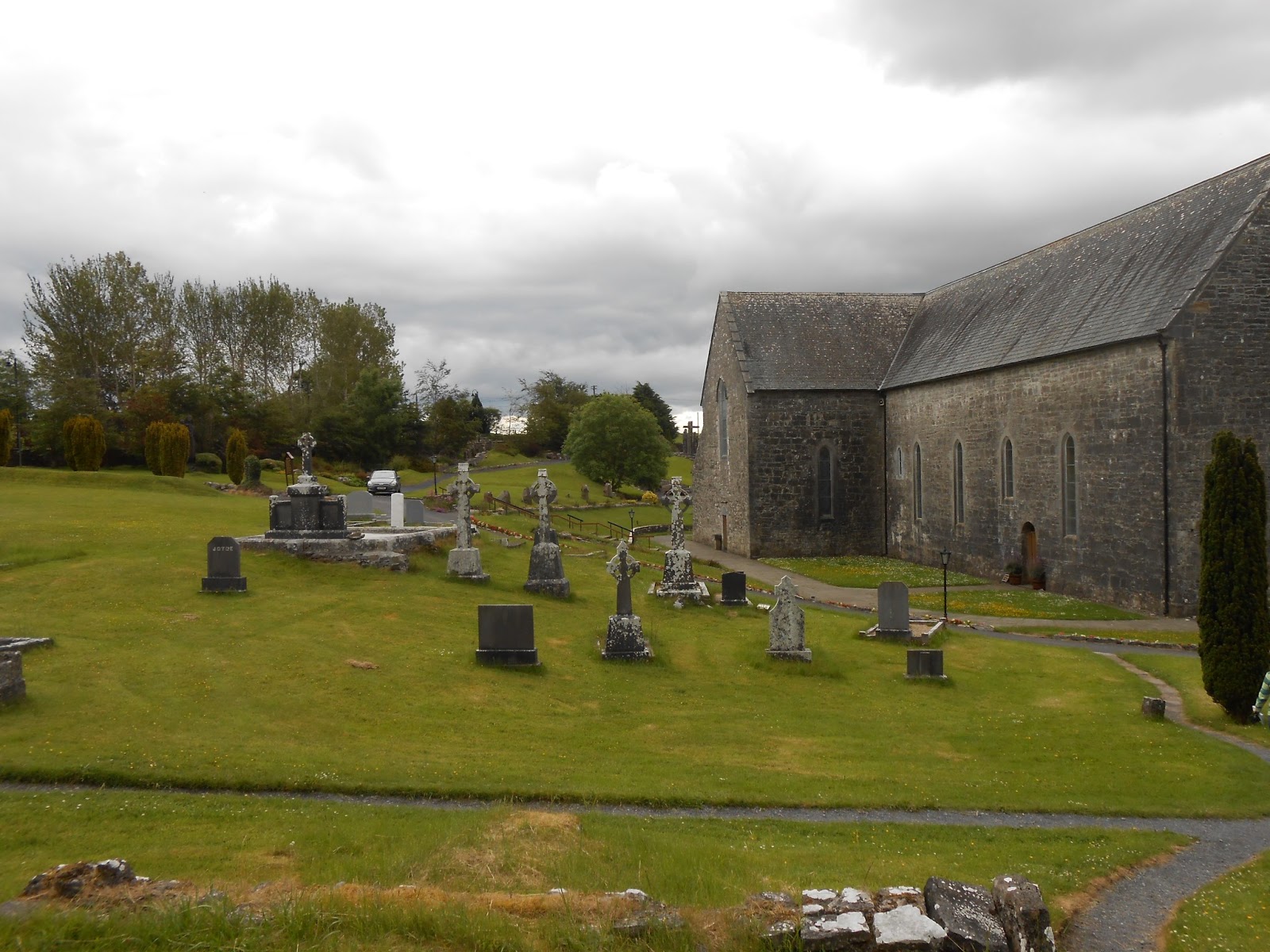
The Abbey of Ballintubber has been called the “Abbey that refused to die”.  Located on a site where St. Patrick was reputed to have baptized people and a small church was established; the abbey itself was constructed in 1261 A.D.  Despite King Henry ordering all abbeys and monasteries closed in 1542 A.D., Oliver Cromwell destroying most of the structure in 1653 A.D., the penal times when the Catholic Church was outlawed in Ireland and the Great Famine, the Eucharist has continuously been celebrated at the abbey since its founding in 1261 A.D.  Even when there was no roof on the structure, people would still gather for Mass and the celebration of their faith.

Abbey of Ballintubber

As with all churches and ruins of churches in Ireland (because they are considered holy ground), the Abbey of Ballintubber is surrounded by a cemetery.  All the graves face east.  They face the rising of the sun and, by this, give silent witness to our Christian hope in the great day of resurrection.  These countless graves and indeed the very witness of this “abbey that refused to die” teach us that there will be a day of resurrection and that all wrongs will be righted and that we, as Christians, live by hope and not resignation.  We live our lives today already in the dawning light of the great day of resurrection!
Lessons offered quietly and in truth.  They speak to our hearts and they bring comfort, consolation and hope.

A visit to Glendalough

16 Sunday Jun 2013

Posted by mcummins2172 in Uncategorized

≈ Leave a comment

(I am currently on an eleven day diocesan pilgrimage to Ireland.  Our pilgrimage group is visiting different religious and cultural sites in the central and southern part of Ireland.  The following is a reflection on our visit to the ruins of the monastic city of Glendalough.) 

Glendalough is a glacially-formed valley in Ireland that is within an hour’s drive outside of Dublin.  The name means “glen of the two lakes”.  The glen is remarkable for its peacefulness and beauty.  In the sixth century, St. Kevin arrived in the glen seeking a life of prayer, penitence and contact with nature.  The reputation of the holy man grew and other people came to the glen seeking Christian community.  A monastic city grew and thrived there for centuries.  Scholars estimate that at its height around one thousand souls lived within the monastic city with non-monastics (merchants, tradesmen, etc.) living outside its walls and pilgrims arriving continuously from all over Ireland and Europe.  The monastic city became a center of faith, learning, peace and life within the dark and often violent times of the middle ages.  The city was destroyed around 1368 A.D. by British troops and now all that is left are the stone ruins of a once thriving faith and cultural center.
 
Today, as I toured Glendalough and learned its history, I was reminded of the stunning mosaic above the main altar in the Basilica of San Clemente in Rome.  In the center of the mosaic is the cross of Christ and from the cross sprouts branches calling to mind the saying of Christ that he is the branch and that we are the branches and that the cross is indeed the “tree of life”.  Within the twists and turns of these branches are found different images of culture and life: artists at work, people performing music, laborers, people learning and many more such images.  The mosaic testifies that life flows from the cross of Christ and that it is life that both transforms and builds culture.  The monastic city of Glendalough was a living testimony of this truth.  In a savage and brutal time a man began a community that, informed by the Christian faith and the light of the Gospel, developed learning and truly aided humanity.  I would say that Ireland and in fact all of humanity is in a better place because St. Kevin and his followers took the light of the Gospel seriously and, by so doing, raised the human condition. 
The monastic city of Glendalough and the mosaic of San Clemente remind us that Church and faith build culture.  This is an important memory for Christians as we live in a time steeped with revisionist history and agendas seeking to cast the Catholic Church solely in negative and demonizing terms.  These tendencies portray the Catholic Church as an impediment to human progress rather than the catalyst that it has historically been and also continues to be.  History records that St. Kevin’s faith, and the vision of the monastic city, brought light and hope to a truly dark and dangerous time.  This is just one example of a multitude throughout history and around the world.
We, as Christians, must be prepared to do the same today.  I would even go so far as to say that we cannot but do so because it is within the very makeup of who we are.  The mosaic of San Clemente demonstrates this almost organic connection between the proclamation of the Gospel and the growth of human learning, light and hope.  God is the source of all knowledge, light and truth; therefore, to encounter Christ is to encounter truth and light.  It is easy to tear down.  It is not easy to build.  The Christian faith builds culture and life and this work shines forth even more brilliantly and truly when the surrounding ethos has nothing to truly offer the deepest yearning of the human heart. 
Does this mean that we need to seek out our own Glendaloughs and retreat from the troubles of our age?  First, I would say that some men and women are called to the monastic and eremitic witness but not the majority.  Second, I would say that St. Kevin and monastics and hermits of all times do not “hide away” from the human condition but rather, have the courage, guided and impelled by grace, to enter fully into the human condition.  The community founded by St. Kevin became a faith and cultural center precisely because it grew into a community of authentic humanity.  A “growth” made possible by the light of the Gospel.  The Gospel leads to true humanity; the “world” (despite loud protestations to the contrary) is what often fears the human condition.  
What do we Christian do in this age and every age?  We cling to the light of the Gospel and we allow this light to develop an authentic humanity that is clearly distinguishable from the shallowness of a worldly ethos.  The Christian monastic living in a monastery separated from the rush of the world is called to do this as well as the Christian disciple living in the non-stop movement of a major city.  The light of the Gospel leads to an authentic humanity which, in turn, creates a human space where life can be found and true friendship can be encountered.
Today, we each need to be a “St. Kevin” – trusting in the light of the Gospel and living an authentic humanity.            

Anniversary of ordination and some lessons learned

03 Monday Jun 2013

Posted by mcummins2172 in Community of Sant'Egidio, gratitude, Ordination anniversary, priesthood, thanks to God

≈ 2 Comments

On June 3, 1995 I was ordained a Roman Catholic priest.  These years have been and continue to be an amazing adventure!  Over these years I have been confessor, teacher, parochial vicar, pastor, youth ministry director, vocation and seminarian director, university chaplain, confidant, counselor, committee chairman, pilgrim, retreat director and friend.  I have experienced people automatically putting me on an unrealistic pedestal just for being a priest as well as people scorning, ridiculing, trying to convert me and automatically assuming things about me just for being a priest.

A couple of constants throughout my ministry have been building projects and working with youth and young adults.  At my first assignment at All Saints Church in Knoxville I watched (and learned) as the multi-purpose building and rectory were built followed in short order by the church building itself.  At Knoxville Catholic High School I assisted as the community left the old school and moved to a new property across town and I had a role in the design of the school chapel.  When I arrived at St. Mary Church in Athens, TN as pastor I stepped into the design phase of the new church building project.  In the course of five years we built the new church and rectory, literally picked up and moved the classroom building to the new property and sold the old property leaving the parish debt-free.  In the course of my time at the Catholic Center at ETSU one focus I have had has been the renovation of the chapel and I can honestly say that I think it looks quite good and is a place of prayer and worship.  But, even more than the building of structures, I have worked in the building and strengthening of Christian community. 

Except for the couple of years focusing on the building needs at St. Mary Church in Athens my ministry has always had the component (if not outright focus) of working with youth and young adults.  During these years I have been in the role of parish youth minister, diocesan youth ministry director (twice), high school chaplain and teacher (now twice) and college chaplain (now twice).  My whole priesthood has been lived under the scandal of the clergy sexual abuse crisis and in a time when many priests express fear and worry of being too close to young people.  For whatever reason I have been called back again and again to this ministry and I have chosen to say “yes” and remain with our young people.  It has been a blessing.

My priesthood has been blessed, strengthened and perhaps even saved through the Community of Sant’Egidio.  In a way that I can only describe as providence I met this community and now cannot even consider my life of faith apart from the community and their strange notion that yes, lifelong friendship is possible especially friendship with the poor!  This community has helped me to name and clarify rumblings in my own soul and heart regarding the true work of the priest and the disciple of Christ.  I have seen the danger of priest solely as CEO/administrator and I do not want that.  I want to be a priest – a man whose whole life is rooted in the mystery of Christ and who lives and who acts in the ways of Christ.  The community has helped me to see that there is a different way to live priesthood and discipleship and they have helped me to recognize that Christ is indeed encountered in faithful friendship with the poor. 

Here are some things that I have learned in my years of priesthood:

It is not about me. This is freeing realization when all is said and done.  The job of “Savior of the world” has already been taken and God is bringing about his Kingdom – end of story.  I have my part to play and there is certainly work to do but the final result is not in question.  This realization allows one to enjoy where one is at and also not think too highly of oneself.  It also helps lead one into the grace of obedience and its wisdom that the world cannot understand.     

It is the basics and it is the Gospel that truly matter.  In my years as a priest I have seen and participated in a number of different programs, drives and activities … and some of them even worked!  But when all is said and done – at least in my experience – it all comes back to the basics of the Christian life: serving and loving, proclaiming the Scriptures, breaking the bread and being a community in Christ. 

To love Christ one must also love the Church.  Warts and all, Christ loves his bride, the Church.  I have a deep sorrow for those who cannot recognize this truth.   

The Gospel can never be advanced by manipulation.  Manipulation, in the name of Christianity does occur.  I have seen it.  It might get immediate results but it leaves long lasting wounds and resentment.  God’s measure of success is not the world’s measure and part of growth in faith is to learn God’s measure. 

The poor move us beyond politics.  The poor help us to get real about a lot of things and help us to get beyond the “polarizations” that so much time and energy in our world is wasted upon – not an idea of the poor nor the poor as clients or the poor as a source of service credits but the poor as friends and as brothers and sisters.
  
Be human.  No one will care how much you know until they know how much you care.  God did not disdain becoming human in every sense but sin; why should we?

Good, Better, Best.  This is a philosophy I learned from Fr. Anietie Akata.  If you come to a place or situation which is not good then work to make it good.  If it is good then work to make it better.  If it has been made better then work to make it the best.  It is a good philosophy to live by. 

The love of Christ.  Just recently while in prayer, sitting before an icon of the face of Christ, I was brought to a deeper awareness of God’s love.  It seems that the journey of faith is a journey of coming to know in ever-deeper ways this love.  God continually pours forth his love and this is truly at the heart of all creation.

I give thanks to God on this anniversary of my ordination!  God is truly good in his blessings and in his love poured forth!       


"Stay with us…" The Feast of the Body and Blood of Christ

01 Saturday Jun 2013

Posted by mcummins2172 in Encounter with Christ, Eucharist, Relationship

≈ Leave a comment

“The Road to Emmaus” by Caravaggio

In the last chapter of Luke’s gospel we are given the Emmaus story.  The risen Lord joins two disciples on the road and fully reveals himself to them in the breaking of the bread whereupon he vanishes from their sight.  Prior to this, when they are still on the road and the Lord makes as if to continue on, the disciples make this request, “Stay with us, for it is toward evening and the day is now far spent.” (Lk. 24:29)

This Sunday, as the Church celebrates the Feast of the Body and Blood of Christ (or Corpus Christi), I would suggest this request of the two disciples as a way of exploring this holy mystery of the Eucharist at the heart of the life of the Church. 

Notice first of all that it is a request.  The Church does not own nor control this mystery.  We cannot command the presence of God.  At heart, all we can do is request, ask and when God is present – live in gratitude.  Earlier today I was at the ordination of Fr. Christopher Manning – the newest priest to be ordained to the Diocese of Knoxville – and in his homily, Bishop Richard Stika, spoke of the danger of seeking to control the Eucharist and form it through our thought and perception into our image rather than letting the Eucharist transform and change us.  We do not transform the Eucharist (when we attempt to do so we get into trouble both individually and even as “church”) rather the Eucharist transforms us.  When we receive the Eucharist we need to let this dynamic reality occur and we need to entrust ourselves to this movement of extraordinary grace.  The language of request acknowledges and respects this graced encounter that can never be controlled on our part.  “Stay with us…”

Secondly, notice that it implies relationship.  Our awareness of the mystery of the Eucharist grows as our relationship with Christ as Lord and Savior grows and our lived acknowledgement of Christ as Lord and Savior grows just as our humble entering into the mystery of the Eucharist increases.  Relationship is a lived reality, it is a give and take exchange.  The mystery of the Eucharist (like any relationship) cannot be “proven” from the outside. It must be entered into, in order to be encountered and experienced.  This “entering into the mystery” is not just a matter of filling a spot in a pew on Sunday either.  It is a dynamic of the heart and the heart’s willingness to enter relationship.

The breaking of the bread and Christ giving himself in the form of bread and wine occurs on the road.  The Eucharist is often referred to as “bread for the journey”.  While in this world – as individual pilgrims and as church – we are always on the journey.  We are on journey toward the Kingdom of God and beyond that which holds us bound.  The Eucharist is not prize for the victor who has won solely on his or her own abilities rather, it is food for the pilgrim on the journey, who often stumbles and who can even take wrong turns and get lost sometimes.  We need the Eucharist.  We need it’s transforming grace.

The Eucharist nourishes and refreshes us from the struggles of life.  The weariness of life can be heard in the request of the disciples who just had their hopes dashed by the cross on Calvary.  “…it is toward evening and the day is far spent.”  In a truly divine way, the Eucharist nourishes and refreshes us as we also encounter the pains and struggles of life.  The subtlety of the Eucharist is one of the great paradoxes and stumbling blocks in the eyes of the world.  In the simple receiving of what appears on the surface to be only bread and wine the very life of God is given to us and received by us!  God’s power is revealed exactly in not having to act through flash and show but rather in giving of Himself in a subtle presence.  A discerning and maturing heart begins to recognize this.  The Eucharist nourishes and opens our eyes to the ways of God. 

In his first letter to the Corinthians (1 Cor. 11:23-26), Paul recounts what he himself had received and now, what he himself, hands on.  “…that the Lord Jesus, on the night he was handed over, took bread, and, after he had given thanks, broke it and said, ‘This is my body that is for you.  Do this in remembrance of me.’  In the same way also the cup, after supper, saying, ‘This cup is the new covenant in my blood.  Do this, as often as you drink it, in remembrance of me.”  Before the gospels were written, before the canon of Scripture had been codified, before Christianity was legally recognized and no longer persecuted, the Eucharist was being celebrated.

The first Christians encountered the living Lord in the breaking of the bread … this same encounter continues today.                   

The Holy Trinity and the economy of self-gift

26 Sunday May 2013

Posted by mcummins2172 in economy of consumption, economy of self-gift, Holy Trinity

≈ 1 Comment

Icon of the Holy Trinity by Andrei Rublev

In reflecting on the deep and abiding mystery of the Trinity, some of the truths that we are brought to is that communion with others is always possible, that this communion is necessary and that it is free, although it does take work.  Communion is always possible because the very Creator of all is a communion of persons – eternally abiding in love and self-giving.  This should not be written off as a nice, superficial thought but rather it should be recognized for what it is – a fundamental anthropological and societal truth that does make authentic and abiding claims on life and reality.  Communion is always necessary because without it we are less.  We are not meant to live isolated lives.  Communion is free and this is much to chagrin of the market-place and the economy of consumption.     

Many voices in our time proclaim the opposite.  “Be a self-made man or woman!”  “Pull yourself up by your own bootstraps!”  “It is you against the world.”  “Fear the other and set up walls to protect and keep out!”  This thought has even found its way into the sphere of Christianity in the emphasizing of a “Jesus and I” approach to faith.  Church and community is nice but it is not really all that necessary.  Now it seems that even the acknowledgement afforded by history to the unique status and communion of marriage and family is being discarded as dynamics in contemporary society seek to reshape family more in terms of what “I want” and “my right” rather than in the life-giving reality of self-gift as laid out in the basic biological blueprint of creation itself.  All this leads to an increasingly isolated existence which plays to the benefit of an economy of consumption.

My personal theory is that we are now living in a time when it is the economy with all the pressures at its disposal attempting to shape us in its image rather than us shaping the economy in our image.  To wit – an isolated, self-focused individual trained to view reality through the prism of “I want” is potentially a much better consumer than one who is connected with other people in life-giving ways that are beyond the power of the market-place (i.e. family and individuals living authentic and honest relationships).  

The economy of consumption wants an upgrade to family and existence in general.  A “2.0 family” as it were.  Family defined by self-gift and sacrifice is no longer good enough.  Family defined by want and individuals who are increasingly isolated is now what is needed to keep the economy humming!

In the Holy Trinity we are shown a different economy – not an economy of consumption but an economy of self-gift and we find it revealed that this economy is not only at the foundation of all creation but is the source, itself, of all creation and life. 

Jesus said to his disciples: “I have much more to tell you, but you cannot bear it now.  But when he comes, the Spirit of truth, he will guide you to all truth.  He will not speak on his own, but he will speak what he hears, and will declare to you the things that are coming.  He will glorify me, because he will take from what is mine and declare it to you.  Everything that the Father has is mine; for this reason I told you that he will take from what is mine and declare it to you.”  (Jn. 16:12-15)

Notice how the three Persons of the Trinity freely receive from one another and freely give to one another.  Notice how this gift of self does not diminish each of the Divine Persons in uniqueness but actually fulfills each of the Persons.  The Father is not lessened by the Son receiving all the Father has to offer nor are the Father and Son diminished by the Spirit taking what they offer one another and declaring it to us.  Self-gift does not need to be feared because it leads to the fulfillment of personhood and life and not to a loss of self!

St Paul in his Letter to Romans reflects on what this all means to us who have been caught up into this very mystery of God’s own existence by God’s sheer gift of grace.  Brothers and sisters: Therefore, since we have been justified by faith, we have peace with God through our Lord Jesus Christ, through whom we have gained access by faith to this grace in which we stand and we boast in hope of the glory of God.  Not only that, but we even boast of our afflictions, know that affliction produces endurance, and endurance, proven character, and proven character, hope, and hope does not disappoint, because the love of God has been poured out into our hearts through the Holy Spirit that has been given to us. (Rom. 5:1-5) 

As Christians, we strive for the truth of being, even when we fail individually and communally we still strive by God’s grace.  The economy of consumption is not our economy.  We are meant for so much more!  Peace … Endurance … Proven Character … Hope … Love of God.  

These are all the gifts of the economy of self-gift.  
Not a bad list, when you think about it.    


Feast of the Ascension: God in the "in betweens"

12 Sunday May 2013

Posted by mcummins2172 in Feast of the Ascension, God in the in between moments

≈ 1 Comment

It has been said that as Christians we are always, “aliens in a foreign land.”  We might look the same as others, we might talk the same, we might act the same but as Christians we are never fully at home in this world.  Our souls will always be, in this life, to some extent or another, “restless”.  At some level we know that our true home still awaits us.  As Christians we do not disdain the world nor do we see it as evil.  The opposite, in fact, is the case – we value the world, we marvel at its beauty but we view it within the fuller horizon of the love, truth and hope that we have come to know in Jesus Christ.  What we have come to know in Christ affects everything – even how we judge our place in the world.
This must have been especially true for those first disciples.  They knew Christ.  They had spent time with him.  They experienced the resurrection.  And now, we are told, they watched him ascend into heaven but things are now different – they cannot go back to the way it was before – it can never be the same.  As Christ ascends, they stand in between the earthly ministry and presence of Jesus and the promised fullness of the Kingdom.
“Men of Galilee, why are you standing there looking up at the sky?”  In other words, the angels are reminding the disciples even as they stand in between, “Remember, you are in this world and there is work to be done,” but, they also say, “This Jesus who has been taken up from you … will return in the same way…” but, “keep your eyes on heaven.”  As Christians we live with our feet planted in the world but our eyes on heaven.  Right now (like those first disciples) we live “in between”.
As humans, we are not all that good about living “in between” – we like to be either here or there but one of the gifts of the days of Ascension – the time between Christ ascending to heaven and the coming of the Holy Spirit on Pentecost is to teach and help us recognize that God is present even in the “in between” moments of life.
All lives have moments of “in between”.  The announcement of pregnancy to the birth of a child, the ending of one career to the beginning of the next, graduating from college and preparing to either enter the job market or to move forward to graduate school, the moving from one place and culture to another, the pain of losing a loved one to the acceptance of memory and hope, even the pronouncement of a terminal illness to the point of death – these are all moments when we stand “in between.”  Life is full of “in between” times.
Let us not assume that God is not present in the “in between” moments of life.  Even if we cannot go back, even if things are different – God is still present.  We have experienced the fullness of truth and love in Jesus Christ.  God will remain with us even to the end of the ages and through all the in betweens.  As Christians we live with our feet in this world and our eyes turned toward heaven.

Friendship: Sixth Sunday of Easter

05 Sunday May 2013

Posted by mcummins2172 in friendship, frienship with Christ, mission of the Church

≈ Leave a comment

“The Trinity” by Andrei Rublev.  A meditation on friendship. 

Where does friendship begin?  It is a question worthy of reflecting upon.  When we look at the friendships within our lives, where and when did they start?  Did the friendships begin all at once in an instant, almost like a thunderclap, or did the friendships we have gradually develop and grow over time, even to the point where we might not remember exactly when a friendship began?  I think that the latter of these two is the nature of true friendship.  Friendship grows over time and it grows through daily encounter and interaction. 

As Christians we believe in the friendship of God – not because we have loved God first but because God has first chosen to love us.  The readings for this sixth Sunday of Easter can be read in the terms of friendship (Acts 15:1-2, 22-29, Rev. 21:10-14, 22-23 and Jn. 14:23-29). 

In today’s gospel we find our Lord saying, “Whoever loves me will keep my word, and my Father will love him, and we will come to him and make our dwelling with him…”  In his book, The Priority of Christ, Fr. Robert Barron takes some effort to explore what the doctrine of Christ as fully human and fully God has to say about the very nature of God.  Fr. Barron begins by exploring the very common fallacy of viewing God as just the “biggest” of beings.  He points out that if this were the case then God would still just be a being among other beings and therefore if God is just another being then God’s will necessarily inhibits and limits my freedom and my very being.  Nothing is further from the truth and this is demonstrated in the reality of Christ being fully God and fully human because in Christ we find humanity fully realized and not inhibited in the presence of full divinity.  God is not the biggest being among other beings who will necessarily limit my freedom by his presence; God is “otherly other” – to quote one early Church Father.  God operates in a way that we cannot fully grasp because we are limited beings.  God does not need to compete as we do.

“Whoever loves me will keep my word, and my Father will love him, and we will come to him and make our dwelling with him…”  Christ is offering the terms of a friendship that is truly non-competitive in nature.  This is the amazing promise of Christ.  To the one who strives to keep the word of Christ; God will come and make his dwelling with him or her.  “Dwelling” is a neat word here.  It is not heavy.  It does not oppress.  It is a place of life and home.  The presence of God does not limit nor oppress because God is otherly other.  God can be fully present to us in our lives in a non-competitive manner and in a way that fulfills the human person.  Keeping God’s word leads to true life. 

Our Lord continues this invitation to a non-competitive friendship with the promise of the coming of the Holy Spirit.  “I have told you this while I am with you.  The Advocate, the Holy Spirit, whom the Father will send in my name, will teach you everything and remind you of all that I told you.  Peace I leave with you; my peace I give to you.”  Christ can promise and give a peace that moves beyond the limits of this world precisely because Christ in the fullness of his divinity and humanity is otherly other.  Christ can enter into your life and my life in a truly non-competitive way.  God as Father, Son and Holy Spirit does not come to limit life but to give life and to give peace.

In today’s second reading from the Book of Revelation we are given the image of the new and heavenly Jerusalem.  It has been noted that in the Old Testament there can be seen a progression in regards to the presence of God.  First, God is present for his people in the meeting tent.  Second, God is present in the temple then God is present in Jerusalem.  In the New Testament, God becomes present within the human heart, “…and we will come to him and make our dwelling with him…”.  John writes of his vision, “I saw no temple in the city for its temple is the Lord God almighty and the Lamb.  The city had no need of sun or moon to shine on it, for the glory of God gave it light, and its lamp was the Lamb.”  There is no need of temple or church in the heavenly Jerusalem because the presence of God is fully realized and welcomed within each human heart.  This welcoming begins today and it is found in the daily invitation to encounter our Lord as he makes himself present to us. 

In the first reading from Acts we find the early Church deliberating about its mission to the Gentiles and how this is to occur and even “if” it should occur.  This is no small thing.  In fact, it is at the heart of the mission of the Church and it, in many ways, is a question about friendship.  Can the friendship with God that we now know through Christ be extended and should it be extended to others?  The Church, guided by the Spirit, comes to the decision that yes, friendship should be extended and friendship is always possible.  This mission continues today and it is primarily an invitation to friendship.  The love that we have heard and seen and touched is a love that, by its very nature, must be extended to others.  As Church, we proclaim that friendship is always possible and we make this proclamation in a time that continually seeks to isolate and divide people from one another.  The Church’s witness of the possibility of friendship is truly counter-cultural in our day and age and it is truly needed.

“Whoever loves me will keep my word, and my Father will love him, and we will come to him and make our dwelling with him…”                     

← Older posts
Newer posts →
Follow The Alternate Path on WordPress.com

Enter your email address to follow this blog and receive notifications of new posts by email.

Previous Posts

  • May 2026
  • April 2026
  • March 2026
  • December 2025
  • November 2025
  • August 2025
  • April 2025
  • February 2025
  • January 2025
  • December 2024
  • August 2024
  • July 2024
  • June 2024
  • May 2024
  • April 2024
  • March 2024
  • February 2024
  • January 2024
  • December 2023
  • November 2023
  • October 2023
  • August 2023
  • July 2023
  • May 2023
  • February 2023
  • January 2023
  • December 2022
  • August 2022
  • July 2022
  • April 2022
  • January 2022
  • December 2021
  • September 2021
  • August 2021
  • July 2021
  • May 2021
  • April 2021
  • January 2021
  • December 2020
  • November 2020
  • October 2020
  • August 2020
  • July 2020
  • May 2020
  • April 2020
  • March 2020
  • February 2020
  • December 2019
  • October 2019
  • September 2019
  • August 2019
  • July 2019
  • May 2019
  • April 2019
  • March 2019
  • February 2019
  • December 2018
  • November 2018
  • October 2018
  • August 2018
  • July 2018
  • June 2018
  • April 2018
  • March 2018
  • February 2018
  • January 2018
  • December 2017
  • November 2017
  • September 2017
  • August 2017
  • July 2017
  • June 2017
  • May 2017
  • April 2017
  • March 2017
  • February 2017
  • January 2017
  • December 2016
  • November 2016
  • October 2016
  • September 2016
  • August 2016
  • July 2016
  • June 2016
  • May 2016
  • April 2016
  • March 2016
  • February 2016
  • January 2016
  • December 2015
  • November 2015
  • October 2015
  • September 2015
  • August 2015
  • June 2015
  • May 2015
  • April 2015
  • March 2015
  • February 2015
  • January 2015
  • December 2014
  • November 2014
  • October 2014
  • September 2014
  • August 2014
  • July 2014
  • June 2014
  • May 2014
  • April 2014
  • March 2014
  • February 2014
  • January 2014
  • December 2013
  • November 2013
  • October 2013
  • September 2013
  • August 2013
  • July 2013
  • June 2013
  • May 2013
  • April 2013
  • March 2013
  • February 2013
  • January 2013
  • December 2012
  • November 2012
  • October 2012
  • September 2012
  • August 2012
  • July 2012
  • June 2012
  • May 2012
  • April 2012
  • March 2012
  • February 2012
  • January 2012
  • December 2011
  • November 2011
  • October 2011
  • September 2011
  • August 2011
  • July 2011
  • June 2011
  • May 2011
  • April 2011
  • March 2011
  • February 2011
  • January 2011
  • December 2010
  • November 2010
  • October 2010
  • September 2010
  • August 2010
  • July 2010
  • September 2008
  • August 2008
  • April 2008
  • March 2008
  • February 2008
  • January 2008
  • December 2007
  • November 2007
  • October 2007
  • September 2007

Popular Posts

  • thealternatepath.org/wp-c…
  • thealternatepath.org/wp-c…

Blog at WordPress.com.

  • Subscribe Subscribed
    • The Alternate Path
    • Join 156 other subscribers
    • Already have a WordPress.com account? Log in now.
    • The Alternate Path
    • Subscribe Subscribed
    • Sign up
    • Log in
    • Report this content
    • View site in Reader
    • Manage subscriptions
    • Collapse this bar