![]() |
| Courtroom scene from “Amistad” |
![]() |
| The judge giving his verdict |
08 Sunday Sep 2013
Posted in cross, discipleship, following Jesus
![]() |
| Courtroom scene from “Amistad” |
![]() |
| The judge giving his verdict |
07 Saturday Sep 2013
Posted in Culture of Encounter, dialogue, encounter, peace, President Obama, Syria
In each of the four gospels we have the account of Jesus at the end of his earthly ministry in the garden of Gethsemane when the crowd comes to arrest him. We are given the scene of one of his disciples either preparing to draw a sword and defend Jesus against the encircling mob or actually drawing the sword and severing the ear of a servant who was present. John’s gospel specifically identifies the zealous disciple as Simon Peter.
For our purposes here it is helpful to reflect on Matthew’s account.
While he was still speaking, Judas came, one of the twelve, and with him a great crowd with swords and clubs, from the chief priests and the elders of the people. Now the betrayer had given them a sign, saying, “The one I shall kiss is the man; seize him.” And he came up to Jesus at once and said, “Hail, Master!” And he kissed him. Jesus said to him, “Friend, why are you here?” Then they came up and laid hands on Jesus and seized him. And behold, one of those who were with Jesus stretched out his hand and drew his sword, and struck the slave of the high priest, and cut off his ear. Then Jesus said to him, “Put your sword back into its place: for all who take the sword will perish by the sword.”
This disciple (whether it was Peter or not, I cannot say) was not a bad man. He had a love for Jesus. He did not want to see Jesus hurt nor an injustice toward Jesus committed. He wanted to defend the master and teacher who had done nothing but preach God’s love and mercy and the coming of the Kingdom. His motives were honest, yet from our Lord’s reaction we can see that his action fell short of the mark and he did not yet fully understand what the Lord was about.
Then Jesus said to him, “Put your sword back into its place: for all who take the sword will perish by the sword.”
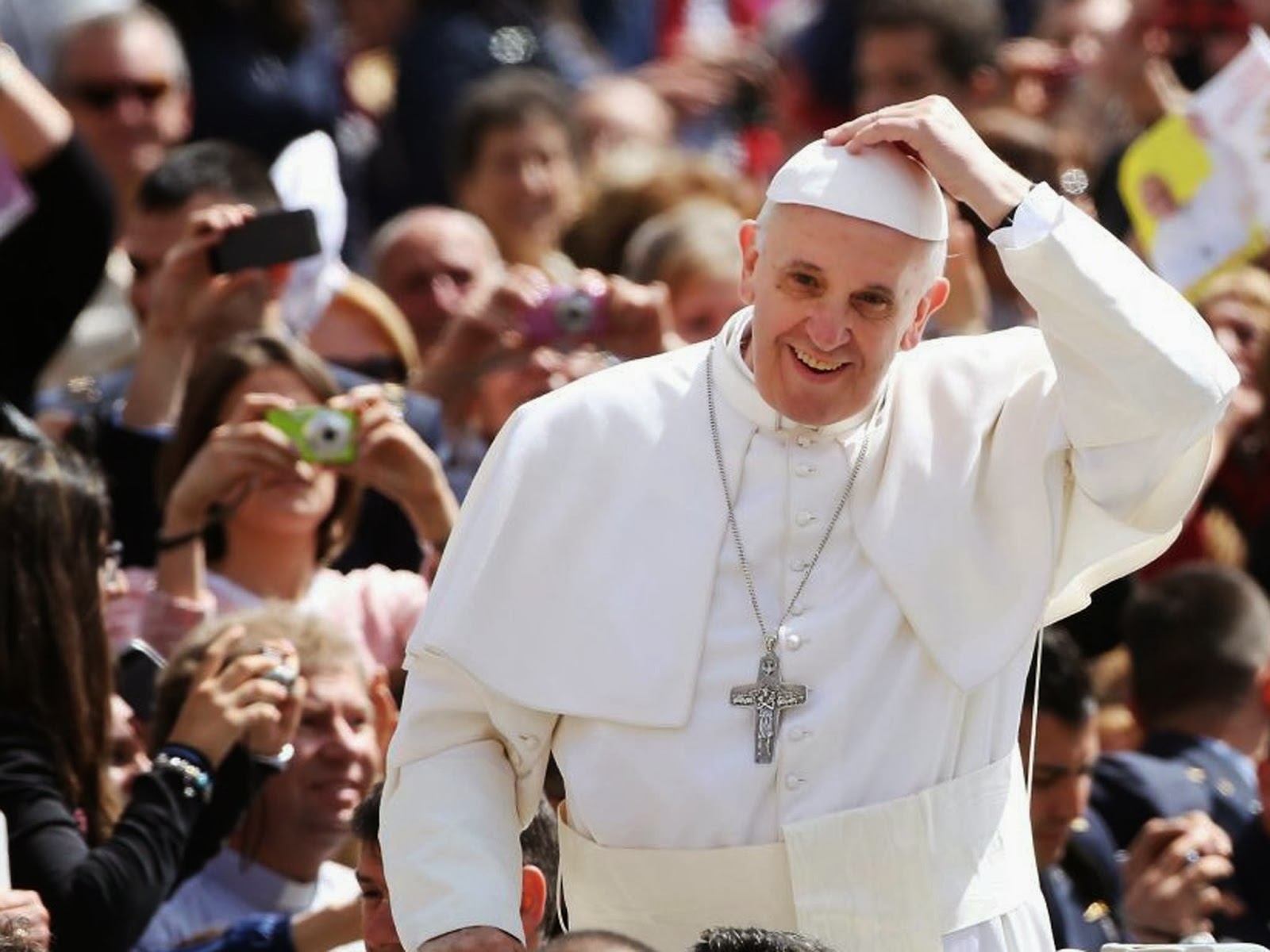
Our Lord, even as he faced his own death, shows us that there is another way; that we do not have to give in to the sad and tired logic of violence, war and retribution. In Christ and in the in-breaking of God’s Kingdom there is the ever new possibility of peace, restored relationship, honest encounter and even friendship. As Pope Francis, a disciple of Christ Jesus, recently said in his Angelus message, “War never brings peace. War begets war! Violence begets violence! … Peace is a treasure of all humanity!” Jesus reveals to us that there is truly another way – there is an ever-new logic of dialogue and encounter.
We have all been witnessing the increasingly brutal cycle of violence in Syria. All of us have been horrified by the gratuitous loss of life and the new revelation of the apparent use of chemical weapons by government forces. We all want to “do something” to stop this horror. No person, honest in his or her humanity, can deny that this is just plain wrong and evil.
President Obama and the members of Congress (like that disciple in the garden of Gethsemane) are good people. They are good people who want to “do something” to end the violence that is ripping Syria apart. But more violence is not the answer that is needed at this moment. A different way is needed and the gospel points out this way.
Then Jesus said to him, “Put your sword back into its place: for all who take the sword will perish by the sword.”
There is another way and we need to give this other way a chance! The work of diplomacy, negotiation, humanitarian aid and dialogue is neither a sign of weakness nor a form of isolationism. Dialogue is the furthest thing from isolationism – it is the willingness to truly seek out and encounter the “other” wherever and whoever he or she might be. The way of encounter acknowledges that we share a common humanity with shared hopes and dreams! The way of violence denies a common humanity. Violence and resorting to the mechanism of violence to achieve ones goal is, in fact, the true isolationism. It is, in essence, stating, in very stark ways, “My way or no way!” It is also (and I believe that this is at play in the current situation) a way of assuaging ones tranquility and sense of having “done something” while not really having to encounter the other because when we encounter we might ourselves have to change. The thought of bombing Syria can be likened to the decision that the only way to solve the domestic abuse situation next door (which everyone in the neighborhood is painfully aware of) is to throw some hand grenades through the front window! What is the priority here? Is it the good of the Syrian people and the country of Syria or is it our own peace of mind? True encounter demands that the good of people always comes first, even above our own sense of tranquility.
Violence begets violence. War begets more war. God calls us to a new way. When we were lost in sin and turned away from God; God came to encounter us, God came to seek out our friendship. Peace belongs to everyone and is ever possible because when we had turned our backs on God, God came to us in peace. This is the “serene and sure vision” of religion that must be brought to our world and brought to all people, including those good people who out of a desire to “do something” would draw the sword. How often must we draw the sword? How many times? When will it end?
At the Meeting of Prayer for Peace in Sarajevo (September 11, 2012) Professor Andrea Riccardi – founder of the Community of Sant’Egidio – offered these words. (The “serene and sure vision”, I would hold, is the vision of Christ in the garden of Gethsemane and it is what we have to give to the world and it is a vision our world desperately needs.)
Let us look at the future without fear! Let us prepare the future in friendliness among peoples. Let us look at the future without being paralyzed by past fears! We need courage and hope to prepare a future of life together in peace. Let us forfeit all prejudices, the preaching of hatred. We can build the future, educating women, men, the youth to peace: for only peace is holy, and living together reveals the will of God and the equality of all people. Equality that is rooted in God himself. For whoever kills a man, but also whoever hates or despises a human being, strikes God himself! Religions can be foreseeing. We can convey a new conviction to everyone, a conviction developed in contact with the sorrows of many and the experience of peoples: war is evil, violence can never be justified in God’s name. Dialogue can help resolve insurmountable problems. We have a serene and sure vision: it is an ancient and very new vision. We are a reference point – the spirit of Assisi is – in the plurality of our religions: a reference point of peace.
Before we rush to “do something”, before we rush to bomb Syria, let us spend some time with our Lord in the garden of Gethsemane and let us learn his way.
This is what Isaiah, son of Amoz, saw concerning Judah and Jerusalem.
In days to come,
The mountain of the LORD’s house
shall be established as the highest mountain
and raised above the hills.
All nations shall stream toward it.
many peoples shall come and say:
“Come, let us go up to the LORD’s mountain,
to the house of the God of Jacob,
that he may instruct us in his ways,
and we may walk in his paths.”
For from Zion shall go forth instruction,
and the word of the LORD from Jerusalem.
He shall judge between the nations,
and set terms for many peoples.
They shall beat their swords into plowshares
and their spears into pruning hooks;
One nation shall not raise the sword against another,
nor shall they train for war again.
House of Jacob, come,
let us walk in the light of the LORD! (Is. 2:1-5)
28 Wednesday Aug 2013
Posted in dignity, hypocrisy, image and likeness of God, Miley Cyrus, St. Augustine
The word “hypocrite” has its origins in a Greek word meaning “actor”. If you have ever seen an ancient Greek play you will remember that all the actors wear masks, you never see an actor’s real face. A hypocrite is someone who puts on a false appearance, someone who wears a mask. Often, we use the term “hypocrite” in relation to people who put on a false appearance in terms of seeming to be religious or in terms of seeming to exemplify a certain virtue. When hypocrisy is revealed we know how harmful it can be. Jesus also knew this. This is why in today’s gospel (Mt. 23:27-32) he chastised the hypocrisy of the scribes and the Pharisees. But hypocrisy can come in a wide variety and in many forms.
Some of you may have seen Miley Cyrus’ act at the MTV Video Music Awards recently. I did not see the show. Since I have moved to Chattanooga I have decided not to have a TV and even when I did have a TV I did not watch MTV. (I remember when MTV first came out and when they actually played music videos. Now, I don’t know what MTV is really about.) Anyway, so many of my friends were talking about it the next day on Facebook that I pulled it up on YouTube and watched it. Now, I do not necessarily have anything against Miley Cyrus. She seems to be quite talented which, to me, makes it all the more sad that she felt she had to perform in such a way but as I watched her performance I was just struck by the hypocrisy of it all. For whatever reason (maybe to move beyond her Hannah Montana image or to prove she is an adult) Miley chose to deny her dignity and on a national stage belittle herself and her worth.
Ladies, because Miley Cyrus is a role model (whether she chooses to admit this or not), because she is someone you grew up with, she also belittled you. This act fundamentally said that all you are is an object, something to be used for the pleasure of another. That is a lie. You are no one’s plaything. You have a dignity and a worth and if others ever try to deny that then to hell with them!
Gentlemen, this act also belittled you. Basically, it said that this is all you are about and that this type of activity is all you want from a woman and that it is also all that you are capable of. It said that there really is no dignity or virtue in being a man. This also is a lie. Don’t settle for this lie.
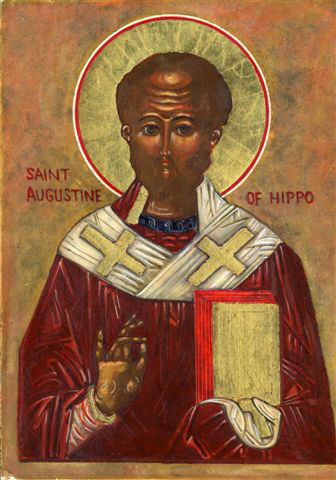
So, MTV has Miley and her crew up on stage dancing around with stuffed bears on their backs. (What was up with that? Who thought that was a good idea?) Who do we have? Well, we have a crusty old bishop from North Africa!
St. Augustine lived in a time very similar to our own. The security and peace of the great Roman Empire was unraveling at the seams. There were many voices in society and culture competing with one another and not connecting. The social institutions were just no longer working. In the midst of all of this; Augustine was asking the question, “Where do I find God?” God was certainly not in the diminishing strength of the empire nor was God in the structures of society. In the best sense of the term, Augustine turned inward and he realized, building on the very beginning of Scripture that we are each made in the image and likeness of God, that the best place to find the reflection of God was within our very selves. That, by God’s grace, once we move beyond our fears and hypocrisies, we can recognize within ourselves a dignity that is truly undeniable because it is a reflection rooted in God himself! Augustine, throughout his life, proclaimed the healing mercy of God’s grace and that how in receiving that mercy we are healed and our dignity is restored. Augustine was no hypocrite. He did not need to put on a false appearance. He trusted in God’s love.
So, after MTV and Miley we are today presented with Augustine – a crusty bishop from North Africa. His words to us today: “Remember your dignity. Don’t be a hypocrite. Don’t settle.”
25 Sunday Aug 2013
Posted in Culture of Encounter, encounter, humility, the Narrow Door
In today’s gospel (Lk. 13:22-30) Jesus is on journey toward Jerusalem, toward the cross and the resurrection, and he is passing through many towns and villages. At one point someone asks him; Lord, will only a few people be saved? The question witnesses to a common assumption of the time that salvation was dependent upon belonging to the “chosen people” or to the right group – be it social, religious or ethnic. (The question might actually have come from someone troubled by this understanding and so he or she asks our Lord for his opinion.) This raises a valid question for us; even if we might not say that salvation is dependent upon belonging to the right group, how often do we act and live our lives like this is so? How often might we distance others from our lives or isolate ourselves from others who are different, who have very apparent needs that might make burdensome demands on my life and time (i.e. the poor, the immigrant, the mentally-handicapped, the elderly)?
18 Sunday Aug 2013
Posted in compassion, God's love, love of God, love of neighbor, peace of Christ
“Peace cannot exist without a strong and passionate love.”
This Sunday’s gospel (Lk. 12:49-53) presents us with this truth for our consideration. Christ speaks here as with a sense of urgency! I have come to set the earth on fire, and how I wish it were already blazing! What Christ brings to us is not a theory or a proposal but the very fire of God’s love! This fire has a name: compassion. At one point in Matthew’s gospel we are told that when Christ looked out on the vast crowd he had compassion for them because they were like sheep without a shepherd. And how great is our Lord’s anguish until it is accomplished! Our Lord burns with the love of the Father which is the love of compassion!
Unfortunately, in our world, this love can be obscured and even suffocated. The violence and indifference of our world can suffocate compassion. Even we disciples can suffocate compassion when we turn from the invitation of our Lord to follow solely our own priorities and interests. It is easy to resign ourselves to the world thinking, “well, that is just the way things are…”
But, the Lord continually comes to us and says, I have come to set the earth on fire… Do you think that I have come to establish peace on earth? No, I tell you, but rather division. True compassion, when lived and witnessed, shocks us because – if even just for a moment – it forces our gaze away from ourselves and toward another.
This is the divisive peace that our Lord brings to the earth. The peace of the gospel is not the world’s peace – peace as a nice, reassuring intimacy and justification for isolation. Christ did not come to the earth to defend the peace of our little self-centeredness; rather, he came to hold forth the call of love for others, for compassion. Christ did not come to defend the peace of the rich man who did not notice the starving Lazarus at his door, nor did Christ come to defend the peace of the priest and the Levite who avoided the man lying helpless on the road. This is not peace. Rather it is avarice, meanness, insensitivity and just plain sin.
Peace cannot exist without strong and compassionate love!
The peace that Christ brings is divisive! It divides us from our self-centeredness. It divides us from our insensitivity to the needs of others. It divides us from attitudes of resignation and withdrawal. It shifts our focus and our heart toward the other in his or her need. It will not allow us to resign ourselves to a comfortable, yet ultimately life-denying, sense of isolation.
The fire that Christ brings to earth is the fire of God’s compassion. It continues to burn and it continues to purify!
Lord, enkindle in us the fire of your love!
(Some thoughts in this reflection are borrowed from Bp. Vincenzo Paglia’s reflection on this Sunday’s readings.)
15 Thursday Aug 2013
Posted in Assumption of Mary, authenticity, discipleship, wholeness
“King of the Hill” is a television cartoon series that tells the story of the Hill family. It is a comedy but the episodes often make very good points to reflect upon. There is one episode where Bobby (the Hill’s teenage son) happens to be at a skateboard park one day when he is introduced to a youth Christian evangelist. This guy skateboards, he has tattoos and he plays in a Christian rock band. He invites Bobby to his ministry and Bobby quickly gets immersed in it. At first Hank and Peggy (Bobby’s parents) are thrilled. Bobby is involved in church stuff! But then they start to have concerns. Bobby is staying out too late with this crowd but it is okay because “it is for the Lord”. He begins to separate himself from his longtime friends. He stops attending church on Sunday with his family because it is just too boring.
28 Sunday Jul 2013
Posted in authenticity, freedom, love, love of God, love of neighbor, prayer
In order to love one must be free. Love can neither be forced nor contrived. For love to be authentic it must be freely given and freely received. This is love’s dynamic and yet, just as love depends on freedom love, itself, makes us freer. In John’s first letter we are told that perfect love casts out all fear. Love creates true freedom. In this Sunday’s second reading from St. Paul’s Letter to the Colossians we are reminded of this salvific fact. Christ, out of love, took on our sinfulness, “obliterating the bond against us, with its legal claims, which was opposed to us, he also removed it from our midst, nailing it to the cross.”
In Christ we have been set free but this is not a freedom to do whatever we please. This is not authentic freedom rather; it is a misuse of freedom. The freedom we gain from the love of Christ is the freedom to enter more deeply into honest relationship with God and with one another. This freedom begins in the very knowledge that in Christ we are loved beyond measure – each and every one of us.
The sins of Sodom and Gomorrah were many but at the heart of these sins was the abuse of relationship, particularly the abuse of the visitor, the stranger. This sin is brought out all the more in contrast to the passage directly preceding that about Sodom and Gomorrah (last Sunday’s readings). In last Sunday’s passage Abraham welcomes the three visitors, he honors his relationship with them and he treats it as a sacred reality to be respected. The people of Sodom and Gomorrah, on the other hand, do not. Their sin is great and grave.
It is easy to judge Sodom and Gomorrah and hold ourselves superior but I wonder if one of the factors of their sinfulness is a factor also present in our own day and time – a life lived in distraction. John Garvey, in an article he wrote entitled, “A Tree Full of Monkeys: Why the Soul Needs Silence” makes a good observation:
It takes effort to be clear about the moment we are in. It requires taking time … We need, through practice, to be made aware of what is wrong about ordinary waking circumstances; it takes effort to do this … it matters, especially in a time when distraction and ideological reinforcement matter more to the culture than sober clarity does. This inattention disrupts our lives at every level – religious, political, aesthetic … Prayer (silence) can begin to make us feel what is directly underfoot, can help us begin to understand where we really are, in the presence of the sacred…
A life of distraction, a life of inattention inhibits freedom and therefore hinders growth in true love and honest relationship and (if left unchecked both in lives of individuals and of society) can be a contributing factor in the abuse of others – those who are indeed our brothers and our sisters. For this we will each have to give an accounting before the judgment seat of God. To love, one must be free. A distracted life is not a free life.
It is worthy to note that in this Sunday’s gospel (Lk. 11:1-13), after our Lord gives us the Our Father, he goes on to further explain prayer by use of three images specifically based in relationship and attentiveness – the attention of one friend to another in need, the willingness to trust in relationship with God and therefore to ask, to seek, to knock and the attentive love of a father to the needs of a child. Let us not fool ourselves. Love can easily and sadly be compromised on all levels and in many ways. The mind can easily become a “tree full of monkeys”. The soul needs silence and prayer not just for sanity but also to safeguard freedom, honest relationship and attentiveness to the needs of the other.
The disciples’ request, “teach us to pray” is another way of asking, “teach us how to love.”
18 Thursday Jul 2013
Posted in Uncategorized
14 Sunday Jul 2013
08 Monday Jul 2013
Posted in How, humility, New Evangelization, Proclaiming the Gospel
I do not think that the New Evangelization is just about what we say as Christians, nor about what new technologies we use to proclaim the Good News but also about how and the manner by which we proclaim, “Jesus is Lord!”
When it comes to the work of apologetics or promoting/debating the faith or current issues or even just day-to-day encounters for that matter, I must admit that I have never been one for witty, “in the moment” comebacks. I think that this is due, partly, to the fact that my parents taught me from an early age not to regard a snarky attitude, in and of itself, as a sure sign of intelligence and also because I do not think that an exchange of one-upmanship in comments leads anywhere truly productive. Such an exchange tends to produce more heat in friction than light to illuminate, I believe.