Martin Luther King, Jr.
16 Monday Jan 2012
Posted in Uncategorized
16 Monday Jan 2012
Posted in Uncategorized
13 Friday Jan 2012
Posted in Uncategorized
Fr. Robert Barron has remarked that authentic love can be defined as “seeking the good of the other for the sake of the other.” This is a thoughtful definition of love and the second aspect is of utmost importance. We are very good at caving in on ourselves in sin and this can even effect our love for another. When I seek the good of the other because I get something out of it (my needs or insecurities are satisfied, my status, acceptance or even power is enhanced) then I am not authentically loving. It is only when I can let go of myself and love the other person solely for the sake of the other person without heeding any benefit or counting any cost that it can be said that I am authentically loving. Love, when it is real, is challenging and it calls for a letting go of self.
This past week has been National Vocation Awareness Week – an opportunity for the Church in the United States to reflect on vocation and pray for an increase in an overall awareness of the universal call to holiness and discipleship and specifically vocations of lives of service within the Church – found in priesthood, consecrated life and the permanent diaconate. The readings for this Sunday with the call of the prophet Samuel (1 Samuel 3:3-10, 19) and the disciples (John 1:35-42) are very fitting for this. The readings have much to teach us about God’s call and our responding and one aspect of this, I believe, is to help us recognize that call or vocation is rooted in authentic love. At the beginning (even birthpoint, I would say) of both Samuel’s call and that of the disciples we find the witness of a love lived authentically. This is not a coincidence I believe and is worthy of reflection.
Samuel was a young boy when God’s call came to him. He was assisting the elderly priest Eli. At first Samuel does not recognize the voice of God and neither does Eli, he thinks that the boy is dreaming things. Samuel needs the direction and insight of his elder but he also needs his elder to show an authentic love for him. After the third call, Eli recognizes what is going on – that God himself is calling the young boy. It is here that Eli faces a critical moment – he can be resentful that God is calling this young boy and not himself (the “priest”), he can despair that this is an indicator that his time is over and now it is time for the younger generation, he can try to cling on and deny Samuel his moment. He can do all of this by remaining silent to what he knows and telling Samuel to ignore the voice, that it is nothing. But Eli does not do this and this is to his everlasting credit. “So (Eli) said to Samuel, ‘Go to sleep, and if you are called, reply, Speak, Lord, for your servant is listening.”
Eli seeks the good of Samuel for the sake of Samuel and not for his own sake. Eli is able to show authentic love for Samuel. He is able to let go of self for the good of the other. And Samuel’s vocation is born.
John the Baptist also stands at a critical moment. The gospels tell us that people from all over were coming to be baptized by John in the Jordan. He had a devoted group of disciples, the religious authorities held a begrudging respect for John, even King Herod feared the prophet. Many would say that John was at the “height of his power.” John knows the yearning of the people and of his disciples for the Messiah. Jesus walks by as John is standing there with two of his disciples. He knows their yearning and he knows that he cannot answer that yearning. It is beyond him. He lets go of self and seeking the good of his two disciples for their good and not his own he points to Jesus and says, “Behold, the Lamb of God.” They have found the Messiah and their calling is born.
We are Church. We are meant to help one another along. There is much concern today about the need for vocations to lives of service within the Church and for our world. Today’s readings have much to teach us. One of the lessons I believe is that the witness of authentic love is the necessary seedbed of vocations. The witness of both Eli and John the Baptist testifies to this.
Love calls forth love.
Our faith as Christians calls us to love authentically – seeking the good of the other for the sake of the other.
09 Monday Jan 2012
Posted in Uncategorized
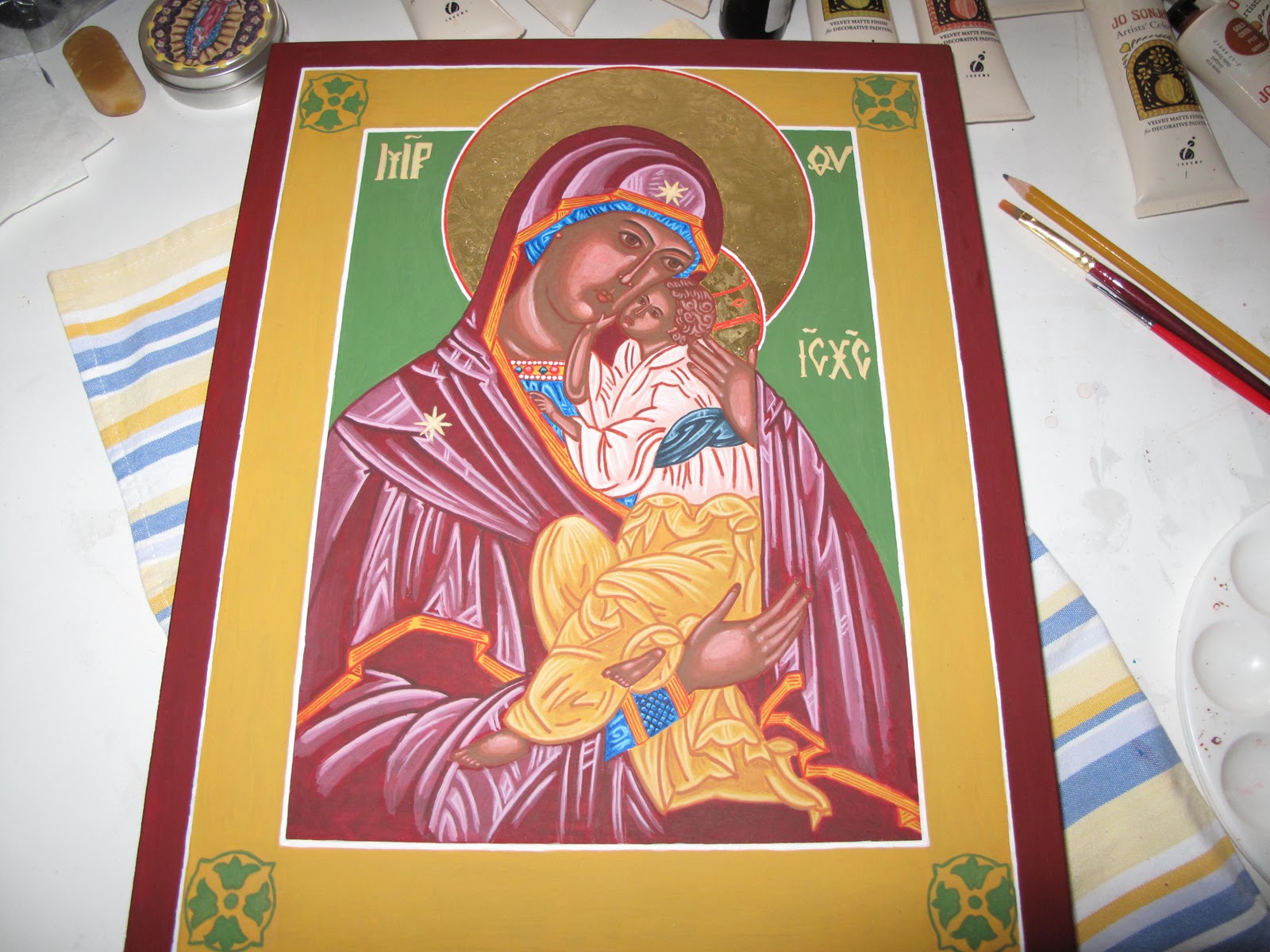
I have gotten a little farther along on the icon of Our Lady of Tenderness. Yesterday’s quiet rainy afternoon helped. My third year of theology studies I really wrestled with the possibility of the monastic life. I don’t doubt my vocation as a diocesan priest but the idea of solitude in God remains very compelling for me. Of course the fact that the semester is beginning in just a couple of days now and things will once again be humming at the Catholic Center may also have something to do with these thoughts…
One of my resolutions for the new year is to get my spiritual house in order. Recently I have had the spiritual intuition that God is asking something new of me. I must admit that this thought had been weighing me down because I have been thinking solely in terms of something I need to give up or let go of but the other day the insight came to me as I was working on this icon that the “something new” God is asking of me is not another cross to carry but rather just to spend more time with Him in friendship and relationship.
God wants time with me. It is a very tender and life-giving invitation.
I have made a reservation later this month for an overnight “quiet” day at Jubilee House (a retreat center) in Abingdon, VA. My hope is to make this a monthly commitment. Please help me by praying that I follow through and am able to keep this commitment.
It is a beautiful thing when our Lord invites us to come away and spend time with Him.
07 Saturday Jan 2012
Posted in Uncategorized
Rise up in splendor, Jerusalem! Your light has come, the glory of the Lord shines upon you. (Isaiah 60:1)
We are the new Jerusalem yet what does it mean to “rise up in splendor”? To help us answer this we have the witness of the Magi in today’s gospel (Mt. 2:1-12). Three times in these twelve verses from Matthew’s gospel the Magi rise and follow.
First, the Magi have arisen to follow the star. The Magi are Gentiles, they are not Jews. They do not have the guidance of the Law and the Prophets. Their guidance is God at work in creation. “Where is the newborn King of the Jews? We saw his star at its rising and have come to do him homage.” They trusted in the voice of God as they best heard it. Trusting, they rose up and followed and this guidance took them as far as it could.
The Magi arrive in Jerusalem. Here the people of the covenant, the people formed by the Law and the Prophets, direct them. “In Bethlehem of Judea, for it has been written through the prophets: And you Bethlehem, land of Judah, are by no means least among the rulers of Judah; since from you shall come a ruler, who is to shepherd by people Israel.” Yet again, the Magi rise up in order to follow. God’s voice in creation is fulfilled in the Law and the Prophets.
They find the “child with Mary his mother” and they do him homage by offering gifts of gold, frankincense and myrrh. They encounter Christ – the Word of the Father and the Word made flesh – through whom all things have come into being (John 1:3) and the very source and fulfillment of the Law and Prophets. All peoples (Jews and Gentiles) are united in the revelation of Christ. Now after encountering Christ and being guided by the voice of God in creation and in the Law and Prophets, the Magi recognize the voice of God within their very selves, “And having been warned in a dream not to return to Herod, they departed for their country by another way.”
Three times the Magi rise up responding in trust and in faith – to God’s voice proclaimed in creation, to the voice of God found in the Law and the Prophets and to the very encounter with God in Christ. The Magi rise up in “splendor” – a splendor not of their own making or doing but of faith in God’s will and God’s providence.
In contrast to the Magi we have King Herod. Herod did not rise up. Herod sends the Magi on to Bethlehem but he himself remains behind trapped in his fear, his love of power and in all the sad violence and division of our world.
There is a fourth gift that the Magi bring on this Feast of the Epiphany. To the Christ child the Magi bring the gifts of gold, frankincense and myrrh. To us, the Magi bring the gift of faith. “Rise up in splendor!” they proclaim. Even in the darkness of uncertain times and struggle or maybe of loss, grief and fear. Even in the times of violence, division and lack of peace. Rise up in splendor! Walk in the ways of faith and in the light of God! Ours is a different way, because even in the midst of darkness, “upon you the Lord shines, and over you appears his glory.”
If we receive and live this fourth gift of the Magi, this most precious gift of faith, we become a light even unto the world, “Nations shall walk by your light, and kings by your shining radiance.”
Rise up in splendor!
30 Friday Dec 2011
Posted in Uncategorized
Today I took part in the most useless of activities.
I went to the sacrament of confession.
I took time out of my schedule when many would say I could have been doing something else. I was not being productive as the world would define it – nothing was made, no deal was struck, no contract was signed, no money exchanged hands. I left with nothing more physically than I originally had going in. The interaction took place in a quiet room set aside from the rush and purpose of the world. I did not even have to pay as one would for a session with a therapist – so I cannot even point to that as a measurement of value. It was free.
The church was quiet. Other people had also come in and were praying the rosary in the front of the church. I knelt in a back pew and silently prayed. The church was the Cathedral of St. John the Baptist in Charleston, S.C. I was in the city for a few days of vacation and stopped at the church before making the drive back home. The sacrament (I came to find out) was being offered. The Cathedral is old and beautiful – made even more so by the Christmas trees flanking the Nativity scene up front and the Christmas poinsettias set around the altar. The old floor boards creaked as people walked by.
In a world dominated by the dual tyrannies of utilitarianism – assigning value solely in terms of productivity and what one can “show” for ones efforts – and a materialism which relentlessly seeks to bracket off any notion of the transcendent actually engaged with and infusing creation, what I did today makes no sense whatsoever. Baptism, confirmation, marriage, even ordination can be explained off by these viewpoints as important rites of passage needed for the proper functioning of a civic religion. Even the Mass can be justified for the sake of fellowship and the value of community it instills. But confession? On a weekday? Confession is the most useless of activities.
Yet that is what I did and I am better for it. To one without faith or even one dominated by the tyrannies of our day I cannot explain it nor will I seek to. What I know is that grace was present, forgiveness was given and hope was born once again in my soul.
For my penance the priest reminded me that it is still the Christmas season and I should offer a prayer of gratitude.
Sitting once again in a back pew I thumbed to the end of the missal and found a prayer for faith, hope and love. The section on hope struck me. “Remind us of the truth of who we are: sinners, yet also beloved sons and daughters of God … give me the gift of hope.”
Hope is born through this truth and in this most useless of activities.
26 Monday Dec 2011
Posted in Uncategorized
![]() |
| St. Theresa Catholic Church in Madalla, Nigeria |
News has come out of Nigeria that there have been orchestrated explosions at Christian churches throughout the country on Christmas day. At least thirty-nine persons have been killed. Boko Haram, a Muslim militant group has taken credit for the bombings. The group wants to establish Shariah law throughout the country.
December 26th is the Feast of St. Stephen, the first Christian martyr. Today’s senseless act of violence reminds us that the age of the martyrs is not over. These men and women died in witness to their faith – celebrating the birth of the Prince of Peace.
As we face this violence the temptation to respond in kind is strong but we look to the witness of St. Stephen to remind us that the weapons we fight with are not of this world and are based in the love and mercy of God. It is the love which has overcome all the sad violence and divisions of this world.
I pray for our brothers and sisters in Nigeria – for those who lost their lives in the simple act of attending Christmas Mass and for those who mourn the loss of their loved ones.
Here is the second reading from the Office of Readings for the Feast of St. Stephen. I believe that the words carry great weight at this time.
| A sermon of St Fulgentius of Ruspe |
|---|
| The armour of love |
|---|
25 Sunday Dec 2011
Posted in Uncategorized
The Catholic Center is quiet…
Bailey and Maxine are dozing at my feet, probably dreaming of their stockings stuffed with chew toys and snacks.
The midnight Mass was beautiful.
It is a chilly and crisp morning outside and in the quiet of the Christmas morning the gift of the Christ child (God become man that we might have life) warms the heart and radiates a serene and eternal peace.
Merry Christmas everyone!
22 Thursday Dec 2011
Posted in Uncategorized
Are we getting what Pope Benedict is trying to tell us? And if not, why?
I must say that I find some people’s negative perception of Pope Benedict to be quite perplexing. I will admit that he is not as photogenic as Bl. John Paul II nor does he seem to possess the natural media savvy that the previous pontiff did. But why the negative perception? Is it all due to these types of superficial impressions? Some of it is, I believe. Often, people are quite satisfied to remain on the level of the superficial and not deviate from what they have been fed.
But it is also due, I believe, to the fact that Pope Benedict himself is content to remain his own man who realizes that the Pope does not have to be a pop star nor a political power-broker to affect change in the world and to fulfill the unique witness that is his as the Bishop of Rome. Pope Benedict is happy not to play by contemporary society’s presumptions and biases and frankly, I think that this both perplexes and ticks a lot of people off at the same time (which is quite a feat and also amusing to watch!).
I think a case in point is to note where Pope Benedict is choosing to travel to during his pontificate. Yes, he has been to the “big” countries (the U.S., England, France, etc.) but he is certainly not limited to this itinerary. His last trip was to the small African country of Benin. Who goes to Benin? Well, apparently the pope does. It was just announced that he intends to visit Mexico and Cuba this coming year (bypassing the U.S. in the process).
Benedict is choosing not to be limited by western, “First World”, modern notions of power, prestige and how “real change” in the world is affected. Again, he is content to live his papacy as he so determines is best – primarily as a bishop, priest, teacher and (fundamentally) a disciple of Christ.
A recent article by Elizabeth Scalia in “First Things” has helped me put words on this. Below is the link. Check it out. It is worth the read.
All this also provides, I believe, a worthy Advent and Christmas reflection. As asked above: “Who goes to Benin? Apparently the pope does.” so also it is good to ask: “Who would go to the small, unknown and very unremarkable town of Bethlehem to be born in order to save the world? Apparently God would.”
11 Sunday Dec 2011
Posted in Uncategorized
The play, “To Kill a Mockingbird” is a story about prejudice and the courage to do what is right. In the play, Atticus Finch – a lawyer, agrees to defend a young black man (Tom Robinson) when he is unjustly accused of a crime he did not commit. Racial bigotry is stirred up and Atticus and his family are persecuted for seeking justice for the young man. Despite the persecution Atticus does fight for justice for Tom but by the end of the trial bigotry and the need to scapegoat win out and the young man is condemned for a crime he did not commit. After this verdict as Atticus leaves the courtroom and passes his two children, a black minister who is aware of all the factors at play tells the girl and boy to stand because their father is passing, “a good and just man.”
Is not Atticus, in many ways, a figure of John the Baptist? Atticus can be seen as a man proclaiming the truth even in the face of persecution, misunderstanding and ridicule. Like John the Baptist, he proclaimed and held to the light even in the very midst of darkness. Both men faced the same temptations – the temptation to remain quiet, to keep ones head down, to not make waves. Both also faced the temptation to proclaim oneself.
Throughout the play, Atticus is a soft spoken, humble man even as others talk about all his achievements and abilities. In his final speech in the courtroom Atticus does not proclaim his own skill as a lawyer nor his gift of rhetoric; rather, he proclaims and points to truth and justice for Tom Robinson. It was a proclamation to those gathered in the courtroom just as pointed as the cry of the Baptist in the wilderness.
John the Baptist also faced this temptation to proclaim self. The people were streaming toward John from all over the countryside, there was a deep yearning for the messiah – John knew this and he could have seized all that energy and power! But he didn’t. “I am not the Christ,” said John. “I am the voice of one crying in the desert, make straight the way of the Lord … I am not worthy to untie his sandals.”
John the Baptist was able to do two things extremely well: he was able to look away from himself and he was able to look toward God. In this he was able to recognize the truth of who he was – a man in need of a savior – and therefore he was able to recognize the true savior when he came (in contrast to the Pharisees). “I baptize with water; but there is one among you whom you do not recognize, the one who is coming after me, who sandal strap I am not worthy to untie.” (John 1:27)
What John the Baptist and the figure of Atticus proclaim to us is that truth and justice do not lie inherently within ourselves as if they were our own possessions. They are not part of our constitutional makeup that we can either summon or dispose of at will. Rather, truth and justice are acquired by us only insofar as we place ourselves in relation to truth and justice itself – whom we proclaim to have a name and a face: Jesus.
As we place ourselves in relation to Christ, we both learn to see anew with eyes enlightened by faith (judging rightly) and our own dignity is found. The words spoken by the black preacher to the children of Atticus might then be applied to any one of us, “Stand, your father (mother) is passing, a good and just man (woman).” Whether victorious or not in the realm of worldly success and opinion; could there be any higher compliment?
Come, Lord Jesus and do not delay and, in all things, may we testify to the light!
09 Friday Dec 2011
Posted in Uncategorized
The theological virtue of faith is about seeing.
This coming Sunday (the third Sunday of Advent) we are presented with the figure of John the Baptist in the Gospel reading. John the Baptist in many ways epitomizes the virtue of faith.
Here is the reading for this Sunday:
A man named John was sent from God.
He came for testimony, to testify to the light,
so that all might believe through him.
He was not the light,
but came to testify to the light.
And this is the testimony of John.
When the Jews from Jerusalem sent priests
and Levites to him
to ask him, “Who are you?”
He admitted and did not deny it,
but admitted, “I am not the Christ.”
So they asked him,
“What are you then? Are you Elijah?”
And he said, “I am not.”
“Are you the Prophet?”
He answered, “No.”
So they said to him,
“Who are you, so we can give an answer to those who sent us?
What do you have to say for yourself?”
He said:
“I am the voice of one crying out in the desert,
‘make straight the way of the Lord,'”
as Isaiah the prophet said.”
Some Pharisees were also sent.
They asked him,
“Why then do you baptize
if you are not the Christ or Elijah or the Prophet?”
John answered them,
“I baptize with water;
but there is one among you whom you do not recognize,
the one who is coming after me,
whose sandal strap I am not worthy to untie.”
This happened in Bethany across the Jordan,
where John was baptizing. (John 1:6-8, 19-28)
John the Baptist does two things quite well: he looks away from himself and he looks toward the coming of the Messiah. Both are exercises of the virtue of faith and both are about learning to see correctly.
Throughout his preaching John does not proclaim himself. Again and again, he states that he is not the Messiah. At best John says he is, “the voice of one crying out in the desert…” John knew the tenor of his times. He knew the deep yearning of the people. He, in fact, was witnessing it first-hand as the whole country-side was streaming toward him in order to be baptized. John of all people at that time could have seized all of that energy and power! But he didn’t. John recognized the truth of himself. We find this expressed in his admission regarding the one coming after him whose, “… sandal strap I am not worthy to untie.” This recognition was an act of faith and it enlightened his eyes in order to truly see.
Faith is the theological virtue by which we believe in God and believe all that he has said and revealed to us, and that Holy Church proposes for our belief, because he is truth itself. By faith “man freely commits his entire self to God.” For this reason the believer seeks to know and do God’s will. “The righteous shall live by faith.” Living faith “work(s) through charity.” (Rom. 1:17, Gal. 5:6) (CCC #1814)
John’s self admission demonstrates that he was someone who freely committed “his entire self to God.” Faith begins where the heart is broken. John possessed the courage and honesty required to recognize his own need and by so doing was then able to fully commit his entire self to God.
Because John recognized his own need he was then able to recognize the Messiah when at last he came. John always points toward Christ.
“I baptize with water;
but there is one among you whom you do not recognize,
the one who is coming after me,
whose sandal strap I am not worthy to untie.” (John 1:27)
The gift of faith remains in one who has not sinned against it. But “faith apart from works is dead”: when it is deprived of hope and love, faith does not fully unite the believer to Christ and does not make him a living member of his Body.
The disciple of Christ must not only keep the faith and live on it, but also profess it, confidently bear witness to it, and spread it: “All however must be prepared to confess Christ before men and to follow him along the way of the Cross, amidst the persecutions which the Church never lacks.” Service of and witness to the faith are necessary for salvation: “So every one who acknowledges me before men, I also will acknowledge before my Father who is in heaven; but whoever denies me before men, I also will deny before my Father who is in heaven.” (Mt. 10:32-33) (CCC #1815-1816)
Faith is exercised when Christ is recognized and proclaimed. Blessed Teresa of Calcutta exercised the virtue of faith when she recognized the face of Christ in the dying poor. She “saw” Christ in their faces.
The theological virtue of faith is neither naïve hope nor illusion but true seeing enlightened by honesty and courage.