Fourth Sunday in Ordinary Time (B): The authority of Christ

In the course of his ministry Jesus asks an important question, “Who do people say that I am?”  It is important both for the response that is given (ultimately by Peter) but also for Jesus himself asking the question.  Jesus does not ask, “What are people saying about my teachings?”  He does not ask, “How do you think people are responding to my message?”  He asks, “Who do people say that I am?”

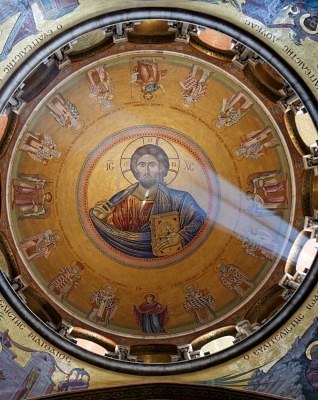
Elsewhere in the gospel Jesus says, “I am the way, the truth and the life.”  Fr. Robert Barron in his Catholicism series makes an important observation.  Among all the founders of the world’s great religions Jesus’ claim is unique.  Buddha says, “I have found a way.”  The Prophet Muhammad says, “I have received a revelation.”  On Mount Sinai Moses receives the Commandments.  All the founders point to a greater truth beyond themselves.  Jesus alone points to his very self.  “I am the way, the truth and the life.”  This one claim sets Jesus apart from all the rest and it demands of us a radical decision.  Either Jesus is who he claims to be or he is not. 

In today’s gospel (Mk. 1:21-28) there are two groups that encounter and witness this unique authority of Christ.  The first are the people gathered in the synagogue, “The people were astonished at his teaching, for he taught them as one having authority and not as the scribes.”  The second “group” is the unclean spirit, “What have you to do us, Jesus of Nazareth?  Have you come to destroy us?  I know who you are – the Holy One of God!”  These immediate reactions – the astonishment of the people, the fear of the unclean spirit – testify to the unique authority of Christ. 

It is helpful to remember that the word “authority” has its roots in a Latin word meaning, “to make grow.”  From this we can realize that one of the marks of true authority is that it is not in competition with others.  True authority does not need to suppress the other for its own sake and purposes.  This type of non-competitive authority can only come from Christ who is not just one other being among other beings but rather being itself.  “I am…”, says Jesus. 

There is a misunderstanding quite common in our day that leads to viewing God as opposed to my freedom.  This misunderstanding is that God is seen as the biggest, most powerful, most omniscient being of all.  This is not the case.  Get rid of all those categories and thoughts!  God is not “a being” among other beings, God is being itself and therefore God is not opposed to my freedom but rather God is the very foundation and source of true freedom. 

This unique authority of Christ which is non-competitive, which does not need to suppress the other, which by its very nature and presence calls forth life (knowledge and deep insight for those people gathered in the synagogue, healing and freedom for the man imprisoned by the unclean spirit) witnesses to the unique reality of Christ – “I am the way, the truth and the life.” – and it demands of us a radical choice. 

Third Sunday in Ordinary Time (B): A very imperfect church, response to Jefferson Bethke and Spoken Word

I have been reading Fr. James Martin’s new book, “Between Heaven and Mirth.” In the book Fr. Martin reflects on the role of humor in the life of faith and throughout the reflection he scatters humorous jokes and stories. In chapter four he reflects on “serious reasons for good humor” – the last reason he lists is the practical nature of humor and he does this in a tongue-in-cheek way by sharing a story about his father’s cousin Bernie.

Bernie, it seems, lived in Philadelphia but owned a small store on the coast in New Jersey. One evening he was speeding down the interstate toward his store. He was late for an appointment. It was the last day of the month so he knew that the police officers would be out, eager to give tickets in order to make their quota. But, he was in a hurry and decided to take his chances doing about eighty miles an hour.

Sure enough, after crossing into New Jersey he saw the flashing red lights and was pulled over. The officer walked up to his car with a pleased look on his face. “I have been waiting for you all day!” said the officer.

Bernie, off the top of his head replied, “Well, I got here as fast as I could!” Fr. Martin concludes, “The officer laughed so hard that he didn’t give Bernie a ticket.”

It is good to laugh.

Mark’s gospel is the shortest and most succinct of the canonical gospels. One can feel throughout Mark’s account of the good news a sense of urgency. Jesus has a mission and time must not be wasted! This sense of urgency is given expression in the very first chapter. Jesus proclaims, “This is the time of fulfillment. The Kingdom of God is at hand.” (Mk. 1:15) But then what does he do? With this sense of urgency it would be expected that he would march straight to Jerusalem in order to set things right. But he does not do that. Rather, in this time of fulfillment, Jesus forms community (Church) and not only that but a community of very insignificant people who were certainly not on any “A-list” of their day – fishermen, tax collectors, religious zealots. They were people of no real consequence.

Also, they were a group of imperfect people. They disagreed, they argued with one another, they were fearful, they bore resentments, they miscommunicated, they did not always understand, one betrayed Jesus and another denied him. In other words, they were human, just like us. And Jesus was in their midst and Jesus is in our midst calling, healing and enabling us (in all of our imperfections) to be church for one another and for the world.

Recently there has been a Youtube video that has sparked discussion. In the video a young rapper who has all the right looks and wears the perfect cool style of clothing and has all the perfect video angle shots raps about how he loves Jesus but hates religion. He goes on to say that Jesus hates religion and therefore the church also. Isn’t it nice when Jesus agrees with our own point of view? He raps that religion told him to pretend to be perfect but he does not consider the possibility that maybe he was the one who was getting the message wrong from the beginning.

To this young man I would say re-read the gospels because I think you missed something. Consider today’s gospel (Mk. 1:14-20) where Jesus in the very urgency of proclaiming the Kingdom decides to gather a community of very imperfect believers and he decides to remain within their very midst. Consider where Jesus says that he is the vine and we are the branches. Consider the sending of the Holy Spirit upon the community gathered at Pentecost. Reflect on Paul’s beautiful analogy of Christ being the head of the body and we the members. Consider Paul’s own conversion on the road to Damascus when the exalted Lord instead of asking, “Saul, Saul, why do you persecute my followers?’ rather asks, “Saul, Saul, why do you persecute me?” (Acts 9:4).  Consider the beautiful imagery of the bride awaiting the bridegroom found throughout the New Testament.

In the urgency of proclaiming the Kingdom, isn’t it interesting that Jesus calls and gathers a community of very imperfect people and he remains in their midst.

He remains in the midst of the Church today.

The Dangers of Radical Secularism

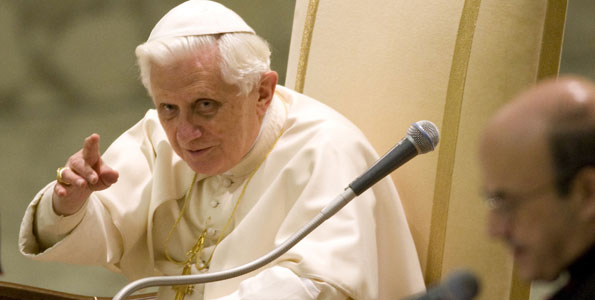
In a recent meeting with U.S. Bishops in Rome, Pope Benedict XVI made some pointed comments about the dangers of radical secularism in the United States.  It is a valid point that the anthropology of radical secularism is very limited and limiting.  It does not allow for the full dignity of the human person.  The best it can offer is an isolated individualism.   

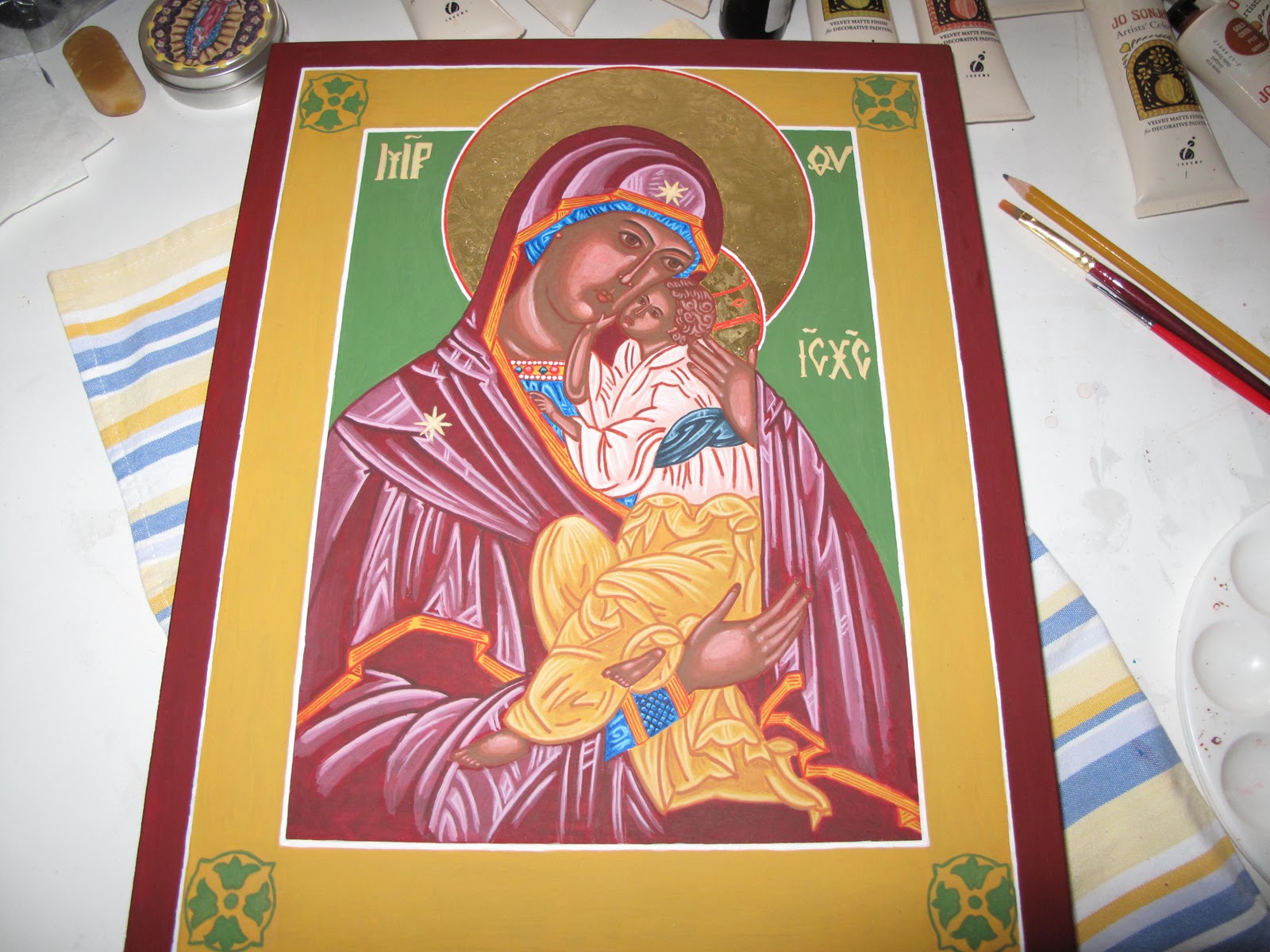
Our Lady of Tenderness icon

I just completed the icon of Our Lady of Tenderness.

With us Mary stands in need of a saviour; yet who else cradled the infant saviour in her arms providing him warmth and nourishment, who else sang him to sleep, who else wiped away his tears and gave him encouragement?

When Jesus saw his mother and the disciple whom he loved standing beside her, he said to his mother, ‘Woman, here is your son.’ Then he said to the disciple, ‘Here is your mother.’ (John 19:26-27)

It is a tender thing our Lord does; as he is dying he finds a home for his mother and he gives his Church a mother.

Tenderness is not weakness.

Tenderness reveals the strength of love.

Mary, gentle woman and first of disciples pray with us and for us!

Second Sunday in Ordinary Time (B): National Vocation Awareness Week and Authentic Love

Fr. Robert Barron has remarked that authentic love can be defined as “seeking the good of the other for the sake of the other.”  This is a thoughtful definition of love and the second aspect is of utmost importance.  We are very good at caving in on ourselves in sin and this can even effect our love for another.  When I seek the good of the other because I get something out of it (my needs or insecurities are satisfied, my status, acceptance or even power is enhanced) then I am not authentically loving.  It is only when I can let go of myself and love the other person solely for the sake of the other person without heeding any benefit or counting any cost that it can be said that I am authentically loving.  Love, when it is real, is challenging and it calls for a letting go of self.

This past week has been National Vocation Awareness Week – an opportunity for the Church in the United States to reflect on vocation and pray for an increase in an overall awareness of the universal call to holiness and discipleship and specifically vocations of lives of service within the Church – found in priesthood, consecrated life and the permanent diaconate.  The readings for this Sunday with the call of the prophet Samuel (1 Samuel 3:3-10, 19) and the disciples (John 1:35-42) are very fitting for this.  The readings have much to teach us about God’s call and our responding and one aspect of this, I believe, is to help us recognize that call or vocation is rooted in authentic love.  At the beginning (even birthpoint, I would say) of both Samuel’s call and that of the disciples we find the witness of a love lived authentically.  This is not a coincidence I believe and is worthy of reflection.

Samuel was a young boy when God’s call came to him.  He was assisting the elderly priest Eli.  At first Samuel does not recognize the voice of God and neither does Eli, he thinks that the boy is dreaming things.  Samuel needs the direction and insight of his elder but he also needs his elder to show an authentic love for him.  After the third call, Eli recognizes what is going on – that God himself is calling the young boy.  It is here that Eli faces a critical moment – he can be resentful that God is calling this young boy and not himself (the “priest”), he can despair that this is an indicator that his time is over and now it is time for the younger generation, he can try to cling on and deny Samuel his moment.  He can do all of this by remaining silent to what he knows and telling Samuel to ignore the voice, that it is nothing.  But Eli does not do this and this is to his everlasting credit. “So (Eli) said to Samuel, ‘Go to sleep, and if you are called, reply, Speak, Lord, for your servant is listening.”

Eli seeks the good of Samuel for the sake of Samuel and not for his own sake.  Eli is able to show authentic love for Samuel.  He is able to let go of self for the good of the other.  And Samuel’s vocation is born.

John the Baptist also stands at a critical moment.  The gospels tell us that people from all over were coming to be baptized by John in the Jordan.  He had a devoted group of disciples, the religious authorities held a begrudging respect for John, even King Herod feared the prophet.  Many would say that John was at the “height of his power.”  John knows the yearning of the people and of his disciples for the Messiah.  Jesus walks by as John is standing there with two of his disciples.  He knows their yearning and he knows that he cannot answer that yearning.  It is beyond him.  He lets go of self and seeking the good of his two disciples for their good and not his own he points to Jesus and says, “Behold, the Lamb of God.”  They have found the Messiah and their calling is born.

We are Church.  We are meant to help one another along.  There is much concern today about the need for vocations to lives of service within the Church and for our world.  Today’s readings have much to teach us.  One of the lessons I believe is that the witness of authentic love is the necessary seedbed of vocations.  The witness of both Eli and John the Baptist testifies to this. 

Love calls forth love.

Our faith as Christians calls us to love authentically – seeking the good of the other for the sake of the other.     

Our Lady of Tenderness

I have gotten a little farther along on the icon of Our Lady of Tenderness. Yesterday’s quiet rainy afternoon helped. My third year of theology studies I really wrestled with the possibility of the monastic life. I don’t doubt my vocation as a diocesan priest but the idea of solitude in God remains very compelling for me. Of course the fact that the semester is beginning in just a couple of days now and things will once again be humming at the Catholic Center may also have something to do with these thoughts…

One of my resolutions for the new year is to get my spiritual house in order.  Recently I have had the spiritual intuition that God is asking something new of me.  I must admit that this thought had been weighing me down because I have been thinking solely in terms of something I need to give up or let go of but the other day the insight came to me as I was working on this icon that the “something new” God is asking of me is not another cross to carry but rather just to spend more time with Him in friendship and relationship. 

God wants time with me.  It is a very tender and life-giving invitation. 

I have made a reservation later this month for an overnight “quiet” day at Jubilee House (a retreat center) in Abingdon, VA.  My hope is to make this a monthly commitment.  Please help me by praying that I follow through and am able to keep this commitment. 

It is a beautiful thing when our Lord invites us to come away and spend time with Him. 

Feast of the Epiphany – the fourth gift of the Magi

Rise up in splendor, Jerusalem!  Your light has come, the glory of the Lord shines upon you.  (Isaiah 60:1)

We are the new Jerusalem yet what does it mean to “rise up in splendor”?  To help us answer this we have the witness of the Magi in today’s gospel (Mt. 2:1-12).  Three times in these twelve verses from Matthew’s gospel the Magi rise and follow. 

First, the Magi have arisen to follow the star.  The Magi are Gentiles, they are not Jews.  They do not have the guidance of the Law and the Prophets.  Their guidance is God at work in creation. “Where is the newborn King of the Jews?  We saw his star at its rising and have come to do him homage.”  They trusted in the voice of God as they best heard it.  Trusting, they rose up and followed and this guidance took them as far as it could. 

The Magi arrive in Jerusalem.  Here the people of the covenant, the people formed by the Law and the Prophets, direct them.  “In Bethlehem of Judea, for it has been written through the prophets: And you Bethlehem, land of Judah, are by no means least among the rulers of Judah; since from you shall come a ruler, who is to shepherd by people Israel.”  Yet again, the Magi rise up in order to follow.  God’s voice in creation is fulfilled in the Law and the Prophets.

They find the “child with Mary his mother” and they do him homage by offering gifts of gold, frankincense and myrrh.  They encounter Christ – the Word of the Father and the Word made flesh – through whom all things have come into being (John 1:3) and the very source and fulfillment of the Law and Prophets.  All peoples (Jews and Gentiles) are united in the revelation of Christ.  Now after encountering Christ and being guided by the voice of God in creation and in the Law and Prophets, the Magi recognize the voice of God within their very selves, “And having been warned in a dream not to return to Herod, they departed for their country by another way.” 

Three times the Magi rise up responding in trust and in faith – to God’s voice proclaimed in creation, to the voice of God found in the Law and the Prophets and to the very encounter with God in Christ.  The Magi rise up in “splendor” – a splendor not of their own making or doing but of faith in God’s will and God’s providence. 

In contrast to the Magi we have King Herod.  Herod did not rise up.  Herod sends the Magi on to Bethlehem but he himself remains behind trapped in his fear, his love of power and in all the sad violence and division of our world. 

There is a fourth gift that the Magi bring on this Feast of the Epiphany.  To the Christ child the Magi bring the gifts of gold, frankincense and myrrh.  To us, the Magi bring the gift of faith.  “Rise up in splendor!” they proclaim.  Even in the darkness of uncertain times and struggle or maybe of loss, grief and fear.  Even in the times of violence, division and lack of peace.  Rise up in splendor!  Walk in the ways of faith and in the light of God!  Ours is a different way, because even in the midst of darkness, “upon you the Lord shines, and over you appears his glory.” 

If we receive and live this fourth gift of the Magi, this most precious gift of faith, we become a light even unto the world, “Nations shall walk by your light, and kings by your shining radiance.”

Rise up in splendor!   

Confession – the most useless of activities

Today I took part in the most useless of activities. 

I went to the sacrament of confession. 

I took time out of my schedule when many would say I could have been doing something else.  I was not being productive as the world would define it – nothing was made, no deal was struck, no contract was signed, no money exchanged hands.  I left with nothing more physically than I originally had going in.  The interaction took place in a quiet room set aside from the rush and purpose of the world.  I did not even have to pay as one would for a session with a therapist – so I cannot even point to that as a measurement of value.  It was free.

The church was quiet.  Other people had also come in and were praying the rosary in the front of the church.  I knelt in a back pew and silently prayed.  The church was the Cathedral of St. John the Baptist in Charleston, S.C.  I was in the city for a few days of vacation and stopped at the church before making the drive back home.  The sacrament (I came to find out) was being offered.  The Cathedral is old and beautiful – made even more so by the Christmas trees flanking the Nativity scene up front and the Christmas poinsettias set around the altar.  The old floor boards creaked as people walked by. 

In a world dominated by the dual tyrannies of utilitarianism – assigning value solely in terms of productivity and what one can “show” for ones efforts – and a materialism which relentlessly seeks to bracket off any notion of the transcendent actually engaged with and infusing creation, what I did today makes no sense whatsoever.  Baptism, confirmation, marriage, even ordination can be explained off by these viewpoints as important rites of passage needed for the proper functioning of a civic religion.  Even the Mass can be justified for the sake of fellowship and the value of community it instills.  But confession?  On a weekday?  Confession is the most useless of activities.  

Yet that is what I did and I am better for it.  To one without faith or even one dominated by the tyrannies of our day I cannot explain it nor will I seek to.  What I know is that grace was present, forgiveness was given and hope was born once again in my soul.  

For my penance the priest reminded me that it is still the Christmas season and I should offer a prayer of gratitude. 

Sitting once again in a back pew I thumbed to the end of the missal and found a prayer for faith, hope and love.  The section on hope struck me.  “Remind us of the truth of who we are: sinners, yet also beloved sons and daughters of God … give me the gift of hope.”

Hope is born through this truth and in this most useless of activities.     

Church bombings in Nigeria and the Feast of St. Stephen

St. Theresa Catholic Church in Madalla, Nigeria

News has come out of Nigeria that there have been orchestrated explosions at Christian churches throughout the country on Christmas day.  At least thirty-nine persons have been killed.  Boko Haram, a Muslim militant group has taken credit for the bombings.  The group wants to establish Shariah law throughout the country. 

December 26th is the Feast of St. Stephen, the first Christian martyr.  Today’s senseless act of violence reminds us that the age of the martyrs is not over.  These men and women died in witness to their faith – celebrating the birth of the Prince of Peace. 

As we face this violence the temptation to respond in kind is strong but we look to the witness of St. Stephen to remind us that the weapons we fight with are not of this world and are based in the love and mercy of God.  It is the love which has overcome all the sad violence and divisions of this world. 

I pray for our brothers and sisters in Nigeria – for those who lost their lives in the simple act of attending Christmas Mass and for those who mourn the loss of their loved ones.

Here is the second reading from the Office of Readings for the Feast of St. Stephen.  I believe that the words carry great weight at this time. 

A sermon of St Fulgentius of Ruspe
The armour of love
Yesterday we celebrated the birth in time of our eternal King. Today we celebrate the triumphant suffering of his soldier.  Yesterday our king, clothed in his robe of flesh, left his place in the virgin’s womb and graciously visited the world. Today his soldier leaves the tabernacle of his body and goes triumphantly to heaven.
 
Our king, despite his exalted majesty, came in humility for our sake; yet he did not come empty-handed. He brought his soldiers a great gift that not only enriched them but also made them unconquerable in battle, for it was the gift of love, which was to bring men to share in his divinity. He gave of his bounty, yet without any loss to himself. In a marvellous way he changed into wealth the poverty of his faithful followers while remaining in full possession of his own inexhaustible riches.
 
And so the love that brought Christ from heaven to earth raised Stephen from earth to heaven; shown first in the king, it later shone forth in his soldier. Love was Stephen’s weapon by which he gained every battle, and so won the crown signified by his name. His love of God kept him from yielding to the ferocious mob; his love for his neighbour made him pray for those who were stoning him. Love inspired him to reprove those who erred, to make them amend; love led him to pray for those who stoned him, to save them from punishment. Strengthened by the power of his love, he overcame the raging cruelty of Saul and won his persecutor on earth as his companion in heaven. In his holy and tireless love he longed to gain by prayer those whom he could not convert by admonition.
 
Now at last, Paul rejoices with Stephen, with Stephen he delights in the glory of Christ, with Stephen he exalts, with Stephen he reigns. Stephen went first, slain by the stones thrown by Paul, but Paul followed after, helped by the prayer of Stephen. This, surely, is the true life, my brothers, a life in which Paul feels no shame because of Stephen’s death, and Stephen delights in Paul’s companionship, for love fills them both with joy. It was Stephen’s love that prevailed over the cruelty of the mob, and it was Paul’s love that covered the multitude of his sins; it was love that won for both of them the kingdom of heaven.
 
Love, indeed, is the source of all good things; it is an impregnable defence,- and the way that leads to heaven. He who walks in love can neither go astray nor be afraid: love guides him, protects him, and brings him to his journey’s end.
 
My brothers, Christ made love the stairway that would enable all Christians to climb to heaven. Hold fast to it, therefore, in all sincerity, give one another practical proof of it, and by your progress in it, make your ascent together.