Parent’s Prayer for a Child Leaving Home

As things get ready to start here at ETSU with the upcoming fall semester I am reminded that many parents are preparing themselves to let a child leave home.  I remember that when I was chaplain at Knoxville Catholic High School I would often tell the seniors to be patient with their parents because the time around graduation and whatever comes next is also a time of adjustment for them.  Things are different.  The child that one has cared for, loved and raised is getting ready to leave home and this calls for a letting go on the part of every parent. 
I do believe that Christian marriage and parenting is a holy vocation.  Each vocation has its unique encounter with the cross and I think that the letting go that a parent has to go through is such an encounter.  But, we believe and hold that through the cross we discover new life. 
Letting go in faith can be a sacred moment. 
The other night through a PBS special I “discovered” the singer Justin Hines.  Obviously he has been around for a while but it was the first time that I heard his music.  I find his voice and his songs to be very appealling and good. 
His song, “Wish You Well” is, I believe, a wonderful parent’s prayer for a child leaving home.  Here are the lyrics:
No
Darling I can’t take your thirst away but I can show you to the sea
While you’re walking on your path unknown
I said, “Will you think of me?” 
Well time will tell and I wish you well 
Too many times I’ve seen those ghosts before
I’ve watched them dance around your bed
I would give you all of my sleep filled nights just to see you get some rest 
It’s not my place to try to fill that space but I can wish you well
Oh
I wish you well 
In times like this I tend to ponder of things we’ll miss
We can always reminisce 
When you come back from the great beyond with moonlight in your hair
I will meet you where that dark road ends
And it won’t be long until we’re there 
And once
Once again we’ll talk about way back when
Oh
But until then I wish you well
Oh
I wish you well
There are, I believe, some real gems to reflect on in this song.  Here are a few that strike me.
Darling I can’t take your thirst away but I can show you to the sea.  It is a powerful and beautiful thing when a parent recognizes the desire in the heart of his or her child and then does not try to stand in the way, nor find the answer for the child nor seek to control but rather points out, helps and encourages the child to find his or her own way.  I can show you to the sea.
I would give you all of my sleep filled nights just to see you get some rest.  A parent, even when letting go, remains a parent.  A parent knows that a child will face struggle and even experience pain and hurt in life but just as a parent cannot answer the unique desire in the heart of his or her child; a parent cannot carry the child’s own cross.  But a parent always wishes he or she could. 
It’s not my place to try to fill that space but I can wish you well.  This is an expression of humble and truthful awareness.  We can take another to the sea, we can wish we could carry another’s cross but, in truth, we realize that only God and the other can do that.  It’s not my place to try to fill that space … but I can wish you well.  Faith brings a different dynamic to letting go.  In faith, we do not send another off, abandoned and alone, on his or her own.  In faith, when we let go, we commend another into God’s care and through this there is a deep awareness and freedom that can be gained.  In faith-filled letting go we are reminded very particularly of who we indeed are and also what we can and what we cannot do.  We are not God; parents also are limited creatures and fellow pilgrims with their children on the way.    
In faith-filled letting go the child will always remain a son or daughter but through the embracing of this particular cross the parent may very well gain, in the due course of time, another pilgrim friend to walk the way of life with.  
Check out the video of Wish You Well by Justin Hines by clicking the link below. 
Parents, you are in my prayers.

St. Clare – in praise of virtue

Today the Catholic Church remembers St. Clare.  St. Clare was a contemporary and friend of St. Francis.  Inspired by his witness Clare also took upon herself a life of poverty, charity and chastity.  She founded an order of nuns that continues to witness the love of Christ to our world.  She died in 1253.   
St. Clare and all the saints remind us that there is a continual need for virtue in our world.  The more that I minister in the college setting the more I realize this.  We obsess over physical beauty while neglecting the beauty of the soul.  Virtue is not content to let the person sell him or herself short and virtue nourishes the soul where so much that our world offers, in the end, just leaves one empty inside. 
Below is a letter written by St. Clare to Blessed Agnes of Prague.

Consider the poverty, humility and charity of Christ
Happy the soul to whom it is given to attain this life with Christ, to cleave with all one’s heart to him whose beauty all the heavenly hosts behold forever, whose love inflames our love, the contemplation of whom is our refreshment, whose graciousness is our delight, whose gentleness fills us to overflowing, whose remembrance makes us glow with happiness, whose fragrance revives the dead, the glorious vision of whom will be the happiness of all the citizens of the heavenly Jerusalem. For he is the brightness of eternal glory, the splendour of eternal light, the mirror without spot. 
Look into that mirror daily, O queen and spouse of Jesus Christ, and ever study therein your countenance, that within and without you may adorn yourself with all manner of virtues, and clothe yourself with the flowers and garments that become the daughter and chaste spouse of the most high King. In that mirror are reflected poverty, holy humility and ineffable charity, as, with the grace of God, you may perceive. 
Gaze first upon the poverty of Jesus, placed in a manger, wrapped in swaddling clothes. What marvellous humility! What astounding poverty! The King of angels, Lord of heaven and earth, is laid in a manger. Consider next the humility, the blessed poverty, the untold labours and burdens which he endured for the redemption of the human race. Then look upon the unutterable charity with which he willed to suffer on the tree of the cross and to die thereon the most shameful kind of death. This mirror, Christ himself, fixed upon the wood of the cross, bade the passers-by consider these things: ‘All you who pass this way look and see if there is any sorrow like my sorrow.’ With one voice and one mind let us answer him as he cries and laments, saying in his own words: ‘I will be mindful and remember and my soul shall languish within me.’ Thus, O queen of the heavenly King, may you ever burn more ardently with the fire of this love. 
Contemplate further the indescribable joys, the wealth and unending honours of the King, and sighing after them with great longing, cry to him: ‘Draw me after you: we shall run to the fragrance of your perfumes, O heavenly bridegroom.’ I will run and faint not until you bring me into the wine cellar, until your left hand be under my head and your right hand happily embrace me and you kiss me with the kiss of your mouth. 
In such contemplation be mindful of your poor little mother and know that I have inscribed your happy memory indelibly on the tablets of my heart, holding you dearer than all others.

St. Lawrence, deacon and Martyr

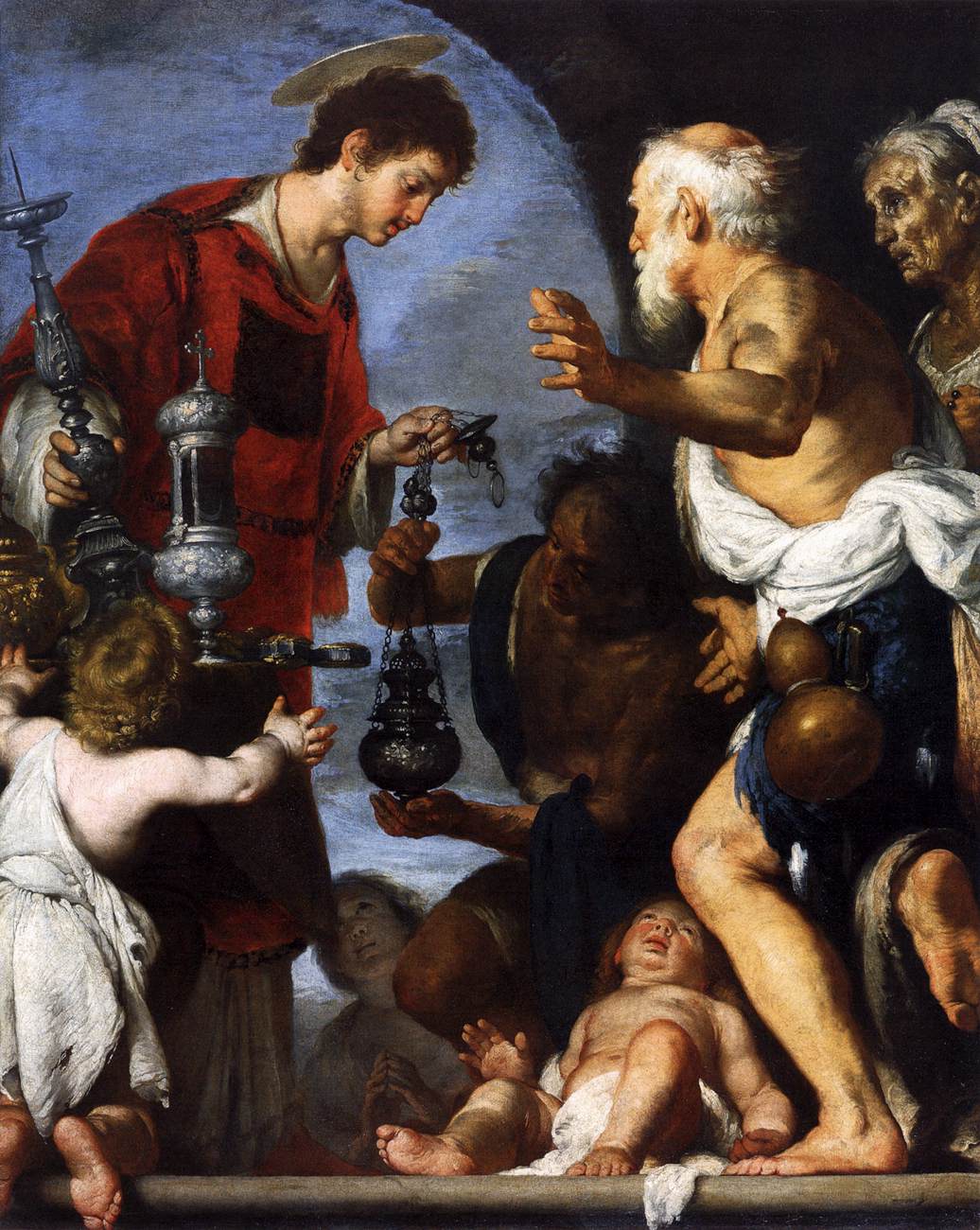
The Charity of St. Lawrence by Bernardo Strozzi
A sermon preached by St Augustine on the feast day of St Lawrence
The Roman Church commends this day to us as the blessed Lawrence’s day of triumph, on which he trod down the world as it roared and raged against him; spurned it as it coaxed and wheedled him; and in each case, conquered the devil as he persecuted him. For in that Church, you see, as you have regularly been told, he performed the office of deacon; it was there that he administered the sacred chalice of Christ’s blood; there that he shed his own blood for the name of Christ. The blessed apostle John clearly explained the mystery of the Lord’s supper when he said Just as Christ laid down his life for us, so we too ought to lay down our lives for the brethren. St Lawrence understood this, my brethren, and he did it; and he undoubtedly prepared things similar to what he received at that table. He loved Christ in his life, he imitated him in his death. 
And we too, brethren, if we truly love him, let us imitate him. After all, we shall not be able to give a better proof of love than by imitating his example; for Christ suffered for us, leaving us an example, so that we might follow in his footsteps. In this sentence the apostle Peter appears to have seen that Christ suffered only for those who follow in his footsteps, and that Christ’s passion profits none but those who follow in his footsteps. The holy martyrs followed him, to the shedding of their blood, to the similarity of their sufferings. The martyrs followed, but they were not the only ones. It is not the case, I mean to say, that after they crossed, the bridge was cut; or that after they had drunk, the fountain dried up. 
The garden of the Lord, brethren, includes – yes, it truly includes – includes not only the roses of martyrs but also the lilies of virgins, and the ivy of married people, and the violets of widows. There is absolutely no kind of human beings, my dearly beloved, who need to despair of their vocation; Christ suffered for all. It was very truly written about him: who wishes all men to be saved, and to come to the acknowledgement of the truth. 
So let us understand how Christians ought to follow Christ, short of the shedding of blood, short of the danger of suffering death. The Apostle says, speaking of the Lord Christ, Who, though he was in the form of God, did not think it robbery to be equal to God. What incomparable greatness! But he emptied himself, taking the form of a servant, and being made in the likeness of men, and found in condition as a man. What unequalled humility! 
Christ humbled himself: you have something, Christian, to latch on to. Christ became obedient. Why do you behave proudly? After running the course of these humiliations and laying death low, Christ ascended into heaven: let us follow him there. Let us listen to the Apostle telling us, If you have risen with Christ, savour the things that are above us, seated at God’s right hand.


St. Teresa Benedicta of the Cross (Edith Stein)

On August 9th the Catholic Church remembers St. Teresa Benedicta of the Cross.   Edith Stein was born to a Jewish family in 1891.  She studied philosophy and was a student of the renowned professor Edmund Husserl.  As she grew older she became more and more non-religious (drifting from her Jewish roots) but she also began to meet Christians whose intellectual and spiritual lives she came to admire.  She was searching.  In 1921, while visiting some friends, Edith spent a whole night reading the autobiography of St. Teresa of Avila.  She later recalled, “When I had finished the book I said to myself: This is the truth.”
In 1934 Edith entered a Carmelite convent and she took the name Teresa Benedicta of the Cross.  She took the name as a symbol of her acceptance of suffering.  “I felt,” she wrote, “that those who understood the Cross of Christ should take upon themselves on everybody’s behalf.”  In 1942 Teresa along with her sister Rosa (who had also become Catholic) and members of her religious community were arrested by the Nazis.  On August 9, 1942 St. Teresa Benedicta of the Cross died at the concentration camp in Auschwitz. 
In his second volume of Jesus of Nazareth Pope Benedict reflects on the depth of awareness of sin that our Lord had and knew as he was making his journey to the cross.  It is common to think that because our Lord was sinless he really did not know the weight of sin but the Holy Father states that the opposite is in fact the case.  Because of his sinlessness (unlike us) our Lord truly recognized the real tragedy and sorrow of sin and it was this that he bore to the cross for all of us.
“The drama of the Mount of Olives lies in the fact that Jesus draws man’s natural will away from opposition and back toward synergy, and in so doing he restores man’s true greatness.  In Jesus’ natural human will, the sum total of human nature’s resistance to God is, as it were, present within Jesus himself.  The obstinacy of us all, the whole of our opposition to God is present, and in his struggle, Jesus elevates our recalcitrant nature to become its real self.” 
“If the Letter to the Hebrews treats the entire Passion as a prayer in which Jesus wrestles with God the Father and at the same time with human nature, it also sheds new light on the theological depth of the Mount of Olives prayer.  For these cries and pleas are seen as Jesus’ way of exercising his high priesthood.  It is through his cries, his tears, and in his prayers that Jesus does what the high priest is meant to do: he holds up to God the anguish of human existence.  He brings man before God.”
St. Teresa Benedicta wrote much throughout her life both prior to her conversion and afterwards.  Her writings witness to a highly intelligent woman courageous in her search for the truth.  She found that truth in the cross.  Her final work was a study on St. John of the Cross entitled, “The Science of the Cross.”  
In the cross, St. Teresa realized, Jesus brings us before God.   

The Debt Ceiling, our Nation’s Credit Rating and the Common Good

After weeks of very public political brinkmanship (on all sides) regarding the debt ceiling our country now finds that our credit rating has been downgraded. 
I think that we are being told that we need to get our act together as a country. 
I saw a news clip today where a psychologist was offering advice on how individuals could avoid depression resulting from this tarnishing our our nation’s “gold standard” in credit rating.  Now, I am sure that there are going to be economic ramifications to this slip from AAA to AA+ that will have to be shouldered by all of us (probably more overwhelmingly by the poor) but I must admit that I do not think this slip is going to send me into a depressive tailspin.  
Credit rating has its place but when ranked with the founding principles of our nation – life, liberty, the pursuit of happiness, freedom, democracy, the dignity of the human person – I do not find it to be the most important element that builds the greatness of our nation.    
The truth is we are more than the market and maybe it is time that we start remembering this.  
Part of this “remembering”, I believe, is to regain a sense of the common good.  A couple of years ago I read an interesting article in America magazine by Darrin W. Snyder Belousek entitled, “How Greenspan Got it Wrong.” (Vol. 200, No. 11, March 30-April 6, 2009)  In the article Belousek (a Mennonite philosopher) argues that Greenspan’s philosophy of self-regulation by self-interest (a view held by many) was a strong determining factor in the setup for our country’s economic meltdown in the Great Recession.  He goes on to state that we need to regain a sense of the common good and that Catholic social teaching offers a plentiful resource for this regaining. 
I was struck by that article and the next semester here at the Center I offered a series entitled, “Discussions on the Common Good” where we read some writings on the concept of the common good and discussed.  (I plan to offer the series again this fall semester.)  A philosophy professor attended the series and at one point he remarked how philosophical discussion in our society has so overwhelmingly focused on the individual as to obscure any real and substantive notion of a common good.  I found his comment to be very revealing of where we find ourselves as a country. 
Belousek ended his article with this: “The need now, for both people of faith and all people of good will, is a return to the ethics of virtue and the philosophy of the common good, within which human freedom and individual interest find their ‘due place and proportion.’  The welfare of the nation depends on it.”
Belousek may very well be playing the role of the prophet.  We need an understanding of the common good so we can once again start talking to one another and working with one another not because (whether we like it or not) we have to but because it is built within our very makeup. 
The Modern Catholic Encyclopedia published by The Liturgical Press has this to say about the common good:
“The concept of the common good is based on the belief that we human beings are naturally members of society.  We are not isolated individuals who choose to come together in society only because it is necessary to do so to protect individual rights and freedoms.  Rather, individuals find their own meaning and identity and dignity as part of the larger community. 
As a social being, every individual has the moral responsibility to work for the good of the community.  The individual’s own good is closely related to this common good; it is only when the right conditions of social life are established that individuals and social groups can flourish. 
It is not enough to be morally sensitive and principled in one-on-one relationships and in dealings with other individuals.  Moral responsibility includes the obligation to work for the social systems and conditions necessary for the human fulfillment of all. 
The common good is not a value easily understood in American culture.  Because of the strong emphasis on individual rights and freedoms, the good of the community is often thought of as the good of many individuals.  ‘The greatest good of the greatest number’ is not, however, the same as the common good.  The common good is the social order that makes possible and protects the good of all, the minority as well as the majority.”
Again, “We are not isolated individuals who choose to come together in society only because it is necessary to do so to protect individual rights and freedoms.  Rather, individuals find their own meaning and identity and dignity as part of the larger community.” 
An understanding of the common good points to a deeper ontological reality: communion and community is part of our very identity and makeup.  When we so sharply and starkly divide reality into “us vs. them” or “liberal vs. conservative” or “blue vs. red” we are at some level attempting to split our very nature.  This divided approach to existence is destined for frustration and failure.  
I agree with Belousek that the welfare of our nation depends on the regaining of an ethics of virtue and a philosophy of the common good.  Maybe the slip in our nation’s credit rating will provide the impetus for all of us to reevaluate priorities.  
And whether or not the powers-that-be in Washington or on Wall Street catch the hint I know that we (wherever we might find ourselves) can begin crafting human spaces where community is respected and the worth of every individual is acknowledged.   

Eighteenth Sunday in Ordinary Time (A): The inefficiancy of remaining

There is a saying that goes: “People will not care how much you know until they know how much you care.” 
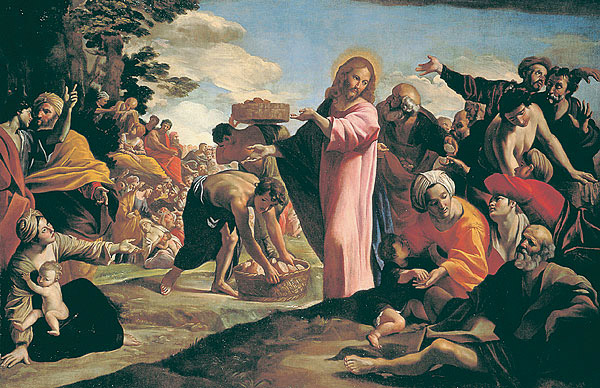
The episode of the multiplication of the loaves is reported six times in the Gospel (twice in Matthew and Mark and once each in Luke and John).  Because this episode is found in all the gospels we can conclude that it evidently left quite an impression on the community of the first disciples.  It is in the multiplication of the loaves that we get a view of how much our Lord and our God does indeed care for his people.  Matthew writes that when our Lord disembarked and saw the crowd, “his heart was moved with pity for them…” (Mt. 14:15)

God does indeed care for us, God does have a heart that can be moved with pity and it is through this that we also realize how we, in turn, are to care for one another as disciples of Christ. 

As Christians; we proclaim a certain type of God who we have come to know specifically through the revelation of Christ.  If God were to have created everything and set it in motion but then stepped back, leaving creation to its own devices – we might honor God, we might understandably be fearful of God but I do not think we could say that we “love” God nor that God loves us.  But this is not the God we Christians proclaim.  Our God is not content to leave us to our own devices.  Our God has indeed entered into the human scene and not just to correct and instruct us but also to take on our suffering, our misfortune, our poverty and even our guilt.  Even though himself guiltless; Christ took on our guilt.
We proclaim a God who cares and, in turn, this reveals how we, ourselves, are to care.  In today’s gospel passage (Mt. 14:13-21) it can be said that the disciples were being quite thoughtful in regards to the situation of the crowd.  The disciples see the vast crowd of people and they recognize that it is indeed late and so they say to our Lord, “This is a deserted place, and the hour is now late; send the crowds away so that they may go into the villages and buy food for themselves.”  But our Lord asks something more of his disciples and this important to note.  He responds, “There is no need for them to go away; give them some food yourselves.”
In this passage we see that our Lord is moving his disciples (which means all of us) beyond “the well-rooted habit of saying, ‘Every man for himself!’ or ‘Let the authorities take care of it!'” (quote from Bishop Vincenzo Paglia) to “There is no need for them to go away; give them some food yourselves.”   Our Lord is asking us as his disciples to remain with the poor and not to worry if we will navigate the situation perfectly but just to remain.  It is here, in this “remaining”, that our Lord turns and asks each of us, “How will you show that you care?”
Our world today is very concerned about efficiency and this is found across all spheres of life (business, government, ecclesial, social).  One might even say that there is a dictatorship of efficiency.  Time must be managed correctly and therefore relationships also, certain goals must be met and achieved, all things must be backed up (all i’s must be dotted and all t’s must be crossed).  Yes, there is certainly a place and a value for efficiency but I do not think efficiency was the primary concern of our Lord.  Rather, the primary concern – I believe – was the care of souls.  The Lord’s “heart was moved with pity.”  The care of souls is often (from my experience) a messy endeavor and anything but the most “efficient” of endeavors. 
It may not be the most “efficient” thing to remain while also not knowing the best way to necessarily navigate a situation but this is what our Lord asks us to do.   “There is no need for them to go away…”  It is in the remaining that our Lord meets us and he asks us to show that we care.
People will not care how much you know until they know how much you care.   

Caravaggio and my mother

It is interesting how art inserts itself into life at the most seemingly random moments sometimes.

Yesterday morning after I came in from watering the flowers at the Center I found a message on my cell phone informing me that my mother had been taken to the Emergency Room of a local hospital. 

My mother has cardiopulmonary disease (COPD) and must be on oxygen at all times.  For the past four years she has been living in an independent living center and has been in and out of the hospital for breathing issues.  For the past few weeks she has been weaker than usual and has found it harder to breathe.  This morning it all came to a head and it was decided that she should go to the ER. 

I spent all morning in the ER with her. 

The hospital is new, very clean and prides itself on being “green”. 

At one point in the ER room a team of three nurses were working on my mother.  All three nurses were young with summer tans, wearing dark blue nursing outfits and spoke easily with East Tennessee accents.  Two of them were bent over my mother at different angles and the third, who was a student, stood back observing.  I sat in a chair to the side with a view of the full length of the bed and my mother reclined on it looking tired and gray, oxygen mask strapped to her face with the oxygen vapor drifting around her nose and mouth.  The nurses continued their work around her. 

As I gazed on all of this the image of Caravaggio’s “Deposition of Christ” flashed through my mind.  The body of our Lord is taken down from the cross and a group of people bend over him at various angles as they lay him out.  Our Lord had gone even into death out of love for us and the Father. 

We believe and hold that our suffering can be a sharing in the suffering of Christ and that God himself has entered into the suffering of humanity.  Therefore we have a hope that moves beyond fear.  Because of this Christianity is not naive about suffering – even finding a grace within it. 

The eighth chapter of Romans speaks to this reality:  “Brothers and sisters: What will separate us from the love of Christ?  Will anguish, or distress, or persecution, or famine, or nakedness, or peril, or the sword?  No, in all these things we conquer overwhelmingly through him who loved us.  For I am convinced that neither death, nor life, nor angels, nor principalities, nor present things, nor future things, nor powers, nor height, nor depth, nor any other creature will be able to separate us from the love of God in Christ Jesus our Lord.”  (Romans 8:35, 37-39)
My mother has been stabilized and moved to a room out of the ER.  The next few days will consist in a series of tests to determine the source of her loss of blood and anemia.  We will see what the next few days bring.  Whatever it might be we have hope because we know our suffering is part of the suffering of Christ and we know that our Redeemer lives. 


The Sacraments of the Catholic Church and the madness of Denethor

As we face the social issues of our day (i.e. marriage and gay rights, the dignity of women and the priesthood) people both without and within the Catholic Church often question the teaching of the Church and ask why doesn’t the Church just change its teaching to be more in step with the times.  Another area which may not be so pressing as far as secular culture is concerned but is of unique importance among the different branches of Christianity and, at least from my experience, often an issue on the local level in the parish is that of sharing communion with other Christians.  Why does the Catholic Church teach what it does in these regards; often to the marked disagreement, frustration and even open hostility of others?

I would like to offer a reflection on this issue and from the start I believe it important to state that the position of the Catholic Church in these matters is not so much about being against others (although it is often interpreted and portrayed this way) as it is about the Church being true to its own identity and authority and, in fact, actually recognizing the limits of the authority that it has been given.

I would like to explain by beginning with an allusion to the tragic figure of Denethor in J.R.R. Tolkein’s “Lord of the Rings” trilogy.

Denethor is the Lord of Gondor but it is specified throughout the trilogy that the ruling house that Denethor and his sons Boromir and Faramir represent is meant to be a House of Stewards.  The House of Anarion cannot claim the throne, in fact their purpose is to hold the kingdom until the return of the true king.  But Denethor oversteps his bounds – forgetting the role of the steward and claiming the authority that belongs to the king alone – and as Gondor is besieged and seems to be falling, he himself falls into despair..  Denethor fails to recognize the true king himself (Aragorn) when he is present before him while only seeing doom and destruction.  Finally, in this nihilistic madness Denethor attempts to set fire to his one remaining son Faramir.  When this is thwarted he leaps upon the pyre and destroys himself.

Right before this act of suicide Denethor despairs in the fall of the city and the loss of his power, “I would have things as they were in all the days of my life and in the days of my longfathers before me: to be the Lord of this City in peace, and leave my chair to a son after me, who would be his own master and no wizard’s pupil.  But if doom denies this to me, then I will have naught: neither life diminished, nor love halved, nor honor abated.”

In an attempt to break through the madness, Gandalf challenges the despairing Denethor with a summons back to truth and clarity, “To me it would not seem that a Steward who faithfully surrenders his charge is diminished in love or in honor…”  Tragically, Denethor cannot recognize this.

Later, in contrast to Denethor’s folly and miserable end, we are given the image of the true king:  “But when Aragorn arose all that beheld him gazed in silence, for it seemed to them that he was revealed to them now for the first time.  Tall as the sea-kings of old, he stood above all that were near; ancient of days he seemed and yet in the flower of manhood; and wisdom sat upon his brow, and strength and healing were in his hands, and a light was about him.  And then Faramir cried:  “Behold the King!”

The Catechism of the Catholic Church offer these words concerning the sacraments:

“Adhering to the teaching of the Holy Scriptures, to the apostolic traditions, and to the consensus … of the Fathers,” we profess that “sacraments of the new law were … all instituted by Jesus Christ our Lord.”  (CCC 1114)

Sacraments are “powers that come forth” from the Body of Christ, which is ever-living and life-giving.  They are actions of the Holy Spirit at work in his Body, the Church.  They are “the masterworks of God” in the new and everlasting covenant.  (CCC 1116)

As she has done for the canon of Sacred Scripture and for the doctrine of the faith, the Church, by the power of the Spirit who guides her “into all truth,” has gradually recognized this treasure received from Christ and, as the faithful steward of God’s mysteries, has determined its “dispensation.”  Thus the Church has discerned over the  centuries that among liturgical celebrations there are seven that are, in the strict sense of the term, sacraments instituted by the Lord.  (CCC 1117)

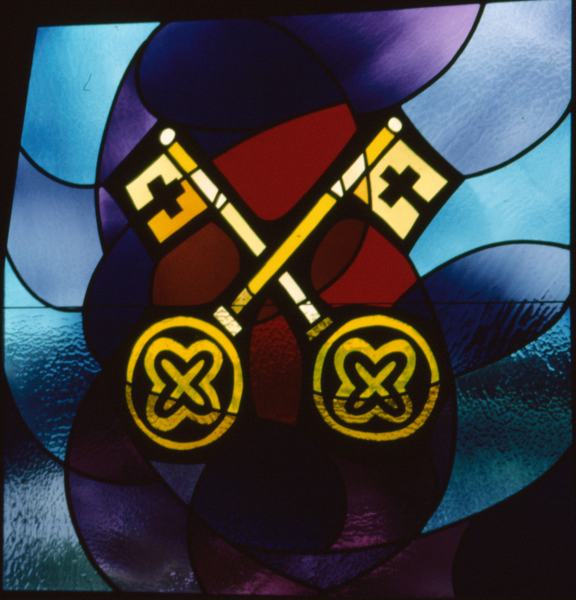
The Catholic Church is the “faithful steward of God’s mysteries.”  The Church is neither the owner nor the one who holds authority over the sacraments.  This authority rests with Christ alone – the one who instituted the sacraments.  The quotes above clearly demonstrate that the Catholic Church did not invent the sacraments of its own accord but rather “gradually recognized this treasure received from Christ.”

When the Catholic Church approaches the issues of what marriage is, who is called to serve the community in ordained ministry or what must the authentic reception of communion entail it does so from the understanding of a steward and not that of the creator.  This is an important distinction between the Catholic Church and other Christian faith traditions and also secular society – both of which approach these issues from the standpoint of having legitimate authority over these realities.

This is critical in understanding the Catholic Church’s approach to these realities.  Despite what is often interpreted – that the Catholic Church does have the authority and can change these teachings but chooses not to because we are opposed to one group or another – the Church, in fact, cannot change the sacraments precisely because it lacks the authority to change them.

Here, I would like to make a theological note of distinction that also factors into this issue.  When people often wonder why the Catholic Church does not allow female ordained ministers while many Protestant traditions do or why the Church is opposed to redefining marriage while other faith traditions do or why the Catholic Church does not celebrate open communion while others do they do not realize that they are in fact comparing apples to oranges.

One of the moves of the Protestant reformation was to redefine and also reduce the number of sacraments and, in essence, transfer the authority of who governs the sacraments to the church community.  This is an aspect of Protestant ecclesiology and with this understanding it is perfectly understandable to then adjust the sacraments to different times and needs.  With this ecclesiology one can ordain women, open communion to all or alter marriage because the authority does rest (in this scenario) with the church community.

This is not the Catholic understanding and whether one agrees with it or not (I personally agree) you cannot authentically equate the Protestant approach with the Catholic as the two are coming from different starting points.

But, often we do not recognize this and therefore many people insist on comparing apples and oranges thinking all the time that both are apples.

The Catholic Church must be true to its origins and foundation – to do otherwise would be to enter into a schizophrenic state which would ultimately lead only to despair and madness.

The Catholic Church is, in these regards, first and foremost, “the faithful steward of God’s mysteries.”

The Church, guided by the Holy Spirit, will not allow itself to fall into Denethor’s folly.