• About The Alternate Path

The Alternate Path

~ Thoughts on Walking the Path of Christian Discipleship

The Alternate Path

Author Archives: mcummins2172

Slutwalks: "Healthy sexuality" or power politics?

14 Saturday May 2011

Posted by mcummins2172 in Uncategorized

≈ Leave a comment

I have been keeping an eye on the reports and commentaries regarding the “Slutwalks” that have sprung up recently and I find myself both interested in them but also put off. I am interested because I think that they  point to some current dynamics in our society. I am put off because I do not agree with a mentality that I believe is partly present in these demonstrations.

I agree that any form of violence against another person is wrong. I agree that victims should not be blamed for acts of violence perpetrated against them. I agree that people have the right to wear what they please without fearing any form of violence because of what they wear. I may shake my head and personally wonder what they are thinking (i.e. fleece pajama bottoms worn in public) but that is as far as another can go in the public commons. I also think that there is value in being prudent and there is space for the needed virtue of modesty (for both women and men) but, in the end, adults being adults can wear what they please.

But I find myself disagreeing with the stated goal of some in the movement to reclaim the word “slut”. I do not use the word. Neither would I call another person by this word because it is a derogatory from the get go. How can we “reclaim” that which is negative from the beginning? “Reclaim” to me means to restore something to its original meaning or purpose, often being seen as a positive. “Reclaim” as it is being used here seems to me to be the opposite; actually warping the word “slut” from it original context. It is like trying to concoct a virtue out of a vice. This seems an example of double-speak and language manipulation and, I believe, it points to a mentality present in the movement that I just cannot agree with.

An aim of the SlutWalk movement is to reappropriate the word “slut.” “I come from a frame of mind that language is powerful, and you can also change language,” said SlutWalk founder Jarvis, using the word “queer” as an example of a word that was once strictly pejorative but is now a common sexual identifier used by the LGBT community. (taken from “Slutwalks Sweep the Nation” by Laura Stampler, HuffingtonPost.com)

This mentality, it seems to me, is one of viewing sex and sexuality solely in terms of power paradigms and defining the core reality of the human person solely in terms of the material and sexual.

I would like to examine the second aspect first: defining the human person solely in terms of the material and sexual.

As I have been pondering all of this I have been drawn back to the book, “The Cloister Walk” by Kathleen Norris. In her chapter on the Virgin Martyrs, Norris explores the case of Maria Goretti; an eleven-year-old girl stabbed to death in 1902 during an attempted rape. In the horrific violence of the moment this girl choose to be killed rather than raped. She was canonized in 1950. Norris writes this,

Maria Goretti, canonized in 1950, was the first virgin martyr declared such by the church for defending her chastity rather than her faith, and it’s easy to see this development in a cynical light; a perfect expression of a sexually uptight era. Indeed, a popular pamphlet of the time, written by an American priest, dubbed her “the Cinderella Saint.” But our cynicism blinds us to a deeper truth: a martyr is not a model to be imitated, but a witness, one who testifies to a new reality. And our own era’s obsession with sexual “liberation” blinds us still further, making it difficult to see the true nature of Maria Goretti’s witness, what it might mean for a peasant girl to “prefer death to dishonor.” We may make fun of someone so foolish – a male friend recalls with shame how he and his schoolmates snickered over Maria Goretti in the playground of his parochial school, not long after she was canonized – but such joking is a middle class luxury.

For Maria Goretti, the issue was not a roll in the hay. The loss of her virginity in a rigidly patriarchal peasant culture could have had economic and social consequences so dire that it might have seemed a choice between being and nonbeing. And is it foolish for a girl to have such a strong sense of her self that she resists its violation, resists being asked to do, in the private spaces of her body, what she does not want to do? (Here Norris shares how once when she was fifteen she herself was attacked by a man but was able to fight him off.) It happens more than we like to think, even to middle-class girls like me. But the poor are far more vulnerable; perhaps the scandal of Maria Goretti is the recognition that there can be bodily integrity, honor, and even holiness, among the poorest of the poor, that even a peasant girl of simple faith can claim an inner self, a soul that will make room for Christ but not a rapist. Not even a rapist with a knife.

What we resist seeing in late-twentieth-century America – where we are conditioned, relentlessly, by images of girls’ and women’s’ bodies as available – is the depth of that soul, and how fierce a young girl’s sense of bodily and spiritual integrity can be.

Yes, sexuality and sexual identity is powerful and are important aspects of who we are but sexuality is not the sole defining principle of the human person and neither is it the deepest core of who we are. The deepest core of who we are is not our sexuality but the fact that we are made in the image and likeness of God; the Imago Dei. Sexuality is not denied but held in proper balance and purpose only when this deeper reality of the human person is recognized and acknowledged.

Please read again the last sentence I quoted from Kathleen Norris – “the depth of that soul”. When we define the human person solely in terms of the material, an understanding that denies any sense of the spiritual, then we lose that “depth of soul” which the eleven year old saint witnesses to. Further, it seems to me that when the spiritual component of who we are is denied then it is very easy to fall into the belief that the sexual is our deepest core because in the sexual there is a sense of connection and transcending of self that cannot seemingly be found anywhere else in a material-only world. But this is not the case. The truth is that the fullness of bodily and spiritual intergrity is there, we just “resist seeing” the full possibilities of this and of connection with others and of transcending self.

The sin of our age is not that we have loved too much but that we love too little.

Now, let us look to the first aspect: viewing sex and sexuality solely in terms of power paradigms. I believe that this aspect is an understandable result of the denial of spiritual and bodily integrity.

It seems interesting to me that the more “casual” sex and sexuality becomes; the more it is reduced to just another weapon ready-at-hand for use in the culture and gender wars and the more there seems to be an effort to define the relation of men and women solely in terms of confrontation and antagonism.

(I also find it interesting to note how as the divorce rate climbs so too does the cost of weddings go through the roof!  Another topic for another post, but related I believe.)

In my reading of the commentaries and interviews regarding the slutwalks and also the watching of youtube videos, I have noticed that the word “power” is used quite often.  In fact, I would think that if one were to do a word cloud regarding slutwalks the word “power” would be present in very bold and large letters.  Why is this?

A sincere part of this is, I believe, that rape and sexual violence are abuses of power. To regain ones integrity in this sense is to regain ones power.  This is valid and an important part of the healing process.

But, I think there is another aspect present in the use of this term that connects to the mentality that I have made mention of.  In this sense, I would say that “power” is being used due to the fact that when sexuality is divorced from the deeper context of bodily and spiritual integrity (the Imago Dei) it quickly devolves into just another form of power politics.

Sexuality and power are linked.  We ought not be naive about this.   

There is a latent power in sexuality – the power to create, to connect and even (if just for a moment) transcend self – when held in relationship to the core reality of the human person, the Imago Dei, this power is focused, given purpose and directed higher.  It can even participate in the very mystery of creation.  When divorced from the Imago Dei this power has lost its purpose and focus and it cannot be called higher because there is nothing to call it higher!  Therefore, it quickly devolves into power politics – an empty shell of what it could truly be. 

The very frustration and vitriol given expression when sexuality is viewed solely in terms of power paradigms is itself a witness, I believe, to the error and fallacy of the resistance to see and acknowledge the Imago Dei in the human person and the possibility of bodily and spiritual integrity.

We frustrate ourselves when we deny the fullness of our anthropology.

Viewing sexuality solely in terms of power politics is a reduction and not an exalting of the latent power present in sexuality.

Can power politics create life?  I do not think so. 

The slutwalks will, I am sure, continue and the word “power” will be used for a variety of reasons. 

These are interesting times in which we live…
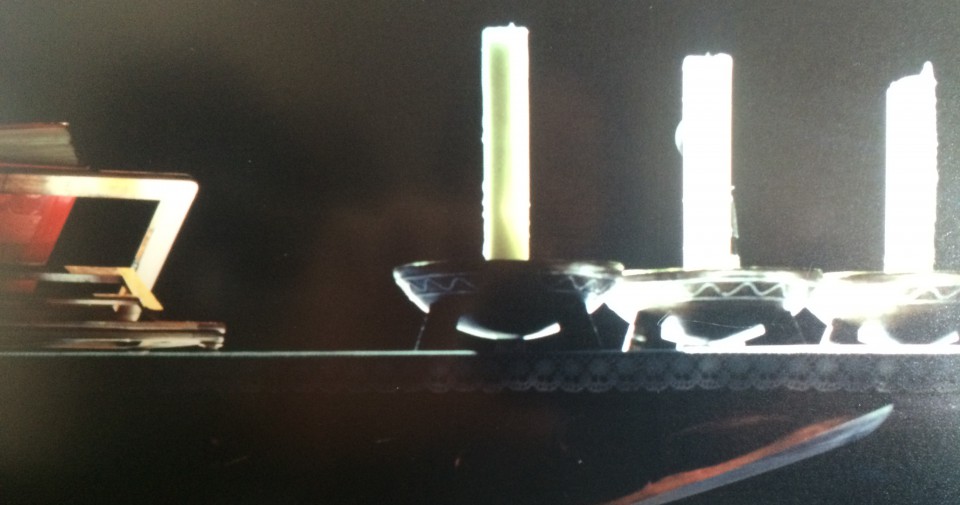
Happy Mother’s Day!

08 Sunday May 2011

Posted by mcummins2172 in Uncategorized

≈ Leave a comment

“When Jesus saw his mother and the disciple whom he loved standing beside her, he said to his mother, ‘Woman, here is your son.’  Then he said to the disciple, ‘Here is your mother.’  And from that hour the disciple took her into his own house.”  (John 19:26-27)

As he is dying on the cross our Lord does a very tender thing; he finds a home for his mother and he gives his Church a mother. 

May God bless all mothers on this special day! 

Third Sunday of Easter (A):The Road to Emmaus

07 Saturday May 2011

Posted by mcummins2172 in Uncategorized

≈ 1 Comment

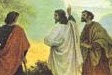
There is a famous painting of the road to Emmaus experience by the artist Robert Zund (posted above).  In the painting you see three men walking through a towering forest.  Their backs are to you – almost as if the viewer is walking the path behind them.  The man in the middle (the risen Lord) is talking and gesturing while the other two are in rapt attention.  You can almost hear Jesus explaining the Scriptures and feel the breeze of the day as you enter into the scene. 

In my vocation work I have often thought that a good vocation/discipleship poster would be to cut out the images of the three men walking, then find some black and white photos of everyday life (i.e. a busy city street scene, people going to a ball game or attending a fair or festival, etc.) and splice (keeping proportions correct) the image of the risen Lord and two disciples into the heart of the crowd.  Then add a catchy phrase like: “The call continues.” or “Do you also want your heart to ‘burn within you’?”

Why the poster?  Because it is in the everyday that Christ comes to us and it is here in the Mass – in the opening of Scripture and in the breaking of bread – when our eyes are opened to recognize and name those moments when our hearts burned within us in our encounters with the Lord.  As disciples we need both and we are meant for both – not just one or the other (either the everyday or the liturgical). 

The Mass is the Emmaus road encounter.

For six days we have walked through our lives in a variety of settings and ways – as parents, as young person, as an elderly person, maybe married, maybe single.  For six days we have walked as a teacher or a nurse, a lawyer or doctor, as a person in the business world.  We may have known joy these days.  We may have known defeats.  Daily life can often be a defeat, “the defeat of the Gospel in the lives of Christians and in human life, the defeat of the Gospel in the lives of those who are persecuted, who are poor, in those effected by war and violence, loneliness and abandonment.”  Like the two disciples are lives might be saddened by defeat.  

But, the risen Lord comes to us.  This is important to note.  When we gather on Sunday for Mass, when all of our Emmaus walks converge, we do not just remember the past or tell stories of a time long ago.  Christ is here.  Christ in his grace and revelation opens the Scriptures to us.  Christ himself breaks the bread (his body and his blood) for us.  When we gather for Mass on our Emmaus road we do not just reflect on an idea.  Here, we encounter the risen Lord and he speaks to our hearts and he shares his very self. 

“Were not our hearts burning within us?” 

Sabbath rest and the danger of activism

06 Friday May 2011

Posted by mcummins2172 in Uncategorized

≈ Leave a comment

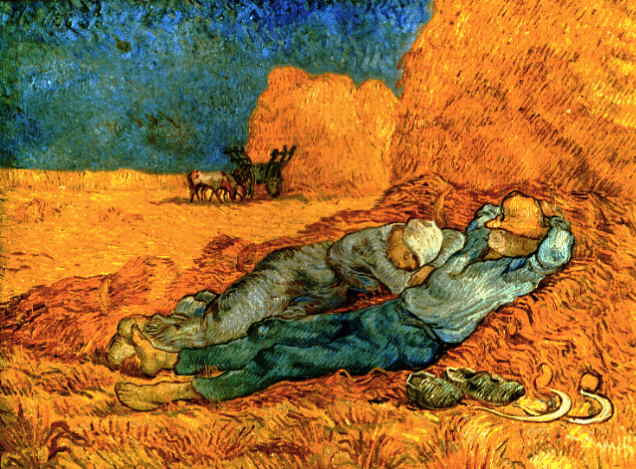
Maybe it is because the semester has finished here at the university and things are quiet at the Catholic Center and I am anticipating the slower pace of the summer months but my soul recently has been reflecting on the need to rest and recoup. 

I have noticed that in more than a few of his writings, interviews and reflections Pope Benedict talks about the danger of “activism”.  A danger that is very rampant in our day and age.  Activism is that tendency to think we always have to be active; we always have to be doing something if life is going to be worthwhile and we are going to “make our mark” in history.  Of all people certainly it is a pope who could be tempted to activism as he looks at the needs of the world and the pulpit he alone has to address those needs.  A pope, he notes, could continually be active – twenty four hours and seven days a week.  But, wisely the Holy Father cautions us and himself against this temptation and he does this because he is a humble man who knows that the job of Savior of the world has already been filled.  Activism (he knows) is rooted in hubris, in pride.  The antidote to activism is the humble realization that we are creature and not Creator and also the willingness to enjoy this realization. 

Further, not only does activism puff us up it also wears us down.  We cannot go twenty four and seven.  We need rest and specifically sabbath rest.  Paradoxically activism even warps the arena and space of rest.  Rest rather than standing on its own with its own value becomes, under the tyranny of activism, just an allotted time and space only begrudgingly allowed in order to rest up for more work!  The day off is allowed only in order that we might be better workers not because the day off itself (leisure) has its own value and its own nourishment that the human soul stands in need of.

Under activism rest itself becomes shallow, superficial and tiresome. 

Sabbath rest is different.  Here is a quote from the treatise, “Flight from the World” by St. Ambrose that helps to bring out the unique character of sabbath rest. 

Let us take refuge from this world. You can do this in spirit, even if you are kept here in the body. You can at the same time be here and present to the Lord. Your soul must hold fast to him, you must follow after him in your thoughts, you must tread his ways by faith, not in outward show. You must take refuge in him. He is your refuge and your strength. David addresses him in these words: I fled to you for refuge, and I was not disappointed.

Since God is our refuge, God who is in heaven and above the heavens, we must take refuge from this world in that place where there is peace, where there is rest from toil, where we can celebrate the great sabbath, as Moses said: The sabbaths of the land will provide you with food. To rest in the Lord and to see his joy is like a banquet, and full of gladness and tranquility.

Sabbath rest is “like a banquet … full of gladness and tranquility.”  Rather than emptying and depleting the soul; Sabbath rest nourishes and fulfills and it enables us to put things in proper perspective. 

We are made and meant for sabbath rest; for the banquet that nourishes, fulfills and restores relationship.  We are not made to just work and work and hopefully maybe catch a day off here and there. 

“The sabbaths of the land will provide you with food.” 

It would do us all well to be attentive to this truth.   

Second Sunday of Easter (A): Divine Mercy Sunday

01 Sunday May 2011

Posted by mcummins2172 in Uncategorized

≈ Leave a comment

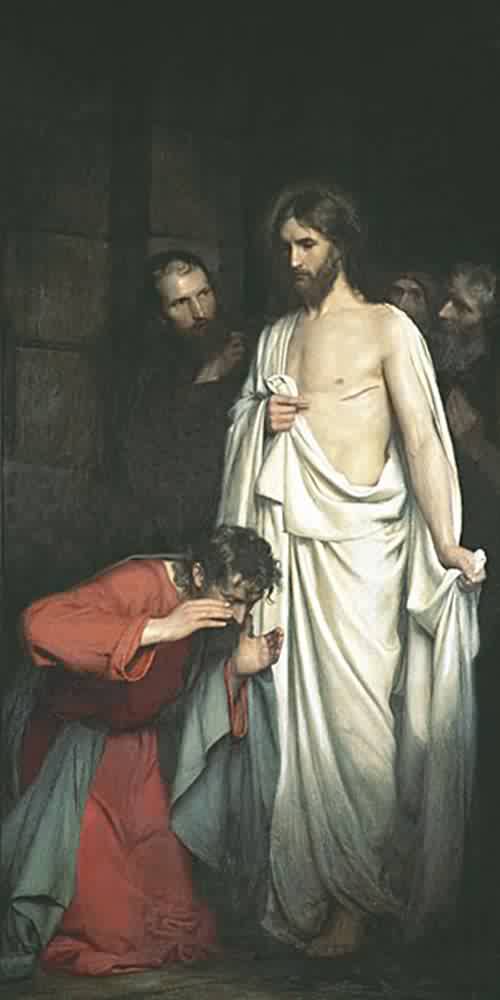
Thomas was not a bad man nor was he a mediocre disciple.  I believe that sometimes we can read today’s gospel (John 20:19-31) and think to ourselves, “Tsk, tsk if only you didn’t doubt and had more faith Thomas.”  But Thomas did have faith and he did have a great love for our Lord.  We need to remember that it was Thomas who said, “Let us also go, that we may die with him.” when Jesus decided to go to his friend Lazarus despite the fact that the authorities were seeking to kill him.  These are not the words of a half-hearted disciple.  Thomas had great faith, he had great love for our Lord but he also had a broken heart.  The crucifixion and all of sin’s “No!” that it contained had broken Thomas’ heart.  All of Thomas’ love for the Lord, his hope and faith in the Lord had been broken by the wood of the cross. 

Thomas’ heart was broken.  So, when the other ten announced the Lord as risen (the Easter gospel); Thomas replied with his own “creed” (which is in essence a “non-creed”).  “Unless I see … unless I put my finger in the mark of the nails and my hand in his side, I will not believe.”  This is the “non-creed” not of a man who is bad or mediocre but rather generous and loving yet profoundly and deeply broken-hearted.

There are many non-creeds in our world today proclaimed by people who are not bad people or even mediocre (quite the contrary) but people who are broken, who are hurting.  And there is a danger to the non-creed because it is limiting, it does close one in on one-self.  Life is limited and because of this isolation occurs – leading to further violence and further pain. 

But our Lord is risen.  In his divine mercy he comes to the disciples (even through the locked doors of their fear and isolation), he comes to Thomas and in the tenderest way reproaches Thomas and his non-creed.  In fact, in response to Thomas’ non-creed it could be said that our Lord speaks his own creed, “Peace be with you.”  As disciples we live in the ever-newness of the creed of our risen Lord.  In all times and all seasons, we cling and hold fast to it.  This is what we do and who we are as Church, we remain faithful.  “Peace be with you.”

Today, Shawn (a young man being received into the Catholic Church at the Center) through your baptism, confirmation, first communion and entrance into the Church step into this living creed of our risen Lord.  This is a new day, an Easter day for you!  We celebrate with you and we thank you because today you remind us that we are each only allotted so many Easters in our lives.  We are each given only so many days and opportunities to encounter the risen Lord and to step away from the non-creeds and into the fullness of our Lord’s peace! 

In a special way I want to say a word to your sponsors and your Catholic friends because in our meetings you have said, time and time again, that it is they who have been the strongest influence in your desire to join the Church.  Dear friends, please recognize this.  You have lived the creed for Shawn – the peace that only our Lord can give – through your friendship, through your love, through your faith, through your being family.  The creed we profess is not meant to be a static formula but a lived reality.  Let us all recognize this.

Our risen Lord gathers his family of disciples together and he speaks to our hearts. 

“Peace be with you.”

Easter, 2011 – tens of thousands plus one

27 Wednesday Apr 2011

Posted by mcummins2172 in Uncategorized

≈ Leave a comment

Mark Twain once remarked that the reports, present in his day, of the imminent demise of the Catholic Church were similar to being invited to a funeral that keeps getting postponed. 

The numbers are still coming in but in the United States this last weekend it looks like tens of thousands were received into the Catholic Church.  For 2010, the U.S. Conference of Catholic Bishops reports that there were over 43,000 adult baptisms and more than 75,000 people received into full communion with the Church in the U.S. alone (this also does not count the over 830,000 infant baptisms reported for that year).  It is safe to assume, I believe, that the numbers for 2011 will be consistent with this trend. 

What seems to be striking for commentators this year is the wide variety of people who are entering the Church.  There are people from all walks of life and all socio-economic-cultural distinctions and people brought up in different faith traditions (Christian and non-Christian) and ethnic groups.  People are entering the Church individually and also as families. 

One newly minted Catholic – since last Easter Sunday – who is receiving attention is Abby Johnson.  Mrs. Johnson is a former Planned Parenthood clinic director who had a conversion after witnessing an ultrasound-guided abortion in fall of 2009.  She is the author of the bestselling book “Unplanned”.

These men and women have been studying, learning, reflecting and praying about entering the Church for months through the Rite of Christian Initiation for Adults (RCIA) program present in Catholic parishes.  Ahdija Cheumbike Baker (a former Muslim) from New Orleans, LA remarks on the value of an extensive preparation program for entrance into the Church, “If I had gone to a church that gets you in and out in 45 minutes, I probably wouldn’t have changed my religion; but at St. Peter Claver I feel a deep connection.” 

We celebrate with these new members of the Church!  They witness to us the vitality and true life of the Christian faith and we pray that they will now continue to grow in their Catholic faith.  For them (as for all of us) Easter of 2011 rather than being the end of a journey is really just a beginning…

In this post’s title I wrote “plus one” for a valid reason.  This coming Sunday at our last spring semester Mass, Shawn Stewart will be baptized, confirmed and receive first communion at the Catholic Center!  Shawn and I have been meeting for months now in preparation but his more fundamental preparation and witnessing of the faith has been through all the Catholic friends whom he has known over his life.  Please keep Shawn in your prayers as this Sunday approaches.

The Church continues to be church…

Christ is risen!  Very truly he is risen! 

Humming "All Glory, Laud and Honor" – Palm Sunday and the Triduum

16 Saturday Apr 2011

Posted by mcummins2172 in Uncategorized

≈ Leave a comment

For about a week now I have been humming, “All Glory, Laud, and Honor” – the traditional hymn associated with Palm Sunday.  The hymn is usually sung after the distribution of palms and as the congregation enters into the church calling to mind our Lord’s entrance into Jerusalem. 

Since Ash Wednesday we as the Church have been preparing for the celebrations of the upcoming week. 

I do not preach on Palm Sunday (which is an option for the priest and deacon).  I believe that the reading of our Lord’s passion and death says it all and sometimes the best thing that a preacher of the word can do is know when to remain silent.

At the end of the Mass though I do share some words regarding what we as Church will be about this next week.

In our diocese, the Tuesday of Holy Week is when we celebrate the Chrism Mass at the cathedral in Knoxville.  At the Mass the whole diocese comes together under the unity of our bishop and the oils to be used in sacramental celebrations throughout the next year are blessed and distributed – the oil of the sick, the oil of the catechumens and the sacred chrism.  Also, at this Mass, both the priests of the diocese and the bishop recommit ourselves to service within the Church.

I also note that the season of Lent ends with the beginning of the celebration of the Lord’s supper on Holy Thursday.  (We fast and abstain on Good Friday because it is “Good Friday” not be because it is another Friday in Lent.)  Actually, with the beginning of the Holy Thursday Mass we enter not only into the shortest season of the year – Holy Thursday, Good Friday and the Easter Vigil – but also one celebration.  This is testified to by the fact that we as a community make the sign of the cross at the beginning of the Holy Thursday celebration and do not make it again until the conclusion of the Easter Vigil Mass.  As Catholics, we begin and end prayer with the sign of the cross.  The fact that we do not make the sign of the cross as church again until the end of the vigil demonstrates that these three days are to be seen as one celebration marking the life, suffering, death and resurrection of our Lord.

On Holy Thursday we remember and reflect upon the institution of the Eucharist.  “This is my body … This is my blood … Do this in remembrance of me,” says our Lord.  The centrality of the eucharist to the life of christian discipleship is witnessed to by the fact that our Lord’s instituting of the eucharist is found in each of the three synoptic gospels (Mt. 26:26-30, Mk. 14:22-25, Lk. 22:14-23) and where John in his account of the Last Supper chooses to focus on the washing of feet (also remembered in the Holy Thursday celebration) he elsewhere reminds us of the specific instruction of our Lord, “I am the bread of life.  Your ancestors at the manna in the wilderness, and they died.  This is the bread that comes down from heaven, so that one may eat of it and not die.  I am the living bread that came down from heaven.  Whoever eats of this bread will live for ever; and the bread that I will give for the life of the world is my flesh.” (John 6:48-51)

At the conclusion of the Holy Thurday celebration the sanctuary of the church is made bare and the Blessed Sacrament is removed in preparation for Good Friday when all creation is in hushed silence in remembrance of our Lord’s suffering, death and three days in the tomb. 
On the evening of Good Friday, the community gathers to pray for the Church and our world and to reverence the wood of the Cross by which we all are set free.  At this service we also share communion reserved since the Holy Thursday celebration.
Holy Saturday we remain with Christ in the tomb.
At sundown on Holy Saturday, the Easter fire is lit and the Easter Vigil begins.  The Church throughout the world gathers to celebrate the Lord’s resurrection!  The paschal candle (representing the light of Christ) is blessed and processed into a darkened church and as the procession makes it way along; all those who are present light their own candles from that of the paschal candle (the light of the resurrection grows).  Once gathered in the church the community of the faithful hear readings from all of Sacred Scripture, reflecting the whole scope of salvation history which proclaims God’s goodness and works; culminating in the resurrection of Christ by which death itself is vanquished!  Men and women who have been preparing for months to receive the sacraments and enter into the Catholic Church are welcomed into the fullness of the Body of Christ through sacramental ritual following the homily.  Communion is shared and the church once darkened is now fully lit, reflecting the splendor of the risen Christ in the lives of his people – the church gathered in worship!
At the conclusion of the Easter Vigil the community once again marks itself with the sign of the cross bringing an end to the celebration of the Triduum and a beginning to the celebration of the Easter season! 
          

True Freedom

15 Friday Apr 2011

Posted by mcummins2172 in Uncategorized

≈ Leave a comment

The readings for this past Wednesday’s Mass have much to say about true freedom. 

The first reading (Daniel 3:14-20, 91-92, 95) recounted the story of the three young men (Shadrach, Meshach, and Abednego) thrown into the furnace for refusing to bend their knees in homage to the false idol of the king.  “Be ready now to fall down and worship the statue I have made, whenever you hear the sound of the trumpet, flute, lyre, harp, psaltery, bagpipe, and all the other musical instruments…”  Yet, even though thrown into the furnace, the three youths were preserved by the grace of God and became a witness even unto the king.

The Gospel reading (John 8:31-42) also invites us into a reflection on true freedom.  It is important to note that our Lord does not locate freedom within our own narrow wills (doing whatever we want) but rather in a lived relationship to truth and obedience to God.  “If you remain in my word, you will truly be my disciples, and you will know the truth, and the truth will set you free … Amen, amen, I say to you, everyone who commits sin is a slave of sin.  A slave does not remain in a household forever, but a son always remains.  So if the Son frees you, then you will truly be free.”

We might tend to think of the story of the three youths as a quaint story of the past, vivid in detail for children’s Bible study, but my experience has demonstrated that there are many “musical instruments” calling us in our day and age to bend the knee in homage to a whole host of false idols … and there are many people more than willing, it seems, to bend the knee.  My experience also has shown me that these people who so easily bend the knee tend to also be the ones who so vocally both proclaim and demand their freedom to do whatsoever they please.  Yet our Lord points out, “everyone who commits sin is a slave of sin”.  Freedom is not gained when truth and God are abandoned, what is really attained is a mass conformity that lies under an illusion of freedom – it is, in fact, a form of slavery. 

Shadrach, Meshach and Abednego stand out because they would not bend their knees.  They would not fall down in an automatic conditioned response to the powers of their time.  The truth had set them free and they were the only ones truly free enough to make a free choice.  We do not remember those who bend their knees to the powers of their time.  We remember those (free in relation to truth and obedience to God) who choose to not bend the knee and remain standing.  These are the ones who have fought the hard fought fight.  They cannot bend their knee because they have come to know their own and everyone else’s true worth.  They will not deny the truth and because of this they are truly free. 

“If you remain in my word … you will know the truth, and the truth will set you free.”

"In the palm of your hand" – St. Peter’s truth

12 Tuesday Apr 2011

Posted by mcummins2172 in Uncategorized

≈ Leave a comment

I sought the Lord, and afterward I knew
He moved my soul to seek him, seeking me.
It was not I that found, O Savior true;
No, I was found of thee.

Thou didst reach forth thy hand and mine enfold;
I walked and sank not on the storm-vexed sea.
‘Twas not so much that I on thee took hold,
As thou, dear Lord, on me.

I find, I walk, I love, but oh, the whole
Of love is but my answer, Lord, to thee!
For thou wert long beforehand with my soul;
Always thou lovedst me.

Fifth Sunday of Lent (A): "Do you believe?"

09 Saturday Apr 2011

Posted by mcummins2172 in Uncategorized

≈ Leave a comment

It is interesting to note how in this gospel passage of the raising of Lazarus (John 11:1-45) Jesus is met with confusion, contradiction, shock, grief, regret and fear (a whole gamut of reactions) as he journeys toward the tomb of his friend.  The disciples do not understand – thinking Lazarus was only asleep.  Both Martha and Mary at separate instances remark, “Lord, if you had been here…” voicing the regret so common at the death of a loved one.  The weeping of the crowd and the tears of the family giving expression to the death of hope when faced with the starkness of the tomb.  “Why roll back the stone?  It will be awful and certainly useless.”  Is all of this not the human condition as we stand before the tombs of our lives and all the tombs of our world?

But the gospel message is this: Christ enters into all of this.  Our Lord does not deny any of these reactions to death and to the tomb.  Neither does he ask us to pretend that these reactions on our part do not exist.  We are fearful before the tombs of our world!  We are lost and confused!  Death does not make sense!  We do know grief and regret!  Our Lord does not deny any of this but what he does do is that he comes to us in the very face of the tomb and all that it stirs up within us and asks, “Do you believe?”  Not, “Believe and you will never know hurt nor loss nor pain.” but “Even now when faced with the tomb, do you believe?”


Sr. Helen Prejean and members of the Catholic Center community


This last week Sr. Helen Prejean gave a lecture on the death penalty at ETSU.  Sr. Helen has devoted her life and energy to ministering to people on death row as well as the families of victims of unimaginably horrific crimes.  This little Cajun nun with a broad smile and an easy-going nature stands before the tombs of our world.  How does she do that?  Where does she find the strength?  As I listened to her talk I heard her say in her own way that she has met Christ on death row and that she as a disciple has given her own answer to his question, “Do you believe?”

Some have referred to religion as an “opiate for the masses” – a way to avoid the stark realities of existence.  True Christianity is not an opiate.  Are there false versions of Christianity?  Yes, it is easy to see them at work in our time.  In these false versions of Christianity true faith means worldly success, wealth, getting what you want and never knowing true suffering.  It promotes a praise/paid mentality – the more you praise, the more you get paid.  This false reading of the Scriptures does seek to reduce the Christian message to an opiate for the masses but it is not the true gospel.  (Also, in fairness, I would contend that there are also a plethora of secular “opiates for the masses” that are at work in our world.  Lets not fool ourselves – these secular opiates also, through their own mechanisms, seek to numb people to the stark realities of existence.)

True Christianity acknowledges the tombs of our lives and our world.  The disciple is able to go to the tomb and even there (in the very midst of all that the tomb stirs up within us) is able to live an answer to that fundamental question of our Lord, “Do you believe?”  And it is in the living of the mystery that the disciple is brought to an awareness that in our belief we will indeed see and know the glory of God. 

← Older posts
Newer posts →
Follow The Alternate Path on WordPress.com

Enter your email address to follow this blog and receive notifications of new posts by email.

Previous Posts

  • April 2026
  • March 2026
  • December 2025
  • November 2025
  • August 2025
  • April 2025
  • February 2025
  • January 2025
  • December 2024
  • August 2024
  • July 2024
  • June 2024
  • May 2024
  • April 2024
  • March 2024
  • February 2024
  • January 2024
  • December 2023
  • November 2023
  • October 2023
  • August 2023
  • July 2023
  • May 2023
  • February 2023
  • January 2023
  • December 2022
  • August 2022
  • July 2022
  • April 2022
  • January 2022
  • December 2021
  • September 2021
  • August 2021
  • July 2021
  • May 2021
  • April 2021
  • January 2021
  • December 2020
  • November 2020
  • October 2020
  • August 2020
  • July 2020
  • May 2020
  • April 2020
  • March 2020
  • February 2020
  • December 2019
  • October 2019
  • September 2019
  • August 2019
  • July 2019
  • May 2019
  • April 2019
  • March 2019
  • February 2019
  • December 2018
  • November 2018
  • October 2018
  • August 2018
  • July 2018
  • June 2018
  • April 2018
  • March 2018
  • February 2018
  • January 2018
  • December 2017
  • November 2017
  • September 2017
  • August 2017
  • July 2017
  • June 2017
  • May 2017
  • April 2017
  • March 2017
  • February 2017
  • January 2017
  • December 2016
  • November 2016
  • October 2016
  • September 2016
  • August 2016
  • July 2016
  • June 2016
  • May 2016
  • April 2016
  • March 2016
  • February 2016
  • January 2016
  • December 2015
  • November 2015
  • October 2015
  • September 2015
  • August 2015
  • June 2015
  • May 2015
  • April 2015
  • March 2015
  • February 2015
  • January 2015
  • December 2014
  • November 2014
  • October 2014
  • September 2014
  • August 2014
  • July 2014
  • June 2014
  • May 2014
  • April 2014
  • March 2014
  • February 2014
  • January 2014
  • December 2013
  • November 2013
  • October 2013
  • September 2013
  • August 2013
  • July 2013
  • June 2013
  • May 2013
  • April 2013
  • March 2013
  • February 2013
  • January 2013
  • December 2012
  • November 2012
  • October 2012
  • September 2012
  • August 2012
  • July 2012
  • June 2012
  • May 2012
  • April 2012
  • March 2012
  • February 2012
  • January 2012
  • December 2011
  • November 2011
  • October 2011
  • September 2011
  • August 2011
  • July 2011
  • June 2011
  • May 2011
  • April 2011
  • March 2011
  • February 2011
  • January 2011
  • December 2010
  • November 2010
  • October 2010
  • September 2010
  • August 2010
  • July 2010
  • September 2008
  • August 2008
  • April 2008
  • March 2008
  • February 2008
  • January 2008
  • December 2007
  • November 2007
  • October 2007
  • September 2007

Popular Posts

  • thealternatepath.org/wp-c…

Blog at WordPress.com.

  • Subscribe Subscribed
    • The Alternate Path
    • Join 156 other subscribers
    • Already have a WordPress.com account? Log in now.
    • The Alternate Path
    • Subscribe Subscribed
    • Sign up
    • Log in
    • Report this content
    • View site in Reader
    • Manage subscriptions
    • Collapse this bar