• About The Alternate Path

The Alternate Path

~ Thoughts on Walking the Path of Christian Discipleship

The Alternate Path

Author Archives: mcummins2172

The Second Paragraph

27 Thursday Mar 2008

Posted by mcummins2172 in Uncategorized

≈ Leave a comment

Commit yourself to one campaign, the goal of which is to make everyone happy. Sacrifice yourself continually, with Jesus, so as to bring peace to hearts and souls, and development and prosperity to all peoples. This will be your spirituality, discrete and concrete at the same time. (Cardinal Van Thuan, Five Loaves and Two Fish)

Reflection

The willingness to serve is a sure and certain way to cultivate hope in ones heart. In the action of serving another person a fundamental inner shift occurs. The shift is this: we stop thinking about ourselves, even if just for a few moments. When service occurs in truth and charity the focus turns from “I” to the “other”. For a little bit of time we forget ourselves, we set ourselves aside, in favor of the other person.

And here is the paradoxical rub – its when we forget ourselves in service that we gain our true selves. To borrow from Thomas Merton’s analogy; it is when we sacrifice ourselves for the other with Jesus that the false self fades in light of the approach of the true self . Hope will not keep company with illusion; only as the false self lessens and the true self is gained will hope be cultivated in ones heart.

This is the spirituality of the washing of the feet; it is both discrete and concrete in the same moment and also thoroughly sublime.

The First Paragraph

26 Wednesday Mar 2008

Posted by mcummins2172 in Uncategorized

≈ 1 Comment

You want one revolution: to renew the world. You will be able to fulfill this precious and noble mission that God has entrusted to you only “with the power of the Holy Spirit.” Every day, where you live, prepare a new Pentecost. (Cardinal Van Thuan, Five Loaves and Two Fish)

Reflection

Present in these words are two radical realizations and one responsibility. The first realization is that not only does God seek relationship with us, with me, but also that God has given us his very Spirit of which to partake. We are not alone, even into the very depths of our soul. The second realization is that God has entrusted to each one of us a precious and noble mission, a purpose to our lives. The uniqueness which we realize with God’s Spirit dwelling within us is a uniqueness which we, in turn, are to carry out into the world but only with the power of the Holy Spirit can we carry it out, only with the power of the Holy Spirit can we fulfill the mission God has entrusted to us. True uniqueness is realized and fulfilled not separate from God but in relationship with God.

The responsibility then is not to go forth and conquer the world, “renewing” it according to our terms and conditions and in our image, but every day and in every concrete situation in which we find ourselves to prepare a new Pentecost. Put concretely it means; in this situation in which I find myself today I need to let go of self in order to give God enough room to work. This is how I make of every day and even every situation and encounter of the day the possibility of a new Pentecost.

Cardinal Francis Xavier Nguyen Van Thuan

25 Tuesday Mar 2008

Posted by mcummins2172 in Uncategorized

≈ Leave a comment

Biographical Sketch of Francis Xavier Nguyen Van Thuan (as taken from The Road of Hope)

  • Francis Xavier Nguyen Van Thuan was born on April 17, 1928, in Hue, Vietnam. As a boy, Van Thuan participated in the various activities of the Catholic movement, Eucharistic Crusade, and discovered a priestly vocation. He entered the seminary in Hue and was ordained a priest in June 1953.
  • From 1956 to 1959, Van Thuan studied in Rome, receiving his doctorate in canon law from what is now the Pontifical University Urbaniana. Upon returning to Vietnam, he was asked to teach at the seminary and later became its Rector and Vicar General.
  • In 1967, Pope Paul VI named Van Thuan bishop of Nha Trang, a position he held for eight years. During this time, Van Thuan focused his attention on priestly vocations and the theological formation of both clergy and laity. He served as chairman to the Vietnamese Episcopal Conference for social communications and development and collaborated in founding Radio Veritas, Asia’s Catholic broadcast network. In 1971, he joined the Pontifical Council of the Laity, and at the request of Paul VI traveled widely to solicit aid for the reconstruction of Vietnam.
  • On April 23, 1975, Van Thuan was named Titular Archbishop of Vadesi and Coadjutor Archbishop of Saigon in South Vietnam. But only three months later Bishop Van Thuan was taken into custody and held in the parish church of a small village where he was placed in solitary confinement on March 18, 1976.
  • On December 1, 1976, the Archbishop and 1,500 other prisoners were sent to North Vietnam where Van Thuan was held in a number of “re-education camps.” Nine years of his imprisonment were spent in various isolation cells.
  • On November 21, 1988, the Archbishop was formally released from prison, but kept under house arrest in Hanoi for three years, thus preventing him from any pastoral activity.
  • In December 1991, Van Thuan was expelled from Vietnam and went to Rome.
  • On November 24, 1994, Archbishop Van Thuan was named Vice President of the Pontifical Council for Justice and Peace. On June 24, 1998, he became its President.
  • In 2001, Francis Xavier Nguyen Van Thuan was named a Cardinal by Pope John Paul II.
  • On September 16, 2002, Cardinal Francis Xavier Nguyen Van Thuan died in the peace of Christ.

Regarding the twenty-four paragraphs, Cardinal Van Thuan wrote in Five Loaves and Two Fish,

“I have shared with you some of my experiences following Jesus so as to find him, to live beside him, and thus to carry his message to everyone.

Perhaps you might ask: How can one practice complete union with Jesus in a life tossed about by so many changes? I have not hidden the answer from you, but for clarity I will rewrite it, my secret!

… They are very practical points. If we live the twenty-four hours of our day radically for Jesus, we will be saints. They are twenty-four stars that light up our road of hope.

I will not explain these thoughts to you; instead I invite you to meditate on them calmly, as if Jesus were speaking sweetly, intimately to your hearts. Do not be afraid to listen to him, to speak with him. Do not hesitate… You will find that grace will shine forth, transforming your lives.”

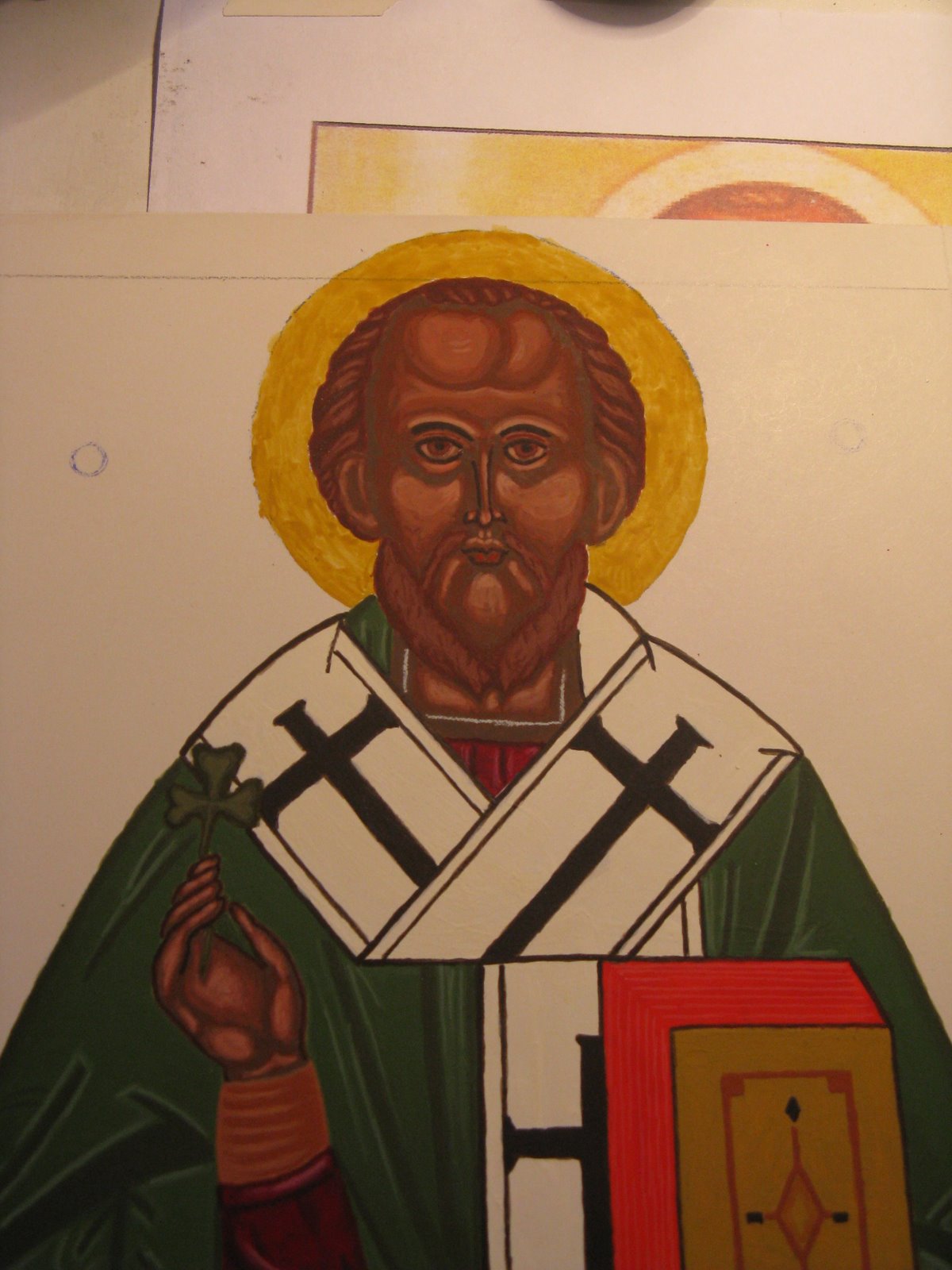
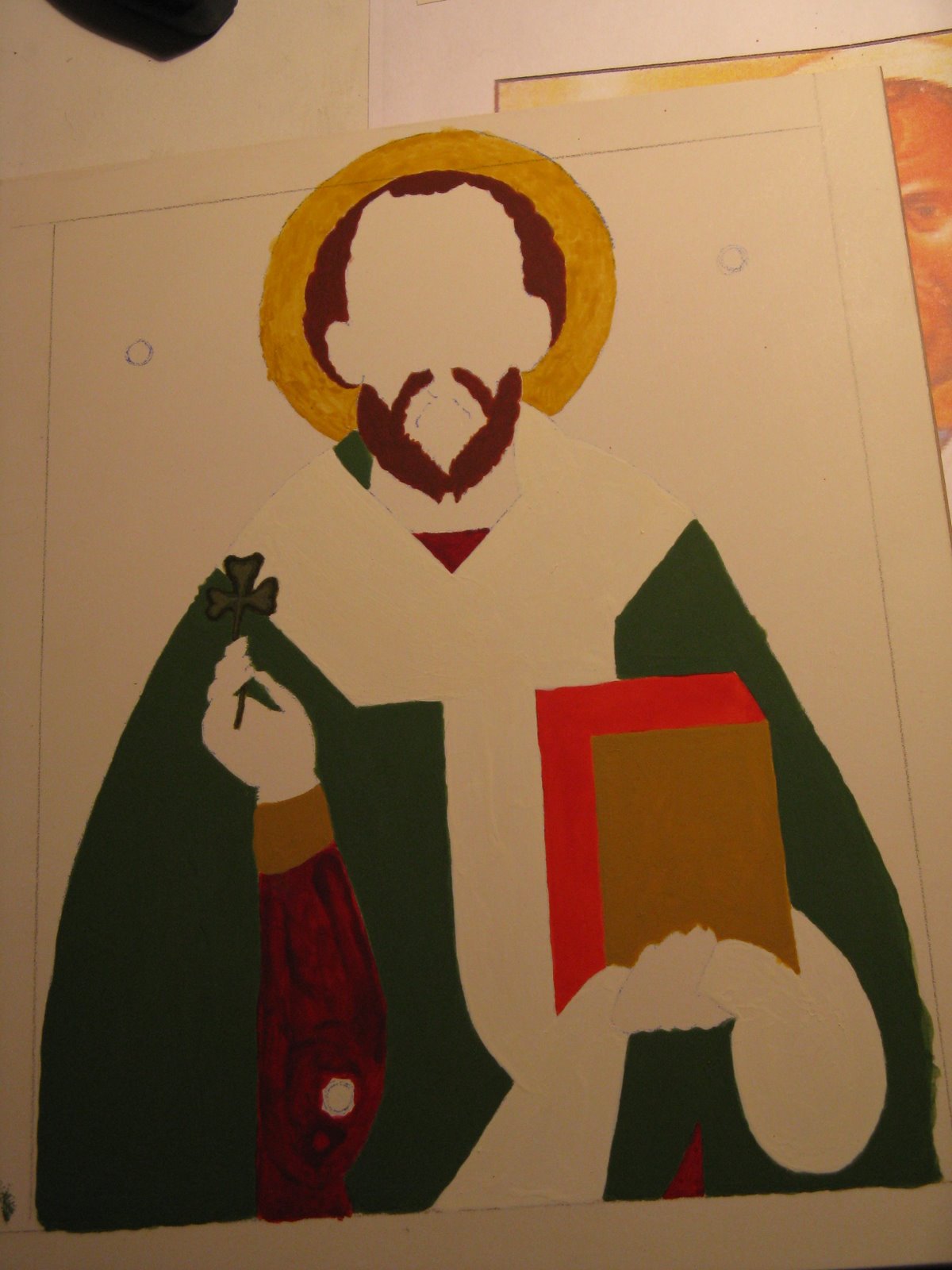
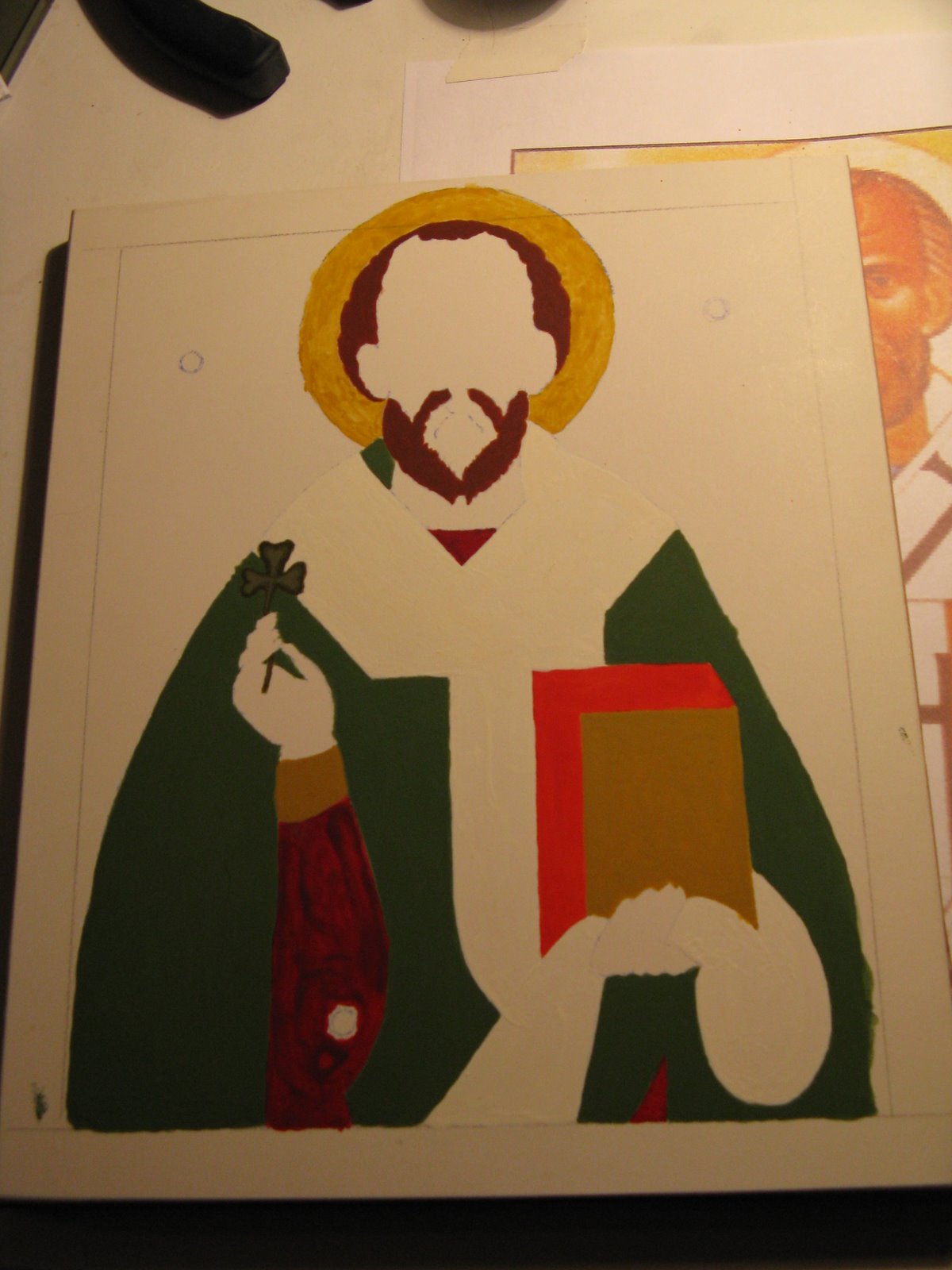
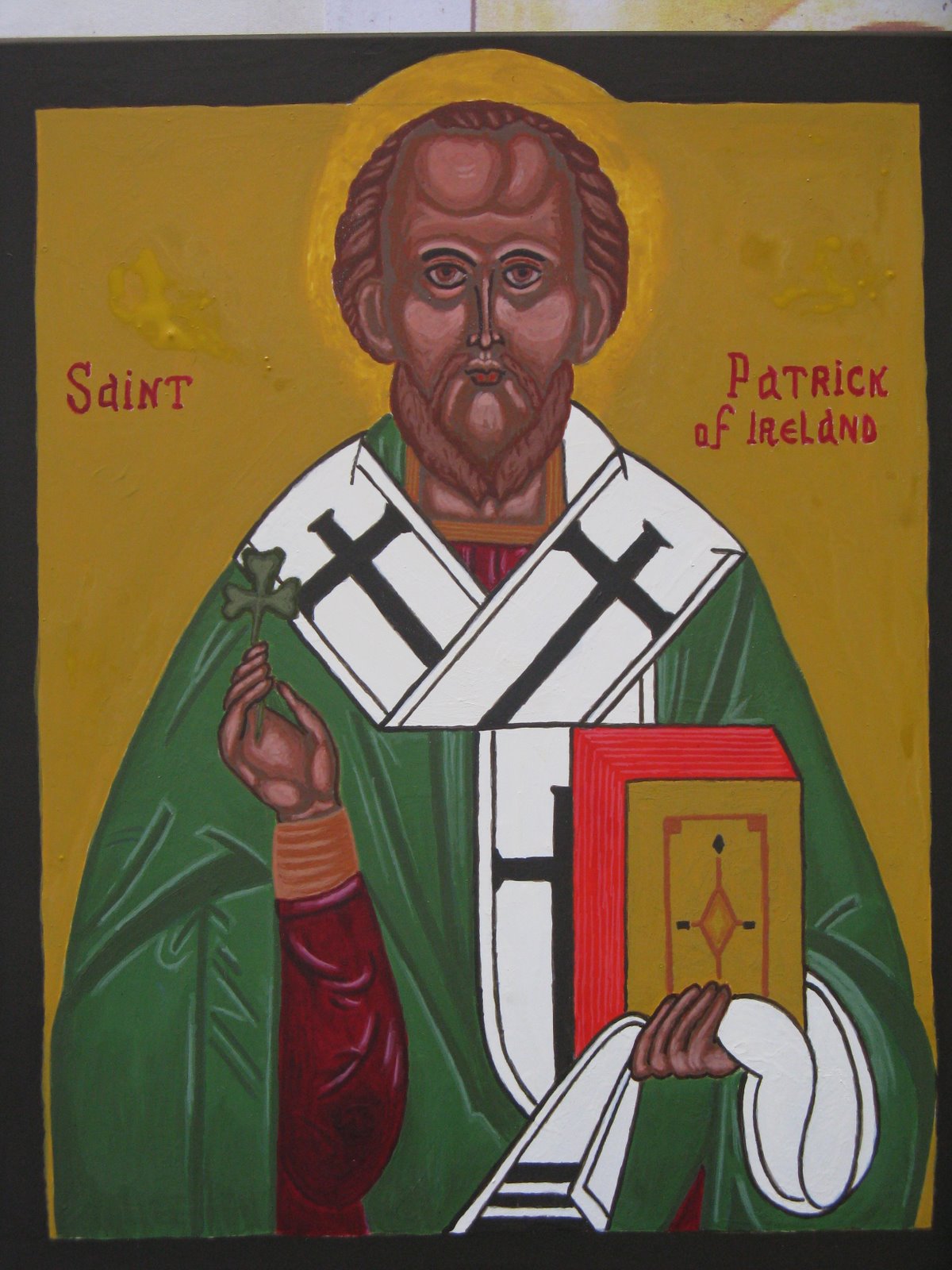
St. Patrick Icon finished

18 Tuesday Mar 2008

Posted by mcummins2172 in Uncategorized

≈ Leave a comment

Saints be praised!

Happy St. Patrick’s Day!

17 Monday Mar 2008

Posted by mcummins2172 in Uncategorized

≈ 2 Comments


Yes, I know it is Holy Week and we are supposed to downplay this day devoted to Ireland’s most famous saint … but my middle name is Emmet afterall. The icon is close to being done – still have the halo to do and the trim work and varnish but I had to get something out for the day! God’s blessings to you and yours!

Revealing and Re-veiling: Matthew 17:1-9

16 Saturday Feb 2008

Posted by mcummins2172 in Uncategorized

≈ Leave a comment

I recently heard a religious sister share some advice she once gained from her spiritual director. Her director told her, “In the course of our spiritual lives, our lives of discipleship, God both reveals Himself and re-veils Himself.” In other words, sometimes God makes Himself known and present to us in very palpable and powerful ways and then there are times (maybe even periods of our lives) when God steps back, when God re-veils Himself. Both movements are part of the spiritual life and both are part of the same journey. The discipline of the Christian life is to accept and be comfortable in both. When God reveals we should accept it and receive it. We should avoid the common temptation of running away because the light is too pervasive and too bright. Also, when God re-veils Himself we should accept this. We should not seek to run back to the mountaintop of transfiguration because it will not be the same. We should accept the yearning of the re-veiling because this expands our hearts – it increases our capacity to love.

As I reflected on this spiritual director’s insight and connected it to the story of the Transfiguration as found in Matthew’s Gospel I was brought to another awareness. It is very simple and has been present right in front of me in Matthew’s account a hundred times over. The insight is this: Jesus is just as present to his disciples as they depart from the mountain as he is when he is transfigured on the mountain. Jesus is not transfigured only to then tell his disciples to leave on their own while he remains on the mountaintop. No, Jesus goes down with them. “As they were coming down the mountain…” writes Matthew.
Whether it is a peak moment of transfiguration or whether it is a time of veiling, Christ is present. The goal is to recognize him, to be with him and to receive what he has to offer at that moment – both the moments of revealing and re-veiling.

Christian Community

27 Sunday Jan 2008

Posted by mcummins2172 in Uncategorized

≈ 1 Comment

In the 1980’s, Robert Bellah and a team of sociologists set out to study American society. They compiled their findings in the book, Habits of the Heart. At one point they write this,

We believe that much of the thinking about the self of educated Americans … is based on inadequate social science, impoverished philosophy and vacuous theology. There are truths we do not see when we adopt the language of radical individualism. We find ourselves not independently of other people and institutions but through them. We never get to the bottom of ourselves on our own. We discover who we are face to face and side by side with others in work, love and learning. All of our activity goes on in relationships, groups, associations, and communities ordered by institutional structures and interpreted by cultural patterns of meaning. Our individualism is itself one such pattern. And the positive side of our individualism, our sense of the dignity, worth, and moral autonomy of the individual, is dependent in a thousand ways on a social, cultural, and institutional context that keeps us afloat even when we cannot very well describe it. There is much in our life that we do not control, that we are not even “responsible” for, that we receive either as grace or face as tragedy; things Americans habitually prefer not to think about. Finally, we are not simply ends in ourselves, either as individuals or as a society. We are parts of a larger whole that we can neither forget nor imagine in our own image without paying a high price. If we are not to have a self that hangs in a void, slowly twisting in the wind, these are issues we cannot ignore.
To be Christian means to be called to the community of discipleship and this is, by its very nature, a rejection of radical individualism. We live in relationship one with another and each of us with the living Christ and we realize who we are only in and through these relationships. “I urge you,” writes Paul in First Corinthians, “… that there be no divisions among you, but that you be united in the same mind and in the same purpose.” Stay united, “… so that the cross of Christ might not be emptied of its meaning.” Christian community is not just a nice by-product of the revelation of Christ, it is of the very essence of this revelation. Something very fundamental is at work when we gather and live as brothers and sisters in Christ.

Our society is fragmented – painfully fragmented – and there are forces that seek to encourage this fragmentation. (It is easier to manipulate people when they are isolated and not talking one to another.) Community and dialogue are the great fears of the forces of fragmentation. Today, one of the greatest witnesses we can give as Christians is to live community. Community, in a land which extols individualism, is radically countercultural and in community we are healed, we discover ourselves through our encounter with the other in Christ.

Here at the Catholic Center I will point to myself as an example. People sometimes ask me when did I know that I wanted to become a priest? In many ways my vocation began here. When I was a young boy I had thought about being a priest – elementary and high school. But the “idea” never went anywhere, it never grew because beginning around 6th grade through my second year in college I was not involved in church. I had an “idea” in the back of my mind but that was all that it remained – an “idea”. It was only when I came back to the church here at the Catholic Center, when I began to live in the context of community that the “idea” grew – it became no longer just an idea but a hope and ultimately a joy. We realize ourselves in Christian community.

In Matthew’s Gospel, Jesus calls Peter and Andrew, he calls James and John together. They form community. It is interesting to read each of the gospels from the first to the last chapter and notice how much the disciples changed and are transformed (not into someone different but into truly who they are). They are changed primarily through their encounter with Christ but also (and there is sufficient proof for this in Scripture and not the most flattering proof either) through their encounters with one another in Christ.

“I urge you … remain united.” writes Paul. There is something truly fundamental and formative that occurs only in the context of Christian community.
The Baptism of the Lord: Downward Mobility

12 Saturday Jan 2008

Posted by mcummins2172 in Uncategorized

≈ Leave a comment

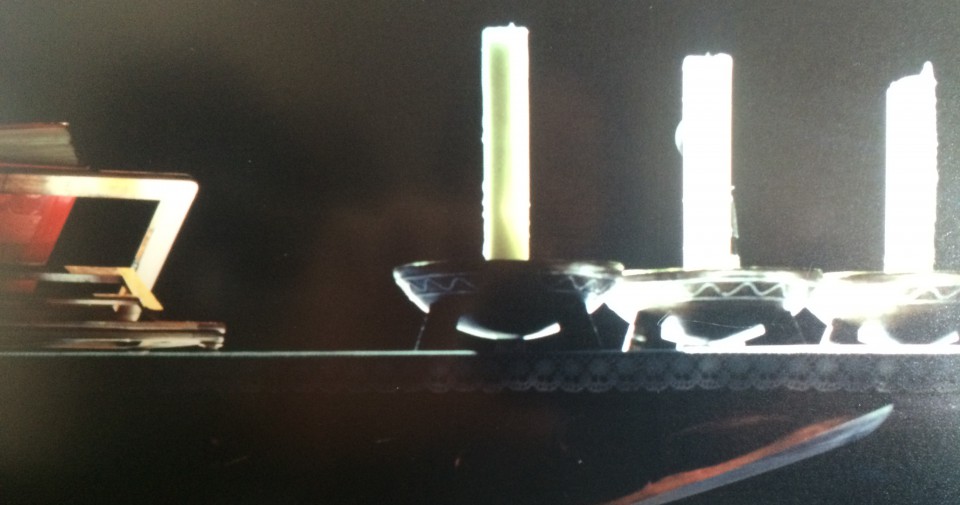
I have had the opportunity to visit the catacombs in Rome. The tunnels (literally the local cemeteries) where the early Christians gathered in secret to worship during times of persecution. Here the Christians proclaimed Scripture and shared Eucharist. Rome’s catacombs go deep into the earth. I share this image because every time I walk down the stairs to the basement chapel of the Catholic Center at ETSU I think of my experience of entering the catacombs. Our little basement chapel is a catacomb church. We are getting back to our roots and we are about something subversive – just as subversive today as it was two thousand years ago. Like those first Christians as we break open Scripture and Eucharist we are being formed by something different than what the world offers.

There will always be a subversive component to the Christian faith because our faith is about that which is more than the world. An example: our world promotes upward mobility which, in and of itself, has nothing inherently wrong with it – we want to achieve and use the gifts God has given us, we want to be successful at what we do and provide for those we love and care for. What the gospels proclaim throughout their message though is not upward but rather downward mobility. The Son emptied himself and became human, “born in the likeness of a slave”. Isaiah prophesied the one who would bring justice but not by a show of power and might but by “not crying out, not shouting … a bruised reed he shall not break.” Jesus comes to John (not John to Jesus) and by so doing joins himself to all the disenfranchised people – the ones of no worth – who were looking for something more. Jesus humbles himself and is baptized by John. Downward mobility.

This is what is put before us. If, in the area of church life, upward mobility is gauged by mega-churches, donations flowing in, larger and larger crowds then how is downward mobility gauged in the life of a faith community? Not quantifiable but qualitatively. Walls are torn down, hearts are opened, reconciliation is sought rather than competition, there is a willingness to serve and seek and to find in the one being served not just another “client” or a means to my own sanctification but Christ himself.

It is not a numbers game – it is about so much more. Today’s feast calls us back to our roots, it calls us to be subversive and to make Jesus proud! But, before we jump into the fray, we need to be wise. We cannot do this on our own – there is hardship, struggle and just plain evil that we will face. The baptism of Jesus is connected to our own individual baptisms not because Jesus needed the cleansing from sin that we do but because we need to hear the words of the Father which he heard. We need this grace because only by it can we continue in the subversive life of the Kingdom – living downward mobility. Through Jesus and our baptism into his very life and death, the Father says to us, “You are my beloved son, You are my beloved daughter – with whom I am well pleased.” This is the grace which saves.

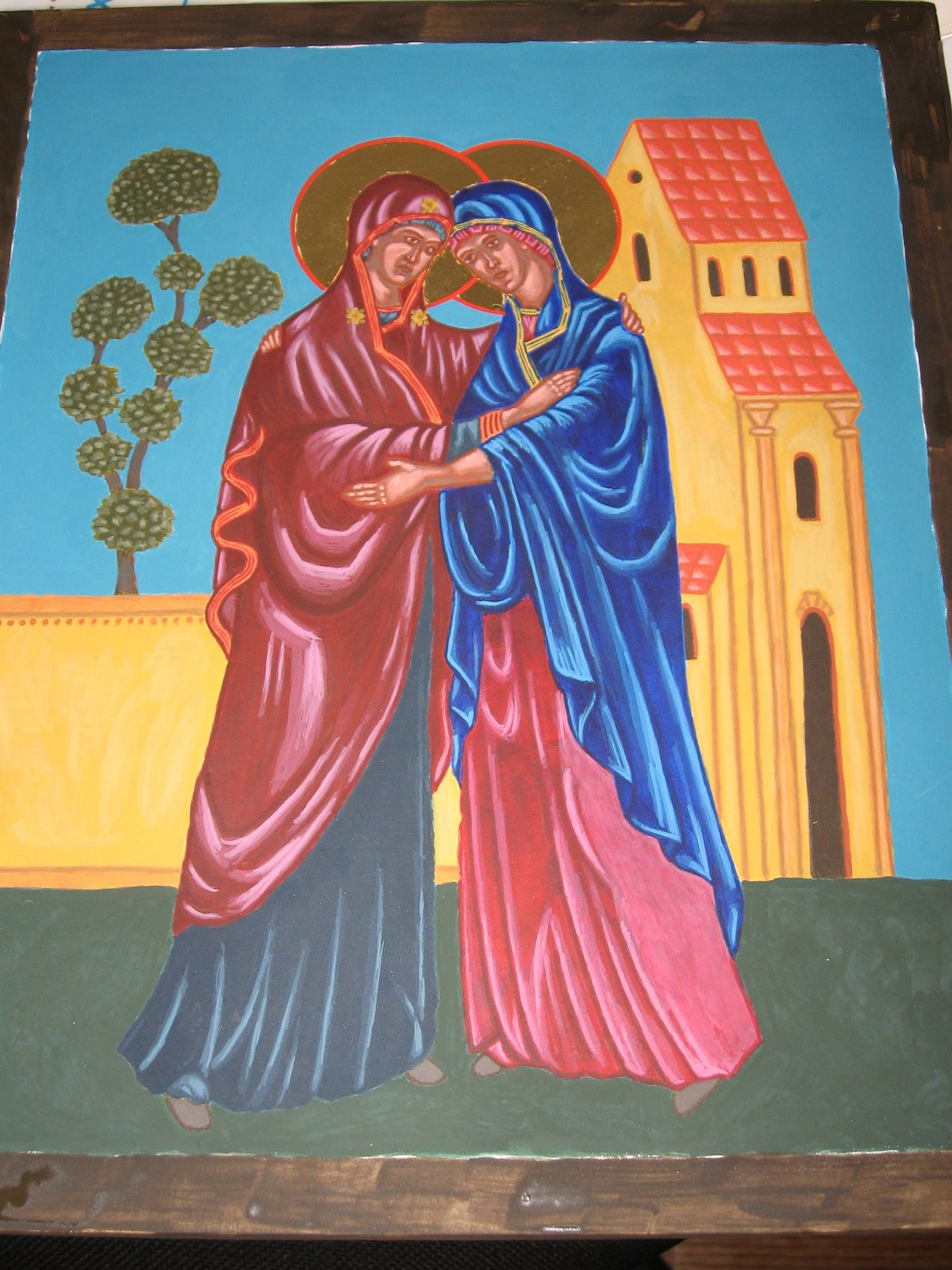
The Visitation

21 Friday Dec 2007

Posted by mcummins2172 in Uncategorized

≈ Leave a comment

Mary then set out for a town in the Hills of Judah. She entered the house of Zechariah and greeted Elizabeth. When Elizabeth heard Mary’s greeting, the baby leapt in her womb. Elizabeth was filled with holy spirit, and giving a loud cry, said, “Your are most blessed among women and blessed is the fruit of your womb! How is is that the mother of my Lord comes to me? The moment your greeting sounded in my ears, the baby within me suddenly leapt for joy. Blessed are you who believed that the Lord’s word would come true!”

And Mary said:

My soul proclaims the greatness of the Lord,
my spirit exults in God my savior!
He has looked upon his servant in her lowliness,
and people forever will call me blessed.
The Mighty One has done great things for me,
Holy is his Name!
From age to age his mercy extends
to those who live in his presence.
He has acted with power and done wonders,
and scattered the proud with their plans.
He has put down the mighty from their thrones
and lifted up those who are downtrodden.
He has filled the hungry with good things
but has sent the rich away empty.
He held out his hand to Israel, his servant,
for he remembered his mercy,
even as he promised our fathers,
Abraham and his descendants forever.

Mary remained with Elizabeth about three months and then returned home.

(Lk. 1:39-56)

Mary’s Perpetual Virginity

20 Thursday Dec 2007

Posted by mcummins2172 in Uncategorized

≈ Leave a comment

In iconography the three “stars” around Mary represent her perpetual virginity. Mary was a virgin before, during and after her pregnancy. It is a great mystery and witness to contemplate.

← Older posts
Newer posts →
Follow The Alternate Path on WordPress.com

Enter your email address to follow this blog and receive notifications of new posts by email.

Previous Posts

  • March 2026
  • December 2025
  • November 2025
  • August 2025
  • April 2025
  • February 2025
  • January 2025
  • December 2024
  • August 2024
  • July 2024
  • June 2024
  • May 2024
  • April 2024
  • March 2024
  • February 2024
  • January 2024
  • December 2023
  • November 2023
  • October 2023
  • August 2023
  • July 2023
  • May 2023
  • February 2023
  • January 2023
  • December 2022
  • August 2022
  • July 2022
  • April 2022
  • January 2022
  • December 2021
  • September 2021
  • August 2021
  • July 2021
  • May 2021
  • April 2021
  • January 2021
  • December 2020
  • November 2020
  • October 2020
  • August 2020
  • July 2020
  • May 2020
  • April 2020
  • March 2020
  • February 2020
  • December 2019
  • October 2019
  • September 2019
  • August 2019
  • July 2019
  • May 2019
  • April 2019
  • March 2019
  • February 2019
  • December 2018
  • November 2018
  • October 2018
  • August 2018
  • July 2018
  • June 2018
  • April 2018
  • March 2018
  • February 2018
  • January 2018
  • December 2017
  • November 2017
  • September 2017
  • August 2017
  • July 2017
  • June 2017
  • May 2017
  • April 2017
  • March 2017
  • February 2017
  • January 2017
  • December 2016
  • November 2016
  • October 2016
  • September 2016
  • August 2016
  • July 2016
  • June 2016
  • May 2016
  • April 2016
  • March 2016
  • February 2016
  • January 2016
  • December 2015
  • November 2015
  • October 2015
  • September 2015
  • August 2015
  • June 2015
  • May 2015
  • April 2015
  • March 2015
  • February 2015
  • January 2015
  • December 2014
  • November 2014
  • October 2014
  • September 2014
  • August 2014
  • July 2014
  • June 2014
  • May 2014
  • April 2014
  • March 2014
  • February 2014
  • January 2014
  • December 2013
  • November 2013
  • October 2013
  • September 2013
  • August 2013
  • July 2013
  • June 2013
  • May 2013
  • April 2013
  • March 2013
  • February 2013
  • January 2013
  • December 2012
  • November 2012
  • October 2012
  • September 2012
  • August 2012
  • July 2012
  • June 2012
  • May 2012
  • April 2012
  • March 2012
  • February 2012
  • January 2012
  • December 2011
  • November 2011
  • October 2011
  • September 2011
  • August 2011
  • July 2011
  • June 2011
  • May 2011
  • April 2011
  • March 2011
  • February 2011
  • January 2011
  • December 2010
  • November 2010
  • October 2010
  • September 2010
  • August 2010
  • July 2010
  • September 2008
  • August 2008
  • April 2008
  • March 2008
  • February 2008
  • January 2008
  • December 2007
  • November 2007
  • October 2007
  • September 2007

Popular Posts

  • None

Blog at WordPress.com.

  • Subscribe Subscribed
    • The Alternate Path
    • Join 156 other subscribers
    • Already have a WordPress.com account? Log in now.
    • The Alternate Path
    • Subscribe Subscribed
    • Sign up
    • Log in
    • Report this content
    • View site in Reader
    • Manage subscriptions
    • Collapse this bar