• About The Alternate Path

The Alternate Path

~ Thoughts on Walking the Path of Christian Discipleship

The Alternate Path

Category Archives: homily

"It is not good for man to be alone.": Twenty-Seventh Sunday in Ordinary Time (B)

06 Saturday Oct 2012

Posted by mcummins2172 in creation, homily, love, marriage, sacrifice, union of man and woman

≈ Leave a comment

It is not good for man to be alone. 

These words spoken by God at the very dawn of creation bring forth a singular truth regarding the human condition.  Communion and relationship are at the very root of what it means to be human.  In one sense this should come as no surprise as we are made in the image and likeness of God who is a communion of persons – Father, Son and Holy Spirit.  God is not a “far-away and high loneliness” but rather a living relationship of three Persons.  It can be said that God does not live alone and therefore man and woman are not meant to live alone.  We are meant for communion and communion, solidarity and support are the root of every human vocation.  By living communion (whether that be the communion of friendship, of discipleship, of the common good, of church, of witness) we are being brought to that ultimate communion which will be the union of the human family with God. 

This Sunday we are asked to reflect on a specific kind of communion which originates from marriage – the union of man and woman. 

I wish that I could say that I get into our surrounding mountains here in East Tennessee more often than I do.  We are indeed blessed here with the beauty of God’s creation.  But, even if I cannot get away for a hike too often, I am pretty consistent about taking my two dogs for a walk at least every other day if not every day.  For a few minutes I step out from the office, I step away from the computer and from the Internet and facebook, I let go of whatever project is occupying my thoughts and I am able to be with my dogs and enjoy the beauty of the day and creation.  When I do this I am always better for it.  Creation and its structure and laws has a way of putting things right, speaking to the truth and depth of who we are and refreshing the soul.

In today’s gospel (Mk. 10:2-16) when our Lord is asked if it is lawful for a husband to divorce his wife he turns to creation when he gives his answer.  

But from the beginning of creation, ‘God made them male and female.  For this reason a man shall leave his father and mother and be joined to his wife, and the two shall become one flesh.’  So they are not longer two but one flesh.  Therefore what God has joined together, no human being must separate.  

This “turn to creation” on our Lord’s part is not an aside nor just a nice rhetorical device.  To truly understand marriage one must look to the laws of creation itself.  Marriage is not rooted in the laws of governments that come and go nor is it ultimately founded in the social values of any given time which, it must be acknowledged, are often biased toward the powerful and oppressive of the weak and poor.  Marriage even precedes the foundation of the Church herself, whose relation to marriage is that of steward and not creator.  Marriage, the union of man and woman, originates in creation itself.  It is even such a high display of love that it is presented as an image of God’s love for his people and Christ’s love as bridegroom for his bride, the Church.

That the two shall become one flesh testifies (probably more powerfully than anything else) to the reality that communion lies at the very foundation of human existence and human vocation.  This is a needed witness, if not the most important witness, to our day and age which is so dominated by a self-centered and self-seeking approach to human existence.  Marriage lived even in the struggles of human weakness yet open to God’s healing and sanctifying grace, witnesses to that fundamental law of creation that the two actually do become one flesh.  A law which can neither be faked nor manipulated because it is linked to truth itself.  Life is found through communion, through sacrifice and through love and not through a self-centered and isolated existence. 

This Sunday’s second reading from the Letter to the Hebrews (2:9-11) reminds us that when we were lost and isolated in sin and death, God stepped out of his glory and took on suffering for us.  In order that, He who consecrates and those who are being consecrated all have one origin.  (Notice again the use of the imagery of creation and origin.)  Our origin is God, a communion of Persons, who spoke forth creation in love and who let go of his glory in love that we might have life. 

In the love and sacrifice of communion we are rooted and we are fulfilled.  It is written into the very laws of creation and into creation being sanctified by grace.     


The Expansiveness of Love: Twenty-Sixth Sunday in Ordinary Time (B)

29 Saturday Sep 2012

Posted by mcummins2172 in 26th Sunday in Ordinary Time (B), fearless moral inventory, homily, humility, love, safeguarding ones own

≈ Leave a comment

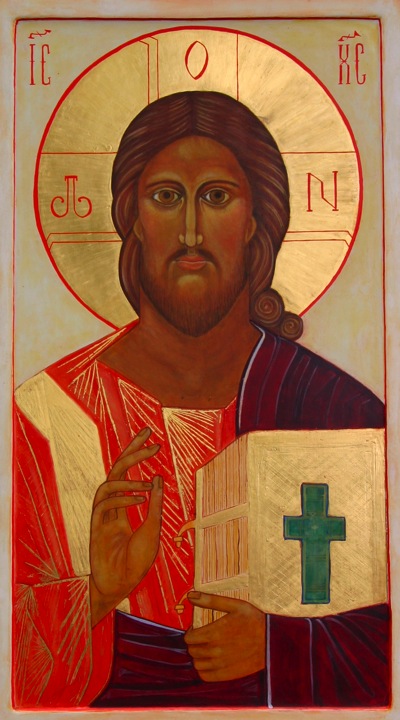
Icon of Christ – the Divine Physician

It has been noted that the besetting sin of our day is not that we love too much but rather that we love too little.  It is my estimation that although often trumpeted,  proclaimed, and sung about in all sectors of society the love that is most often highlighted today is, in fact, impoverished and anemic.  When we scratch just under the surface we realize that what often passes for “love” is really, in fact, just safeguarding ones own interest – ones own viewpoint of the way things are, ones own prosperity, ones own desire and need, the success and comfort of ones own group, ones own ideology, ones own honor, family and kin. 

The truth is that there is nothing new under the sun; this temptation to safeguard ones own has been around for a very long time.  In fact, we find it in today’s gospel passage (Mk. 9:38-43, 44,47-48).  John himself is operating under this temptation when he says to Jesus; Teacher, we saw someone driving out demons in your name, and we tried to prevent him because he does not follow us.  On the surface John might have convinced himself that the attempt to prevent this person and his actions was out of love for Jesus but in fact it was more about privilege and our Lord recognized this.  Do not prevent him.  There is no one who performs a mighty deed in my name who can at the same time speak ill of me.

In today’s gospel passage our Lord asks us to do two things.  The first is to in humility make what is often called a “fearless moral inventory”.  Our Lord asks us to look within and to honestly gauge what motivates us.  He does this by highlighting the temporal nature of the physical body.  If your hand … If your foot causes you to sin cut it off … If your eye causes you to sin, pluck it out.  Any reasonable person is going to realize that its not my hands or my feet or my eyes that cause my sin but rather something much deeper within – my own disordered desires which motivate and impel me. 

If, indeed, it is my body parts that should be cut off if it is proven that they are the root of my sin then even more so must my heart and what motivates me from within be laid open before the Divine Physician in order for that which corrupts to be cut out and removed by his grace.  Every time we come before the Lord in personal prayer, in sacramental celebration or in service to another we must let go of the subtle temptation to safeguard our own and, in humility, open our hearts to Christ. 

This is the first request our Lord makes of us in today’s gospel passage.  The second request both flows from and is dependent upon the first.  Christ asks us to spend ourselves in love.  Elsewhere in scripture, we are told that our love should be sincere.  The sincerity of love both for neighbor and God is dependent upon our willingness to look both fearlessly and humbly within and to let go and move beyond anything that inhibits and disorders love.  This includes the temptation to safeguard our own. 

When we view the lives of the saints one common characteristic we find is that these men and women spent themselves in love.  This is said over and over again in regards to the saints.  They learned the lesson of today’s gospel passage and each, in his or her own unique way, did not just avoid sin (which certainly is important) but also literally spent themselves in love.  They learned and trusted in the expansive love of Christ.  Anyone who gives you a cup of water to drink because you belong to Christ, amen, I say to you, will surely not lose his reward. 

Christ calls us to spend our lives in love, to an expansiveness of heart, because here (and not in safeguarding our own) is where fulfillment and true joy are to be found.           

A Gospel passage in three movements: Twenty-Third Sunday in Ordinary Time (B)

09 Sunday Sep 2012

Posted by mcummins2172 in 23rd sunday in Ordinary Time (B), frienship with Christ, homily, listening, speaking correctly

≈ Leave a comment

In this Sunday’s gospel passage (Mk. 7:31-37) there are three “movements” worthy of reflecting upon.  This passage tells the good news of how Jesus cured the deaf man with the speech impediment and it is worthy to note how our Lord heals the man. 

The first movement is that Jesus takes the man away by himself.  He took him off by himself away from the crowd.  Jesus welcomes this poor man.  He teaches by way of action what James is later to write in his letter (James 2:1-5); …show no partiality as you adhere to the faith in our glorious Lord Jesus Christ.  It is certainly true that God shows no preference between people but we see throughout Scripture that the heart of God leans in a special way toward the poor and the weak. 

Jesus welcomes this man and he takes him off to the side as if to stress the need of a personal relation and encounter with Christ as the foundation of any true healing.  Miracles, it has been noted, “occur in the realm of a deep friendship and trust in God.”  It is true that God respects our freedom enough to not force his love on us but it is also equally true that the respect must go both ways.  Neither God nor his love is a genie to be summoned on command by our whims and needs.  The love and grace of God and the miracles of God in life are dependent (to a considerable extent) upon our friendship with and trust in God.

Jesus then, following ancient custom, puts his finger in the man’s ears and then (with saliva) touches the man’s tongue.  These are the second and third movements respectively. 

Jesus touches the man’s ears.  Each person needs to be “open” to hearing the Word of God.  In our distracted world we need to learn how to cultivate the art of listening, especially listening for the Word of God as it comes to us.  This art implies the willingness to live with an open heart and a humble and receptive spirit.  I think in times past we could almost coast on this because times and circumstances lent themselves to the art of listening.  I do not think we can say this anymore.  There are too many distractions.  We must be intentional about creating in our lives and in our world environments (even pockets) of quiet in order that the discipline of listening and real encounter with another can be developed and grow.  This certainly applies to our faith life and our relationship with Christ. 

(At this point, I want to take an aside and point to two things beginning this week at the Catholic Center that relate here.  The first is Monday morning prayer on campus which will be held every Monday at 7:15 a.m.  Each month we will explore a different prayer form together.  The second is Wednesday Adoration of the Blessed Sacrament which our Graduate Student/Young Adult group is organizing which will be held every Wednesday from 3:00 to 5:00 p.m.  These are both moments to just listen and to be with the Lord.)

Jesus touches the man’s tongue, looks up to heaven, groans and says, Ephphatha! or “Be opened!”.  And immediately the man’s ears were opened, his speech impediment was removed, and he spoke plainly.  In the fact that we are told that the man was able to speak plainly we can see that the miracle proclaimed in this passage concerns not just the restoration of speech but really the ability to speak correctly.  Words carry great power.  We find this throughout Scripture from the very beginning in the creation account where we are told that God spoke and it came to be to John’s reflection of Jesus being the Logos or Word of the Father.  Our words can participate in the very creativity of God or they can be misused in order to harm, to do evil and to create nothing but division. 

For our words to be purified, for them to participate in the very creativity of God and not be malicious nor deceitful then we must first of all (as noted above) listen to the Word of God.  Our words can do great good but they can also do great harm.

Three movements: truly encountering and living in friendship with Christ, listening to the Word of God and learning to speak correctly.           


Hearts open to God: Twenty-Second Sunday in Ordinary Time (B)

01 Saturday Sep 2012

Posted by mcummins2172 in 22nd Sunday in Ordinary Time (B), heart, homily, open to God, ritual

≈ Leave a comment

Statue of Christ the Redeemer in Rio de Janeiro, Brazil

It is helpful in today’s gospel passage (Mk. 7:1-8, 14-15, 21-23) to distinguish what our Lord is condemning from what he is not condemning.  Our Lord is not condemning ritual action per se.  We realize this if we call to mind elsewhere in the Gospel where our Lord states that he has come not to abolish but to fulfill the law.  What our Lord is condemning in this gospel passage is the temptation to keep our hearts distant from God. 

This temptation can take a variety of forms.  One form is indeed to cloak itself in a form of religious ritualism that really misses the mark.  Here our Lord quotes Isaiah, “This people honors me with their lips, but their hearts are far from me; in vain do they worship me, teaching as doctrines human precepts.”  You disregard God’s commandments but cling to human tradition.  This misuse of ritual as a means to hide our hearts from God rather than the proper exercise of ritual which guides one to an encounter with the Divine can often be seen in the tendency to (as a friend of mine would say) “major in the minors.”  This means to get lost in an over focus on what is of little importance while neglecting the loftier things.  In our first reading for the Sunday (Dt. 4:1-2, 6-8), Moses reminds Israel that the statutes and commandments of the Lord are given that they might have life.  The commandments are given in order that the Israelites might live with hearts open to an encounter with God.

This is one way of keeping our hearts distant from God but there is another way which is quite prevalent today and also worthy of note.  This second way of keeping our hearts distant from God is witnessed in a lack of respect for ritual.  This can be heard often in the critique that the Catholic and Orthodox Church are just about “dead ritual” that has no real value in the true Christian life.  This perception demonstrates a profound ignorance both about the sense of God in one’s life and also often an over-inflated sense of self.  Downplaying the awareness of God as the transcendent mystery while inflating our own ego (which I would argue often happens in many Christian circles today) is another way of keeping our hearts distant from God.  One might profess relationship with Christ but it is, in fact, easy here to keep ones heart distant through both an over focus on self and a viewing of God as just being the means by which I and my needs are satisfied.

Ritual, when properly lived, reminds us that it is God we are approaching.  Ritual calls forth respect in regards to what we are about and also to Whom we are addressing ourselves.  Ritual, through its concrete action, opens our hearts to an encounter with the Divine Mystery.  Ritual, truly lived, recognizes God as God and reminds us of our proper place in this encounter.

Both ritualism and the denial of any value to ritual can be used to cloak the same sin: keeping our hearts distant from God.  Today, Christ invites us to do a little heart surgery in our lives – to acknowledge the root of our sins and to acknowledge that these sins grow in our lives and in our world precisely in relation to how much we keep our hearts distant from God. 

From within people, from their hearts, come evil thoughts, unchastity, theft, murder, adultery, greed, malice, deceit, licentiousness, envy, blasphemy, arrogance, folly.  All these evils come from within and they defile. 

“By affirming this, Jesus clarifies that evil does not grow by chance, as if it was the fruit of a blind destiny.  Evil has its own soil that is the heart.  And it has also its farmers: men and women.  Each person is a farmer, at times very active, of small or large quantities of bitter grass in our hearts, grass that often poisons our lives and the lives of others.”  (Bishop Vincenzo Paglia, The Word of God Everyday)

We are responsible for the bitterness in our world and also, often, in our lives.  No one is exempt.  But, just as we can be farmers in our hearts sowing bitter grass, we can also be farmers sowing that which is true and good – solidarity, compassion, patience, humility, piety, mercy and forgiveness.  Our Lord knows that it all happens in the heart and the first step is to stop keeping our hearts distant from God.  In all times and seasons, we ought to welcome the word of the Gospel and the grace of God into our hearts. 

In his letter, the apostle James gives us this wise advice: …welcome with meekness the implanted word that has the power to save your souls.  But be doers of the word, and not hearers who deceive themselves.        

Church, forget not your power! (Sixteenth Sunday in Ordinary Time – B)

21 Saturday Jul 2012

Posted by mcummins2172 in 16th Sunday in Ordinary Time (B), gospel, homily, power

≈ Leave a comment

The Gospel passage for this Sunday (Mk. 6:30-34) has the apostles returning to the Lord after having been sent out on mission to proclaim the coming of the Kingdom of God, to heal the sick and to aid the weak and the poor.  The evangelist makes note of a “power” being conferred on the apostles in order to acomplish these tasks.  It is quickly realized that the power mentioned here is neither economic nor political because those first disciples clearly had neither.  The “power” that the disciples went forth with were obedience to Jesus, the proclamation of his words and repeating the Lord’s gestures of mercy.  Through these simple powers great things happened and the apostles return full of excitement to share their experiences.  We can imagine the affectionate expression on Jesus’ face on their return and in their recounting of what had happened. 

Today, the Gospel gives us a different way than just the economic and political to affect the world.  This is a needed message for our time so steeped in materialism.  This influence of materialism can be witnessed in society’s fixation with the “material” power of economics and politics as the only ways to really get things done.  What the Gospel offers is a different way and a way that is more authentic and more human.  It is a power that truly heals and touches the human heart.

In our Christian heritage there is a famous quote that states, “Christian, forget not your dignity!”  In relation to today’s Gospel I think we can say, “Church, forget not your power!”  I am not saying that there is no place for economics or politics – lets not be naive – but also lets not forget that the true power of the Church resides in neither of these.

The power of the Christian community (the power to which the Church alone is the steward) is threefold:

1. obedience to Jesus,
2. the proclamation of his words,
3. repeating the Lord’s gestures of mercy. 

Obedience to Jesus.  Jesus is Son of God, Son of Man and Lord of history.  Why do we keep searching for other lords and other messiahs?  Yet, we do.  There are great men and great women throughout history yet none other is Son of God and Son of Man.  The primary witness of the disciples is found not in so much of what they said but in what they did.  They remained with the Lord.  They returned to him (as we see in today’s Gospel).  When they wandered and stumbled they turned back.  Even when they scattered from the cross; they gathered together again in the locked room.  In times of triumph, times of struggles, and times of uncertainty the disciples remained with the Lord.  There is a power found in obedience to the Lord.

The proclamation of Christ’s words.  There are many great ideas, theories and achievement throughout human history and these, rightly, can amaze and astound us.  We celebrate what is good and true.  But even as the Church can and should learn from these achievements she must remember that the words which she has to share are authentic, true and needed for every place and age.  They are words that truly bring life.  The words are not of our own making; rather they have been entrusted and given to us.  We are to speak Christ’s words to our world.  Elsewhere in the Gospel our Lord tells us that no one puts a light under a bushel basket yet how often are we tempted to give the Gospel second place in our lives to the latest theory, psychology, philosophy or social fad?  When we do so are we not, in essence, placing a bushel basket over the light of the Gospel?  The words of Christ truly heal because Christ alone is the Lord of life.

The Lord’s gestures of mercy.  Our Lord knew the power of gesture: he writes in the sand, he touches the leper, he sits down at the well with the samaritan woman, he heals the demoniac, he feeds the five thousand.  It is interesting to note how our Lord’s gestures were directed toward the expression of mercy.  Even the cleansing of the Temple can be seen as the desire to clear away a crushing and deadening legalism in order that God’s house might once again be seen as a house of mercy.  The Church is at its best when it lives our Lord’s gestures of mercy – when the untouchable are touched, when the hungry are fed when the sinner is forgiven.  These gestures might not make the evening news or any of the plethora of our society’s award shows but they are true, they are noted by heaven and they bring hope and healing to our world.

At the end of today’s gospel passage we are told that when Jesus disembarked from the boat and saw the vast crowd his heart was moved with pity.  The people were starving.  They were tired of that which failed to satisfy.  We, today, are tired of that which fails to satisfy.  Salvation does not come through politics nor does it come through the economy.  Salvation comes through mercy – God’s mercy at work in our world, our hearts and our lives. 

Christian, forget not your dignity!  Church, forget not your power! 


15th Sunday of Ordinary Time (B): Love and freedom from death, guilt and ego

14 Saturday Jul 2012

Posted by mcummins2172 in 15th Sunday in Ordinary Time (B), care for others, death, ego, guilt, homily, joy, love

≈ Leave a comment

st1\:*{behavior:url(#ieooui) }

“Return of the Prodigal Son” by Rembrandt
Saint Paul has written that God chose us in Christ in order to be full of love.  Here is where our religion begins.  It has been noted that the first Christians were just like the people around them: a mixture of rich and poor, weak and strong, male and female.  One could not tell the difference just by looking.  But, as a group, the Christians were noted for their care for others and for their joy. 

The original Christians were known for their taking care of others.  Especially others that the rest of society did not care for.  They buried the unknown poor, they cared for the sick.  They cared for the beggars.  Most of all, they cared for one another – sharing all so that no one was in need.  Many groups in history are known for power, strength, violence and bravery.  Few are known for how they loved each other.  This is the witness of our faith. 

Those first Christians were also known for their joy.  Joy is the infallible sign of God’s presence – it goes beyond happiness (which is having the world as we would have it) toward being in tune with the world as God would have it.  We find joy when we live as God would have us live.  

The first Christians shared all the conditions and struggles of life that their neighbors shared (and we still do).  We share the struggles, uncertainties and pains of this world.  Where then does our joy come from?  It comes from being freed to love and rejoice because, in Christ, we are freed from the three chains of death, guilt and ego.

We all fear death whether we acknowledge it or not and most of our sins come from this deep fear of diminishment, loss and ultimately oblivion.  But, as Christians, we know someone who once was dead and now lives.  We can boast, “Death, where is your sting?”

As Christians we are also freed from guilt.  We all know and bear this misery.  It is the felt knowledge that we have done what we should not and that we have not done what we should.  And even when we are not personally guilty of a specific sin we do share in the wholesale guilt of the human race.  And no human can forgive us, because we all share in sin.  But God can forgive and God has in Christ.  In Christ our guilt is wiped away – replaced by God’s mercy. 

Finally, the Christian is freed from the ego.  We are each both blessed and cursed by being a unique individual.  We can be so obsessed about taking care of ourselves and living in our own bubble that we forget others and forget the great mystery that it is only in dying to self that we rise to new life.  Through Christ we have learned that we save ourself by losing ourself.  Maturity comes when I realize that my life is not just about me.

In our care and in our joy we, as Christians, are known.  We love because, in Christ, we have been loved and freed from death, from guilt and from the ego.  This is the witness of our faith.  

See, how much these Christians love one another!  Hopefully, this will one day be said of our generation of Christians!     

Newer posts →
Follow The Alternate Path on WordPress.com

Enter your email address to follow this blog and receive notifications of new posts by email.

Previous Posts

  • December 2025
  • November 2025
  • August 2025
  • April 2025
  • February 2025
  • January 2025
  • December 2024
  • August 2024
  • July 2024
  • June 2024
  • May 2024
  • April 2024
  • March 2024
  • February 2024
  • January 2024
  • December 2023
  • November 2023
  • October 2023
  • August 2023
  • July 2023
  • May 2023
  • February 2023
  • January 2023
  • December 2022
  • August 2022
  • July 2022
  • April 2022
  • January 2022
  • December 2021
  • September 2021
  • August 2021
  • July 2021
  • May 2021
  • April 2021
  • January 2021
  • December 2020
  • November 2020
  • October 2020
  • August 2020
  • July 2020
  • May 2020
  • April 2020
  • March 2020
  • February 2020
  • December 2019
  • October 2019
  • September 2019
  • August 2019
  • July 2019
  • May 2019
  • April 2019
  • March 2019
  • February 2019
  • December 2018
  • November 2018
  • October 2018
  • August 2018
  • July 2018
  • June 2018
  • April 2018
  • March 2018
  • February 2018
  • January 2018
  • December 2017
  • November 2017
  • September 2017
  • August 2017
  • July 2017
  • June 2017
  • May 2017
  • April 2017
  • March 2017
  • February 2017
  • January 2017
  • December 2016
  • November 2016
  • October 2016
  • September 2016
  • August 2016
  • July 2016
  • June 2016
  • May 2016
  • April 2016
  • March 2016
  • February 2016
  • January 2016
  • December 2015
  • November 2015
  • October 2015
  • September 2015
  • August 2015
  • June 2015
  • May 2015
  • April 2015
  • March 2015
  • February 2015
  • January 2015
  • December 2014
  • November 2014
  • October 2014
  • September 2014
  • August 2014
  • July 2014
  • June 2014
  • May 2014
  • April 2014
  • March 2014
  • February 2014
  • January 2014
  • December 2013
  • November 2013
  • October 2013
  • September 2013
  • August 2013
  • July 2013
  • June 2013
  • May 2013
  • April 2013
  • March 2013
  • February 2013
  • January 2013
  • December 2012
  • November 2012
  • October 2012
  • September 2012
  • August 2012
  • July 2012
  • June 2012
  • May 2012
  • April 2012
  • March 2012
  • February 2012
  • January 2012
  • December 2011
  • November 2011
  • October 2011
  • September 2011
  • August 2011
  • July 2011
  • June 2011
  • May 2011
  • April 2011
  • March 2011
  • February 2011
  • January 2011
  • December 2010
  • November 2010
  • October 2010
  • September 2010
  • August 2010
  • July 2010
  • September 2008
  • August 2008
  • April 2008
  • March 2008
  • February 2008
  • January 2008
  • December 2007
  • November 2007
  • October 2007
  • September 2007

Popular Posts

  • thealternatepath.org/wp-c…
  • thealternatepath.org/wp-c…
  • thealternatepath.org/wp-c…
  • thealternatepath.org/wp-c…
  • thealternatepath.org/wp-c…

Blog at WordPress.com.

  • Subscribe Subscribed
    • The Alternate Path
    • Join 156 other subscribers
    • Already have a WordPress.com account? Log in now.
    • The Alternate Path
    • Subscribe Subscribed
    • Sign up
    • Log in
    • Report this content
    • View site in Reader
    • Manage subscriptions
    • Collapse this bar