• About The Alternate Path

The Alternate Path

~ Thoughts on Walking the Path of Christian Discipleship

The Alternate Path

Category Archives: Uncategorized

Leisure – Pieper style

16 Monday Aug 2010

Posted by mcummins2172 in Uncategorized

≈ 1 Comment

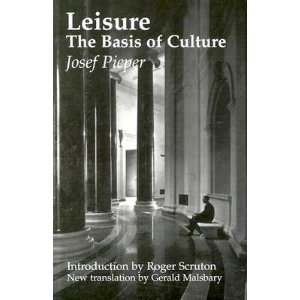
The opposite of acedia (“despair in weakness” or what we might term “depression”) is not the industrious spirit of the daily effort to make a living, but rather the cheerful affirmation by man of his own existence, of the world as a whole, and of God – of Love, that is, from which arises that special freshness of action, which would never be confused by anyone with any experience with the narrow activity of the “workaholic.”  (Taken from Leisure: The Basis of Culture by Josef Pieper)

I have decided to lead a reading/discussion group on Pieper’s sixty page essay, Leisure: The Basis of Culture this fall semester at the Catholic Center as part of our faith formation opportunities.  This essay, I believe, can change the way one views the world and how one lives life.  In this essay, Pieper offers an important commentary and corrective to trends present in our current cultural climate and a needed voice that our young people, especially, need to hear.

I believe that this essay is also valuable for anyone who is open to discerning God’s call in life.  In fact I highly recommend it.  Of specific importance is Pieper’s distinction (gained from ancient and medieval philosophy) between ratio and intellectus.  Ratio (Pieper points out) is the “power of discursive thought” – it is intellectual work, what we can deduce and arrive at by our own power and effort.  Ratio is important, through the effort of human intellect we have achieved and continue to achieve much but ratio is not the only game in town.  Intellectus is also a form of knowing.  Intellectus “refers to the ability of ‘simply looking’ to which the truth presents itself as a landscape presents itself to the eye.”  Intellectus can be described as, “Listening-in to the being of things.”  The crux of the problem, which Pieper points out, is that in our modern world, for a variety of reasons, we have reduced all forms of knowing to ratio and, in the process, have shuffled intellectus to the fringes if not to out-right disdainment.

Thomas Merton once observed that American society is a society that is neither conducive to nor encouraging of the contemplative life.  I would agree and I would also say that if we are anything we are a nation of engineers – we like to figure things out and we are pretty darn good at it.  But “full knowing” is both ratio and intellectus.  An over-emphasis on either one without the other limits us, limits life and limits society. 

Yes, in discerning God’s movement in ones life there is work to be done (ratio) but, more fundamentally, there is the need of “listening-in to the being of things” (intellectus).  Here it does us well to take a cue from our Lord’s response to Martha’s complaint – while she bustles about – as Mary sits content at his feet (Lk. 10:38-42).  “Martha, Martha you worry and are troubled about many things (an apt description of life lived solely in ratio), whereas only one thing is needed.  Mary has chosen the better part, and it will not be taken away from her.”

In discerning God’s movement in life do the work but also learn how to listen-in to the being of things – ratio and intellectus.       

The Feast of the Assumption of Mary

15 Sunday Aug 2010

Posted by mcummins2172 in Uncategorized

≈ Leave a comment

The Feast of the Assumption of Mary is my favorite Marian feast!  It is a holy mystery full of beauty and hope for all followers of Christ.  Below are some thoughts by Bishop Vincenzo Paglia concerning today’s feast.

In the heart of the month of August, the Churches of the East and the West together celebrate the feast of the Assumption of Mary.  As known, in the Catholic Church the dogma of the Assumption was proclaimed during the Holy Year of 1950…  But the roots of the memorial reach back to the first centuries of the Church.  In the East, where the feast perhaps began, it is still called, “The Dormition of the Virgin” today.  Saint Theodore of Stadium, astonished by the truth of this feast, asked himself, “What words will I use to explain your mystery?  My mind is in difficulty … your mystery is uncommon and sublime: it transcends all of our ideas.”  And he added, “She who became a mother by giving birth remained as intact as a virgin, because it was God who was generated.  Thus in your living formation, unlike all others, you alone rightfully put on the glory of the complete person, body and soul.”  And he concluded, “You have fallen asleep, yes, but not to die.  You have been assumed into heaven, but you do not stop protecting the human family.”  

Mary, most holy, we turn to you who dwell body and soul in the eternal presence of our Lord and Savior Jesus Christ and in the fullness of God who is Father, Son and Holy Spirit.  Please pray for the Church, pray for us as we make our pilgrim way.  Please pray for our diocese of Knoxville, our Bishop Richard Stika, all members of our diocese, all our priests, deacons, religious and seminarians.  Please pray for our young people that they too will strive, through grace, for the glory of that “complete person” who reflects the very glory of God.  Please pray that they will be open to God’s call for them and the true fulfillment that can only be known in saying “yes” to God as you, yourself, did. 

Ramadan

12 Thursday Aug 2010

Posted by mcummins2172 in Uncategorized

≈ Leave a comment

Today the Muslim world begins the month of Ramadan.  This is a time of fasting, prayer, purification and spiritual discipline carried out in order to express gratitude for God’s guidance and also to atone for past sins.  During this month it is recommended that each Muslim read the entire Quran. 

One of the highlights for me last year in our ministry here at the Catholic Center was when we invited the Muslim Student Association to join us one Wednesday evening for dinner.  This was near the end of the fall semester.  Then, in return, the MSA invited us to a dinner in the spring semester at the local Muslim community center.  A friendship has begun between our two groups that I hope will continue to grow and even become stronger.

During our visit to the Muslim community center we were welcomed to witness as the community gathered for one of their prescribed times of prayer.  Watching the men kneel and prostrate themselves in prayer I could not help but be struck by their sincere reverence for God. 

So, to my friends in the MSA I say, “As Salaam Alaikum” (“Peace be Upon You”) as you begin this holy season of Ramadan and I pray God’s blessings for you!

It is also fitting, I believe, on this day to reflect on the Church’s teaching found in Nostra Aetate (Declaration on the Relation of the Church to Non-Christian Religions) from the Second Vatican Council. 

The Church, therefore, urges her sons to enter with prudence and charity into discussion and collaboration with members of other religions.  Let Christians, while witnessing to their own faith and way of life, acknowledge, preserve and encourage the spiritual and moral truths found among non-Christians, also their social life and culture.

The Church has also a high regard for the Muslims.  They worship God, who is one, living and subsistent, merciful and almighty, the Creator of heaven and earth, who has also spoken to men.  They strive to submit themselves without reserve to the hidden decrees of God, just as Abraham submitted himself to God’s plan, to whose faith Muslims eagerly link their own.  Although not acknowledging him as God, they venerate Jesus as a prophet, his virgin Mother they also honor, and even at times devoutly invoke.  Further, they await the day of judgment and the reward of God following the resurrection of the dead.  For this reason they highly esteem an upright life and worship God, especially by way of prayer, alms-deeds and fasting.

Over the centuries many quarrels and dissensions have arisen between Christians and Muslims.  The sacred Council now pleads with all to forget the past, and urges that a sincere effort be made to achieve mutual understanding; for the benefit of all men, let them together preserve and promote peace, liberty, social justice and moral values. 

St. Lawrence and the real Prosperity Gospel

10 Tuesday Aug 2010

Posted by mcummins2172 in Uncategorized

≈ 1 Comment

There is a malformation of the gospel occurring in our day and it is called the “Prosperity Gospel”.  The basic tenet of the Prosperity Gospel (from what I can tell) is that if you have faith then God will bless you abundantly (which means materially).  Faith leads to success in all of ones enterprises and endeavors and to comfort in ones life.  The Prosperity Gospel proclaims that you can indeed have your best life now!  This take on the Gospel is out there, it is prevalent and it has many adherents … the only problem is that it is not Christian.

My question to those who proclaim the Prosperity Gospel is this: if faith equals success, material blessings and comfort then why did Peter and Paul die penniless, in chains and – according to all counts – unsuccessful?  Was their faith not strong enough?  Did they not really believe in Christ as Lord and Savior?  And what about all the other martyrs of our faith (Lawrence included)? 

The Prosperity Gospel leaves no room for the martyrs because they stand in witness against its basic tenet. 

St. Lawrence was a deacon of the early Roman Church.  He lived his faith in a time when the Church was being persecuted.  Lawrence was known for his love of the poor and his service to them.  He also oversaw the temporal goods of the Roman Church.  This was widely known and at one point the prefect of Rome brought in Lawrence and demanded that he hand over the wealth of the church.  Lawrence asked for a few days to gather the wealth.  After a few days Lawrence once again came before the prefect and presented to him the poor, the beggars, the sick, the elderly, the foreigners and said, “Here, this is the treasure of the church!”  Lawrence was martyred (tradition has it by being grilled alive, this is why he is often pictured with a grill). 

Lawrence knew that the true prosperity of the gospel is not found in material blessings but in the abundance of love which God has shown for us and which we, in turn, are to show to one another.  We have been loved abundantly so we, in turn, must also love abundantly!  The treasure of the church continues to be the poor, the outcast, the sick, the foreigner, the elderly, and the one who is hurting because they are the beloved of God and Christ is with them.  They might not count much to our world but they are precious in God’s eyes! 

The abundance of love is the true prosperity of the gospel. 

St. Lawrence and all holy martyrs, pray for us!     

St. Teresa Benedicta of the Cross – resting secure in a mother’s arm

09 Monday Aug 2010

Posted by mcummins2172 in Uncategorized

≈ Leave a comment

Edith Stein was born into a Jewish family in Breslau, Prussia in 1891.  During her life Edith was to become a well respected scholar and prolific writer.  In 1922 she entered the Catholic Church.  She was a leading thinker in the Catholic women’s movement in Germany and entered the Cologne Carmel in 1933, making final profession of vows in 1938 taking the name Teresa Benedicta of the Cross.  Being of Jewish descent, she was arrested by the Nazis and sent to Auschwitz/Birkenau and died in 1942.

Her writings are of great value and offer great wisdom for the life of discipleship.  Below is an excerpt that speaks to trusting in God even in the temptation of disbelief and despair of nothingness.

Anxiety, to be sure, is under ordinary circumstances not the dominant mood of human life.  It overshadows everything else only under pathological conditions, while normally we go through life almost as securely as if we had a really firm grip on our existence.  This may in part be explained by the fact that we feel tempted to pause at any superficial view of life which stimulates an appearance of lasting existence within a static temporal continuum and which under the veil of our multiple cares hides from us the sight of life’s nullity.  Generally speaking, however, this feeling of security in human existence cannot be called a mere result of such an illusion of self-deception.  Any circumspect reflective analysis of the being of people shows clearly how little reason for such a feeling of security there is just in actual human existence, and to what extent the being of people is indeed exposed to nothingness.  

Does this mean then that the feeling of existential security has been proven objectively groundless and irrational and that therefore “a passionate … consciously resolute and anxiety-stricken freedom toward death” represents the rational human attitude?  By no means.  The undeniable fact that my being is limited in its transience from moment to moment and thus exposed to the possibility of nothingness is counterbalanced by the equally undeniable fact that despite this transience, I am, that from moment to moment I am sustained in my being, and that in my fleeting being I share in enduring being.  In the knowledge that being holds me, I rest securely.  This security, however, is not the self-assurance of one who under her own power stands on firm ground, but rather the sweet and blissful security of a child that is lifted up and carried by a strong arm.  And, objectively speaking, this kind of security is not less rational.  For if a child were living in the constant fear that its mother might let it fall, we should hardly call this a rational attitude. 

In my own being, then, I encounter another kind of being that is not mine but that is the support and ground of my own unsupported and groundless being.  And there are two ways in which I may come to recognize eternal being as the ground of my own being.  One is the way of faith when God reveals himself as he who is, as the Creator and Sustainer, and when our Redeemer says, “He who believes in the Son possesses eternal life” (John 3:36).  Then I have in these pronouncements clear answers to the riddle of my own being.  And when he tells me through the mouth of the prophet that he stands more faithfully at my side than my father and my mother, yea that he is love itself, then I begin to understand how rational is my trust in the arm that carries me and how foolish is all my fear of falling prey to nothingness – unless I tear myself loose from this sheltering hold.  

The way of faith, however, is not the way of philosophic knowledge.  It is rather the answer of another world to a question which philosophy poses.  But philosophy has also its own specific way: It is the way of discursive reasoning, the way or ways in which the existence of God is rationally demonstrated. 

Amazing Grace

07 Saturday Aug 2010

Posted by mcummins2172 in Uncategorized

≈ Leave a comment

“Do not be afraid any longer, little flock, for your Father is pleased to give you the kingdom.” 
(Luke 12:32)

What the Father has done for us in Christ … it is truly amazing.  Amazing grace…

A song of praise on the lips witnesses to joy in the heart!

St. Ignatius of Loyola

31 Saturday Jul 2010

Posted by mcummins2172 in Uncategorized

≈ Leave a comment

Today the Church celebrates the feast of St. Ignatius of Loyola.  St. Ignatius lived from 1491-1556 and is the Founder of the Society of Jesus (the Jesuits).  St. Ignatius and the Jesuits have and continue to contribute greatly to the life of the Church and the development of Christian thought. 

In the history of Christian spirituality and discernment, Ignatius developed a spirituality that views imagination and feeling as positive components of the spiritual life rather than just distractions to be moved beyond.  The correct use of imagination and the gauging of feelings, Ignatius realized, are means by which we can grow in discipleship and in an awareness of God’s presence in our lives. 

One of the disciplines of this spirituality is to take time at the close of each day for an examen – time to review the day and ones conduct and thoughts during the course of the day. 

Below is a simple examen developed by John Veltri SJ followed by a Prayer for Generosity attributed to Ignatius himself.  The discipline of the daily examen is a great aid in discerning God’s will in ones life.

An Awareness Examen at the End of the Day

Ask for the light of the Holy Spirit to see through God’s eyes…
1.  What gifts I have received during the day that I can be grateful for.
2.  Where God has been working during the day in my life; where I am cooperating with God today; where I am cooperating with the sinful element within me and not doing what I want to do in the Lord (Rom. 7:15-20)
3.  The forgiveness God offers for the times when I have not been attentive and responsive to God’s presence and love in my life.
4.  How God’s help will guide me through tomorrow, and that God’s Spirit will be with me. 

Prayer for Generosity (attributed to St. Ignatius)

Eternal Word, only begotten Son of God,
Teach me true generosity,
Teach me to serve you as you deserve.
To give without counting the cost,
To fight heedless of wounds,
To labor without seeking rest,
To sacrifice myself without thought of any reward
Save the knowledge that I have done your will.  Amen. 

Quote from the Bard

29 Thursday Jul 2010

Posted by mcummins2172 in Uncategorized

≈ Leave a comment

“Beauty is bought by judgment of the eye,
Not utter’d by base sale of chapmen’s (shopmen’s) tongues.”

(Reply of the Princess of France to the flatteries of Lord Boyet in Love’s Labour’s Lost)

There is a transcendent quality to beauty. Here I speak of true beauty and not the manufactured beauty that our world is so good at concocting and continually parading in front of us. The two (true beauty and false beauty) can be distinguished by their fruits. True beauty fills the soul, nourishes, brings joy and maturity. False beauty leaves the soul both empty and ravenous and stunts growth into personhood.

True beauty, it seems to me, can never be fully manipulated because beauty, by its very nature, always points beyond itself to the ultimate source of all beauty – who is God. It is no coincidence that when we gaze on a moment of beauty our breath stops, our attention is held, thoughts are raised and the soul is filled; this cannot be contrived, we stand in relation to the Divine. True beauty leads one to God.

Somewhere I read that the Greek word most often translated into “good” in the tenth chapter of John when Christ refers to himself as the “good” shepherd would, in fact, be more accurately translated as “beautiful”.  “I am the beautiful shepherd.” (Jn. 10:11)
In Christ the fullness of God and humanity dwells … beauty enfleshed.

Sts. Joachim and Ann

26 Monday Jul 2010

Posted by mcummins2172 in Uncategorized

≈ Leave a comment

Today the Church celebrates the feast of Sts. Joachim and Ann – the parents of Mary and grandparents of Jesus. Joachim and Ann are never mentioned in the canonical gospels. Most of what we know about them comes from the Protoevangelium of James – stories regarding the youth of Mary that come out of the oral tradition of the Church. The Protoevangelium of James has had a significant influence in the history of the Christian faith beginning in the early centuries of the Church through the Middle Ages and still has a lot to offer.

We may not know much, biographically, about Joachim and Ann but we can say that someone had to teach Mary the history of her people and someone had to instill within her the hope and dreams of Israel. Someone, had to help prepare Mary for her being able to say “yes” when the angel Gabriel came to her.

From the prayers for today’s feast:

God of our fathers,
you gave Saints Joachim and Ann
the privelege of being the parents of Mary,
the mother of your incarnate Son…

and

Father,
your Son was born as a man
so that men could be born again in you.
As you nourish us with the bread of life,
given only to your sons and daughters,
fill us with the Spirit who makes us your children.

So … kudos to you Joachim and Ann! You done good! And thank God for all those grandparents and parents who simply and humbly and in often daily and unseen ways pass on the beauty of faith and hope!

Providence … its not just a town in Rhode Island.

24 Saturday Jul 2010

Posted by mcummins2172 in Uncategorized

≈ Leave a comment

The more that I grow in faith the less I believe in coincidence. Providence is the opposite of coincidence.

Providence is God’s plan for achieving the final purpose he has in mind for creation. This purpose is for all of God’s creation – the physical and the spiritual realities.

From our perspective providence can be seen as the unfolding of God’s plan over the course of time. God has set a goal to which all of creation is moving, God is active in attaining the goal and God is the goal itself. Through the revelation of the Son we have come to realize that God’s purpose for creating all that exists is that God wants to share the eternal glory and joy of the Trinitarian communion (Father, Son and Holy Spirit) with his creatures. God is fully aware of the plan, we catch glimpses of it.

There are implications to a belief in divine providence and I want to look at some of these because I believe that they can provide a needed corrective to the tenor of our times (a time more awash, it seems, in a vague notion of coincidence and fatalism than anything else).

Here are some implications as I see them:

Providence implication #1 – God is bigger than evil. A belief in divine providence is not naive to the reality of evil in the world and in the life of each individual. In fact, a belief in providence demands that one truly confront and wrestle with the dynamic of evil but to do so in the recognition of the larger scope of God’s plan. This recognition of a larger scope and plan is key both to a correct understanding of evil and also to the avoidance of despair. (Our Catholic thought has much wisdom and insight to offer on the problem of evil, frankly too much to share here … maybe in a later post. Suffice to say; God is not the author of evil, evil is freely chosen on the part of creatures and because God’s providence is bigger and precedes evil then what goes wrong through evil can always be ultimately embraced and transformed through divine providence.) Even though it can hurt, harm and kill, evil is fighting a losing battle.

Providence implication #2 – We are part of something much bigger than ourselves and we only have to worry about our particular moment. A belief in divine providence allows for an honest assessment of life and our place in the great procession of creation. It is said that when Pope John XXIIIrd would turn in at night he would often say (here I paraphrase), “God, it is your church, it is in your hands, I am going to bed.” We are not very good at seeing the big picture anymore and because of this we easily fall into the false assumption that “everything depends on me”. Well, it doesn’t. We need the humble wisdom of John XXIIIrd, a wisdom founded in a belief in God’s plan. God is in charge, we are just asked to do our part – now to do it well – but only to do our part.

Providence implication #3 – God is active in our lives and has a purpose for each of us. It is my humble estimation (now as a priest of fifteen years and disciple for longer) that despite our often loud proclamations of our relationship with Jesus Christ we are not really all that comfortable with God truly being that intimately involved in our daily lives and at work in the stuff of creation. We do like God nearby in moments of struggle and upheaval to give us comfort and assurance but other than this we generally like God up on his throne … far, far away, either benignly smiling upon us or shaking his finger at us. Whenever God shows up he tends to upset the apple cart and make a mess of things. The fact is that God stomps his feet, makes us uncomfortable, and demands that we examine ourselves, our lives and our actions and this is not always agreeable to our refined sensibilities. God is not always the polite visitor. A belief in providence is a belief that God is around and that God is intimately involved, both in the “stuff” of the world and also the “stuff” of our lives and we better get comfortable with it because, like it or not, God is here.

Also, because God is around and God is involved then God does have a plan for each of us and it is only when we wake up and start listening to what God has to say – whether it agrees with our plan or not – that we will come to know the joy and fulfillment that only God can give.

There is a lot to be said for providence.

← Older posts
Newer posts →
Follow The Alternate Path on WordPress.com

Enter your email address to follow this blog and receive notifications of new posts by email.

Previous Posts

  • August 2026
  • July 2026
  • May 2026
  • April 2026
  • March 2026
  • December 2025
  • November 2025
  • August 2025
  • April 2025
  • February 2025
  • January 2025
  • December 2024
  • August 2024
  • July 2024
  • June 2024
  • May 2024
  • April 2024
  • March 2024
  • February 2024
  • January 2024
  • December 2023
  • November 2023
  • October 2023
  • August 2023
  • July 2023
  • May 2023
  • February 2023
  • January 2023
  • December 2022
  • August 2022
  • July 2022
  • April 2022
  • January 2022
  • December 2021
  • September 2021
  • August 2021
  • July 2021
  • May 2021
  • April 2021
  • January 2021
  • December 2020
  • November 2020
  • October 2020
  • August 2020
  • July 2020
  • May 2020
  • April 2020
  • March 2020
  • February 2020
  • December 2019
  • October 2019
  • September 2019
  • August 2019
  • July 2019
  • May 2019
  • April 2019
  • March 2019
  • February 2019
  • December 2018
  • November 2018
  • October 2018
  • August 2018
  • July 2018
  • June 2018
  • April 2018
  • March 2018
  • February 2018
  • January 2018
  • December 2017
  • November 2017
  • September 2017
  • August 2017
  • July 2017
  • June 2017
  • May 2017
  • April 2017
  • March 2017
  • February 2017
  • January 2017
  • December 2016
  • November 2016
  • October 2016
  • September 2016
  • August 2016
  • July 2016
  • June 2016
  • May 2016
  • April 2016
  • March 2016
  • February 2016
  • January 2016
  • December 2015
  • November 2015
  • October 2015
  • September 2015
  • August 2015
  • June 2015
  • May 2015
  • April 2015
  • March 2015
  • February 2015
  • January 2015
  • December 2014
  • November 2014
  • October 2014
  • September 2014
  • August 2014
  • July 2014
  • June 2014
  • May 2014
  • April 2014
  • March 2014
  • February 2014
  • January 2014
  • December 2013
  • November 2013
  • October 2013
  • September 2013
  • August 2013
  • July 2013
  • June 2013
  • May 2013
  • April 2013
  • March 2013
  • February 2013
  • January 2013
  • December 2012
  • November 2012
  • October 2012
  • September 2012
  • August 2012
  • July 2012
  • June 2012
  • May 2012
  • April 2012
  • March 2012
  • February 2012
  • January 2012
  • December 2011
  • November 2011
  • October 2011
  • September 2011
  • August 2011
  • July 2011
  • June 2011
  • May 2011
  • April 2011
  • March 2011
  • February 2011
  • January 2011
  • December 2010
  • November 2010
  • October 2010
  • September 2010
  • August 2010
  • July 2010
  • September 2008
  • August 2008
  • April 2008
  • March 2008
  • February 2008
  • January 2008
  • December 2007
  • November 2007
  • October 2007
  • September 2007

Popular Posts

  • thealternatepath.org/wp-c…
  • thealternatepath.org/wp-c…

Blog at WordPress.com.

  • Subscribe Subscribed
    • The Alternate Path
    • Join 172 other subscribers
    • Already have a WordPress.com account? Log in now.
    • The Alternate Path
    • Subscribe Subscribed
    • Sign up
    • Log in
    • Report this content
    • View site in Reader
    • Manage subscriptions
    • Collapse this bar