• About The Alternate Path

The Alternate Path

~ Thoughts on Walking the Path of Christian Discipleship

The Alternate Path

Category Archives: Uncategorized

Costly Stones and Votive Offerings

16 Friday Nov 2007

Posted by mcummins2172 in Uncategorized

≈ Leave a comment

“While some people were speaking about how the temple was adorned with costly stones and votive offerings, Jesus said, ‘All that you see here – the days will come when there will not be left a stone upon another stone that will not be thrown down.” (Lk. 21:5-6)

When we approach this passage of Luke’s gospel with a thought to the final days we tend to do so with an interpretation that is “writ large” I believe. All the great structures of humankind – we reflect – from the Temple in Jerusalem to the Taj Mahal to the Eiffel Tower to the latest skyscraper of capitalism will be torn down, will crumble before the approach of God. All the great accomplishments of humankind – as many and as varied as they are – are as dust before God and his Kingdom. In other words, look to what is happening without (most notably in the big events of the day’s news) in order to see the approach of God’s Kingdom, to predict the “End Times” and therefore to best be ready.

I wonder though if Jesus’ summons to be vigilant for the coming of the Kingdom might not be so much one of prediction and looking without to the “big” events of the world as more of a call of preparation and looking within – in humility and in truth. Through my relationship with Jesus, is the Kingdom being born within my life? Is the Kingdom witnessed to by my life and my actions? With this turn within we are led to ask what are those “costly stones and votive offerings” that we cling to in our lives – those attitudes and objects that we want to think offer protection, security and a sense of forever but which, in fact, really offer nothing in the end but imprisoning walls?

Here, the Litany of Humility prayed each week by Mother Teresa’s Missionaries of Charity might help open our eyes to the “costly stones and votive offerings” of our own lives.

From the desire of being esteemed,
From the desire of being loved,
From the desire of being extolled,
From the desire of being honored,
From the desire of being praised,
From the desire of being preferred,
From the desire of being approved,
From the desire of being consulted,

Deliver me, O Jesus.

From the fear of being humiliated,
From the fear of being despised,
From the fear of suffering rebukes,
From the fear of being calumniated,
From the fear of being forgotten,
From the fear of being wronged,
From the fear of being ridiculed,
From the fear of being suspected,

Deliver me, O Jesus.

Deliver us, O Lord, from our own costly stones and votive offerings – all those objects and attitudes that seek to stand in the way and prohibit the inbreaking of your Kingdom, your light and your truth into our lives! Lord, throw down the stones of these walls in order that your Kingdom and its life will grow within our hearts! The “stone not left on another stone” in the life of the disciple is a testament not of woe and doom but of the emergence of true life. As we grow in the Kingdom we learn to value less all those costly stones and votive offerings of our lives that we can so readily cling to.

We best ready ourselves for the coming of the Lord by looking within in a spirit of humble preparation and welcome and not by looking without in a false spirit of prediction.

Peace Appeal

07 Wednesday Nov 2007

Posted by mcummins2172 in Uncategorized

≈ Leave a comment

A few weeks ago in Naples, Italy Pope Benedict XVI gathered with representatives from the world’s major religions (Christian and non-Christian) in order to dialogue and prayer for peace in our world. At the end of the gathering the religions gathered signed a joint “Peace Appeal”. Below is a copy of the Appeal. It is worth reading and reflection. This annual gathering is coordinated by the Community of Sant’Egidio. If you want to add your own name to the Appeal – which I have – you can go to http://www.santegidio.org/ and click on the “Peace Appeal”. “Never can evil and violence be justified by invoking the name of God.” (Pope Benedict XVI). Pray for peace!
PEACE APPEAL

Men and women of different religions, from many parts of the world, we have gathered here in Naples to forge bonds of brotherhood, and call to God for the great gift of peace. The name of God is peace.

In the heart of the Mediterranean Sea and in this extraordinary city, which is well acquainted with poverty and greatness of heart, we stooped down upon the wounds of the world. There is an illness that pollutes every thing and its name is violence. Violence is the grim daily companion of too many men and women on our planet. Violence becomes war, terrorism, poverty and despair, exploitation of our planet. It is fuelled by contempt, it stuns people with hatred, it kills hope and sows fear, it strikes down the innocent, and debases humanity. Violence seduces the hearts of human beings and tells them, “nothing can change”. This pessimism makes people believe that living together is impossible.

From Naples we can say, stronger than before, that anyone who uses the name of God to hate the other, to practice violence, or to wage war, is cursing the name of God.

As Benedict XVI told us, “Never can evil and violence be justified by invoking the name of God”.
We focused on our diverse religious traditions, we heard the sorrow of the South of the World, and we felt the burden of pessimism rising from the 20th century with its weight of war and shattered illusions. We need the strength that comes from the spirit of love, which helps rebuild and mend the unity of humankind. The power of the spirit changes the hearts of men and women and transforms history.

In the depths of our religious traditions we have discovered that a world without dialogue is a world without hope, where people are fated to fear each other. Dialogue does not cancel differences. Dialogue enriches life and dispels pessimism that makes one see the other as a threat. Dialogue is not the illusion of the weak, it is the wisdom of the strong, who rely on the weak power of prayer. And prayer changes the world and the destiny of humankind. Dialogue weakens no-one’s identity, and it encourages everyone to see the best in the other. Nothing is lost with dialogue, everything is possible through dialogue.

To those who still kill, to those who still sow terrorism and wage war in the name of God, we say: “Stop! Do not kill! Violence is always a defeat”.

We commit ourselves to learn the art of living together and to offer it to our fellow believers. There is no alternative to the unity of the human family. We need brave builders, in all cultures, and in all religious traditions. We need the globalization of the spirit, which reveals to us what we no longer see: the beauty of life and of the other, in all circumstances, even the hardest.Our religious traditions teach us that prayer is an active power in history, and it moves peoples and nations. Humbly, we offer this ancient wisdom to the service of all peoples, of every man and every woman, to open a new era of freedom from fear and contempt for the other. It is the spirit of Assisi, and here, from Naples, full of courage and strength, it challenges violence and any abuse of religion as a pretext for violence.

Following in this path, confident that peace can be a gift to the whole world, we commit ourselves to the Most High.

Naples, 23 October 2007

Zacchaeus – Salvation in Two Movements

02 Friday Nov 2007

Posted by mcummins2172 in Uncategorized

≈ Leave a comment

The well known story of Zacchaeus, the diminutive tax collector, (Lk. 19:1-10) reveals to us the two movements of salvation.

Throughout the gospels, the “good news” of Jesus Christ, we find Jesus coming to meet us where we are at. This, I believe, is the lived reality of the canticle of descent found in the second chapter of the Letter to the Philippians. Jesus Christ, the Word made flesh, emptied himself and took the form of a slave not just in the lowliness of the incarnation nor just in the pain and suffering of the crucifixion and death but also throughout his life and ministry. Jesus’ words to the tree perched tax collector are worthy of note here. “Zacchaeus, come down quickly, for today I must stay at your house.” It is the slave, the obedient servant, who must do something. Jesus is continually obedient to the will of the Father and his direction in his life and this leads the Lord to meet us where we are at. To listen to Luke’s account, one could say that it even impels him. Jesus is led to meet us even in our sin, even in our forsakenness. This is the first movement – God seeks us out, God comes to meet us where we are at.

The second movement is our response. Yes, Jesus comes to meet us where we are at but he does not intend for us to stay there. Visited by God, we must now respond in kind (as much as a creature to its Maker can). Zacchaeus stands his ground against the criticism of the crowd. “Behold, half of my possessions, Lord, I shall give to the poor, and if I have extorted anything from anyone I shall repay it four times over.” Our shall responds to Jesus’ must. There is a deep irony in this which raises the worthwhile reflection of “in what true freedom consists”. Here, I propose that the more one welcomes Jesus; the more our limited shall begins to share in the very must of Jesus (the obedient servant) and, further, the more one discovers true freedom.

Responding to this welcome of Zacchaeus and his response of shall, Jesus says, “Today salvation has come to this house … For the Son of Man has come to seek and to save what was lost.”

Salvation comes in two movements – God seeking and our responding, God’s must and our shall.

Saints preserve us … and teach us!

31 Wednesday Oct 2007

Posted by mcummins2172 in Uncategorized

≈ Leave a comment

I love the Feast of All Saints! It is one of my favorite feasts in the Church’s year. These men and women from throughout the centuries (our elder brothers and sisters in the faith) literally show us what it looks like to follow Christ and, by so doing, what it means to be fully human. The saints are true icons as opposed to pop cultures’ rip-off versions. (I find it interesting how pop culture in all its flash and bravado continually needs to steal the language and imagery of religion. If pop culture is such a powerful force why does it need the language and imagery of another worldview? Shouldn’t it be able to create its own language and imagery? Hmmm, it makes one wonder…)

One of the lessons that the saints teach us is that we learn the Christian life by doing the Christian life. I remember as a youngster learning to ride a bike for the first time. I did not spend weeks in preparation studying the mathematical equations and wind velocity of the bike. Nor did I take apart every piece of the bike and scrutinize it. No, I got on the bike one day (my dad ran behind me) and I learned how to ride. Yes, I faltered and went off balance some at first (this is where my dad came in) but before I knew it I was riding the bike! The saints tell us that it is the same in the Christian life. If we want to be a forgiving person then forgive. If we want to be prayerful then pray. If we want to reach out to the poor then don’t just talk about it, go and encounter the poor! “Its that simple?” we ask. “Yes” say the saints.

We learn the Christian life by doing the Christian life!

Humility’s link with Hospitality

26 Friday Oct 2007

Posted by mcummins2172 in Uncategorized

≈ Leave a comment

Humility is essential for there to be true hospitality. In order to truly welcome another one must know and accept the truth of oneself and not live with an overinflated sense of one’s ego. In other words, the more we grow in humility the better we become at welcoming the other.

This, I believe, is one of the lessons given us in the parable of the Pharisee and the tax collector (Lk. 18:9-14). Both men go to the Temple to pray but only one leaves being “set right with God”. Only the tax collector is able to receive God, to welcome God into his heart. What allowed him to do this was his humility. The tax collector knew the truth of his sin. He knew his condition before the throne of God. Not even daring to lift his eyes to heaven, the tax collector beat his breast saying, “O God, be merciful to me, a sinner.” In his humility, this man opened his heart to God. He allowed a space for God to come in. In a combination of hospitality and humility the tax collector welcomed God and by so doing was “set right with God”.

The Pharisee could not do this. Whatever the reason – whether it be arrogance, pride or fear or a combination of all three – the Pharisee could not admit the truth of his need and therefore his heart remained closed. The Pharisee, so proud of his religious observance, allows no space for God to enter. He leaves neither knowing God nor even his very self, for that matter.

Humility allows for hospitality. Humility enables us to open the space in our hearts needed in order to welcome the other, whether that be God or our neighbor.

It is a good thing to learn the wisdom of the tax collector.

God measuring out the bounds of creation

26 Friday Oct 2007

Posted by mcummins2172 in Uncategorized

≈ 1 Comment

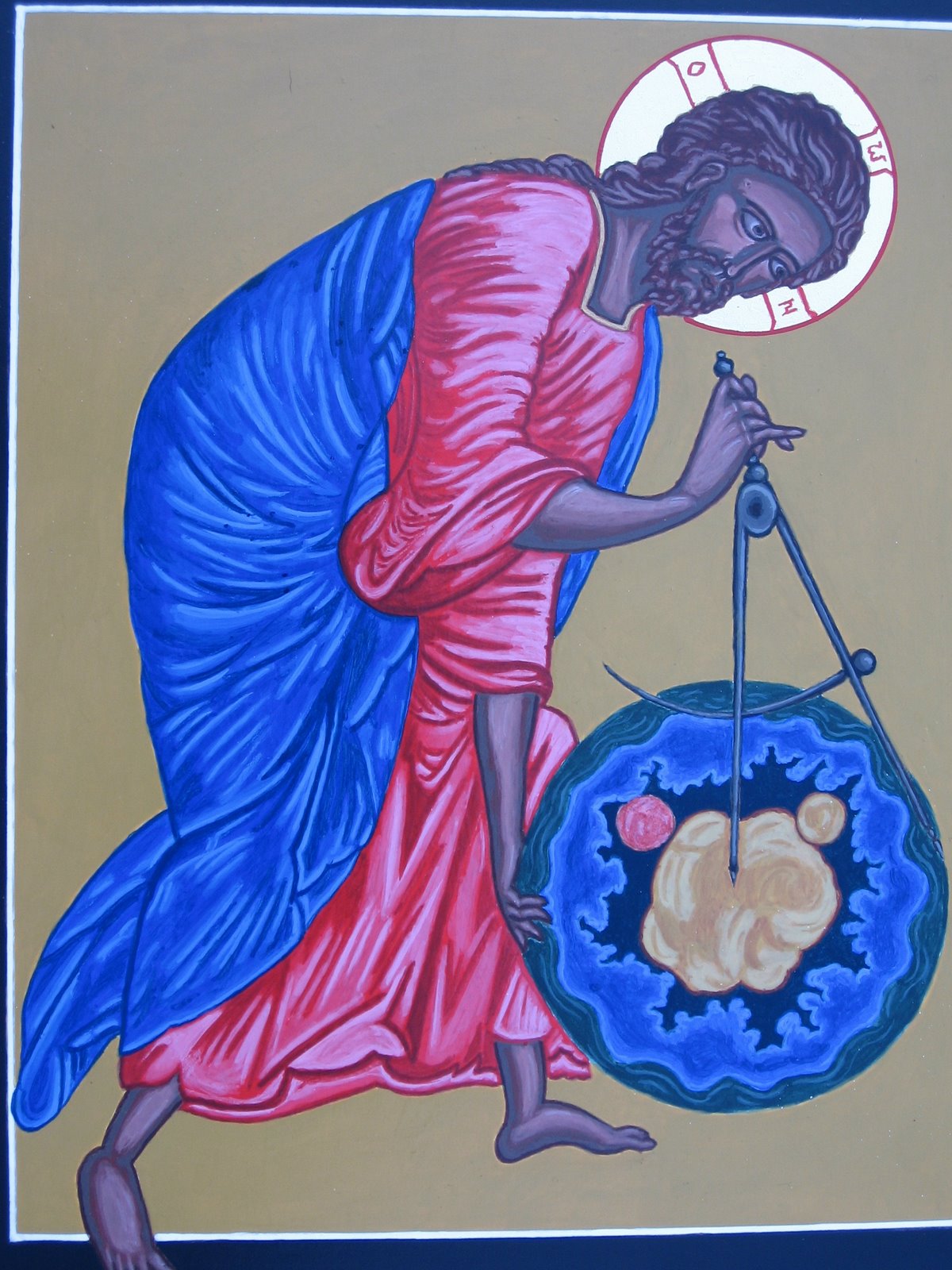
This is a photo of an icon of creation that I just completed. The image is adapted from an image found in the Bible Moralise – mid 13th century.
In the beginning was the Word.
And the Word was with God
and the Word was God;
he was in the beginning with God.
All things were made through him
and without him nothing came to be.
(John 1:1-3)
Bless the Lord, my soul!
Clothed in majesty and splendor;
O Lord, my God, how great you are!
You are wrapped in light as with a garment;
you stretch out the heavens like a tent,
you build your upperrooms above the waters…
You set the earth on its foundations,
and never will it be shaken.
(Psalm 104:1-3a, 5)

The Persistent Widow

20 Saturday Oct 2007

Posted by mcummins2172 in Uncategorized

≈ Leave a comment

In a reflection on the gospel parable of the persistent widow (Lk. 18:1-8), Bishop Vincenzo Paglia writes that the widow, “was certainly a victim, but not one resigned to her condition. Insistently, she went before the judge demanding justice.” Yes, she was a victim – an injustice had been committed against her – she knew it, the judge knew it and the people of the town knew it. But what is striking here is that she is not resigned to her condition. The widow was persistent in her demand for justice. This persistence is all the more striking in considering the context of the time when women had little to no room for any appeal to justice, especially widows. The question is worthy of being asked; what enabled this woman to not resign herself, to not be merely a victim?

I believe an answer to this question may be found in Jesus’ own further reflection on the parable. The Lord says, “Will not God then secure the rights of his chosen ones who call out to him day and night?” In fact the answer found here is threefold: 1) God, 2) his chosen ones, 3) calling out to God “day and night”.

God. Known or unknown, acknowledged or not acknowledged – there is a God and because of this fact (to paraphrase Dr. Martin Luther King Jr.) there is an arc of justice to the universe, it may move slowly but it does move surely. And it will not be denied. The judge may not have feared or believed in God but the widow did and she knew that God’s justice surpasses any injustice.

His chosen ones. Not only is there a God to this universe but God chooses to enter into relationship with His people. God the great clock maker who builds and sets the machine running but then steps away is not the God of our Bible. The Scriptures – contrary to the clock maker image – demonstrate that God does not step away from His creation but, in fact, steps further and further into His creation – even to the point of the incarnation, even to the point of death. God is present here. God is a friend to call upon. The widow knew this. She knew when she stood before the judge that she was not standing alone. God stood with her.

God hears those who call out to Him “day and night”. The widow was a person of prayer. By her very need, by the very fact of literally having no further recourse, the widow embodies the weak strength of prayer. This embodiment is not the resignation and imprisonment of victimhood that is one of the deadening tumors of a worldview that allows no space for God. No, this embodiment is the very essence of strength – a strength that acknowledges that there is a God, that God chooses to enter into relationship with us and that, therefore and by God’s choice, we are never merely a victim. Through her prayer, the widow knew herself to be a child of God.

This is the widow’s faith, the faith that Jesus holds up to us as a model. And Jesus asks us, “When the Son of Man comes, will he find faith on earth?”

Gratitude

12 Friday Oct 2007

Posted by mcummins2172 in Uncategorized

≈ Leave a comment

Ten lepers were cleansed (Lk 17:11-19). At some point all ten had to have known that they were cleansed of their disease but only one returned and fell at the feet of Jesus and only that one heard the words, “Stand up…” spoken by the Lord of Life. There is a difference between “knowledge of” and gratitude and the story of the one grateful leper demonstrates this for us. Further, the story verifies that there is a specific growth in the awareness and understanding of the human person that comes only through gratitude. Here it is important to remember that only the one who returned and thanked Jesus heard the words, “Stand up”.

We can live life with a “knowledge of” God and there is certainly a level of good in this. We can know God is in heaven and that we believe in Him but in this secure knowledge; God remains separate, God stays “up there”. Gratitude (different from “knowledge of”) allows no room for separation. Gratitude by its very nature implies an open heart, it implies a desire for relationship. Gratitude means falling at the feet of the other, heart open and vulnerable, and saying “thank you”. It is a healing thing to be able to honestly and sincerely say “thank you”. In his gratitude the one leper who returned did not only acknowledge his cleansing and he did not only demonstrate his desire for a continuing relationship with the Lord but through this return he also came to a deeper awareness of who he was (an opportunity unfortunately passed over by the other nine).

“Stand up” says Jesus to the one who returned. When God speaks to us and says “stand up” it means be freed from the burden of sin – all its weight and its lies and its false understandings. To “stand up” means not to be bowed down to the earth with our eyes averted from heaven but to stand erect, to return to the posture in which we were originally made by our Creator – feet on earth and eyes to heaven – in all of this coming to a deeper awareness of the truth of who we are.

Gratitude and relationship are what lead to this realization. This is the lesson for all disciples of the one leper who returned. “One of them, realizing he had been healed, returned, glorifying God in a loud voice; and he fell at the feet of Jesus and thanked him.” And to him alone, Jesus said, “Stand up.”

The "Thickness" of Time

10 Wednesday Oct 2007

Posted by mcummins2172 in Uncategorized

≈ Leave a comment

Now, is it just me or does it seem that our modern world is consumed with time. I would even go so far as to suggest that probably never before has there been such an obsession with time and the unrelenting demand to manage it and make every moment memorable and productive (according to a specific criteria though).

One might assume that this is the way things have always been; but Charles Taylor, in his book A Secular Age, demonstrates that the “homogeneous, empty” approach to time of our age has developed out of the disenchantment of the world and the birth of the secular. In other words, time has not always been viewed as it now is and further (of important note), time does not always need to be understood as it now is. Things can change – individually and even as a society.

With the removal of the Sacred and the defining of human fulfillment solely to an exclusive humanism that does not allow for anything beyond itself, time loses its thickness. When time is held in relation to eternity there is a depth dimension to the movement of our days. When time is separated from eternity we are left with just one minute falling after another … after another … after another … In this ticking of the disenchanted, secular clock we rush to fill up the space with experiences. We rush to “make productive” every moment. God forbid that one second slip away! In the secular backdrop, time is found to be an merciless tyrant and the supreme irony is that as we ourselves seek to master every single moment of time we are the ones who end up in fact becoming mastered by the click of the clock.

This does not have to be. With the Sacred and the awareness of eternity, time (rather than being a tyrant) becomes a friend. When I pray before the Blessed Sacrament there is a different depth to time. When we gather in worship around the altar heaven and earth unite – the eternal and the finite. When we gather as Christian community or in Christian service we witness to a different time. To be a Christian in our secular age means, literally, to run according to a different clock – a clock where time and eternity interpenetrate. For the Christian, time always has the potential to be thick.

My belief is that on an intuitive level we all know this, we all experience this and we all yearn for this. These are the moments in life when it all comes together, when it fits, when beauty reveals itself and insight is gained. It might be a moment of life changing epiphany or a simple daily awareness, either way time witnesses to eternity.

I think that the desire of the younger generations for something “more” (which I witness again and again in my ministry) is in part a desire to break free of the secular world’s limited, empty and homogeneous march of time. We, as Church, would do well to listen attentively to the yearnings of the younger generations. Like the young Samuel and the elderly Eli, the intuitive yearnings of the younger generations can awaken in the older generation an awareness that it has wisdom and guidance to impart. The Church has a different notion of time to give to the hearts of those who yearn for something “more”.

At heart, it is a radical act to live according to a different time frame but following Jesus – the incarnate, Eternal Word – has always tended toward the radical I suppose.

Carrie Underwood as theologian

29 Saturday Sep 2007

Posted by mcummins2172 in Uncategorized

≈ Leave a comment

I have heard it said in different ways and I have also read it at different times, that the one true possible regret in life (when all is said and done) is the regret of not having been a saint. Now, this sounds both pretty lofty and quite intense but I think that the song of a popular singer can help us here. The singer is Carrie Underwood and the song is “So Small“.

What you got if you ain’t got love, the kind that you just want to give away … Sometimes the mountain you’ve been climbing is just a grain of sand … When you figure out love is all that matters after all, it sure makes everything else seem so small.

When we figure out that love is all that matters after all – the love that you just want to give away…

The lesson that the saints learned and the task that stands before us all is to learn to love with the very heart of Christ – with the love that gives away.

Now, we can replace this love with all sorts of things (we are very adept at this). We can even try to avoid this love but it must be stated that we are always less for it. It is of great benefit to us to notice in the parable of Lazarus and the rich man (Lk. 16:19-31) both what we are told and also what we are not told – both in regards to the rich man’s possessions and his very self. Both what is made present to us and what is left absent from us in the parable have something to teach here. Jesus says, “Once there was a rich man who dressed in purple and fine linen and feasted every day…” This man had all the best that the world could afford but what is not mentioned? What is absent from this succinct summation of the man’s life and “possessions”? Joy. In the midst of all the fine dining and all the sumptuous living, there is found a noticeable absence of joy in the man’s heart.

This absence, this vacuum is indicative of a loss of personhood. This is the other part of what we learn from what is left unsaid in the parable. Jesus intentionally does not name the rich man in the parable. We know the poor man’s name – Lazarus the beggar – but not the rich man’s. His name stands forgotten. Name is personhood. It is identity. So, somewhere along the line, this man lost not just his capacity for joy but tragically even more so. The man lost his very self.

To learn the lesson of the saints, to learn how to love with the very heart of Christ (to figure out in our lives that which is most important) means both to find joy and to gain true personhood. When we love with the heart of Christ, with the love that gives away, we gain our name – our very selves. And this is a beautiful thing to behold!

But you, man of God, shun all this. Strive to be holy and godly. Live in faith and in love, with endurance and gentleness. Fight the good fight of faith and win everlasting life to which you were called… (1 Tim. 6:11-12)

If I may be so bold as to paraphrase. In the light of God’s grace, seek to shun all that reduces the truth of who you are and live the love that gives and by so doing discover the very name that God alone has given you.

When we figure out love is all that matters after all, it sure makes everything else seem so small.

The one regret is not to have been a saint…

← Older posts
Newer posts →
Follow The Alternate Path on WordPress.com

Enter your email address to follow this blog and receive notifications of new posts by email.

Previous Posts

  • May 2026
  • April 2026
  • March 2026
  • December 2025
  • November 2025
  • August 2025
  • April 2025
  • February 2025
  • January 2025
  • December 2024
  • August 2024
  • July 2024
  • June 2024
  • May 2024
  • April 2024
  • March 2024
  • February 2024
  • January 2024
  • December 2023
  • November 2023
  • October 2023
  • August 2023
  • July 2023
  • May 2023
  • February 2023
  • January 2023
  • December 2022
  • August 2022
  • July 2022
  • April 2022
  • January 2022
  • December 2021
  • September 2021
  • August 2021
  • July 2021
  • May 2021
  • April 2021
  • January 2021
  • December 2020
  • November 2020
  • October 2020
  • August 2020
  • July 2020
  • May 2020
  • April 2020
  • March 2020
  • February 2020
  • December 2019
  • October 2019
  • September 2019
  • August 2019
  • July 2019
  • May 2019
  • April 2019
  • March 2019
  • February 2019
  • December 2018
  • November 2018
  • October 2018
  • August 2018
  • July 2018
  • June 2018
  • April 2018
  • March 2018
  • February 2018
  • January 2018
  • December 2017
  • November 2017
  • September 2017
  • August 2017
  • July 2017
  • June 2017
  • May 2017
  • April 2017
  • March 2017
  • February 2017
  • January 2017
  • December 2016
  • November 2016
  • October 2016
  • September 2016
  • August 2016
  • July 2016
  • June 2016
  • May 2016
  • April 2016
  • March 2016
  • February 2016
  • January 2016
  • December 2015
  • November 2015
  • October 2015
  • September 2015
  • August 2015
  • June 2015
  • May 2015
  • April 2015
  • March 2015
  • February 2015
  • January 2015
  • December 2014
  • November 2014
  • October 2014
  • September 2014
  • August 2014
  • July 2014
  • June 2014
  • May 2014
  • April 2014
  • March 2014
  • February 2014
  • January 2014
  • December 2013
  • November 2013
  • October 2013
  • September 2013
  • August 2013
  • July 2013
  • June 2013
  • May 2013
  • April 2013
  • March 2013
  • February 2013
  • January 2013
  • December 2012
  • November 2012
  • October 2012
  • September 2012
  • August 2012
  • July 2012
  • June 2012
  • May 2012
  • April 2012
  • March 2012
  • February 2012
  • January 2012
  • December 2011
  • November 2011
  • October 2011
  • September 2011
  • August 2011
  • July 2011
  • June 2011
  • May 2011
  • April 2011
  • March 2011
  • February 2011
  • January 2011
  • December 2010
  • November 2010
  • October 2010
  • September 2010
  • August 2010
  • July 2010
  • September 2008
  • August 2008
  • April 2008
  • March 2008
  • February 2008
  • January 2008
  • December 2007
  • November 2007
  • October 2007
  • September 2007

Popular Posts

  • thealternatepath.org/wp-c…
  • thealternatepath.org/wp-c…
  • thealternatepath.org/wp-c…
  • thealternatepath.org/wp-c…

Blog at WordPress.com.

  • Subscribe Subscribed
    • The Alternate Path
    • Join 156 other subscribers
    • Already have a WordPress.com account? Log in now.
    • The Alternate Path
    • Subscribe Subscribed
    • Sign up
    • Log in
    • Report this content
    • View site in Reader
    • Manage subscriptions
    • Collapse this bar