• About The Alternate Path

The Alternate Path

~ Thoughts on Walking the Path of Christian Discipleship

The Alternate Path

Category Archives: Uncategorized

The Embrace

13 Thursday Dec 2007

Posted by mcummins2172 in Uncategorized

≈ Leave a comment

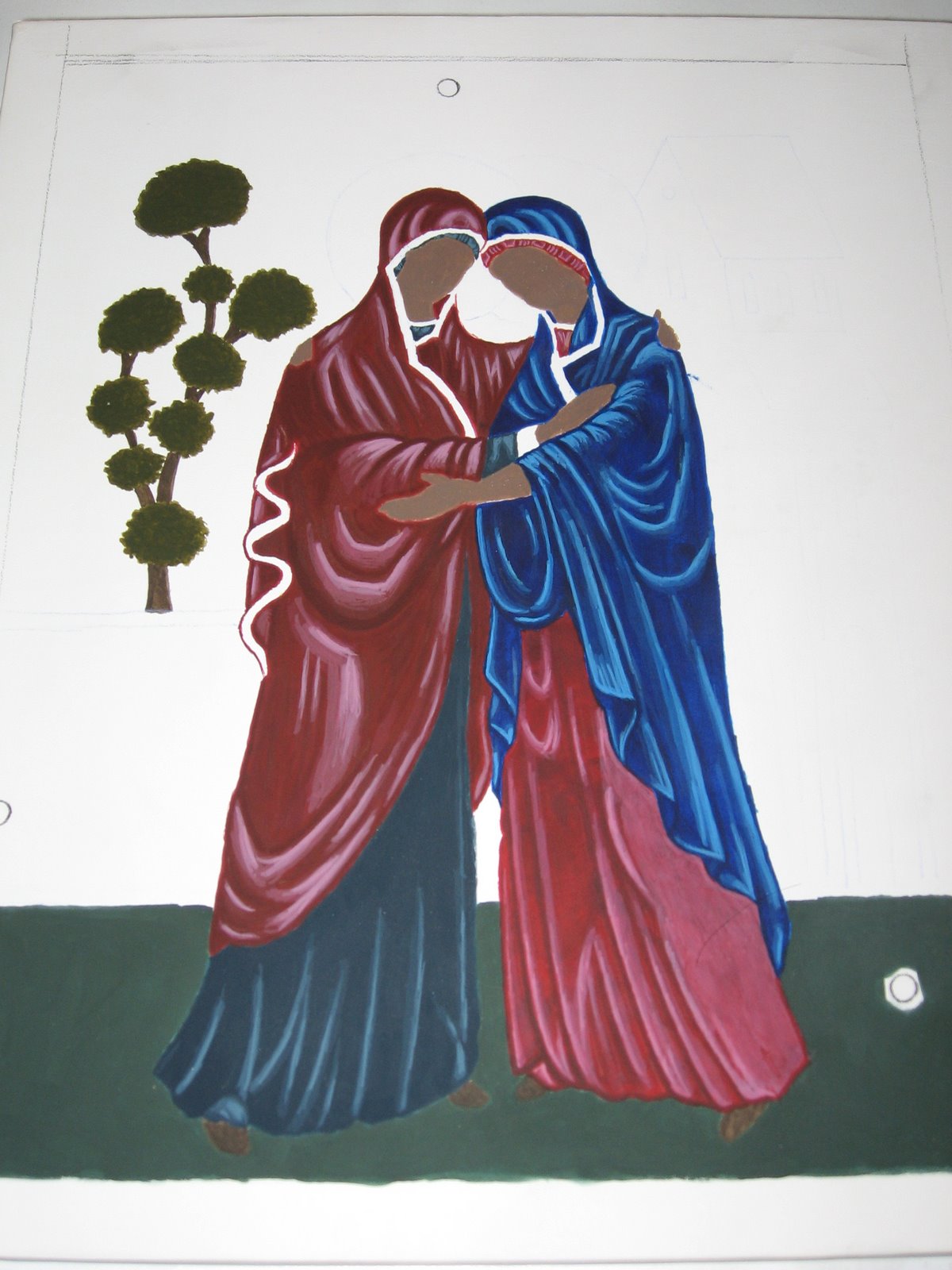
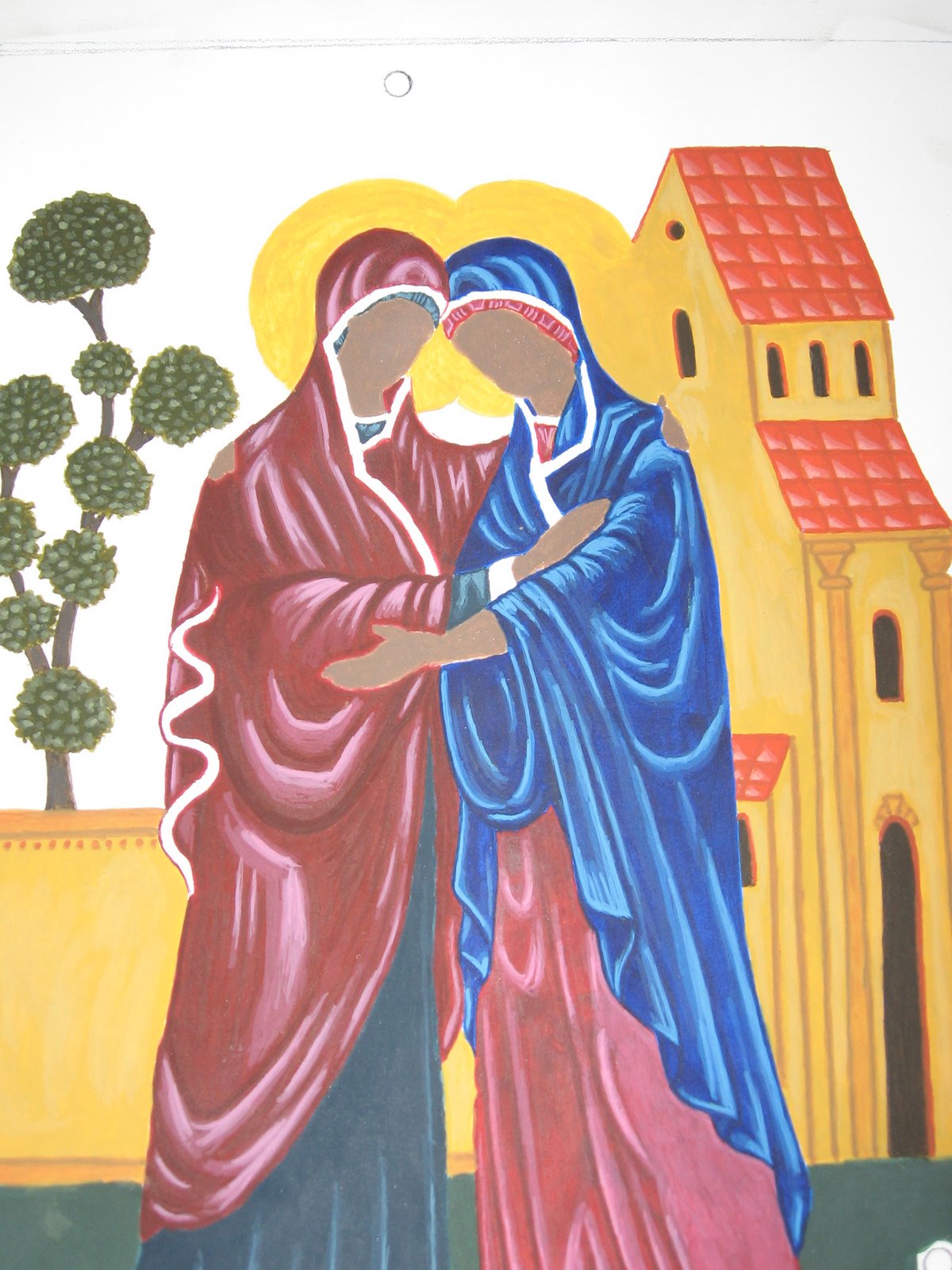
I have altered the icon from the original, not intentionally though. In the original icon – on Elizabeth’s left arm that embraces Mary there is a red sleeve. I did not notice this in the original image I copied from and left the sleeve out. Now Elizabeth’s arm is bare – the sleeve pushed up. I like this though. We “roll up” our sleeves when we are busy, when we have work to do. I can imagine Elizabeth busy about the work of the day when Mary arrives. Immediately this work is left behind as Elizabeth embraces her cousin in welcome!

Both of these women knew full well the daily realities of life. Both lived in a setting that our society would classify as “third world” and thus consider of little importance and find easy to ignore.

But God does not think as we think and neither does God assign value as we do. For God, this encounter between two poor women in a third world country is of supreme value.

Here is a prayer experiment to help put the image in the context of our day. In prayer, imagine the setting not being what is found in the icon but the scene of a refugee settlement camp in one of the countries of Africa. Both Mary and Elizabeth’s skin is of a darker hue and they are members of a tribe forced to flee their country due to the threat of genocide. For weeks they have been separated from one another and finally (after searching non-stop) they find one another in the chaos of the camp. Imagine the joy and the love and the peace of that moment even as chaos and despair seem to swirl around them.

This encounter, for God, is of utmost importance; no matter if the world deems it of any significant value.

Part of the task put before us during the Advent season is to learn to see as God sees and to learn to value as God values.

The Tree

12 Wednesday Dec 2007

Posted by mcummins2172 in Uncategorized

≈ Leave a comment

“… the most important tree in the desert is the tree of genealogy. Every tribe is a tree, and man in the desert defines himself as a branch of the tree. … The branch cannot have life without the tree nor the tree without roots or the stable foundation in time. … Man is therefore man only by reason of his genealogy.” (Professor Wael Farouq – professor of Arabic at the American University in Cairo – quoted by Archbishop Migliori, “Catholicism and Islam: Points of Convergence and Divergence”, Origins, Vol. 37, No. 26)

Behind Mary stands a tree. I do not think that this tree is just for decoration nor is it there just to fill up space and balance the icon.

If we affirm that Jesus Christ is fully human then we must allow for all the constitutive elements of what it means to be “human” – one of these being genealogy. “Man is therefore man only by reason of his genealogy.”

The tree witnesses to the genealogy of Jesus – a genealogy which Matthew in the first chapter of his gospel takes great pains to lay out and to present. Jesus is both son of David (in the particularity of God’s covenant with Israel) and son of Abraham (in the universality of God’s Kingdom). Because of this “both”, the life of the Christian is a life lived in the dynamic tension between both the particular and the universal dimensions of God’s Kingdom.

What is also of importance to note in Matthew’s tracing of Jesus’ family tree is how intimately God is involved from the beginning. Throughout the centuries, God both nourishes and prunes this tree and in either circumstance God is there, God is involved.

Before demanding obedience to His will, before the dynamic interplay of faith and reason – God seeks relationship with us. This seems to be the primary move on God’s part. God enters into human history. God does not seem to be content to be just creator at the beginning and judge at the end. God enters into the very scene itself and, again and again, plays a dynamic role. This is true in the history of our world and in the history of our lives. God moves in our lives – often in ways unseen and unnoticed but true nonetheless – both nourishing and pruning.

The icon reminds us that God prepares the tree for its fullest flowering – the very Word made flesh.

From the stump of Jesse a shoot will come forth;
from his roots a branch will grow and bear fruit.

(Isaiah 11:1)

From Darkness to Light

10 Monday Dec 2007

Posted by mcummins2172 in Uncategorized

≈ Leave a comment

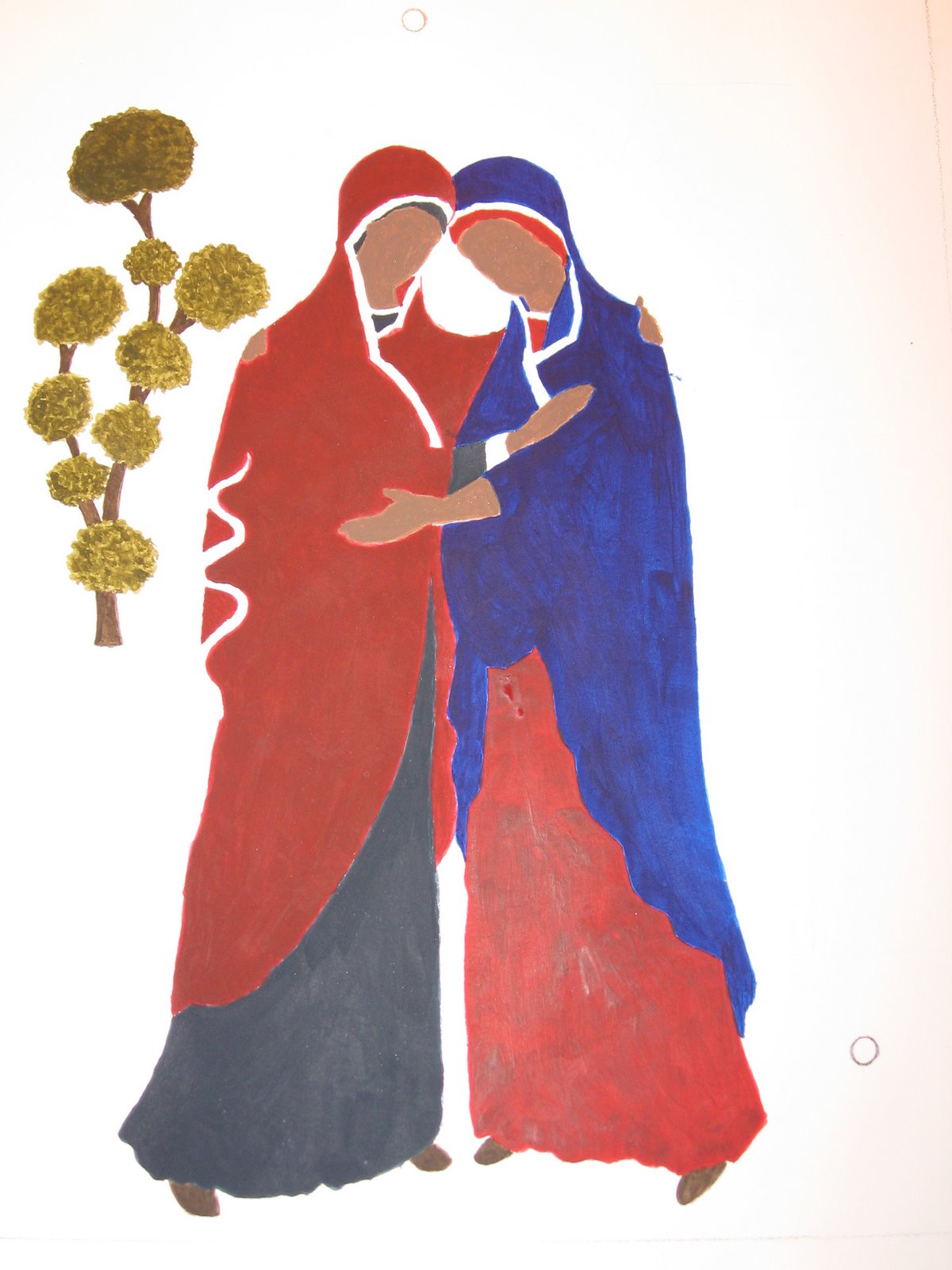
The first step in applying the colors for an icon is to paint the darker, base colors. From this base you then “build up” – adding lighter shades in order to bring depth and movement to the image.

It is a valid art technique and, for iconography, it lends itself to a spiritual/theological interpretation. The interpretation being that the very life of the Christian is a life of being transformed from darkness to light or from glory to glory.

In Western Christianity we have tended to primarily emphasize the atoning and redemptive aspect of our faith (Christ took on the weight of our sin thereby setting us free) often to the diminishment of the transfigurative aspect of the Christian life – an aspect that Eastern Christianity has maintained in its thought. Through Christ (which means living the Christian life; i.e. receiving the sacraments, loving God and neighbor, worshiping God, living community, serving others, etc.) we are transfigured. We are changed from glory to glory. It could be said that living these aspects of the Christian life allows Christ the brush strokes necessary to make of our very lives an icon to God’s glory – bringing depth and beauty to our existence and revealing, through us, God’s Glory to the world.

Advent as a season of hope is a perfect time to deeply reflect on this transfigurative dimension of our Christian faith. This transfiguration has begun through our baptisms and it continues here and now.

Two verses from St. Paul’s Second Letter to the Corinthians can aid us in reflecting on the transfigurative dimension of our lives in Christ.

So, with unveiled faces, we all reflect the Glory of the Lord, while we are transformed into his likeness and experience his Glory more and more by the action of the Lord who is spirit.
(2 Cor. 3:18)

God who said, ‘Let the light shine out of darkness’, has also made the light shine in our hearts to radiate and to make known the Glory of God, as it shines in the face of Christ. (2 Cor. 4:6)

Second Sunday of Advent (A)

08 Saturday Dec 2007

Posted by mcummins2172 in Uncategorized

≈ Leave a comment

Dr. Martin Luther King Jr. once offered these words of reflection,

Despite the fact that all to often people see in the church a power opposed to any change, in fact, the church preserves a powerful ideal which urges people toward the summits and opens their eyes as to their own destiny. From the hot spots of Africa to the black areas of Alabama, I have seen men and women rising and shaking off their chains. They have just discovered they were God’s children, and that, as God’s children, it was impossible to enslave them.

The church preserves a powerful ideal which urges people toward the summits… When we are Church at its best we realize that this ideal is neither of our own making nor of our crafting. We neither own nor control this message, in fact, as its servants we realize that we have been entrusted with it solely in order to be good and wise stewards (of whom there will be an accounting one day). This ideal – the proclamation of being sons and daughters of God – is not a hope invented but rather a hope received.

John the Baptist throughout his life and proclamation knew this distinction and it was based on this awareness that he condemned the religious authorities of his day who lived on the illusion of controlling the way to righteousness. John knew the source of the Kingdom – it did not lie within the control of the religious establishment nor did it lie within himself and his own charisma – it lay within God’s action and God’s movement. The Kingdom was grounded in God’s prerogative. “I baptize with water … the one who is coming after me is mightier than I. I am not worthy to carry his sandals. He will baptize you with the Holy Spirit and with fire…”

The season of Advent invites us to recognize the true source of the “ideal” that we hold and proclaim as Church. It is not a hope invented but a hope received. If it were invented then we would be the most pitiable of people. God has chosen to move specifically within human history. God has come to us. Only in the realization of this amazing truth is it possible to sing, “Justice shall flourish in his time and fullness of peace forever.”

The recognition of hope received though does not lessen the responsibility on our part as Church. Isaiah’s prophecy and description of the Anointed One also contains within it our mission as Church as well. As we receive; we are to proclaim. As we know; we are to live.

They had just discovered they were God’s children, and that, as God’s children, it was impossible to enslave them.

Hope received, not invented, is the Advent proclamation and it is the source of the beauty of peace.

I have seen men and women rising and shaking off their chains – they discovered that they were God’s children.

A note on terminology

07 Friday Dec 2007

Posted by mcummins2172 in Uncategorized

≈ Leave a comment

Some people have asked about the use of the term “write” in relation to the drawing and painting of an icon.

The term “write” is used because an icon is considered to be an expression of visual theology. So, this being the context, it is correct to say that one is “writing” an icon. (This is much to the chagrin of my brother John – the journalist and writer.)
Further, through the medium of image and symbol not only does the icon express great truths of our faith but it also brings one into a living encounter with those truths. It can be said that it is just as much the icon that observes us as it is we who take in the icon.
Here, a key distinction in perception might be helpful. In standing before an icon a person is not viewing a static, passive object that one then assimilates by his or her own powers – similar to reading a textbook in order to solely draw out what one needs to know. In coming before an icon one is fundamentally entering into an encounter and a dialogue with a reality that is active and present and that has something to say and teach what we need to hear.
In iconography the active agent is not just the viewer – it is also the icon itself. The icon invites one into the openness of a dialogue between a person and the eternal.
Theology is the dialogue between the soul and God who has fully and definitively revealed Himself in Jesus Christ – the Logos, the Word “made flesh” – and who communicates Himself to us through our senses, our conscience and our reason. Jesus is the primary and fullest image (icon) of God the Father. “He (Christ) is the image of the unseen God, … for God was pleased to let fullness dwell in him.” (Col. 1:15, 19). The theology of iconography springs from the incarnation – the choice of God to become en-fleshed. All this being said; when one paints an icon, one is “writing” a theology of God and salvation – a theology that has its roots in nothing less than the incarnation itself.

The Ordinariness of it All

07 Friday Dec 2007

Posted by mcummins2172 in Uncategorized

≈ Leave a comment

The scene portrayed is actually quite common. It is nothing really extraordinary – two friends embracing. The spectacle is repeated each day in a thousand different ways and contexts. It happens at airports, in driveways, at parties – to mention just a few contexts. In fact the occurrence is so common as often to be overlooked and passed over by the bystander.

But for the ones within the embrace, in whatever setting, there is found a deep joy and communion of heart.

There is a deep tenderness and understanding in this specific encounter between Mary and Elizabeth. It is, I believe, a silent moment. The very foundation of the world has been shaken and these two women know it. In fact, they are at the very epicenter.

The world rushes by – not even noticing these two women in the embrace. What is so special about it? It happens all the time. What the world fails to see and what these two women know is that everything has changed. The world and all its structures has been turned on its head.

A new communion has been established between God and us, and therefore, between me and you.

I have just seen that if one traces the outer edges of the two halos and carries the tracing down to where the arms cross then the image of a heart is drawn.

Mary’s choice for Hope

06 Thursday Dec 2007

Posted by mcummins2172 in Uncategorized

≈ Leave a comment

Mary’s visit to Elizabeth is found only in Luke’s gospel. The passage begins after Gabriel’s announcement and Mary’s “yes” to God’s will and it concludes with Mary’s great canticle and her staying for three months with her cousin (Lk. 1:39-56).

Mary decides after the angel’s departure to set out to visit her cousin Elizabeth in the hills of Judah. Some scripture translations add “in haste” as the descriptive.

The decision is no light matter. The journey would have taken four days. A young girl (14 or 15 years old) walking alone would have been quite vulnerable. The journey certainly had risks and would have been a fearful thing to contemplate. But Mary’s decision to go brings out an important dynamic in the life of Christian faith.

Simply put, Mary makes the choice for hope and not for fear. Hope here is not naive, unrealistic optimism but rather a virtue given, a gift from God that is acted upon. Hope is the choice to trust in God’s promise and to live by God’s promise.

In many ways, I believe – as we come to Advent in the year 2007 – we live in a culture and a context ruled by (and manipulated by, I might add) the mechanics of fear. “Terrorists on the outside, “illegals” on the inside.” Mary’s choice for hope and not fear is a witness to us. It points out a different way.

(By the way, I hate the phrase “an illegal” that is being used to describe a whole grouping of people – a human being made in God’s image is never an “illegal”. Human dignity is determined not by any country’s mandate but by God-given inalienable rights that our own country’s Declaration of Independence speaks so movingly of. I think that the fear-mongers in the media and society who toss this term around need to re-read their own country’s founding documents.)

The mechanics of fear choke, stifle and ultimately kill off all life. The opposite of fear is not bravado and strength, rather it is hope. To choose hope is to step away from fear and to make the choice to trust in God. It is the choice to live by the vision of the Kingdom of God that is inaugurated by the coming of God’s own Son.

At the very beginning of the gospel – before all the disciples time and again do “not get it”, before the religious authorities misunderstand, before the political rulers fear – Mary understands what is beginning to unfold and she sings of it in her canticle.

At fifteen years of age, Mary setting out on a four day journey shows us a different way – the way of hope.

The Cartoon

05 Wednesday Dec 2007

Posted by mcummins2172 in Uncategorized

≈ Leave a comment

I am not a trained artist in any sense of the term. Although both my father and mother drew and painted when they were younger. I remember as a young boy watching as my mother drew flowers and people’s faces – maybe an interest was gained through this. (A hope I have during my time here at the university is to take some drawing classes.)

Right now I copy the icons that I write – either I print them off of the Internet or photocopy them from a book. Once I have the copy I use tracing paper in order to sketch out the cartoon. I trace the lines, the tilt of the head, the movement of the hand all from the original.

I have been told that in iconography this is legitimate and accepted. There is no copyright being infringed upon – this helps to calm my scrupulosity. Through tracing one learns to write as an iconographer would write. Your own hand learns to move as the hand of an iconographer’s would across the board. The very discipline of tracing reminds one that we receive from those who have gone before us even when they are unknown to us. I do not know who originally wrote this icon of the Visitation that is my source but I am now learning from her or him. In fact in the tracing of the icon I am listening to what the original iconographer has to say about this particular moment in Scripture. I am standing with the iconographer and together we are reflecting on the mystery of the Visitation.

Advent itself leads one to a recognition of and gratitude for all the unknown people who have preceded us on the journey and from whom we have received the beautiful gift of faith. Advent calls us to remember and even stand with all those generations who yearned for and awaited the coming of the Messiah. They were the ones who learned to read the great promise in the words of Scripture and build their lives centered on the hope of the promised Savior – the unknown Simeons and Annas. Advent further helps us to remember and again stand with all the generations who have lived since the great Christ event – all the unknown people who have formed and lived what we in turn have been given and entrusted with. All these unknown people teach us how to write our own lives as Christians.

Iconography demonstrates that in faith and probably throughout all aspects of life we may not so much invent on our own as we 1. receive, 2. enflesh and, in turn, 3. pass on.

To whoever wrote this icon of the Visitation, “thank you”.

Place and Space

03 Monday Dec 2007

Posted by mcummins2172 in Uncategorized

≈ Leave a comment

The place of writing an icon is important, at least it has become so for me. On the surface with paint tubes, brushes and papers strewn everywhere the place can appear to be nothing more than a cluttered mess. In fact though it is a place of prayer and reflection – a place of encounter between one human soul and that which is much deeper and more true – the Divine.

My icon writing “place” is a drafting table. A gift given by some friends a few years ago. Currently the table occupies an area in my office at the Catholic Center looking out the front windows. Sitting at the desk with the blinds open I look straight out onto the front porch of the house and beyond that onto Locust Street. I many ways – I have come to realize – I look out onto life. Across University Parkway from campus with well kept sidewalks, beautiful old houses (large and small) and large shading trees the tree streets neighborhood is very inviting to many people.

So far during my first five months at this residence I have seen a July 4th parade pass by (replete with children on tricycles and even a fire truck with flashing lights) and a Halloween costumed group of revelling, college students walk by – to the next house party I assumed. Everyday I see college students ride by on bikes going to a from campus. I have seen whole families out for a stroll and have even witnessed a grandmother pulling two infant grandchildren in a red wagon. Couples hand in hand, young and old, find the trees streets to be a very inviting place to stroll. And always there are children either carrying book bags or baseball bats…

A few days ago I looked up from my desk in order to catch the sight of a gust of wind moving a swirling cloud of fall leaves down the street. “The Spirit blows where it wills…” I thought.

Place is important – where God has put us at this moment, at this time in our lives. Wherever this may be, God has us here for a reason. For me, my place is now the Catholic Center at ETSU in Johnson City, TN. – my hometown, being close to family and ministering to this community.

I also hold that the move to make a space for God is also important because allowing God a space sanctifies the place we happen to find ourselves occupying. Whether “making space” means setting aside fifteen minutes a day to pray, making a prayer corner in one’s home (and using it) or having a drafting table to write icons on – the space allows God in. The space allows God to touch the movement of our lives and to bless it.

Mary and Elizabeth – the two women embracing in the icon of the Visitation – allowed a space for God in their lives. They let God in and they knew joy for it.

Christ the King

24 Saturday Nov 2007

Posted by mcummins2172 in Uncategorized

≈ Leave a comment

With the predawn opening of America’s department stores on Black Friday we have entered (willingly or not) into the frenzy of the secular holiday. We are now officially awash in the sights and sounds of the season and we are told to buy, buy, buy … not only is it good for the economy but it is also an act of patriotism!

In the Feast of Christ the King, our Church throws us a lifeline to hold onto and to help us go deeper in order to find “the true reason for the season”. This Sunday we remember and reflect on who Jesus Christ is and what his birth means for us and for all of history. This Feast allows us to skip forward to the “last chapter” of the book – as it were – before we enter into the opening pages of Advent.

Christ is King – but in what does his kingship consists and how is it achieved? The kingship of Christ consists not in worldly might and the ability to impose one’s will and dominate (attested to by both Scripture and Tradition) but rather in the ability to reconcile and to make peace. Christ holds together. He heals that which has been fractured by sin. This is truly the work of God alone. The hymn found in The Letter to the Colossians proclaims, “For in Christ all the fullness was pleased to dwell and through him to reconcile all things for him, making peace by the blood of his cross through him…”. Christ the King makes peace. Christ heals that which is fractured both individually in our hearts and universally in our world and all creation.

How is this achieved? Here we are confronted with nothing less than the mystery and the paradox of the cross. At this moment, a quote from Thomas Merton might be an aid as we contemplate the work of Christ the King on the cross.

Do not depend on the hope of results.
When you are doing the sort of work you have taken on,
you may have to face the fact that your work will be apparently worthless
and even achieve no worth at all,
if not perhaps, results opposite of what you expect.
As you get used to this idea,
you will start more and more to concentrate not on the results,
but on the value, the rightness, the truth of the work itself.

Hanging there on the cross (being jeered at and mocked by all around him) Christ the King is “doing” the work of peace and of reconciliation, not by the imposition of his will but by the very rightness, the very truth of the work itself – the rightness of the giving of himself and the truth of obedience to the Father’s will. Here alone is where peace is found and where the work of peace is built and achieved.

We always pray for peace during this time of year. We pray for it, we yearn for it, we even sing songs testifying to our desire for peace. In all this our Christian faith says “yes” it is right to pray for peace but also it is right to work to build true peace. Here though (our faith also wisely cautions) let our work be true and let our action be informed by the full revelation of Christ – peace is not built through the power of an action and the imposition of will but through right action – doing something because it is the right thing to do – no matter how small, seemingly insignificant and maybe even disparaged and mocked. Christ the King – “making peace by the blood of his cross” – teaches us that peace (both in our hearts and in the world) can only be built through the rightness and the truth of the work itself.
← Older posts
Newer posts →
Follow The Alternate Path on WordPress.com

Enter your email address to follow this blog and receive notifications of new posts by email.

Previous Posts

  • May 2026
  • April 2026
  • March 2026
  • December 2025
  • November 2025
  • August 2025
  • April 2025
  • February 2025
  • January 2025
  • December 2024
  • August 2024
  • July 2024
  • June 2024
  • May 2024
  • April 2024
  • March 2024
  • February 2024
  • January 2024
  • December 2023
  • November 2023
  • October 2023
  • August 2023
  • July 2023
  • May 2023
  • February 2023
  • January 2023
  • December 2022
  • August 2022
  • July 2022
  • April 2022
  • January 2022
  • December 2021
  • September 2021
  • August 2021
  • July 2021
  • May 2021
  • April 2021
  • January 2021
  • December 2020
  • November 2020
  • October 2020
  • August 2020
  • July 2020
  • May 2020
  • April 2020
  • March 2020
  • February 2020
  • December 2019
  • October 2019
  • September 2019
  • August 2019
  • July 2019
  • May 2019
  • April 2019
  • March 2019
  • February 2019
  • December 2018
  • November 2018
  • October 2018
  • August 2018
  • July 2018
  • June 2018
  • April 2018
  • March 2018
  • February 2018
  • January 2018
  • December 2017
  • November 2017
  • September 2017
  • August 2017
  • July 2017
  • June 2017
  • May 2017
  • April 2017
  • March 2017
  • February 2017
  • January 2017
  • December 2016
  • November 2016
  • October 2016
  • September 2016
  • August 2016
  • July 2016
  • June 2016
  • May 2016
  • April 2016
  • March 2016
  • February 2016
  • January 2016
  • December 2015
  • November 2015
  • October 2015
  • September 2015
  • August 2015
  • June 2015
  • May 2015
  • April 2015
  • March 2015
  • February 2015
  • January 2015
  • December 2014
  • November 2014
  • October 2014
  • September 2014
  • August 2014
  • July 2014
  • June 2014
  • May 2014
  • April 2014
  • March 2014
  • February 2014
  • January 2014
  • December 2013
  • November 2013
  • October 2013
  • September 2013
  • August 2013
  • July 2013
  • June 2013
  • May 2013
  • April 2013
  • March 2013
  • February 2013
  • January 2013
  • December 2012
  • November 2012
  • October 2012
  • September 2012
  • August 2012
  • July 2012
  • June 2012
  • May 2012
  • April 2012
  • March 2012
  • February 2012
  • January 2012
  • December 2011
  • November 2011
  • October 2011
  • September 2011
  • August 2011
  • July 2011
  • June 2011
  • May 2011
  • April 2011
  • March 2011
  • February 2011
  • January 2011
  • December 2010
  • November 2010
  • October 2010
  • September 2010
  • August 2010
  • July 2010
  • September 2008
  • August 2008
  • April 2008
  • March 2008
  • February 2008
  • January 2008
  • December 2007
  • November 2007
  • October 2007
  • September 2007

Popular Posts

  • thealternatepath.org/wp-c…
  • thealternatepath.org/wp-c…
  • thealternatepath.org/wp-c…
  • thealternatepath.org/wp-c…

Blog at WordPress.com.

  • Subscribe Subscribed
    • The Alternate Path
    • Join 156 other subscribers
    • Already have a WordPress.com account? Log in now.
    • The Alternate Path
    • Subscribe Subscribed
    • Sign up
    • Log in
    • Report this content
    • View site in Reader
    • Manage subscriptions
    • Collapse this bar