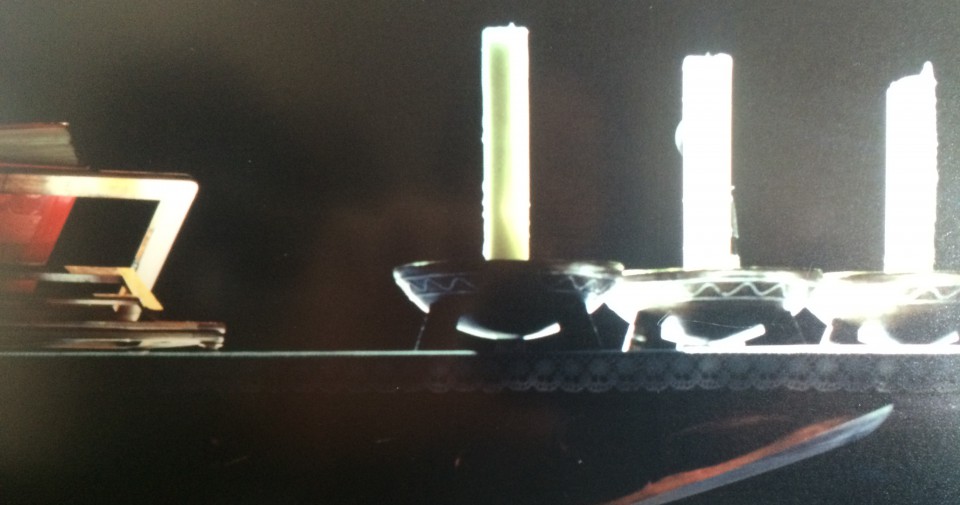
The Possibility of Holiness

I am not holy.  My sins, failures and weaknesses are before me every day, but I believe in the possibility of holiness and it is this belief that keeps me in the Church. 

I am not naïve to the sins and failures of the institution of the Church nor its representatives – past and present, universal and local – but neither am I naïve to the sins and failures of those outside the Church and those who deride “church”.  I have also witnessed their sins and their hidden despair and I want none of it.  The louder and more forced the laugh; the deeper the despair, I believe.  
I do not want nor need a “Church” made in my image.  I know my sins.  Holiness is challenge – lived daily and without fanfare.  I am a creature and I need my Creator to heal what is broken within me.  To pretend that there is no brokenness is, in fact, to deny my Creator. 
Holiness is simple.  I am tired of a presentation of faith that needs to be hyper-stimulated.  I feel sorry for our young people who are growing up in such a world.  I am sorry for the times the Church buys into this.  Holiness cannot be manufactured.  Holiness grows simply and quietly.  What is manufactured quickly fades and leaves a void.  Maybe holiness can begin to grow in this void maybe it cannot.  I know that God can work as God so chooses and I have to trust in this.  
Holiness is not argument and it is not philosophy.  Debate does not lead to conversion, the witness of holiness does.  Philosophy and its structure is a good tool but it is not salvific faith.  The wise steward, we are told, is the one who can go to the storeroom and pull out both the old and the new as needed.  Maybe there are other tools available?
Holiness does not isolate.  Christ, the All Holy One, came into our very midst.  He called us brothers and sisters and taught us to love one another.  Holiness is found in my encounter with the other although it may not be immediately apparent.  The holiness uniquely found in community forces me out of myself and I need this.  If anything, the direction of holiness is from the mountain back down into the valley of the everyday. 
Holiness is not on a mountaintop somewhere but in the Gospel, the sacraments and community.  I need these every day.
Many people like to point to the sins of the Church.  It is nice to have an excuse isn’t it?  Pointing out the perceived sins of others does not grow holiness in my own life; it just gives me a way out.  I need to stand before my Creator on my own and not in contrast to what I perceive as the sins of others. 
Holiness is beautiful and I need beauty – a child playing peek-a-boo, friends laughing, feet being washed.  
I feel sorrow for those who have left the Church.  Christ loves the Church … how can you love Christ and not love what he loves?  Maybe Christ’s love should be bigger than my own resentments and excuses?
Holiness is living in friendship with God.            

The Feast of the Baptism of the Lord: Baptized into the Commitment of Christ

Fr. Robert Barron is a respected theologian, author and speaker.  I was privileged in seminary to have him as one of my professors.  He shares a sports analogy that I have made use of a number of times because, I believe, it speaks so well.  

Imagine a sporting event.  It can be anything – a soccer match, a football or basketball game, a tennis match, volleyball, whatever.  Now imagine all the different characters and roles of the game.  Picture the players (either or a team or an individual) striving with all their ability.  The athlete’s job is to play with all of ones skill.  Imagine the coach or coaches on the sidelines.  Their job is to direct, strategize and encourage.  Imagine the umpires or referees.  Their job is to call foul, to penalize and to make sure that the game is played fairly.  Picture the fans and the crowd.  Their job is to cheer on the team, the athlete, to enjoy the game and to have pride.  These are the different roles and characters of a sporting event and we can probably easily imagine them.  

There is one more role that is critical to any game yet it is easily overlooked.  It is the role of the field or the court itself.  Imagine a sporting event, any type of game, trying to be played without a field or court, without in or out boundaries.  Players can run anywhere, shoot from anywhere.  It would not work, the game would turn to chaos!  It is the field or the court itself with it’s “in and out” boundaries that keep the energy of the game directed and moving!  The field or court itself has a critically important role to play to any sporting event.  

The analogy is this.  Just as the boundaries of a sporting field or court keep the energy of the game directed and moving so the commitments we freely make in our lives keep the energy of our lives moving and directed.  True, authentic and freely entered into commitments do not deny freedom, rather they fulfill our freedom!  If our lives are to go anywhere then they need commitments.  Without commitments it would be like playing a game without any boundaries.  There may be a lot of running around and energy but it is really not going anywhere. 

The Feast of the Baptism of the Lord can be approached from different angles.  The voice of the Father and the coming of the Spirit validates Christ as the Son of God.  The humility of Christ is revealed in his willingness to be baptized by John “in order to fulfill all righteousness”.  In Christ, earth and heaven are once more reconciled.  All of these are true and worthy of deep reflection but what has stood out for me in my prayer over the readings this last week is Christ’s commitment to the will of the Father.  

The one undergirding and guiding principle of our Lord’s life is his obedience to the will of the Father.  Romano Guardini, in his book “The Lord” notes that at different times people have tried to define Christ in different terms – radical revolutionary, utopianist, anti-bourgeois romantic, mystic, itinerant preacher, social reformer.  All of these definitions for Christ, contends Guardini, fall far short of the truth of who Christ is.  The identity of Christ is not to be found in political or social categories but goes much deeper to the very core of the human condition.  Christ is the one who perfectly chooses and follows the will of the Father in all things!  Because of this Christ can never be neatly boxed into any of our human and social categories because he transcends them all!  Christ is just as comfortable having dinner with tax collectors and prostitutes as he is with the righteous and the Pharisee.  He is not naïve to the sins of any group but he is faithful to the will of his Father that all might be saved and have life. 

Christ is defined by his commitment to the will of the Father.  In our baptisms, we have been baptized into the life and death of Christ and we have also been baptized into his commitment.  It is in commitment to God’s will in our life that we find life and we find purpose.  

In this way we know that we love the children of God when we love God and obey his commandments.  For the love of God is this, that we keep his commandments.  And his commandments are not burdensome, for whoever is begotten by God conquers the world. (1 Jn. 5:2-3)  

Authentic and freely-entered into commitment is not opposed to freedom rather it fulfills freedom.  We have been baptized into the life and death of Christ that we might share in his resurrection.  We have also been baptized into his commitment.  In this, life gains direction and it gains purpose which lasts even unto eternity.            

New Year’s Resolution, Pope Francis and the Illusion of Immortality and a Dislocated Shoulder

The end of one year and the beginning of another is always a good time to reflect on the gift of “time” that we have been given.  We take stock of the preceding year.  What were the good moments and blessings?  What were my mistakes, missed opportunities and struggles?  We make resolutions for the coming year.  “This year I resolve to … (fill in the blank).”  In both taking stock on what has occurred and looking to the future is the realization that time is a gift and not necessarily a given (although we can easily think so) and how we make use of this gift does matter both for ourselves and for others. 
In my own “New Year reflecting” I have gained some good perspective both by an insight given by Pope Francis and by a recent personal experience.  The insight being the first of the fifteen spiritual diseases the Holy Father made mention of in his speech to the Curia: the illusion of immortality.  The personal experience being my recent dislocated shoulder acquired on a ski trip to Utah.
The media has certainly picked up on Pope Francis’ Christmas address to the Curia and, as often seems to be the case, many outlets are demonstrating more their own particular slant on things than are offering good reporting.  In the Catholic Church we are used the spiritual practice of the examination of conscience.  It is a helpful and fruitful discipline in the spiritual life.  As I read the address given by the Holy Father to the Curia, I heard a pastor leading his community in an examination of conscience in order that the community might advance on the way of discipleship.  Are these maladies present in the Curia and its work?  Probably, more or less, but neither are these maladies limited to ecclesial circles alone.  Any institution (corporate, media, government, educational) would do well to undertake such a thorough examination.  Something tells me not to hold my breath on this possibility though.  To those media and secular institutions chuckling about the Pope’s remarks, I would remind them that Jesus said something about focusing on the speck in your neighbor’s eye while ignoring the plank in your own.
Here is what the Holy Father said about the first malady.  The first is “the sickness of considering oneself ‘immortal’, ‘immune’ or ‘indispensable’, neglecting the necessary and habitual controls. A Curia that is not self-critical, that does not stay up-to-date, that does not seek to better itself, is an ailing body. … It is the sickness of the rich fool who thinks he will live for all eternity, and of those who transform themselves into masters and believe themselves superior to others, rather than at their service”. 
The Community of Sant’Egidio has a saying, “Each one of us is given only so many Easters.”  Only so many Easters to come to know the risen Lord, only so many Easters to let the truth of the resurrection and the gospel settle into our hearts and our very living.  In other words, no one is immortal.  We each have only so many years given us yet it is so easy to fall into the illusion of immortality.  I can easily think “I can do that tomorrow” but I might not have a tomorrow.  This is the “sickness of the rich fool” and it is very easy to catch, individually and even institutionally!  The humility of knowing that I am not immortal, immune nor indispensable leads me to value each day, each setting and each encounter.  It also allows me to cultivate empathy in my heart.  “There but for the grace of God go I,” is a prized awareness gained by the person who knows that he or she is also not immune.  An awareness of my mortality also leads me to better claim the possibilities each day offers.  A body in motion tends to stay in motion.  This is a dictate of good health and the Holy Father is applying it to the spiritual life both of the individual Christian and to the life of the whole Church.  The Church must remain healthy!  Striving for health enables health!  The illusion of immortality does not enable good health because it leads one into the fallacy of thinking that what is necessary and habitual applies neither to me nor to the institution of which I am a part. 
It is a humbling thing to wipe out on a ski slope and dislocate ones shoulder but humbling moments can lead to wisdom if they are approached correctly.  Five days ago on a trip visiting my brother and his family in Utah I did just this yet, while certainly humbling, I am already learning from this experience.  A body in pain will quickly cut through the illusion of immortality.  This is one learning gained. As I ever so slowly made my way down the remainder of the slope after my fall, not able to put the slightest pressure on my right arm, and once I saw in the clinic my shoulder blade about an inch lower on my arm than where it should be I was under no illusion regarding my mortality!  But there have been other learnings gained.  My brother Tony, with whom I was skiing, is an avid skier as well as being a former Army Airborne Ranger.  The skillset he brings to skiing is at a much higher and advanced level than mine.  Maybe there was a brotherly sense of needing to prove something at work but I should have taken things slower and more elementary.  There is an important value in the mundane work of developing the necessary skillset required rather than jumping right into something.  There is also an important value in acknowledging the correct level at which ones skillset is!  Another lesson learned (again, from my brother) was how I saw him staying aware of the risks involved and planning accordingly.  (I think this also might harken back to his Ranger training.)  He stays updated on the avalanche possibilities, he checks the weather, he takes the time to pack the needed gear before he and his family head out on an outdoor adventure, even when this causes his wife and son a little frustration.  But the extra time given at the outset can prove critical later. 
We are not immortal, the time we are given is a gift and we are called to be good stewards of the time we have been allotted.  In our lives of faith we need to do the mundane work of developing the skillset that is needed and we must not be naïve regarding the situation and times we find ourselves in as Christians.  Our Lord calls us to daily prayer, to the daily work of community and service and he calls us to be as cunning as serpents regarding the world in which we live.  We need to know that the extra time given at the outset can prove critical later.  
Not to boast but hopefully to acknowledge; one skillset I did bring to the table the day of my wipeout on the ski slope was a relaxed and calm approach to the event gained through the discipline of prayer.  The doctor and clinic staff remarked how popping my shoulder back into place was one of the easiest they had ever done.  “Most patients,” they said, “especially those with some muscle mass tend to tense up and this is what leads to a painful experience.  You, on the other hand, were so relaxed and calm that the shoulder easily popped back into place!”  When the staff gathered around me to begin the procedure and the nurse encouraged me to slowly breathe in and out and focus on my breathing I easily slipped into the Jesus Prayer in my thoughts.  A prayer I strive to live with every day.  (Breathe in) Lord Jesus Christ, Son of God, (breathe out) have mercy on me, a sinner.
Each one of us is given only so many Easters.  How might I make best use of the time I have been allotted?  As we make our New Year resolutions it might be worthwhile to reflect on this question.  It might also be worthwhile to be open to insights coming from the most unexpected of places in our lives and experiences (i.e. the insight of a Pope as well as insights gained from dislocating ones shoulder).  

Thoughts on the Sunday readings: John the Baptist and Atticus Finch (3rd Sunday of Advent-B)

The play, “To Kill a Mockingbird” is a story about prejudice and the courage to do what is right.  In the play, Atticus Finch – a lawyer, agrees to defend a young black man (Tom Robinson) when he is unjustly accused of a crime he did not commit.  Racial bigotry is stirred up and Atticus and his family are persecuted for seeking justice for the young man.  Despite the persecution Atticus does fight for justice for Tom but by the end of the trial bigotry and the need to scapegoat win out and the young man is condemned for a crime he did not commit.  After this verdict as Atticus leaves the courtroom and passes his two children, a black minister who is aware of all the factors at play tells the girl and boy to stand because their father is passing, “a good and just man.”

Is not Atticus, in many ways, a figure of John the Baptist?  Atticus can be seen as a man proclaiming the truth even in the face of persecution, misunderstanding and ridicule.  Like John the Baptist, he proclaimed and held to the light even in the very midst of darkness.  Both men faced the same temptations – the temptation to remain quiet, to keep ones head down, to not make waves.  Both also faced the temptation to proclaim oneself.

Throughout the play, Atticus is a soft spoken, humble man even as others talk about all his achievements and abilities.  In his final speech in the courtroom Atticus does not proclaim his own skill as a lawyer nor his gift of rhetoric; rather, he proclaims and points to truth and justice for Tom Robinson.  It was a proclamation to those gathered in the courtroom just as pointed as the cry of the Baptist in the wilderness.

John the Baptist also faced this temptation to proclaim self.  The people were streaming toward John from all over the countryside, there was a deep yearning for the messiah – John knew this and he could have seized all that energy and power!  But he didn’t.  “I am not the Christ,” said John.  “I am the voice of one crying in the desert, make straight the way of the Lord … I am not worthy to untie his sandals.”

John the Baptist was able to do two things extremely well: he was able to look away from himself and he was able to look toward God.  In this he was able to recognize the truth of who he was – a man in need of a savior – and therefore he was able to recognize the true savior when he came (in contrast to the Pharisees).  “I baptize with water; but there is one among you whom you do not recognize, the one who is coming after me, who sandal strap I am not worthy to untie.” (John 1:27)

What John the Baptist and the figure of Atticus proclaim to us is that truth and justice do not lie inherently within ourselves as if they were our own possessions.  They are not part of our constitutional makeup that we can either summon or dispose of at will.  Rather, truth and justice are acquired by us only insofar as we place ourselves in relation to truth and justice itself – whom we proclaim to have a name and a face: Jesus.

As we place ourselves in relation to Christ, we both learn to see anew with eyes enlightened by faith (judging rightly) and our own dignity is found.  The words spoken by the black preacher to the children of Atticus might then be applied to any one of us, “Stand, your father (mother) is passing, a good and just man (woman).”  Whether victorious or not in the realm of worldly success and opinion; could there be any higher compliment?

Come, Lord Jesus and do not delay and, in all things, may we testify to the light! 

Thoughts on the Sunday readings: St. John the Baptist and True Worship (2nd Sunday of Advent – B)

Pope Francis (in a homily given at the Basilica of St. Paul Outside the Walls on April 14, 2013), offered these words about true worship of God. 

     What does it mean, then, to worship God?  It means learning to be with him; it means that we stop trying to dialogue with him; and it means sensing that his presence is the truest, the most good, the most important thing of all.  All of us, in our own lives, consciously and perhaps sometimes unconsciously, have a very clear order of priority concerning the things we consider important.  Worshipping the Lord means giving him the place that he must have; worshipping the Lord means stating, believing – not only by our words – that he alone truly guides our lives.  Worshipping the Lord means that we are convinced before him that he is the only God, the God of our lives, the God of our history.
     This has a consequence in our lives: we have to empty ourselves of the many small or great idols that we have and in which we take refuge on which we often seek to base our security…
The words of Isaiah the prophet are given in regards to John the Baptist, “Behold, I am sending my messenger ahead of you; he will prepare your way.  A voice of one crying out in the desert: ‘Prepare the way of the Lord, make straight his paths.’”  John the Baptist, on the banks of the Jordan River and not in the resplendence of the Temple, is calling the people of Israel back to true worship of God.  John the Baptist, on this second Sunday of Advent, is calling us also to true worship of God. 
To prepare the way of the Lord, to make straight his paths means to clear out from our lives and our hearts all those many small and great idols that we carry and to which we cling in order to give the true and living God the priority which alone is God’s due.  To prepare the way of the Lord means, as Pope Francis says, “…learning to be with (God) … sensing that his presence is the truest, the most good, the most important thing of all.”
Sometimes true character is demonstrated by what one refuses even more so than by what one achieves.  Just as John proclaimed the coming of the Messiah he also proclaimed that he was not the one!  The gospel testifies that all the people of the Judean countryside were coming to John – they were all yearning for the Messiah, for a change.  John could have grabbed that desire and energy of the masses and claimed it for himself but he did not.  “One mightier than I is coming after me … I have baptized you with water; he will baptize you with the Holy Spirit.” 
The real test of worship is how it transforms lives, how it opens us up in humble awareness to the presence of God in our lives.  John had this awareness even, it seems, from those first months in his mother’s womb when he leapt for joy in the presence of the Messiah who, himself, was being carried in womb of the Virgin.  John in the desert, clothed in camel’s hair and a leather belt, witnessed true worship of God and this is what drew the people of Israel to him.  They recognized his authenticity.  John the Baptist lived in the presence and awareness of God.  He made straight the way of the Lord in his own life.  He invites us to do the same. 
Prepare the way of the Lord!  Make straight his paths!   Worshipping the Lord means giving him the place that he must have; worshipping the Lord means stating, believing – not only by our words – that he alone truly guides our lives.  Worshipping the Lord means that we are convinced before him that he is the only God, the God of our lives, the God of our history    

Forgiveness

Seven years and seven months she waited.  Her daughter had been kidnapped by the Lord’s Resistance Army. Not knowing whether her child was alive or dead, Angelina Atyam continuously called out to the Lord for the return of her child.  She was not alone in her anguish.  The children of other parents had also been kidnapped by the LRA – young men to be indoctrinated as soldiers, young women to be used as sex slaves for the army.  Sitting on a panel at the “Love and Forgiveness in Governance: Learning from Experience” conference held at Georgetown University on November 14th, Angelina Atyam shared her story. 

For myself, Angelina Atyam was the most eloquent of the speakers at the conference that day and all of the speakers were excellent, many of them renowned scholars and educators in their field.  She spoke from the heart and she spoke from the gospel.  She recounted a prayer service she attended with many of the parents of kidnapped children in which the words of the Our Father burned into her soul, “…and forgive us our trespasses as we forgive those who trespass against us.”  Struck by the force of these words and their blunt directness she stood up in the midst of this group and said, “Yes, we must forgive!”  Through forgiveness Angelina found a different way.  Neither passive resignation nor consuming anger – she found a way which gave her creative energy to advocate for the children and even reach out to the very ones that had kidnapped her child in a way that neither put them nor the government on the defensive.  She had found a different way which was the way of the gospel. 
“Seven years and seven months sounds very biblical,” said Angelina Atyam.  After this time and after her choice for forgiveness her daughter escaped the LRA and found her way back to her mother.  Angelina Atyam continues to advocate for all the children kidnapped by the LRA.
Forgiveness is not a weak choice.  In a world often  governed by the dynamics of power and retribution we are encouraged in the assumption that there really is no place for forgiveness and if forgiveness is exercised it is easily written off as either quaint (an interesting anomaly) or the choice of the weak.  Yet, a growing body of evidence is demonstrating that forgiveness has a truly transformative power in the lives of societies and individuals (i.e. the truth and reconciliation processes held in different countries, most notably that of post-Apartheid South Africa).
Our Lord calls us to forgive seventy times seven and has given us the words of the Our Father (his own prayer) to make our own, “…and forgive us our trespasses as we forgive those who trespass against us.”  Forgiveness is a deep courage as well as a process of growth.  It is a deep courage rooted in the gospel itself which says there is another way other than the cycle of power and retribution.  Christ has overcome all the sad logic of violence in our world and calls us into the creative energy of the Kingdom of God!  How many artistic portrayals of the resurrection depict the resurrected Christ practically naked (therefore vulnerable) holding nothing but a representation of the cross triumphant while the Roman soldiers (depictions of all the sad logic of violence in our world) turn away in fear and dread.  Christ is risen!  The sad logic of sin, death and violence gives way to the ever new promise of the Kingdom of God!  Forgiveness is possible and forgiveness breaks the cycle of power and retribution!
Forgiveness is a process of growth.  Passive resignation offers no growth for the individual and neither does retribution.  Both actually stunt individuals and communities in growth.  When we carry resentment, when we carry anger, we only damage ourselves.  Angelina Atyam recognized this truth.  By embracing forgiveness, she gave all the emotions surrounding her daughter’s kidnapping both direction and purpose.  This woman trained as a mid-wife became an internationally recognized spokesperson for the children of Uganda addressing presidents, heads of states and representatives of the United Nations.  Rather than being consumed by anger and resignation, forgiveness let loose all those energies in her life! 
As a Christian, I believe we still have so much to learn about forgiveness and it’s potentialities in our lives and in our world.  We say the Lord’s Prayer and we read the Lord’s injunction to forgive yet we rarely dive into and embrace the depths of these truths and we are less for that.  Our world is left impoverished.  Those women and men who do embrace the truth of forgiveness astound, amaze and even frighten us.  Their ways are not necessarily our ways because they know that there is a different option than just that of resignation or retribution.  “Every child is my child,” said Angelina Atyam.  This includes the child kidnapped by the LRA who is now a fully indoctrinated soldier – even the very ones that kidnapped her daughter.  What an amazing thing to say and what an amazing freedom achieved which gave her the voice to say it!
Forgiveness is not a weak choice.                              

Thoughts on the Sunday readings: the Boldness of Beauty (33rd Sunday in Ordinary Time, A)

In the beginning of her book An American Childhood Annie Dillard tells the story of watching a neighbor girl skate on the city street on a cold, Pittsburg winter night:

The night Jo Ann Sheehy skated on the street it was dark inside our house.  We were having dinner in the dining room – my mother, my father, my sister Amy, who was two and I.  There were lighted ivory candles on the table … Now we sat in the dark dining room, hushed…  Behind me, tall chilled windows gave out onto our narrow front yard and street.  A motion must have caught my mother’s eye; she rose and moved to the windows, and Father and I followed.  There we saw the young girl, the transfigured Jo Ann Sheehy skating alone under the streetlight. 

She was turning on ice skates inside the streetlight’s yellow cone of light – illumined and silent.  She tilted and spun.  She wore a short skirt, as if Edgerton Avenue’s asphalt had been the ice of an Olympic arena.  She wore mittens and a red knitted cap below which her black hair lifted when she turned.  Under her skates the street’s packed snow shone; it illumined her from below, the cold light striking her under her chin.  

I stood at the tall window, barely reaching the sill; the glass fogged before my face, so I had to keep moving or hold my breath.  What was she doing out there?  Was everything beautiful so bold? 

Nelson Mandela once said: It is our light not our darkness that most frightens us.  We ask ourselves, “Who am I to be brilliant, gorgeous, talented?”  Actually, who are you not to be.  Playing small does not serve the will of God.  We are born to make manifest the glory of God within us.  It is not just within some of us, it is within everyone.  The more we light our own light shine; the more we unconsciously give other people the permission to do the same.

In today’s Gospel (Mt. 25:14:30) we are given the parable of the talents.  The term “talent” in our Lord’s day was used to denote a certain measurement of wealth.  It is due to this very parable that the word “talent” has the meaning which we know today.  In the parable, the master who is departing on a journey leaves a different sum of talents with three different servants.  The first two servants double what was given them and are rewarded accordingly.  The third servant (out of fear) buries the talent he is given and makes nothing.  He is punished for his laziness. 

So, we see this parable as an instruction about using the gifts, the talents that we have been given in life and not being fearful.  It is also helpful to note where this parable falls within Matthew’s gospel.  It is in the section where Jesus is discussing the end times and it comes right before the section where Jesus sets the criteria for judgment of our lives.  (The Gospel passage we will hear next Sunday.)

With the awareness of this context we see that the use of talents is not toward the goal of comfort in this life but toward the goal of the reign of God.  This parable warns us that the servant preferred to hide his life in a hole, in an avaricious and egoistic tranquility … Jesus unveils the ambiguity of one who contents himself with how things are, has no desire to change, no aspiration to transform life and, no ambition for a happier life for all. (Bishop Vincenzo Paglia)

The Kingdom of God begins with each one of us when we make the choice to not close ourselves off in our own self interest but make the bold choice for life and to help alleviate the sufferings of the other person.  It is a choice that must begin within – the choice to begin changing our own hearts and the choice to bring the Gospel to our world and live the Gospel for our world.

“Does beauty have to be so bold?” wondered the young Annie Dillard.  Yes, it does.  We are each born to make manifest the glory of God within us.   

The danger of narrowcasting in the Church

Tags

, , , , ,

studio-broadcasting-camps-2There has been a trend developing in our national news media and you have probably noticed it.  It is the move from “broad-casting” to “narrow-casting”.  Charles Seife, in his book, Virtual Unreality: Just Because the Internet Told You So, How Do You Know It’s True?, lays it out quite clearly.
Back when the Big Three ruled the airwaves, the nightly news had to perform a delicate balancing act.  A news program had to try to appeal to the entire television audience – it had to be, quite literally, a broad cast – if it was to compete with the other two networks that were taking the same strategy.  This meant that the networks couldn’t become too partisan or take an extreme position on anything, for fear of alienating its potential audience…
Then cable and the internet increased our choices.  The Big Three kept trying to capture as big a slice of America as possible by staying centrist, but a couple of upstarts – particularly Fox News and MSNBC – realized that there was another possible strategy.  Instead of trying to go after the entire American population with a broadly targeted program that appealed to everyone, you could go with a narrowly targeted program that appealed to only a subgroup of the population.  Throw in your lot with, say, die-hard Republicans and give them coverage that makes them happy; you alienate Democrats and won’t get them as viewers, but you can more than make up for that loss by gaining a devoted Republican fan base …  MSNBC did exactly the reverse … 
“So, what’s the big deal?” one might wonder.  Let the conservatives have their Fox News and the liberals their MSNBC then everyone gets what they want.  As Charles Seife argues in his book though we need challenges to our assumptions in order for our ideas and understanding to grow and evolve.  True information can only be gained through this sometimes difficult but essential process.  If all we get when we switch on the news is a presentation that is catered to our particular slant on the world then we get stuck in our own assumptions and we even become more radicalized.  We do not get true information.
With news and data that is tailored to our prejudices, we deprive ourselves of true information.  We wind up wallowing in our own false ideas, reflected back to us by the media.  The news is ceasing to be a window unto the world; it is becoming a mirror that allows us to gaze only upon our own beliefs. 
Couple this dynamic with the microsociety-building power of the hyper-interconnected internet and you’ve got two major forces that are radicalizing us.  Not only does the media fail to challenge our preconceptions – instead reinforcing them as media outlets try to cater to smaller audiences – but we all are able to find small groups of people who share and fortify the beliefs we have, no matter how quirky or outright wrong they might be.  Ironically, all this interconnection is isolating us… 
Lack of true information, radicalization and isolation – this is a disturbing and dangerous mix that, I would argue, we are witnessing the affects of throughout our world today.  That is a larger discussion but my purpose for this reflection is to wonder how much this trend of “narrow-casting” has moved into the life of the Church.  I would point to the wide-ranging reactions to the recent preparatory meeting of the upcoming Synod on the Family in Rome as a prime example.  The way I read them, reactions posted in journals, on the internet and the blogosphere were often extreme and catered to a particular slant.  There was a lot (and continues to be a lot) of noise regarding the preparatory meeting in these pieces but not much true information … at least from my reading.
Call me crazy but I have a hunch that Pope Francis knows what he is doing and that the Holy Spirit is in the midst of the Church.  Maybe our United States “American” (I say this because this is the only cultural context I can speak to) tendency to interpret an event (i.e. the Synod on the Family) only by catering to a particular viewpoint is more of a reflection of a deficiency in our culture than a reflection of what actually transpired in Rome?  Maybe we have become more conditioned by narrow-casting than we realize?
Pope Francis is not a product of United States “American” culture.  I do not think that he has been conditioned by narrow-casting.  I think he asked the participants at the meeting in Rome to speak boldly from their hearts because he knows what Charles Seife knows.  True information is only gained through the difficult process of having assumptions challenged – if the assumptions are true then they will only grow stronger through this process, if not then they will fall by the wayside.  Pope Francis values true discussion because he values true information.  Isn’t true information what we want any leader (particular the Pope) to have?
Catholic means “universal”.  I do not believe that there is space for narrow-casting in the Church.  In fact, I wonder if it might even be a sin against the unity of the Church.  Seife lays out the fruits of narrow-casting: lack of true information, radicalization and isolation.  All of these harm the Body of Christ.
Come, Holy Spirit and enkindle within us the fire of your love and strengthen your Church that she might be a humble and authentic witness of the gospel!

The Feast of the Dedication of St. John Lateran and Stewardship Sunday

One summer when I was in seminary I spent seven weeks in Cuernavaca, Mexico for a Spanish immersion program.  Cuernavaca is a beautiful city located in the mountains outside of Mexico City.  I was living with a host family and I would walk a couple of blocks each day to the language institute for my classes.  The previous semester in seminary I had taken a class on the writings of St. Paul and I decided to also read through all of Paul’s letters that summer.  So, each day in the afternoon after class I would walk down the street to a little neighborhood park with my Bible and Spanish books and read a little bit of St. Paul and study some Spanish, read some St. Paul and study some Spanish.  St. Paul became my Spanish study companion.  
Reading Paul’s letters though I started to note how he often emphasized and encouraged the fledgling Christian communities in their collections and support for the needs of the church.  At first I thought this was just about the reality of money and how you just need it in order to get things done.  But the more I read St. Paul, the more I realized that the collection itself was not the primary thing for him rather it was what the giving of support itself represented in the growing spiritual maturity of the community.  The willingness to give to support the needs of the church community (whether local or not) was a reflection of the gospel taking root in one’s heart – either the heart of an individual or that of a community.  It was a sign of one’s ability to let go of self in order to focus on the needs of the other.  Paul realized that the ability to give was an important demonstration of maturity in discipleship; so by encouraging these communities in their support he was actually encouraging their growth in discipleship.  
This Sunday the Church celebrates the Dedication of the Basilica of John Lateran in Rome and in our own parish we also mark this as Stewardship Sunday.  An historical note – the actual “cathedral” of the Bishop of Rome is not St. Peter’s but the Basilica of St. John Lateran.  Before the Basilica of St. Peter we know today was constructed the bishop of Rome (the Pope) resided at St. John Lateran for hundreds of years and this basilica is still considered the actual cathedral seat of Rome.  The Church celebrates this Feast of Dedication as a moment to reflect on our unity as Church throughout the world and our understanding of the Bishop of Rome having a unique authority given by Christ for the shepherding of his Church.  
It is also a good moment to reflect on the reality of what it means to be “Church” and the gift of faith we have been given and the gift we are called to pass on to others.  Paul writes in his first letter to the Corinthians, “Brothers and sisters: you are God’s building.  According to the grace of God given to me, like a wise master builder I laid a foundation, and another is building upon it.  But each one must be careful how he builds upon it, for no one can lay a foundation other than the one that is there, namely, Jesus Christ.” (1 Cor. 3:9-11)  We are collectively and each individually “God’s building”.  We are the Church – more so than any building, even more than magnificent buildings like St. John Lateran, St. Peter’s or the Shrine of our Lady of Guadalupe in Mexico – we are the Church, the dwelling place of the Holy Spirit in our world.  But if we listen to Paul’s words and we take them to heart we realize that we also are “builders”.  We are not the foundation – that is Christ our Lord, but we are builders and Paul advises that each of us “must be careful” in how we build upon this foundation.  Our lives matter, how we live our lives of faith matter and not just for us but also for others.  
I have shared that both of my parents are deceased and now looking back in hindsight some of the fondest memories and, I think, most formative moments for me were when my parents demonstrated their faith.  Nothing earth-shattering rather these were daily things like prayer before a meal, saying the rosary, making the sign of a cross when we drove by a church.  To this day I remember how every so often on a Saturday morning my Dad would gather my three brothers and I in our car and drive us to church to go to confession and God knows we needed it!  But standing in line as a young boy with my father, who was not a perfect man, left a strong and lifelong impression on me.  Whether he knew it or not my father was building upon the foundation he had received both for himself and for me.  Without saying a word he was witnessing the need for forgiveness and mercy in our lives.  Our lives matter.  How we live our lives and our faith matter.
On this Feast of the Dedication of the Basilica of St. John Lateran and Stewardship Sunday it is good to reflect on what it means to be Church, on what we have received and the call for each of us to be wise builders.  St. Paul knew this.  The ability to give and to support is a reflection of our own growing maturity as disciples, of how the gospel has taken root in our lives.  How we live our lives of faith matter, not just for us but for others – especially those who come after us.       

The Feast of All Souls: the Word of God, Faith and Mercy.

You know, as a priest, you see many things and sometimes you see things that do not necessarily go as planned.  A number of years ago I was in a cemetery for a graveside service on a bright sunny day.  A woman had died and her children and friends had gathered for the funeral.  I concluded the Church’s prayers at the graveside and stepped to the side.  The funeral director then stepped in front of the people to share a few words.  A service that this particular funeral home provided for a fee was to release a flock of doves.  The doves were trained to circle around in the air.  As the birds did this the director would offer a few words about how the doves represented the already departed members of the deceased’s family.  The director would then release a single dove – representing the recently deceased.  This bird was trained to join the flock and then all the birds would fly off (back to the funeral home).  Well, the flock was released and was circling in the air and the director said his few words.  Then the director released the one dove.  That bird flew up, saw the flock and bee-lined it in the opposite direction!  And behind me I heard someone say, “Well, she never really cared much for her family!” 
On this Feast of All Souls I do not have a flock of birds nor do I have any other gimmicks.  What the Church simply has at the moment of death, loss and suffering is the Word of God, our faith and our belief in the mercy of God.  
It has been noted that one of the primary works of the Holy Spirit is to continually remind us of what God has done through Jesus Christ, to continually lead us back to Scripture and learn anew and with new depth of understanding what God has done.  In moments of pain and loss we can forget.  In these moments God remembers for us and God invites us into this sacred remembering!  “The souls of the just are in the hand of God, and no torment shall touch them … Those who trust in him shall understand truth, and the faithful shall abide with him in love …” (Wis 3:1,9)  “Hope does not disappoint, because the love of God has been poured out into our heart through the Holy Spirit that has been given to us.” (Rom 5:5)  Hope springs from this remembering.  We remember not what we have done but what God has done and continues to do for us!  Jesus said, “And this is the will of the one who sent me, that I should not lose anything of what he gave me, but that I should raise it on the last day.”(Jn 6:38) 
It is a good and beautiful thing to pray for the departed.  Our prayers assist our loved ones and they quicken our own hearts!  Hope as gift of the Holy Spirit does not come through some magic formula or esoteric demands but rather through daily and often ordinary choices.  When we pray we are making a choice for hope.  When we pray for our dearly departed we remind ourselves of the greater reality that life is not ended but changed at the moment of death!  Death is not the final word. When we were lost in sin and death and could no longer remember, God remembered for us and sent his Son, who died that we might have life and that we might not be forgotten and lost through death.  
It is a holy thing to pray for the departed. 
I believe that one of the most beautiful things the Church does is the Rite of Christian Burial.  It is simple, honest, straight-forward and beautiful.  It does not need gimmicks.  Throughout the Rite we find the proclamation of faith and the proclamation of God’s mercy.  Sometimes the wisdom of the Church is displayed in what she does not say and this is evidenced in the funeral rite.  Throughout all the prayers and rituals of the rite we proclaim our hope in the resurrection and we commend the dearly departed to the mercy of God and we go no further.  God alone sees into the human heart.  God alone makes the final judgment.  We, on our part, commend to God’s mercy. 
It is a beautiful and holy and hope-filled thing to pray for our dearly departed.