Fifteenth Sunday in Ordinary Time: the Sower and the Seed

I recently heard of an interesting TV commercial that had been put out by Catholic Charities in the Philippines a while back.  The commercial begins with a businessman walking into a crowded subway.  He is rushed and he is carrying his lunch in a bag.  As he is hurrying to catch his train he notices a homeless man sitting on the ground in a corner.  The man is dirty and obviously in need.  At first the businessman makes to walk on by but then he stops, walks over to the homeless man and gives him his sack lunch. 

Now, a second scene – it is the next day – once again, the businessman enters the busy subway station carrying his lunch and again he sees the homeless man.  He tries to walk by but once more his conscience calls and he heads over to give his lunch to the homeless man.  Things change though and this time the homeless man’s face changes to that of the face of Christ. 

Finally, a third scene.  This time we see from the viewpoint of the homeless man sitting in the subway station watching as people rush by.  We see the businessman once again coming forward with his lunch but the face of the businessman changes to that of the face of Christ.

In this short commercial we find a fine portrayal of both the dynamic of Christian giving and receiving and also the dynamic of encounter with Christ and transformation in the Christian life. 

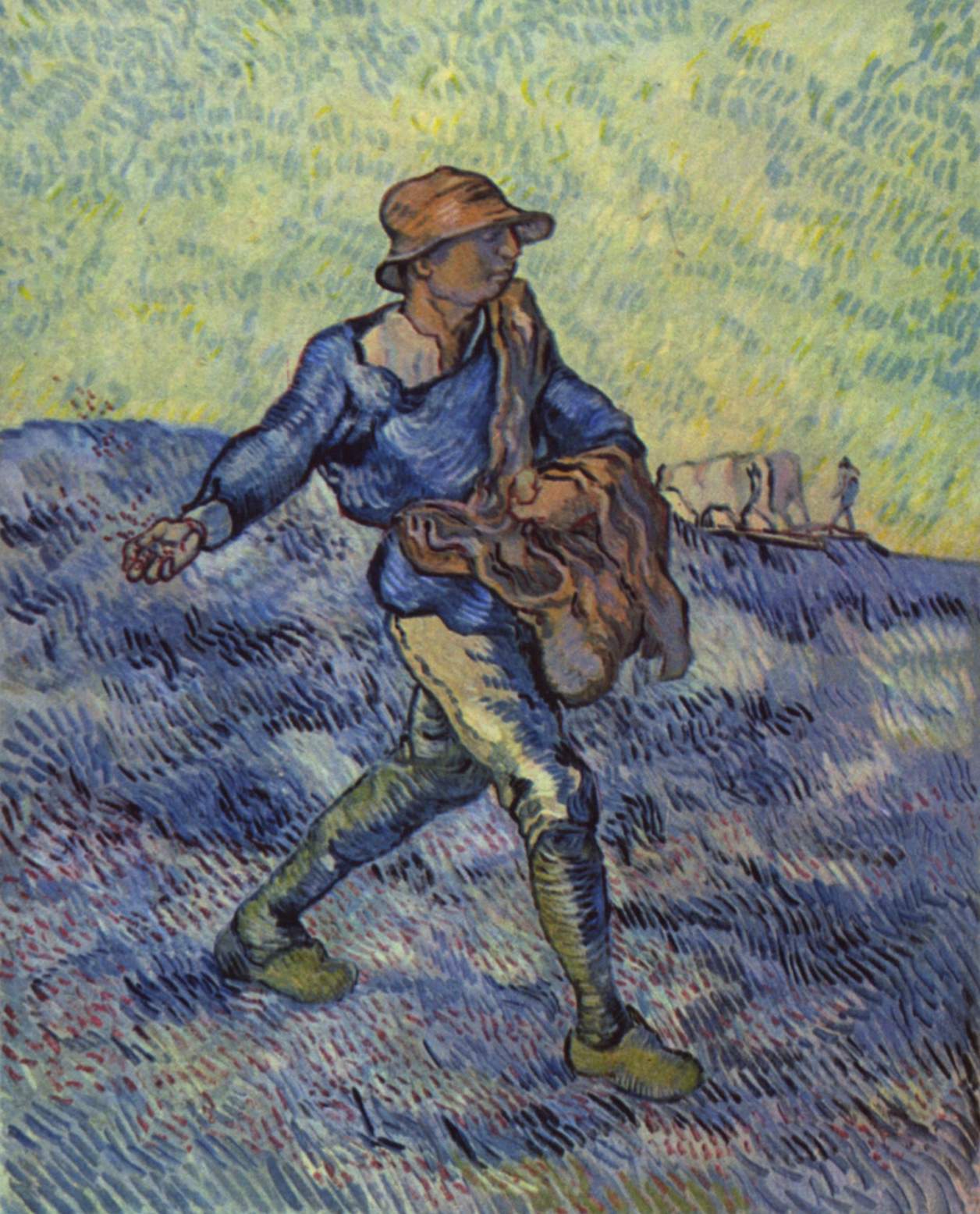
An interesting point of reflection regarding the parable of the sower and the seed that we are given in this Sunday’s gospel (Mt. 13:1-23) is the almost remarkable carelessness of the sower.  He certainly does not discriminate in the scattering of the seed.

The sower goes out to sow and, with broad sweeping arms, copiously disseminates his seeds. He does not seem concerned about selecting the terrain, since many of the seeds are lost. Only those seeds that fall on good earth bear fruit. Jesus, even if he does not say it, is comparing himself to the sower. His generosity in sowing seeds is entirely his, not ours. The sower does not calculate nor measure his generosity. All the more! He seems to place his faith also in trampled soil – rocky soil as much as in the yielding, ploughed earth. The sower tosses his seed even in the bad earth, hoping that it will take root and sprout. The whole range of soils is important for the sower. In fact, there is no part of the soil that he does not consider worthy of attention. Not a single portion is discarded. The terrain is the world, even that part of the world that is each one of us. It is not difficult to recognize in the diversity of the soils the complexity of situations in the world and in each one of us. Jesus does not want to divide men and women in two categories, those who represent fertile soil and those who represent arid soil.  (Quote taken from Bishop Vincenzo Paglia)

There is, at heart, a mystery to the encounter with Christ and the movement of God’s gratuitous grace in our lives.  This encounter is something that can neither be programmed nor predicted – although, we, as church, often try our hardest it seems.  The inner terrain of each of our hearts seems to be the determining factor when the possibility of encounter with Christ draws near.  This openness to possibility, this being “good soil” can occur anywhere and at anytime – from the pew of a church to a busy subway station.   

It is helpful to note that parables are not meant to be likened to engineering manuals which give precise directions and formulations.  Rather, the dynamic of the parable is better likened to an invitation to a feast.  We receive the invitation, we go and enter into the feast and it is within the feast that we encounter others and form relationships; all of a sudden there are new possibilities which we might never have expected and, in all of this, we come to know more deeply and live more authentically the mystery of Christian discipleship.  We are meant to “sit” in the parable and let it speak to us rather than trying to pry and wring out its truths by our own effort.  Through this parable of the sower and the seed our Lord is inviting us into the mystery of encounter with himself and the mystery of keeping our hearts open and cultivated.

The commercial noted above is powerful by the very fact that it does not need nor seek to explain anything.  It just portrays a moment.  A man made a decision and in that decision the Kingdom was able to break through and there was transformation. 

A parable is an invitation.  “A sower went out to sow…”    

A celibate’s take on sex and sexuality in our culture

One might wonder why a professed celibate is writing on sex and sexuality.  After all, isn’t this kind of out of my element?

Well, a couple of things first.  Sexuality and intimacy are not just genital.  This is being realized and comprehended more and more in the development of psycho-sexual understanding.  The desire for intimacy, relationship, communion, creativity and living passionately are all part of the human makeup and are also linked into sexuality.  Professed celibates promise to forego marriage and therefore the possibility of a committed relationship with another person thus denying, for the sake of the Kingdom, genital expression of intimacy and love.  But these other components are not meant to be denied nor cut off from the celibate’s life.  Therefore the celibate can talk authentically about intimacy and relationship as well as communion, creativity and living life passionately.  In fact, the challenge and calling of the celibate is to fully live these dimensions while foregoing the genital expression of sexuality.  Further, I would add that the celibate has a needed and unique perspective to share.

My second thought comes out of this unique perspective that the celibate has and it is specifically an awareness that comes out of negation.  Authentic knowledge does not come just from participation but also negation.  Here, I would like to use a comparison.  

A number of people reading these words have probably gone on a diet at one time or another or have participated in some form of fasting from food.  My experience when I go without food (and I do not believe that I am unique in this) is that it is exactly when I go without that I realize how deeply – often on a subconscious level – food has an influence and even control in my life.  One day when I was fasting I was travelling and therefore walking through an airport terminal; now I had been in terminals hundreds of times prior to this but it was on this day that I first really came to see how food (in a plethora of options) is thrown at the traveller in these terminals.  Food is everywhere in the airport terminal and it often works on a subconscious level!  My experience this day in the terminal allowed for this (at that time) new awareness of how food operates in life and it was the fasting that provided the context for this awareness to come forth. 

In fasting one starts to realize how food can operate on a variety of levels in life, i.e. as a coping mechanism to deal with stress, loneliness or anger.  This is more on the negative side of things.  But, also one becomes more aware of the positive dimensions of food; i.e. the value of a leisured non-rushed simple meal or the experience of joy that comes from a wonderful meal shared with friends where relationship is also nourished.

Using this common example of dieting or fasting as a basis and recognizing the authentic knowledge acquired through negation, it can then be said that the renunciation which the celibate undertakes in regards to sexual expression also leads to an authentic and valid knowledge about the dimensions of sex and how it also operates in our lives (often unconsciously) both negatively and positively.  You start to see how sex can and is used in our day as a coping mechanism for such things as stress, loneliness and pain.  You also gain a greater awareness and regard for the truly positive nature of the authentic sex act as a unique union of two persons that connects with the very mystery of creation itself and bringing forth new life. 

So, I believe that the celibate does have a unique perspective and authentic knowledge to share regarding sex and sexuality. 

With all this being said I would like to share some insights that I have gained regarding sex and sexuality in our culture. 

“We are a nation that is addicted to sex.”  This was an insight shared by Msgr. Steven Rosetti in our recent summer priest gathering for the Knoxville and Nashville dioceses and I am in full agreement.  “Addiction” is a heavy word and it is not used lightly.  Addiction by its very definition implies both a serious lack of control and also limited to no true freedom in choices that are made.  This addiction must be acknowledged as well as the factors that promote “sexuality as addiction” and the use of sexuality as a coping mechanism.  Also, the powers that benefit from sex as addiction need to be brought to light and held accountable.  Sex sales; there is money to be made in sex as addiction – a great deal of money in fact.  It seems to me that one of the primary sins behind the selling of sex in our day – that needs to be ranked in there with impurity and the objectification of the human person – is just plain old-fashioned greed.

The addiction to sex in our culture and time has a particular voyeuristic strain to it.  We all buy into this.  Whether it is the lone figure slipping into the peep show or society being amused by the latest indiscretion of a political figure, clergyman or celebrity.  We fixate on this.  Pornography is an epidemic in our time whether it is visual (appealing to men) mainly via the internet or verbal (appealing to women) via gossip and “romance” novels.  I believe that this voyeuristic strain to our culture’s addiction to sex has something to say about a deep isolation being experienced in our society.  We are cut off from one another and this is becoming even more so.  We want relationship but we do not know how to go about it.  We want connection with others yet we substitute this with fixation and fantasy.

In one form or another in my sixteen years as a priest I have been involved in ministry with youth and young adults (i.e. parish and diocesan youth ministry, high school chaplain, college chaplain) and I have come to believe that America has an unhealthy fixation on the high school and early college years.  Take some time and just consider currently how many TV shows, how many movies, how many books and articles are devoted to these years – often with a voyeuristic slant and connotation.  I have been in both settings and believe me it is neither that epic nor filled with the deep angst as often portrayed by Hollywood and society.  Just because young people are forced to appear adult (which means sexual) by society that does not mean they are adults nor are they sexual.  They are kids.  They are young people.  The rest of society needs to get a clue and move on with life and let our young people be young people.  When I hear adults encourage young people to enjoy these years because they are the “best years of your life” I shake my head and think how particularly sad a statement that is.

Success does not always equal personal integration.  We cannot seem to get this through our heads as a nation.  Time and time again we are shocked with the revelation of the latest sexual undoing of an otherwise very successful figure in society (i.e. Gov. Schwarzenegger, Congressman Weiner – the two most recent examples in the political theater but there are ministerial and other societal examples as well).  At the root of these undoings, it seems to me, is the unwillingness to look within and really be serious about the inward and introspective journey.  These figures may have been very successful on the outside but obviously they were being chased by some inner demons that were never confronted.  Maybe these examples can help call for a redefining of what true “success” in the human life really entails.

Do not look for prophets among the therapeutic set.  We are a therapeutic society but the therapeutic by its very structure does not contain the charism of prophetic witness.  The therapeutic does not necessarily ask if the societal context is either wrong or good rather it seeks to give the client the skills needed to navigate and even prosper in the given context.  But what does it mean to “prosper” if the given context is unhealthy?  For example, (in an addictive context that promotes uninhibited sexual expression as the norm) it is very easy to begin to view celibacy, modesty and virginity as deviant, repressive and unhealthy.  Is this true or is the perspective more of a reflection of the current and unexamined bias of society? 

Yes, there is certainly a healing value to the therapeutic in situations of life but the therapeutic cannot authentically judge societal contexts – that is outside of its purview.  If it does attempt to do so then it is fair to question if it is overreaching its bounds.  This does not mean that there is not a place for authentic judgement and assessment (there is); it just means we ought not look to the therapeutic to do it.  Although it must be admitted that we do this all the time – just look at the self-help and therapeutic sections in any bookstore.  But it is fair to ask how far this has really gotten us and is this seemingly automatic conditioned turn to the therapeutic the only alternative available in assessing the contexts and circumstances of life?

Now, what does faith have to offer in navigating the context of sex and sexuality that we find ourselves in today?  Here are some things that I find helpful.

“Custody of the eyes.”  There is an older priest of my diocese that often uses this as a catchphrase which he learned back in his seminary training and it is just as true today as it was then.  There are some images that just cry for our attention and as soon as we look they have won.  We are not cameras, mechanisms that can look on any image whether it be sexual, violent, manipulative, etc. and remain unaffected.  What we see, what we look upon effects us and also remains within us.  Prudential judgment regarding custody of the eyes is a good thing and it also demonstrates an advanced awareness of self.  We learn that there are some paths we just do not need to go down.  In this regard I would like to offer another thought.  If what we gaze upon effects us then this is just as true for the positive as it is for the negative.  When we learn to look upon and cultivate an appreciation of true beauty then we are nourished within.  (I personally believe that religious iconography has a profound role to play in this regard.)

Humility.  Just because I find another person attractive that does not mean that the attraction is mutual.  This can be a very humbling realization.  We are not the center of the world (despite what our desires, imaginings and sometimes even voices in society tell us) nor are we God’s greatest gift to creation.  We are one creature in a whole creation given us by the Creator and this is a good thing.  I can learn to enjoy what I have been given and let others things just pass on by.

Prayer, fasting and almsgiving – they are not just for Lent anymore.  There is a profound value to these tried and true spiritual practices as noted in the example of fasting above.  These practices move us beyond a myopic view of self and help us glimpse the truly larger context of life.  It is worthwhile to continually develop these spiritual disciplines throughout all the seasons of our lives.

Modesty remains a virtue even when it is derided by some corners of society.  I find that modesty rather than being a sign of prudishness is in fact a witness to ones sense of self-worth and dignity.  We are not just physical beings and this is not just a material world, sorry Madonna and your latest personification: Lady Gaga.  We are body, mind and spirit – each one of us.  Modesty safeguards this true understanding of the human person.  I have great respect for the person who cultivates modesty in his or her life.   

Community and service.  We crave relationship and communion.  This is a need that is hardwired into our very makeup.  There seems to currently be a development in the theological understanding of what it means to be made in the image of a God who is a communion of persons.   I think that this will prove very beneficial not just for a deeper understanding of God but for a deeper understanding of ourselves and how relationship is at the root of who we are.  I believe it to be very important to seek both community and ways to serve in life and both of these can prove to be helpful buffers against the hypersexualized context of our times.

Humor, which is closely tied to humility.  We need to laugh at ourselves sometimes and this includes all the dimensions of life – including the sexual.  Our particular attractions, foibles and neuroses in things sexual can be quite entertaining.  Laughter is indeed a medicine and it can be a gift that really alleviates any oppressive weight.  It is okay to laugh and chuckle every now and then.

I hope that this is helpful.  I do not pretend that these thoughts are in anyway exhaustive in any sense nor the end of the discussion. 

Just the musings of one celibate as he ponders the context in which we live and the signs of the times.                      


Independence Day (July 4, 2011)

Below are the two options in our current Sacramentary for the opening prayer for Masses on Independence Day and other Civic Observances.  They are both worth reading and reflecting upon as we remember our founding as a nation. 

Opening Prayer

All-powerful Father,
today we rededicate ourselves to your service,
and to the works of justice and freedom for all.

As you have called us from many people
to be one nation,
help us to give witness in our lives
and in our life as a nation
to the rich diversity of your gifts.

We ask this through our Lord Jesus Christ, your Son,
who lives and reigns with you and the Holy Spirit,
one God, for ever and ever. 

Alternative Opening Prayer

Father of all nations and ages,
we recall the day when our country
claimed its place among the family of nations.
For what has been achieved we give you thanks;
for the work that still remains we ask your help.

Grant that under your providence
our country may share your blessings
with all the peoples of the earth.

We ask this through Christ our Lord. 

The Holy Face of Manoppello: some further thoughts on the scandal of the particular

Often, it seems to me, the particular and universal are held in stark opposition and contrast – especially in terms of religion.  Many would contend (both inside and outside of faith) that a devout Christian, Muslim, Jew or whatever cannot really have love and respect for others of a differing creed and therefore the most “Godly” thing to do would be to put away any form of restrictive creed in order to just love all people.  My own experience though leads me to believe differently.  The particular leads one to the universal rather than away from it and to try to achieve the universal without the particular is to end up with just a whispy sentimentalism. 

It is the fact that I am a disciple of Christ and that I have encountered the risen Lord that both leads me and challenges me to an authentic awareness of the dignity of all peoples (even those who stand opposed to me).

In his writings – specifically The Grammar of Assent – Blessed John Henry Cardinal Newman wrestles with the question of what truly leads one to make an assent of ones whole self (body, mind and spirit) to a proposition, any proposition.  In this he distinguishes two modes of apprehending: notional and real.  Both are needed, he asserts, in the attaining of the mature mind and each strengthens the other rather than being opposed.   

Notional apprehending occurs in the intellect in terms of abstractions and ideas.  This is the realm of philosophies and worldviews.  This type of apprehending is important.  Here is often where the guiding principles of our lives are thrashed out, determined and set forth. 

Real apprehending occurs in the particular and concrete.  My daily encounters, experiences, loves and loses are the stuff of this apprehending.  Here also is included memory and imagination.  It is important to point out that Newman demonstrates that it is real apprehension alone – as opposed to notional – which leads to passion and action in our lives. 

This coming Monday here in the United States we will celebrate the fourth of July – our national holiday.  It is often remarked that this country was founded on certain core principles and that our founding fathers fought for these principles.  This is true but it is important to note that these principles were held so dear precisely because they were enfleshed for the founding fathers in the lives of their children and fellow citizens.  “We the people … secure domestic tranquility, provide for the common defense, promote the general welfare and secure the blessings of liberty for ourselves and our posterity…” (Emphasis mine.)  The founding principles of this nation are rooted in the enfleshed lives of its people.  To separate the two is to fall into a form of national schizophrenia as Dr. King was able to recognize. 

Sorry, I digress a bit.  

The point is this: the real and the notional are not opposed and neither is the particular and the universal.  Yes, they rub against one another and sometimes even collide and seemingly contradict but that does not mean they are opposed. 

Further, to separate the two is a great disservice.  Either you are the most “particular of particularists” in terms of faith, creed, politics or whatever or you are the most ephemeral of universalists.  Neither extreme leads to the attaining of a mature mind.  Both, in my opinion, are copouts.

In his address to those at the shrine of the Holy Face of Manoppello (see previous post), Pope Benedict reminds us that when we serve the poor, the elderly, the disadvantaged and marginalized then we see the face of Christ and also in the face of Christ we recognize the face of all other people as brother and sister.  I can honestly say (real apprehension) that this is true. 

When I love my neighbor I learn how to love all people more deeply.  As I encounter and love Christ I am led to an authentic and true love for all people.      

The Holy Face of Manoppello and the scandal of the particular

God has a face! 

This is an utterly unique Christian claim.  Only Christianity makes this claim among all the world’s religions and it is a claim made possible only through Jesus Christ – who is God incarnate for us.

In many ways this claim hits on the scandal of the particular that is at the heart of our faith.  It is a scandal that can never quite be shaken from the Christian message although many have tried.  It is one thing to talk of “God” in a general and (often for many people) abstract sense.  But to really say that God walked among us, talked to us, ate, slept, laughed, that he even looked a certain way … well, this all starts to make quite a few people antsy and uncomfortable.  Often many people will scoff at this point and respond to what they determine to be the the naivety and even childishness of the faith but I have come to realize that this is often just a cover for their own nervousness. 

Why is this?

I think that part of it might be rooted in the old saying that the eyes are the windows to the soul.  When God is held in the abstract there are no eyes to look into.  Yes, God has his decrees and commandments and these bring life but there is still fundamentally a safe and semi-comfortable distance between me and the Divine.  But, when God has a human face all of a sudden the safe distance is gone.  It means that I have to look into his eyes (into his soul) and he into mine… 

Jesus Christ had a human soul.  This is a truth of the faith that was thrashed out in the great christological controversies of the Church.  The soul is that place of volition within the human person where will is found and choices are determined.  In the eyes of Christ we see the soul of someone who lived completely in obedience to the will of the Father.  For us, this is both beautiful and utterly terrifying at the same time.

When God is particular that means that God can and will make particular demands on me.  When God is abstract and general then it is enough to be guided solely by “principles” which are also easy enough to dismiss if one so determines.  But there is a trade-off.  A God in the abstract can neither warm nor inflame the heart.  Life remains quite cold.  Only in a God with a human face can we be caught up in the gaze of infinite love and tender mercy.

I just finished reading, “The Face of God: The Rediscovery of the True Face of Jesus” by Paul Badde.  In the book Badde carefully lays out the argument that the relic of the Holy Face of Manoppello (a small city in Italy) is in fact the veil laid over the burial shroud of Jesus in the tomb.  The image on the veil (seen above) matches that found on the Shroud of Turin and likewise is inexplicable in its making.  This veil is what came to be known over time as the Veil of Veronica.  It is all quite intriguing.

I am making no claims here in this blog.  I will leave that to those with more knowledge than I.  But I now hope that if one day (God willing) I am able to travel back to Italy I will plan on a visit to the now minor papal basilica of the Volto Santo di Manoppello. 

(On September 1, 2006 Pope Benedict XVI travelled to Manoppello to personally view the image and pray before it.  Two weeks after his visit he elevated the church to the level of a minor papal basilica.  Below is an excerpt of the Holy Father’s address on this occasion.)

What I can say for now is that this book has brought out for me the unique beauty of the particular that is at the heart of our faith as Christians. 

God has a human face!  It is Jesus Christ!

PILGRIMAGE TO THE SHRINE OF THE HOLY FACE IN MANOPPELLO (ITALY)

ADDRESS OF HIS HOLINESS BENEDICT XVI

Friday, 1 September 2006

Dear Brothers and Sisters,

First of all, I must once again say a heartfelt “thank you” for this welcome, for your words, Your Excellency, so profound, so friendly, for the expression of your friendship and for the deeply meaningful gifts: the Face of Christ venerated here, for me, for my house, and then the gifts of your land that express the beauty and generosity of the earth, of the people who live and work here, and the goodness of the Creator himself. I simply want to thank the Lord for today’s simple, family meeting in a place where we can meditate on the mystery of divine love, contemplating the image of the Holy Face.

During my pause for prayer just now, I was thinking of the first two Apostles who, urged by John the Baptist, followed Jesus to the banks of the Jordan River, as we read at the beginning of John’s Gospel (cf. 1: 35-37).

The Evangelist recounts that Jesus turned around and asked them: “”What do you seek?’. And they answered him, “Rabbi… where are you staying?'”. And he said to them, “Come and see” (cf. Jn 1: 38-39).

That very same day, the two who were following him had an unforgettable experience which prompted them to say: “We have found the Messiah” (Jn 1: 41).

The One whom a few hours earlier they had thought of as a simple “rabbi” had acquired a very precise identity: the identity of Christ who had been awaited for centuries.

But, in fact, what a long journey still lay ahead of those disciples!

They could not even imagine how profound the mystery of Jesus of Nazareth could be or how unfathomable, inscrutable, his “Face” would prove, so that even after living with Jesus for three years, Philip, who was one of them, was to hear him say at the Last Supper: “Have I been with you so long, and yet you do not know me, Philip?”. And then the words that sum up the novelty of Jesus’ revelation: “He who has seen me has seen the Father” (Jn 14: 9).

Only after his Passion when they encountered him Risen, when the Spirit enlightened their minds and their hearts, would the Apostles understand the significance of the words Jesus had spoken and recognize him as the Son of God, the Messiah promised for the world’s redemption. They were then to become his unflagging messengers, courageous witnesses even to martyrdom.

“He who has seen me has seen the Father”. Yes, dear brothers and sisters, to “see God” it is necessary to know Christ and to let oneself be moulded by his Spirit who guides believers “into all the truth” (cf. Jn 16: 13). Those who meet Jesus, who let themselves be attracted by him and are prepared to follow him even to the point of sacrificing their lives, personally experience, as he did on the Cross, that only the “grain of wheat” that falls into the earth and dies, bears “much fruit” (Jn 12: 24).

This is the path of Christ, the way of total love that overcomes death: he who takes it and “hates his life in this world will keep it for eternal life” (Jn 12: 25). In other words, he lives in God already on this earth, attracted and transformed by the dazzling brightness of his Face.

This is the experience of God’s true friends, the saints who, in the brethren, especially the poorest and neediest, recognized and loved the Face of that God, lovingly contemplated for hours in prayer. For us they are encouraging examples to imitate; they assure us that if we follow this path, the way of love, with fidelity, we too, as the Psalmist sings, will be satisfied with God’s presence (cf. Ps 17[16]: 15).

“Jesu… quam bonus te quaerentibus! – How kind you are, Jesus, to those who seek you!”. This is what we have just sung in the ancient hymn “Jesu, dulcis memoria” [Jesus, the very thought of you], which some people attribute to St Bernard.

It is a hymn that acquires rare eloquence in the Shrine dedicated to the Holy Face, which calls to mind Psalm 24[23]: “Such is the generation of those who seek him, who seek the face of the God of Jacob” (v. 6).

But which is “the generation” of those who seek the Face of God, which generation deserves to “ascend the hill of the Lord” and “stand in his holy place”?

The Psalmist explains: it consists of those who have “clean hands and a pure heart”, who do not speak falsehoods, who do not “swear deceitfully” to their neighbour (cf. vv. 3-4). Therefore, in order to enter into communion with Christ and to contemplate his Face, to recognize the Lord’s Face in the faces of the brethren and in daily events, we require “clean hands and a pure heart”.

Clean hands, that is, a life illumined by the truth of love that overcomes indifference, doubt, falsehood and selfishness; and pure hearts are essential too, hearts enraptured by divine beauty, as the Little Teresa of Lisieux says in her prayer to the Holy Face, hearts stamped with the hallmark of the Face of Christ.

Dear priests, if the holiness of the Face of Christ remains impressed within you, pastors of Christ’s flock, do not fear: the faithful entrusted to your care will also be infected with it and transformed.

And you, seminarians, who are training to be responsible guides of the Christian people, do not allow yourselves to be attracted by anything other than Jesus and the desire to serve his Church.

I would like to say as much to you, men and women religious, so that your activities may be a visible reflection of divine goodness and mercy.

“Your Face, O Lord, I seek”: seeking the Face of Jesus must be the longing of all of us Christians; indeed, we are “the generation” which seeks his Face in our day, the Face of the “God of Jacob”. If we persevere in our quest for the Face of the Lord, at the end of our earthly pilgrimage, he, Jesus, will be our eternal joy, our reward and glory for ever: “Sis Jesu nostrum gaudium, qui es futurus praemium: sit nostra in te gloria, per cuncta semper saecula”…

© Copyright 2006 – Libreria Editrice Vaticana


The Feast of the Body and Blood of Christ

In Scripture we hear those words which stand at the center of today’s feast – “This is my body”, “This is my blood.” These words have echoed down through the centuries and will continue to the end of the world. Here in the most unique, continuous and particular way Christ is present to us, His Church. Not by our effort but by His gift – Christ is present in order to nourish and to strengthen us. Here, we receive the very life and love of God. The mystery of the Eucharist is beyond our comprehension and it is a mystery in the true sense of the term; not a puzzle to be figured out in order to then be discarded but a mystery to be lived and appreciated.

But as we reflect today we must remember another key component to this reality of the Eucharist; not only is Christ present in the Eucharist but He is present as a “broken body” and as blood “poured out”. Christ is not present in just any manner in the Eucharist but ultimately as a friend who gives his life for those whom he loves. To have a true awareness of the Eucharist means to be aware of this reality – Christ broken and poured out. And to live as a disciple means to receive this amazing grace and to strive to live the same reality as our Eucharistic Lord – to be broken and to be poured out for others. This is what fulfills the Church’s adoration of the Eucharist.

The Church guards the concreteness of Jesus’ words and venerates his body and blood in the bread and wine, so that He can still be encountered today. We could add that Jesus is not present in the bread and wine in just any way; he is present there as a “broken” body and wine “poured out”, that is, as the one who passes among men and women and does not save himself but gives his entire life, to the point of dying on the cross, until “blood and water” come out from his heart. He held back nothing of himself. He kept nothing for himself, to the very end. That broken body and that poured out wine are a scandal for each one of us and for the entire world, accustomed as we are to living for ourselves and holding back as much as possible of our lives. The bread and wine that are shown to us several times during the holy liturgy contrast with our love for ourselves, with the scrupulous attention we give to our bodies, and with the meticulous care we take to spare ourselves and avoid commitments and exertion. Nonetheless, they are given to us and continue to be broken and poured out so that we might be freed from our slaveries, so that our harshness may be transformed, our greed crumbled, and our self-love scratched. As the bread and wine draw us out of a world turned in on itself and condemned to loneliness, they gather us together and transform us into the one body of Christ. (Quote from Bishop Vincenzo Paglia)

Saint John Chrysostom once wrote, “If you want to honor the body of Christ, do not disdain it when it is nude. Do not honor the Eucharistic Lord with silken vestments, while outside of the church you neglect that other Christ who is naked and afflicted by the cold.” As disciples, we try to live these words, we know we fall short and we pray for forgiveness. Here we pray the words of the two disciples on the road to Emmaus as the risen Lord (his glory hidden) attempts to go a separate way. “Stay with us, because it is almost evening.”

The story of Emmaus (which is a Eucharistic story) reminds us that Christ has made himself humanity’s companion on our long journey through history. Christ walks with us – each and every one of us and us as Church. We are not alone. Christ is among us to comfort, to instruct, to correct; and when we fall short, to forgive. In this awareness of the Eucharist and in this awareness of our own frailty and weakness the most honest prayer we can utter is “Lord, stay with us, because it is almost evening.”

St. Josephine Bakhita: a doorkeeper saint

It is a wonderful thing to develop a new friendship with a saint. 

A while back I came across a reference to St. Josephine Bakhita and following that I kept running into her again and again in my reading.  I have learned over time that when this happens it is something to pay attention to.  (It can be likened to the the saint tapping you on your shoulder; trying to get your attention.)  Eventually I took the hint and I began searching out information on this patron saint of the Sudan.

This last weekend I watched an Italian movie on her life. 

There are many things that strike me about Bakhita’s life but one of the most striking elements is her ability to open hearts.  (Because of this ability it is fitting that Bakhita served as the portress – or doorkeeper – of her community’s house for years.)

St. Bakhita endured great cruelty and prejudice during her life and she overcame it all but she also won over the hearts of many of the very people who caused her suffering.  She did not do this by clever argument or debate or vitriol but by the witness of love and the willingness to forgive.

This ability to open hearts is greatly needed in our world today.  Hearts are closed and fearful. 

We need the doorkeeper saints such as St. Bakhita and also Blessed Andre Bessette to teach us how to open hearts through the witness of love and humility. 

I pray that we as Church have hearts open to learn what the doorkeeper saints have to teach us. 


Christ the Tree of Life icon

I have just completed writing an icon that I began a year and a half ago. 

The term “write” is used in regards to icons rather than “painting” because icons are considerd visual theology. 

The icon is of Christ the Tree of Life.  I first encountered this icon through the Community of Sant”Egidio – both on the Community’s website and in its chapel in Rome.  I do not know how old the original image is but I find it be a very powerful and holy image. 

Christ sits surrounded by the twelve apostles.  Christ is the Word of life and the passage that is opened for contemplation is, “I am the vine and you are the branches.”  Some of the apostles hold open books while others hold rolled up scrolls.  To the open books I added scripture passages that speak to the reality of Christ living in us and our life in Christ: Colossians 3:14-15, Ephesians 3:20-21, 1 Corinthians 12;12-13, 1 John 4:14-15 and 1 Peter 1:22-23.

Christ surrounded by his apostles within the context of a “living tree” is, I believe, a wonderful image of Church.  All is focused on Christ who is central and the branches strain toward heaven and the Father.  The twelve apostles remind us of the apostolic nature of the Church – a mark of the Church often unreflected upon in our day.  Christ retains the wounds of the crucifixion as the resurrection experiences recalled in scripture testify.  Even in his glory Christ remains united to the suffering of his Church and all creation.    

In the original icon the Father was pictured at the top of the icon in human form and there was a more ornate and detailed depiction of the Holy Spirit in the form of a dove.  In the Orthodox Church there has been an instruction that the Father should not be pictured in human form and I agree with this.  We can depict the Son because of the incarnation – the “Word become flesh ” – and we can use the images of the dove, tongues of fire and celestial light for the Holy Spirit but the Father remains beyond our imagings.  In this icon I replaced the image of the Father with rays of light streaming from a central point.  The rays also draw our attention to that point. 

The Holy Spirit unites the Father and the Son.  I simplified the image of the Holy Spirit in this icon.  The living reality of the Church gathered around Christ also exists and grows under the care and empowerment of the Holy Spirit.