Trinity Sunday: God as Trinity and how we live our lives

Reflecting on the reality of baptism, Diadochus – a theologian of the early church – writes, “Before a person comes to be baptized, grace is at work, from without, encouraging the soul toward the good, while Satan is at work, from within. After baptism, the contrary is the case. Grace works from within and the demons from without. These continue their work, and work even more evilly than before, but not as present together with grace. The only way they can work is through the promptings of the flesh.”

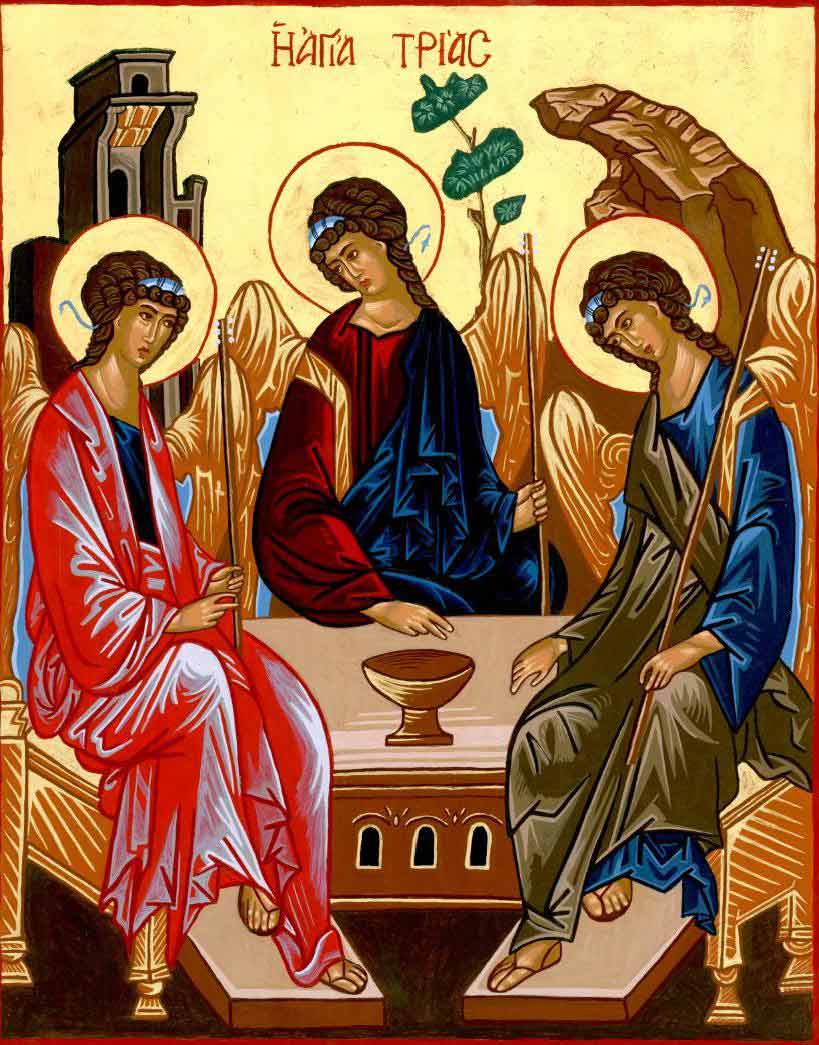
Today, we as church, reflect on that most profound of mysteries – the Trinity. As Christians we believe and we profess that God is one and that God is three. We are not Unitarians and neither are we Jehovah Witnesses – both of which deny the Trinity. Through the revelation of Jesus Christ and the outpouring of the Holy Spirit we have been brought to the realization that Father, Son and Holy Spirit are one God.

I believe that the quote by Diadochus concerning baptism can help bring us to the only point by which we can begin to contemplate this mystery – from within. The mystery of the Trinity is not a problem to be objectively solved or a riddle that can be puzzled through by our wits alone. The Trinity is a mystery to be lived. This mystery demands the involvement and engagement of the whole person – mind, body and spirit.

God began the invitation to this mystery. In John’s gospel we are reminded that, “God so loved the world that he gave his only Son … For God did not send his Son into the world to condemn the world, but that the world might be saved through him.” (John 3:16-17) Through God’s love and God’s initiative (as known in baptism) we are brought into communion with God and into the relationship that is the Trinity.

It is here, in this reality of lived relationship, that we begin our awareness of God as three. Paul – in his second Letter to the Corinthians – writes, “Mend your ways, encourage one another, agree with one another, live in peace, and the God of love and peace will be with you.” (2 Cor. 13:12) Paul firmly connects how we live our lives with the presence of God: “Mend your ways … and the God of love and peace will be with you.” Awareness and knowledge of God can only begin from within. Paul is calling for a sincere examination of conscience here. Are we living our lives in such way that Father, Son and Spirit are welcome to come, reside and be present?

In God’s great revelation to Moses the Lord defines himself by proclaiming, “The Lord, the Lord, a merciful and gracious God, slow to anger and rich in kindness and fidelity.” (Ex. 34:6) Again, awareness and knowledge of God can only begin from within. If God defines himself as “merciful” and “slow to anger and rich in kindness and fidelity” then why would he make himself present and known in a heart that lacks these qualities?

God has taken the initiative and invites us into relationship with himself as Father, Son and Holy Spirit but this mystery, to be authentically known, must be lived.

It has to begin from within; from how we choose to live our lives.

God’s grace – restoring this "old house"

We are taking a few days this week to do some renovation work here at the Catholic Center.  We are tearing down wall paper, repainting some rooms, doing some minor electrical and general repair work, planting some pompous grass and doing other yardwork. 

Yesterday we did quite a bit of work and have more to do the next couple of days.  But it is coming along. 

Looking at the stripped down walls and the ladders propped here and there I have been reminded of an insight of one of my professors in seminary (Sr. Sara Butler) on the Catholic understanding of the work of God’s grace in our lives: grace rather than being seen as just a “covering over” of self and sin is in fact better likened to the action of renovating a house from within.

God’s grace works from the inside out and, bit by bit in God’s time, it restores and reclaims the whole person – scrubbing down and fixing what needs to be fixed.  All done, in order to make of our whole selves a worthy and welcoming home for the Lord to come and dwell within.   

God wants all of who we are restored to full relationship with him and nothing less, it seems, will do. 

I find this quite comforting.   

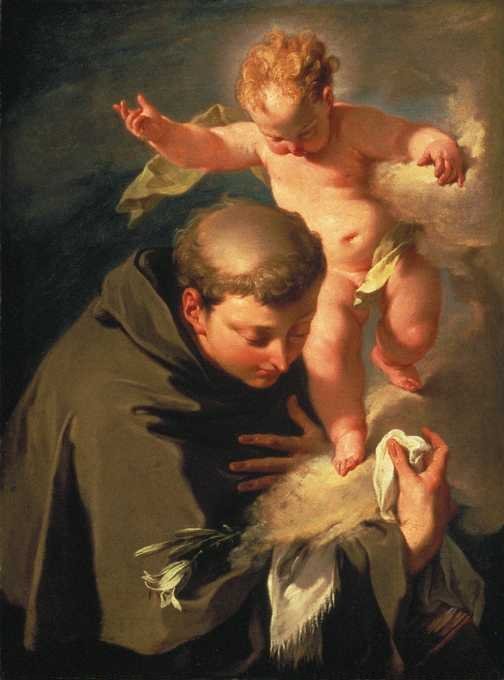
Pentecost continued: St. Anthony of Padua

On June 13th the Church celebrates the feast of St. Anthony of Padua.  This year’s feast falls the day after our celebration of Pentecost and I found the excerpt from a sermon by the saint offered in today’s Office of Readings to be a great reflection on how to keep the outpouring of the Holy Spirit active in our lives.  Below is the excerpt.

From a sermon by Saint Anthony of Padua, priest

Actions speak louder than words

The man who is filled with the Holy Spirit speaks in different languages. These different languages are different ways of witnessing to Christ, such as humility, poverty, patience and obedience; we speak in those languages when we reveal in ourselves these virtues to others. Actions speak louder than words; let your words teach and your actions speak. We are full of words but empty of actions, and therefore are cursed by the Lord, since he himself cursed the fig tree when he found no fruit but only leaves. Gregory says: “A law is laid upon the preacher to practice what he preaches.” It is useless for a man to flaunt his knowledge of the law if he undermines its teaching by his actions.

But the apostles spoke as the Spirit gave them the gift of speech. Happy the man whose words issue from the Holy Spirit and not from himself! For some men speak as their own character dictates, but steal the words of others and present them as their own and claim the credit for them. The Lord refers to such men and others like them in Jeremiah: So, then, I have a quarrel with the prophets that steal my words from each other. I have a quarrel with the prophets, says the Lord, who have only to move their tongues to utter oracles. I have a quarrel with the prophets who make prophecies out of lying dreams, who recount them and lead my people astray with their lies and their pretensions. I certainly never sent them or commissioned them, and they serve no good purpose for this people, says the Lord.

We should speak, then, as the Holy Spirit gives us the gift of speech. Our humble and sincere request to the Spirit for ourselves should be that we may bring the day of Pentecost to fulfillment, insofar as he infuses us with his grace, by using our bodily senses in a perfect manner and by keeping the commandments. Likewise we shall request that we may be filled with a keen sense of sorrow and with fiery tongues for confessing the faith, so that our deserved reward may be to stand in the blazing splendor of the saints and to look upon the triune God.

St. Anthony, pray with us and for us!

Pentecost Sunday with a touch of green

Here is a thought experiment: picture yourself as a parent looking upon your child.  (For those of you blessed with this role this should be easy.)  As you look upon your child imagine all the love and care that is present in your heart.  Now, multiply this by infinity.  This is what God feels when God looks upon you and me – love multiplied by infinity.  Yet, this depth of love (God to us and us to one another) is so easy to overlook and even forget in the rush and stumblings of life. 

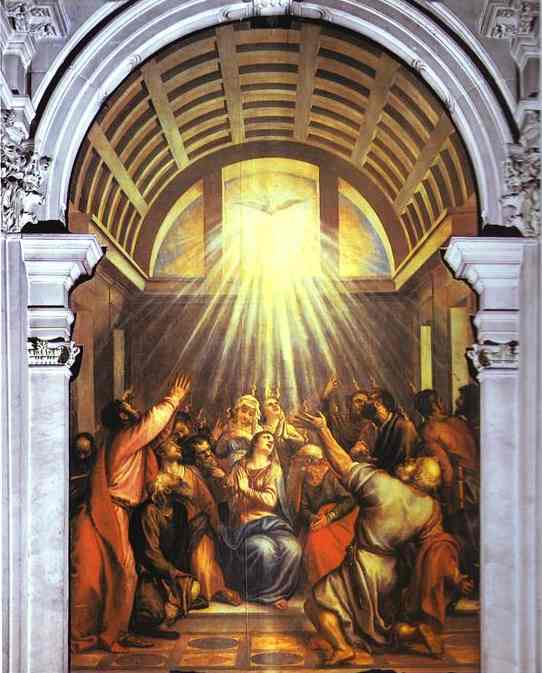
Today we celebrate Pentecost Sunday – the coming of the Holy Spirit upon the Church.  In our western Christian tradition we often associate the color red with the Holy Spirit (i.e. the “tongues of fire” that come upon those gathered for Pentecost).  Red is indeed a powerful color.  It is a color that flashes and holds ones attention.  In the Orthodox Christian tradition another color associated with the Holy Spirit is green.  If we reflect here for a moment this makes perfect sense.  In the creed we profess our belief in the Holy Spirit as “the Lord, the giver of life”.  Here, in East Tennessee, all we have to do is look around at the myriad shades of green to recognize it as indeed a color which signifies life.

But, just as the depth of love is so present that it is easy to overlook in our lives so is the presence of green easy to take for granted (until, that is, life becomes dry). 

I share this because I believe it is helpful when we think of the Holy Spirit to allow some shadings of green into the equation.  I believe this allowance may expand our thoughts of how God works and even enable us to come to a deeper awareness of true power. 

Today, in our society we like our heroes and superheroes.  It seems that every other movie marketed out of Hollywood is based on some comic book hero (i.e. Superman, Spider-man, Batman, X-men, Thor, Green Lantern) and the plot line remains the same.  In all the scenarios power is strength and determination and it is exercised through brute force and clashes that are anything but subtle and easily overlooked.  In fact, it seems that in every story the whole world both hangs in the balance and holds its collective breath as it stands by and watches the great clash … just hoping for the best.  Power is strength and it forces attention.

But, is this how God (the creator of all and also the “all-powerful”) works?  It does not seem so.  At least, this is not my reading of Christ hanging on the cross.  God’s power does not need to point to itself nor force attention, it seems.  Powerful nations have clashed with great armies throughout the centuries but can any nation cause the sun to rise or set?  Can any nation or science create from nothing even the smallest form of life?  It seems that God’s power is humble – not found in clash and conflict demanding attention – but in love and in life.  That which is easily overlooked.

The gospel today tells us that the disciples had locked themselves in the room out of fear.  But that Christ, risen from the dead, came to them demonstrating a different form of power than that of the world.  This is not a power that points to itself and demands attention but rather one easily overlooked yet it is the power that overcomes fear and brings life and love.  Then Christ breathed on the Church and said, “receive the gift of the Holy Spirit.”  God’s own power, God’s own Spirit – so much at work, so present and yes, so easily overlooked.

“Come, Holy Spirit and enkindle in us the fire of your love!”  

Memorial Day, Pope John Paul II and priests as "men of communion"

Memorial Day was officially proclaimed on May 5, 1868 by General John Logan, national commander of the Grand Army of the Republic, in his General Order No. 11, and was first observed on May 30, 1868, when flowers were placed on the graves of Union and Confederate soldiers at Arlington National Cemetery. The first state to officially recognize the holiday was New York in 1873 … Memorial Day is not about division. It is about reconciliation; it is about coming together to honor those who gave their all.  (taken from http://www.usmemorialday.org/)

There is much talk today about how we live in such polarized times as a country (red states vs. blue states, this group vs. that group) and as Church (traditionalists, orthodox vs. liberal – however you may wish to define any of these terms) but what more polarized time (at least in our country’s history) could there have been than immediately after the Civil War? 

The day we observe today came about as an opportunity to heal divisions and regain unity.  Memorial Day has much to teach us both as a nation and as Church (for whether we like it or not all the baptized are members of the Body of Christ.) 

Polarization does not serve the unity of the Church.

In the polarized context of our times I think it all the more important to give a listening and truly attentive ear to what Blessed John Paul II wrote in his famous encyclical on the priesthood, “Pastoris Dabo Vobis” (“I Will Give You Shepherds”).

John Paul specifies that priests are to be “men of communion”.  He plants this understanding right in the very communion of the Trinity.

“The priest’s identity,” as the Synod Fathers wrote, “like every Christian identity, has its source in the Blessed Trinity”, which is revealed and is communicated to people in Christ, establishing, in him and through the Spirit, the Church as “the seed and the beginning of the Kingdom”…  

In this way the fundamentally “relational” dimension of priestly identity can be understood.  Through the priesthood which arises from the depths of the ineffable mystery of God, that is, from the love of the Father, the grace of Jesus Christ and the Holy Spirit’s gift of unity, the priest sacramentally enters into communion with the Bishop and with other priests, in order to serve the People of God who are the Church and to draw all mankind to Christ in accordance with the Lord’s Prayer:  “Holy Father, keep them in your name, which you have given me, that they may be one, even as we are one … even as you, Father, are in me, and I in you, that they also may be in us, so that the world may believe that you have sent me” (Jn 17:11,21). 

Pope John Paul II, later in his encyclical, then goes on to reflect on the value of communion in the human formation of priests.

Future priests should therefore cultivate a series of human qualities, not only out of proper and due growth and realization of self, but also with a view to the ministry.  These qualities are needed for them to be balanced people, strong and free, capable of bearing the weight of pastoral responsibilities.  They need to be educated to love the truth, to be loyal, to respect every person, to have a sense of justice, to be true to their word, to be genuinely compassionate, to be men of integrity and, especially, to be balanced in judgment and behaviour…

Of special importance in the capacity to relate to others.  This is truly fundamental for a person who is called to be responsible for a community and to be a “man of communion”.  This demands that the priest not be arrogant, or quarrelsome, but affable, hospitable, sincere in his words and heart, prudent and discreet, generous and ready to serve, capable of opening himself to clear and brotherly relationships and encouraging the same in others, and quick to understand, forgive and console (see also 1 Tim 3:1-5, Tit 1:7-9).  People today are often trapped in situations of standardization and loneliness, especially in large urban centres, and they become ever more appreciative of the value of communion.  Today this is one of the most eloquent signs and one of the most effective ways of transmitting the Gospel message.

I believe it extremely important that today priests be known as “men of communion” and I believe that Blessed John Paul II also believed this.  I think that the above quotes testify to this. 

The words found in the last sentence quoted are truly powerful and bear great weight.  In a time of polarization and isolation; being a “man of communion” is indeed one of the most eloquent signs and one of the most effective ways of transmitting the Gospel message.

The Church, by its very nature established in the heart of the Trinity, must be a place of communion and priests must strive to serve communion. 

In all times and seasons, we as Church set our lives not by the limits and sad resignations of this world (i.e. polarization) but the truth and communion of the Kingdom of God.   

Words: Pieper’s "Abuse of Language, Abuse of Power"

At one point in his ministry our Lord tells us, “Let your yes mean yes and your no mean no.”  There is an intrinsic power and truth to words that must be respected.  Words convey reality.  John at the very beginning of his gospel gives us a glimpse into this profound connection of words and reality when he writes,

In the beginning was the Word, and the Word was with God, and the Word was God.  He was in the beginning with God; all things were made through him, and without him was not anything made that was made.  In him was life, and the life was the light of men.  The light shines in the darkness, and the darkness has not overcome it.  (John 1:1-5)

To respect words and their conveyance of reality is to show respect to the very foundation of reality.  To manipulate words is to seek to manipulate truth and to instead choose falsity and illusion over reality.  The manipulation of words is itself a violent act.  It is an act of self-centered pride ultimately doomed to frustration and failure precisely because it is based in falsity. 

Over the past few weeks I have had three different conversations (initiated by others, I would add) on the power of words and attempts to manipulate and distort words. 

These conversations have led me to the essay, “Abuse of Language, Abuse of Power” by Josef Pieper.  I would like to share a few quotes from his essay that I believe are worthy of note and consideration. 

Human words and language, accomplish a twofold purpose…  First, words convey reality.  We speak in order to name and identify something this is real, to identify it for someone, of course – and this points to the second aspect in question, the interpersonal character of human speech. 

Pieper then goes on to flesh out the interpersonal character of speech by the use of a negative:

Can a lie be taken as communication?  I tend to deny it.  A lie is the opposite of communication.  It means specifically to withhold the other’s share and portion of reality, to prevent his participation in reality.  And so: corruption of the relationship to reality, and corruption of communication – these evidently are the two possible forms in which the corruption of the word manifests itself. 

Further Pieper writes,

Any discourse detached from the norms of reality is at the same time mere monologue.   What does it mean, after all, to be detached from the norms of reality?  It means indifference regarding the truth.

Pieper then carries this through to a prophetic warning,

The degradation, too, of man through man, alarmingly evident in the acts of physical violence committed by all tyrannies (concentration camps, torture), has its beginning, certainly much less alarmingly, at the almost imperceptible moment when the word loses its dignity.  The dignity of the word, to be sure, consists in this: through the word is accomplished what no other means can accomplish, namely, communication based on reality.

I share this because I believe we live in a time when language is being abused and manipulated.   The temptation in this is to return “like for like.”  But here is where the above quoted teaching of our Lord is essentially important for the disciple.  When so many seem to prefer the choice of illusion over reality; disciples, all the more, must make sure that our yes means yes and our no means no.  Ours is and must be a different choice.
 
By so doing we will all the more stand out and our words, rather than just being “mere monologue” that might have flash but really accomplish nothing, will harmonize with the very truth of creation and even share in the very power of that truth.    

Why Rapture? Why now?

Today might be the day.  You never know.  Our Lord himself said he knew neither the day nor the hour but we Christians hold that our Lord will return in glory and we look toward this day.  Recently a Christian movement has gained some attention by its prediction that today (May 21, 2011) is the day.  They might be right but these predictions have occurred before.  In fact, the man purporting to have now cracked the code that today is the day has predicted Judgement Day before but obviously that prediction was incorrect and based on lack of information as he later stated. 

What is interesting is the attention that this prediction has received.  I think that this attention is speaking to some interesting dynamics present in our day and age.  Here are a few as I see them.

In our American mindset we like to figure things out.  We are very pragmatic as a people.  This is a part of our national strength and character.  Our country has accomplished some great things because of this strength.  The problem though is that we easily apply this mindset to faith and Scripture as though it all were a code to be puzzled through and this, I think, misses the mark.  As a wise professor once told me, “The paschal mystery is not a puzzle to be figured out and solved but a mystery to be lived.  As we live the mystery we are brought to greater and greater understanding and deeper discipleship.”  Maybe instead of viewing the Bible as a hidden code to be cracked (which I personally think demeans Holy Scripture) we should see it as a sacred space of encounter and relationship between us and God and us and our neighbor.  My take on faith is that it is not about figuring out a certain date as it is about learning how to live as our Lord lived which means living and embracing the paschal mystery in our own lives.

I believe that fear is a factor in all of this.  The world is changing and whenever there is change we get uncomfortable.  The weather patterns are changing.  Global warming is an all but accepted fact.  Pope Benedict in his writings acknowledges this.  Global warming does not so much mean that things will just get a little warmer but that weather will become more extreme (i.e. the recent tornadoes in the southern states, more severe flooding and more severe draughts).  Recent earthquakes have rattled our collective consciousness.  The economic meltdown has demonstrated that commerce is not the all-solid foundation we once believed.  Gauging our greatness on our ability to consume might be becoming a thing of the past.  Those Muslims who once resided on their side of the world now live in the house up the street and next door there is now a homosexual couple.  Christianity is now just one other voice in a largely secular society.  For many, the world as they know it is ending.  Surely our Lord must be returning soon to save his chosen!  As Christians, we cannot be meant to live in a world like this!  But, maybe now is the time when Christians, rather than being taken from the world, are meant to be more than ever in the world – living the paschal mystery in love and not in fear speculating on dates.

Sincerity also has a role to play here.  I believe the man who has made this prediction and the people of this movement are very sincere.  They believe that this is the day and, again, they may be right.  But sincerity does not always equal truth.  One might be very sincere but completely wrong.  But we do not always catch this in our day and age.  Partly due, I believe, to a decrease in and de-emphasizing of critical thinking.  If one is sincere enough, feels enough, believes enough then it must be so!  Well … no, not really.  Sincerity itself does not equal truth.

Finally, a yearning for sacred time.  Yesterday, as I was driving down the interstate and reflecting on this I found myself indeed yearning for the return of the Lord.  We, the Church, are the bride and we do indeed yearn for the return of the bridegroom.  The world is limited, it is marked by sin and all its effects and it does become wearisome.  As Christians we are meant to yearn for the fulfillment of all ages and for more than this world has to offer.  The prayer, “Come, Lord Jesus” is an honest prayer spoken from the heart of the Christian.  Any prediction of the end time taps into this honest yearning in the heart of the Christian.

Today at 6 p.m. I will be in the middle of saying Mass – not a bad place to be when the world is supposed to end.  It may happen today.  It may not.

Whenever it does happen (either the end of the whole world or the end of my own little life) I hope my Lord finds me in faith and hope, with a song in my heart – not worried about determining a date but more focused on living and embracing the paschal mystery.


Fourth Sunday of Easter (A): The Good Shepherd

What would you do if to remain in a place would almost certainly mean losing your life?  This is question found at the heart of the French film, “Of Gods and Men.”  The film is based on the true story of eight Cistercian Trappist monks living their lives in the Atlas Mountains of Algeria in the 1990’s.  The country is caught up in a violent and bloody civil war between a totalitarian regime and violent Islamic extremists.  The monks have lived in peace with their Muslim neighbors but there is violence all around and non-Muslims are being killed.  The monks know that it is just a matter of time. 

The film powerfully portrays the debate these men have both as a community and in their own souls about remaining or leaving.  These men are not super-heroes and they are not portrayed that way.  They are ordinary men who, through prayer and interaction among themselves and with the villagers – each come to the realization that he must remain. 

Late one night the extremists arrive.  Six of the monks are taken away to be used as hostages.  In the winter of 1996, the monks were killed. 

The men choose to remain – specifically, out of love for their Lord and their own calling and also out of love for the villagers and their need.  The men chose to remain.

Today, the church celebrates Good Shepherd Sunday and one overriding characteristic of the Good Shepherd is that, come what may, the good shepherd remains.  He does not seek to save himself.  In the gospel account of Jesus’ passion we find that everyone else flees, everyone else seeks to save himself (the disciples run away, Peter denies Jesus, Pilate washes his hands of the matter, the religious establishment is concerned only with its own position) except our Lord.  Our Lord remains, our Lord does not seek to save himself.  Our Lord is the good shepherd.  The sheep hear and recognize his voice because in love he chooses to remain.  Because of this his voice is authentic and true; it cuts through all the noise, false voices and distractions of the world and it speaks directly to our hearts.

What is very moving (and beautifully portrayed) in the film is how the decision to remain is not unilateral and neither is it forced on anyone.  Each man makes his own decision to remain and it is the love found in the daily encounters (the daily life of the brothers themselves, the encounters with the villagers and their needs, the encounter with Christ in prayer) that led each one to that decision. 

The voice of the Good Shepherd speaks to our hearts through the love found in daily encounters.

We all know the temptation to flee; to save oneself above all else.  This temptation is there for each of us in a multitude of ways: the stress of relationships and pressures of work, the pain of illness, suffering and persecution, the fear of that which is different and unknown.  This temptation can seem so powerful and overwhelming.  What can enable one to remain in the face of it?  Love can, the love that we know and receive from our Lord in the everyday encounter.

The Good Shepherd speaks to our hearts and his voice is authentic and true.

Slutwalks: "Healthy sexuality" or power politics?

I have been keeping an eye on the reports and commentaries regarding the “Slutwalks” that have sprung up recently and I find myself both interested in them but also put off. I am interested because I think that they  point to some current dynamics in our society. I am put off because I do not agree with a mentality that I believe is partly present in these demonstrations.

I agree that any form of violence against another person is wrong. I agree that victims should not be blamed for acts of violence perpetrated against them. I agree that people have the right to wear what they please without fearing any form of violence because of what they wear. I may shake my head and personally wonder what they are thinking (i.e. fleece pajama bottoms worn in public) but that is as far as another can go in the public commons. I also think that there is value in being prudent and there is space for the needed virtue of modesty (for both women and men) but, in the end, adults being adults can wear what they please.

But I find myself disagreeing with the stated goal of some in the movement to reclaim the word “slut”. I do not use the word. Neither would I call another person by this word because it is a derogatory from the get go. How can we “reclaim” that which is negative from the beginning? “Reclaim” to me means to restore something to its original meaning or purpose, often being seen as a positive. “Reclaim” as it is being used here seems to me to be the opposite; actually warping the word “slut” from it original context. It is like trying to concoct a virtue out of a vice. This seems an example of double-speak and language manipulation and, I believe, it points to a mentality present in the movement that I just cannot agree with.

An aim of the SlutWalk movement is to reappropriate the word “slut.” “I come from a frame of mind that language is powerful, and you can also change language,” said SlutWalk founder Jarvis, using the word “queer” as an example of a word that was once strictly pejorative but is now a common sexual identifier used by the LGBT community. (taken from “Slutwalks Sweep the Nation” by Laura Stampler, HuffingtonPost.com)

This mentality, it seems to me, is one of viewing sex and sexuality solely in terms of power paradigms and defining the core reality of the human person solely in terms of the material and sexual.

I would like to examine the second aspect first: defining the human person solely in terms of the material and sexual.

As I have been pondering all of this I have been drawn back to the book, “The Cloister Walk” by Kathleen Norris. In her chapter on the Virgin Martyrs, Norris explores the case of Maria Goretti; an eleven-year-old girl stabbed to death in 1902 during an attempted rape. In the horrific violence of the moment this girl choose to be killed rather than raped. She was canonized in 1950. Norris writes this,

Maria Goretti, canonized in 1950, was the first virgin martyr declared such by the church for defending her chastity rather than her faith, and it’s easy to see this development in a cynical light; a perfect expression of a sexually uptight era. Indeed, a popular pamphlet of the time, written by an American priest, dubbed her “the Cinderella Saint.” But our cynicism blinds us to a deeper truth: a martyr is not a model to be imitated, but a witness, one who testifies to a new reality. And our own era’s obsession with sexual “liberation” blinds us still further, making it difficult to see the true nature of Maria Goretti’s witness, what it might mean for a peasant girl to “prefer death to dishonor.” We may make fun of someone so foolish – a male friend recalls with shame how he and his schoolmates snickered over Maria Goretti in the playground of his parochial school, not long after she was canonized – but such joking is a middle class luxury.

For Maria Goretti, the issue was not a roll in the hay. The loss of her virginity in a rigidly patriarchal peasant culture could have had economic and social consequences so dire that it might have seemed a choice between being and nonbeing. And is it foolish for a girl to have such a strong sense of her self that she resists its violation, resists being asked to do, in the private spaces of her body, what she does not want to do? (Here Norris shares how once when she was fifteen she herself was attacked by a man but was able to fight him off.) It happens more than we like to think, even to middle-class girls like me. But the poor are far more vulnerable; perhaps the scandal of Maria Goretti is the recognition that there can be bodily integrity, honor, and even holiness, among the poorest of the poor, that even a peasant girl of simple faith can claim an inner self, a soul that will make room for Christ but not a rapist. Not even a rapist with a knife.

What we resist seeing in late-twentieth-century America – where we are conditioned, relentlessly, by images of girls’ and women’s’ bodies as available – is the depth of that soul, and how fierce a young girl’s sense of bodily and spiritual integrity can be.

Yes, sexuality and sexual identity is powerful and are important aspects of who we are but sexuality is not the sole defining principle of the human person and neither is it the deepest core of who we are. The deepest core of who we are is not our sexuality but the fact that we are made in the image and likeness of God; the Imago Dei. Sexuality is not denied but held in proper balance and purpose only when this deeper reality of the human person is recognized and acknowledged.

Please read again the last sentence I quoted from Kathleen Norris – “the depth of that soul”. When we define the human person solely in terms of the material, an understanding that denies any sense of the spiritual, then we lose that “depth of soul” which the eleven year old saint witnesses to. Further, it seems to me that when the spiritual component of who we are is denied then it is very easy to fall into the belief that the sexual is our deepest core because in the sexual there is a sense of connection and transcending of self that cannot seemingly be found anywhere else in a material-only world. But this is not the case. The truth is that the fullness of bodily and spiritual intergrity is there, we just “resist seeing” the full possibilities of this and of connection with others and of transcending self.

The sin of our age is not that we have loved too much but that we love too little.

Now, let us look to the first aspect: viewing sex and sexuality solely in terms of power paradigms. I believe that this aspect is an understandable result of the denial of spiritual and bodily integrity.

It seems interesting to me that the more “casual” sex and sexuality becomes; the more it is reduced to just another weapon ready-at-hand for use in the culture and gender wars and the more there seems to be an effort to define the relation of men and women solely in terms of confrontation and antagonism.

(I also find it interesting to note how as the divorce rate climbs so too does the cost of weddings go through the roof!  Another topic for another post, but related I believe.)

In my reading of the commentaries and interviews regarding the slutwalks and also the watching of youtube videos, I have noticed that the word “power” is used quite often.  In fact, I would think that if one were to do a word cloud regarding slutwalks the word “power” would be present in very bold and large letters.  Why is this?

A sincere part of this is, I believe, that rape and sexual violence are abuses of power. To regain ones integrity in this sense is to regain ones power.  This is valid and an important part of the healing process.

But, I think there is another aspect present in the use of this term that connects to the mentality that I have made mention of.  In this sense, I would say that “power” is being used due to the fact that when sexuality is divorced from the deeper context of bodily and spiritual integrity (the Imago Dei) it quickly devolves into just another form of power politics.

Sexuality and power are linked.  We ought not be naive about this.   

There is a latent power in sexuality – the power to create, to connect and even (if just for a moment) transcend self – when held in relationship to the core reality of the human person, the Imago Dei, this power is focused, given purpose and directed higher.  It can even participate in the very mystery of creation.  When divorced from the Imago Dei this power has lost its purpose and focus and it cannot be called higher because there is nothing to call it higher!  Therefore, it quickly devolves into power politics – an empty shell of what it could truly be. 

The very frustration and vitriol given expression when sexuality is viewed solely in terms of power paradigms is itself a witness, I believe, to the error and fallacy of the resistance to see and acknowledge the Imago Dei in the human person and the possibility of bodily and spiritual integrity.

We frustrate ourselves when we deny the fullness of our anthropology.

Viewing sexuality solely in terms of power politics is a reduction and not an exalting of the latent power present in sexuality.

Can power politics create life?  I do not think so. 

The slutwalks will, I am sure, continue and the word “power” will be used for a variety of reasons. 

These are interesting times in which we live…
Happy Mother’s Day!

“When Jesus saw his mother and the disciple whom he loved standing beside her, he said to his mother, ‘Woman, here is your son.’  Then he said to the disciple, ‘Here is your mother.’  And from that hour the disciple took her into his own house.”  (John 19:26-27)

As he is dying on the cross our Lord does a very tender thing; he finds a home for his mother and he gives his Church a mother. 

May God bless all mothers on this special day!