"Called by Name"

Today the Diocese of Knoxville begins the “Called by Name” program.  “Called by Name” is a three-week process where we, as a diocese, reflect on the vocations of service within the Church – priesthood, religious and diaconate.  During this process every parish, school and university center will pray for an increase in vocations and from within our own communities recommend and encourage men and women who might have a vocation to a life of christian service. 

What might one look for in candidates for the priesthood, diaconate and religious life?  Here are some suggestions to consider:

  • A growing prayer life and relationship with God
  • An ability to articulate faith and principles of the Christian life in ones own words
  • An awareness of the value of Christian community, a willingness to operate as a member of community and the ability to interact with people of all ages
  • An ability to maintain healthy friendships with men and women
  • A willingness to live out of an option for the poor and those who are most in need
  • A respect for different cultures
  • The distinction of being a real church person who accepts and lives out the teachings and morals of the Church

Bishop Stika has written a prayer to be said throughout our diocese these three weeks, it is found below and I encourage us all to make it part of our daily prayer. 

A prayer for the increase of priestly and religious vocations
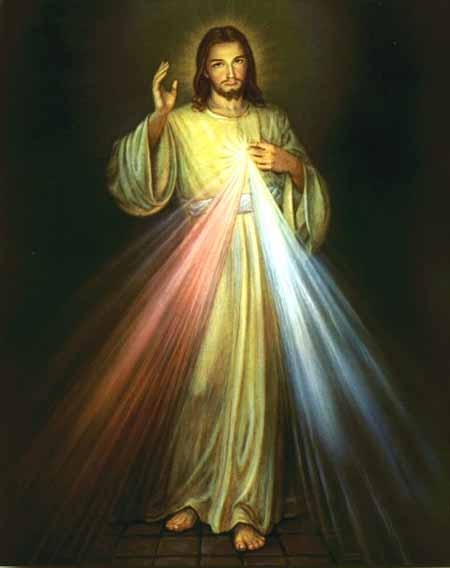
Lord Jesus Christ, Son of the Eternal Father, Son of the Virgin Mary, we thank you for offering Your life in sacrifice on the cross and for renewing this sacrifice in every Mass celebrated throughout the world.
In the power of the Holy Spirit we adore You and proclaim Your living presence in the Eucharist. We desire to imitate the love you show us in Your death and resurrection, by loving and serving one another.
We ask You to call many young people to religious life and to provide the holy and generous priests who are so needed in your church today.
Lord Jesus, hear our prayer.
AMEN.

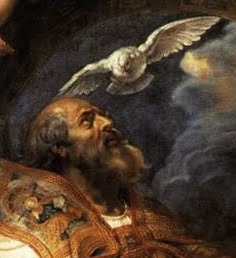
St. Gregory the Great and the sacrifice of self

On September 3rd the Church celebrates the feast of St. Gregory the Great – pope and doctor of the Church.  St. Gregory is noted for the liturgical reform and chant initiated during his papacy.  He wrote on many topics, below is an excerpt from a homily he wrote on Mt. 4:18-22. 

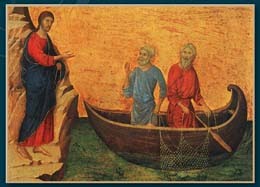
You have heard, dearly beloved, that at a single command Peter and Andrew left their nets and followed the Redeemer.  They had at this time seen him perform no miracles, they had heard nothing from him about eternal retribution: and yet at a single command from the Lord they forgot everything they seemed to possess.  How many of his miracles do we see?  How much suffering do we endure?  How many harsh warnings threaten us?  And yet we refuse to follow him when he calls.  He who counsels us about conversion is already seated in heaven; he has already subjected the necks of the Gentiles to the yoke of faith; he has already laid low the world’s glory; in its mounting ruins he already declares the approaching day of his strict judgment: and yet our proud hearts do not desire willingly to abandon what they lose daily, whether they will or not.  Dearly beloved, what are we going to say at his judgment, we who are not turned away from love of the present world by commands nor corrected by buffeting?

But someone may say in his silent thoughts, “What, and how much, did they give up at the Lord’s command, these two fishermen who had almost nothing?”  But in this, dearly beloved, we must weigh up the natural feeling rather than the amount.  Someone who has kept back nothing for himself has left much behind; someone who has abandoned everything, no matter how little it is, has left much behind.  Surely we hold on to what we have with love, and what we do not have we long for and seek to possess?  Peter and Andrew gave up much when along with their possessions they renounced even their craving to possess…

Nothing can be offered to God more precious than good will.  Good will means to experience fear for the adversities of another as if they were our own, to give thanks for a neighbor’s prosperity as for our own advancement, to believe another’s loss is our own, to count another’s gain our own, to love a friend not in the world but in God, to bear even with an enemy by loving him, to do to no one what you do not wish to suffer yourself, to choose to help a neighbor in need not only to the extent of your ability but even to assist him beyond your means.  What is richer and more substantial than this whole burnt offering, when what the soul is offering to God on the altar of its heart is a sacrifice of itself?

"Dear Lord … I’m a charismatic!" and "Called by Name"

The title is tongue-in-cheek but it is a realization I have recently come to in my spiritual life. 

I don’t know about you but I am the type of reader that when I find an author I enjoy I try to get my hands on and read every book he or she has written.  My current favorite author is Raniero Cantalamessa and I have read a number of his books already and am currently reading, “Come, Creator Spirit: Meditations on the Veni Creator”.  Cantalamessa, a long-time supporter of the charismatic movement, has a wealth of knowledge regarding Church history and spirituality.  He writes with a confident ease and in the above mentioned book he demonstrates the ever-present reality of the Holy Spirit in the life of the disciple and the Church.  I have never viewed myself as a “charismatic” – in terms of my own spirituality – but the truth is that every christian, by right of his or her baptism, is a charismatic.  The Holy Spirit is present, calling forth and creating new life. 

One interesting side-note that I have learned in my writing and studying of icons is that in Orthodox thought the color most often connected with the Holy Spirit is green and not necessarily the red that we tend to picture in our western Christian minds.  If we recall the words of the Creed we might see the connection more clearly.  In the Creed we profess, “…we believe in the Holy Spirit, the Lord, the giver of life…”.  Green is the ever present color of life – just take a moment outside and look around.  It is present in a multitude of different shades and hues and it reflects the presence of the Holy Spirit.

Below are some quotes from Cantalamessa’s book that I find worthy of reflection:

“…the Holy Spirit infuses in us not only “the gift of God,” but also the ability and the need to give ourselves.  From the Spirit we “catch,” so to say, the very qualities of what he is in himself.  The Spirit is “self-giving,” and in whomever he touches, the Spirit creates a dynamism that leads that one, in turn, to be a self-giving gift to others.”   

Here, Cantalamessa quotes Diadochus of Photike,

“Before a person comes to be baptised, grace is at work, from without, encouraging the soul toward the good, while Satan is at work, from within.  After baptism, the contrary is the case.  Grace works from within and the demons from without.  These continue their work, and work even more evilly than before, but not as present together with grace.  The only way they can work is through the promptings of the flesh.”

“And so it is with the Holy Spirit in the body of Christ which is the Church.  The Spirit is to the Church what the human soul is to the human body.  The Spirit is the principle that moves and inspires the whole.  What then would be the conclusive sign that one has received the Holy Spirit?  To speak in tongues?  To work miracles?  Not, not those, but to love the unity, and to know that you are firmly committed to living in union with the Church…” 

This coming Sunday, our diocese will begin the “Called by Name” process.  This is a three week process where we as a diocese reflect on the calling to vocation – specifically lives of service in our Church.  Each parish will be participating and will be conducting various activities these next few weeks plus praying intentionally for vocations to priesthood, religious life and the permanent diaconate.  For these three weeks I have decided to pray the “Come, Creator Spirit” each day for our diocese and for vocations.  I invite you to join with me in this prayer. 

Come, Creator Spirit

Come, Creator Spirit,
visit the minds of those who are yours;
fill with heavenly grace
the hearts that you have made.

You who are named the Paraclete,
gift of God most high,
living fountain, fire, love
and anointing for the soul.

You are sevenfold in your gifts,
you are finger of God’s right hand,
you, the Father’s solemn promise
putting words upon our lips.

Kindle a light in our senses,
pour love into our hearts,
infirmities of this body of ours
overcoming with strength secure.

The enemy drive from us away,
peace then give without delay;
with you as guide to lead the way
we avoid all cause of harm.

Grant we may know the Father
     through you,
and come to know the Son as well,
and may we always cling in faith
to you, the Spirit of them both.

Amen. 
St. Augustine’s anthropology

Today, we suffer from a very limited (and therefore limiting) anthropology.  It is an anthropology inherited from the Enlightenment and its reaction to the religious conflicts resulting from the turmoil surrounding the Reformation and Counter-Reformation.  Men and women were killing one another in the name of God and therefore Enlightenment thinkers decided to begin a process where we could arrive at a common understanding by, bit by bit, bracketing God and the transcendent out of the equation (here it must be acknowledged that there are many positives that we know and experience from this move – i.e. freedom of conscience, freedom of religion, an understanding of human rights, etc.) but, there are always “unintended consequences” to actions made, and one such consequence to this “bracketing off of God and the transcendent” is a reduced human anthropology. 

When we bracket off God then we can no longer authentically speak of humanity made in “the image and likeness” of God.

St. Augustine, whose feast we celebrate today, lived way before this move and therefore the anthropology found in his writings is much fuller and does not suffer from the limitations we have to deal with.  His anthropology is a needed corrective to the impoverished one we have inherited.

Below is a quote from the Confessions of Saint Augustine as found in today’s office of readings.  Listen to the fullness of anthropology that Augustine expresses.

Urged to reflect upon myself, I entered under your guidance into the inmost depth of my soul.  I was able to do so because you were my helper.  On entering into myself I saw, as it were with the eye of the soul, what was beyond the eye of the soul, beyond my spirit: in your immutable light.  It was not the ordinary light perceptible to all flesh, nor was it merely something of greater magnitude but still essentially akin, shining more clearly and diffusing itself everywhere by its intensity.  No, it was something entirely distinct, something altogether different from all these things; and it did not rest above my mind as oil on the surface of water, nor was it above me as heaven is above earth.  This light was above me because it had made me; I was below it because I was created by it.  He who has come to know the truth knows this light …

I sought a way to gain the strength which I needed to enjoy you.  But I did not find it until I embraced the mediator between God and men, the man Christ Jesus, who is above all, God blessed for ever.  He was calling me and saying: I am the way of truth, I am the life.  He was offering the food which I lacked the strength to take, the food he had mingled with our flesh.  For the Word became flesh, that your wisdom, by which you created all things, might provide milk for us children. 

Augustine’s primary move was into the self to find the fullest reflection of God.  Yes, all creation reflects God and is His handiwork and witnesses to God’s glory but the human self is the fullest reflection of God’s glory and therefore the best path to encounter God.  As Augustine turned inward he did not find an enclosed space, limited and dark with no real connection to the rest of reality; instead he found a space on which shone the very light of God.  Augustine’s “depth of the soul” is not a locked panic room but rather an open courtyard where relationship with one another and encounter with the Divine is always possible!

St. Augustine, pray for us in our impoverishment!  May we learn from your wisdom!

St. Monica’s wisdom

I find it interesting to note the reactions of people once they learn that someone is discerning a call to religious life or the priesthood.  The reactions are often across the board but there are two extremes that I have seen and even experienced during my own time of discernment.  One extreme is totally opposed.  It can be heard in such statements as, “How can you think of such a thing!”  “You are throwing your life away!”  “You are too young!”  “I want grandchildren!”.  The other extreme is totally “for” – uncritically.  In this extreme, people would have the one just beginning to discern either ordained or professing solemn vows tomorrow if they could.  Neither extreme is helpful.  As is often the case, virtue and wisdom lies in the middle. 

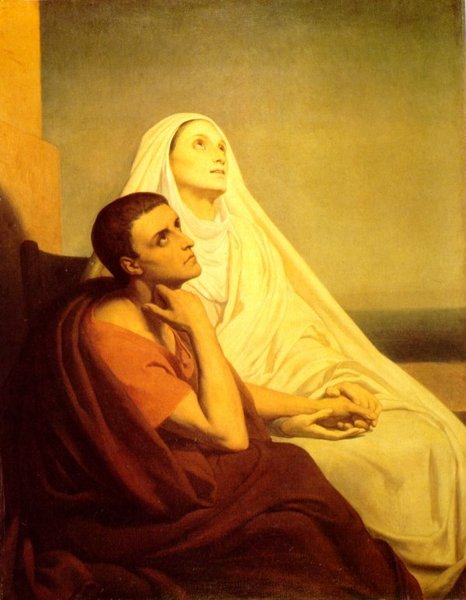
Today as the Church remembers St. Monica (the mother of St. Augustine) we are invited to reflect on her witness and learn from her wisdom.  Monica persevered in her prayer for her son and she prayed that God’s will be done in his life and that he find his way to the Church and there she left it with God.  Now, it does seem that she did have a tendency to intervene in her children’s lives uninvited (I think most parents can recognize this temptation) but there is a tender scene of Augustine and Monica near the end of her life that expresses a mellowing that had occurred for her over her lifetime in this regards and also a healing in this mother-son relationship.  (The young Augustine once  intentionally gave Monica the wrong departure time for a ship thus allowing him to slip out of town to Europe while literally leaving his mother standing on the dock!  Saints also, it seems, have rough patches and learn things too through trial and error in life.)

St. Monica has some specific wisdom to offer parents as they navigate the realities of raising sons and daughters while also learning to let go and let their children be who they are meant to be.  Monica, I believe, teaches the value of the perseverance of prayer, trusting God’s will, continually loving ones children and living ones own life vocation.

My advice to parents on this feast of St. Monica is that if you want to help your child discern his or her vocation first live your own vocation as a disciple, a spouse and parent.  Life vocations are not opposed to one another but in fact support and encourage one another.  (My life as a priest is continually strengthened by the witness of men and women living the christian vocation of marriage or witnessing to Christ sometimes boldly in the single life.)  Also, avoid the two extremes neither of which is helpful – virtue lies in the middle.  Finally (and really foremost) pray; pray for your children, for yourself as a parent – continually ask for God’s wisdom and guidance as you navigate the realities of living your vocation and being family.  Persevere in prayer!

Below is video clip found on the U.S. Bishops’ website “For Your Vocation” (http://www.foryourvocation.org/).  The clip is an interview with a couple and their role in helping their son discern a vocation to priesthood. 

Check it out on this Feast of St. Monica.

St. Bartholomew and the New Martyrs

In Michelangelo’s Last Judgement scene painted in the Sistine Chapel there stands a man slightly below and to the right of the triumphant and exalted Christ; the man’s eyes are turned toward Christ as if pleading for justice and in one of his hand’s hangs his own skin.  In the other is the instrument of his torture and death.  This man is St. Bartholomew.  Tradition holds that after Pentecost the apostle Bartholomew journeyed to India and Armenia to preach the gospel and it was there that he was martyred by being skinned alive.  St. Bartholomew represents all the martyrs of the faith who suffered and died for their faith in Christ and who cry out for justice and intercede for the pilgrim Church. 

One of my favorite churches is Rome is the Basilica of St. Bartholomew.  The basilica sits on the Tiberine Island in Rome and under its main altar is found the relics of the apostle himself.  During his pontificate, John Paul II entrusted the care of this basilica to the Community of Sant’Egidio.  It was also at this time that John Paul II had the desire to honor all the Christian martyrs (Catholic, Orthodox and Protestant) of the twentieth century.  The Community of Sant’Egidio recognized this desire of the late pope and has made the Basilica of St. Bartholomew a shrine to the “New Martyrs” of the twentieth century.  In the side altars of the basilica are found memories of Christian men and women who have given their lives in witness to their faith and in witness to peace and human dignity.  A letter of Dieterich Bonhoeffer stands as witness against the brutalities of Nazism.  The missal of Archbishop Oscar Romero (see above) sits on one of the side altars as a testimony against political and economic oppression.  The Bible of Floribert – a young African customs agent who was killed for not “looking the other way” in order to allow a shipment of rotten rice to enter his country – also stands in testimony against injustice.  These are just a few.  The memories of men and women (Catholic, Orthodox and Protestant) who lived and died for their faith are housed in this basilica in the heart of Rome.  Along with St. Bartholomew, these men and women turn toward Christ the risen Savior and call out for justice and the coming of God’s Kingdom!  

It must be noted that the days of the martyrs are not something of the distant past but rather a present day reality.  The twentieth century was one of bloodiest centuries – if not the bloodiest – for men and women witnessing to Christ.  But it is said that it is in the very blood of the martyrs that is found the seed bed of the church… 

An interesting note to the Basilica of St. Bartholomew is that before being a site for a Christian basilica this island in the middle of the Tiber River was recognized as a place of healing.  A pagan temple stood where now the church does and had within it a well whose waters were believed to contain curative powers.  In front of the altar of the basilica now sits the top of this well (see picture).  The well is now covered but what a powerful foreshadowing to the fullness of grace which now streams from the altar!  From the sacrifice of Christ streams of life-giving and healing waters flow, cleansing us from sin and healing the disunity, injustice and pain of our world.  
The martyrs stand in full witness to this healing grace of Christ, even as they are struck down they witness to that which is ever greater than the violence and evil of our world – an ever-enduring truth that the world cannot wipe away.  The New Martyrs set their lives by the light of the Kingdom of God and whenever men and women live according to the truth of God’s Kingdom (whenever truth and love is chosen over injustice and oppression) healing and authenticity is found and grows – in self, in relationships, in daily encounters and in society.   
With St. Bartholomew the new martyrs turn toward Christ and cry out for justice.  For us, the new martyrs witness to the life-giving truth of the Kingdom of God!    

St. Bartholomew and the encounter with Christ

Today the Church celebrates the feast of St. Bartholomew.  Bartholomew is one of the twelve apostles.  He is originally from Cana in Galilee and in the Gospel of John he is identified with the name Nathanael (meaning gift of God).  Bartholomew’s first encounter with Jesus is recorded in John 1:43-51 and we see that it is an encounter that proves decisive for Bartholomew – he changes his life, leaves all he knows and follows Jesus.  We see this response again and again throughout the gospels.  The encounter with Jesus changes things.  This living encounter is at the heart of discipleship and at the heart of vocation and it is extremely important to note that this encounter is with a person – not an idea or a theory or story or an interesting worldview or philosophy – but a person, the very person of Jesus Christ.  Discipleship and vocation must be rooted in our continuing encounter with Jesus Christ – the one who once was dead but who now lives!  It is just as true today for us as it was for the original twelve and the call is just as deep, just as needed in our world and just as life-giving!

As I enter into my new role as Vocation Director for our diocese I am doing my homework and part of this is reading, studying and reflecting on the fifth edition of The Program of Priestly Formation of the United States Conference of Catholic Bishops.  In the introduction of the PPF we find these words, “Priestly formation today continues the call of Jesus, the response of his first disciples, and their communion of life.  The Gospel foundation (emphasis mine) of priestly formation precedes programs, structures and plans.  What was vital and essential for that first community of disciples remains so today…”  What remains vital today and everyday is the encounter with Christ and the willingness, on our part, to enter into this encounter and to trust it.  This encounter is the Gospel foundation which precedes all else. 

It is important to note in John’s first chapter that it is Philip who first goes to get Bartholomew, “We have found the one that Moses wrote about in the Law, and the prophets as well: he is Jesus, son of Joseph, from Nazareth.”  Bartholomew then chose to accompany Philip back in order to see for himself – even if he was a bit skeptical at first.  This willingness to go and see is key to the life of discipleship and discerning vocation!  Take the time to go and see!  Yes, there probably are a hundred other things that could also be done.  Yes, in the eyes of the world, it might seem a foolish waste of time.  Yes, probably others will not understand.  Yes, it will mean trusting and the risk of being disappointed.  But … take the time to go and see anyway! 

Take the time to encounter Christ and let him speak to your heart!

St. Bartholomew, pray for us!

(In my next post I will discuss St. Bartholomew and the new martyrs.)

Van Morrison – the mystic

I actually have some time off for vacation so I am going to head over the mountains and meander around North Carolina for a few days.  To cover the blog while I am away I am posting the vocal stylings of Van Morrison, whom I am convinced is a mystic.  Enjoy!

“When will I ever learn to live in God?” by Van Morrison

The sun was setting over Avalon
The last time we stood in the west
Suffering long time angels enraptured by Blake
Burn out the dross innocence captured again

Standing on the beach at sunset all the boats
All the boats keep moving slow
In the glory of the flashing light in the evenings glow

When will I ever learn to live in God?
When will I ever learn?
He gives me everything I need and more
When will I ever learn?  (Refrain)

You brought it to my attention everything that was made in God
Down through centuries of great writings and paintings
Everything lives in God

Seen through architecture of great cathedrals
Down through the history of time
Is and was in the beginning and evermore shall be

*Refrain

Whatever it takes to fulfill his mission
That is the way we must go
But you’ve got to do it your own way
Tear down the old, bring up the new

And up on the hillside its quiet
Where the shepherd is tending his sheep
And over the mountains and the valleys
The countryside is so green

Standing on the highest hill with a sense of wonder
You can see everything is made in God
Head back down the roadside and give thanks for it all

*Refrain