The evidence of self-denial: "a comfortable hope"

During his upcoming visit to England, Pope Benedict will beatify John Henry Cardinal Newman – convert to Catholicism and influential theologian.  The ceremony will take place on September 19th.  Newman’s writings are abundantly rich and full of wisdom and knowledge.  For the purpose of the blog here I found a quote by Newman from his homily “Self-Denial, the Test of Religious Earnestness”.  If we are truly to be men and women of faith, disciples of the Lord, then we must learn to exercise the discipline of self-denial in our lives in one form or another.  True growth to a maturity in faith can only be achieved via this route.  In other words:

“Then Jesus said to his disciples, ‘If you want to follow me, deny yourself, take up your cross and follow me.  For whoever chooses to save his life will lose it, but the one who loses his life for my sake will find it.  What will one gain by winning the whole world if he destroys himself?  There is nothing you can give to recover your own self.”  (Mt. 16:24-26)

I believe that Newman’s words in this regard are a needed witness to all Christians in our day and time.  We are too comfortable with the status quo.  We are only too happy to remain half asleep.  We like our Jesus in measured doses … but when we “measure” Jesus out to our liking we stunt ourselves.  This is the problem.  We never reach the true maturity we are meant for.  We are happy to remain on the comfortable plateau of our “Jesus moments” while ignoring the path of self-denial that leads beyond the plateau … but ultimately up the mountain to a greater maturity.

“Wake up!” says Newman or (my words), “Get some backbone in your faith!”  It is only when we pick up the cross and learn the discipline of self-denial that we gain ourselves, that we grow to a true maturity in faith and discipleship, “…the one who loses his life for my sake will find it.”. 

Below are Newman’s words:

Now I do not for an instant suspect, my brethren, that you are in the sound slumber of Sin.  This is a miserable state, which I should hope was, on the whole, the condition of a few men, at least in a place like this.  But, allowing this, yet there is great reason for fearing that very many of you are not wide awake: that though your dreams are disturbed, yet dreams they are; and that the view of religion which you think to be a true one, is not that vision of the Truth which you would see were your eyes open, but such a vague, defective extravagant picture of it as a man sees when he is asleep.  At all events, however this may be, it will be useful (please God) if you ask yourselves, one by one, the question, “How do I know that I am in the right way?  How do I know that I have real faith, and am not in a dream?”

The circumstances of these times render it very difficult to answer this question.  When the world was against Christianity it was comparitively easy.  But (in one sense) the world is now for it … Thus, whether in private families, or in the world, in all ranks of middle life, men lie under a considerable danger at this day, a more than ordinary danger, of self-deception, of being asleep while they think themselves awake.

How then shall we try ourselves?  Can any tests be named which will bring certainty to our minds on the subject?  No indisputable tests can be given.  We cannot know for certain.  We must beware of an impatience about knowing what our real state is.  St. Paul himself did not know till the last days of his life (as far as we know), that he was one of God’s elect who shall never perish.  He said, “I know nothing by myself yet am I not hereby justified;” i.e. though I am not conscious to myself of neglect of duty, yet am I not therefore confident of my acceptance?  Judge nothing before the time…  And yet though this absolute certaintly of our election unto glory be unattainable, and the desire to obtain it an impatience which ill befits sinners, nevertheless a comfortable hope, a sober and subdued belief that God has pardoned and justified us for Christ’s sake (blessed be His name!), is attainable, according to St. John’s words, “If our heart condemn us not, then have we confidence toward God.”  And the question is, how are we to attain to this, under the circumstances in which we are placed?  In what does it consist?

…since the nature of Christian obedience is the same in every age, it still brings with it, as it did then, an evidence of God’s favour.  We cannot indeed make ourselves as sure as our being in the number of God’s true servants as the early Christians were, yet we may possess our degree of certainty, and by the same kind of evidence, the evidence of self-denial.  This was the great evidence which the first disciples gave, and which we can give still … yet at least we learn thus much from them (early Christians), that a rigorous self-denial is a chief duty, nay, that it may be considered the test whether we are Christ’s disciples, whether we are living in a mere dream, which we mistake for Christian faith and obedience, or are really and truly awake, alive, living in the day, on our road heavenwards.

“Then Jesus said to his disciples, ‘If you want to follow me, deny yourself, take up your cross and follow me. For whoever chooses to save his life will lose it, but the one who loses his life for my sake will find it.”

Vatican Protests "Outrageous" Qur’an Burning Plan

From my perspective, Pastor Jones – by planning to burn the Qur’an and using the Bible as a weapon – is getting it wrong on both fronts.  I pray for Pastor Jones and his church of fifty people.  I pray that their lives will be led more by the transforming love of Christ than by fear. 

Vatican Protests “Outrageous” Qur’an Burning Plan

Calls for Respect, Protection for Other Religions

VATICAN CITY, SEPT. 8, 2010 (Zenit.org).- The Pontifical Council for Interreligious Dialogue is protesting the “outrageous and grave” proposal of a man to hold a “Qur’an Burning Day” on Saturday.

Terry Jones, pastor of the Dove World Outreach Center in Gainesville, Florida, said that he wants to publicly burn a Qur’an, the holy book of Islam, on Saturday’s anniversary of the 2001 terrorist attacks by Muslim fundamentalists.

The Pontifical council stated in its English-language communiqué that “these deplorable acts of violence, in fact, cannot be counteracted by an outrageous and grave gesture against a book considered sacred by a religious community.”

“Each religion, with its respective sacred books, places of worship and symbols, has the right to respect and protection,” it stated.

On the occasion of the Sept. 11 anniversary, the council affirmed, we should instead “offer our deep sentiments of solidarity with those who were struck by these horrendous terrorist attacks.”

“To this feeling of solidarity we join our prayers for them and their loved ones who lost their lives,” it added.

As well, the council called on “each religious leader and believer” to “renew the firm condemnation of all forms of violence, in particular those committed in the name of religion.”

The communiqué quoted a 1999 address of John Paul II to the ambassador of Pakistan: “Recourse to violence in the name of religious belief is a perversion of the very teachings of the major religions.”

It also referenced the words of Benedict XVI in a 2006 audience with the ambassador of Morocco: “Violence as a response to offences can never be justified, for this type of response is incompatible with the sacred principles of religion.”

Catholic leaders worldwide are joining with U.S. officials to protest Jones’ initiative, calling for interreligious respect and expressing concern that Christian minority communities and Americans abroad will be unjustly attacked in recompense.

Cardinal Theodore McCarrick, former archbishop of Washington, said in a press conference that this initiative does not correctly represent Christianity nor the “real America.”

He underlined the need for an authentic Christian attitude of reaching out to Muslims in love.

Birth of Mary

Today the Church celebrates the feast of the Birth of Mary and here, in the Diocese of Knoxville, we celebrate the anniversary of the establishment of our diocese! 

We know that this feast dates back at least to the early 700’s as at that time Pope Sergius established that four separate feasts honoring Mary should be kept in Rome with one of these being the birth of Mary.  This feast of the Birth of Mary is important because in the birth of Mary we see that the promise of God to bring salvation to all peoples and to heal the effects of sin has begun.  Mary is the morning star announcing the rising of the Sun!  The morning star, it must be noted, shines not with its own glory but rather, it reflects the coming glory of the Sun upon all the earth.  Mary shines with and reflects the very light of Christ and his resurrection and triumph!

O do not weep, Mother of God, 
beside the Cross of Christ, our Saviour.
Be joyful, for truly he is risen;
in his body there lies hidden
all the ransom
and the salvation
of all people! 
Below are some words written by St. Andrew of Crete in regards to today’s feast:
Justly then do we celebrate this mystery since it signifies for us a double grace.  We are led toward the truth, and we are led away from our condition of slavery to the letter of the law.  How can this be?  Darkness yields before the coming of light; and grace exchanges legalism for freedom.  But midway between the two stands today’s mystery, at the frontier where types and symbols give way to reality, and the old is replaced by the new.
Therefore, let all creation sing and dance and unite to make worthy contribution to the celebration of this day.  Let there be one common festival for saints in heaven and men on earth.  Let everything, mundane things and those above, join in festive celebration.  Today this created world is raised to the dignity of a holy place for him who made all things.  The creature is newly prepared to be a divine dwelling place for the Creator. 

Quote for Labor Day

Below is a quote by Roger Scruton in his Introduction to “Leisure, The Basis of Culture” by Josef Pieper.

“Don’t just do something: stand there!”  The command of an American President to a fussy official was one of those rare moments in American politics when truth prevailed over industry.  Josef Pieper’s serene reflections on the art of being serene ought to be read by every practical person – and the more that person is involved in business, politics, the public life, the more useful will Pieper be to him.  For here, in a succinct yet learned argument, are all the reasons for thinking that the frenzied need to work, to plan, and to change things is nothing but idleness under other names – moral, intellectual, and emotional idleness.  In order to defend itself from self-knowledge, this agitated idleness is busy smashing all the mirrors in the house. 

Leisure has had a bad press.  For the puritan it is the source of vice; for the egalitarian a sign of privilege.  The Marxist regards leisure as the unjust surplus, enjoyed by the few at the expense of the many.  Nobody in a democracy is at ease with leisure, and almost every person, however little use he may have for his time, will say that he works hard for a living – curious expression, when the real thing to work for is dying.

The calumnies, however, do not apply: so argues Josef Pieper.  We mistake leisure for idleness, and work for creativity.  Of course, work may be creative.  But only when informed by leisure.  Work is the means of life; leisure the end.  Without the end, work is meaningless – a means to a means to a means … and so on forever, like Wall Street or Capitol Hill.  Leisure is not the cessation of work, but work of another kind, work restored to its human meaning, as a celebration and a festival. 

"Called by Name"

Today the Diocese of Knoxville begins the “Called by Name” program.  “Called by Name” is a three-week process where we, as a diocese, reflect on the vocations of service within the Church – priesthood, religious and diaconate.  During this process every parish, school and university center will pray for an increase in vocations and from within our own communities recommend and encourage men and women who might have a vocation to a life of christian service. 

What might one look for in candidates for the priesthood, diaconate and religious life?  Here are some suggestions to consider:

  • A growing prayer life and relationship with God
  • An ability to articulate faith and principles of the Christian life in ones own words
  • An awareness of the value of Christian community, a willingness to operate as a member of community and the ability to interact with people of all ages
  • An ability to maintain healthy friendships with men and women
  • A willingness to live out of an option for the poor and those who are most in need
  • A respect for different cultures
  • The distinction of being a real church person who accepts and lives out the teachings and morals of the Church

Bishop Stika has written a prayer to be said throughout our diocese these three weeks, it is found below and I encourage us all to make it part of our daily prayer. 

A prayer for the increase of priestly and religious vocations
Lord Jesus Christ, Son of the Eternal Father, Son of the Virgin Mary, we thank you for offering Your life in sacrifice on the cross and for renewing this sacrifice in every Mass celebrated throughout the world.
In the power of the Holy Spirit we adore You and proclaim Your living presence in the Eucharist. We desire to imitate the love you show us in Your death and resurrection, by loving and serving one another.
We ask You to call many young people to religious life and to provide the holy and generous priests who are so needed in your church today.
Lord Jesus, hear our prayer.
AMEN.

St. Gregory the Great and the sacrifice of self

On September 3rd the Church celebrates the feast of St. Gregory the Great – pope and doctor of the Church.  St. Gregory is noted for the liturgical reform and chant initiated during his papacy.  He wrote on many topics, below is an excerpt from a homily he wrote on Mt. 4:18-22. 

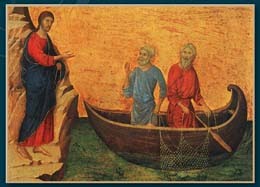
You have heard, dearly beloved, that at a single command Peter and Andrew left their nets and followed the Redeemer.  They had at this time seen him perform no miracles, they had heard nothing from him about eternal retribution: and yet at a single command from the Lord they forgot everything they seemed to possess.  How many of his miracles do we see?  How much suffering do we endure?  How many harsh warnings threaten us?  And yet we refuse to follow him when he calls.  He who counsels us about conversion is already seated in heaven; he has already subjected the necks of the Gentiles to the yoke of faith; he has already laid low the world’s glory; in its mounting ruins he already declares the approaching day of his strict judgment: and yet our proud hearts do not desire willingly to abandon what they lose daily, whether they will or not.  Dearly beloved, what are we going to say at his judgment, we who are not turned away from love of the present world by commands nor corrected by buffeting?

But someone may say in his silent thoughts, “What, and how much, did they give up at the Lord’s command, these two fishermen who had almost nothing?”  But in this, dearly beloved, we must weigh up the natural feeling rather than the amount.  Someone who has kept back nothing for himself has left much behind; someone who has abandoned everything, no matter how little it is, has left much behind.  Surely we hold on to what we have with love, and what we do not have we long for and seek to possess?  Peter and Andrew gave up much when along with their possessions they renounced even their craving to possess…

Nothing can be offered to God more precious than good will.  Good will means to experience fear for the adversities of another as if they were our own, to give thanks for a neighbor’s prosperity as for our own advancement, to believe another’s loss is our own, to count another’s gain our own, to love a friend not in the world but in God, to bear even with an enemy by loving him, to do to no one what you do not wish to suffer yourself, to choose to help a neighbor in need not only to the extent of your ability but even to assist him beyond your means.  What is richer and more substantial than this whole burnt offering, when what the soul is offering to God on the altar of its heart is a sacrifice of itself?

"Dear Lord … I’m a charismatic!" and "Called by Name"

The title is tongue-in-cheek but it is a realization I have recently come to in my spiritual life. 

I don’t know about you but I am the type of reader that when I find an author I enjoy I try to get my hands on and read every book he or she has written.  My current favorite author is Raniero Cantalamessa and I have read a number of his books already and am currently reading, “Come, Creator Spirit: Meditations on the Veni Creator”.  Cantalamessa, a long-time supporter of the charismatic movement, has a wealth of knowledge regarding Church history and spirituality.  He writes with a confident ease and in the above mentioned book he demonstrates the ever-present reality of the Holy Spirit in the life of the disciple and the Church.  I have never viewed myself as a “charismatic” – in terms of my own spirituality – but the truth is that every christian, by right of his or her baptism, is a charismatic.  The Holy Spirit is present, calling forth and creating new life. 

One interesting side-note that I have learned in my writing and studying of icons is that in Orthodox thought the color most often connected with the Holy Spirit is green and not necessarily the red that we tend to picture in our western Christian minds.  If we recall the words of the Creed we might see the connection more clearly.  In the Creed we profess, “…we believe in the Holy Spirit, the Lord, the giver of life…”.  Green is the ever present color of life – just take a moment outside and look around.  It is present in a multitude of different shades and hues and it reflects the presence of the Holy Spirit.

Below are some quotes from Cantalamessa’s book that I find worthy of reflection:

“…the Holy Spirit infuses in us not only “the gift of God,” but also the ability and the need to give ourselves.  From the Spirit we “catch,” so to say, the very qualities of what he is in himself.  The Spirit is “self-giving,” and in whomever he touches, the Spirit creates a dynamism that leads that one, in turn, to be a self-giving gift to others.”   

Here, Cantalamessa quotes Diadochus of Photike,

“Before a person comes to be baptised, grace is at work, from without, encouraging the soul toward the good, while Satan is at work, from within.  After baptism, the contrary is the case.  Grace works from within and the demons from without.  These continue their work, and work even more evilly than before, but not as present together with grace.  The only way they can work is through the promptings of the flesh.”

“And so it is with the Holy Spirit in the body of Christ which is the Church.  The Spirit is to the Church what the human soul is to the human body.  The Spirit is the principle that moves and inspires the whole.  What then would be the conclusive sign that one has received the Holy Spirit?  To speak in tongues?  To work miracles?  Not, not those, but to love the unity, and to know that you are firmly committed to living in union with the Church…” 

This coming Sunday, our diocese will begin the “Called by Name” process.  This is a three week process where we as a diocese reflect on the calling to vocation – specifically lives of service in our Church.  Each parish will be participating and will be conducting various activities these next few weeks plus praying intentionally for vocations to priesthood, religious life and the permanent diaconate.  For these three weeks I have decided to pray the “Come, Creator Spirit” each day for our diocese and for vocations.  I invite you to join with me in this prayer. 

Come, Creator Spirit

Come, Creator Spirit,
visit the minds of those who are yours;
fill with heavenly grace
the hearts that you have made.

You who are named the Paraclete,
gift of God most high,
living fountain, fire, love
and anointing for the soul.

You are sevenfold in your gifts,
you are finger of God’s right hand,
you, the Father’s solemn promise
putting words upon our lips.

Kindle a light in our senses,
pour love into our hearts,
infirmities of this body of ours
overcoming with strength secure.

The enemy drive from us away,
peace then give without delay;
with you as guide to lead the way
we avoid all cause of harm.

Grant we may know the Father
     through you,
and come to know the Son as well,
and may we always cling in faith
to you, the Spirit of them both.

Amen. 

St. Augustine’s anthropology

Today, we suffer from a very limited (and therefore limiting) anthropology.  It is an anthropology inherited from the Enlightenment and its reaction to the religious conflicts resulting from the turmoil surrounding the Reformation and Counter-Reformation.  Men and women were killing one another in the name of God and therefore Enlightenment thinkers decided to begin a process where we could arrive at a common understanding by, bit by bit, bracketing God and the transcendent out of the equation (here it must be acknowledged that there are many positives that we know and experience from this move – i.e. freedom of conscience, freedom of religion, an understanding of human rights, etc.) but, there are always “unintended consequences” to actions made, and one such consequence to this “bracketing off of God and the transcendent” is a reduced human anthropology. 

When we bracket off God then we can no longer authentically speak of humanity made in “the image and likeness” of God.

St. Augustine, whose feast we celebrate today, lived way before this move and therefore the anthropology found in his writings is much fuller and does not suffer from the limitations we have to deal with.  His anthropology is a needed corrective to the impoverished one we have inherited.

Below is a quote from the Confessions of Saint Augustine as found in today’s office of readings.  Listen to the fullness of anthropology that Augustine expresses.

Urged to reflect upon myself, I entered under your guidance into the inmost depth of my soul.  I was able to do so because you were my helper.  On entering into myself I saw, as it were with the eye of the soul, what was beyond the eye of the soul, beyond my spirit: in your immutable light.  It was not the ordinary light perceptible to all flesh, nor was it merely something of greater magnitude but still essentially akin, shining more clearly and diffusing itself everywhere by its intensity.  No, it was something entirely distinct, something altogether different from all these things; and it did not rest above my mind as oil on the surface of water, nor was it above me as heaven is above earth.  This light was above me because it had made me; I was below it because I was created by it.  He who has come to know the truth knows this light …

I sought a way to gain the strength which I needed to enjoy you.  But I did not find it until I embraced the mediator between God and men, the man Christ Jesus, who is above all, God blessed for ever.  He was calling me and saying: I am the way of truth, I am the life.  He was offering the food which I lacked the strength to take, the food he had mingled with our flesh.  For the Word became flesh, that your wisdom, by which you created all things, might provide milk for us children. 

Augustine’s primary move was into the self to find the fullest reflection of God.  Yes, all creation reflects God and is His handiwork and witnesses to God’s glory but the human self is the fullest reflection of God’s glory and therefore the best path to encounter God.  As Augustine turned inward he did not find an enclosed space, limited and dark with no real connection to the rest of reality; instead he found a space on which shone the very light of God.  Augustine’s “depth of the soul” is not a locked panic room but rather an open courtyard where relationship with one another and encounter with the Divine is always possible!

St. Augustine, pray for us in our impoverishment!  May we learn from your wisdom!

St. Monica’s wisdom

I find it interesting to note the reactions of people once they learn that someone is discerning a call to religious life or the priesthood.  The reactions are often across the board but there are two extremes that I have seen and even experienced during my own time of discernment.  One extreme is totally opposed.  It can be heard in such statements as, “How can you think of such a thing!”  “You are throwing your life away!”  “You are too young!”  “I want grandchildren!”.  The other extreme is totally “for” – uncritically.  In this extreme, people would have the one just beginning to discern either ordained or professing solemn vows tomorrow if they could.  Neither extreme is helpful.  As is often the case, virtue and wisdom lies in the middle. 

Today as the Church remembers St. Monica (the mother of St. Augustine) we are invited to reflect on her witness and learn from her wisdom.  Monica persevered in her prayer for her son and she prayed that God’s will be done in his life and that he find his way to the Church and there she left it with God.  Now, it does seem that she did have a tendency to intervene in her children’s lives uninvited (I think most parents can recognize this temptation) but there is a tender scene of Augustine and Monica near the end of her life that expresses a mellowing that had occurred for her over her lifetime in this regards and also a healing in this mother-son relationship.  (The young Augustine once  intentionally gave Monica the wrong departure time for a ship thus allowing him to slip out of town to Europe while literally leaving his mother standing on the dock!  Saints also, it seems, have rough patches and learn things too through trial and error in life.)

St. Monica has some specific wisdom to offer parents as they navigate the realities of raising sons and daughters while also learning to let go and let their children be who they are meant to be.  Monica, I believe, teaches the value of the perseverance of prayer, trusting God’s will, continually loving ones children and living ones own life vocation.

My advice to parents on this feast of St. Monica is that if you want to help your child discern his or her vocation first live your own vocation as a disciple, a spouse and parent.  Life vocations are not opposed to one another but in fact support and encourage one another.  (My life as a priest is continually strengthened by the witness of men and women living the christian vocation of marriage or witnessing to Christ sometimes boldly in the single life.)  Also, avoid the two extremes neither of which is helpful – virtue lies in the middle.  Finally (and really foremost) pray; pray for your children, for yourself as a parent – continually ask for God’s wisdom and guidance as you navigate the realities of living your vocation and being family.  Persevere in prayer!

Below is video clip found on the U.S. Bishops’ website “For Your Vocation” (http://www.foryourvocation.org/).  The clip is an interview with a couple and their role in helping their son discern a vocation to priesthood. 

Check it out on this Feast of St. Monica.