
VIII. 7.
The watcher comes, knowing the small
knowledge of his life in this body
in this place in this world. He comes
to a place of rest where he cannot
mistake himself as larger than he is,
the place of the gray flycatcher,
the yellow butterfly, the green dragonfly,
the white violet, the columbine,
where he cannot mistake himself
as more graced or graceful than he is.
At the woods’ edge, the wild rose
is in bloom, beauty and consolation
always in excess of thought.
“A Small Porch” by Wendell Berry
Sunday, May 24th concludes Laudato Si’ Week – a time set in the Catholic Church to mark the fifth anniversary of Pope Francis’s encyclical “Laudato Si’: On Care for Our Common Home” and to reflect on the teachings that Pope Francis offers in the encyclical, the concerns he gives voice to and the hope that he calls us to as followers of Christ and as stewards of creation.
This year, Laudato Si’ Week is observed in the midst of a global pandemic. A small airborne virus has slammed the brakes on our human world in all of its pride, presumption and whirlwind activity. COVID 19 has left us all disoriented and, at the woods’ edge.
Berry’s poem makes prophetic utterance when he writes, He comes to a place of rest where he cannot mistake himself as larger than he is … where he cannot mistake himself as more graced or graceful than he is. This is where we are. It is where illusions are wiped away and we are made to recognize our very real creatureliness. Yes, made in the image and likeness of God – a child of God – but still one creature within a very large creation nonetheless.
Yet, there are hidden gifts found in this moment and Berry’s poem can help us to recognize them. Not to diminish the very real pain and suffering that is occurring in the world but there is a “rest” found when we are brought, by hook or by crook, to an authentic and real knowledge of who we are. There is a rest gained when we are made to recognize that we are neither larger than we actually are nor more graced and graceful. There is a rest that only a humble heart can experience – whether the humility was sought or not does not matter. The rest and its healing is the same. It is worthwhile to both recognize and receive this rest.
We are not alone. This is another gift found at the wood’s edge. We are with the gray flycatcher, the yellow butterfly, the green dragonfly, the white violet, the columbine… God never intended the glory of his image and likeness in which man and woman are made to be manipulated and twisted into a cruel separation marked by a misguided sense of superiority, dominance and indifference towards the rest of his creation. That is not the work of God but rather of the evil one and of our often eager willingness to cooperate through sin in that twisting of the Creator’s original intent. At the wood’s edge, cut off from the illusions of the world and our lives, we begin to notice again what has always been true – that we are not alone. We are one part of an incredible and vast creation that gives witness and praise to the love, power and glory of the One who alone is creator. The wood’s edge bears witness that neither the universe nor creation are random occurrences in time and space but rather a deliberate act of will by a God who is love. We can know this witness and learn what it has to teach if we are open and willing to see and listen. Yes, we are part of something much bigger than ourselves but we are neither lost within its vastness nor left in abandonment on our own.
The final gift is freedom. At the woods’ edge, the wild rose is in bloom, beauty and consolation always in excess of thought. What wild roses are in bloom in this moment beyond our imagining? The wood’s edge offers a true and startling freedom to each one of us. Do we have to go back to the way it was before? Is it even worthwhile to go back to the way it was? What about less? Less running, less stress, less things, less acquiring, less activity often just done for pride and activities’ sake? What the wood’s edge offers is neither an invitation to magical flights of fancy nor naïve wishful thinking but a true gut check in reality (sometimes a gut punch) daring us to take the risk of asking if it, indeed, has to be the same and, if not, then why not seek and live a different way? What other persons (or the world, for that matter) choose to do at the wood’s edge does not matter. What matters is my choice. Am I willing to go deeper beyond the wood’s edge trusting that there is a beauty and consolation found within that is always in excess of thought?
COVID-19 has forced us to the wood’s edge. It is quite disconcerting. All sorts of primal fears get stirred up and the initial instinct is to either retreat to the safe and familiar or lash out in fear and anger but as Pope Francis and Wendell Berry both know in their own unique ways; new life, true relationship and authentic freedom are often found on the edge (or periphery) of things. Maybe the best thing we can do right now is just be willing to be at the wood’s edge – to watch, listen and learn what it has to teach.
 It is interesting how some things stay with us and even become operating principles in our lives.
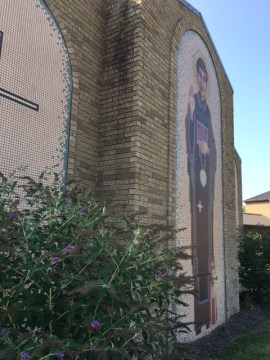 What is best for the environment? This is a question I find myself continually returning to after reading Pope Francis’ encyclical “Laudato Si” as well as my own growing interest in protecting and safe-guarding creation. Do the plants and shrubs we favor around churches help benefit the environment or do they just look nice from our human perspective? Can our parish grounds themselves become places that benefit and support creation? A couple of years ago now I planted two butterfly bushes in front of our Parish Life Center because they fit and enhance the space, they are low maintenance and hardy and, in regards to this question, they are a benefit to bees and butterflies. A simple choice in a planting can have ripples of effect.
 Wolves (for which I have always had an interest in since I was a child) were my main interest in visiting Yellowstone but during these days I was also thrilled to view numerous black bears (a few with cubs), bison, elk, mule deer, bighorn sheep, pronghorn, an osprey nest inhabited by mother, father and two chicks, foxes, coyotes, badgers, a bald eagle flying and numerous smaller animals and birds.
![IMG_5641[3392]](https://thealternatepath.org/wp-content/uploads/2017/07/img_56413392.jpg?w=290&h=193) For a week, I was “unplugged” – to some degree. Other than sharing some pictures on Facebook and Instagram and talking with the people I met or was around during the day I had no idea what was going on in the world. I would rise early to get into the park before the heat of the day became too oppressive, return to Gardner for lunch and a short siesta and then return into the park not to leave until late in the evening.
For a week, I was “unplugged” – to some degree. Other than sharing some pictures on Facebook and Instagram and talking with the people I met or was around during the day I had no idea what was going on in the world. I would rise early to get into the park before the heat of the day became too oppressive, return to Gardner for lunch and a short siesta and then return into the park not to leave until late in the evening.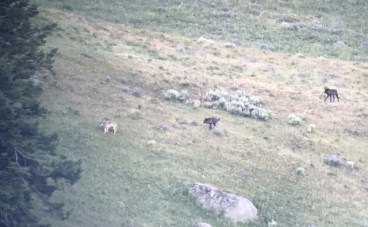 Although I have an interest in wolves and have now spotted three packs during my two visits to Yellowstone I do not think I have some “mystical” connection with them because the wolves are unconcerned about me and that is the way it should be. The wolves are just out there being wolves and if something were to happen and all of sudden humanity disappeared from the face of the earth the wolves, bears, bison, elk and all animals would just continue continuing on. But the wolves and other animals are of concern to me and that is what makes me human.
 The Alternate Path