• About The Alternate Path

The Alternate Path

~ Thoughts on Walking the Path of Christian Discipleship

The Alternate Path

Author Archives: mcummins2172

Being a St. Augustine nerd and discernment

30 Wednesday May 2012

Posted by mcummins2172 in Discovering Vocation, St. Augustine, Vocation

≈ Leave a comment

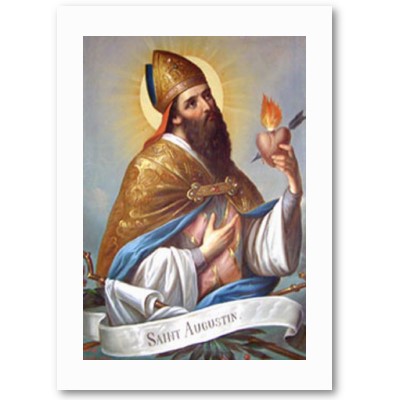
There are Star War nerds, Star Trek nerds, Hello Kitty nerds and Lord of the Rings nerds … just to name a few.  Part of the dynamic of the “nerd” is to keep returning to the source of fascination – watching the movie or reading the book for the one hundredth time.  With this stipulation, I have come to realize that I am a St. Augustine nerd.  Anything I come across by the Bishop of Hippo I latch onto even if I have already encountered it a number of times before.  Today’s excerpt from Augustine’s Confessions found in the Office of Readings is a prime example.  This is a very familiar section to me but yet, once again, it spoke in a new way and I found myself being led by the saint’s thoughts into a new insight.

The part that most struck me was the first paragraph quoted.

Lord, you know me.  Let me know you.  Let me come to know you even as I am known.  You are the strength of my soul; enter it and make it a place suitable for your dwelling, a possession without spot or blemish.  This is my hope and the reason I speak.  In this hope I rejoice, when I rejoice rightly.  As for the other things of this life, the less they deserve tears, the more likely will they be lamented; and the more they deserve tears, the less likely will men sorrow for them.  For behold, you have loved the truth, because the one who does what is true enters into the light.  I wish to do this truth before you alone by praising you, and before a multitude of witnesses by writing of you.

First off, Augustine’s audaciousness strikes me.  Lord … Let me know you.  This is God that Augustine is addressing before whom we are each just a speck of dust yet Augustine is confident to make this request.  Augustine can do this because he has come to realize that God indeed wants to be known by us.  God wants relationship with us.  In fact, all of salvation history can be read as God seeking relationship with us.  An effort, on God’s part, that culminates and is fulfilled in the incarnation and resurrection of Jesus Christ.

Second, Augustine realizes that for us to begin to know God we need to first open ourselves to him; allowing him to make of us a pleasing dwelling place by his purifying presence.  Augustine is not shy about confessing his own sinfulness and he is wise enough to recognize that God cannot dwell together with sin and evil.  We cannot hold onto our sins and expect God to not notice nor care.  The presence of God demands conversion – both big and small – on our part.  I believe that one of the most besetting sins of our age is a fundamental ingratitude in the heart that flies into a huff when anyone (including God) dares to challenge it to move beyond its self-absorption and narcissism.  This ingratitude is witnessed to in the thought that God had better accomodate himself to my sins rather than myself being challenged and converted. 

I would venture to say that Augustine would have no place for those with an ungrateful heart.  In other words, I think that the saint would be someone who would find it hard to suffer fools.  This awareness on Augustine’s part of the needed purifying presence of God in life brings insight and allows him to judge rightly the tenor of the times where what does not deserve tears is lamented and where what does deserve tears is barely noticed let alone sorrowed after.  Allowing God’s presence to make of us a pleasing dwelling does not just remain within as a comforting sentiment, a warm fuzzy inside.  The more that God comes to dwell within the more one is able to both discern the world and see correctly while also discerning oneself and ones own place in the world.

This is where my own Vocation Director ears listen in attentively to Augustine’s development of thought.  When we in all humility allow God to come within us and “know” us; we learn who we ourselves are meant to be.  We start to realize our vocation in life.  When we do not allow God within then we will never break beyond the surface of any true self-knowledge.  No matter how many seminars we go to or self-help books we read or hours in therapy we attend or “stuff” we acquire.

When we allow God within we discover who we ourselves are.

For behold, you have loved the truth, because the one who does what is true enters into the light.                 

Pentecost: Think Green

25 Friday May 2012

Posted by mcummins2172 in Holy Spirit, Pentecost

≈ Leave a comment

Throughout the Scriptural proclamation of Pentecost (Acts 2:1-11, 1 Cor. 12:3b-7, 12-13 and John 15:26-27; 16:12-15) there is the underlying theme of restored communication – being able once again to speak to one another. 
It has been said that the coming of the Spirit on Pentecost signals the end of the division and discord which resulted from the Tower of Babel.  Where the pride of Babel led to the dividing of humanity; now all peoples and nations are united in their listening to the proclamation of the gospel resulting from the coming of Spirit upon the disciples.  When the crowd from a multitude of peoples and nations gathers at the door of the house where the apostles were we are told that they ask, Are not all these people who are speaking Galileans?  Then how does each of us hear them in his native language?  Through the Holy Spirit divisions are overcome and it is possible to once again speak to one another.
The coming of the Holy Spirit also brings healing to those divisions that occur within our very selves.  We all have these.  In some form or another we are each fragmented.  These are the wounds and effects of original sin.  St. Paul summarizes what we all experience when he says, For I do not do the good I want, but the evil I do not want is what I do. (Rom. 7:19)  It is only the healing balm of the Holy Spirit which heals this inner fragmentation allowing us to then authentically proclaim, Jesus is Lord!  This proclamation found in Paul’s first letter to the Corinthians is not just a nice catchphrase or slogan but is, in fact, a tangible witness of an authenticity achieved by a self that is being healed of the divisions within by God’s grace.  This proclamation cannot be faked.  It must be lived.
Finally, the outpouring of the Holy Spirit heals the deepest wound within; allowing us to once again hear the voice of God.  I have much more to tell you, says our Lord, but you cannot hear it now.  But when he comes, the Spirit of truth, he will guide you to all truth.  He will not speak on his own, but he will speak what he hears, and will declare to you the things that are coming. The Holy Spirit leads us into the very things of God which heal, elevate and enlighten.  The Spirit leads us beyond the crass reasoning of the secular and or our age.  Transcendence, living by something more than this world, is possible.
I have an interest in iconography.  For a number of years now I have been studying icons and even learning how to paint (write) icons.  Icons are considered visual theology (very appropriate for a visual age).  Over these years one thing that I have learned is that in Russian Orthodox thought red is not the only color that can be associated with the Holy Spirit.  (In western Christianity we primarily use red as the liturgical color of the Holy Spirit.)  In Orthodox thought green can also be seen as a color denoting the Holy Spirit.  When we consider the creed that we profess this makes sense.  In the Nicene Creed we proclaim the Holy Spirit to be the Lord, the giver of life…  Recently I was able to spend an afternoon on a short hike in the mountains and at one point I found myself right at the edge of a wooded area looking down upon a little vale of tall green grass.  It was quiet and still.  You could only hear the wind rustling the leaves of the trees.  The leaves above me were green and as the wind continued to blow I saw waves ripple through the green grass.  Green was all over and it struck me how green is the color of life.  It is so present (at least in East Tennessee) that it is easily overlooked often, I think, like the work of the Holy Spirit. 
I share this thought because I think it is helpful to add a little green to our understanding of the Holy Spirit and I think that the readings for this day with their theme of restored connection, dialogue and relationship allow for this.  Yes, the Holy Spirit is red: the Spirit purifies, inflames and convicts us in the truth.  And yes, the Holy Spirit is green: the Spirit restores, renews and both summons us and enables us to achieve an authenticity in life and in relationship.
But when he comes, the Spirit of truth, he will guide you to all truth.

Ascension Sunday: The concreteness of the Ascension

19 Saturday May 2012

Posted by mcummins2172 in Ascension of Christ, love

≈ Leave a comment

“The Ascension of Our Lord Jesus Christ” by Piotr Basin

Today, the Church celebrates one of its most concrete feasts – the ascension of Christ.  Throughout history there have been (and will continue to be, I am sure) Utopian dreams of a better world of tomorrow.  These dreams have been based on everything from the rise and triumph of the proletariat to the notion of a separated community of the enlightened to (one which is very much in vogue now) the undaunted belief in the sure progress of science.  These are the Utopian dreams that history has seen come and go.  They are often idealistic and based in a hoped for vision of tomorrow but today’s feast is different.  Where Utopian dreams are often ideological and abstract the ascension of Christ is concrete and sure. 

It is so because of the simple fact that it is not founded in some abstract principle or ideal but in the very resurrected body of Christ.  Christ is indeed risen which means he is risen body and soul, flesh and blood.  Anything less would not be fully and authentically human.  Christ ascends to the Father not just in spirit or thought but in the very concrete reality of his full humanity.  Throughout this Easter season in the Scriptures proclaimed we have heard Christ, time and time again, assuring his disciples that he is indeed present in “flesh and bone”.  This means fully present not just up to the moment of the ascension but in the ascension itself and now at the Father’s right hand.  From the day of the ascension heaven “began to populate itself with the earth, or, in the language of Revelation, a new heaven and earth began.”

In the ascension we truly realize that we are not orphans.  We are not left to the cold and cruel winds of chance, fate and odds or a history without direction.  Direction has been set.  The resurrected Christ (body and soul) sits at the Father’s right hand.  This, and nothing less, is our goal.  It is what we are meant for and what we are called to by God’s grace.

It is truly concrete and it is achieved and experienced concretely. 

In the gospel Jesus tells us that he is “the way” and the way, it turns out, is walked concretely.  The ascension is experienced again not in some abstract manner but in how we concretely treat and love the smallest and poorest brothers and sisters in our midst.  This, I have found, is a foundational understanding of the Community of Sant’Egidio which really is nothing more than discipleship 101.  When we love concretely we experience the ascension and we are brought toward the fullness of the future that God has prepared for us in Christ.

Let me share an example.  For three years now our Johnson City Community of Sant’Egidio has been taking sandwich bags every Monday to the John Sevier Center.  (The John Sevier Center is a low-income housing unit in downtown Johnson City.)  We do not go there as experts in anything.  We know we cannot solve the residents problems and struggles.  We just go and we are faithful in going and in this simple act of being present a human space is created both for the residents and for us.  We become friends.  We are brought a little bit further toward the fullness that awaits us all.  In this human space miracles happen and signs are given – demons are cast out and life is gained.  I have seen it for myself these past three years.

Christ bestows his love upon us.  We are meant to communicate it.  Love that is not communicated soon withers and dies. 

Love is lived not abstractly but concretely and it is in the concrete act that we are brought toward the fullness that awaits us all.       


"Let us love one another."

11 Friday May 2012

Posted by mcummins2172 in Bishop Vincenzo Paglia, Community of Sant'Egidio, love

≈ Leave a comment

In my own prayer, reflection and preparation for the Sunday homily I often consult, “The Word of God Everyday”.  This is the daily Scripture reflection book for the Community of Sant’Egidio.  The reflections are written by Bishop Vincenzo Paglia.  Below I have copied in whole his reflection for this coming Sunday, the sixth Sunday of Easter.  I find it to be very good and thought-provoking.  I hope that you do too. 

 “Let us love one another.” This is the imperative that the apostle John never tires from addressing to his community. He knows how important love is in the life of all disciples, because he learned it directly from Jesus and had a concrete experience of his love. He was able to taste Jesus’ sweetness, to see how radical and abundant his love was, as he even loved his enemies, even to the point of giving his own life as a gift. John was a privileged witness of this love, an attentive custodian and a caring preacher. In his first letter, he wants to unveil the nature of Jesus’ love and reveal its source: “Let us love one another, because love is from God; everyone who loves is born of God and knows God” (1 Jn 4:7). The apostle speaks here of a love different from the one we normally understand. For us, love is a complex of sentiments that arises spontaneously from the heart, composed of attraction, kindness, desire, passion, self-gratification and satisfaction. To refer to this kind of love, the language of the New Testament employs the Greek word “eros.” The apostle, instead, uses the word “agape” to speak of the love that comes from God and that should govern the relationship between disciples.

To understand God’s love (agape) we cannot begin from our feelings or from our psychology, but from God. The Holy Scripture is the special document for understanding God’s love. It is, in fact, none other than a narrative of the historical event of God’s love for all of humanity. Page after page, in Holy Scripture, we discover a God who does not seem to find rest until he finds repose in the heart of each person. We could paraphrase the well-known sentence that Saint Augustine wrote about man and apply it to the Lord: “Inquietum est cor meum…” (trans. My heart is restless). Davide Maria Turoldo spoke of the “restless heart of God,” which descended to earth to seek out and save that which had been lost, to give life to that which had it no longer. It is a God who becomes a beggar, a beggar for love. In truth, while God extends his hand to ask for love, he gives it to humanity. God is the spirit that descends into the material; the light that penetrates the darkness to give life, to spiritualize, to elevate and to save.

This is Christian love: a God who descends freely into the trenches of the lives of all people to reach out to his beloved. Yes, God is restless until he finds us, until he touches our heart. And God was so restless “that he gave his only Son, so that everyone who believes in him may not perish but may have eternal life” (Jn 3:16). God’s love, we could say, “is in descent”, it comes down to reach deep into the lives of all men and women with total devotion, “laying down his life for his friends,” as Jesus himself says. John continues to reflect in his first letter: “In this is love (Christian love), not that we loved God but that he loved us and sent his Son to be the atoning sacrifice for our sins” (1 Jn 4:10). God is the one who loves first, loving even those who are unworthy of his love. God’s love, in essence, is entirely free. It is unjustified. God, in fact, does not love the righteous, but the sinners who are not worthy of being loved. Paul says that God chose the things that do not count for much so that they would count. God chose what was despised in the sight of men so that it would be an object of his grace (1 Cor 1:28). This is the God of the Gospels; a God who is moved by a love that seems attracted particularly by the absence of life and by the negation of love. God is a love that annihilates itself just to reach the most wretched of all people to enrich that person with its friendship. Jesus’ life is held within this very love. God, in fact, is not Being in itself, as understood in Aristotelian thought, but is Being for us, an infinite opening and passionate love for us.

If the entirety of Scripture is the history of God’s love on earth, then the Gospels are its culmination. Therefore, if we want to utter something about God’s love, if we want to give it a face and a name, we can say that love is Jesus. Love is everything that Jesus said, lived, did, loved, suffered… Love is seeking out the sick, it is having friends who are notorious sinners and Samaritans, that is, people who are considered foreigners, enemies and despised. Love is giving one’s life for all; it is remaining alone if needed so as not to betray the Gospel; it is having as a first companion in heaven a man condemned to death, the penitent thief… This is God’s love, which is entirely different from the self-love pounded into our psyche, from the ups and downs of our temperament, of our moods. The bonds of affection between people based on natural attraction are fleeting: it takes little to ruin and destroy them. It is now rare for people to have life-long relationships and difficult to understand relationships as definitive. Self-love, which exists more for personal satisfaction than for the happiness of others, is not strong enough to resist the tempests and problems of life. There are so many victims who fall down the weak and slippery slope of self-love. Only God’’s love is the solid rock that spares us from destruction, because before oneself, there is the other. Jesus gave us an example of this with his own life. He was able to say to his disciples: “As the Father has loved me, so I have loved you; abide in my love” (Jn 15:9).

The relationship between the Father and the Son is the model and source of Christian love. Certainly such a love could not come from us alone. We can, however, receive it from God. And, if we receive it, this love generates an abundant, universal fellowship that knows no enemies. It gives rise to a new community of men and women, where God’s love crosses over—even identifies with—the mutual love between people. One, in fact, is the cause of the other. A well-known Russian theologian used to love to say, “Do not allow your soul to forget this saying of the ancient spiritual masters: after God, regard every person as God!” This type of love is the distinctive sign of whoever is born of God. But this love is not a possession that one can acquire once and for all, nor is it the birth right of this or that group. God’s love does not know any limits or borders of any kind. It goes beyond space and time. It shatters every ethnic, cultural and national barrier. It even breaks through the barrier of faith, as one reads in the Acts of the Apostles when the Holy Spirit filled the house of the pagan Cornelius. Agape is eternal; everything passes, even faith and hope, but love remains forever. Not even death can break it for love is stronger than death. Jesus can rightfully conclude, “I have said these things to you so that my joy may be in you, and that your joy may be complete” (Jn 15:11).

Go to the primary source – the Leadership Conference of Women Religious and the Congegation for the Doctrine of the Faith

04 Friday May 2012

Posted by mcummins2172 in dialogue, LCWR, Vatican

≈ 1 Comment

When I studied theology in seminary I had a number of professors impart the same advice, “Go to the primary source.”  In other words, do not just read another person’s interpretation of a document.  Do not just accept what another person says that a document states; rather, go to the document and read it for yourself and then form your own opinion.

This advice, which has held me in good stead since the day I first heard it, has been running through my mind as I peruse the different editorials and interpretations of the Vatican’s Congregation for the Doctrine of the Faith’s recently issued, “Doctrinal Assessment of the Leadership Conference of Women Religious (LCWR)” in the United States.  What I hear most people saying that the document states and is about is not what I find when I read the document for myself.  Here are some examples.

From many commentaries one would think that this Assessment came out of the blue and sucker punched the sisters.  This is not the case.  The document demonstrates that there has been an ongoing dialogue between the LCWR and the Congregation since 2008.  There is a paper trail to prove it.

Another common misconception is that the Vatican disregards the social justice work of the religious sisters in the United States.  Again, this is not the case.  Here I share a quote which begins the second chapter of the Assessment, “The Holy See acknowledges with gratitude the great contribution of women Religious to the Church in the United States as seen particularly in the many schools, hospitals, and institutions of support for the poor which have been founded and staffed by Religious over the years.”  Throughout the document the Congregation praises the work and witness of religious sisters.

Another misconception running rampant in the editorials that I have come across is that the Vatican is out to punish the sisters.  Another quote from the Assessment, “The renewal of the Leadership Conference of Women Religious which is the goal of this doctrinal assessment is in support of this essential charism (i.e. social justice and service to the poor) of Religious which has been so obvious in the life and growth of the Catholic Church in the United States … The overarching concern of the doctrinal Assessment is, therefore, to assist the Leadership Conference of Women Religious in the United States in implementing an ecclesiology of communion founded on faith in Jesus Christ and the Church as the essential foundation for its important service to religious Communities and to all those in consecrated life.” 

“Renewal … concern … assist” these do not sound like the words of punishment to me.

There are two ecclesiological considerations that are at play here that are worthy of note I believe.

The first is that the Christian Church (at least in the Catholic Church’s perspective) is not just a social service agency.  Many contemporary viewpoints and commentators would like to limit the Church’s role specifically to this and only this.  “Yes, the Church has a part to play in the larger society when it feeds the poor and helps the needy but don’t you dare bring your doctrine into the public square.  There is no space for that and doctrine really is not all that important anyway.”  Well, the Church disagrees and it has been around long enough to see such ideologies come and go and one thing that it has learned in its two thousand year history is that witness divorced from doctrine soon crumbles.  The Congregation’s call to the LCWR to reassess its doctrinal foundations is not a punishment but rather a call to renewal in order to strengthen the witness of Religious in our society and world.

The second consideration is that the Catholic Church in its ecclesiology has a mechanism for dealing with such issues.  This cannot be said of all Christian faith traditions.  I am not naive.  I know that authority has been misused and heavy-handed at different points throughout Church history yet this is not the sole purview of the Catholic Church.  Every government, every religious group and every secular institution also shares in this sin.  Yes, authority has been misused throughout history but that does not mean that every exercise of legitimate authority is an injustice.  Some might wonder how this exercise of authority furthers the kingdom of God but it can also be wondered how the absence of any authority furthers God’s Kingdom.  How often must the Body of Christ be splintered because there seems to be no other way to solve a conflict or discuss a concern?  The Catholic Church has a mechanism.  It may not always be pretty.  It may not always run perfectly.  It must continually be held up to and renewed by the light of the Gospel but at least the Catholic Church has one.

This dialogue and process between the Congregation for the Doctrine of the Faith and the Leadership Conference of Women Religious did not just come out of the blue and it will not be solved overnight.  The dialogue and process will continue.  As this occurs, I hope that all of us will take to heart the common sense advice of my professors, “Go to the primary source.” and I also hope that media commentators will exercise their role responsibly and respect what the Church is about (even if they disagree) and reflect on the facts rather than their own biases and opinions.      


Fourth Sunday of Easter (B): The act of love begets love

28 Saturday Apr 2012

Posted by mcummins2172 in Uncategorized

≈ Leave a comment

Anonymous – Christ as the Good Shepherd,
Vatican Museum

As opposed to the good shepherd, the hired man is marked by two similar yet distinct traits: self-interest and disinterest in others.  A focus on self above all and a turning away from others.  When the wolf comes, our Lord says, the hired man runs away.  His one concern is about saving himself while he also has no concern for the defenseless sheep.

Yet Christ is the good shepherd who loves his sheep.  The good shepherd, in stark contrast to the hired man who works only for pay, is free.  The good shepherd is not imprisoned by the narrow confines of self-interest and therefore he has true concern for the others.  “I am the good shepherd, and I know mine and mine know me, just as the Father knows me and I know the Father; and I will lay down my life for the sheep.” (John 10:14)

We can say that Christ is, indeed, the freest person that ever walked the earth.  Jesus’ freedom is not based in the grasping of pride (the sin of Adam and Eve) and the exerting of ones will over the other but in obedience to the Father.  “…the Father knows me and I know the Father…”  Jesus let go of the glory of God that was his due (Phil. 2:6-8) and, clinging to the guidance and movement of the Holy Spirit, aligned himself fully to the will of the Father. 

Jesus knew that true freedom that each one of us at our core and in those silent and alone moments in our lives both yearn for and know that we are indeed meant for.  This is the freedom that is able to say in regards to laying down ones own life, “No one takes it from me, but I lay it down on my own.”  This is the essence of true freedom: the ability and willingness to lay down ones life on ones own.

How might we gain this true freedom?  How might we be freed from the twin imprisonments of self-interest and disinterest in others?  One word: “love” but here I want to make a qualification because this word is so bandied about in our day that it easily loses any real substance.  It is worthy of note that the word “love” is used only once in today’s gospel passage (John 10:11-18) and it is not used in designating Jesus’ action toward the sheep.  The words used in that regard are “knowing” and “laying down ones life”.  The word “love” in this passage designates the Father’s response to the Son, “This is why the Father loves me, because I lay down my life in order to take it up again.”

The action of letting go of self, the action of turning toward the other in his or her need begets love.  It helps to heal what is wounded within and it moves us toward that true freedom that is the defining characteristic of the good shepherd.  There is a tried and true spiritual principle in this: if we find ourselves imprisoned in self-interest and disinterest then perform an act of gratuitous love, even the simplest of things and for even the briefest moment.  In other words, for a moment turn your gaze away from yourself.

Love begets love and it brings healing and freedom.  It also brings hope.

There is a very contemporary portrayal of this currently playing in movie theaters across our country.  I have not yet read the books but last Thursday I saw the movie, The Hunger Games.  At the heart of the movie (at least as I saw it) there is a moment where a young girl is killed in this competition that pits child fighting against child to the death.  The heroine, who was trying to protect this young girl is heartbroken.  But even in her pain and grief she does a tender thing.  She gathers flowers and places them around the body of the young girl lying dead on the forest floor.  In the cold world depicted in this story where, I would say, the sense of God has been lost (a world that at best can only say, “May the odds continually be in your favor.” rather than, “God be with you.”) the heroine performs a corporal work of mercy.  She buries the dead and she does it in love.  Via video cameras the nation watches this and in response in an imprisoned part of the country a riot against the injustice of the oppressors breaks out all because the heroine performed this simple act of taking the time to acknowledge the humanity and the dignity of this young girl.  A humanity and dignity that all the “powers that be” were trying their best to negate. 

The act of love itself begets love which brings healing, freedom and hope.  “A good shepherd lays down his life for his sheep.”

This Sunday is Good Shepherd Sunday and a day when the Church asks us to pray in a special way for vocations to priesthood and religious life.  Our world needs all Christians to learn the love and the true freedom of the good shepherd and to be set free from the prison of self-interest and disinterest.  But our world and our church also needs men and women specifically willing to answer the call to love and lay down their lives as priests and men and women living the consecrated life.  To our young people in a special way I want to say this: know that this type of love and the freedom it brings is possible.  We can live free of self-interest and disinterest.

The act of love begets love.

Christ has loved us to the end and we live in the grace of that love.       


Third Sunday of Easter (B): "Something Happened"

21 Saturday Apr 2012

Posted by mcummins2172 in Uncategorized

≈ Leave a comment

“Peter Preaching at Pentecost” by Benjamin West

When I was a college student at East Tennessee State University and just starting to come back to Church I took a college class on the history of Christianity.  When we got to the subject of the resurrection I remember our professor stating (much to the chagrin of the more fundamentalist Christian students) that the academic discipline of history could not make a conclusive statement either for or against the resurrection.  But what the discipline could say is that “something happened” that enabled those first disciples to move from remaining behind locked doors in fear as we find in today’s gospel (Lk. 24:35-48); “But they were startled and terrified and thought that they were seeing a ghost.” to boldly proclaiming Christ as Messiah in the public square as we find Peter doing in today’s first reading (Acts 3:13-15, 17-19); “You denied the Holy and Righteous One and asked that a murderer be released to you … Repent, therefore, and be converted…” 

That class and I would say specifically that statement “something happened” was one of the key components of my returning to the Church and the active practice of the faith.  What enabled Peter (the one who had denied knowing Jesus) and those first disciples (the ones who had run away) the ability to move from fear to being bold proclaimers of Christ and the resurrection?  Was it just a hoax they cooked up in their minds to steal the body away and see how long they could ride the “Jesus as Messiah” train?  Hoaxes do not last so long (two thousand plus years) nor show such continued vitality.  Was it that the “spirit” of Jesus had risen – his vision of the world and living together in harmony – while his body remained dead.  But who willingly chooses martyrdom rather than denial for an idea (as we see throughout history beginning with those first fearful disciples)?

In today’s gospel we are given some specifics about the resurrection that are worthy of note.  Jesus again appears to his disciples.  Again he say, “Peace be with you.”  Knowing their fear and their uncertainty he says,

“Why are you troubled?  And why do questions arise in your hearts?  Look at my hands and my feet, that it is I myself.  Touch me and see, because a ghost does not have flesh and bones that you can see I have.”  And as he said this, he showed them his hands and his feet.  While they were still incredulous for joy and were amazed, he asked them, “Have you anything here to eat?”  They gave him a piece of baked fish; he took it and ate it in front of them.” 

Neither hoaxes nor ideas ask for a piece of fish to eat.

There are many ways to run from the scandal of the resurrection.  We are all quite adept at it; both without and even within the Church.  One such way (often touted as being an “enlightened” approach) is to see the resurrection as a nice idea – Jesus’ spirit continuing to live on.  But today’s gospel is quite clear.  Jesus is not a ghost.  Jesus is risen – body and soul.  He is the firstborn from the dead.  Jesus is risen and he has not risen in vain. 

If we are to be christian then we must be willing to encounter the fullness of the resurrection; that “something that happened” as my professor said so many years ago and in that encounter we must be willing to make a fundamental faith statement, “I believe”.   Only this will move us from fear to peace.

This encounter and the peace and courage it alone brings continues today.  Recently Pope Benedict (who is Peter in our midst) travelled to Mexico and Cuba.  In the face of the chaotic violence of the drug trade engulfing Mexico (estimates of around fifty thousand people killed) this eighty-five year old man proclaimed firmly and resolutely that drug trafficking is a sin and it is wrong.  Then going to Cuba at a Mass where the very Cuban government sat in the front rows, again this elderly man who has no armies behind him nor economic might called for greater freedom.  What enables him to do this?  If one reads his two books on Jesus of Nazareth or listens to any of his words one quickly realizes the answer.  This man has encountered Christ risen and alive – not an idea of Christ, not just the spirit of Christ – but Jesus Christ himself and he has made his faith statement.

The peace is there if we are willing to encounter and if we are willing to profess. 


Second Sunday of Easter (B): Divine Mercy

15 Sunday Apr 2012

Posted by mcummins2172 in Uncategorized

≈ Leave a comment

Thomas was not a bad man nor was he a second-rate apostle.  Rather, Thomas was a man who had been hurt, a man whose hopes had been crushed.  Thomas believed in Jesus.  He had followed Jesus and had made the decision to set his life by Jesus.  Now, Jesus had been killed.  The weight and injustice of the world had crushed Thomas’ hope.  So Thomas says, “Unless I see the mark of the nails in his hands and put my fingers into the nailmarks and put my hand into his side, I will not believe.” (John 20:27)

Every Sunday when we gather for the Mass we profess the creed.  What Thomas says in today’s gospel, “Unless I see the mark of the nails…” is, in fact, a non-creed and it is a non-creed professed by many people in our world today – not necessarily evil people but people who are prisoners of themselves and of their own sensations.  Thomas, at this moment, was egocentric and lost in himself because he was lost in his own pain and crushed hope.  He was focused inward – solely on himself.  Even when the other disciples say, “We have seen the Lord!” he will not believe because he is so imprisoned within himself.  Thomas will not even entertain the possibility.  Egocentrism always leads one to unbelief – one becomes a prisoner to ones own sensations and cannot believe in anything else.

Many people in our world live this way.  We, ourselves, know the temptation to live this way.  The temptation is always there to shut the doors, to turn in on ourselves, to live egocentric lives and to allow the entrance of only a select few, if even that.  The danger is that egocentric lives easily become fear-filled and violent lives.  The “other” can quickly become the “enemy” and mistrust can settle in our hearts.  It is important to note that both times when the risen Lord appears in this Sunday’s gospel (Jn. 20:19-31) we are told that he easily passes through the locked doors and says, “Peace be with you.”  The resurrection demonstrates that there is now another way.  We do not have to live behind doors locked in fear.  We can know peace!

In the Divine Mercy apparition to St. Faustinia Jesus reveals his Divine Heart and the abundance of mercy which flows from it.  In today’s gospel the risen Lord frees Thomas from the prison of his egocentrism by touching Thomas’ heart.  Jesus does not craft a well-reasoned argument or lesson for the unbelieving Thomas; rather, the risen Lord shows Thomas the marks of evil on his own body in order that Thomas might learn to turn away from self in compassion and be moved both by his wounds and the wounds of the least of his brothers and sisters. 

We are believers when we are touched in the heart, when we are moved at the sight of the wounds caused by evil and when we learn not to trust in ourselves and be focused solely on ourselves but to trust in the truth and energy of the resurrection and the divine love and mercy the flows from the gospel and that heals and frees from evil.

Lord, we believe, help our little faith. 

Help us to open the doors of our hearts. 

Our Lord and our God!

(Parts of this reflection are inspired by and taken from the homily for the second Sunday of Easter given by Bishop Vincenzo Paglia as found in The Word of God Every Day.) 

Easter with the Community of Sant’Egidio

10 Tuesday Apr 2012

Posted by mcummins2172 in Uncategorized

≈ Leave a comment

Easter Sunday Mass at Cabrini Nursing Home in Manhattan, NY.

Hello everyone. 

Sorry that I have not been posting lately.  I have been on the road quite a bit between campus ministry work, vocation ministry and the Community of Sant’Egidio. 

I have just finished celebrating the Triduum and Easter with the the U.S. Community of Sant’Egidio at Mount Manresa Retreat Center on Staten Island, NY.  (Being at the ETSU Newman Center allows me to be present to the community in this regard.  The majority of the ETSU community head home for Easter so I can be present to the Sant’Egidio community.)  It means a lot that the Sant’Egidio community has a priest to celebrate these days with them who understands the spirituality and charism of the community.  It also means a lot to me and continues to nourish and strengthen my own discipleship. 

This year, after the Triduum celebrations those who were able journeyed to Cabrini Nursing Home in Manhattan for the Easter Sunday Mass.  The New York community has been serving and praying at Cabrini for twenty years and this was the first year that Easter Sunday Mass was able to be celebrated at Cabrini.  Sadly, it will also be the last as it was just announced that Cabrini has been sold to make room for condominiums.  All the residents (some two hundred and sixty persons) are being dispersed to different nursing homes.  We pray for all our friends at Cabrini and the New York community will continue to do what it can to stay in touch with our friends at Cabrini.  (I have attached a photo from the Easter Sunday Mass.)

Even in the sadness of Cabrini closing we know that Christ is risen and that Christ is Lord and we give thanks for all the resurrections experienced at Cabrini over the years!   

Fifth Sunday of Lent (B): Forgiveness and "Create in me a clean heart, O God"

24 Saturday Mar 2012

Posted by mcummins2172 in Uncategorized

≈ Leave a comment

Recently I have been reading God in Action: How Faith in God Can Address the Challenges of the World by Cardinal Francis George of Chicago.  I am finding it to be a good read and very enlightening on where we find ourselves in our culture today. 

At one point in the book Cardinal George writes about a discussion he had with a group of Chicago priests regarding what they might think is the source of the ills of our time.  Some of the priests suggested a forgetting of what sin is or a lack of morals or the breakdown of the family unit.  But one young priest suggested not a forgetting of sin but rather a forgetting of how to forgive.  The cardinal highlights this comment and carries it further in his book.  As a society we have forgotten how to forgive one another and because of this we have become locked in our selves holding on to and even intentionally nursing past hurts and wrongs.  Through this we are becoming turned in on ourselves and further isolated from one another.  We see this reflected in the growing violence within our society and the growing violence found within our foreign policy.  In forgetting how to forgive we become angry people and we are in danger of becoming an angry society.

The readings for the Sunday suggest a different way – a way that leads to life and not to death.

A couple of years ago (through the generosity of some friends as a Christmas gift) I was able to purchase the complete set of St. Augustine’s commentary on the psalms.  Now, I try (when time permits) to read Augustine’s thoughts on the psalm being used for the responsorial psalm in the next upcoming Sunday Mass as a way of preparing for the Sunday celebration and also trying to get some homily ideas going.  Augustine’s commentary on Psalm 51 is very insightful and beautiful I believe and demonstrates a mature awareness of the human condition.  We are all sinners before God and to deny this is a lie both about who we are and also the very nature of God.  “Create a clean heart in me, O God” is probably the truest petition any one of us can ever make to God.  Augustine cautions that we must avoid the temptation to thrust our own sins “behind our back” and pretend that they do not exist.  Rather, we must be honest and humble and keep our sins before our face because it is this humility that God recognizes and heals. 

This is how all those of upright heart conduct themselves.  Very different are the crooked who consider themselves upright and God perverse; when they do anything bad they rejoice, and when they have to endure anything bad they blaspheme.  What is more, when they find themselves in trouble and under the lash, they say from their misshapen hearts, “God, what have I done to you?”  the truth is that they have done nothing to God; all the harm they have done is to themselves.

Does this not ring true?

Elsewhere in his commentary the Bishop of Hippo encourages us to, “grip the root of deliberate love.”  God’s love for us in not haphazard and inconsistent (when often what passes for love in our world is).  God’s love in our life is deliberate, consistent and specific.  God wants nothing but what is best for us.  In the first reading (Jer. 31:31-34) we hear of this deliberateness of God: The days are coming, says the Lord, when I will make a new covenant with the house of Israel and the house of Judah … I will place my law within them and write it upon their hearts; I will be their God, and they shall be my people.

To learn forgiveness is to learn to be honest before God, to hold our own sins before ourselves before we judge one another, to petition for a clean heart to be created within us and to trust in the deliberateness of God’s love.

In his commentary Augustine also points out that where sin often seems to thrive in the spectacle (think of rock stars who seem to get their kicks by mocking religion and morality on stage in the glare of the spotlight and the camera); forgiveness is content to be humble and work in the quiet of ones own heart and ones own conscience. 

Forgiveness does not need the spectacle because it is sure in itself.

In today’s Gospel (John 12:20-33) some Greeks come to Philip seeking to see Jesus.  It could be said that they are seeking a spectacle.  It is interesting to note that Jesus never really grants their request.  Rather, our Lord, begins a reflection on how the Son of Man is to glorified and therefore how true disciples are to glorify the Son of Man in their own lives.  “Amen, amen, I say to you, unless a grain of wheat falls to the ground and dies, it remains just a grain of wheat; but if it dies, it produces much fruit.”  Who notices the falling of a piece of grain to the ground and dying?  This is the exact opposite of the spectacle.  Yet, in this humble and unnoticed act life is born which eventually leads to true nourishment.

We need to learn the way of forgiveness.  Forgiveness brings life and it liberates from isolation and anger.  The readings for this Sunday, the Gospel, the writings of the saints, the disciplines of Lent, the sacrament of reconciliation all help to teach us this healing truth.   


← Older posts
Newer posts →
Follow The Alternate Path on WordPress.com

Enter your email address to follow this blog and receive notifications of new posts by email.

Previous Posts

  • May 2026
  • April 2026
  • March 2026
  • December 2025
  • November 2025
  • August 2025
  • April 2025
  • February 2025
  • January 2025
  • December 2024
  • August 2024
  • July 2024
  • June 2024
  • May 2024
  • April 2024
  • March 2024
  • February 2024
  • January 2024
  • December 2023
  • November 2023
  • October 2023
  • August 2023
  • July 2023
  • May 2023
  • February 2023
  • January 2023
  • December 2022
  • August 2022
  • July 2022
  • April 2022
  • January 2022
  • December 2021
  • September 2021
  • August 2021
  • July 2021
  • May 2021
  • April 2021
  • January 2021
  • December 2020
  • November 2020
  • October 2020
  • August 2020
  • July 2020
  • May 2020
  • April 2020
  • March 2020
  • February 2020
  • December 2019
  • October 2019
  • September 2019
  • August 2019
  • July 2019
  • May 2019
  • April 2019
  • March 2019
  • February 2019
  • December 2018
  • November 2018
  • October 2018
  • August 2018
  • July 2018
  • June 2018
  • April 2018
  • March 2018
  • February 2018
  • January 2018
  • December 2017
  • November 2017
  • September 2017
  • August 2017
  • July 2017
  • June 2017
  • May 2017
  • April 2017
  • March 2017
  • February 2017
  • January 2017
  • December 2016
  • November 2016
  • October 2016
  • September 2016
  • August 2016
  • July 2016
  • June 2016
  • May 2016
  • April 2016
  • March 2016
  • February 2016
  • January 2016
  • December 2015
  • November 2015
  • October 2015
  • September 2015
  • August 2015
  • June 2015
  • May 2015
  • April 2015
  • March 2015
  • February 2015
  • January 2015
  • December 2014
  • November 2014
  • October 2014
  • September 2014
  • August 2014
  • July 2014
  • June 2014
  • May 2014
  • April 2014
  • March 2014
  • February 2014
  • January 2014
  • December 2013
  • November 2013
  • October 2013
  • September 2013
  • August 2013
  • July 2013
  • June 2013
  • May 2013
  • April 2013
  • March 2013
  • February 2013
  • January 2013
  • December 2012
  • November 2012
  • October 2012
  • September 2012
  • August 2012
  • July 2012
  • June 2012
  • May 2012
  • April 2012
  • March 2012
  • February 2012
  • January 2012
  • December 2011
  • November 2011
  • October 2011
  • September 2011
  • August 2011
  • July 2011
  • June 2011
  • May 2011
  • April 2011
  • March 2011
  • February 2011
  • January 2011
  • December 2010
  • November 2010
  • October 2010
  • September 2010
  • August 2010
  • July 2010
  • September 2008
  • August 2008
  • April 2008
  • March 2008
  • February 2008
  • January 2008
  • December 2007
  • November 2007
  • October 2007
  • September 2007

Popular Posts

  • thealternatepath.org/wp-c…
  • thealternatepath.org/wp-c…
  • thealternatepath.org/wp-c…

Blog at WordPress.com.

  • Subscribe Subscribed
    • The Alternate Path
    • Join 157 other subscribers
    • Already have a WordPress.com account? Log in now.
    • The Alternate Path
    • Subscribe Subscribed
    • Sign up
    • Log in
    • Report this content
    • View site in Reader
    • Manage subscriptions
    • Collapse this bar