
A beautiful person singing a beautiful prayer. God-given talent is always beautiful and rings true!

04 Friday Mar 2011
Posted in Uncategorized
A beautiful person singing a beautiful prayer. God-given talent is always beautiful and rings true!
27 Sunday Feb 2011
Posted in Uncategorized

After fifteen years of listening to confessions as a priest you begin to learn a few things about sin, grace and their effects in life. Sin wounds us on a variety of levels but I believe that one of the most corrosive effects of sin is how it wounds our memory – individually and as community. In sin we forget – we forget who God is and who we are.
In sin we begin to forget who God is… Throughout the gospels we see that Jesus continually puts before us a specific understanding of God the Father. God is Abba, “daddy” – the one who loves unconditionally and who gives life abundantly. In the gospel for today (Mt. 6:24-34) Jesus reminds us that God watches over the birds of the air and the flowers of the field. God is the father who yearns for the return of the prodigal son and who loves his son just as much when he is lost as when he is found again. God’s love remains constant. But we forget. In sin we quickly begin to think of God as distant, aloof – either a harshly judging and condemning God or so aloof as to be of no real consequence. We easily replace “God is love” with “God helps those who help themselves” (a saying found nowhere in all of Scripture).
In sin we begin to forget ourselves… I have seen this dynamic again and again – the fruit of sin is that little voice in the back of our thoughts constantly murmuring: “Who do you really think you are?” “You are not worthy of love.” “If people only knew the real you…” “You have no worth, no real value.” Sin leads one down a very dark alley of self doubt and ultimately self hatred.
In sin there is this double memory loss: the forgetting of God and the forgetting of self and I believe that this double memory loss is what is at the foundation of the worry that Jesus addresses in today’s gospel. Throughout this passage our Lord makes clear statements both about our value and worth the very character of God in order to remind us of the truth. “Look at the birds of the sky; they do now sow or reap … yet your heavenly Father feeds them.” Then he asks, “Are you not more important than they? Can any of you by worrying add a single moment to your life span?”
To address this worrying – rooted in the forgetfulness caused by sin – our Lord brings healing by calling us to memory; instructing us to remember both who God is (God is love. God watches over all creation. God seeks out and saves. God is near.) and who we are (We are beloved of God. “Look at the birds … are you not more important than they?”)
In today’s first reading we read from the forty-ninth chapter of the Book of the prophet Isaiah. A few verses before this reading we find this, “The Lord called me before I was born, while I was in my mother’s womb he named me.” God knows each one of us even more than we know ourselves. I believe that one of the graces of the sacrament of reconciliation is that when we have forgotten who we are through sin and are lost God remembers for us and by so doing summons us to truth.
“Do not worry about tomorrow,” says our Lord. Be rooted in the sure knowledge and memory of love.
24 Thursday Feb 2011
Posted in Uncategorized

In his book “Saint Paul”, Pope Benedict offers the following thoughts on the experience that Paul had on the road to Damascus (Acts 9) and its implication for the Christian life:
“As can be seen, in all these passages Paul never once interprets this moment as an event of conversion. Why? There are many hypotheses, but for me the reason is very clear. This turning point in his life, this transformation of his whole being was not the fruit of a psychological process, of a maturation or intellectual and moral development. Rather it came from the outside: it was the fruit, not of his thought, but of his encounter with Jesus Christ. In this sense it was not simply a conversion, a development of his ‘ego’, but rather a death and a resurrection for Paul himself. One existence died, and another, new one was born with the Risen Christ…
We are only Christians if we encounter Christ. Of course, he does not show himself to us in this overwhelming, luminous way, as he did to Paul to make him the Apostle to all peoples. But we too can encounter Christ in reading Sacred Scripture, in prayer, in the liturgical life of the Church. We can touch Christ’s Heart and feel him touching ours. Only in this personal relationship with Christ, only in this encounter with the Risen One do we truly become Christians. And in this way our reason opens, all Christ’s wisdom opens, as do all the riches of truth.”
Our Holy Father makes an important point when he reflects that the experience Paul had on the road to Damascus was not an inner psychological development on Paul’s part – a maturing of his ego – but rather an encounter with another, specifically the Risen Lord (the one who once was dead but who now lives). It is this encounter from without that alone necessitates a dramatic death and resurrection in Saul’s own life. The one who once was persecuting the Church becomes the Apostle to the Gentiles!
The Pope then brings this very same dynamic to our doorstep. “We are only Christian if we encounter Christ.” The encounter we have may not be as dramatic as that of Paul on the Damascus road but it is just as true. In our prayer, in Sacred Scripture, in the worship of the Church, in service to another we also encounter Christ. In all these ways we “touch Christ’s Heart and feel him touching ours.” The heart of all discipleship is encountering Christ.
In this realization there is an implication for discerning ones vocation in life. We cannot necessarily reason our way to a vocation in life! Christian vocation is not the result of a inner and private process of ego maturation. Christian vocation springs first and foremost from the encounter with Christ!
This does not mean that our reason and intellect are unengaged in the process but it does mean putting first things first! The encounter with Christ is primary and then from this reason is enlightened and fulfilled. “Only in this personal relationship with Christ, only in this encounter with the Risen One do we truly become Christians. And in this way our reason opens, all Christ’s wisdom opens, as do all the riches of truth.”
We cannot reason our way to a vocation in the Christian life. If we attempt this route we will just spin our wheels – expending a lot of energy but really going nowhere.
If you want to know your vocation then go to Christ. Approach him in the Blessed Sacrament, find him in the Scriptures, recognize him in the face of the poor, listen to him in the silent movement of your heart and will. Allow Christ to encounter you and then your reason will be enlightened and all the riches of truth will be found. And do not be afraid. If Christ calls you then he will sustain you.
“We are only Christian if we encounter Christ.”
22 Tuesday Feb 2011
Posted in Uncategorized
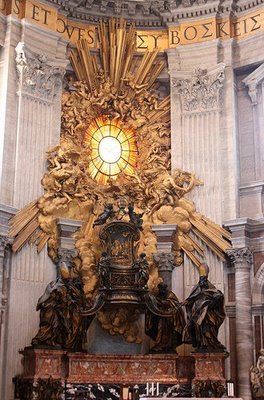
On February 22nd the Church celebrates the Feast of the Chair of St. Peter. This feast (which can be traced back to the mid-fourth century) has its roots in an ancient Roman custom of keeping an empty chair in a home for deceased persons from February 13th to 22nd. The exact date of St. Peter’s martyrdom is not known so custom has ascribed the date to February 22nd. The bishop’s chair, or cathedra, is an expression of the bishop’s pastoral authority in a diocese. On today’s feast the Church reflects on the unique authority of the Bishop of Rome as successor to Peter in the life of the Church.
Below is a recent Angelus message offered by the current successor to Peter.
11 Friday Feb 2011
Posted in Uncategorized

In his fifth exposition on Psalm 119, St. Augustine reflects on learning the commandments of God both in and through practice. Augustine writes, “(The psalmist) adds, therefore, ‘Blessed are you, O Lord: teach me your ways of justice.’ He prays, ‘Teach me’: let me learn them as people who carry them out learn them, (bold emphasis mine) not as those who simply memorize them in order to have something to say.” Augustine then a little further goes on to reflect, “Why then does he go on to pray, ‘Teach me your ways of justice?’ It must be because he wants to learn them by putting them into practice, not merely by repeating them and committing them to memory.” (Quotes taken from Expositions of the Psalms, New City Press, 2003)
Augustine here is hitting on a very important point. There is a depth and authenticity of knowledge regarding God’s commandments that can only be gained by and through lived practice. “…let me learn them as people who carry them out learn them…” In this Sunday’s gospel (Mt. 5:17-37) our Lord says, “I tell you, unless your righteousness surpasses that of the scribes and Pharisees, you will not enter the Kingdom of heaven.” (Mt. 5:20)
The scribes and Pharisees certainly knew the words of God’s commandments and they could certainly quote the Scriptures and God’s law and prophets but they lacked that which is of of the utmost importance: the insight gained only through practice. “…let me learn them as people who carry them out learn them…” Therefore the righteousness of the scribes and Pharisees was lacking and our Lord recognized this.
Our Lord in today’s gospel is calling for something much more deeper for us – his disciples. The mere memorizing of words is not enough. Our Lord, who comes “not to abolish but fulfill” (Mt. 5:17) the law and prophets greatly desires that we have a lived knowledge of God’s law so he steps it up by taking it to the heart – to that place within us where grace and our will interact.
“You have heard is said, ‘You shall not kill’ … But, I say to you, whoever is angry with his brother will be liable to judgment.” (Mt. 5:21-22) “You have heard that it was said, ‘You shall not commit adultery’ … But, I say to you, everyone who looks at a woman with lust has already committed adultery with her in his heart.” (Mt. 5:27-28) “Again, you have heard is said … ‘Do not take a false oath’ … But I say to you, do not swear at all. Let your ‘Yes’ mean ‘Yes,’ and your ‘No’ mean ‘No’.” (Mt. 5:33-37)
This knowledge which can only be gained through practice begins within – in that place where God’s grace and our will meet and the choice is made to carry out God’s commandment. This is the knowledge which moves beyond the mere memorizing of words to that which is true, authentic and that which gives life and wisdom. This is what our Lord greatly desires for us. It is the only knowledge that can transform lives … beginning with our own.
11 Friday Feb 2011
Posted in Uncategorized
I want to unite my life to your life,
my thoughts to your thoughts,
my affections to your affections,
my heart to your heart,
my works to your works,
my whole self to your self,
in order to become through this union
more holy and more pleasing in the sight of your Father
and in order to make my life
more worthy of your grace
and of the reward of eternity.
I want to join your intentions to my intentions,
the holiness of your actions to mine
and the excellence of your lofty virtues
to the lowliness of mine.
For example, when I pray,
I will join the holiness of your prayer to mine;
in the totality of my life as well as in its every detail,
I will join the whole breadth and height
of your divine intentions
to whatever I have to do or to suffer.
I will join, if possible, your looks to my eyes,
your holy words to my tongue,
your meekness to my gentleness,
your humiliations and self-emptying to my humility,
in a word, your whole divine spirit to my actions:
and when, in some one of my works,
I discover something not inspired by your spirit
and which proceeds rather from my self-centeredness
or from some poorly mortified affection,
I will renounce it and disown it with my whole heart.
No, my Jesus, I promise myself to have nothing in me
which is not in union with your lofty virtues.
(Jean-Pierre Medaille, SJ)
07 Monday Feb 2011
Posted in Uncategorized

Ignorance of the Catholic faith I can accept. Intentional ignorance and the effort to proselytize Catholics I have no respect for. Simple ignorance is a weakness, a lack of true knowledge that can be addressed through education. Intentional ignorance and proselytizing is a conscious avoidance of the truth and fundamentally a disrespect to the other person which masquerades under the guise of christian care.
You would think that having grown up in East Tennessee and now serving as a priest for fifteen years here I would not even bat an eye at the efforts by some groups to proselytize Catholics (being so used to it) but I am still taken aback whenever I encounter it. I think because it runs so counter to a sense of respect for the other person that is deeply ingrained in the Catholic understanding and because these efforts are so often so blatant and “in your face” as if these groups actually think they are outsmarting and pulling one over on us poor Catholics.
I believe they think they are getting away with it because the Church does not respond in kind to their proselytizing efforts. What they fail to realize is that the Church’s decision to not play the game is not a demonstration of the Church’s obliviousness but rather a demonstration of its true discipleship. The Church is fully aware of what these groups are about but just because they choose these tactics does not mean that we have to. The temptation is certainly there to respond in kind. Like James and John we also might want to call down “fire from heaven” (Lk 9:54) but again and again throughout its teaching and documents on evangelization and mission the Church denounces proselytism and its methods because, at heart, these techniques and the mindset that form their foundation are a denial both of the dignity of the other person and of true christian discipleship.
Below is a list of some of the tactics of proselytism with my own thoughts offered in brackets:
• an unjust criticism and ridicule of Churches and their religious practices; (This might come out in blatant scoffing, promoting a superficial view of the Church as outdated or be expressed through pointed questions asked in “concern” but if one is attentive you quickly realize that the desire to actually listen to and even receive the answers given is lacking. There is no true dialogue if the other is unwilling to listen and possibly even have his or her own perceptions challenged.)
• the use of moral compulsion and psychological pressure through certain publicity techniques in the communications’ media; (Emotion-filled worship services making use of hi-tech gadgetry and advertising methods is a common technique. It should be noted that this was also a favorite method used by the Nazi propaganda machine in Germany. I have a friend who has attended some of these types of services and he describes them as being “an inch wide and an inch deep”. If you ever happen to be in one look around and see if his description is accurate.)
• the explicit or implicit offer to help in areas of education and health as well as in material and financial assistance, as a means to create dependency; (The intention here is key. The help offered is not freely given but it comes with strings attached. Because of these “strings” it is completely legitimate to ask what is the real motive.)
• attitudes and practices which exploit people’s needs, psychological weakness or lack of education, especially in situations of exhaustion and desperation, with no respect for human freedom and dignity. (Any form of manipulation is a denial of human dignity and it has nothing to do with the christian message.)
These points are taken from “Encounter with the Living Jesus Christ: The Way to Conversion, Communion and Solidarity in America” (Vatican City, 1997).
What then to do in response? There are some things we can do but, it must be noted, they are all “choices for” and not “decisions against”. Again, we must avoid the temptation of James and John. As Christians we are fundamentally for Christ and the fullness of the gospel rather than being against anything.
Be Church in all its fullness, follow Christ in authentic and mature discipleship and promote a true and full understanding of Sacred Scripture and when encountering proselytizing groups say, “God bless you. Now go away and let me get on with my life. When you are able to enter into true dialogue then we can talk.”
In the end all will be revealed and that which is lacking will be made known.
A further note: As I have continued to reflect on this topic I realized that proselytism and its tactics can be applied not just to certain religious groups but also to certain strains of secularism. Just as there can be religious proselytizers there can also be secular proselytizers, both of which by their tactics deny respect for the other person.
04 Friday Feb 2011
Posted in Uncategorized

In Matthew 5:13-16, our Lord gives us two very distinctive images for what it means to live the life of discipleship – salt and light. We can say that part of the distinctiveness of these images is that both express a sense of “straightforwardness”.
The taste of salt is immediately known. It is not a flavor content to hide under other flavors. When salt is there the effect on the taste of something in unmistakable. The same can be said for light. It also is immediate in its effect. Either it is there or it is not. When light shines in a dark space it is known. Both salt and light are straightforward in their nature.
St. Augustine, in a commentary on psalm 112 (the psalm which we hear this Sunday) reflects on the similar straightforward nature of discipleship. Augustine contrasts the straightforwardness of the disciple with the ones who stumble in their envy of the sinner or who feel that their good deeds perish and are of no worth unless they receive some perishable reward in return – such as acknowledgement and the flattery of others. But the disciple who is straightforward is the one who does the good because it is the right thing to do – whether noticed by others or not. The disciple “neither seeks the approval of other people nor covets earthly riches…”
Augustine goes on to note that Psalm 112 proclaims that “glory and wealth are in the house of the just one…” Augustine comments that this “house” of the just one is in fact his or her heart and it is there that the just one dwells in a richer style than anything this world can afford. The “glory and wealth” of the just one is his or her righteousness before God. This is a “house” that no thief can break into and a “wealth” that can never be stolen.
In his words to his disciples our Lord is very specific. “You are the salt of the earth…” “You are the light of the world…” This straightforward nature of discipleship is already within – it has been placed there by God’s grace in baptism; we are sons and daughters of God! This truth does not have to be earned or gained. It is already present in the very makeup of who we are!
We, on our part, have to trust, believe and live it out. We must overcome the temptation to limit ourselves by the narrow horizons that we, our world and our own painful experiences set. “Salt losing its taste…”, and “light being hidden under the bushel basket” is, in fact, our giving in to our limited horizons and not living according to fullness of God’s horizon. As Nelson Mandela once remarked, “Our playing small does not serve the will of God!”
We are the salt of the earth … we are the light of the world … we are straightforward in our living according to the horizon that God has set for us.
03 Thursday Feb 2011
Posted in Uncategorized
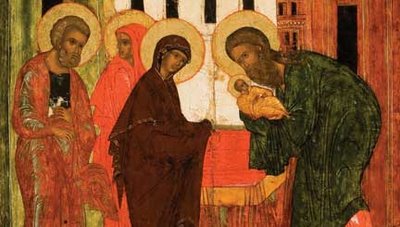
Every February 2nd the Church celebrates the Feast of the Presentation of the Lord. On this day we remember Joseph and Mary bringing the infant Jesus to the temple according to the law of the Lord (Luke 2:22-40). It is an ancient custom to bless candles on this feast. The blessed candles are then used throughout the year. The candles and their symbolism and significance work on many levels.
 Just as Joseph and Mary carried the infant Jesus (the light of the world) into the temple so we now, through our baptisms, carry the light of Christ within us. Sometimes this light burns strong and true but there are times when the light seems weak and close to going out. These can be times of struggle and difficulty. In these moments we might wonder how we can keep the light of faith lit when there seems to be such upheaval all about.
 01 Tuesday Feb 2011
Posted in Uncategorized

In some ways I hesitate to share this post because I am aware of our Lord’s admonition in the sixth chapter of Matthew’s gospel:
When you fast, do not look gloomy like the hypocrites. They neglect their appearance, so that they may appear to others to be fasting. Amen, I say to you, they have received their reward. But when you fast, anoint your head and wash your face, so that you may not appear to be fasting, except to your Father who is hidden. And your Father who sees what is hidden will repay you. (Mt. 6:16-18)
But I trust in our Lord’s benevolence and if I err in sharing these thoughts for other people’s consideration then I call upon God’s mercy.
A few months ago I determined through prayer and its insight to commit every Friday as a day of fasting and abstinence from eating meat. I talked this decision over with my spiritual director and I have determined that there are three compelling motives that have brought me to this decision: 1. a desire to grow closer to Christ 2. my role as vocation director and a fast specifically for vocations to priesthood and the consecrated life 3. a way of sharing in the repentance of the Church for the recent scandals that have wounded the body of Christ.
In many of his words regarding the clergy scandals our Holy Father has called for a renewed spirit of repentance within the whole church. I believe that we must be sincere in this. Sincere repentance can help heal the wounds that afflict the Church and we all, as members of the Church, have a role to play.
In my new ministry as Vocation Director for our diocese I am finding that there is much to do but the ministry must be about more than just “doing” because vocations cannot be programmed, designed nor produced. Vocations are a response of the heart to the call of Christ. This one day of the week I offer up my little discomfort that hearts might be open and willing to respond to God’s call.
I want to draw closer to Christ and yet I resist. Fasting helps me to recognize all the ways (some big, some small) that I resist. Fasting helps to clarify my thoughts and focus my attention and realize what is of true and lasting worth. I have found that when I fast I am less caught up in my own illusions and I notice things more.
Talking about noticing things… A little aside here – when I first began this weekly fast there were a number of weeks that I had to travel and I happened to find myself in airports on a few Fridays. I quickly came to realize (as I walked from gate to gate with a growling stomach) how a considerable amount of square footage in airport terminals is dedicated to the selling of food and beverages and how there seems to be an efficiency in getting the smells of cooking food out into the terminal! Lord, lead me not into temptation and help me walk by that Cinnabon stand!
I offer these thoughts for consideration. There is a value to fasting. God can take the littlest thing we have to offer and can do great things with it!
 The Alternate Path