• About The Alternate Path

The Alternate Path

~ Thoughts on Walking the Path of Christian Discipleship

The Alternate Path

Category Archives: homily

The Preacher as Servant to Dialogue – Insights from Bl. Pope Paul VI

23 Thursday Apr 2015

Posted by mcummins2172 in dialogue, gospel, homily, Pope Paul VI, preaching

≈ 1 Comment

Tags

Christ, Dialogue, gospel, homily, Pope Paul VI, Preaching

Pope Paul VIIt is always helpful to notice references in writings, especially papal writings, and then be willing to explore those writings referenced.  With a little digging you can be brought to some insightful, advantageous and even saving information.  Since I wrote my post on the preacher as servant of dialogue I have done some digging into the writings of Bl. Pope Paul VI.  Pope Francis references Paul VI quite extensively in Evangelii Gaudium.  Specifically referenced is Paul VI’s 1975 Apostolic Exhortation Evangelii Nuntiandi where the pontiff reflects on the Church’s responsibility of evangelization in the modern world.  What I have found of interest though (and the purpose for this post) is an earlier writing of Pope Paul VI – his first encyclical, Ecclesiam Suam (ES) and its section on the work of dialogue.

In this encyclical, Paul VI explores how the world and the Catholic Church can meet one another and even get to know and love one another.  (ES, 3)  When considering how the Church should engage the world, Paul VI quickly discards the ever-present temptation to focus solely on the evils of the world and crusade against them as well as the desire to subjugate the world in a form of theocracy.  Neither of these approaches will work.  Rather, Bl. Paul VI concludes; …it seems to Us that the sort of relationship for the Church to establish with the world should be more in the nature of a dialogue, though theoretically other methods are not excluded.  We do not mean unrealistic dialogue.  It must be adapted to the intelligences of those to whom it is addressed, and it must take account of circumstances. (ES, 78)

Paul VI then goes on to stress that this form of encounter is demanded due to dynamics prevalent within modern society – the understanding of the relationship between the sacred and profane, the pluralism of society and the maturity of thought men and women have attained in our modern world.  I think it safe to say that gone are the days (at least here in the U.S.) when the priest is the most educated person in the room.  But there is a deeper impetus for the discipline of dialogue and that is the respect it demonstrates.  The willingness to dialogue by its very nature witnesses to a person’s esteem for the other as well as one’s own understanding and kindness.  These are attitudes that every disciple of Christ, especially those called to the task of preaching, should cultivate and exemplify in life.

Our dialogue, therefore, presupposes that there exists in us a state of mind which we wish to communicate and to foster in those around us.  It is the state of mind which characterizes the man who realizes the seriousness of the apostolic mission and who sees his own salvation as inseparable from the salvation of others. (ES, 80)

If we want dialogue then we, ourselves, must be willing to dialogue authentically and, not only that, the discipline of dialogue builds on dialogue. The preacher, as servant to dialogue, must be willing and, in fact, is duty-bound to work at fostering this discipline in our world today.  Our world needs the discipline of dialogue.

Bl. Paul VI roots preaching in this greater task of the Church’s dialogue with our world.  Preaching is the primary apostolate … We must return to the study, not of human eloquence of empty rhetoric, but of the genuine art of proclaiming the Word of God.  We must search for the principles which make for simplicity, clarity, effectiveness and authority, and so overcome our natural ineptitude in the use of this great and mysterious instrument of the divine Word, and be a worthy match for those whose skill in the use of words makes them so influential in the world today and gives them access to the organs of public opinion.  We must pray to the Lord for this vital, soul-stirring gift… (ES, 90-91)

Paul VI then goes on to list out the proper characteristics of dialogue and, if proper for dialogue, then proper for preaching as the preaching task flows by nature out of the greater work of the Church’s dialogue with our world.

Clarity before all else; the dialogue demands that what is said should be intelligible. (ES, 81)  The caliber of an artist is found not in a work of art standing alone and isolated as if in a vacuum but in the ability of a work of art to engage people where they are at in their lives, to move them and to call forth a response, a dialogue.  If there is no engagement, it is fair to question if it is true art.  Striving for clarity in dialogue and striving for clarity in preaching matters.  Let there be no mistake, this takes work and practice but this ability to translate the realities of faith and gospel into the language of where people are at is extremely important and it marks authentic preaching.

Our dialogue must be accompanied by that meekness which Christ bade us learn from Himself: “Learn of me, for I am meek and humble of heart.” (ES, 81)  Our dialogue and our preaching must not be marked by arrogance or bitterness.  We must learn the meekness of Christ himself because in this lies the power of the gospel.  This “meekness of Christ” sets the words of the Church apart from all the other words that continuously wash over people in their everyday lives.  We should not underestimate this characteristic of meekness in the lives of people who are daily inundated and even assaulted by words wrapped in bias, anger, coercion and manipulation.

Our dialogue must have a confidence not just in the power of our own words (which could easily lead to arrogance) but also in the good will of both parties to the dialogue. (ES 81)  We must continually seek the good in the other and this must mark the words that we use and the dialogue we engage in.  To be a good preacher one must be convinced that people are yearning for the Word of God … and they are.  It might not be fully expressed, the desire might even be distorted, hidden or stunted but it is there and the preacher must learn to both listen for that desire and speak to that truth within the heart of people. This is not an easy discipline to acquire in a world that continually seeks to isolate and separate people but it is essential and is truly a counter-cultural witness.

Authentic dialogue must have the prudence of a teacher who is most careful to make allowances for the psychological and moral circumstances of his hearer … The person who speaks is always at pains to learn the sensitivities of his audience, and if reason demands it, he adapts himself and the manner of his presentation to the susceptibilities and the degree of intelligence of his hearers. (ES, 81)  Prudence is a cardinal virtue and can be practiced and developed by any person.  The virtue of prudence is fulfilled in the supernatural virtue of Counsel, one of the seven gifts of the Holy Spirit.  Prudence seeks to be aware of the other person(s).  The good shepherd knows his sheep.  Prudence can be seen as a proactive movement of respect.  It is not learning the sensitivities of the other in order to manipulate with the intent of achieving some desired result but learning about the other person in order to meet that person where he or she is at.  Authentic preaching must always avoid the temptation to manipulate.  I believe that Bl. Paul VI understood this because immediately after this reflection on prudence as a constitutive element of true dialogue he writes,

In a dialogue conducted with this kind of foresight, truth is wedded to charity and understanding to love.

And that is not all.  For it becomes obvious in a dialogue that there are various ways of coming to the light of faith and it is possible to make them all converge on the same goal.  However divergent these ways may be, they can often serve to complete each other.  They encourage us to think on different lines.  They force us to go more deeply into the subject of our investigations and to find better ways of expressing ourselves.  It will be a slow process of thought, but it will result in the discovery of elements of truth in the opinion of others and make us want to express our teaching with great fairness.  It will be set to our credit that we expound our doctrine in such a way that others can respond to it, if they will, and assimilate it gradually.  It will make us wise; it will make us teachers. (ES, 82-83)

In the dynamic of manipulation, I try to force you to change, consciously or unconsciously.  Authentic dialogue stands opposed to manipulation in all its forms.  Authentic dialogue summons both parties to an honest investigation of the subject at hand as well as a fearless rooting out of the tendencies of manipulation that each one of us carry within ourselves.

Finally, the discipline of dialogue and preaching must begin in the witness of the preacher’s own life if it is to be authentic and salvific in the lives of other people.

Since the world cannot be saved from the outside, we must first of all identify ourselves with those whom we would bring the Christian message – like the Word of God who Himself became a man.  Next we must forego all privilege and the use of unintelligible language, and adopt the life of ordinary people in all that is human and honorable.  Indeed, we must adopt the way of life of the most humble people, if we wish to be listened to and understood.  Then, before speaking, we must take great care to listen not only to what men say, but more especially to what they have in their hearts to say.  Only then will we understand them and respect them, and even, as far as possible, agree with them. 

Furthermore, if we want to be men’s pastors, fathers and teachers, we must also behave as their brothers.  Dialogue thrives on friendship, and most especially on service. (ES, 87) 

Dialogue and preaching, if it is to be authentic, must become incarnate which means that the preacher’s life must also become incarnate within the life of his community just as the Word of God became incarnate.  We are told at different times in the gospel story that Jesus was aware of the thoughts of other people before they ever even expressed them.  This was no form of magical clairvoyance on the part of our Lord but the ability to listen to hearts.  The Church has been given this ability, the preacher must cultivate this ability.  “Heart speaks to heart” noted Bl. John Henry Cardinal Newman.  The preacher must learn how to listen to both the heart of God speaking to the heart of his people as well as to the reply and yearning of God’s people.

To end, I would like to share one further quote from Ecclesiam Suam. 

To this internal drive of charity (the gifts Christ has bestowed on the Church in abundance) which seeks expression in the external gift of charity, We will apply the word “dialogue.”

The Church must enter into dialogue with the world in which it lives.  It has something to say, a message to give, a communication to make. (ES, 64-65)

The preaching task is rooted in the greater task of the Church’s dialogue with the world.  As a servant to dialogue, the preacher shares intimately in this task.  Hopefully, we can learn from the insight and wisdom of Bl. Pope Paul VI.

Thoughts on the Sunday readings: Seventh Sunday (A): The Law of Generosity

22 Saturday Feb 2014

Posted by mcummins2172 in generosity, God's love, homily, love of God, love of neighbor

≈ Leave a comment

The “eye for an eye” teaching that our Lord refers to in today’s gospel (Mt. 5:38-48) was actually an attempt to restrict violence in a time when revenge was indiscriminate and excessive.  In the revenge culture of the time not only was it the perpetrator of a violent act who became a possible target for reprisal but any member of the same family, clan, ethnic group or even someone “thought” to be responsible or connected.  The culture of revenge was excessive.  Sadly, the same mentality of revenge is still present and active in our world today.  
An “eye for an eye” therefore was an attempt to limit the continuous cycle of revenge and violence.  For our Lord though it was not enough.  His desire is not just to limit the cycles and structures of violence but to heal the human heart from which all evil desires spring.  Evil and violence can never overcome evil and violence, even when co-opted for a good.  Dr. Martin Luther King Jr. had an astute awareness of this truth.  In his writings and speeches we certainly find the call to end the massive injustices that the African-American community faced but we also find Dr. King reflecting on how the path of non-violence was also meant as a means to help heal those white brothers and sisters whose hearts were hardened by racism and prejudice.  
God says to Moses, Be holy, for I, the Lord, your God, am holy.  You shall not bear hatred for your brother or sister in your heart.  Though you may have to reprove your fellow citizen, do not incur sin because of him.  Take no revenge and cherish no grudge against any of your people.  You shall love your neighbor as yourself.  (Lv. 19:1-2, 17-18)
In contrast to the law of co-opted violence, our Lord calls us to the law of abundant generosity – to be holy as God is holy, who makes the sun to rise on the bad as well as the good.  God is love; he is abundant in his mercy.  Our Lord is not naïve; he knows the full weight of evil and violence.  On the cross, Jesus took on the full weight of sin and its structures.  
In the law of abundant generosity, Jesus is calling us to a pragmatism of generosity.  Evil and violence cannot heal the human heart (even when co-opted in an attempt for the good).  Evil and violence cannot end the cycles of revenge and violence … only love can.  When someone strikes you on one cheek, turn the other one.  When someone wants your tunic, give your cloak as well.  When someone presses you into service for one mile, go for two.  Our Lord proposes to us the pragmatism of generosity.  It is through this pragmatism that is found true healing for hearts that are wounded and hardened.  
There is a story told of a painter who arrived one day in a small town and set himself up in the town square offering portrait paintings. For a few days he sat in the square with no one purchasing a portrait.  On the fourth day the artist approached the town drunk (whom he had noticed earlier) and said, “Listen, come and let me paint your portrait.  I need to keep my skills up and at the end you will have a free portrait.”  The man agreed.  He sat in the portrait chair and straightened himself up as best he could.  The painter looked at him silently, reflected for a few moments, smiled and began to paint.  The painting continued for a few days but the painter would never allow the man to view the painting while it was in progress.  Finally, the portrait was completed.  The painter handed the portrait to the man and the man’s mouth fell open.  Pictured in the painting was not a town drunk but an accomplished man – there was a gleam in his eyes, he held a steady gaze.  Instead of scruffy clothes and a disheveled appearance, the man was clean shaven and wore a nice suit.  “What is this?” demanded the man, “You have not painted me.”  “You are right,” replied the painter calmly, “I have not painted you as you now are but as the man whom you might become.”
The pragmatism of generosity sees and responds to the other person in terms of who he or she is meant to be.  Jesus calls us to live this law of generosity – to be holy as God is holy.

The Feast of the Presentation: a Sign that will be contradicted

02 Sunday Feb 2014

Posted by mcummins2172 in detachment, discipleship, homily, presentation of the Lord, spiritual life

≈ Leave a comment

Here is some sound advice from our Christian spiritual tradition.  “If you want to advance in the spiritual life and the life of faith then love what Christ loved from the cross and disdain what Christ disdained from the cross.”  
It is on the cross that Simeon’s words in today’s gospel (Lk. 2:22-40) reach their fulfillment.  The innocent child is revealed as the man of sorrows and the “Christ of the Lord” who takes on the weight of sin that we might know salvation.  
Since the children share in blood and flesh, Jesus likewise shared in them, that through death he might destroy the one who has the power of death, that is, the Devil, and free those who through fear of death had been subject to slavery all their life.  Surely he did not help angels but rather the descendants of Abraham; therefore, he had to become like his brothers and sisters in every way, that he might be a merciful and faithful high priest before God to expiate the sins of the people.  (Heb. 2:14-18)  
This is the salvation which God prepared in the sight of every people – Christ on the cross – and it continues to be a sign of contradiction and a sign of salvation to our world today. 
What did Christ disdain from the cross?  He disdained the lure of money, of power, of popularity and the ever present temptation to save oneself and all costs.  What did Christ love from the cross?  The will of the Father – that is all he had and it is all he wanted.   
If we learn to disdain what Christ disdained and love what Christ loved then we develop what the Christian spiritual tradition terms “detachment”.  Detachment is neither indifference nor ambivalence.  Both of these are kind of a negative “talk to the hand, I really don’t care” approach to life.  Detachment denies neither the energies nor the relationships of life rather it embraces them and rightly orders them.  
Fr. Robert Barron in his “Untold Blessings” series reflects on this sense of detachment and uses the Beatitudes as a way of recognizing all the things that we attach ourselves to and thereby become addicted to.  Here are just a couple of beatitudes from the sixth chapter of Luke for consideration in this regard.
Blessed are you poor…  How easily do we attach ourselves to material things?  We want the right house, the right bank account, the right toys to play with and our society tells us we should have these things – for ourselves and for those we love.  Now, look at the cross.  What did Christ have on the cross?  Nothing, all he had was the knowledge of doing the will of the Father and that was enough for Jesus.  Things are things – they are neither bad nor good in and of themselves – sometimes we will have things sometimes we won’t.  It doesn’t matter.  As we gain detachment we find joy not in things but in relationship with God and in doing his will.
Blessed are you when men hate you…  Here is a tricky one.  How easy it is to become addicted to approval.  We all want to be liked, we want to be accepted and belong.  But again, look at the cross – Jesus was hated; he was mocked and seen as a common criminal.  The same crowds that sang hosannas and waved palm branches when he entered Jerusalem were the ones that yelled “Crucify him!” to Pilate.  To Jesus it did not matter.  He loved just the same.  He was detached from the need for the approval of others.  He was focused on the will of the Father.  Neither praise nor disdain lessened the love of Christ.   There are times when we will be praised and times when we will be mocked or even condemned.  There are times we will succeed and times we will fail.  If we develop detachment it will not matter what time and situation we find ourselves in we will love just the same.
How do we gain this spiritual sense of detachment?  Do we isolate ourselves from others or do we repress all our feelings?  No, that is not the Christian way.  We look to Christ and we keep Christ at the center of our lives – just as Simeon did.  Even though he did not yet know him, Simeon awaited the coming Messiah.  He held that hope and that promise in his heart.  Behold, this child is destined for the fall and rise of many in Israel…
Love what Christ loved from the cross, disdain what Christ disdained from the cross.         

Sign language and "the hamburger of Christ" – NDHS homily on January 9th

10 Friday Jan 2014

Posted by mcummins2172 in homily, language of God, peace of Christ

≈ Leave a comment

I have been talking with Rosa.  Rosa is the lady who helps to keep the school clean.  You have probably seen her around during the day.  Rosa is deaf and she is helping me to re-learn sign language.  A while back I was chaplain to the deaf community in our diocese.  The ministry was always small – centering around a few Catholic students at Tennessee School of the Deaf and a few deaf adults.  Well, the students graduated, some of the adults passed away, others moved out of the diocese.  The ministry has been kind of shuttered for a few years now and I have not signed for a while.  
As I am re-learning my signs I have been reminded of my first few months signing and the mistakes I made along the way.  To begin learning sign I went to Camp Mark 7, a sign language learning camp in the Adirondack Mountains begun by the first deaf priest in the U.S.  I first learned how to sign the Mass.  I remember it was about six months into signing the Mass back in the diocese that a member of the deaf community came to me with a concern.  She signed, “Father, you keep making this sign (hands tightly clasped together) for ‘peace’ like when you say, ‘The peace of Christ.’  This is not correct.  This is the sign for peace (she held her hands together but then she moved them apart as if they were flowing out).  The sign which you keep making is the sign for ‘hamburger’.” So … for close to about six months I, throughout the Mass, kept wishing people the “hamburger of Christ!”
It seems to me that a couple of dynamics in learning a language are the rules and structure of the language (those things that must be memorized) as well as the willingness to just take a risk and, frankly, being okay with the fact that mistakes will be made and sometimes one will make a fool of himself or herself.  But, you know what – the world doesn’t end.  I can honestly say that I have learned enough now to make a fool of myself in multiple languages … not just in English!
In today’s first reading (1stLetter of John 4:19-5:4) we are given a bit of John’s wonderful reflection on what it means that God is love and that we have been loved by God.  (I really encourage all people to take some time to truly read and reflect upon John’s first letter.) 
Everyone who believes that Jesus is the Christ is begotten by God, and everyone who loves the Father loves also the one begotten by him.  In this way we know that we love the children of God when we love God and obey his commandments.  For the love of God is this, that we keep his commandments.  And his commandments are not burdensome, for whoever is begotten by God conquers the world.  And the victory that conquers the world is our faith.
The word “commandments” here seems quite heavy and (at least in the tenor of our day and age) not very thrilling.  But I think it helpful to hold this word together with an awareness of the role of rules and structure in language.  The rules and structure of language are means to an end.  We learn the rules that we might communicate, have relationship and friendship with another person, that we might be able to speak their language.  The “commandments” that John makes mention of are not just a set of arbitrary rules we are forced to follow just because; rather they are the specific means to an end.  Christianity, at its heart, is a way to live and to encounter God and one another.  Christianity is not so much rules as it is relationship.  In living our faith, in obeying God’s commandments, we begin to learn the language of God and enter into true relationship with him! 
And like any language, to learn it we have to be willing to take a risk, to step out and possibly even make a fool of oneself.  In today’s gospel reading (Lk. 4:14-22) Jesus took a risk.  This was his first act of public ministry.  “Today this Scripture passage is fulfilled in your hearing.”  I think he must have been nervous when he said that.  We need to be sincere when we profess that Jesus is fully human just as he is fully divine.  Part of the wonder of being human is sometimes being nervous, part of the wonder of being human is taking a risk.  Jesus is risking reaching out to us and to all of humanity in the language of God – a new way to communicate with God and one another, a new way to have relationship and friendship and a new and full way to live and experience life.
The rules and structure of language and the commandments of God which are not burdensome but give life and the willingness to take a risk, step out and live an ever-new relationship with God.   

Notes on Preaching, #2 "The Joy of the Gospel"

08 Sunday Dec 2013

Posted by mcummins2172 in homily, Joy of the Gospel, Pope Francis, preaching

≈ Leave a comment

Let us renew our confidence in preaching, based on the conviction that it is God who seeks to reach out to others through the preacher, and that he displays his power through human words. (EG, 136)

Pope Francis calls preachers of the Word to a sacred remembering of the power of preaching.  Throughout Scripture we find, time and time again, God choosing to work with human beings in all of our limits to proclaim his plan and his grace.  From Moses through the Old Testament prophets to John the Baptist to the apostles and to the great missionary Paul – there is a need that the Word of God be proclaimed and the need continues in our day!  People need to encounter the Word of God in all its richness and challenging beauty!  
I find it interesting that Pope Francis, after making this bold and challenging proclamation, then moves to the almost seemingly mundane character of dialogue and conversation as the foundation of preaching. 
It is worth remembering that “the liturgical proclamation of the word of God, especially in the eucharistic assembly, is not so much a time for meditation and catechesis as a dialogue between God and his people, a dialogue in which the great deeds of salvation are proclaimed and the demands of the covenant are continually restated”.   The homily has special importance due to its eucharistic context: it surpasses all forms of catechesis as the supreme moment in the dialogue between God and his people which lead up to sacramental communion. The homily takes up once more the dialogue which the Lord has already established with his people. The preacher must know the heart of his community, in order to realize where its desire for God is alive and ardent, as well as where that dialogue, once loving, has been thwarted and is now barren. (EG, 137)
To help unpack this move toward dialogue and conversation I would like to quote in length a section out of Fr. Robert Barron’s book, The Priority of Christ: Toward a Postliberal Catholicism.  
At one point in his book, Fr. Barron is exploring intersubjectivity as a component of true knowledge. 
For the Christian, authentic knowledge comes not through isolation or objectification but rather through something like love.  Therefore it should not be surprising that the fullness of knowing would occur through an intersubjective process, with knowers, as it were, participating in one another as each participates in the thing to be known.  If, as the Johannine prologue implies, the ground of being is a conversation between two divine speakers, it seems only reasonable that the search for intelligibility here below takes place in the context of steady and loving conversation.  
In a lyrical and compelling section of “Truth and Method,” Hans-Georg Gadamer reminds us that a healthy conversation is something like a game.  As two players surrender to the movement and rules of the game of tennis, they are carried away beyond themselves in such a way that the game is playing them much more than they are playing it.  In a similar way, when two or more interlocutors enter into the rhythm of an intellectual exchange, respectful of its rules and of one another, they are quite often carried beyond their individual concerns and questions and taken somewhere they had not anticipated, the conversation having played them.  The fundamental requirement for this sort of shared self-transcendence is a moral one: each conversationalist has to surrender her need to dominate the play for her purposes; each must efface herself, not only before the others but, more importantly, before the transcendent goal that they all seek.  To have a conversation is humbly to accept the possibility that one’s take on things might be challenged or corrected, that the other’s perspective might be more relatively right than one’s own.  
Holding these thoughts with those of Pope Francis we can see that preaching has as its true basis the very common and universal reality of honest conversation and dialogue rather than the latest and currently trendy fad, philosophy or method.  Rather than belittling the preaching task these depth explorations of conversation and dialogue show forth the true richness of understanding afforded this important and critical task!
The homily takes up once more the dialogue which the Lord has already established with his people. The preacher of the Word, along with the people of God, is himself caught up in this ongoing conversation between the Lord and his people yet he has a truly unique and important role to play.  The preacher must allow himself to be caught up in the game and must constantly fight against the temptation to dominate the play for his purposes.  This is a renunciation and an asceticism that every preacher must develop in his life.  If a homily is too self-referential then it has missed the mark and probably most of the people of God have already tuned out.  To make use of the above analogy – a person cannot play a good and rousing game of tennis if he is more concerned about how he looks rather than the game!  To preach is to enter into the great game of the dialogue between our risen Lord and his people! 
The proper progress of the dialogue though is dependent upon respect of the rules given.  Here are a few that I find present and have sparked for me in the thoughts quoted above.  
Fundamentally, the dialogue is Christ’s and not my own.  If my preaching is to mean anything then somehow Christ must speak through my words to the heart of those who are gathered.  This means that I must learn how to get out of the way and not try to dominate the play for my own agenda or emotional needs.  My experience has taught me that this is not as easy to do as one might think but it is essential.
For my preaching to be effective I must be in dialogue with Christ myself and I must be in dialogue with the community of the Church.  The preacher must know Christ and allow himself to be known by Christ fully.   The preacher must know the heart of his community, in order to realize where its desire for God is alive and ardent, as well as where that dialogue, once loving, has been thwarted and is now barren.  In order to know his community, the preacher must be with his community.  He must have the “smell of his sheep” on him as Pope Francis has famously said.  When the community is not known there is always the danger of preaching at people rather than continuing the great dialogue that the Lord has begun.  Would it not be an extremely sad thing for a preacher to come before the gates of heaven only to there be brought to the realization that his preaching was more of an interruption and distraction to our Lord’s great dialogue with his people rather than an assistance?
If authentic preaching has as part of its basis knowledge of the community then homily preparation is just as much about visiting the homebound, celebrating with families, serving the poor and weeping with those who mourn as it is about studying the Scriptures and reflecting on Biblical commentaries.  The preacher who shuts himself away in a rectory or a parish office is stunting his preaching potential and doing a great disservice to his community.  Christ dwells in the midst of his people, especially the poor.  Whenever and wherever Christ is encountered deeper understanding of Sacred Scripture is gained.     
The homily is the ultimate moment of catechesis but it is not just catechesis.  Scriptural studies and commentaries can provide good and worthy insights for preaching but preaching should not just become a lecture on Scripture or the faith.  There are appropriate moments for that (i.e. Bible Studies or Faith formation) but it is not the homily.  The homily is not meant to give facts about Jesus or his time or a period in Israel’s history; the homily is meant to help people encounter Christ, right now in their lives!    
Another rule – the preacher must learn how to allow the dialogue to carry him!  As two players surrender to the movement and rules of the game of tennis, they are quite often carried beyond their individual concerns and questions and taken somewhere they had not anticipated, the conversation having played them.  In humble prayer, the preacher must first encounter the Word and let the Word speak to him, once something sparks then the preacher must let the Word carry him to where it wants him to go.  Again, this gets into not trying to dominate the conversation.  We need to trust that the Word of God is indeed active and alive and we need to trust that the Word will take us to what the community needs to hear.  I believe that it is the author Annie Dillard who once reflected that if you want to learn where a bee hive is (and hence find the honey) then you must first learn how to follow bees.  The preacher must learn how to be guided by what sparks for him from God’s holy Word.  The preacher must learn how to follow bees.
Some thoughts for consideration as this ongoing reflection on the importance of preaching to the great task of evangelization continues…                        

John the Baptist: Second Sunday of Advent (C)

08 Saturday Dec 2012

Posted by mcummins2172 in homily, humility, John the Baptist, joy, poverty

≈ Leave a comment

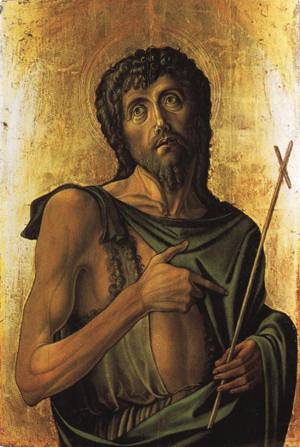
Icon of St. John the Baptist

The truth is that today the Word of God comes to us. 

We have two options: we can keep this Sunday’s gospel (Lk. 3:1-6) at a comfortable distance by thinking, “Oh, ‘in the reign of Tiberius Caesar‘ that is in the past.  Nice story.” or we can catch what Luke the evangelist is actually doing in his litany of specific names and titles.  For Luke the “word” is not some vague spiritual idea or inspiring myth.  No, the “word” is in fact a historical reality that “comes down” into the affairs of human nations and times and even into the stuff and routine of our daily lives.  The “word” chooses to be specific and to enter into particular times and places.  …the word of God came to John the son of Zechariah in the desert.  

John welcomed the word in the desert we are told.  Again, we cannot be comfortable here.  The desert is not some far off place on another continent with an exotic sounding name.  Despite the noise and amusements we are, in fact, right in the middle of the desert of our times where life is not truly lived nor joy truly found.  Elsewhere in the scriptures we are told that Herod was hateful of John’s denunciations of his actions yet, at the same time, drawn to his words. John, I think, was such a compelling figure for the ruler precisely because he was able to do what Herod was not.  John recognized the desert of his time and because of that he was able to live his life not lost in an endless series of amusements but rather authentically and fully.  John truly lived his life and he truly knew joy.

How did he do this and how might we?  Three lessons for us: poverty, humility and hospitality.

John was a poor man and he accepted his poverty.  We know that materially John had nothing (wearing only a camel-skin and a belt) but even more so John accepted the poverty of letting go of the myth of self-sufficiency.  John, in the depth of very being made a soul-searching inventory, and accepted the truth of dependence upon God in both its bitterness and sweetness.  We are told that John survived on locust and wild honey.  Because of his poverty, John is free.  Herod is not free.

John knew the joy of humility.  He does not need the illusion of the “royal palace” in whatever shape it may come and he cautions and chastises those who cluster around the palaces of our world.  John, in contrast to the false pride of our world, would be very comfortable (I think) with the saying, “Christian, remember your dignity.”  The school of humility leads one away from false pride yet it also leads one back to true pride.  We are children of Abraham, we are sons and daughters of the Father and even as we are not worthy to untie the thong of his sandal (Jn. 1:27) we are abundantly and immensely loved by our Lord and Savior!  Humility overcomes false pride because humility leads one to put trust in the Lord and the Lord alone.  Humility leads to joy. 

When the “word” came to John he welcomed it.  God loves us too much to let us remain comfortable and content in the false illusions of the desert of our world.  One way or another God is coming to us.  The key is to not fear but to welcome, to be hospitable.  What a great thing it is to have God come to us and to seek entrance into our hearts.  When we welcome Christ into our hearts then Christ will make his dwelling there and make of our own hearts a place of welcome for others. 

This, I think, is the surest “proof” if something is from God or not.  Is our heart becoming a place of welcome and hospitality for others or not?  Through his poverty and humility John did not become severe and distant.  Rather, the opposite.  If one reads further in this third chapter of Luke (and it will be proclaimed next Sunday), John knew the struggle and hardships of people and when the people asked the prophet what they should do he responded by keeping it simple.  Be good people, seek to do what is right and just, care for one another and recognize the coming of the Kingdom of God.  John’s heart was anything but distant and cold. 

John’s heart was a place of welcome and hospitality because he, himself, had welcomed the Word of God.   

The Humble God: Feast of Christ the King

24 Saturday Nov 2012

Posted by mcummins2172 in faith, gratitude, homily, humility, pride

≈ Leave a comment

At one point in his commentary on this Sunday’s Responsorial Psalm (Ps. 93), St. Augustine shares this observation: Humble people are like rock.  Rock is something you look down on, but it is solid.  What about the proud?  They are like smoke; they may be rising high, but they vanish as they rise.  

In the gospel for today’s Feast of Christ the King (Jn. 18:33b-37) we are given the humble God.  Pilate (representative of all the power of the world) questions Christ – a seemingly defeated and isolated man, abandoned by his friends and followers and mocked by his own people.

Pilate answered, “I am not a Jew, am I?  Your own nation and chief priests handed you over to me.  What have you done?”  Jesus answered, “My kingdom does not belong to this world.  If my kingdom did belong to this world, my attendants would be fighting to keep me from being handed over to the Jews.  But as it is, my kingdom is not here.”  So Pilate said to him, “Then you are a king?”  Jesus answered, “You say I am a king.  For this I was born and for this I came into the world, to testify to the truth.  Everyone who belongs to the truth listens to my voice.”  

Today, we as Church, proclaim Christ is King yet, like Pilate, our understanding and idea is limited.  It is interesting to note on this Feast of Christ the King that our Lord, himself, never took on the title of “king”.  Even on this most final and bitter of stages; when the fallen pride of our human condition would eagerly grasp onto a title of assertion to throw back into the face of the powers of this world (how often we see this exalted on our movie screens in the myth of redemptive violence) our Lord chooses a different path.  “You say I am king.  For this I was born and for this I came into the world, to testify to the truth.  Everyone who belongs to the truth listens to my voice.”

Our Lord rejects the title “king” and by so doing he forswears the fallen world and all it has to offer – self-indulgent pride, sad divisions and triumphalism and all forms of violence.  Our Lord chooses a different path – the path of humility.  “For this I was born and for this I came into the world, to testify to the truth.  Everyone who belongs to the truth listens to my voice.”  

Humility has more in common with truth than does pride and power.  In fact, humility is essential if there is to be any real understanding of truth.  If we would know the truth then any temptation to put ourselves at the center of creation (and these temptations come in all shapes and sizes: blue and red, enlightened secularist and righteous religious, male and female, rich and poor, all colors of skin and shades of culture) must be put aside.  Everyone (I repeat “Everyone”), needs to accept the purifying light of humility because the only constant, the only necessary is God – all else is contingent upon God’s will.  We are not necessary.  The more we realize this then the more we open ourselves to those moments when we catch a glimmer that God is indeed the “rock”, the only solid basis of all creation and then gratitude will grow in our hearts.

All is grace.

Do you want joy and gratitude?  Then look to the one we proclaim “king” yet who never sought that title for himself.  “For this I was born and for this I came into the world, to testify to the truth.  Everyone who belongs to the truth listens to my voice.”  Cultivate humility.  It will lead you to truth and truth will bring gratitude.              

Of the End Times: Thirty-Third Sunday in Ordinary Time (B)

17 Saturday Nov 2012

Posted by mcummins2172 in end times, faith, homily, hope, love

≈ Leave a comment

One of my professors in seminary once remarked that the events of the last days as portrayed in the Scriptures should be read like the labor pangs of birth rather than cataclysmic destruction.  In fact, the birth analogy is more in keeping with the fuller sense of Scripture than the “cataclysmic, world destroyed in a ravaging ball of fire, Hollywood 2012 movie” interpretation.

The texts of Scripture do not confirm, … a sort of “theory of catastrophes,” according to which there must first be a complete destruction of the world after which God can finally turn everything to good.  No, God does not arrive at the end, when all is lost.  He does not disown his own creation.  In the book of Revelation we read, “You created all things, and by your will they existed and were created” (4:11).
The “upheaval” expressed throughout the New Testament is that when the Son of Man comes, he comes not in the weariness of our habits nor does he insert himself passively into the natural course of things.  When Christ comes, he brings a radical change to the lives of men and women and it is always a change that brings the fullness of life.
Notice that in this Sunday’s gospel passage (Mk. 13:24-32) after our Lord speaks of the coming of the Son of Man with “great power” he goes on to state: Learn a lesson from the fig tree.  When its branch becomes tender and sprouts leaves, you know that summer is near.  In the same way, when you see these things happening, know that he is near, at the gates.  Our Lord does enter into our lives and the life of our world with “great power” but the upheaval he brings is an invitation to turn away from sin and the works of sin and to turn toward the fullness of life.
As Christians we are to live in this world not bound by the deadening works of sin and pride but rather in the upheaval and pangs of birth of the establishment of the Kingdom of God.  Because every day and in every situation Christ is near, at the gates.  The Book of Revelation gives us an image of this hope toward which we yearn and work.  Then I saw a new heaven and a new earth; for the first heaven and the first earth had passed away, and the sea was no more.  And I saw the holy city, the new Jerusalem, coming down out of heaven from God, prepared as a bride adorned for her husband (Rev. 21:1-2).  The great “Day of the Lord” is not yet to happen it has already happened!  God has entered into creation and history in the person of Christ, eternity has entered into time, and now this upheaval comes to every generation and even each day.  We are caught up in the great work of God where all peoples and nations will be gathered together into the new Jerusalem! 
The “end of the world” must come every day.  Every day, we must put an end to both the small or big pieces of the world’s evil and malevolence, but not by God but by people.  Moreover, the days that pass, end inexorably. Nothing remains of them, but the good fruit or, unfortunately, the hardships that we create for others.  Scripture invites us to keep the future, toward which we are led, in front of our eyes: the end of the world is not a catastrophe, but will in fact establish the holy city that comes down from heaven.  It is a city that is a concrete reality, not an abstract one, gathering all the people around their Lord.  This is the goal (and, in a sense also, the end) of history.  But his holy city must begin in our daily life now so that it may grow and transform the lives of men and women into God’s likeness.  It does not have to do with an easy and automatic grafting, but the common toil that every believer must fulfill, remembering what the Lord says, “Heaven and earth will pass away, but my words will not pass away.”
(Quotes taken from The Word of God Every Day by Vincenzo Paglia.)

God truly present: Thirty-first Sunday in Ordinary Time (B)

03 Saturday Nov 2012

Posted by mcummins2172 in homily, love of God, love of neighbor, presence of God

≈ Leave a comment

Not long ago I had a conversation with a man who is a convert to Catholicism.  I asked him what was it that brought him into the faith.  He replied that when he was a young man the company he worked for got a job to do some restoration work in a Catholic Church.  When he and his boss met with the parish priest to go over the work needing to be done he was struck by the sight of the priest genuflecting before the tabernacle as they entered the church.  In that simple action he realized that God was present in that church.  This awareness remained with him and grew and it began the process and journey that eventually led him into the Catholic Church.  He told me, “Prior to that I had a notion that God was everywhere yet not really present.  In the Catholic Church I have found God truly present.”

God truly present!  This is the Catholic intuition.  It is what underlies our understanding of the sacraments, the reservation of the Blessed Sacrament in the tabernacle, the Catholic approach to prayer, mysticism and (in fact) the entire life of discipleship.  The understanding of God truly present is also foundational in our belief in the communion of saints which we just celebrated on November 1st with the Feast of All Saints.  It is not just that saints were good men and women who did good deeds (worthy of being nominated for CNN’s annual “Heroes” celebration).  God became truly present to the world in the lives of the saints and these men and women became truly transformed and reflective of the presence of God.  (The Catholic understanding of relics is rooted in this reality.)  The saints are, in fact, quite subversive because their very lives witness against a materialistic-only view of reality as well as a vague sense of the Divine that is content in keeping God removed and far off.  These are both tendencies seeking to be persuasive in our world today, yet the saints witness to something both different and real – the incarnational and sacramental truth of the Christian faith.     

God truly present as opposed to a vague sense of God who is everywhere but really nowhere. 

This awareness is not some “add-on” nor corruption of true Christianity.  It is the essence of true Christianity and it is grounded in creation through the Word of God and the very incarnation of the Word of God.  Throughout the whole of Scripture we find this awareness being revealed and proclaimed.   

In today’s gospel (Mk. 12:28b-34) Jesus (who is the Word made flesh) specifically holds together the love of God and the love of neighbor in such a unity that the two cannot be separated.  Love, if it is to be true, must be present and real.  In the first Letter of John we have a developed reflection on this twofold commandment to love God and neighbor: Those who say, “I love God”, and hate their brothers and sisters, are liars: for those who do not love a brother or sister whom they have seen, cannot love God whom they have not seen.  The commandment we have from him is this: those who love God must love their brothers and sisters also. (1 Jn. 4:20-21)

Love of God and neighbor, if it is to be real, must be present.  And where true love is, present is God.  The saints reveal this truth to us – not just through what they did but through their very lives transformed and reflective of a God not content to remain removed but continually seeking to be present.   


Learning to See: Thirtieth Sunday in Ordinary Time (B)

27 Saturday Oct 2012

Posted by mcummins2172 in Bartimaeus, blindness, healing, homily, sight

≈ 1 Comment

Eustache Le Sueur “Christ Healing the Blind Man”

At one point in his Catholicism series, Fr. Robert Barron reflects on Israel’s hopes for the coming messiah.  He lists out the expectations of what the messiah would accomplish and he demonstrates how Jesus fulfills all of these expectations yet in often unexpected ways.  One such example is the expectation that the messiah would restore the unity of Israel.  Fr. Barron points out that Jesus does in fact accomplish this but not through leading an army nor through political maneuvering.  Jesus accomplishes the expectation of restoring unity through his miracles of healing.  In their physical impairments; the blind, the lame, the mute and the leper were not only handicapped in body but were also cut off from the ritual life of Israel and therefore could not fully participate in their society.  By his acts of healing not only was Jesus curing the physical ailment of the person but he was also restoring him or her to full participation in the community. 

This Sunday’s gospel story of the blind beggar Bartimaeus (Mk. 10:46-52) is a case in point.  But, not only that, it must be noted that Jesus recognizes the separation and isolation present that was easily overlooked by the very people who were longing for the messiah.  Mark tells us that when Jesus left Jericho he was with a sizable crowd and that as this crowd surrounding Jesus draws near and begins to pass the blind beggar Bartimaeus (in his poverty it must be noted) weakly begins to call out: Jesus, Son of David, have pity on me.  Mark specifically then states: And many rebuked him, telling him to be silent.  The very ones who were yearning for the full restoration of Israel remained blind to this man’s (their fellow Israelite) separation and isolation. 

But, Jesus saw Bartimaeus and he heard his cry.  In this we are brought to the realization that not just the work of restoring unity but also the ability to first see isolation and separation is an aspect that also marks the long awaited messiah as anticipated in the writings of the prophet Jeremiah.  Part of which we hear in today’s first reading (Jeremiah 31: 7-9): Behold, I will bring them back from the land of the north; I will gather them from the ends of the world, with the blind and the lame in their midst, the mothers and those with child; they shall return as an immense throng. 

Through Christ, we have been made a priestly people and we now share in the High Priesthood of Christ (Hebrews 5:1-6).  As a nation of priests we are entrusted with the work of restoring unity to a divided and hurting world and the first step in this work (upon which the whole is based) is the ability to see and recognize separation and isolation.  Separation and isolation within our own world and within our own hearts.  For this, it is essential that we have the trust and faith of the blind beggar.  Like Bartimaeus, we too need to trust that our God is a loving and merciful God who hears the cry of his people. 

Jesus, Son of David, have pity on me.  This must be our prayer and we must let this prayer lead us to the separated and isolated places of our world and the separated and isolated places in our own hearts because it is there that we will encounter Christ and we will truly come to know him as messiah.

After hearing his request, Jesus says to Bartimaeus: Go your way; your faith has saved you.  Mark then writes, Immediately he (Bartimaeus) received his sight and followed him (Jesus) on the way.  Through this encounter in a place of isolation and separation, Bartimaeus came not just to be healed physically of his blindness but also to be healed spiritually as he came to recognize Jesus as both Messiah and Lord.  Today’s gospel calls us also to a healing just as it did that first crowd.  May our blindnesses also be healed and may we learn to see as our Lord sees in order that our work of restoring unity might be true.          

← Older posts
Newer posts →
Follow The Alternate Path on WordPress.com

Enter your email address to follow this blog and receive notifications of new posts by email.

Previous Posts

  • December 2025
  • November 2025
  • August 2025
  • April 2025
  • February 2025
  • January 2025
  • December 2024
  • August 2024
  • July 2024
  • June 2024
  • May 2024
  • April 2024
  • March 2024
  • February 2024
  • January 2024
  • December 2023
  • November 2023
  • October 2023
  • August 2023
  • July 2023
  • May 2023
  • February 2023
  • January 2023
  • December 2022
  • August 2022
  • July 2022
  • April 2022
  • January 2022
  • December 2021
  • September 2021
  • August 2021
  • July 2021
  • May 2021
  • April 2021
  • January 2021
  • December 2020
  • November 2020
  • October 2020
  • August 2020
  • July 2020
  • May 2020
  • April 2020
  • March 2020
  • February 2020
  • December 2019
  • October 2019
  • September 2019
  • August 2019
  • July 2019
  • May 2019
  • April 2019
  • March 2019
  • February 2019
  • December 2018
  • November 2018
  • October 2018
  • August 2018
  • July 2018
  • June 2018
  • April 2018
  • March 2018
  • February 2018
  • January 2018
  • December 2017
  • November 2017
  • September 2017
  • August 2017
  • July 2017
  • June 2017
  • May 2017
  • April 2017
  • March 2017
  • February 2017
  • January 2017
  • December 2016
  • November 2016
  • October 2016
  • September 2016
  • August 2016
  • July 2016
  • June 2016
  • May 2016
  • April 2016
  • March 2016
  • February 2016
  • January 2016
  • December 2015
  • November 2015
  • October 2015
  • September 2015
  • August 2015
  • June 2015
  • May 2015
  • April 2015
  • March 2015
  • February 2015
  • January 2015
  • December 2014
  • November 2014
  • October 2014
  • September 2014
  • August 2014
  • July 2014
  • June 2014
  • May 2014
  • April 2014
  • March 2014
  • February 2014
  • January 2014
  • December 2013
  • November 2013
  • October 2013
  • September 2013
  • August 2013
  • July 2013
  • June 2013
  • May 2013
  • April 2013
  • March 2013
  • February 2013
  • January 2013
  • December 2012
  • November 2012
  • October 2012
  • September 2012
  • August 2012
  • July 2012
  • June 2012
  • May 2012
  • April 2012
  • March 2012
  • February 2012
  • January 2012
  • December 2011
  • November 2011
  • October 2011
  • September 2011
  • August 2011
  • July 2011
  • June 2011
  • May 2011
  • April 2011
  • March 2011
  • February 2011
  • January 2011
  • December 2010
  • November 2010
  • October 2010
  • September 2010
  • August 2010
  • July 2010
  • September 2008
  • August 2008
  • April 2008
  • March 2008
  • February 2008
  • January 2008
  • December 2007
  • November 2007
  • October 2007
  • September 2007

Popular Posts

  • thealternatepath.org/wp-c…
  • thealternatepath.org/wp-c…
  • thealternatepath.org/wp-c…
  • thealternatepath.org/wp-c…
  • thealternatepath.org/wp-c…

Blog at WordPress.com.

  • Subscribe Subscribed
    • The Alternate Path
    • Join 156 other subscribers
    • Already have a WordPress.com account? Log in now.
    • The Alternate Path
    • Subscribe Subscribed
    • Sign up
    • Log in
    • Report this content
    • View site in Reader
    • Manage subscriptions
    • Collapse this bar
 

Loading Comments...