• About The Alternate Path

The Alternate Path

~ Thoughts on Walking the Path of Christian Discipleship

The Alternate Path

Category Archives: Uncategorized

Twenty-Ninth Sunday in Ordinary Time – the face of the other

14 Friday Oct 2011

Posted by mcummins2172 in Uncategorized

≈ Leave a comment

In the movie Juno there is a scene where the very apparently pregnant Juno – a teenage girl who has decided to give birth to her child and give the infant up for adoption – says to her boyfriend and father of the child, “When you look at me you don’t stare at my belly, rather you look at my face.”  Juno makes a powerful statement here I believe.  To “look into the face” of another person is to acknowledge the dignity and worth of the person, no matter the circumstances or the situation.  It is to recognize the image and likeness of God in the other person. 
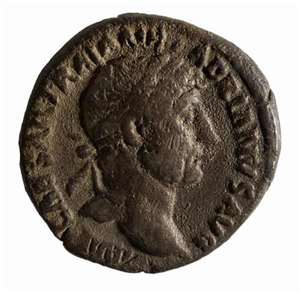
In this Sunday’s Gospel (Mt. 22:15-21), the ones who come to Jesus do not approach with pure motives rather they are seeking to trap him with his own words.  They are hoping to put him in a bind of seeming to either side with the Roman occupiers over and against the Jewish people or with the people in rebellion toward the occupiers.  “Is it lawful to pay the census tax or not?”  But Jesus avoids the trap being set by responding with a question of his own.  “Show me the coin … Whose image is on the coin?”  “Caesar’s,” they answer.  “Then repay to Caesar what belongs to Caesar and to God what belongs to God.”  But more than being just a deft answer to a sticky situation our Lord, in this passage, gives us a fundamental truth that is worthy of reflection. 

If it is the fact of Caesar’s image being imprinted on the coin that proves ownership; then what image do we bear and to whom do we belong and to whom do we owe ultimate allegiance?  “So God created man in his image; in the image of God he created him; male and female he created them.” (Gen. 1:27). 

“Repay to Caesar what belongs to Caesar and to God what belongs to God.”  To acknowledge whose image we bear means both to acknowledge to whom we owe all and to repay to him what is owed.  How might we repay to God what is owed?  Here, is where Juno helps us.  When we look nowhere else but in the face of the other person (and our own face at times) – despite the circumstance or the situation which sometimes even hides and seemingly disfigures – and acknowledge the dignity and worth which is there then we are repaying to God that which is owed.  

I once heard someone say that if you want to do something good for a parent (to give a gift that would truly touch the parent’s heart) then do something good for that parent’s child.  We are all children of God.

God smiles when we are able to look in the face of one another.    

Virtues Matter – Justice

11 Tuesday Oct 2011

Posted by mcummins2172 in Uncategorized

≈ Leave a comment

Before moving into the reflection on the virtue of justice I would like to share a quote I just came across regarding judgment. Since the previous reflection was on the virtue of prudence which entails the exercise of judgment in life I thought this quote quite relevant and also well-written. It is taken from the book Lost in Transition by Christian Smith, Kari Christoffersen, Hilary Davidson and Patricia Snell Herzog. 

When it comes to moral matters, many Americans hear the words “to judge” or “judging” in the very negative sense of condemning, castigating, disparaging, or executing. To judge is this sense is to be self-righteously superior, hypercritical, and judgmental. And that itself seems morally wrong – we think it is wrong, in fact. Some may even call to mind the command of Jesus Christ, “Do not judge lest you be judged” (Matthew 7:1). But “to judge,” of course, also has other important meanings. It can mean to assess, discern, estimate, appraise, weigh, evaluate, and critique. All of that can be done with great humility, openness, reciprocity, care, and even love for the idea of the person being judged. Judging in this sense need not be self-righteous, condemning, triumphalist, or destructive. But making moral judgments in this second sense seems almost inconceivable to most emerging adults today…

But inconceivable does not mean impossible and it is a fair question to ask why does making moral judgments in this latter sense “seem” inconceivable and is that a true estimation? I would contend that it is not. Judgment does not have to necessarily imply judgmentalism and judgment is required to successfully navigate life. 

Now, on to the virtue of justice… It is helpful to note that the cardinal virtues of prudence, justice, fortitude and temperance are human virtues that are open to being refined by grace. In being human virtues they are acquired and strengthened by human effort and they are the “fruit and the seed of morally good acts” (CCC #1804). One does not have to be a person of faith in order to have a developed understanding of the cardinal virtues and to live a life guided by prudence, justice, fortitude and temperance. 

Where prudence is the virtue that “disposes practical reason to discern our true good in every circumstance” (CCC #1806), justice is the virtue that directs our will into proper action. Once, we have figured out the good to do then, in justice, we are called to do it. This applies both to those daily mundane situations of our lives as well as the extraordinary events that we may experience and that can potentially greatly shape our lives. But, it is important to note here an important aspect of living the virtues: it is those daily, mundane choices for virtue that strengthen our will to be ready to make the choice for the good when the moment is critical and urgent. In faith, we believe that yes, all things are possible with God’s grace; but it is unlikely that one who has not practiced the virtues continuously will have the moral fortitude to do “the right thing” when the stakes are high. God’s grace cooperates with our free will, it does not overwhelm it. 

It is because of this continuous nature of living the virtues, that the Catechism of the Catholic Church is comfortable in stating, “The just man (or woman), often mentioned in the Sacred Scriptures, is distinguished by habitual right thinking and the uprightness of his (her) conduct toward his (her) neighbor.” (CCC # 1807) The word “habitual” is a key marker in this understanding of the just person and, I believe, it agrees with our own experience. We would not call someone just who is good one day or in one situation and not good the next day or in another situation. Virtue implies consistency. 

The virtue of justice challenges us to continuous right thinking and uprightness in conduct. By doing so it also implies that this continuous nature is, indeed, possible to achieve in life and it also aids in determining the lack of justice when it is present. For example, when you hear someone talking negatively about another person or disparaging another person or even group of people, is it not normal to wonder what the person says about you when you are not around? We immediately recognize the inconsistency and would not define this person as a just person but this assessed recognition is possible only because the just life (by which we measure, evaluate and contrast this inconsistency) is possible. There are just men and women and if one were to ask why they are said to be just, I think we might be hard-pressed to point to just one specific instance. 

A just life does not fall neatly into a thirty minute TV sitcom, five minute YouTube video or a short sound bite. A just life is demonstrated and achieved only over time and in various circumstances, but it is recognizable when present and when it is authentic it speaks volumes. 

Justice is the moral virtue that consists in the constant and firm will to give their due to God and neighbor. Justice toward God is called the “virtue of religion.” Justice toward men disposes one to respect the rights of each and to establish in human relationships the harmony that promotes equity with regard to persons and to the common good. (CCC # 1807)
Twenty-Eighth Sunday in Ordinary Time (A) – Mirroring Christ

07 Friday Oct 2011

Posted by mcummins2172 in Uncategorized

≈ Leave a comment

I call it “mirroring” and I truly enjoy it when I see it. There might be a more technical term for the occurrence in behavioral science but I am not aware of it. It is when a child (young, teenager, older, even adult) does something that exactly mirrors what his or her parents do. It is usually something unconscious, we are not even often aware of it – a tilt of the head, a movement of the hands to emphasize something, a particular face that is made. I just saw mirroring not that long ago in a sacristy. Two young ladies were talking before Mass and one of them moved her head and arms in such a motion that as soon as I saw it I thought, “That is her mom. That is exactly what her mother does.”

Sometimes we even catch ourselves mirroring our parents and, believe me, that is a reality check. (Maybe we are more like mom and dad than we care to admit.)

I think it is fascinating. It points out how much we truly are connected and how much we do influence one another – in ways we do not often even think about. Yet, at the same time we are unique and different. And the mirroring does not deny the uniqueness, in fact our uniqueness enables the mirroring. The daughter in the sacristy was not pretending to be her mother. She was not consciously imitating her mother. She was just being herself and it was in that very uniqueness that she mirrored her mother. 

I think that we can apply this to the life of faith. One of the greatest treasures we have in our Christian faith is the communion of saints and these men and women are all across the board. There is St. Louis – a king, Francis who embraced poverty and powerlessness, Joan of Arc who led armies, Maximillian who laid down his life in a concentration camp, Catherine who took a Pope to task, the Ugandan martyrs – to name a few. All races and languages. All personalities and temperaments. Each one completely unique and yet each one fully mirroring Christ in his or her life. To mirror – to be a saint as we are all called to be – does not deny uniqueness in fact it facilitates uniqueness. Discipleship is not about conforming ourselves to some sort of cookie cutter image of who we are not. Discipleship is about mirroring Christ in our very uniqueness which is made possible by the empowerment of the Holy Spirit. The more we live in the Holy Spirit – the more our uniqueness is made present and the more we mirror Christ.

I wonder if this is a work at the end of this Sunday’s parable (Mt. 22: 1-14)?  It seems so odd that the king tosses this man out of the banquet who had just been invited in off the street because he was not wearing the right clothes. The question of the king is key, “My friend, how is it that you came in here without a wedding garment?” The words are “a wedding garment” – something that is particular and unique to the individual. Not Francis’ garment, not Joan’s, not Maximillian’s, not our parents’, not anyone else’s – only our own.

The man came along for the ride to the banquet but he had no desire to truly know the king – so he had no wedding garment of his own. The uniqueness of his own lived faith, his particular mirroring of Christ, was lacking. All the man could do in response to the king’s questioning was be “reduced to silence.”

The saints, each in his or her own unique “wedding garment”, have preceded us and invite us to the wedding banquet. The question is, “What will our wedding garment be?” Discipleship is about mirroring Christ in our very uniqueness.

Virtues Matter – Prudence

05 Wednesday Oct 2011

Posted by mcummins2172 in Uncategorized

≈ Leave a comment

It is helpful, I think, to go back to the root meaning of the word “virtue”. As noted in the introductory reflection the word “virtue” has its root in the Latin word “virtus” meaning “strength” or “force”. Over time virtue has been used to connote a variety of different ideas and attitudes and it is helpful to move past these to the word’s original meaning and purpose. Virtue is not something to be laughed at or belittled. It is an active force and a demanding discipline that, when developed and fostered, can truly guide life and even lead one to achieve remarkable things in life.

Here is what the Catechism of the Catholic Church has to say about virtue, “A virtue is a habitual and firm disposition to do the good. It allows the person not only to perform good acts, but to give the best of him or herself. The virtuous person tends toward the good with all his or her sensory and spiritual powers; the virtuous person pursues the good and chooses it in concrete actions.” (CCC #1803) 

This is not milk toast, nor is it a wimpy passivism and neither is virtue a Victorian or sexually repressed hang-up. Virtue allows one to achieve the best of him or herself. Virtue will not allow a person to sell himself or herself short precisely because virtue is rooted in an awareness of the true dignity of the human person. It is out of this awareness that judgments are made as to what is for the good and what is not.

Some voices would say that one should not judge and would even (incorrectly, I would add) quote Scripture as proof, “Judge not, lest you be judged.” This attitude is a copout rooted in moral sloth. We make judgments everyday. Society and our individual lives would come to a grinding halt if judgments ceased being made. Part of the discipline of virtue is not to cease making judgments but to determine and acknowledge what is within ones individual purview to judge and what is not and what is within society’s purview to judge and what is not. I cannot see within the soul of another (only God can) so I cannot judge what is within another person. But we can (individually and as a society) see actions and their consequences and therefore we do have the right to make judgments on actions. Therefore, we can make judgments and decisions that actually pursue the good in our everyday experiences and we can choose the good in concrete actions and circumstances.

This is where prudence (often referred to as the auriga virtutum – the charioteer of the virtues) comes in.

“Prudence is the virtue the disposes practical reason to discern our true good in every circumstance and to choose the right means of achieving it; ‘the prudent man looks where he is going.’ (Prov. 14:15) … Prudence is ‘right reason in action,’ writes St. Thomas Aquinas, following Aristotle. It is not to be confused with timidity or fear, nor with duplicity or dissimulation. It is called (the charioteer of the virtues) because it guides the other virtues by setting rule and measure. It is prudence that immediately guides the judgment of conscience. The prudent man (or woman) determines and directs his or her conduct in accordance with this judgment. With the help of this virtue we apply moral principles to particular cases without error and overcome doubts about the good to achieve and the evil to avoid.” (CCC # 1806)

Despite what some might say, to make a prudential judgment and choose the good in a situation is not a form of unhealthy repression. In fact, the exact opposite is the case. Prudential judgment witnesses to a robust moral and psycho-social health. Prudential judgment also gives witness to the ability to see through the common illusion of ones self being the center of all existence. We live in communion with others and our actions have an effect on others – either to build up or to tear down. The virtue of prudence demonstrates both an awareness of and a deep respect for the other person. Prudence means that, if need be, I can curtail my own need or desire in order to promote and safeguard the good of the other person. Because of this, prudence also demonstrates a mastery over ones own inner impulses rather than our being controlled by our desires. (Part of being a charioteer is to be the one who directs, controls and guides the energy of the horses rather than the horses having control.)

Prudence grounds itself in an advanced and mature understanding of the human person being more than just his or her desires and impulses and an awareness of the greater context in which we live – that we live in communion with other persons. One way, I believe, to develop the virtue of prudence in ones life is to keep in the forefront of ones own mind both the reality of ones own dignity and also the dignity of every other person. Through this dual awareness the prudent man or woman gains the ability (as Proverb 14:15 states), “to look where he (or she) is going”, make a reasoned judgment and determine a course of action rather than letting the circumstance and/or impulses of the moment dictate what to do.

Through the exercise of prudence and all that forms its foundation it is possible to achieve the beauty and authenticity of a life will lived.

Twenty-Seventh Sunday in Ordinary Time (A): Desire and Fear

01 Saturday Oct 2011

Posted by mcummins2172 in Uncategorized

≈ Leave a comment


St. Augustine of Hippo

St. Augustine once remarked that there are “two things in human beings from which all sins spring: desire and fear.”  He then goes on to note, “Suppose a reward is offered to you to induce you to sin, something you find very attractive; you commit the sin for the sake of what you desire.  Or perhaps you are not seduced by bribes, but are intimidated by threats; then you do it because of something you fear.”  (Exposition on Psalm 79)  If we take a moment to honestly reflect on our own motives and actions I think we can readily recognize the truth found in Augustine’s observations on the dynamic of sin. 
This awareness of the dynamic of desire as one of the primary motives of sin is expressed by our Lord in this Sunday’s gospel parable (Mt. 21:33-43).  It is found in the attitudes and actions of the tenants.  The tenants continue to mistreat and even kill the servants that the landowner sends to them.  But it is when the landowner sends his son that the dynamic of disordered desire present in their hearts is truly revealed for all to see.  “This is the heir,” they say, “Come, let us kill him and acquire his inheritance.”  They are so caught up in their disordered desire that they are blind to reason.  What murderer could ever hope to rightfully gain the inheritance of the murdered victim?  It is their inflamed desire for the inheritance that has led them into this great sin.

The paradox found when we hold this parable in relation to the whole Gospel proclamation is that the disordered desires of the human heart are indeed laid bare when the Son is sent to precisely break the cycle of desire and fear in which we are lost.  And it is broken despite our very selves.  “Come, let us kill him and acquire his inheritance.”  In Christ, this is exactly what has happened but we do not steal away the inheritance as the tenants sought to do.  In the love of God, the inheritance not deserved is plentifully given!  In Christ, the only rightful heir, we gain that inheritance which also makes of us sons and daughters.  This is what God has done and it is a wonder to behold! 

The infinite love of God breaks and transforms the cycle of fear and desire by himself becoming the one saving victim of that sad cycle.  Where once desire and fear led only into sin; it now – through love of God and fear of God – motivates one toward the good.  So, Paul can write confidently in his letter to the Philippians, “Finally, brother and sisters, whatever is true, whatever is honorable, whatever is just, whatever is pure, whatever is lovely, whatever is gracious, if there is any excellence and if there is anything worthy of praise, think about these things.  Keep on doing what you have learned and received and heard and seen in me.  Then the God of peace will be with you.” (Philippians 4:7-9)

“…think about these things.” 

“So then, my brothers and sisters,” writes Augustine, “love and fear lead us to every right action, and love and fear lead us to every sin.”  Desire is not bad in and of itself.  In fact it can be a great good and a path to holiness.  The key distinction is found in the motivation of the heart and if we are trusting enough to lay our hearts and our desire open to the work of healing grace.       

Virtues Matter

30 Friday Sep 2011

Posted by mcummins2172 in Uncategorized

≈ 1 Comment

I try, at least once a week, to be present on the university campus on which I serve as the Newman Center chaplain. I do this for a variety of reasons. When I am on campus I will often have someone approach me with a question about the Catholic Church or interested in the Catholic Center. I use my time walking from building to building posting flyers to pray for the university and all its members. I enjoy running into Catholics on campus and I get to check out all the flyers of the different groups on campus and get a sense of what is going on. 

In reading the flyers I have learned that there is a lot of verbiage shared on the college campus about rights and freedoms (which is certainly fine and appropriate) but not so much about responsibilities. 

This has left me wondering because we grow in full maturity as human persons not just through the exercise of our rights and freedoms but also through the living of responsibilities and commitments. The truth is that an over-focus on one side without an awareness of the other side leaves the human person stunted in his or her moral development and ultimately frustrated; precisely because we are not achieving that which we are meant to achieve – full personhood. 

Because of this I have decided to spend time this semester reflecting and writing on responsibility and commitment in human life and sharing these reflections through the Catholic Center facebook group and website and my own blog site. 

I share these thoughts because I truly believe that our responsibilities and commitments matter and that to pretend that they do not or to negate through silence is, in fact, a great disservice. 

A good way, I believe, to approach this issue of responsibility and commitment in human life is to explore what we mean by the term “virtue” – what it is, where it comes from, and how we develop it in our lives. 

So, what is “virtue”? The word “virtue” has its root in a Latin word meaning “force”. Virtue can be defined as a practiced and developed, “habit of good behavior which enables us to do what is right with increasing ease, joy and consistency, in response to God’s offer of and invitation to covenant love” (The Modern Catholic Encyclopedia). 

There are three components to this short definition that I believe are worthy of reflection and consideration. First, virtue is a “habit of good behavior”. We must be involved in the process and our choices do have consequences. No one is going to get stronger physically by just thinking about it. To get stronger and healthier physically, a person needs to develop the habit of exercise and appropriate rest and also that of right eating. It is the same dynamic in the moral life; exercising the virtues are the means by which we grow morally. Second, virtues “enable us to do what is right with increasing ease, joy and consistency”. There is a basic law of physics which states that a body at rest remains at rest and a body in motion remains in motion. The effects of the practice of the virtues and good choices are not confined only to the moment in which they occur but strengthen us also for the “next moment” or the choice that awaits us in the future (a choice which may have truly serious ramifications for our lives). Third, virtues are lived “in response to God’s offer of and invitation to covenant love”. God’s grace is present and it is important for us to recognize this. God is involved in the equation of life and how we live. It is important to remember that we do not have to “go it alone”. God is present. Even when we stumble (which we all do, hence the sacrament of reconciliation) God is there to offer his grace and love. We on our part have to be willing to receive and the habit of the virtues just as it is grounded in God’s continual invitation to us also opens us up to receive even more of God’s presence and love. Grace is not opposed to our lives but rather grace builds upon nature. 

Our Christian heritage lists seven virtues: the four cardinal virtues (prudence, justice, fortitude and temperance) and the three theological virtues (faith, hope and love). All of the virtues depend on our hearts being open to, working with and developing the habit of the virtues while also cooperating with the movement of the Holy Spirit in our lives. 

Last week, at the International Day of Peace event on campus, I watched a couple demonstrate the beauty and fluidity of the tango. Time and again, the couple in their comments stressed that the dance was not choreographed beforehand but was directed by the flow of the music in the moment but (at the same time) it was truly apparent that the couple was dedicated in knowing, studying and practicing the style and movements of the dance. This continual practice in no way hindered nor opposed the movement of the dance in the moment but rather it was the two in tension and cooperation together that brought the dance to its beauty and fulfillment. In the habit of the virtues the steps and practice are our own and the flow of the music is the Holy Spirit active. The two are not opposed but rather together bring to fulfillment the beauty and rhythm of a life well lived.

Over these next few weeks I will reflect on each of the seven virtues and how each – when practiced and lived – truly helps us to achieve the beauty and authenticity of a life well lived.

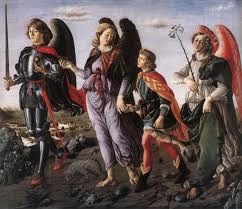
Feast of the Archangels – September 29th

29 Thursday Sep 2011

Posted by mcummins2172 in Uncategorized

≈ Leave a comment

 From the Office of Readings for the Feast of the Archangels:

Now a great sign appeared in heaven: a woman, adorned with the sun, standing on the moon, and with the twelve stars on her head for a crown. She was pregnant, and in labour, crying aloud in the pangs of childbirth. Then a second sign appeared in the sky, a huge red dragon which had seven heads and ten horns, and each of the seven heads crowned with a coronet. Its tail dragged a third of the stars from the sky and dropped them to the earth, and the dragon stopped in front of the woman as she was having the child, so that he could eat it as soon as it was born from its mother. The woman brought a male child into the world, the son who was to rule all the nations with an iron sceptre, and the child was taken straight up to God and to his throne, while the woman escaped into the desert, where God had made a place of safety ready, for her to be looked after in the twelve hundred and sixty days.


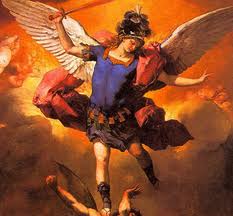
Archangel Michael


And now war broke out in heaven, when Michael with his angels attacked the dragon. The dragon fought back with his angels, but they were defeated and driven out of heaven. The great dragon, the primeval serpent, known as the devil or Satan, who had deceived all the world, was hurled down to the earth and his angels were hurled down with him. Then I heard a voice shout from heaven, ‘Victory and power and empire for ever have been won by our God, and all authority for his Christ, now that the persecutor, who accused our brothers day and night before our God, has been brought down. They have triumphed over him by the blood of the Lamb and by the witness of their martyrdom, because even in the face of death they would not cling to life. Let the heavens rejoice and all who live there; but for you, earth and sea, trouble is coming – because the devil has gone down to you in a rage, knowing that his days are numbered.’


As soon as the devil found himself thrown down to the earth, he sprang in pursuit of the woman, the mother of the male child, but she was given a huge pair of eagle’s wings to fly away from the serpent into the desert, to the place where she was to be looked after for a year and twice a year and half a year So the serpent vomited water from his mouth, like a river, after the woman, to sweep her away in the current, but the earth came to her rescue; it opened its mouth and swallowed the river thrown up by the dragon’s jaws. Then the dragon was enraged with the woman and went away to make war on the rest of her children, that is, all who obey God’s commandments and bear witness for Jesus. (Revelation 12:1-17)

From a sermon of Pope St Gregory the Great:

The word “angel” denotes a function rather than a nature

You should be aware that the word “angel” denotes a function rather than a nature. Those holy spirits of heaven have indeed always been spirits. They can only be called angels when they deliver some message. Moreover, those who deliver messages of lesser importance are called angels; and those who proclaim messages of supreme importance are called archangels. And so it was that not merely an angel but the archangel Gabriel was sent to the Virgin Mary. It was only fitting that the highest angel should come to announce the greatest of all messages.


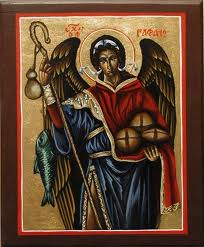
Archangel Raphael


Some angels are given proper names to denote the service they are empowered to perform. In that holy city, where perfect knowledge flows from the vision of almighty God, those who have no names may easily be known. But personal names are assigned to some, not because they could not be known without them, but rather to denote their ministry when they came among us. Thus, Michael means “Who is like God”; Gabriel is “The Strength of God”; and Raphael is “God’s Remedy.”


Whenever some act of wondrous power must be performed, Michael is sent, so that his action and his name may make it clear that no one can do what God does by his superior power. So also our ancient foe desired in his pride to be like God, saying: I will ascend into heaven; I will exalt my throne above the stars of heaven; I will be like the Most High. He will be allowed to remain in power until the end of the world when he will be destroyed in the final punishment. Then, he will fight with the archangel Michael, as we are told by John: A battle was fought with Michael the archangel.


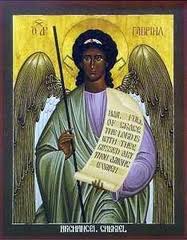
Archangel Gabriel


So too Gabriel, who is called God’s strength, was sent to Mary. He came to announce the One who appeared as a humble man to quell the cosmic powers. Thus God’s strength announced the coming of the Lord of the heavenly powers, mighty in battle. Raphael means, as I have said, God’s remedy, for when he touched Tobit’s eyes in order to cure him, he banished the darkness of his blindness. Thus, since he is to heal, he is rightly called God’s remedy.

On the front porch with De Caussade

25 Sunday Sep 2011

Posted by mcummins2172 in Uncategorized

≈ Leave a comment

I took advantage of the fact that since I had no parishes to fill in for Mass this morning I could sit out on the front porch of the Center, read some Abandonment to Divine Providence by Jean-Pierre De Caussade, drink tea and watch the bumble-bees and butterflies dance around the butterfly bush. 

This was all the more pleasant by the fact that I was kept awake into the wee hours of the morning by the sounds of a college party across the street.  As I sat there watching the butterflies and bees and the beauty of the sunlight shining through the branches and flowers of the bush I came to the realization that yes, let the youth have their late night parties.  I will enjoy the peace and serenity of the morning.  The youth do not yet know what they are missing.  Hopefully, time and experience will help mature their awareness. 

A thought by De Caussade:

Thus, beloved souls, you cannot know from where you came nor where you are going; nor can you know from what idea of God you have been produced nor to what end it is leading you.  For you there remains only a passive self-abandonment, carrying on without thinking and concerned with no models or examples of any particular mode of spirituality.  You must act when it is time for action and stop when it is time to stop.  In this self-abandonment you read or put books aside, talk to people or keep silent, write or drop your pen, and never know what will follow.  Finally, after several transformations, the formed and finished soul, now endowed with wings, flies up to heaven, but leaves on earth a fertile seed to work in other souls. 


Twenty-Sixth Sunday in Ordinary Time (A) – pie-crust promises

24 Saturday Sep 2011

Posted by mcummins2172 in Uncategorized

≈ Leave a comment

In the classic movie, “Mary Poppins”, at the end of the first day, Mary is putting her two young charges to bed. The brother and sister are so excited from the events of the day that they ask the nanny, “You will never leave us, will you?” And the young boy quickly adds, “Will you stay if we promise to be good?” To this second question the wise nanny responds, “That is a pie-crust promise. Easily made and easily broken.”

“That is a pie-crust promise. Easily made and easily broken.” I like that phrase and it connects right with today’s gospel (Mt. 21:28-32). “Yes, Father,” says the second son “I will go out and work in the vineyard.” He promises, but he does not go – a pie-crust promise. It cannot be that way with us. Discipleship is a lived reality – a lived response to the risen Lord who is just as present to us today as any of the people we now see around us with our physical eyes.

Also, just as we as disciples are not to be about “pie-crust” promises neither are we to be about blaming others. This is another teaching from today’s readings. Ezekiel, in our first reading (Ez. 18:25-28), offers his prophetic challenge during a specific time frame in the history of Israel. Israel had fallen, the people had been deported to Babylon and sitting by the river Chuza they were left wondering how this could have ever happened. What had led up to this catastrophe? Whose fault was it? Where is our scapegoat? Surely, they concluded, it must have been our parents, our grandparents. They had not practiced their faith rightly and now God is punishing us for their sins. Yes, it is their fault!

Ezekiel, with the courage of a prophet, answers back, “No, that is wrong”. Or, in other words, “stop trying to pass the buck”. “If someone commits iniquity and dies it is because he committed the iniquity. If he turns away from iniquity and does good, then he shall live.” It is no one else’s fault but how often do we hear or maybe even say the opposite. “He or she made me do it. That person is the one at fault!” This has been the line from the beginning, Adam said to God: “Eve made me do it!” Then Eve said to God, “The serpent made me do it.” The truth is, no one makes us do anything – we choose. What we have a selective memory about though is that with choices come consequences – when the consequences are in our favor we remember and celebrate our choice but when the consequences are not pleasant we grumble and complain.

No pie-crust promises. No blaming others. Discipleship calls us to an integrity and authenticity of living but we know that these temptations are there.  How might we find the strength needed to move beyond these temptations? The Letter to the Philippians has some good words of advice for all of us, “Have in you the same attitude that is also in Christ Jesus.” In other words, “Humbly regard others as more important than yourselves, each looking out not for his own interests, but for those of others.” As we adopt this attitude of Christ Jesus we gain that integrity of living which moves us beyond the temptations of pie-crust promises and the blaming of others. Humility is indeed the needed remedy to these two temptations.

Christ emptied himself and took the form of a slave – humbling himself and in this is found the path to true life.

Feast of the Korean Martyrs

20 Tuesday Sep 2011

Posted by mcummins2172 in Uncategorized

≈ Leave a comment

Today the Church celebrates the feast of the Korean Martyrs – Andrew Kim Taegon, Paul Chong Hasang and their companions.  Between 1839 and 1867, one hundred and three men and women gave their lives in witness for their faith in Christ in Korea. 

The Gospel reading for today is taken from Luke 8:19-21,

The mother of Jesus and his brothers came to him but were unable to join him because of the crowd.  He was told, “Your mother and your brothers are standing outside and they wish to see you.”  He said to them in reply, “My mother and my brothers are those who hear the word of God and act on it.”

In some ways our Lord’s response is tongue-in-cheek in that the one who truly accepted the word of God and said “yes” with her whole being was Mary herself.  This passage rather than diminishing Mary in fact honors her and calls us all to the awareness of how we also are called to be brothers and sisters to the Lord. 
 
We, likewise, are to receive God’s word, allow God’s word into our very lives and give birth to God’s word by the lives we live and the actions we do. 
 
Andrew, Paul and all their companions were brothers and sisters to our Lord in this true sense of the term and our world and Church are indeed better for their witness!
 
Sts. Andrew Kim Taegon,  Paul Chong Hasan and all your companions, pray for us! 

← Older posts
Newer posts →
Follow The Alternate Path on WordPress.com

Enter your email address to follow this blog and receive notifications of new posts by email.

Previous Posts

  • May 2026
  • April 2026
  • March 2026
  • December 2025
  • November 2025
  • August 2025
  • April 2025
  • February 2025
  • January 2025
  • December 2024
  • August 2024
  • July 2024
  • June 2024
  • May 2024
  • April 2024
  • March 2024
  • February 2024
  • January 2024
  • December 2023
  • November 2023
  • October 2023
  • August 2023
  • July 2023
  • May 2023
  • February 2023
  • January 2023
  • December 2022
  • August 2022
  • July 2022
  • April 2022
  • January 2022
  • December 2021
  • September 2021
  • August 2021
  • July 2021
  • May 2021
  • April 2021
  • January 2021
  • December 2020
  • November 2020
  • October 2020
  • August 2020
  • July 2020
  • May 2020
  • April 2020
  • March 2020
  • February 2020
  • December 2019
  • October 2019
  • September 2019
  • August 2019
  • July 2019
  • May 2019
  • April 2019
  • March 2019
  • February 2019
  • December 2018
  • November 2018
  • October 2018
  • August 2018
  • July 2018
  • June 2018
  • April 2018
  • March 2018
  • February 2018
  • January 2018
  • December 2017
  • November 2017
  • September 2017
  • August 2017
  • July 2017
  • June 2017
  • May 2017
  • April 2017
  • March 2017
  • February 2017
  • January 2017
  • December 2016
  • November 2016
  • October 2016
  • September 2016
  • August 2016
  • July 2016
  • June 2016
  • May 2016
  • April 2016
  • March 2016
  • February 2016
  • January 2016
  • December 2015
  • November 2015
  • October 2015
  • September 2015
  • August 2015
  • June 2015
  • May 2015
  • April 2015
  • March 2015
  • February 2015
  • January 2015
  • December 2014
  • November 2014
  • October 2014
  • September 2014
  • August 2014
  • July 2014
  • June 2014
  • May 2014
  • April 2014
  • March 2014
  • February 2014
  • January 2014
  • December 2013
  • November 2013
  • October 2013
  • September 2013
  • August 2013
  • July 2013
  • June 2013
  • May 2013
  • April 2013
  • March 2013
  • February 2013
  • January 2013
  • December 2012
  • November 2012
  • October 2012
  • September 2012
  • August 2012
  • July 2012
  • June 2012
  • May 2012
  • April 2012
  • March 2012
  • February 2012
  • January 2012
  • December 2011
  • November 2011
  • October 2011
  • September 2011
  • August 2011
  • July 2011
  • June 2011
  • May 2011
  • April 2011
  • March 2011
  • February 2011
  • January 2011
  • December 2010
  • November 2010
  • October 2010
  • September 2010
  • August 2010
  • July 2010
  • September 2008
  • August 2008
  • April 2008
  • March 2008
  • February 2008
  • January 2008
  • December 2007
  • November 2007
  • October 2007
  • September 2007

Popular Posts

  • thealternatepath.org/wp-c…
  • thealternatepath.org/wp-c…
  • thealternatepath.org/wp-c…

Blog at WordPress.com.

  • Subscribe Subscribed
    • The Alternate Path
    • Join 156 other subscribers
    • Already have a WordPress.com account? Log in now.
    • The Alternate Path
    • Subscribe Subscribed
    • Sign up
    • Log in
    • Report this content
    • View site in Reader
    • Manage subscriptions
    • Collapse this bar