• About The Alternate Path

The Alternate Path

~ Thoughts on Walking the Path of Christian Discipleship

The Alternate Path

Category Archives: Uncategorized

Virtues Matter – The Theological Virtues

21 Monday Nov 2011

Posted by mcummins2172 in Uncategorized

≈ Leave a comment

This coming Sunday (First Sunday of Advent, 2011) Catholic churches in the English speaking world will begin use of the third English translation of the Roman Missal.  There has been quite a bit of commentary either favoring the new translation or criticizing it.  The intent of the new edition is to draw closer to the original Latin; which for the Catholic Church and its two thousand year liturgical tradition is no small matter.  “Lex orandi; lex credendi” – the law of prayer establishes the law of belief. 

For our purpose here I would like to point to one change in the liturgy.  At the very beginning of the Mass and running throughout the liturgy the priest celebrant addresses the community gathered with, “The Lord be with you.”  In the second translation of the Missal the community response was, “And also with you.”  Now, in the third translation (being faithful to the original Latin) the response of the community is: “And with your spirit.” 

This shift to “with your spirit” highlights, I believe, a deeper and needed awareness of human anthropology. In an age of materialism that relentlessly seeks in pervasive ways (some subtle, some not) to define, and I would add restrict, an awareness of reality to only that which can be measured and weighed, the response “And with your spirit.” strikes a rather revolutionary and counter-cultural tone.

From the very beginnings of our worship this response on the part of the believing church state that we have a certain perspective on reality and that we do not buy into assumptions founded in the dictatorship of materialist thought.  There is a spiritual dimension to life and all reality.  “And with your spirit.” is a liturgical profession of the Church in its belief in this spiritual dimension to reality and the human condition.

The Church’s understanding of the “theological” virtues (faith, hope and love) is likewise a profession of this awareness of the spiritual dimension of the human condition.  Where the four cardinal virtues (prudence, justice, fortitude and temperance) can be acquired and developed by human effort and will – although open to being elevated by divine grace (CCC # 1810); the theological virtues “relate directly to God.” (CCC # 1813)  Just as “And with your spirit.” professes a belief in the spiritual dimension so does the designation of faith, hope and love as “theological” virtues profess an awareness of both the possibility and need of a lived relationship with God (who is spirit) necessary for a truly authentic and fulfilled life. 

(The theological virtues) dispose Christians to live in a relationship with the Holy Trinity.  They have the One and Triune God for their origin, motive and object.  The theological virtues are the foundation of Christian moral activity; they animate it and give it its special character.  They inform and give life to all the moral virtues.  They are infused by God into the souls of the faithful to make them capable of acting as his children and of meriting eternal life.  They are the pledge of the presence and action of the Holy Spirit in the faculties of the human being.  (CCC # 1812-1813) 

In the Christian understanding of these virtues as theological not only do we find that these virtues perfect and fulfill our individual lives and our interactions one with another and undergird the living of human community but these virtues dispose us to live in relationship with the Holy Trinity. 

In forthcoming blog posts I will delve more deeply into each of the theological virtues.  I would like to conclude this post with one thought for consideration.  In the western world we are living in a time that is witnessing a growth in atheistic and agnostic thought.  The reasons for this are many and varied I believe and space here will not allow for an adequate exploration of these reasons.  Non-belief is now a valid option for many people.  Some voices of non-belief are extremely anti-religion (I would even say “fundamentalistic” in their approach and thought) but not all are.  The virtues in life and in society provide a place of encounter where cooler heads can meet and dialogue.  We need to learn how to live together for the common good.  Talking, if guided by honesty and respect, does not necessarily mean the selling out of ones core values.  In the virtues we find a privileged place of encounter that can provide great benefit for all of society.   

Thirty-third Sunday in Ordinary Time (A) – the boldness of beauty

13 Sunday Nov 2011

Posted by mcummins2172 in Uncategorized

≈ Leave a comment

In the beginning of her book An American Childhood Annie Dillard tells the story of watching a neighbor girl skate on the city street on a cold, Pittsburg winter night:

The night Jo Ann Sheehy skated on the street it was dark inside our house.  We were having dinner in the dining room – my mother, my father, my sister Amy, who was two and I.  There were lighted ivory candles on the table … Now we sat in the dark dining room, hushed…  Behind me, tall chilled windows gave out onto our narrow front yard and street.  A motion must have caught my mother’s eye; she rose and moved to the windows, and Father and I followed.  There we saw the young girl, the transfigured Jo Ann Sheehy skating alone under the streetlight. 

She was turning on ice skates inside the streetlight’s yellow cone of light – illumined and silent.  She tilted and spun.  She wore a short skirt, as if Edgerton Avenue’s asphalt had been the ice of an Olympic arena.  She wore mittens and a red knitted cap below which her black hair lifted when she turned.  Under her skates the street’s packed snow shone; it illumined her from below, the cold light striking her under her chin.  

I stood at the tall window, barely reaching the sill; the glass fogged before my face, so I had to keep moving or hold my breath.  What was she doing out there?  Was everything beautiful so bold? 

Nelson Mandela once said: It is our light not our darkness that most frightens us.  We ask ourselves, “Who am I to be brilliant, gorgeous, talented?”  Actually, who are you not to be.  Playing small does not serve the will of God.  We are born to make manifest the glory of God within us.  It is not just within some of us, it is within everyone.  The more we light our own light shine; the more we unconsciously give other people the permission to do the same.

In today’s Gospel (Mt. 25:14:30) we are given the parable of the talents.  The term “talent” in our Lord’s day was used to denote a certain measurement of wealth.  It is due to this very parable that the word “talent” has the meaning which we know today.  In the parable, the master who is departing on a journey leaves a different sum of talents with three different servants.  The first two servants double what was given them and are rewarded accordingly.  The third servant (out of fear) buries the talent he is given and makes nothing.  He is punished for his laziness. 

So, we see this parable as an instruction about using the gifts, the talents that we have been given in life and not being fearful.  It is also helpful to note where this parable falls within Matthew’s gospel.  It is in the section where Jesus is discussing the end times and it comes right before the section where Jesus sets the criteria for judgment of our lives.  (The Gospel passage we will hear next Sunday.)

With the awareness of this context we see that the use of talents is not toward the goal of comfort in this life but toward the goal of the reign of God.  This parable warns us that the servant preferred to hide his life in a hole, in an avaricious and egoistic tranquility … Jesus unveils the ambiguity of one who contents himself with how things are, has no desire to change, no aspiration to transform life and, no ambition for a happier life for all. (Bishop Vincenzo Paglia)

The Kingdom of God begins with each one of us when we make the choice to not close ourselves off in our own self interest but make the bold choice for life and to help alleviate the sufferings of the other person.  It is a choice that must begin within – the choice to begin changing our own hearts and the choice to bring the Gospel to our world and live the Gospel for our world.

“Does beauty have to be so bold?” wondered the young Annie Dillard.  Yes, it does.  We are each born to make manifest the glory of God within us.   

Thirty-Second Sunday in Ordinary Time (A) – Wisdom and the quest for laundry detergent

06 Sunday Nov 2011

Posted by mcummins2172 in Uncategorized

≈ Leave a comment

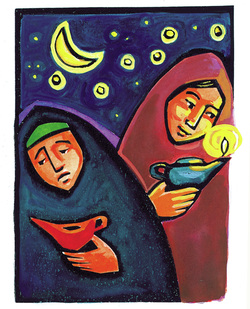
This Sunday I would like to reflect on two images found in the readings: 1. the figure of Wisdom from the first reading (Wisdom 6:12-16) and 2. the wise and foolish virgins from the gospel (Mt. 25:1-13).

Specifically from the first reading there is this passage: “because (Wisdom) makes her own rounds, seeking those worthy of her, and graciously appears to them in their ways, and meets them with all solicitude.”  Often, and especially in the modern university setting, we approach knowledge and truth as something “out there” – to be attained, but primarilly passive.  The facts are there to be arrived at.  The truth can be known but we, on our part, have to go and get it.  It is similar to going grocery shopping.  The other day I realized that I was out of laundry detergent but I knew that there was laundry detergent “out there”.  Kroger has it.  I went to the store, I found the right aisle (if it was a store I was unfamiliar with I might need to ask for guidance) and there was the detergent sitting passive on the shelf. 

We often view truth in our modern understanding the same way but the biblical notion which we find expressed in the reading from the Book of Wisdom turns this assumption on its head.  Yes, there is truth and knowledge “out there” to be acquired in life but also Wisdom “makes her own rounds, seeking those worthy of her…”  God’s wisdom is not passive, sitting on a shelf and waiting.  Wisdom is active of its own accord.  To force the above analogy, it is like the laundry jumping off the shelf, walking down the road and knocking on your front door.  Wisdom seeks out.  Wisdom graciously appears to us in our ways and meets us with all solicitude.

This understanding of the active nature of Wisdom casts a light on the parable of the wise and foolish virgins.  It is worthy to note that both the wise and foolish virgins fall asleep while waiting for the bridegroom.  This is not where the distinction between the two lies.  For all people, “it is easy to rest on our old habits and certainties, it is easy to be overcome by the sweet slumber of self-love, it is easy to be overwhelmed by the weight of our own selfishness.”  All are asleep.

But then the cry comes announcing the groom’s arrival!  What is this cry?  “It is the cry that arises from the far country of the poor, it is the cry that comes from the peoples at war; it is the cry of the lonely elders that ask for company,” it is the cry of the one who is hurting and alone.  “Upon hearing the cry, we jump awake, but if we do not have the extra oil on hand we find all the excuses for not responding.”

It is the “extra oil” that distinguishes the wise from the foolish virgins.  The extra oil is the Word of God as it has come to us and been received and treasured in our hearts and lives.  “It reawakens us to love.  If we do not have the Gospel in our heart then we will not know how to respond to the cry of the poor or how to live a meaningful life.”

Our world stands in need of lives enlightened by Wisdom and by the Word of God – which are active and which seek out hearts that are open and receptive.

Yes, there is wisdom out there to be acquired but sometimes wisdom comes knocking at our own door.
(Quotes referenced are taken from a reflection by Bishop Vincenzo Paglia) 

Virtues Matter – Moral reasoning

06 Sunday Nov 2011

Posted by mcummins2172 in Uncategorized

≈ 1 Comment

 “The truth does not change according to our ability to stomach it.” (Flannery O’Connor)

Before launching into the theological virtues in our continuing reflection on the role and necessity of virtue in a life well lived, I thought it might be worthwhile to share some thoughts on the status of moral reasoning in our times.  After all, this is the context in which we live and the context in which we have to exercise the very virtues which we have been reflecting upon.
Specifically, I would like to share some quotes and insights from the book, Lost in Transition.  (I have found his book to be very enlightening as well as extremely sobering.)  Lost in Transition is the end result of an extensive multi-year sociological survey conducted of current eighteen to twenty-five year old men and women (aka “emerging adults”).  It is very solid in its research and its approach.
One of the areas that the book explores is the moral reasoning capabilities of the age range surveyed.  These capabilities, the authors found, are minimal to practically non-existent.  The authors stress that this lack of moral reasoning capabilities is not so much a reflection on the generation surveyed as it is a reflection of the failure of previous generations to teach and instruct.  (Quotes below are taken from Lost in Transition.)
“But for the moment our point is simply this: the adult world of American culture and society is failing very many of its youth when it comes to moral matters.  We are letting them down, sending many, and probably most, of them out into the world without the basic intellectual tools and basic personal formation needed to think and express even the most elementary of reasonably defensible moral thoughts and claims.  And that itself, we think, is morally wrong … Colleges and universities appear to be playing a part in this failure as well.” 
In relation to our focus on the virtues there is a specific conclusion supported by the research that I believe to be extremely relevant.  “Central to many of the confusions in emerging adult moral reasoning is the inability to distinguish between objectively real moral truths or facts and people’s human perceptions or understandings of those moral truths or facts.  The error of not distinguishing these two things is this: the realities themselves are confused with, and therefore dependent upon, people’s cognitive grasp of them.  What actually exists is conflated into what is believed to exist.  But those are different things that must be kept separate.  For example, the moral truth that human slavery is a categorical moral evil stands true whether or not people understand and believe it…” 
“They (emerging adults) think that people believing something to be morally true is what makes it morally true.  They assume that if some cultures believe different things about morality, then there is not a moral truth at all.  These mentalities naturally lead to moral skepticism, subjectivism, relativism, and, ultimately, nihilism.  Are we surprised then that these are precisely the directions in which we see many emerging adults today actually heading?” 
Finally, a prophetic word of warning: “We think that fact is neither new to the world nor the end of the world.  However, we also do not believe that the moral orders and experiences of societies remain constant throughout history.  Things can definitely get morally better or worse.  And the difference between better and worse can matter profoundly for the potential flourishing of human life in those societies.” 
The thoughts expressed are indeed sobering and I highly recommend the book to anyone working with youth and/or young adults or anyone just generally interested in understanding the moral climate of our times. 
There are two points that I think are worthy of consideration here: 1. the confusion that just believing something to be morally true is what makes it true and 2. the realization that a “good” moral atmosphere in society is not necessarily a given – things can get morally better or worse and this does have profound effects in regards to human flourishing. 
Both points, I believe, are based in an almost criminally negligent naivety regarding reality that when pressed and examined collapses like a house of cards.  If truth were limited to what I and some others might “believe” (i.e. moral relativism or moral individualism) then we would indeed be in a very sad state of affairs.  Part of developing the capacity of moral reason is not to deny the foundational reality of truth but to learn how to discern when truth is being upheld and when it is being betrayed, even by those who might profess a unique knowledge of what is true (i.e. the 9/11 terrorists or church officials and political leaders who cause scandal).  It is not that there is no foundational reality to truth; it is that truth can be betrayed.  Moral reasoning both demands a distinguishing of the two and, when rightly developed and exercised, provides the tools and skills needed to make the distinction. 
There is a moral climate in which we live and it should not be considered a given that this climate will always be conducive to human flourishing.  Also, ensuring that the climate does support human flourishing takes both work and continual vigilance.  I want to note that the authors of Lost in Transition do not propose a certain set of beliefs in this regard but they do say that the ability to reason well, to both know and formulate one’s own thoughts, to show respect and to be able to enunciate ones beliefs well is of key importance in the work of ensuring a climate where human flourishing can be achieved.  This precisely is what is both lacking and not being passed on to our emerging adults.  Theirs is a generation that has grown up in a silent void when it comes to matters of moral reasoning and truthfully expressing deep belief; again, not to their fault but to that of the preceding generations. 
Knowing and practicing the virtues (both cardinal and theological) is one way, I believe, of developing the discipline and skill of moral reasoning and overcoming the silent void of moral indifference that truly wounds and limits even as it professes an “enlightened” neutrality. 

Feast of All Souls

02 Wednesday Nov 2011

Posted by mcummins2172 in Uncategorized

≈ Leave a comment

Taken from the Office of Readings for the Feast of all Souls:

St Ambrose, a book on the death of his brother Satyrus


We see that death is gain, life is loss. Paul says: For me life is Christ, and death a gain. What does “Christ” mean but to die in the body, and receive the breath of life? Let us then die with Christ, to live with Christ. We should have a daily familiarity with death, a daily desire for death. By this kind of detachment our soul must learn to free itself from the desires of the body. It must soar above earthly lusts to a place where they cannot come near, to hold it fast. It must take on the likeness of death, to avoid the punishment of death. The law of our fallen nature is at war with the law of our reason and subjects the law of reason to the law of error. What is the remedy? Who will set me free from this body of death? The grace of God, through Jesus Christ, our Lord.


We have a doctor to heal us; let us use the remedy he prescribes. The remedy is the grace of Christ, the dead body our own. Let us then be exiles from our body, so as not to be exiles from Christ. Though we are still in the body, let us not give ourselves to the things of the body. We must not reject the natural rights of the body, but we must desire before all else the gifts of grace.


What more need be said? It was by the death of one man that the world was redeemed. Christ did not need to die if he did not want to, but he did not look on death as something to be despised, something to be avoided, and he could have found no better means to save us than by dying. Thus his death is life for all. We are sealed with the sign of his death; when we pray we preach his death; when we offer sacrifice we proclaim his death. His death is victory; his death is a sacred sign; each year his death is celebrated with solemnity by the whole world.


What more should we say about his death since we use this divine example to prove that it was death alone that won freedom from death, and death itself was its own redeemer? Death is then no cause for mourning, for it is the cause of mankind’s salvation. Death is not something to be avoided, for the Son of God did not think it beneath his dignity, nor did he seek to escape it.


Death was not part of nature; it became part of nature. God did not decree death from the beginning; he prescribed it as a remedy. Human life was condemned because of sin to unremitting labour and unbearable sorrow and so began to experience the burden of wretchedness. There had to be a limit to its evils; death had to restore what life had forfeited. Without the assistance of grace, immortality is more of a burden than a blessing.


The soul has to turn away from the aimless paths of this life, from the defilement of an earthly body; it must reach out to those assemblies in heaven (though it is given only to the saints to be admitted to them) to sing the praises of God. We learn from Scripture how God’s praise is sung to the music of the harp: Great and wonderful are your deeds, Lord God Almighty; just and true are your ways, King of the nations. Who will not revere and glorify your nature? You alone are holy; all nations will come and worship before you. The soul must also desire to witness your nuptials, Jesus, and to see your bride escorted from earthly to heavenly realities, as all rejoice and sing: All flesh will come before you. No longer will the bride be held in subjection to this passing world but will be made one with the spirit.


Above all else, holy David prayed that he might see and gaze on this: One thing I have asked of the Lord, this I shall pray for: to dwell in the house of the Lord all the days of my life, and to see how gracious is the Lord.

Thirty-First Sunday in Ordinary Time (A) – Big, Big, Big … small.

29 Saturday Oct 2011

Posted by mcummins2172 in Uncategorized

≈ 1 Comment

The mustard seed

There is a TV commercial out currently for one of these small, fuel efficient cars that is quite good.  The commercial begins with an executive in a board room saying “Big”.  Then all those around the table begin to repeat “Big, Big, Big.”  The next scene is a news anchor reporting, “Big, Big.”  Then we are in Hollywood and on the stage is a singer belting out: “Big, Big, Bi-i-i-g!”  All the wheels of the machine are turning in unison proclaiming “BIG”!  Then the scene shifts to an office worker making copies at a machine and as he looks out the window this small car drives by and he says, “small”.  Things stop.  And a new chorus begins, “small, small, small.”

This dynamic can be found in today’s gospel reading (Mt. 23:1-12).  The wheels of the machine in the Israel of Jesus’ day are turning.  The chorus may not be saying “Big” per se but it is certainly humming “widen the phylacteries”, “lengthen the tassels”, “seats of honor”, “greetings”, “rabbi”.  The noise is almost deafening (and crushing).  Jesus hears it.  And Jesus says, “Whoever exalts himself will be humbled; but whoever humbles himself will be exalted.” 

The import of what our Lord does here is brought out when we look at what follows today’s gospel passage.  In the remaining verses of chapter 23 Jesus list a whole series of “Woe to you, scribes and Pharisees, hypocrites!”  In chapter 24, Jesus talks about the end of days.  Then in chapter 25 our Lord gives images of the Kingdom of Heaven and the final judgment.   And in the third and fourth verses of chapter 26 we read; “Then the chief priests and the elders of the people gathered in the palace of the high priest, who was called Caiaphas, and took counsel together in order to arrest Jesus by stealth and kill him.”

The words are indeed radical and revolutionary.  “Whoever exalts himself will be humbled; but whoever humbles himself will be exalted.” 

But we like “Big”; how might we come to recognize the beauty and the wisdom of “small”, of “humble”?

In his second volume of Jesus of Nazareth, Pope Benedict XVI makes a striking observation.  As Christians we proclaim and we know the magnitude of the resurrection of Christ.  We know that it is the defining point of all human history but the Holy Father writes this about the resurrection:

“Throughout the history of the living, the origins of anything new have always been small, practically invisible, and easily overlooked.  The Lord himself has told us that ‘heaven’ in this world is like a mustard seed, the smallest of all the seeds (Mt. 13:31-32), yet contained within it are the infinite potentialities of God.  In terms of world history, Jesus’ Resurrection is improbable; it is the smallest mustard seed of history.”

Big, Big, Big … small.

In Church circles today there is much talk about the “new evangelization”.  A vision given to the Church in this new millennium by Blessed John Paul II.  There are many grand visions of how this evangelization might look and take shape (and these might very well come to pass).  But maybe the first part of this “new evangelization” at the threshold of this new millennium is to both recognize the mustard seeds, the improbable moments, of the Resurrection that are occurring around us and also help to plant and encourage these mustard seeds.  As Pope Benedict reminds us, “the origins of anything new have always been small, practically invisible, and easily overlooked.”   

And, individually, in our lives the way to cultivate the truth and the grace of the Resurrection is to cultivate the improbable mustard seed of humility.  To be willing in the face of “Big” to say “small” and to live the wisdom of humility.   

“Whoever exalts himself will be humbled; but whoever humbles himself will be exalted.”

Virtues Matter – Temperance

28 Friday Oct 2011

Posted by mcummins2172 in Uncategorized

≈ Leave a comment

In the Hebraic thought in which the writings of Old Testament were written the heart was viewed as the center of knowledge and willing and not as the center of romantic love as we tend to envisage it today. This distinction can help us in realizing the true import of the scriptural motif of “creating a new heart” as found, for example, in this passage taken from the Book of the prophet Jeremiah:

“See, days are coming—oracle of the Lord—when I will make a new covenant with the house of Israel and the house of Judah. It will not be like the covenant I made with their ancestors the day I took them by the hand to lead them out of the land of Egypt. They broke my covenant, though I was their master—oracle of the Lord. But this is the covenant I will make with the house of Israel after those days—oracle of the Lord. I will place my law within them, and write it upon their hearts; I will be their God, and they shall be my people. They will no longer teach their friends and relatives, “Know the Lord!” Everyone, from least to greatest, shall know me—oracle of the Lord—for I will forgive their iniquity and no longer remember their sin.” (Jeremiah 31: 31-34)

To have a heart transformed by the Lord is to have the center of our willing and our knowledge (i.e. our choices and our actions) transformed by an awareness of the presence of God. If the conversion of our hearts is true then how we act and how we live in the world and with one another must be affected and purified. 

Temperance is a virtue not readily understood nor applauded in our day and time. Over and over again we hear the message of: “live life to the full!”, “Do what you want.” and if something is to have any true worth and merit then it must be “extreme”. Where does temperance fit it with this? Temperance, it seems to me, neither automatically condemns nor condones the possibilities that life puts before us.

Temperance is the moral virtue that moderates the attraction of pleasures and provides balance in the use of created goods. It ensures the will’s mastery over instincts and keeps desires within the limits of what is honorable. The temperate person directs the sensitive appetites toward what is good and maintains a healthy discretion: “Do not follow your inclination and strength, walking according to the desires of your heart.” (Sir. 5:2) Temperance is often praised in the Old Testament: “Do not follow your base desires, but restrain your appetites.”(Sir. 18:30) In the New Testament it is called “moderation” or “sobriety.” We ought “to live sober, upright, and godly lives in this world.” (Titus 2:12) (CCC #1809) 

Temperance is not opposed to desire but it does say that we are more than our desires and this is a recognition that seems to be sorely lacking in our current social climate. Despite all its protestations to the contrary; a “desire only” approach to life denies the true dignity and capability of the individual. We are more than our desires whether they happen to be desires of attraction or desires of repulsion. 

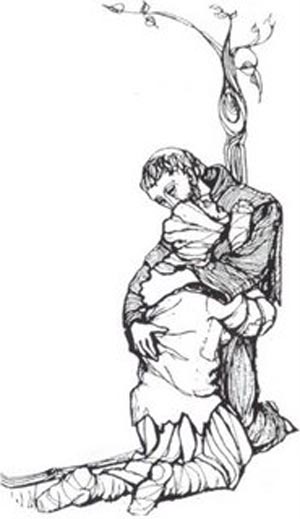
Here, I would like to suggest a historical figure for consideration whom, I believe, stands as a model for temperance (but maybe not in the way we would think). Before his conversion the young St. Francis was a well kept and in many ways self-absorbed young man, the son of a rich merchant. It is said that Francis had a strong aversion to lepers. He was repulsed by them and this “desire” controlled his reactions and encounters with lepers. He would do all he could to avoid encountering any leper at any time. After some sobering experiences in life and as the possibility of a life of service to the gospel began to grow in Francis he realized that the desires of his life were holding him back. He knew he had to gain mastery over his self in order to continue on the spiritual journey but he was at a loss on how to do this. Out riding one day, Francis met a leper on the road whose soars were so loathsome that the young man was horrified. Every “desire” in Francis at that moment was of revulsion and told him to avoid the leper at all costs. But, Francis did the exact opposite. He dismounted from his horse and he kissed the leper.

Temperance “ensures the will’s mastery over instincts and keeps desires within the limits of what is honorable.” (CCC # 1809)

Whether they be desires of attraction or desires of repulsion; the virtue of temperance enables us to live lives that show deep respect for the other person and to strive for what is honorable and good. When so much in his being was telling Francis to run he showed great respect to the leper and chose to act in such a way as to keep his desire (of repulsion in this instance) within the limit of what was honorable. To have avoided the leper would have been the dishonorable thing to do. 

The virtue of temperance not only enables us to strive for what is honorable but says we are capable of achieving what is honorable and just and good in the situations of life.

The virtues will not allow us to sell neither ourselves nor one another short.

The temperate person directs the sensitive appetites toward what is good and maintains a healthy discretion: “Do not follow your inclination and strength, walking according to the desires of your heart.” (Sir. 5:2) (CCC #1809)

"Pilgrims of Truth, Pilgrims of Peace" – Assisi III, Day of Prayer for Peace

27 Thursday Oct 2011

Posted by mcummins2172 in Uncategorized

≈ Leave a comment

On Thursday, October 27th leaders of the world’s religions will gather at the invitation of Pope Benedict XVI in Assisi, Italy to reflect on and dialogue about peace.  The gathering marks the 25th anniversary of the original gathering which was the vision of Blessed John Paul II. 

Below is a link to a video clip of an interview with Cardinal Roger Etchegaray who was instrumental in planning the original gathering.

His observation that true dialogue consists in being more than cordial and polite when meeting a person of another faith is worthy of reflection.  Dialogue demands more than just a naive “coexist” philosophy. 

Also, his warning of the effect of what might happen if Christianity were to disappear from the world scene is an important point to ponder.  Christianity proclaims that “God is love” and that mercy and forgiveness are possible.  If that were to disappear where would we be left?  We need to think twice about the “brave new worlds” we often want to create.     

Here is the link for the video clip with Cardinal Etchegaray:  “http://www.youtube.com/embed/ej3GGZvJXvI” 

Thirtieth Sunday in Ordinary Time – Love pure and simple

23 Sunday Oct 2011

Posted by mcummins2172 in Uncategorized

≈ Leave a comment

In his book The Devil You Don’t Know, Fr. Louis Cameli makes the important observation that as Christians we believe that not only has God made all creation from nothing (ex nihilo) but also from love and now, through Christ, God is summoning all creation back to the fullness of love.  Where the omnipotence of God is revealed in creation from nothing; the heart of God is made known in creation from and for love.  In Christ, we encounter God as love and we learn that the dynamic of true and authentic love stands at the very foundation of all creation and even the Creator himself.

With this awareness, the answer of our Lord to the question of the Pharisees’ “which commandment in the law is the greatest?” takes an added meaning.  “You shall love the Lord, your God, with all your heart, with all your soul and with all your mind.  This is the greatest and the first commandment.  The second is like it: you shall love your neighbor as yourself.” (Mt. 22:35-37)

One does not necessarily have to be a person of faith in order to love others as you yourself.  In fact, this ethical imperative can be a point of encounter and dialogue between people of faith and atheists and agnostics.

This coming week Pope Benedict will continue a tradition begun by Blessed John Paul II in gathering leaders of the world’s religions in Assisi, Italy to discuss and dialogue about peace.  For the first time (and this is upon Pope Benedict’s insistence) a group of non-believers (atheist and agnostic writers and philosophers) have also been invited to this gathering.  The Holy Father knows that the imperative of loving ones neighbor as oneself is a privileged point of encounter between all peoples of faith as well as people of faith and those who profess no faith.

In the command of loving ones neighbor we do indeed have a privileged place of encounter which we share with others but as Christians we also must recognize that our love of neighbor has its foundation in a deeper reality than just the social contract.  The greatest and first commandment for us is that we shall love the Lord, our God, with all our heart, soul and mind.  Our love of neighbor is rooted in our love for God and as we learn in Scripture it is not that we have first loved God; it is that God has first loved us.

The two great commandments given us by Christ are not just something we do but foundational truths of who God is and who we are as made in God’s image.  We are created from love and we are being brought back into the fullness of love by God’s grace.

When we love God and love our neighbor we are about more than just an external action; by loving our neighbor we are being formed into the very truth of who we are meant to be and the truth of all creation.

“This is the greatest and the first commandment.  The second is like it…”

Virtues Matter – Fortitude

20 Thursday Oct 2011

Posted by mcummins2172 in Uncategorized

≈ Leave a comment

Fortitude is the moral virtue that ensures firmness in difficulties and constancy in the pursuit of the good. It strengthens the resolve to resist temptations and to overcome obstacles in the moral life. The virtue of fortitude enables one to conquer fear, even fear of death, and to face trials and persecutions. It disposes one even to renounce and sacrifice his or her life in defense of a just cause. (CCC # 1808) 

On the front steps of the New York City Public Library sits two massive stone lions – one of which is named “Fortitude” and the other “Patience”. The strength and resolve of the lion is an apt symbol for this cardinal virtue but I have learned that the “resolve of a lion” can come in many shapes and sizes. Fortitude can just as easily be witnessed in the tiny figure of a Bl. Teresa of Calcutta as it can in the steely determination of a Winston Churchill. The common element to each figure is that both had backbone and (come what may) each lived his or her life by what he or she knew to be true, just and right. 

The first line of the Catechism’s description of this virtue is worthy of added consideration. Fortitude is the moral virtue that ensures firmness in difficulties and constancy in the pursuit of the good. From this I would argue that fortitude can only be found and achieved in life when there is an awareness of acknowledgement of an objective “good”. The “good” calls forth fortitude. The relativistic thrust of our times cannot promote the virtue of fortitude because there is no “good” to pursue. Everything is relative. So, the best we can hope to achieve is a shallow “live and let live” philosophy that really goes nowhere and ultimately does not satisfy the longing of the human heart. 

But the tenor of the times we have inherited does not have to be our choice. 

Within fortitude is an awareness of our origin and worth and also a goal to strive for and achieve – both a beginning and an end. The awareness may be expressed in specific religious terminology or in universal ethical principles. The awareness states that there is a dignity and worth to the human person and that choices – individual or collective as a society – either uphold and acknowledge this dignity and worth or deny and degrade this dignity and worth and, yes, there are some things worth fighting and sacrificing for. 

Fortitude’s close connection to patience also demonstrates that there are complex realities to be weighed, balanced and judged in the pursuit of the good. An awareness of “the good” does not by necessity only lead to an extreme fanaticism that denies the worth of all else. (This, I would argue is in fact a sin against the good.) Both Bl. Teresa and Churchill faced extremely complicated realities in their pursuit of the good and both demonstrate that the true fortitude and patience of a lion is found in the willingness to navigate, search for and choose the good in a maze of complicated and sometimes competing realities. 

The brazen arrogance of fanaticism has nothing in common with the discerning virtue of fortitude. 

When I work with a man who is considering the possibility of a call to priesthood I encourage him to be attentive to what brings him joy in life. Where happiness can be fleeting; joy is a deep rooted contentment and fulfillment that can be present and known even in the midst of struggle, isolation and persecution. Joy (which cannot be contrived on our part) is the surest indicator of the presence of God. This depth of joy even in the midst of struggle links it closely with fortitude. 

If you want to know joy in life then develop the virtue of fortitude that pursues the true good.

As all lions know; there is a thrill in the hunt!

← Older posts
Newer posts →
Follow The Alternate Path on WordPress.com

Enter your email address to follow this blog and receive notifications of new posts by email.

Previous Posts

  • May 2026
  • April 2026
  • March 2026
  • December 2025
  • November 2025
  • August 2025
  • April 2025
  • February 2025
  • January 2025
  • December 2024
  • August 2024
  • July 2024
  • June 2024
  • May 2024
  • April 2024
  • March 2024
  • February 2024
  • January 2024
  • December 2023
  • November 2023
  • October 2023
  • August 2023
  • July 2023
  • May 2023
  • February 2023
  • January 2023
  • December 2022
  • August 2022
  • July 2022
  • April 2022
  • January 2022
  • December 2021
  • September 2021
  • August 2021
  • July 2021
  • May 2021
  • April 2021
  • January 2021
  • December 2020
  • November 2020
  • October 2020
  • August 2020
  • July 2020
  • May 2020
  • April 2020
  • March 2020
  • February 2020
  • December 2019
  • October 2019
  • September 2019
  • August 2019
  • July 2019
  • May 2019
  • April 2019
  • March 2019
  • February 2019
  • December 2018
  • November 2018
  • October 2018
  • August 2018
  • July 2018
  • June 2018
  • April 2018
  • March 2018
  • February 2018
  • January 2018
  • December 2017
  • November 2017
  • September 2017
  • August 2017
  • July 2017
  • June 2017
  • May 2017
  • April 2017
  • March 2017
  • February 2017
  • January 2017
  • December 2016
  • November 2016
  • October 2016
  • September 2016
  • August 2016
  • July 2016
  • June 2016
  • May 2016
  • April 2016
  • March 2016
  • February 2016
  • January 2016
  • December 2015
  • November 2015
  • October 2015
  • September 2015
  • August 2015
  • June 2015
  • May 2015
  • April 2015
  • March 2015
  • February 2015
  • January 2015
  • December 2014
  • November 2014
  • October 2014
  • September 2014
  • August 2014
  • July 2014
  • June 2014
  • May 2014
  • April 2014
  • March 2014
  • February 2014
  • January 2014
  • December 2013
  • November 2013
  • October 2013
  • September 2013
  • August 2013
  • July 2013
  • June 2013
  • May 2013
  • April 2013
  • March 2013
  • February 2013
  • January 2013
  • December 2012
  • November 2012
  • October 2012
  • September 2012
  • August 2012
  • July 2012
  • June 2012
  • May 2012
  • April 2012
  • March 2012
  • February 2012
  • January 2012
  • December 2011
  • November 2011
  • October 2011
  • September 2011
  • August 2011
  • July 2011
  • June 2011
  • May 2011
  • April 2011
  • March 2011
  • February 2011
  • January 2011
  • December 2010
  • November 2010
  • October 2010
  • September 2010
  • August 2010
  • July 2010
  • September 2008
  • August 2008
  • April 2008
  • March 2008
  • February 2008
  • January 2008
  • December 2007
  • November 2007
  • October 2007
  • September 2007

Popular Posts

  • thealternatepath.org/wp-c…
  • thealternatepath.org/wp-c…
  • thealternatepath.org/wp-c…

Blog at WordPress.com.

  • Subscribe Subscribed
    • The Alternate Path
    • Join 156 other subscribers
    • Already have a WordPress.com account? Log in now.
    • The Alternate Path
    • Subscribe Subscribed
    • Sign up
    • Log in
    • Report this content
    • View site in Reader
    • Manage subscriptions
    • Collapse this bar