• About The Alternate Path

The Alternate Path

~ Thoughts on Walking the Path of Christian Discipleship

The Alternate Path

Category Archives: Uncategorized

Pope Benedict: "Anonymous capital’s power to destroy threatens the world"

21 Thursday Oct 2010

Posted by mcummins2172 in Uncategorized

≈ Leave a comment

Recently at the Synod of Bishops for the Middle East, Pope Benedict offered an impromptu address to the gathered bishops regarding the false powers of our world.

Some commentators noted that while the first English-language accounts of this talk listed the pope’s warnings on terrorism, drugs and violence as ‘false divinities that must be unmasked,’ his primary warning, interestingly, did not make the list: the evil of ‘the anonymous capital of our day that enslaves man.’

In contrast, Italy’s, Corriere della Sera, immediately headlined this as its front-page story: ‘Pope: Anonymous capital’s power to destroy threatens the world.’ (With the sub-headline being: ‘The Pope sets his sights against the irresponsible financial power that places man in slavery.’)”

Below is an excerpt from Pope Benedict’s talk followed by a video clip from Catholic Television of Pope Benedict calling for an awareness of the common good in the work of economics.  (In his address, the Holy Father makes use of the imagery found in the Book of Revelations to structure and bring forth his thought.)

And this process of loss of power (of the false gods) continues throughout history, spoken of in Revelation chapter 12; it mentions the fall of the angels, which are not truly angels, they are not divinities on earth. And is achieved truly, right at the time of the rising Church, where we can see how the blood of the martyrs takes the power away from the divinities, starting with the divine emperor, from all these divinities. It is the blood of the martyrs, the suffering, the cry of the Mother Church that makes them fall and thus transforms the world.

This fall is not only the knowledge that they are not God; it is the process of transformation of the world, which costs blood, costs the suffering of the witnesses of Christ. And, if we look closely, we can see that this process never ends. It is achieved in various periods of history in ever new ways; even today, at this moment, in which Christ, the only Son of God, must be born for the world with the fall of the gods, with pain, the martyrdom of witnesses. Let us remember all the great powers of today’s history, let us remember the anonymous capital that enslaves man, which is no longer in man’s possession, but is an anonymous power served by men, by which men are tormented and even killed. It is a destructive power, that threatens the world. And then the power of the terroristic ideologies. Violent acts are apparently made in the name of God, but this is not God: they are false divinities that must be unmasked; they are not God. And then drugs, this power that, like a voracious beast, extends its claws to all parts of the world and destroys it: it is a divinity, but it is a false divinity that must fall. Or even the way of living proclaimed by public opinion: today we must do things like this, marriage no longer counts, chastity is no longer a virtue, and so on.

These ideologies that dominate, that impose themselves forcefully, are divinities. And in the pain of the Saints, in the suffering of believers, of the Mother Church which we are a part of, these divinities must fall, what is said in the Letters to the Colossians and to the Ephesians must be done: the dominations, the powers fall and become subjects of the one Lord Jesus Christ. On this battle we find ourselves in, of this taking power away from God, of this fall of false gods, that fall because they are not deities, but powers that can destroy the world, chapter 12 of Revelations mentions these, even if with a mysterious image, for which, I believe, there are many different and beautiful interpretations. It has been said that the dragon places a large river of water before the fleeing woman to overcome her. And it would seem inevitable that the woman will drown in this river.  But the good earth absorbs this river and it cannot be harmful.

I think that the river is easily interpreted: these are the currents that dominate all and wish to make faith in the Church disappear, the Church that does not have a place anymore in front of the force of these currents that impose themselves as the only rationality, as the only way to live. And the earth that absorbs these currents is the faith of the simple at heart, that does not allow itself to be overcome by these rivers and saves the Mother and saves the Son. This is why the Psalm says – the first psalm of the Hour – the faith of the simple at heart is the true wisdom (cf Psa. 118:130). This true wisdom of simple faith, that does not allow itself to be swamped by the waters, is the force of the Church…

Do you think the Holy Father is trying to tell us something?
 

The curious case of John

20 Wednesday Oct 2010

Posted by mcummins2172 in Uncategorized

≈ Leave a comment

There are two gospel passages regarding John the beloved disciple that I find intriguing.  Both passages are found at the end of John’s gospel.  The first passage regards the empty tomb.  It is Mary of Magdala, in the twentieth chapter, who is the first to find the tomb open and empty.  Fearing that someone had stolen the body of Christ she runs to Peter and John.

And she said to them, “They have taken the Lord out of the tomb and we don’t know where they have laid him.”

Peter then set out with the other disciple (John) to go to the tomb.  They ran together but the other disciple outran Peter and reach the tomb first.  He bent down and saw the linen cloths lying flat, but he did not enter.

Then Simon Peter came following him and entered the tomb; he too, saw the linen cloths lying flat.  The napkin, which had been around his head was not lying flat like the other linen cloths but lay rolled up in its place.  Then the other disciple who had reached the tomb first also went in; he saw and believed. 

The theologian Hans Urs Von Balthasar has a wonderful take on this passage.  Both Peter and John in this chapter of John’s gospel represent different facets of the Church.  Peter represents the authoritative, hierarchical nature of the Church while John represents the mystical, contemplative side.  Both facets need one another and interact with one another.  The mystical, contemplative may reach the mystery first (as John reached the empty tomb ahead of Peter) but here it waits (and this is important) for the hierachical and authoritative side to catch up and enter first.  In the ways of faith, there are disciples (men and women) who are ahead of the curve but their discipleship is not just demonstrated in being ahead of the rest (“Hey, look at me!”) but also in the awareness of being part of a larger whole, which is the Church.  We go to Christ and we encounter the mystery together.   

Now, the second passage builds off of the symbolism found in this first passage.  This passage comes in the twenty-first chapter of John.  The risen Lord has just asked Peter three times if he loves him.  Following this exchange we are told that,

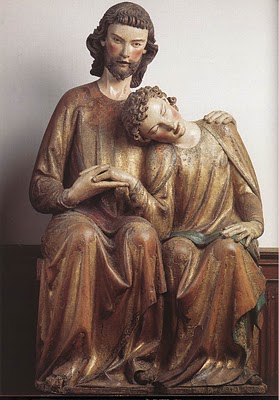
Peter looked back and saw that the disciple Jesus loved was following as well, the one who had reclined close to Jesus at the supper and had asked him, “Lord, who is to betray you?”  On seeing him Peter asked Jesus, “Lord, what about him?”  Jesus answered, “If I want him to remain until I come, does that concern you?  Follow me.”

Because of this the rumor spread in the community that this disciple would not die.  Yet Jesus had not said to Peter, “He will not die,” but “suppose I want him to remain until I come.”

Throughout the history of the Church there have been, and will continue to be, men and women whose authority comes not from the authority of apostolic succession (which is indeed fundamental and at the heart of the structure of the Church) but from the authority of reclining “close to Jesus at the supper“.  The Church needs the authority of the saints just as much as it needs the authority of the magisterium.  Sometimes the two come together – we find this is the enduring witness of the episcopal and papal saints of the Church – but they do not have to. 

Sometimes those whose authority comes from reclining on the breast of Christ will not immediately be recognized and may even be questioned by the rest of the Church.  “Lord, what about him?” asked Peter.  Sometimes these men and women (and we have seen this in the history of our faith) suffer at the very hands of others in the Church but it is precisely here that another important aspect of those whose authority comes from reclining close to Jesus is demonstrated – just as much as they love Christ, they love the Church.  This aspect is indeed worthy of reflection and, I believe, an important witness to our time with its attitude of cutting losses and moving on. 

If we love Christ then we must love the Church.  What kind of friend would say to a friend, “I love you but I hate what you love.”  Christ loves the Church, his heart beats for the Church (even in all of its continuing need of purification) and it is precisely the ones who recline at the breast of Christ who know this truth.  They hear it in the very heartbeat of Christ.  They love the Church enough to even suffer at the hands of others in the Church if need be and to suffer from the actions of others in the Church.  They will not leave because they know that we go to Christ and we encounter the mystery together.  We are indeed part of something bigger than ourselves and these blessed men and women witness this truth to us. 

Jesus answered, “If I want him to remain until I come, does that concern you?”  There have been and continue to be men and women in the Church whose authority comes from reclining near Jesus at supper.  John has much to teach us.  Thank God for these beloved disciples and for the fullness of their witness! 


"Keep Christ near" – St. Teresa of Avila

15 Friday Oct 2010

Posted by mcummins2172 in Uncategorized

≈ Leave a comment

One summer, as a seminarian, I participated in an Appalachian ministry program in Kentucky and during that same time period I was reading some of the writings of St. Teresa of Avila – the saint whose feast the Church celebrates today.  One quiet afternoon I was taking a “siesta” in my room and I had a vision, a dream (I am not sure which) where I was standing on the bank of one side of a river.  There was a bridge that spanned across the river, but I had no desire to cross it.  On the other side of the river there was a beautiful woman standing in a full white habit.  She looked at me and smiled.  Now, again, was it a dream or a vision or just my imagination running wild – I don’t know – but, it has been at least eighteen years now since that summer afternoon and I still remember that smile and it brings with it joy and peace.

St. Teresa is one of my favorite saints.  She lived a life devoted to Christ and the Church (even as some in the Church held her in suspicion).  She was strong willed and intelligent.  Today, recognized as a Doctor of the Church, she offers a profound wisdom founded in a deep knowledge of grace working in the human condition. 

Today’s second reading in the Office of Readings is a brief excerpt from one of her writings.  As I reflected on the reading I was struck by the very simple admonition, “Keep Christ near”.  This must be a profound truth for each disciple of Christ.  No matter what circumstance, situation or season we find ourselves in; we must keep Christ near and in this we will know God’s blessings, protection and strength.

If Christ Jesus dwells in a man as his friend and noble leader, that man can endure all things, for Christ helps and strengthens us and never abandons us.  He is a true friend.  And I clearly see what if we expect to please him and receive an abundance of his graces, God desires that these graces must come to us from the hands of Christ, through his most sacred humanity, in which God takes delight.

Many, many times I have perceived this through experience.  The Lord has told it to me, I have definitely seen that we must enter by this gate if we wish his Sovereign Majesty to reveal to us great and hidden mysteries.  A person should desire no other path, even if he is at the summit of contemplation; on this road he walks safely.  All blessings come to us through our Lord.  He will teach us, for in beholding his life we find that he is the best example. 

What more do we desire from such a good friend at our side?   Unlike our friends in the world, he will never abandon us when we are troubled or distressed.  Blessed is the one who truly loves him and always keeps him near…

Below, is a clip of the Taize version of Teresa’s poem, “Eficacia De La Paciencia” (“Efficacy of Patience”).  Often known as “Nada te turbe”.  Truly, they are words to live by. 

Nada te turbe,
Nada te espante,
Todo se pasa,
Dios no se muda,
La paciencia
Todo lo alcanza;
Quien a Dios tiene
Nada le falta.
Solo Dios basta.   

Let nothing trouble you,
Let nothing scare you,
All is fleeting,
God alone is unchanging.
Patience
Everything obtains.
Who possesses God
Nothing wants.
God alone suffices. 

Forgiveness

13 Wednesday Oct 2010

Posted by mcummins2172 in Uncategorized

≈ Leave a comment

I believe that it is Cardinal Francis George of the Archdiocese of Chicago who has observed that we live in a time when “everything is allowed yet nothing is forgiven”.  It is a sad state of affairs that we find ourselves in (very harsh and isolating) and also a tragic predicament that witnesses to the impoverishment of our times and, despite all our protestations to the contrary, our impoverished understanding of the human condition.

We need, once again, to learn the art of forgiveness – both how to forgive and how to accept forgiveness.  Forgiveness is the key to peace.

In his little book, “Pathways to Relationship”; Bishop Robert Morneau shares two helpful quotes regarding the “machinery of forgiveness”.

Hannah Arendt had discerned that this (mercy/forgiveness) was Jesus’ most endangering action because if a society does not have an apparatus for forgiveness then its members are fated to live forever with the consequences of any violation.  Thus the refusal to forgive sin (or the management of the machinery of forgiveness) amounts to enormous social control.  [Walter Brueggemann]

Forgiveness is the answer to the child’s dream of a miracle by which what is broken is made whole again, what is soiled is again made clean.  The dream explains why we need to be forgiven, and why we must forgive.  In the presence of God, nothing stands between Him and us – we are forgiven.  But we cannot feel His presence if anything is allowed to stand between ourselves and others.  [Dag Hammarskjold]

Below is a video that speaks to the power of forgiveness.


The dynamic of return

11 Monday Oct 2010

Posted by mcummins2172 in Uncategorized

≈ Leave a comment

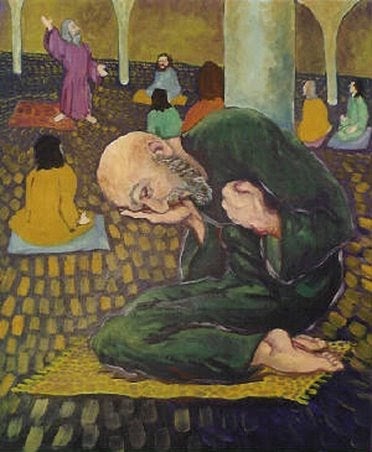
“Do we love God?” This is the question that the Gospel reading for the Twenty-Eighth Sunday in Ordinary Time with the story of the one leper who returns puts before us. It is an important question and one that each sincere disciple must reflect upon. We might believe that there is a God; we might turn to God in moments of crisis or struggle but do we love God?

It is fair to ask, “how does the one leper in today’s gospel (Lk. 17:11-19) evoke this question for our reflection?” He does so by returning. “And one of them, realizing he had been healed, returned, glorifying God in a loud voice; and he fell at the feet of Jesus and thanked him.” By this simple act of returning the one leper expressed his gratitude and demonstrated his honest desire to enter into relationship with God. He is not content to just hold God as an “interesting concept” in life nor is it enough for him to just receive the help needed in struggle and then walk away (although it seems to have been enough for the other nine … at least at that moment in their lives). Rather, he returns.

Actually, the movement of “returning” links each of the readings for this Sunday. We have just examined it in the Gospel reading. In the first reading (2 Kings 5:14-17), we are told that after carrying out the prophet’s instructions by washing himself in the Jordan river and being healed, Naaman then, “returns with his whole retinue to the man of God.” Also, to give thanks.

In the second Letter to Timothy (2 Timothy 2:8-13), we are told, “Beloved, remember Jesus Christ…” and all that he has done and all that he has won for us. To “remember” in this regards is to return – to come back once again to Christ, to place ourselves at his feet and to give thanks. “Remember Jesus Christ…”

Yes, it is possible to live ones life keeping God at a safe distance as an interesting concept to ponder every so often or only to turn to God when in need but for a disciple of Christ this just cannot be. Discipleship, by its very nature, implies relationship. It implies the willingness, vulnerability and humility to love. Do we love God? For a disciple the answer must always be “yes” – a full “yes” said in the knowledge and acceptance of all that love implies.

This call to love God can truly be frightening because we both know our own unworthiness and we know the infinite goodness of God. But here it is helpful to remember an important dynamic of true love – love perfects itself. Despite all our shortcomings, sins and failures; even the slightest return, even the littlest movement of love on our part is met with the immensity of God’s love and it is in this supremely unequal exchange of love (bit by bit) that we are a little more perfected, a little more healed and made whole. Lord, set me free; that I might draw closer to thee.

To the one cleansed leper who returned – who made that choice to enter into relationship and to love God – our Lord said, “Stand up and go; your faith has saved you.” The other nine did not hear these words because they did not return to give thanks but the one who returned did. “Stand up”, or in other words, regain your dignity, your knowledge that you are a child of God and live now in this reality. When we love God and allow God to love us we gain the truth of who we are.

Reflection Point: Spend some time praying with and reflecting on Luke 17:11-19 and the image found above. Do you recognize the choice to return even as others rush on by? What might this say about your desire for God? Give thanks to God for his blessings.

Pope Benedict on interreligious dialogue

01 Friday Oct 2010

Posted by mcummins2172 in Uncategorized

≈ Leave a comment

I am off to the Prayer for Peace in Barcelona!  So, no new posts for a week.  Check out the video updates of the Prayer that will be posted on the Community webpage (http://www.santegidio.org/).  In the spirit of the gathering here are some thoughts by Pope Benedict on the value of interreligious dialogue. 

Prayer for Peace, 2010: "Living Together in a Time of Crisis"

28 Tuesday Sep 2010

Posted by mcummins2172 in Uncategorized

≈ Leave a comment

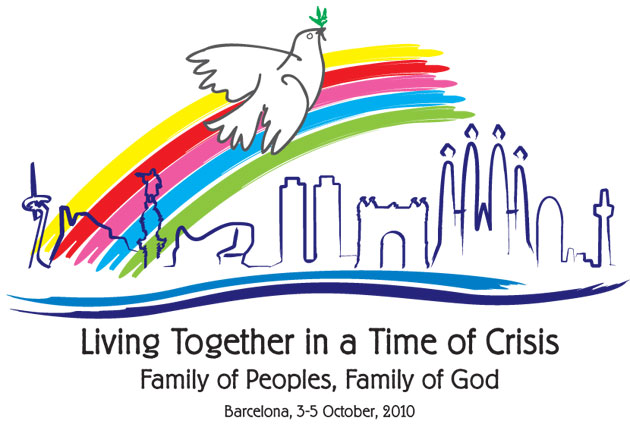
Something unique will soon be happening in Barcelona, Spain – an event that has an important and needed word to say to our turbulent times.  From October 3rd through the 5th, the annual Prayer for Peace gathering organized by the Community of Sant’Egidio will be occurring.  The theme for this year’s Prayer is “Living Together in a Time of Crisis: Family of Peoples, Family of God” and it expresses very well what the Prayer for Peace is about.  The Prayer for Peace brings together leaders of all the world’s religious traditions in a spirit of dialogue and respect consisting of discussion panels on a variety of topics, forums and a common pledge to work for peace.  By so doing, the gathering witnesses to the world that it is precisely in the authentic practice of religion (and not its negation) where a unique and needed path toward peace and mutual understanding among peoples in our world can be found.  True religious expression is a means for peace and not for conflict.   


John Paul II with world’s religious leaders in Assisi, 1986

It was John Paul II who was the first to gather the world’s religious leaders together to pray for peace at an unprecedented meeting in Assisi, Italy in 1986.  The Holy Father had the intuition that prayer, respect and dialogue could unite differing peoples together in the quest for peace, justice and the common good.

The small Community of Sant’Egidio was present at that first Prayer for Peace in 1986 – not in an organizing way – but as one witness among others to the event.  But, the community did “catch” the intuition of John Paul II and following that first gathering began the task of organizing an annual Prayer for Peace.  Often, following that first Prayer for Peace, John Paul II would encourage Andrea Riccardi (founder of the Community of Sant’Egidio) to keep the spirit of Assisi alive!

In many ways the Prayer for Peace is an enfleshed expression of the Second Vatican Council document, Nostra Aetate (Declaration on the Relation of the Church to Non-Christian Religions).

In this age of ours, when men are drawing more closely together and the bonds of friendship between different peoples are being strengthened, the Church examines with greater care the relation which she has to non-Christian religions.  Ever aware of her duty to foster unity and charity among individuals, and even among nations, she reflects at the outset on what men have in common and what tends to promote fellowship among them.

All men form but one community.  This is so because all stem from the one stock which God created to people the entire earth (cf. Acts 17:26), and also because all share a common destiny, namely God.  His providence, evident goodness, and saving designs extend to all men (cf. Wis. 8:1, Acts 14:17, Rom. 2:6-7, 1 Tim. 2:4) against the day when the elect are gathered together in the holy city which is illumined by the glory of God, and in whose splendor all peoples will walk.

Men look to their different religions for an answer to the unsolved riddles of human existence…


Professor Andrea Riccardi

 The Catholic Church rejects nothing of what is true and holy in these religions.  She has a high regard for the manner of life and conduct, the precepts and doctrines which, although differing in many ways from her own teaching, nevertheless often reflect a ray of that truth which enlightens all men.  Yet she proclaims and is in duty bound to proclaim without fail, Christ who is the way, the truth and the life (Jn. 1:6).  In him, in whom God reconciled all things to himself (2 Cor. 5:18-19), men find the fullness of their religious life. 

The Church, therefore, urges her sons and daughters to enter with prudence and charity into discussions and collaboration with members of other religions.  Let Christians, while witnessing to their own faith and way of life, acknowledge, preserve and encourage the spiritual and moral truths found among non-Christians, also their social life and culture. 

I will be attending the Prayer for Peace and it will be the fourth one that I have attended.  Why do I take the time and the effort to go? 


She’ar Yashuv Cohen, Chief Rabbi of Haifa, Israel in 2008

 I go because the Prayer for Peace is a powerful witness to the reality of religion as a path to peace in answer to the loud and vocal contention by some who choose to view religious expression solely as a source of conflict and division in our world and its history; a sad legacy of the past that humanity would be better off to just jettison and finally get rid of.  While witnessing to this; the Prayer also stands solidly in prophetic testimony against those who do use religion as a source of violence and conflict.  Without exception, the Prayer for Peace affirms that any violence or oppression in the name of God is a sin against God and humanity! 

I go because I am a Christian and a follower of Jesus Christ and it is precisely in the living of my faith that I am brought to a profound respect for others.  The Prayer for Peace is an expression not of a false ecumenism and interfaith dialogue (either avoiding acknowledgement of honest differences in an attempt to water down truth into a bland syncretism, until no one is really satisfied nor any viewpoint respected, or saying, “Yes, we can have dialogue but only on my terms.”) but of that true ecumenism and interfaith dialogue which has discovered that it is exactly in authentically living and entering into the heart of ones own faith and belief that we find paths toward others and also points of encounter and dialogue. 


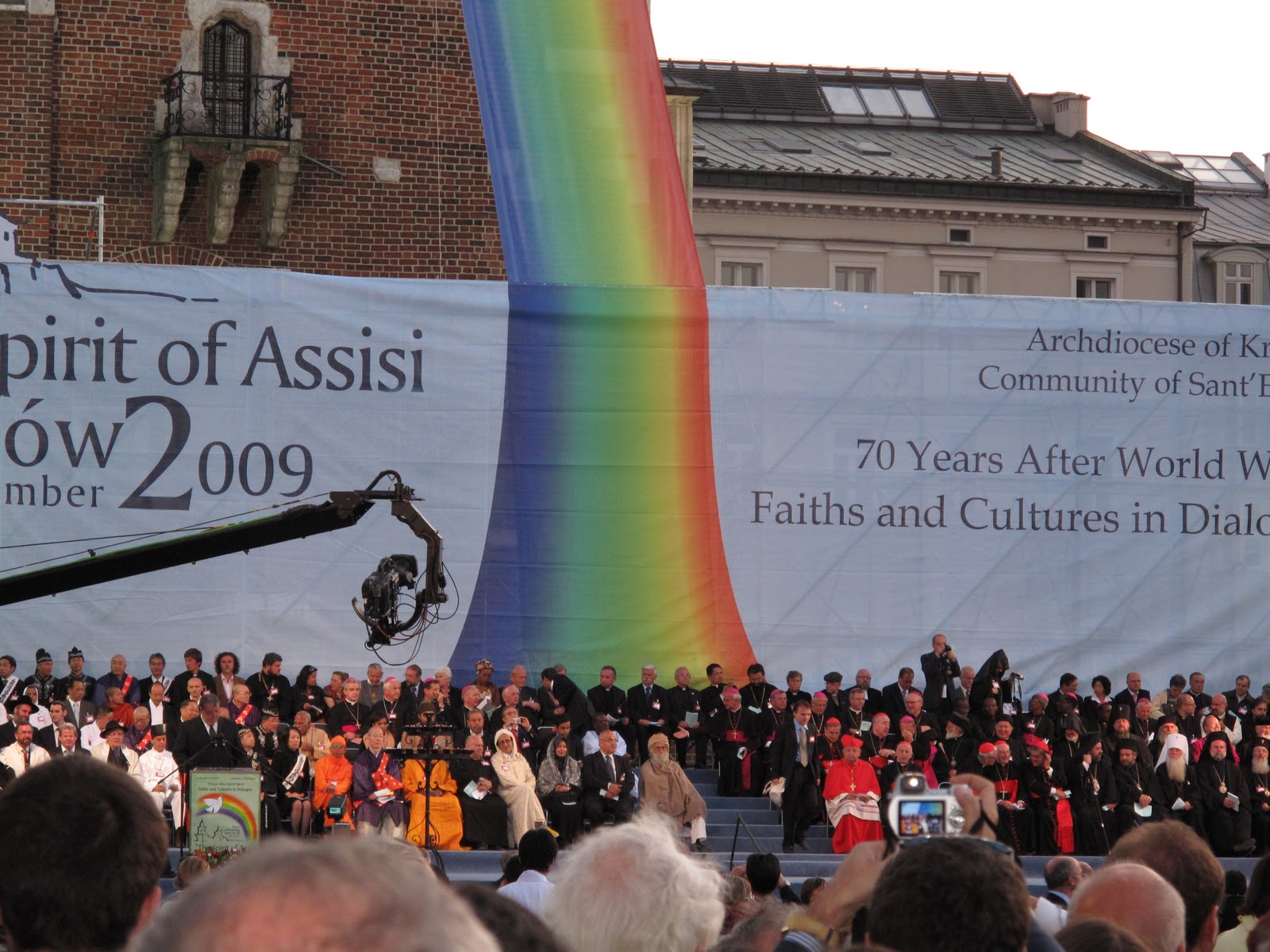
Closing ceremony of Prayer for Peace, 2009 in Krakow Poland

I go because I do not accept the prevalent,  impoverished  and misguided anthropology and cynicism of our times that encourages people not to trust, not to believe in anything greater than themselves and ultimately, not to risk the vulnerability of love.  I go because I believe we must all work to create and to secure a human space in our world – a space that allows for the true dignity and worth of every human person and therefore specifically necessitates a respect for the desire of belief. 

When we forget God; we lose ourselves, we lose peace and our world suffers.  This sad dynamic has been witnessed time and time again throughout history.  We just need to look to the century just concluded (one of the bloodiest) and the witness of the many millions of men and women who died under the oppression of so many totalitarian and fascist regimes that denied and criminalized the practice of faith. 

The Prayer for Peace runs from October 3-5, there will be videos of different moments in the gathering posted on the Community of Sant’Egidio’s website: (http://www.santegidio.org/).  I encourage you to check it out and to join in this international witness of religion as a path to peace!  

Michael, Gabriel and Raphael

28 Tuesday Sep 2010

Posted by mcummins2172 in Uncategorized

≈ 2 Comments

On September 29th the Church celebrates the Feast of the Archangels (Michael, Gabriel and Raphael) and acknowledges that there is a spiritual side to existence and that there are pure spiritual beings in God’s creation.  Recently there has certainly been an upsurge of interest regarding angels (which says something about our yearning for the spiritual) but it is of value to note what the Church, in its teaching role, has to say about angels. 

First, angels are creatures.  Angels are not God nor are they independent of God.  There was a time when angels did not exist.  Angels were created by God and their existence demonstrates that there are two spheres of creation – one purely spiritual and the other physical and spiritual.  Because angels are not God, they do not enjoy the powers nor wisdom of God.  They are creatures like us.  They cannot read the inner thoughts of men and women unless we somehow make known to them our needs and requests.   

Second, because angels are pure spirit they are genderless, neither male nor female.  This is hard for us to get our minds around, being so conditioned by our own physicality.  There is another component to this which has ramifications for us – humans do not become angels in the fullness of the Kingdom of God.  We tend to say things like, “Now God has another angel in heaven.” when a loved one dies but this, in fact, is misleading.  In the fullness of the Kingdom of God we are not changed and transformed into a different type of creature; in fact we profess the opposite in our belief in the resurrection of “body and soul” – we remain who we are, but glorified.  When Christ appeared after his resurrection he did not appear as an angel but a glorified human (flesh and spirit).  This is the same glory that awaits us. 

Angels, like us, have free will.  This is witnessed in the rebellion of Lucifer and his angels.  Angels have made the choice to either serve God and enter the beatific vision or to rebel and become evil.  Another important point here – the devil is a creature (always a creature), God alone is the creator.

Angels (since they are pure spirit, pure will) are known and identified by their function and divine commission.  They carry out a task from God.  The very names of the archangels demonstrate this.  Michael means, “Who is like God?”.  When Lucifer sought to make himself “God”, Michael stood in his way with the burning truth, “Who is like God?”  Gabriel means, “God is my strength”.  Raphael means, “God is my health.”  These are the three archangels named and present in Scripture.  In apocryphal Jewish literature there are five other archangels named; Uriel “God is my light”, Jophiel “The beauty of God”, Chamael “The angel of God’s wrath”, Zadkiel “The righteousness of God” and Jophkiel “The purity of God”. 

God could govern all creation by his own design but has choosen to employ angels as cooperators in his plans for creation and humanity.  Angels assist us throughout life but in quiet ways without show.

There are nine choirs of angels: (listed in ascending order) Angels, Archangels, Principalities, Powers, Virtues, Dominations, Thrones, Cherubim, and Seraphim.

The Church teaches that every person (Christian and non-Christian) has a guardian angel, a friend to help us on our pilgrimage in this world.  On October 2nd, the Church celebrates the Feast of the Guardian Angels.  I once read that there was a pope who would give the members of the Vatican diplomatic corp a common bit of advice.  He would tell them that in the course of their duties if they were going to meet with an official opposed to the mission of the Church that, the night before the meeting, the diplomat should say a prayer asking his guardian angel to speak to the official’s guardian angel in order to help in opening the official’s heart to the work and need of the Church.  I think it is good advise!  There is nothing wrong in using all contacts! 

Angels walk with us and together we give glory to God!


One step enough for me

24 Friday Sep 2010

Posted by mcummins2172 in Uncategorized

≈ 1 Comment

On September 18th I posted a rendition of “Lead Kindly Light”, sung by Aled Jones.  This poem written by John Henry Cardinal Newman is truly beautiful and speaks heart to heart.  There is one part of the poem that keeps coming to my thoughts and I believe it speaks both to the dynamic of discipleship and also discernment.  It is this:

Keep thou my feet, I do not ask to see
     the distant scene, one step enough for me. 

There is a double humility called for in the life of discipleship.  This “double humility” finds expression in today’s gospel reading: Luke 9:18-22.

Once when Jesus was praying in solitude, and the disciples were with him, he asked them, “Who do the crowds say that I am?”  They said in reply, “John the Baptist; others, Elijah; still others, ‘One of the ancient prophets has arisen.’  Then he said to them, “But who do you say that I am?”  Peter said in reply, “The Christ of God.”  He rebuked them and directed them not to tell this to anyone.

He said, “The Son of Man must suffer greatly and be rejected by the elders, the chief priests, and the scribes, and be killed and on the third day be raised.”

The double humility is first; acknowledging Christ as Messiah, as Lord of ones life and second; allowing Christ to be God for us according to his terms and not our own.  This second humility is more difficult for us than the first but it must be entered into and accepted because it is the true path of discipleship.  

Newman’s “one step enough for me” expresses the beauty of this double humility.  One step is enough.  We do not have to see the distant scene.  The Kingdom of God is coming; we just have to do our part and we have to trust – God will see it through.

Discernment, along with all of discipleship, is also a matter of trusting and the willingness to take one step, the next step.  We do not have to have it all figured out (in fact we never will); we do not have to see the distant scene, we just need to take the next step – God will see us through.  

Lead Kindly Light.

Not telling the story by telling a story: Pope Benedict and the secular media

21 Tuesday Sep 2010

Posted by mcummins2172 in Uncategorized

≈ 3 Comments

I call it “not telling the story by telling a story”. It continues to amaze me how so many (it seems) in the secular media approach and “cover” Church events – especially Papal visits. They just don’t get it and I am more and more convinced that often they just do not want to get it … probably because the real story challenges both the “powers that be” and ingrained perceptions. Sidestep journalism and commentary at its finest. So … my advice to those who really want to learn about events in the Church and the message of the Church to our world today: evaluate your sources. Don’t take reports at face value; do the work needed. You will be better off for it.

Here is a little thought experiment. View the video below. Is it the whole story about the recent papal visit? No. Were there other aspects? Yes. Were there protests? Yes. Are there issues that need to be addressed – and are being addressed – in the life of the Church? Yes, certainly. But view the video below critically – what is happening, what is being said, how many people are there, notice their actions and reactions. Now, consider how generally the papal visit has been covered (if at all) in the media – both print and video. Would you say that what is seen and heard in this clip found expression in the general media coverage? Or does there seem to be a disconnect? And if there is a disconnect, why?

← Older posts
Newer posts →
Follow The Alternate Path on WordPress.com

Enter your email address to follow this blog and receive notifications of new posts by email.

Previous Posts

  • May 2026
  • April 2026
  • March 2026
  • December 2025
  • November 2025
  • August 2025
  • April 2025
  • February 2025
  • January 2025
  • December 2024
  • August 2024
  • July 2024
  • June 2024
  • May 2024
  • April 2024
  • March 2024
  • February 2024
  • January 2024
  • December 2023
  • November 2023
  • October 2023
  • August 2023
  • July 2023
  • May 2023
  • February 2023
  • January 2023
  • December 2022
  • August 2022
  • July 2022
  • April 2022
  • January 2022
  • December 2021
  • September 2021
  • August 2021
  • July 2021
  • May 2021
  • April 2021
  • January 2021
  • December 2020
  • November 2020
  • October 2020
  • August 2020
  • July 2020
  • May 2020
  • April 2020
  • March 2020
  • February 2020
  • December 2019
  • October 2019
  • September 2019
  • August 2019
  • July 2019
  • May 2019
  • April 2019
  • March 2019
  • February 2019
  • December 2018
  • November 2018
  • October 2018
  • August 2018
  • July 2018
  • June 2018
  • April 2018
  • March 2018
  • February 2018
  • January 2018
  • December 2017
  • November 2017
  • September 2017
  • August 2017
  • July 2017
  • June 2017
  • May 2017
  • April 2017
  • March 2017
  • February 2017
  • January 2017
  • December 2016
  • November 2016
  • October 2016
  • September 2016
  • August 2016
  • July 2016
  • June 2016
  • May 2016
  • April 2016
  • March 2016
  • February 2016
  • January 2016
  • December 2015
  • November 2015
  • October 2015
  • September 2015
  • August 2015
  • June 2015
  • May 2015
  • April 2015
  • March 2015
  • February 2015
  • January 2015
  • December 2014
  • November 2014
  • October 2014
  • September 2014
  • August 2014
  • July 2014
  • June 2014
  • May 2014
  • April 2014
  • March 2014
  • February 2014
  • January 2014
  • December 2013
  • November 2013
  • October 2013
  • September 2013
  • August 2013
  • July 2013
  • June 2013
  • May 2013
  • April 2013
  • March 2013
  • February 2013
  • January 2013
  • December 2012
  • November 2012
  • October 2012
  • September 2012
  • August 2012
  • July 2012
  • June 2012
  • May 2012
  • April 2012
  • March 2012
  • February 2012
  • January 2012
  • December 2011
  • November 2011
  • October 2011
  • September 2011
  • August 2011
  • July 2011
  • June 2011
  • May 2011
  • April 2011
  • March 2011
  • February 2011
  • January 2011
  • December 2010
  • November 2010
  • October 2010
  • September 2010
  • August 2010
  • July 2010
  • September 2008
  • August 2008
  • April 2008
  • March 2008
  • February 2008
  • January 2008
  • December 2007
  • November 2007
  • October 2007
  • September 2007

Popular Posts

  • thealternatepath.org/wp-c…
  • thealternatepath.org/wp-c…
  • thealternatepath.org/wp-c…

Blog at WordPress.com.

  • Subscribe Subscribed
    • The Alternate Path
    • Join 156 other subscribers
    • Already have a WordPress.com account? Log in now.
    • The Alternate Path
    • Subscribe Subscribed
    • Sign up
    • Log in
    • Report this content
    • View site in Reader
    • Manage subscriptions
    • Collapse this bar