Near the end of his little book, “Obedience” Cardinal Cantalamessa reflects on an expression found throughout Scripture that is very dear to God. “Here I am.” These words are dear to God because they are an expression of an obedience rooted in love (imagine a parent walking into a home and calling out to his or her child, “Where are you?” and the child, playing in the back room, simply responding “Here I am”). It is a simple automatic connection of love, relationship and obedience and it is through all of this that God is able to do great things.
To continue Cardinal Cantalamessa’s thought – Abraham responded, “Here I am” and God made him the father of faith and brought forth from him innumerable descendants – as many as the stars in the sky. Moses said, “Here I am” and through him God was able to set his people free and lead them to the promised land. The young Samuel did not fully understand at first but after being instructed by the elder Eli answered, “Here I am” and God made of him a great prophet who would anoint David as king. Isaiah said, “Here I am” and through his writings we are given the beautiful imagery of the coming Messiah as the one who would bring forth God’s reign and also be the suffering servant. We are told that the word of God came to John the Baptist in the desert and his, “Here I am” was his willingness to go forth and proclaim the coming of God’s Kingdom even to the point of giving his life. Mary, the mother of our Lord, said, “Here I am” when she responded to Gabriel’s message by saying, “Behold, I am the handmaid of the Lord. May it be done to me according to your word.” Jesus’ whole life, every aspect of his being, was, “Here I am” to the Father’s will. He took this loving response to the call of the Father to the level of the infinite and through that he won salvation for all.
The life of every Christian should be lived as an expression of these simple words, “Here I am”.
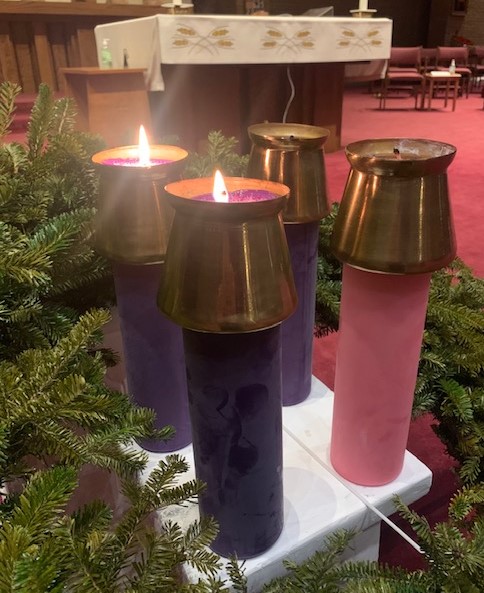
We talk about the season of Advent being both a time of waiting and of hope. How are the two connected? Here is a thought.
The waiting of Advent is not a passive thing. As Christians we are not just sitting, twiddling our thumbs waiting on the Master’s return. The waiting of Advent is an active waiting.
It is said that a large part of success in life is the willingness to just show up. It may sound simple but it is a key ingredient in success and accomplishment. Being willing to “show up” is saying, “Here I am” to God and to neighbor. We show up to God when we value our relationship with Him – when we take the time to pray, when we give priority and value to worship and adoration of God. We show up when we strive to both learn and live by God’s teachings for us through Scripture and Tradition. We show up when we are obedient to God’s will for us. We are that child in the back room playing and we should easily and automatically in love respond, “Here I am” when our loving Father calls out for us.
We respond, “Here I am” to our neighbor when we also show up for them. We show up when we strive to be fully present to the other person – spouse, child, parent, neighbor, stranger. We show up to our neighbor when we desire and choose to live the particular vocation God has called each one of us to. We show up when we live our commitments and responsibilities in life. It is the mature thing to do and there is no substitute.
This willingness to just show up, to say, “Here I am” is the active waiting of Advent and it is connected to hope.
Hope is a theological virtue in our Christian understanding. Part of being a theological virtue means that the source of this virtue is God. We – on our own – cannot make hope, we cannot contrive it. Hope is a gift from God that is only received by living in right relationship with God. We cannot make hope but we can live our lives in such a manner as to be open to receive this most precious of gifts. We can make the choice to live in a way that opens our hearts to this gift, that will allow this gift to take root in our lives and to bear fruit and then, our lives, can be a witness of hope in our world.
The active waiting of Advent is living is such a manner as to receive hope. Responding, “Here I am” is allowing hope to take root within us. Just showing up is the willingness to live in hope.
The waiting of Advent is active, in fact, it is probably the most active thing we could ever do. It is the willingness to say, “Here I am”. It is the desire to just show up.