Christ the King and how we honor Him

There is a story told about the temple mount in Jerusalem.  

Before there was a temple, before there was even a city, there were two brothers that lived on either side of the hill.  One brother was wealthy yet he had no family.  The other brother had very limited resources but he had a large family.  One evening the wealthy brother was thinking of his brother on the other side of the hill.  “My brother,” he thought “does not have much and he has many mouths to feed and here I am with all my wealth.  I know what I shall do, every night under the cover of darkness I will take one sack of grain from my granary and carry it over to my brother’s and place it in his granary.”  Now, that very same evening the other brother was thinking of his wealthy sibling.  “My brother,” he thought “does not have the blessing of a family but he does have riches, I might as well help him grow even more in his riches.  I will take a sack of grain from my granary every night and carry it to my brother’s granary and place it with his grain.”  The brothers began to do this every night, all the time not saying a word to the other about what they were doing.  They were both amazed to see every morning that the number of sacks in their granaries remained the same although they had taken away a sack the previous evening.  This all continued for a while until one night they met one another at the crest of the hill carrying their sacks of grain.  Upon seeing one another they immediately realized what had been transpiring and they embraced one another in love.  And upon their embrace the voice of God sounded from heaven, “This is where I will build my house upon earth!” 

The moral of the tale, I believe, is this: when we make the choice to love and to give then we open our hearts that God might come in and make a dwelling place within us.  When we choose to love, God makes his home within and with us.

In one of the Harry Potter movies (I cannot remember which) the wise wizard Dumbledore shares this insight with the young Harry, “Harry, it is neither our abilities nor our skills that define our character, rather it is the choices we make that truly define who we are.”  It is when we make a choice, when we exercise our will; that we truly define and determine who we are.

One of the beautiful aspects of our Christian faith tradition is the belief that every human person is made in the very image and likeness of God – the “imago Dei”.  As we proclaim this, it is understandable to then ask how we are made in God’s image.  Is it in our bodies, our physical makeup, that we image God?  No, because God is pure spirit and does not have a body.  Is it in our abilities or our skills that we image God?  Well, not really, our skills and abilities (no matter how impressive they might be) are not really all that much compared to the truth of God.  How are we made in God’s image?  Many of the greatest thinkers and saints of our faith tradition have answered this question by saying that it is in our will where we find most fully the image of God.  It is by our choosing the good that we show forth God’s image in which we are made.  When we, aided by God’s grace, make the choice to love, the choice to give, the choice to let go of self, the choice to forgive, to show mercy then we truly reveal the image of God in which we are made.  Our character is defined and determined by the choices that we make.

On this feast of Christ the King we proclaim that Christ is indeed Lord and King of all creation.  He is master.  Christ is the one who was dead but who is now risen and alive.  He is the firstborn.  As we proclaim Christ as King it is fair to ask what type of king do we have?  What is our king’s character?

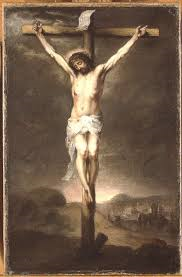
The Gospel reading for this feast (Lk. 23: 35-43) tells us something truly important about the king we have and proclaim and it is revealed in the choice he made.  It is important to note that in the space of just eight verses, as our Lord is being crucified, he is presented with the same temptation three times; three times from different groups: the rulers, the Roman soldiers and the criminal hanging next to him.  The temptation is simple, “Save yourself!”  Rulers: “He saved others, let him save himself if he is the chosen one, the Christ of God.”  Soldiers: “If you are King of the Jews, save yourself.”  Criminal: “Are you not the Christ?  Save yourself and us.”  Three times this temptation is presented before our Lord and he could have chosen to save himself … but he did not.  Rather, he made a different choice.  He choose to obey the Father’s will; he choose to love both God and us, he choose to give of himself even unto death.

This is the king we have, the king that we proclaim and that we glorify!  Our character is defined by our choices and our king’s character is revealed in his choice here at the end of Luke’s gospel.  In the face of all the world’s temptation, Christ made a different choice – he made the choice of love.  Today we glorify Christ as king and as we do the same gospel truth is now put before us.  We all have the same temptation that our Lord faced and we know this.  In so many varied ways the world continues to put the same temptation before every disciple of Christ – sometimes subtly sometimes very blatantly.  “Save yourself!  Do not care about others.  Do not think of others.  Who cares about them?  Think only of yourself.  Save yourself!” 

But Christ our King shows us that there is a different way, a different choice can always be made.

When the world says, “Save yourself!” we, with God’s grace, can make a different choice.  We can make the choice to love.  We can choose to serve and to give of self.  We can forgive and offer mercy.  “Save yourself,” is not the only option we have.  Like Christ, our king, we can make the choice to love and to give.  We can always make the choice for the good regardless of the situation or the context in which we find ourselves.    

And the gospel truth is this: it is when we choose to love and to give (even when it seemingly leads to more hardship, more pain, difficulties and even death) that new and more abundant life is found and known.  More abundant than we could ever possibly imagine!  This is the truth of the cross and the resurrection – the seed of the glory of the resurrection is always found in the loss of the cross!

Today we celebrate Christ as King of Creation and we recognize the gospel truth that he puts before us.  As the world loudly proclaims, “Save yourself” to be the only option we know this not to be true.  Our king has shown us a different way.  There is always another choice that can be made – the choice to love – and it is in this choice that we find new and more abundant life.                   

Mayor Rob Ford and the Knockout Game – signs of our times

Mayor Rob Ford

Two things have struck me this past week. 

The first is the train wreck occurring in Toronto around Mayor Rob Ford caught in the use of drugs and a new allegation regarding prostitutes.  The videos of the imploding mayor ranting during a city government meeting have gone viral on the web.  It is painful to watch as Mayor Ford is clearly a man out of control yet one who will not resign his office and someone who therefore, in effect, is holding an entire city and its government hostage.  Yet, what particularly struck me was a news commentator reporting on the situation who made the observation that regardless of whether one agrees with the mayor or not he is showing that he certainly has a “huge pair”.  First of all, I will say that I think that the commentator’s remark was unacceptable and unprofessional and secondly, I will leave it to the reader to surmise to what the commentator was referring.  

The second incident of the past week is a video news report I saw on the “game” called knockout.  This game involves a teenage male running up to an unsuspecting person, often from behind, and hitting the person in an attempt to prove that he is powerful enough to knock the person out.  It does not matter if the unsuspecting victim is male, female or an elderly person.  All are fair game.  There are videos of these random attacks that are very disturbing and people have died as a result of these violent outbursts.   
I would propose that both Rob Ford’s ranting and the knockout game demonstrate a crisis in anthropology and particularly masculinity in our society.  Both are a misuse of power and neither gives testament to true courage, strength and determination or having a “huge pair” as the news commentator erroneously remarked.  
Rob Ford boasts that he has done great things for Toronto as mayor and maybe he has but he (at least on the videos I have seen) seems utterly enable to recognize that sheer exercise of power alone does not make the mayor … or the man.  Yes, he is defiant but his defiance should not be lauded but condemned because it demonstrates a profound and dangerous ignorance.  The human person (and therefore human community) is not just will to power and damn all other considerations!  Life is not just about ambition, achievement and reaching the highest possible position with any means justifying the end or any side activity excused as long as it does not interfere with the final goal and the exercise of power.  Ford’s implicit claim that his drug use should be excused, overlooked and hand-slapped because of what he has achieved for Toronto demonstrates a truly stunted view of humanity and yet, sadly, a view that is not uncommon.  
Enter the young men participating in knockout.  The goal of the game is to prove that you are “strong enough” to knock someone out.  I am sure that there are numerous sociological, cultural and historical forces behind such an act of violence yet it cannot be denied that this game fundamentally equates manhood and masculinity with the ability to exercise power and achieve ones purpose – i.e. knocking another human person to the ground.  Nor also, should any of these sociological forces excuse this violent action.  It is wrong and cowardly to attack an unsuspecting person.  Yet, these young people seemingly fail to perceive this and that needs to be recognized for what it is – again, a truly stunted view of humanity and what it means to be a human person and a man. 
Rob Ford and these young men participating in knockout are one and the same. 
I have heard it said that the next great issue facing the Church to which we must bring the light of the Gospel is that of anthropology.  What does it mean to be a “human person” and a subset of that question is what does it mean to be a man?  Rob Ford and the young people participating in knockout demonstrate the fault line of this great issue.  We should not pass these incidents by as unrelated and tangential curiosities in the cultural landscape.  Together they witness a profound shift and loss in an understanding of the human person that has the potential to and already is shaking all levels of society and human understanding and to which no person or group is immune. 
As Christians we must address this loss and fault line running through our times but we need to be authentic in how we do so.   
A truly critical component of the New Evangelization is the proclamation of the Christian understanding of the human person as fully revealed in the person of Christ Jesus himself.  Our world stands in desperate need of this proclamation, yet it is not enough to rest on past laurels.  We can certainly draw inspiration and direction from our heritage in Christ and Christian thought but simply repeating old pat phrases will not do.  We need to proclaim to a new time and a new need what it means to be a human person in Christ and this means that we must, as they say, “have some skin in the game ourselves.”  In order for any proclamation of the dignity of the human person to be authentic, we must first of all encounter Christ in the totality of who we are and we must allow the light of the Gospel the process of penetrating and transforming every single aspect of our very selves.  This alone will enable us to avoid the double pitfalls of a stunted understanding of the human person and of an inauthentic and shallow proclamation that can easily be recognized by the lack of fruit it produces.  
Rob Ford and the young men participating in knockout demonstrate the profound fault line running through our understanding of the human person and, at the same time, the profound need for which so many are yearning – a true understanding of the human person and what it means to be a man.  They show what happens when this understanding is lost.  They are very sad characters.  Only an authentic answer can satisfy this need and that can only be found and gained through a continuing encounter with Christ. 
The New Evangelization cannot be faked.  The Gospel in every age always demands that we have some skin in the game and only this authenticity can answer the stunted view of humanity and the crisis of masculinity present in our time.             

Resurrection: Thirty-Second Sunday in Ordinary Time (C)

As we come to the end of the liturgical year the Church invites us to reflect on the end things – the second coming of Christ, life, death, resurrection and judgment.  The Old Testament itself only reached a degree of certainty about the resurrection quite late, as presented in the first reading from the Second Book of Maccabees (2 Mc 7:1-2, 9-14).  In the time of Jesus belief in the resurrection was hotly debated with the Sadducees being the main group opposed.  So, when the Sadducees approach Jesus in today’s gospel with their lengthy and convoluted question (Lk. 20:27-38) they are more interested in putting him in a verbal trap and proving their point than actually being open to the ever-new possibilities of grace.   

Jesus easily sidesteps their question and their narrative of reality and gives us a glimpse of the fullness that awaits us in the resurrection.  (It is helpful to note here that sometimes the wisdom of the Church in shown in what she chooses not to say just as much in what she explicitly teaches.)  Our belief in what comes after death and in the end things all come from the little glimpses we have been given through the Scriptures and what Christ himself has revealed (as seen in today’s gospel).  This wisdom is pastorally present in the Church’s celebration of funerals, I believe.  In the funeral, we commend the beloved to the mercy of God and that is as far as we can go.  God alone judges the human heart at the moment of his or her death and also God alone knows the time of the end things with their explicit details.  To speculate and then try to speak authoritatively on what we cannot know reveals more foolishness and hubris on our part than any sense of wisdom.   
Sometimes wisdom is also shown in knowing when to keep ones mouth shut.   
In today’s gospel our Lord says that the children of the resurrection will neither marry nor be given in marriage; that they will no longer die for they will be like angels and that God is God not of the dead but of the living, “for to him all are alive.”   
The reality of the resurrected life is a reality that we cannot fully understand because we are all hemmed in by death and this affects our view of everything, our pursuits as well as our relating one to another.  The opposite is true for the resurrected life because with the resurrection, life is continuous; it has neither beginning nor end; there is no further need of marriage for procreation, and death is no longer possible. It is a life full of loving communion with God and with one another, a life without tears, bitterness and sorrows.  This in no way denies but rather fulfills the reality of human existence and relationship.   
In his book on Jesus of Nazareth (the volume focusing on Holy Week) Pope Emeritus Benedict offers this thought in regards to the resurrection: 
Throughout the history of the living, the origins of anything new have always been small, practically invisible, and easily overlooked.  The Lord himself has told us that “heaven” in this world is like a mustard seed, the smallest of all the seeds (Mt. 13:31-32), yet contained within it are the infinite potentialities of God.  In terms of world history, Jesus’ Resurrection is improbable; it is the smallest mustard seed of history. 
To refer to the resurrection of Christ as the “smallest mustard seed of history” seems counterintuitive to say the least but Pope Emeritus Benedict is, in fact, making a profound statement.  From our perspective, from the perspective of those hemmed in by death, the resurrection is truly improbable and just plain impossible but not from God’s perspective.  God is not, nor has God ever been, hemmed in by death as we are.  This “smallest of all seeds” has indeed broken into our world and now all life and all of creation is being transformed!  Death is not the last word!  God is not God of the dead but of the living!   
We, ourselves, are already caught up in this newness of life which has this smallest of seeds as its origin!  In the Apostles Creed we do not profess belief in “life after death” rather; we profess belief in “life everlasting”.  The newness of life in the resurrection is not a “not yet” reality.  It is a reality that has already begun within us.  Today, through our baptisms, we are participating in life everlasting.  The transformation has already begun and is at work within us.  We have a hope which endures because the seed of the resurrection has broken through the dominance of death which had hemmed all humanity and all history in. 
In terms of world history, Jesus’ Resurrection is improbable; it is the smallest mustard seed of history. 
Jesus said to them, “The children of this age marry and remarry; but those who are deemed worthy to attain to the coming age and to the resurrection of the dead neither marry nor are given in marriage.  They can no longer die, for they are like angels; and they are the children of God because they are the ones who will rise.”      

Zacchaeus and Jesse James – Thirty-First Sunday in Ordinary Time (C)

Often, when we think of movies with a faith theme we tend to envision movies that portray the glory or triumphant struggle of faith but there are also movies that explore the other side – the reality of sin and its consequences.

 “The Assassination of Jesse James by the coward Robert Ford” is one such film I believe.  It is not necessarily an “easy” movie to watch precisely for this reason.  It is a film that explores the psychological and spiritual landscape of sin and its effects.  Within the movie there are many amazing scenes of fall and winter landscapes which visually portray the stark inner landscapes of the film’s characters … landscapes that have been deadened and made barren by violence and sin.
Jesse James, played by Brad Pitt, is not romanticized in this movie.  He is presented as a fully complex character – extremely violent, a killer, yet human and full of paranoia near the end of his life.  Robert Ford (played by Casey Affleck) – the man who would assassinate James – is also presented in the complexity of his humanity.  He does not come off as a hero nor is he meant to.  Both characters are men fully caught up in the twisting and disfiguring reality of sin and violence.

There is a telling scene near the end of the movie where James and Ford are sitting together in a room of James’ home in St. Joseph, Missouri.  The house is quiet and James is staring out the window.  He says, “I go on journeys outside my body and look at my red hands and angry face and I wonder where I have gone wrong.  I’ve been becoming a problem to myself.”  Ford is in a stunned silence.  He does not have a response to this admission of James.  He departs the room and James continues to stare out the window.

It is, I believe, a poignant portrayal of the affect of sin in ones life.  In sin, we become problems to ourselves.  Problems that we, on our own, can neither solve nor riddle our way through.  We are too twisted, too ineffectual and too lost.  We stand in the need of grace.

The first reading for this coming Sunday is taken from the Book of Wisdom.  The first verse of the reading says this, “Before the Lord the whole universe is as a grain from a balance or a drop of morning dew come down upon the earth.” (Wisdom 11:22)  In the Gospel reading we are given the story of Zacchaeus the tax collector (Luke 19:1-10).  In the story we are told that Jesus is passing through Jericho and Zacchaeus – a short man – has climbed a tree in order to see the controversial rabbi.  When Jesus comes to the place where Zacchaeus is, he looks directly up at the man and says, “Zacchaeus, come down quickly, for today I must stay at your house.”  

When I hold these two verses together I find myself envisioning a common cinematic technique – the movement from a grand scene of the universe step by step to a particular place and moment in our world.  The full universe to our galaxy to our solar system past the moon to earth through the clouds to the Middle East to the Holy Land to Jericho to the street to our Lord looking up at this short man in a tree.  From the Lord who views all creation as a grain of sand to Zacchaeus in the tree – it is the movement of grace.  “Zacchaeus, come down quickly, for today I must stay at your house.”

As soon as our Lord says this, we are told that the other people began to grumble.  Zacchaeus is a tax collector, he is a man caught up in the barren landscape of sin and violence and the others know this.  He is a sinner, let us not kid ourselves, we must neither romanticize this man before the advent of grace in his life nor reduce him to a funny little children’s cartoon character.  We must see him for who he is, acknowledge the violence of the system he represents and recognize the very real need in which he, himself, stands.  (Maybe an equivalent to our day which might bring all this out for us it to imagine our Lord deciding to go and dine at the house of Bernie Madoff.)   

But something new has now happened!  Zacchaeus has been a problem to himself, a problem in which he has been trapped and lost, but now, in this moment of encounter with Christ, he does something different.  We are told that Zacchaeus stands there in the very midst of the grumbling and he proclaims to the Lord, “Behold, half of my possessions, Lord, I shall give to the poor, and if I have extorted anything from anyone I shall repay it four times over.”  In the encounter with Christ a new way is found!  The starkness of sin, violence and separation is broken through!  The problem that we become to ourselves through sin is broken through!

“And Jesus said to him, ‘Today salvation has come to this house because this man too is a descendant of Abraham.  For the Son of Man has come to seek and to save what was lost.”  In sin, humanity turns in on itself; we become problems to ourselves – a problem that we, on our own, have no hope of solving.  There is a depth to our brokenness that only God can answer.  It is in the gift of grace, the encounter with Christ, that a new way is found … for each and every one of us.

The Feast of All Saints: Don’t Worry, Heaven’s Got a Plan for You


Swedish House Mafia is a former DJ group.  (They have since broken up.)  One of their songs is, “Don’t You Worry Child”.  I would like to share some lines from the first part of the song.
           
There was a time I used to look into my father’s eyes.
      In a happy home; I was a king, I had a golden throne.
     Those days are gone, now just memories on the wall.
 I hear the songs from the place where I was born.
      Upon a hill, across a blue lake, that’s where I had my first heartbreak.
       I still remember how it all changed. 
My father said, “Don’t you worry child.  See, heaven’s got a plan for you.  Don’t you worry now.” 

Today, the Church celebrates the Feast of All Saints – the feast of the men and women of heroic virtue and faith throughout the centuries who witnessed to Christ – both those publicly known and proclaimed by the Church and those who are known to God alone.  The saints, through their encounter with Christ, allowed their lives to be transformed and, I would say, they came to realize a deeper meaning to the words of the song quoted above.  The saints came to know the truth of where we have come from and what we are meant for.   

“There was a time I used to look into my father’s eyes.”  There was a time we lived in relationship with God, we looked into God’s eyes – in a home, we were “kings on a throne” – beloved.  But, something happened – pride grew, we turned away, there was sin.  “Those days are gone, now just memories on the wall”.  There is heartbreak.  It has all changed.  Yet, even in the heartbreak we know in the deepest part of who we are that it is not right, we are meant for something more.  “I hear the songs from the place where I was born.”  On our own we are lost and left yearning for what we once knew.  But God comes to us.  “My father said, “Don’t you worry child.  See, heaven’s got a plan for you.  Don’t you worry now.” 
The saints through their encounter with Christ came to know the truth of where we are from, the pain of our isolation, the Father who has not forgotten and what we are ultimately meant for.  Blessed, indeed, are they!  In this awareness all becomes a blessing – blessed are the poor in spirit, blessed are those who mourn, blessed are the meek, blessed are those who seek for righteousness, the merciful, the clean of heart, the peacemakers and blessed are even those who are persecuted.  Blessed indeed are they, for in this saving awareness all becomes a moment of encounter with Christ and a moment to know who indeed we are and what we are meant for.  
It has been said that when we get to the end of our lives the one regret we might be left with is not to have been a saint.  Each one of us is meant to be a saint … you are meant to be a saint.
Encounter Christ. 
Be attentive to those moments when you catch those songs from the place where you were born. 
Don’t worry.  Trust that heaven has a plan for you.      
(P.S. Here is a link to the song: http://www.youtube.com/watch?v=K9BtTrZdft8)

Pope Francis and non-defensive Christianity

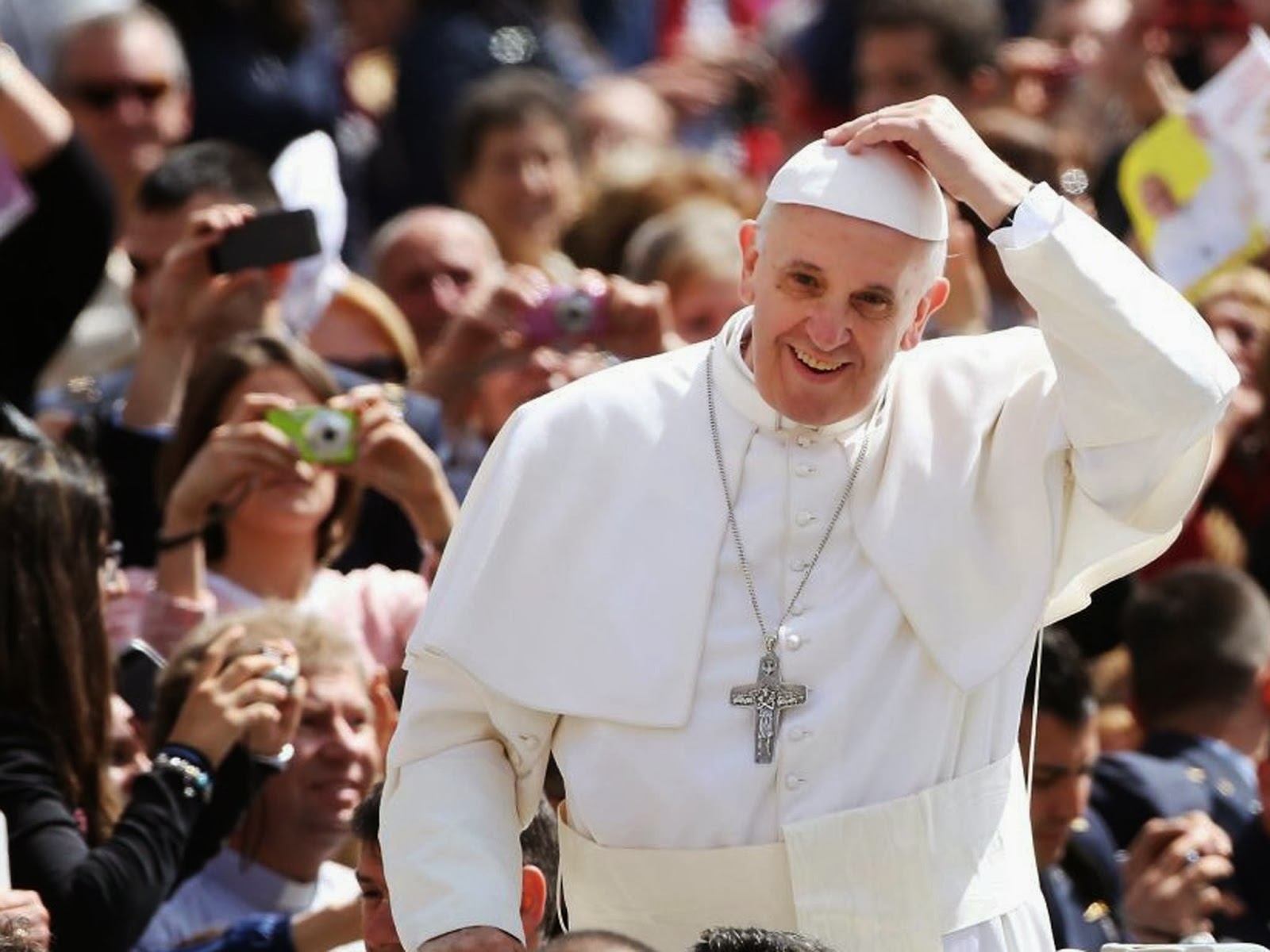
My friends in Rome tell me that Pope Francis is drawing about four times as many people to the Vatican as did both Pope Emeritus Benedict and Bl. John Paul II.  Pope Francis has certainly caught the world’s attention and whether he is being quoted correctly or not people are showing up to listen.  

My own hunch is that many of the people are ones who have not felt connected to the Church in a while.  Why?  I think that the Holy Father is witnessing a non-defensive Christianity and that people find this extremely appealing and attractive, especially younger people.  Whether through his pastoral phone-calls, his choice not to reside in the papal apartments, forswearing security measures and wading into crowds or sitting down with a prominent atheist for a newspaper interview; Pope Francis is demonstrating a Christianity secure in itself and comfortable both in its own skin and in the world.  He is authentic and authenticity attracts.   
The pope has himself said that he is a, “son of the Church”.  He has not changed doctrine.  He thinks with the mind of the Church but he also demonstrates that he is not afraid to encounter the world, he is not afraid to be creative and that he recognizes the beauty of the world and of people while also not being naïve to sin and human weakness. 
The authenticity of Pope Francis can only be born of faith, humility and contact with the poor.  When asked how he would define himself, Pope Francis responded with, “I am a sinner … a sinner upon whom the gaze of Christ has fallen.”  What beautiful words!  And words that immediately connected the pope with every other single person on the face of the earth!  We are all sinners upon whom the gaze and mercy of God has fallen.  
A telling picture I have seen of then Cardinal Bergoglio was a random photo taken of him sitting, obviously tired and weary, on either a bus or train.  The story has been told of how he would take public transportation whenever possible during his time in Argentina – demonstrating both his chosen simplicity of life and his need for being with ordinary people.  If other popes have spoken of the “school of prayer” or the “school of the family”, Pope Francis has truly learned and knows the lessons and wisdom that can only be acquired from the “school of the poor”.  Wisdom acquired from the school of the poor cannot be faked nor pretended.  It is authentic and it speaks directly to people’s hearts.  
I think that it is also of import that Pope Francis is of an older generation and living a non-defensive Christianity.  This should not be underestimated.  I think Pope Emeritus Benedict also lived a non-defensive Christianity but, honestly, too many factors and false perceptions negated against this message getting out.  I think that time and history will demonstrate this component of Pope Benedict’s papacy.  Certainly, Bl. John Paul II proclaimed the goodness of God and the world but for most young people of today their first memory of him is rooted not in the athletic hiker and skier pope but in the time of his physical decline and ill health. 
Pope Francis is the first pope of our era who was not present at the Second Vatican Council. 
I have spent my priesthood working with young people and one thing I have found that truly turns young people off and shuts their ears is when older generations speak as if theirs was the greatest generation or when older generations (because the world may be changing in ways they did not expect) act as if the world is coming to an end!  Neither perspective being true and both demonstrating an inherent narcissism.  By living a non-defensive Christianity, Pope Francis (a man in his later seventies) is doing neither and I think that young people are picking up on it.  
Might a fair question of why young adults are not present in our churches be partly because these two forms of our own narcissism leave them no room in our church pews?  Honestly, why would a young person want to go to a place where either he or she is reminded that his/her generation does not measure up or that there is no future and that everything is coming to an end?  Both are denials of the possibility of youth and are ways of telling younger generations (in subtle and not so subtle ways), “you don’t really matter”.  
Pope Francis is not saying that.  He is saying quite the opposite.  He is saying, “You do matter.”  By living a non-defensive Christianity, Pope Francis is demonstrating a Christianity of hope and a faith that is certainly aware of the beauty and gift of the past but also open to the possibility of the future and he is demonstrating a profound recognition of the dignity and gift of all generations.  
People are showing up to listen for a reason.                   

Jesus, the ten lepers and gratitude

Conversion begins with a cry out to God, it is continued through acts of faith and it is fulfilled through gratitude.   
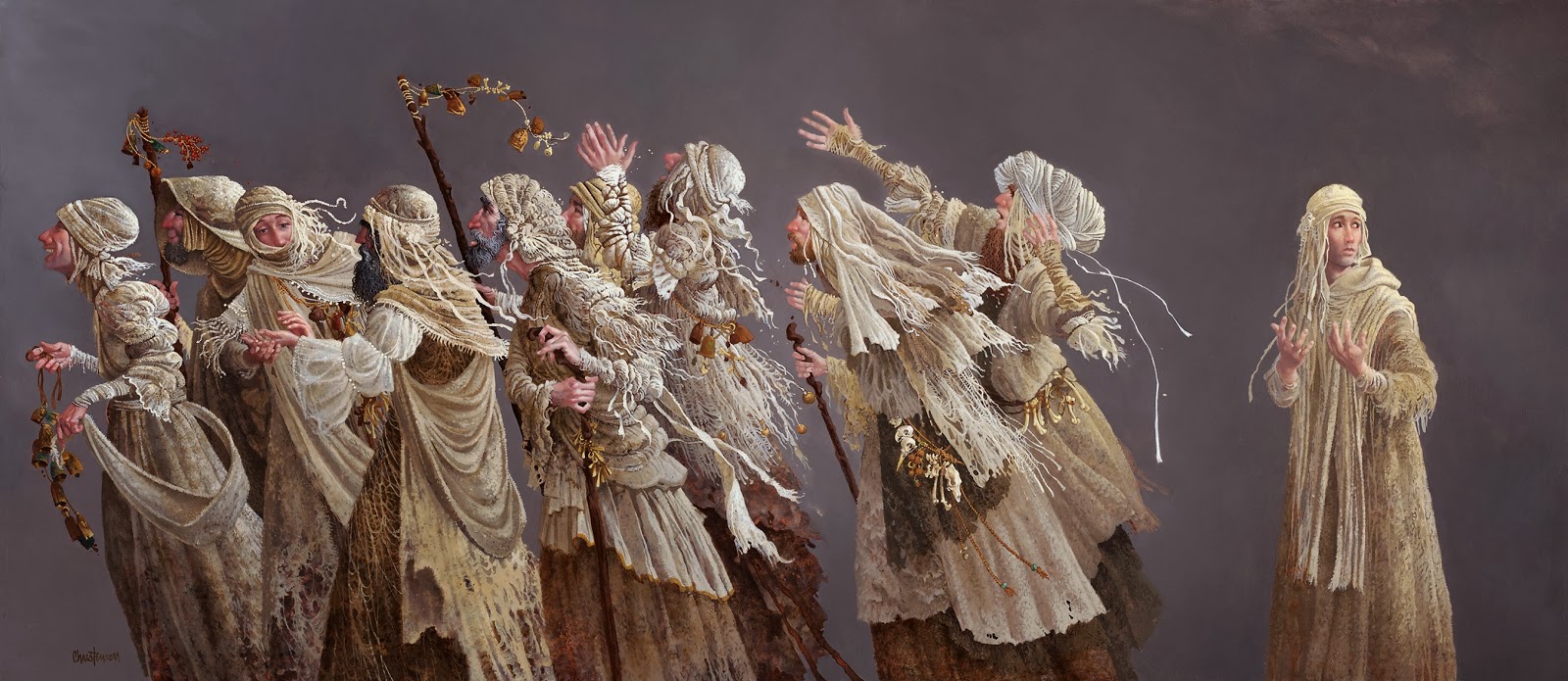
In today’s gospel (Lk. 17:11-19) Jesus is continuing his journey toward Jerusalem and he is travelling through Samaria and Galilee.  As he begins to enter a village he is met by a group of lepers – a common reality of the day, lepers scratching out an existence on the margins of society, the edges of towns.  The lepers do not approach Jesus but they know their need, so they cry out Jesus, Master!  Have pity on us!  In one form or another, each one of us can and should make this prayer our own.  Conversion begins with the honest acknowledgement of our need before God and also the trust that our God does indeed care about us and our needs.  The lepers remain at a distance but Jesus does not.  He goes to the lepers.  God is big enough and great enough to come to us in our need, our pain and our isolation but God is also big enough and great enough to not want us to remain there.  
Go, show yourselves to the priests, says Jesus.  Jesus does not heal them there on the spot as he has done in other circumstances rather he asks that they make an act of faith in going to present themselves to the priests.  It is important to cry out to God but we also have to believe, we have to trust that God is caring and merciful and we have to show forth this belief.  If we want to know the truth of a person we should not just listen to what he or she says; we should more importantly watch what he or she does.  Our actions reveal what we believe.  A person of faith is authentically known by the way he or she lives.   
As they were going they were cleansed.  So often we look for lightning bolts, flaming bushes or the rending of the heavens when it comes to things of faith.  We forget that the life of faith is a journey … a daily journey.  It is as we go along in the journey; it is as we make those daily choices that we are healed and converted from that which has held us bound.  God does not need Hollywood special effects to accomplish his purposes.  God’s greatness is found in the subtle, simple ways in which his will is made known and accomplished. God’s will is active all around us; we just need to gain the eyes to see it. 
Maybe this is what happened to the other nine lepers (the ones who did not return)?  Expecting a lightning bolt moment and apparently not getting one they wrote Jesus off and easily attributed their healing to some other cause.  I think this happens quite often.  God’s glory is continually revealed in our midst and yet we fail to notice because it does not fit “our understanding” of how God should act.  Maybe we should let go of “our understanding” of how God needs to act and should learn how to focus on how God, himself, chooses to act.  I think that the latter is the better option. 
One leper does return.  He was a Samaritan.  He glorifies God and throws himself at the feet of Jesus in gratitude.  Where are the other nine, asks Jesus (maybe with a slight chuckle as he is fully aware of our tendency to not see when we choose not to)?  To the one who returned, he says, Stand up and go; your faith has saved you.  “Stand up…,” these two words are truly important.  In sin, we curve in on ourselves, we become hunched over spiritually and we can no longer stand erect in the full dignity in which we are made.  We might look the picture of perfect health on the outside, but (in sin) within we are hunched over and little.  By returning in gratitude this healed leper is not only healed without but also (and more importantly) within … your faith has saved you.  Gratitude fulfills conversion.  God loves us enough to not force his healing upon us.  Gratitude is our opening the door to Christ. 
Conversion begins with a cry out to God, it is continued through acts of faith and it is fulfilled through gratitude. 

The Our Father and Snapchat

However it might be used or misused; the creators of snapchat know two things very well: images are powerful and friendship is powerful.  The popularity of Snapchat (the smartphone app where people take and send pictures to friends that last just a few seconds) and other similar apps is based on these two foundational principles.   

Images are powerful; ask any person involved in the industries of advertising and promotion.  We are affected by what we see and the influence of images remains with us long after the image itself is gone.  This is where we must not be naïve and be honest about the human condition.  What we see affects us.  We are not cameras.  A camera can look on an image of beauty or of desolation, an image that either lifts up the human spirit or degrades it and not be affected.  A camera is a machine.  So often we approach images with the mistaken notion that we are like cameras – we can look on anything and not really be affected.  This is not true.  We are human beings and not machines.  The dynamic of perception works differently within us.  When we look on something, it no longer remains without, we receive it within through the act of perception and when within, it either builds us up or diminishes us.  There is a power to images that should not be underestimated. 
The “stuff” of snapchat is images that people send one to another and the impact of these images are even more persuasive, I believe, because they last just a few seconds.  When you receive a “snap” (a picture) you know this; so for those few seconds you focus all your attention and concentration on that little screen.  I, at least, know that I do.  Literally, in a manner of seconds, I have received that image into my memory which is the core component of who I am. 
Snapchat also knows the power and influence of friendship.  Friends send one another these pictures and texts.  Friends catch the reference, the joke and the meaning being conveyed by the picture.  Sending a snap is an act of friendship, maybe a simple and often silly act but an act of friendship nonetheless.  Acts of friendship build people up and reinforce bonds.  One of my favorite “snap chat buddies” is Sophie.  Sophie is six years old, she is the daughter of some dear friends and I have known her since the day she was born and I baptized her.  When I receive a snap from Sophie’s mom it is usually a picture of Sophie with coloring on it or a picture of her doing what six year olds do.  The last snap was actually a video of Sophie singing why she loves ice cream.  I love every snap I get, they bring me joy and they strengthen my friendship with Sophie and her family.  Acts of friendship are truly important in our lives. 
On Wednesday of this past week we had in the weekday Mass readings the passage of our Lord giving his great prayer, the Our Father, to the disciples (Lk. 11:1-4).  As I reflected on this reading I realized that the Our Father can be likened to a snap chat from Jesus. 
It is an act of friendship.  The disciples approach Jesus with their request.  Lord, teach us to pray just as John taught his disciples.  The very tenor of the request shows that it had been weighing on their minds for a while and, as a group, they decided to approach Jesus.  Jesus responds and in giving the Our Father he is not just giving his disciples (both then and today) a bunch of words but rather inviting them into a living friendship with him and the Father.  The Our Father is an invitation to live in friendship with God.  Now, we can call God “Father” and we can know that we are never alone and that we are never abandoned.  God is here with us and for us.  The prayer is founded upon and immersed in the language of friendship and relationship!  
Also, the Our Father is more an image given us than a series of words strung together.  It has been said that when we pray the prayer of another person we enter into the very way that person sees the world.  When we pray the Prayer of St. Francis (“Lord, make me an instrument of your peace…) we are seeing the world as St. Francis sees it.  When we pray a prayer written by St. Teresa of Avila we are seeing as St. Teresa sees the world.  When we pray the Our Father … we are entering into the very understanding of Jesus and we are seeing the world as he sees the world!  This is truly amazing and powerful!  When we pray the Our Father we bring within ourselves, if even for just the fraction of a moment, the mind of Christ.  Whenever disciples ask, Lord, teach us to pray… they are in essence asking, “Lord, teach us to see as you see.”  
There is one important way though that the Our Father is not similar to snap chat.  In snapchat, the image disappears.  This is part of the appeal, I believe, of the app.  The Our Father, on the other hand, does not disappear.  Whenever we honestly pray this prayer given us by our Lord we bring it within our very selves and there is remains overtime helping to bind what needs to be bound and loose what needs to be loosed and set free!  The Our Father does not disappear. 
As disciples, we also approach our Lord and ask that he teach us how to pray.  We need to continually learn the Our Father, we need to pray it and we need to live it!  They are words given in friendship by our Lord and they are words that bring us into the very way he sees the world.         

"The poor are the priveleged masters of our knowledge of God…": 25th Sunday in Ordinary Time (C)

“The poor are privileged masters of our knowledge of God; their fragility and their simplicity expose our selfishness, our false certainties, our claims of self-sufficiency and guide us to the experience of the closeness and tenderness of God, to receive his love in our life, his mercy of Father who takes care of us, all of us, with discretion and patient trust.”  (Pope Francis) 

It is an intriguing parable that our Lord gives us this Sunday (Lk. 16:1-13).  This dishonest steward is clearly not a child of the Kingdom in his actions but rather a “child of this world” as our Lord indicates.  Our Lord is not holding him up as a role model but rather highlighting his shrewdness as a way of prodding us to reflect on our own salvation.  Are we just as shrewd, are we just as determined about living our discipleship, living in hopes of the Kingdom of God as this steward is about securing a place to land after his fast approaching termination of employment?  The steward knew what was coming so he devoted all of capabilities and all of his faculties to make sure he did not end up either digging ditches or begging! 

Let’s be honest.  How often do we just coast along when it comes to the matters of faith?  It’s enough to go to Church once a week.  It’s enough to say a prayer every now and then.  It’s enough to give a little something to charity.  It’s enough to be a nice person.  “It’s enough…” – the professed creed of a minimal approach to faith!  “I believe” gives way to “It’s enough…” – a common profession in our day.  Christ will not settle for “It’s enough…”  Christ wants belief because only in belief is life and the Kingdom found!  Christ wants us to have “true wealth”!  Not necessarily silver and gold and the good things that this world affords but the true wealth that endures – relationship with God himself and the joy and salvation which can only come from that!   

How might we gain this “true wealth”?  Where might we find it?  The parable points the way.  The steward went to the debtors and dealt generously with them.  He had them cut the amount that they owed the master.  Debtors are those “in debt”.  They owe.  They stand in need.  Generosity toward “debtors” is generosity toward the poor and the needy.  They are the ones who cannot pay and the ones who stand in need.  Generosity toward debtors saves our lives and our future – individually and collectively.    

But someone might say, “It was the master’s wealth to begin with!  The steward never had a claim on it.  How can we give generously of that which we do not ourselves own?”  What one thing do we have that has not been given us by God?  Did we give ourselves life?  Did we give ourselves creation, air to breathe, water to drink?  Did we give ourselves the intelligence to acquire knowledge and gain skill?  Did we give ourselves the lives of our loved ones and our friends that we hold dear?  Can we determine even the length of our own days?  All is gift!  We never had nor ever will have an honest claim on it!  We are all debtors and God’s gratuitousness exceeds all of our limits!  We can give of the master’s wealth because God is generous. 

“The poor are privileged masters of our knowledge of God; their fragility and their simplicity expose our selfishness, our false certainties, our claims of self-sufficiency and guide us to the experience of the closeness and tenderness of God, to receive his love in our life, his mercy of Father who takes care of us, all of us, with discretion and patient trust.”  

Being a Christian is not about being a hero.  Christ was not a superhero nor were the original apostles and disciples nor any of the saints.  God has no need for superheroes.  Being a Christian means learning the honest truth that it is indeed more blessed to give than to receive.  What does this mean?  It means that when we honestly encounter the poor we are “blessed” by coming face-to-face with the truth of who we are and who God is.  We are blessed when the illusion of our selfishness, false certainties and self-sufficiency is held up to the light of reality. 

“The poor are the privileged masters of our knowledge of God…”   

Hating for Jesus: Twenty-Third Sunday in Ordinary Time (C)

Courtroom scene from “Amistad”
The film “Amistad” is based on the true story of a Spanish slave ship that ends up washing ashore in New England after the slaves kidnapped from Africa were able to mutiny and take control of the ship.  The United States of America had just been established as a country and therefore was quite weak on the international scene.  The plight of these slaves becomes a political hot potato and a legal battle as the current presidential administration would like to send them back to Spain and not rock the boat with the Spanish monarchy while others are fighting for their freedom.  “Are these men free and if not, who do they belong to?” becomes the primary question. 
To help ensure that it gets its way the president’s administration sees to it that a young, up-and-coming judge is assigned to the case.  The president’s man on the case makes it known to the judge (who happens to be a Catholic) that if he finds in favor of Spain and in support of the Administration then his career is set.  For a young judge and a Catholic in Protestant New England this is his ticket!  The case begins and as things progress you begin to notice that the conscience of the young judge is prodding him to the point where you see him enter a church the night before the final judgment is to be given in the case.  He walks in, blesses himself with holy water and goes to knell in prayer before a crucifix.  The next day, to a packed courtroom, the judge finds in favor of the slaves, thus ensuring their freedom and return to Africa.  The president’s man stares at the judge and walks out of the courtroom.  By siding with the slaves the judge knows he had destroyed his career and all his aspirations but he knows it was the right thing to do.  
It is a serious thing to follow Christ and it should not be entered into lightly because to follow Christ means to go where he has gone and it means to embrace the cross just as he embraced it.  This is why our Lord in today’s gospel (Lk. 14:25-33) gives us the image of the builder and the king contemplating battle.  Both men had to truly consider and calculate out what they were contemplating.  It is a serious thing to follow Christ. 
In many ways to follow Christ means to break with how one has lived in the past, how one has lived relationships and how one has gone about all facets of one’s life.  This is why our Lord gives us these very powerful and stark words of “hating” ones mother and father, brother and sister in order to truly follow him.  The power of the word means that everything, every part of one’s life must be re-oriented by and toward one’s relationship with Christ.  Nothing can be left out or hidden away.  But to follow Christ never leads to anything but more life and more love.  As one turns to Christ in his or her life, one is able to love family, neighbor and even the stranger in a deeper and more authentic way.  
The judge giving his verdict
The judge in the story of Amistad witnesses this graced dynamic of truly following Christ.  Just as he comes to “hate” what others have promised him – the success and the power, even probably everything he had worked for and aspired to up until that moment – he is able to know an authentic joy in doing that which was the right thing to do.  He gained a joy that no one could ever take away and he gained new brothers and sisters in the freed African slaves!  
Paul in his letter (Philemon 1:9-10, 12-17) is calling Philemon to the same graced dynamic on behalf of the newly baptized, runaway slave Onesimus.  According to the law of the time Philemon was perfectly in his rights to have Onesimus killed but Paul is saying that now through Christ things are different and he is inviting Philemon to “hate” the old ways of retribution and violence and now recognize how everything must be oriented toward Christ and turned toward Christ in his life.  Perhaps this is why he was away from you for a while, that you might have him back forever, no longer as a slave but more than a slave, a brother, beloved especially to me, but even more so to you, as a man and in the Lord.  So if you regard me as a partner, welcome him as you would me. 
It is a truly serious thing to follow Christ.  In fact, it is the most serious thing one can ever do.  All things which separate us from Christ must be “hated” so true life in all of its depth and breadth might be found and known.