Being Mystics: 11th Sunday in Ordinary Time (B)

Christian Mystics by Florian
Karl Rahner is credited with stating that today when it comes to Christianity one is either a mystic or a nonbeliever.  Gone are the days when one could coast through on being a christian by living in a culture that was, at least, christian in name.  Today our society is more agnostic, more secular, more pluralistic and much more distracting.  This is just the way it is – for good and for woe.  One can no longer get by as a christian by running on the fumes of others.  Our culture and even our communities and families no longer carry the faith for us.  If we are to be christian then we must carry the faith on our own.  In other words, we must be willing to be mystics. 

Rahner’s observation then raises the question, “How might we learn to be mystics?  How might we truly grasp and live the christian faith in our particular day and time?”  I would suggest that both our faith tradition and this Sunday’s readings give us three points of consideration. 

The first point in Christian Mysticism 101 is to learn how to ponder in the Scriptural and Hebraic sense of the term.  In our western pragmatic mindset we tend to equate pondering with figuring out and solving.  The Scriptural understanding is more nuanced though.  In Hebrew thought to ponder does not mean to figure out but to be able to hold the tensions of life together and to remain within that tension in hope and in obedience.  The primary witness of this ability to ponder on the mysteries of life and faith is Mary.  Mary pondered at the words of the archangel Gabriel.  When Mary, Joseph and the twelve year old Jesus were returning from their visit to Jerusalem we are told that Mary held all that had occurred and been spoken in her heart.  Mary remained at the foot of the cross in the midst of pain and hurt.  She held that tension in her heart.

In today’s gospel (Mk. 4:26-34) we hear our Lord say to the crowd, “This is how it is with the kingdom of God; it is as if a man were to scatter seed on the land and would sleep and rise night and day and through it all the seed would sprout and grow, he knows not how.  Of its own accord the land yields fruit, first the blade, then the ear, then the full grain in the ear.  And when the grain is ripe, he wields the sickle at once, for the harvest has come.”

There is a mystery to life and to faith that is beyond our reckoning and our ability.  This is not a lazy excuse on our part.  We certainly have a part to play but the primary role is God’s.  The mystic learns to watch in awe at God’s unfolding work.  God is building his kingdom and despite any sign to the contrary it will be achieved.  Holding the tensions of life opens our eyes to glimpse this and it also makes of us better people.    

The second lesson in christian mysticism is found in the image of the mustard seed.  Again, in today’s gospel we hear our Lord say, “To what shall we compare the kingdom of God, or what parable can we use for it?  It is like a mustard seed that, when it is sown in the ground, is the smallest of all the seeds of the earth.  But once it is sown, it springs up and becomes the largest of plants and puts forth large branches, so that the birds of the sky can dwell in its shade.”

In his second volume on Jesus of Nazareth, Pope Benedict uses the image of the mustard seed to epitomize the resurrection.  This might seem counter-intuitive to us but the Holy Father is making a wise observation.  The resurrection of Christ is the smallest mustard seed of history precisely because it is the most improbable of occurrences in history.  Who rises from the dead?  Throughout history who has ever heard of such a thing or thought such a thing even possible?  Yet all creation and all time is being sanctified through this most improbable of occurrences, this smallest of mustard seeds.  “But once it is sown, it springs up and becomes the largest of plants and puts forth large branches…” 

Once again, the christian mystic learns to trust that God is at work even in the smallest of moments, occurrences and encounters.  The mystic learns that there really is no such thing as coincidence.  Rather all is providence.

The third lesson is to trust and believe in a personal God.  This might seem commonsense when we consider Christianity but it may not be as common nor as sensible in many peoples eyes (ourselves included) as we often suppose.  Why?  Because a personal God will make personal demands upon me.  Even as we might profess Christianity we are quite inventive about keeping the Christian faith a bit removed as just a moral code or social justice doctrine or good principles to aspire to.  We are also quite adept at keeping Jesus locked in as just another teacher or guru from the past.  The mystic is far from comfortable with this comfortable approach to faith and discipleship.  Because of this he or she will often feel alone and out of step with the world and even others who may profess Christianity.  The mystic knows of what is written in today’s second reading (2 Cor. 5:6-10) because he or she is seeking by God’s grace to live it. 

“Brothers and sisters: We are always courageous, although we know that while we are at home in the body we are away from the Lord, for we walk by faith, not by sight.  Yet we are courageous, and we would rather leave the body and go home to the Lord.  Therefore, we aspire to please him whether we are at home or away.  For we must all appear before the judgment seat of Christ, so that each may receive recompense, according to what he did in the body, whether good or ill.” 

The depth and challenge of this aspiration to please God can only come about and be achieved through a relationship with a personal God.  God as a nice theory or life philosophy does not cut it.  God encounters us (and often in the most surprising of places and situations).  The mystic comes to recognize this. 

It is no longer enough to just coast in the Christian faith.  One might try but when the bitter winds of pain, remorse, sin and even evil are encountered such a one will be lost.  The stopgaps are gone.  Again, for better or for woe, there are no longer the social structures to blunt the wind. 

Today, to be a christian means to be a mystic and to ground ourselves within a community of mystics.             
Transcending politics

Christ the King

I love how the Catholic Church transcends the stale dichotomies of partisan politics. 

The first article is on the U.S. Bishops’ endorsement of President Obama’s recent action regarding the Dream Act. The second article is on the Catholic Health Association’s rejection of the HHS mandate compromise. Both the statement from the U.S. Bishops Conference and the Catholic Health Association were issued on the same day. 

http://www.usccb.org/news/2012/12-110.cfm

http://www.cbsnews.com/8301-201_162-57454529/catholic-hospitals-reject-compromise-on-birth-control-insurance-coverage/

The Vatican/LCWR dialogue: The Church reflecting on itself

Members of the leadership of the LCWR

Today as I was driving around town running errands I found myself listening to the Diane Rehm Show on NPR.  The topic was the Vatican and LCWR dialogue that is occurring and garnering much media attention.  I found the discussion and insights of the different guests on the show to be very insightful as they moved beyond a superficial understanding of the issue.  It was a good “give and take”.  Each guest certainly had his or her own particular perspective on the issue but they were willing to acknowledge the valid points of the other guests and did not succumb to the very common temptation of denigrating and belittling the other person and his or her position.  Because of this it was quite refreshing.  (It is always nice to hear mature people discussing an issue.) 

One of the statements that struck me and that I think also allowed for this balanced and respectful approach toward a very complicated issue was when one commentator stated that in regards to Church issues we need to avoid the temptation of thinking in exclusive political terms which tend to divide and separate.  He went on to remind all who were listening that the Church itself does not think in such terms. 

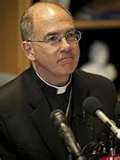
Archbishop Peter Sartain

The Vatican/LCWR dialogue is not about men vs. women nor liberal vs. conservative.  It is a disservice to reduce what is occurring to those stale dichotomies.  This tendency to do so also demonstrates a lack of understanding about the reality of church.  Life and Church are both more than politics.  Sometimes how we view things says more about our own perspectives and biases than it does about the reality of the situation itself.  Maybe people can only see this exchange in political terms not because that is actually what is occurring but because that is how they have chosen to structure (and limit) their own view of reality.   

I would say that this dialogue is about the Church reflecting on what it means to be authentically Church.  In the Catholic Church the Magisterium has a specific role and raising doctrinal concerns is within that role.  In the Catholic Church the Leadership Conference of Women Religious also has a role and purpose as a canonically recognized entity.  But it must be noted that this role and purpose does not put it beyond what it means to be Church in the Catholic sense.  This is what is at issue and from what I have read of the ongoing discussion I believe that both sides are sincere in their desire to authentically dialogue and be brought to greater understanding.

Maybe I am demonstrating my own naive bias here but I believe that the Spirit is at work in this and I think one of the by-products of this discussion between the Vatican and the LCWR could very well be a witness being given to a very polarized and divided society that dialogue and respect is possible.  Mature people can talk to one another while holding to their core convictions and through this exchange be brought to a greater understanding by the movement of the Holy Spirit.  This is what it means to be Church.

Let the secular media and society (very much formed in and fond of the political worldview) keep watching this.  What they witness might very well come to surprise them.             

An actually good graduation commencement speech

In my ministry I have been a chaplain to a high school and now a chaplain at a university Newman Center, so I have attended more graduation commencements than I care to remember.  Usually I have already forgotten the commencement speech five minutes after it has been given.  This speech is different.  I can honestly say that I would place this speech on the very, very short list of commencement speeches that I enjoyed, agreed with and will actually remember anything from.

Thank you Mr. McCullough for your words!

Congratulations graduates!  Remember to “climb the mountain not so the world can gaze on you but so you can enjoy the view!” 


Two Pictures for the Feast of the Most Holy Body and Blood of Christ

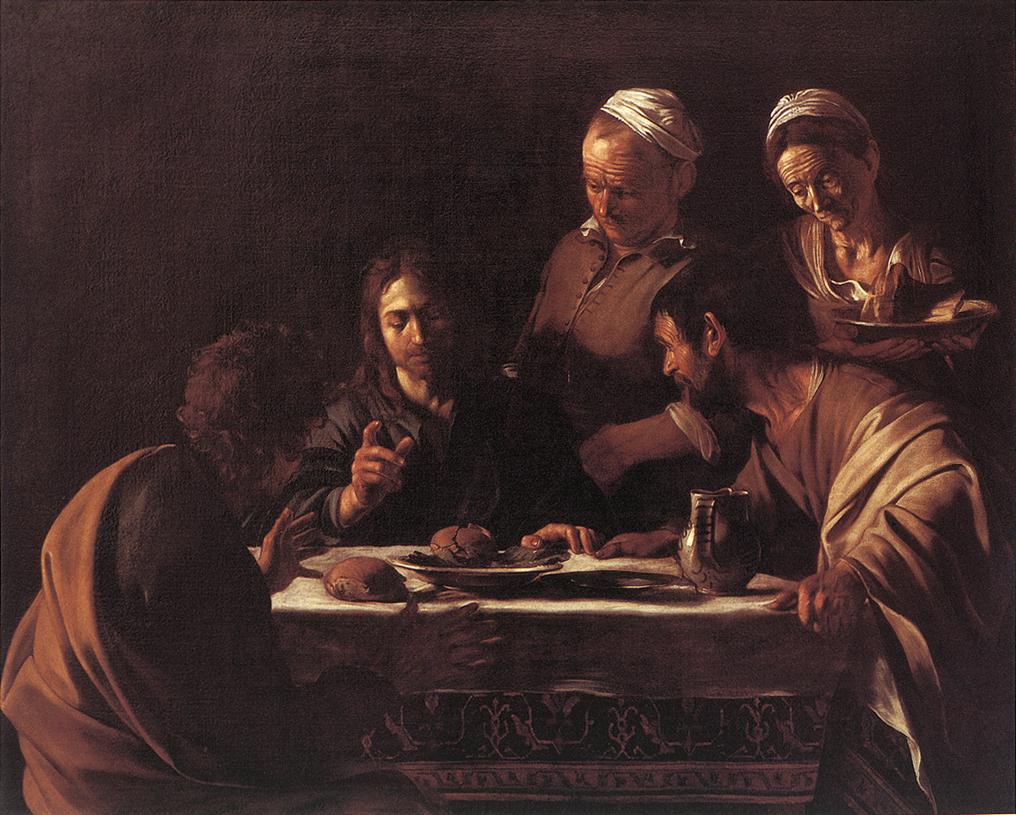
For this Feast of the Most Holy Body and Blood of Christ I have found myself meditating on two images.  One is Caravaggio’s painting, Road to Emmaus, and the second is a black and white photograph of a Mass being conducted in the underground Catholic Church in China.

“Road to Emmaus” by Caravaggio

In the Caravaggio painting Christ is seated at table with the two disciples while an innkeeper and wife (I suppose) look on.  Outside of the figures and the table scene the rest of the image is black and in shadows.  A light shines from the left illuminating the scene.  Half of Christ’s face is in shadow.  The Lord’s right hand is raised in a symbol of blessing over the bread and his eyes are downcast.  One disciples grips the table as if stunned and the other disciple (whose back is turned toward us) raises his hands in shocked amazement.  Caravaggio has captured the moment of recognition when the risen Lord reveals himself to the two disciples in the breaking of the bread!

Outside of this the innkeeper and his wife look on as if there is nothing out of the ordinary and this I find fascinating.  Here is the risen Lord revealing himself in the breaking of the bread to the two disciples yet without the eyes of faith to recognize what is transpiring it seems that there is nothing extraordinary occurring.  In fact, it is the most ordinary of scenes.

Why did the risen Lord choose something so ordinary, so mundane in order to communicate and give himself to us?  In the first reading for this feast (Ex. 24:3-8) we have the scene of Moses erecting an altar and holocausts being offered and the blood of bulls being sprinkled.  This is far from ordinary!  In the second reading (Hebrews 9:11-15) we have a reflection on Christ as the High Priest who reconciles us to God and one another through his own blood.  Again, far from ordinary.  In the gospel (Mark 14:12-16, 22-26) we have the scene of the Last Supper – Jesus blessing and giving the bread and giving the cup while saying, “This is my body … This is my blood …”  Apart from those most important of words the scene itself is very ordinary (a teacher and his disciples sharing a meal).

The gift of faith makes all the difference.  Without faith it just seems so ordinary, not even really being worthy of notice.  With faith our hands grip the table in stunned amazement!  In this most ordinary of scenes the risen Lord is present and God bestows his very life upon us!

The second image is also surrounded by shadow and darkness.  Again the eyes of the faithful are turned toward a set point.  Again, in many ways, the scene is very ordinary.  It is a house in China.  The people are attired in clothes that we are familiar with.  Yet, from the road to Emmaus it is now two thousand years later and on the other side of the world.  The Mass is being offered in the persecuted and underground Catholic Church in China.  The priest elevates the host.  His face is hidden behind his arms.  Again Christ reveals himself in the breaking of the bread!

Once more the eyes of faith are what determine our understanding.  Without faith all we can see is a photo of some obscure and, according to some people, even suspect ritual.  With faith, we find ourselves with the two disciples in Emmaus and with the original twelve in the upper room and we hear those words, “This is my body … This is my blood …”

Christ has chosen to reveal and give of himself in the ordinary occurrence of bread and wine.  Without faith it is seems to be nothing of much value; with faith it is recognized as the very Body and Blood of Christ – the answer given to the deepest hunger, thirst and yearning of the human heart.                

Feast of the Most Holy Trinity: Pentecost and Church revisited

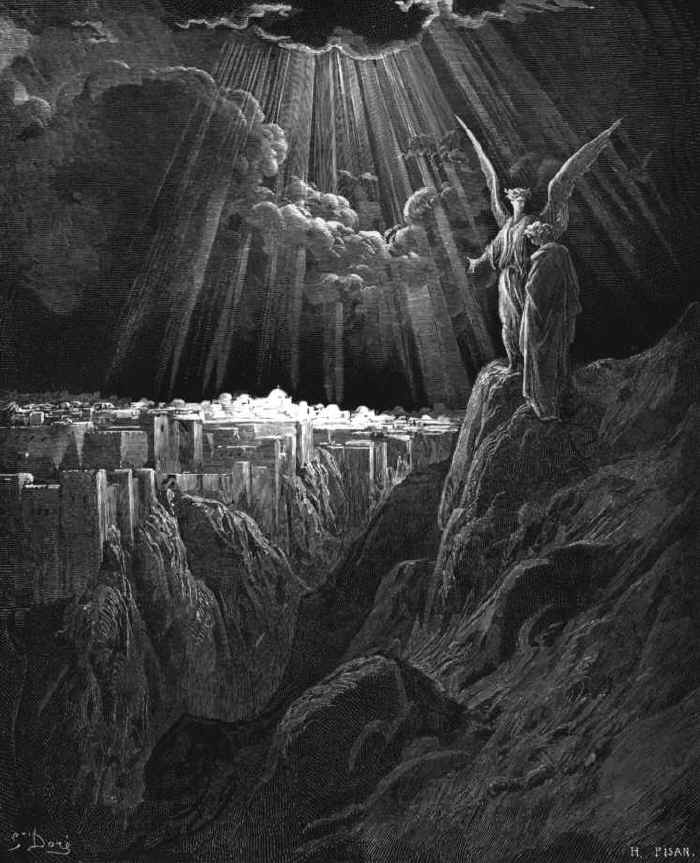
“The New Jerusalem” by Gustave Dore
On this Feast of the Most Holy Trinity I am reminded of a principle that I learned during my studies in seminary.  The principle is that the term “mystery” in the Christian sense does not mean a puzzle to be figured out nor a problem to be solved but rather a reality to be lived and it is in the living that we are brought to a greater and more sublime understanding. 
The Trinity is indeed the greatest of all mysteries.  A mystery that we could never arrive at on our own.  It is impossible for us to grasp.  The Trinity is a mystery that could only be unveiled by God himself.  It is the mystery that God is a communion of persons united in an eternal exchange of love.  It is only through the Spirit of adoption that we are brought to this truth. 
How, then, is this mystery to be lived?  Is it found in fleeing the world; in esoteric and ascetic experience and elevated philosophical thought?  There are some branches of Christian spirituality that promote this view and there certainly is a valid path to be found there but I think there is a much more concrete way laid out for us.  It is a way rooted in the incarnation.  Nikos Kazantzakis puts it this way; “Wherever you find husband and wife, that’s where you find God; wherever children and petty cares and cooking and arguments and reconciliation are, that is where God is too.” 
Scripture tells us that God is love and whoever abides in love abides in God.  For love to be authentic it must be concrete.  It must be lived.  It does no one any good for one to say, “I love you.” but then not live according to that love which primarily means sacrificing for the good of the other.  Ronald Rolheiser in his book The Holy Longing writes that the love which is the Trinity, which is God “is not ‘falling in love,’ but (rather) family, shared existence.”  Anyone can “fall in love” (it happens all the time) but it is only the mature person who can live shared existence and, paradoxically, it is living shared existence which matures us.
Here, I want to emphasize that yes, “family” refers to biological family but it even more so refers to the spiritual family of the Church into which we are born through our baptisms.  Paul writes in his letter to the Romans, The Spirit himself bears witness with our spirit that we are children of God, and if children, then heirs, heirs of God and joint heirs with Christ, if only we suffer with him so that we may also be glorified with him.  To try to achieve an authentic Christian life without the shared existence which is church is a cheap grace that only leads to shallow belief.
Church is not a gathering of like-minded individuals nor a philosophical debate club nor a place where “everyone gets along” nor a wing of any particular political party.  Church is the disparity of peoples, nations, dispositions and temperaments, economic class and languages that are gathered into unity by the Holy Spirit.  What unites us most fundamentally is the Lord in our midst and our being gathered by the Spirit.  This is “catholic” in the truest sense and it is most often and immediately witnessed in that gathering with people that in all honesty we would probably not associate with were it not for our worship in the Sunday Mass.
Yes, the Church is flawed (as is every other institution or government known to humankind) but Christ loves the Church so much so that he has poured out his Spirit upon her.  To reject the Church is to reject that which Christ himself loves.  As he sent those first eleven disciples into the world to baptize in the name of the Trinity our risen Lord said, I am with you always, until the end of the age.  Do we hold this to be true?
It is not from the ground up that the Church is established and grows.  The Church is not the creation of our own effort.  Again, if this were so, Church would be at best just a gathering of like-minded people or a people formed through a common mission or goal.  Rather, the Church comes from on high, from heaven. The Church is born from the community of the Trinity which is God.  In the second verse of the twenty-first chapter of the Book of Revelation we are given this vision, And I saw the holy city, new Jerusalem, coming down out of heaven, from God, prepared as a bride adorned for her husband…  Why does the holy city come down out of heaven?  Because the Church is born from God rather than being made by us.
Church, therefore, is also mystery and it also is only understood when it is lived.  Church is the family, the graced shared existence that leads us into the very mystery of God.  God is love and therefore to know God means to love authentically – not just in word but in deed.
So, if we want to know what it means when we say that God is a trinity of persons and if we want to even experience that deepest of realities in our own lives then the best place to start is in loving one another and in embracing the mystery which is Church.                    

Being a St. Augustine nerd and discernment

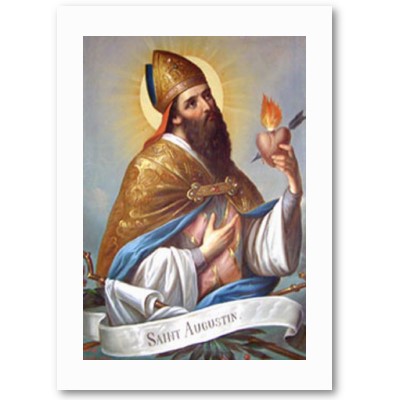
There are Star War nerds, Star Trek nerds, Hello Kitty nerds and Lord of the Rings nerds … just to name a few.  Part of the dynamic of the “nerd” is to keep returning to the source of fascination – watching the movie or reading the book for the one hundredth time.  With this stipulation, I have come to realize that I am a St. Augustine nerd.  Anything I come across by the Bishop of Hippo I latch onto even if I have already encountered it a number of times before.  Today’s excerpt from Augustine’s Confessions found in the Office of Readings is a prime example.  This is a very familiar section to me but yet, once again, it spoke in a new way and I found myself being led by the saint’s thoughts into a new insight.

The part that most struck me was the first paragraph quoted.

Lord, you know me.  Let me know you.  Let me come to know you even as I am known.  You are the strength of my soul; enter it and make it a place suitable for your dwelling, a possession without spot or blemish.  This is my hope and the reason I speak.  In this hope I rejoice, when I rejoice rightly.  As for the other things of this life, the less they deserve tears, the more likely will they be lamented; and the more they deserve tears, the less likely will men sorrow for them.  For behold, you have loved the truth, because the one who does what is true enters into the light.  I wish to do this truth before you alone by praising you, and before a multitude of witnesses by writing of you.

First off, Augustine’s audaciousness strikes me.  Lord … Let me know you.  This is God that Augustine is addressing before whom we are each just a speck of dust yet Augustine is confident to make this request.  Augustine can do this because he has come to realize that God indeed wants to be known by us.  God wants relationship with us.  In fact, all of salvation history can be read as God seeking relationship with us.  An effort, on God’s part, that culminates and is fulfilled in the incarnation and resurrection of Jesus Christ.

Second, Augustine realizes that for us to begin to know God we need to first open ourselves to him; allowing him to make of us a pleasing dwelling place by his purifying presence.  Augustine is not shy about confessing his own sinfulness and he is wise enough to recognize that God cannot dwell together with sin and evil.  We cannot hold onto our sins and expect God to not notice nor care.  The presence of God demands conversion – both big and small – on our part.  I believe that one of the most besetting sins of our age is a fundamental ingratitude in the heart that flies into a huff when anyone (including God) dares to challenge it to move beyond its self-absorption and narcissism.  This ingratitude is witnessed to in the thought that God had better accomodate himself to my sins rather than myself being challenged and converted. 

I would venture to say that Augustine would have no place for those with an ungrateful heart.  In other words, I think that the saint would be someone who would find it hard to suffer fools.  This awareness on Augustine’s part of the needed purifying presence of God in life brings insight and allows him to judge rightly the tenor of the times where what does not deserve tears is lamented and where what does deserve tears is barely noticed let alone sorrowed after.  Allowing God’s presence to make of us a pleasing dwelling does not just remain within as a comforting sentiment, a warm fuzzy inside.  The more that God comes to dwell within the more one is able to both discern the world and see correctly while also discerning oneself and ones own place in the world.

This is where my own Vocation Director ears listen in attentively to Augustine’s development of thought.  When we in all humility allow God to come within us and “know” us; we learn who we ourselves are meant to be.  We start to realize our vocation in life.  When we do not allow God within then we will never break beyond the surface of any true self-knowledge.  No matter how many seminars we go to or self-help books we read or hours in therapy we attend or “stuff” we acquire.

When we allow God within we discover who we ourselves are.

For behold, you have loved the truth, because the one who does what is true enters into the light.                 

Pentecost: Think Green

Throughout the Scriptural proclamation of Pentecost (Acts 2:1-11, 1 Cor. 12:3b-7, 12-13 and John 15:26-27; 16:12-15) there is the underlying theme of restored communication – being able once again to speak to one another. 
It has been said that the coming of the Spirit on Pentecost signals the end of the division and discord which resulted from the Tower of Babel.  Where the pride of Babel led to the dividing of humanity; now all peoples and nations are united in their listening to the proclamation of the gospel resulting from the coming of Spirit upon the disciples.  When the crowd from a multitude of peoples and nations gathers at the door of the house where the apostles were we are told that they ask, Are not all these people who are speaking Galileans?  Then how does each of us hear them in his native language?  Through the Holy Spirit divisions are overcome and it is possible to once again speak to one another.
The coming of the Holy Spirit also brings healing to those divisions that occur within our very selves.  We all have these.  In some form or another we are each fragmented.  These are the wounds and effects of original sin.  St. Paul summarizes what we all experience when he says, For I do not do the good I want, but the evil I do not want is what I do. (Rom. 7:19)  It is only the healing balm of the Holy Spirit which heals this inner fragmentation allowing us to then authentically proclaim, Jesus is Lord!  This proclamation found in Paul’s first letter to the Corinthians is not just a nice catchphrase or slogan but is, in fact, a tangible witness of an authenticity achieved by a self that is being healed of the divisions within by God’s grace.  This proclamation cannot be faked.  It must be lived.
Finally, the outpouring of the Holy Spirit heals the deepest wound within; allowing us to once again hear the voice of God.  I have much more to tell you, says our Lord, but you cannot hear it now.  But when he comes, the Spirit of truth, he will guide you to all truth.  He will not speak on his own, but he will speak what he hears, and will declare to you the things that are coming. The Holy Spirit leads us into the very things of God which heal, elevate and enlighten.  The Spirit leads us beyond the crass reasoning of the secular and or our age.  Transcendence, living by something more than this world, is possible.
I have an interest in iconography.  For a number of years now I have been studying icons and even learning how to paint (write) icons.  Icons are considered visual theology (very appropriate for a visual age).  Over these years one thing that I have learned is that in Russian Orthodox thought red is not the only color that can be associated with the Holy Spirit.  (In western Christianity we primarily use red as the liturgical color of the Holy Spirit.)  In Orthodox thought green can also be seen as a color denoting the Holy Spirit.  When we consider the creed that we profess this makes sense.  In the Nicene Creed we proclaim the Holy Spirit to be the Lord, the giver of life…  Recently I was able to spend an afternoon on a short hike in the mountains and at one point I found myself right at the edge of a wooded area looking down upon a little vale of tall green grass.  It was quiet and still.  You could only hear the wind rustling the leaves of the trees.  The leaves above me were green and as the wind continued to blow I saw waves ripple through the green grass.  Green was all over and it struck me how green is the color of life.  It is so present (at least in East Tennessee) that it is easily overlooked often, I think, like the work of the Holy Spirit. 
I share this thought because I think it is helpful to add a little green to our understanding of the Holy Spirit and I think that the readings for this day with their theme of restored connection, dialogue and relationship allow for this.  Yes, the Holy Spirit is red: the Spirit purifies, inflames and convicts us in the truth.  And yes, the Holy Spirit is green: the Spirit restores, renews and both summons us and enables us to achieve an authenticity in life and in relationship.
But when he comes, the Spirit of truth, he will guide you to all truth.

Ascension Sunday: The concreteness of the Ascension

“The Ascension of Our Lord Jesus Christ” by Piotr Basin

Today, the Church celebrates one of its most concrete feasts – the ascension of Christ.  Throughout history there have been (and will continue to be, I am sure) Utopian dreams of a better world of tomorrow.  These dreams have been based on everything from the rise and triumph of the proletariat to the notion of a separated community of the enlightened to (one which is very much in vogue now) the undaunted belief in the sure progress of science.  These are the Utopian dreams that history has seen come and go.  They are often idealistic and based in a hoped for vision of tomorrow but today’s feast is different.  Where Utopian dreams are often ideological and abstract the ascension of Christ is concrete and sure. 

It is so because of the simple fact that it is not founded in some abstract principle or ideal but in the very resurrected body of Christ.  Christ is indeed risen which means he is risen body and soul, flesh and blood.  Anything less would not be fully and authentically human.  Christ ascends to the Father not just in spirit or thought but in the very concrete reality of his full humanity.  Throughout this Easter season in the Scriptures proclaimed we have heard Christ, time and time again, assuring his disciples that he is indeed present in “flesh and bone”.  This means fully present not just up to the moment of the ascension but in the ascension itself and now at the Father’s right hand.  From the day of the ascension heaven “began to populate itself with the earth, or, in the language of Revelation, a new heaven and earth began.”

In the ascension we truly realize that we are not orphans.  We are not left to the cold and cruel winds of chance, fate and odds or a history without direction.  Direction has been set.  The resurrected Christ (body and soul) sits at the Father’s right hand.  This, and nothing less, is our goal.  It is what we are meant for and what we are called to by God’s grace.

It is truly concrete and it is achieved and experienced concretely. 

In the gospel Jesus tells us that he is “the way” and the way, it turns out, is walked concretely.  The ascension is experienced again not in some abstract manner but in how we concretely treat and love the smallest and poorest brothers and sisters in our midst.  This, I have found, is a foundational understanding of the Community of Sant’Egidio which really is nothing more than discipleship 101.  When we love concretely we experience the ascension and we are brought toward the fullness of the future that God has prepared for us in Christ.

Let me share an example.  For three years now our Johnson City Community of Sant’Egidio has been taking sandwich bags every Monday to the John Sevier Center.  (The John Sevier Center is a low-income housing unit in downtown Johnson City.)  We do not go there as experts in anything.  We know we cannot solve the residents problems and struggles.  We just go and we are faithful in going and in this simple act of being present a human space is created both for the residents and for us.  We become friends.  We are brought a little bit further toward the fullness that awaits us all.  In this human space miracles happen and signs are given – demons are cast out and life is gained.  I have seen it for myself these past three years.

Christ bestows his love upon us.  We are meant to communicate it.  Love that is not communicated soon withers and dies. 

Love is lived not abstractly but concretely and it is in the concrete act that we are brought toward the fullness that awaits us all.       


"Let us love one another."

In my own prayer, reflection and preparation for the Sunday homily I often consult, “The Word of God Everyday”.  This is the daily Scripture reflection book for the Community of Sant’Egidio.  The reflections are written by Bishop Vincenzo Paglia.  Below I have copied in whole his reflection for this coming Sunday, the sixth Sunday of Easter.  I find it to be very good and thought-provoking.  I hope that you do too. 

 “Let us love one another.” This is the imperative that the apostle John never tires from addressing to his community. He knows how important love is in the life of all disciples, because he learned it directly from Jesus and had a concrete experience of his love. He was able to taste Jesus’ sweetness, to see how radical and abundant his love was, as he even loved his enemies, even to the point of giving his own life as a gift. John was a privileged witness of this love, an attentive custodian and a caring preacher. In his first letter, he wants to unveil the nature of Jesus’ love and reveal its source: “Let us love one another, because love is from God; everyone who loves is born of God and knows God” (1 Jn 4:7). The apostle speaks here of a love different from the one we normally understand. For us, love is a complex of sentiments that arises spontaneously from the heart, composed of attraction, kindness, desire, passion, self-gratification and satisfaction. To refer to this kind of love, the language of the New Testament employs the Greek word “eros.” The apostle, instead, uses the word “agape” to speak of the love that comes from God and that should govern the relationship between disciples.

To understand God’s love (agape) we cannot begin from our feelings or from our psychology, but from God. The Holy Scripture is the special document for understanding God’s love. It is, in fact, none other than a narrative of the historical event of God’s love for all of humanity. Page after page, in Holy Scripture, we discover a God who does not seem to find rest until he finds repose in the heart of each person. We could paraphrase the well-known sentence that Saint Augustine wrote about man and apply it to the Lord: “Inquietum est cor meum…” (trans. My heart is restless). Davide Maria Turoldo spoke of the “restless heart of God,” which descended to earth to seek out and save that which had been lost, to give life to that which had it no longer. It is a God who becomes a beggar, a beggar for love. In truth, while God extends his hand to ask for love, he gives it to humanity. God is the spirit that descends into the material; the light that penetrates the darkness to give life, to spiritualize, to elevate and to save.

This is Christian love: a God who descends freely into the trenches of the lives of all people to reach out to his beloved. Yes, God is restless until he finds us, until he touches our heart. And God was so restless “that he gave his only Son, so that everyone who believes in him may not perish but may have eternal life” (Jn 3:16). God’s love, we could say, “is in descent”, it comes down to reach deep into the lives of all men and women with total devotion, “laying down his life for his friends,” as Jesus himself says. John continues to reflect in his first letter: “In this is love (Christian love), not that we loved God but that he loved us and sent his Son to be the atoning sacrifice for our sins” (1 Jn 4:10). God is the one who loves first, loving even those who are unworthy of his love. God’s love, in essence, is entirely free. It is unjustified. God, in fact, does not love the righteous, but the sinners who are not worthy of being loved. Paul says that God chose the things that do not count for much so that they would count. God chose what was despised in the sight of men so that it would be an object of his grace (1 Cor 1:28). This is the God of the Gospels; a God who is moved by a love that seems attracted particularly by the absence of life and by the negation of love. God is a love that annihilates itself just to reach the most wretched of all people to enrich that person with its friendship. Jesus’ life is held within this very love. God, in fact, is not Being in itself, as understood in Aristotelian thought, but is Being for us, an infinite opening and passionate love for us.

If the entirety of Scripture is the history of God’s love on earth, then the Gospels are its culmination. Therefore, if we want to utter something about God’s love, if we want to give it a face and a name, we can say that love is Jesus. Love is everything that Jesus said, lived, did, loved, suffered… Love is seeking out the sick, it is having friends who are notorious sinners and Samaritans, that is, people who are considered foreigners, enemies and despised. Love is giving one’s life for all; it is remaining alone if needed so as not to betray the Gospel; it is having as a first companion in heaven a man condemned to death, the penitent thief… This is God’s love, which is entirely different from the self-love pounded into our psyche, from the ups and downs of our temperament, of our moods. The bonds of affection between people based on natural attraction are fleeting: it takes little to ruin and destroy them. It is now rare for people to have life-long relationships and difficult to understand relationships as definitive. Self-love, which exists more for personal satisfaction than for the happiness of others, is not strong enough to resist the tempests and problems of life. There are so many victims who fall down the weak and slippery slope of self-love. Only God’’s love is the solid rock that spares us from destruction, because before oneself, there is the other. Jesus gave us an example of this with his own life. He was able to say to his disciples: “As the Father has loved me, so I have loved you; abide in my love” (Jn 15:9).

The relationship between the Father and the Son is the model and source of Christian love. Certainly such a love could not come from us alone. We can, however, receive it from God. And, if we receive it, this love generates an abundant, universal fellowship that knows no enemies. It gives rise to a new community of men and women, where God’s love crosses over—even identifies with—the mutual love between people. One, in fact, is the cause of the other. A well-known Russian theologian used to love to say, “Do not allow your soul to forget this saying of the ancient spiritual masters: after God, regard every person as God!” This type of love is the distinctive sign of whoever is born of God. But this love is not a possession that one can acquire once and for all, nor is it the birth right of this or that group. God’s love does not know any limits or borders of any kind. It goes beyond space and time. It shatters every ethnic, cultural and national barrier. It even breaks through the barrier of faith, as one reads in the Acts of the Apostles when the Holy Spirit filled the house of the pagan Cornelius. Agape is eternal; everything passes, even faith and hope, but love remains forever. Not even death can break it for love is stronger than death. Jesus can rightfully conclude, “I have said these things to you so that my joy may be in you, and that your joy may be complete” (Jn 15:11).