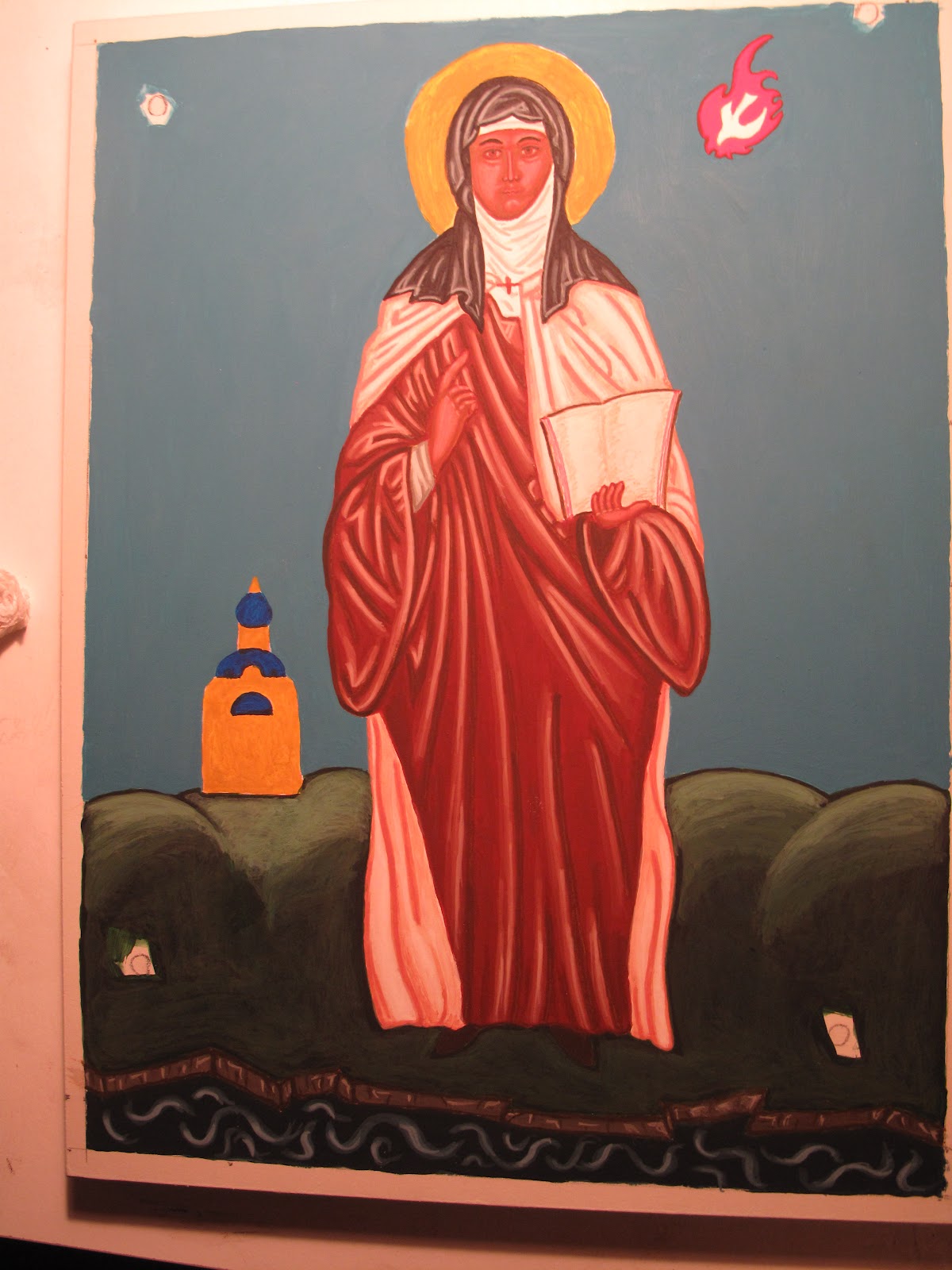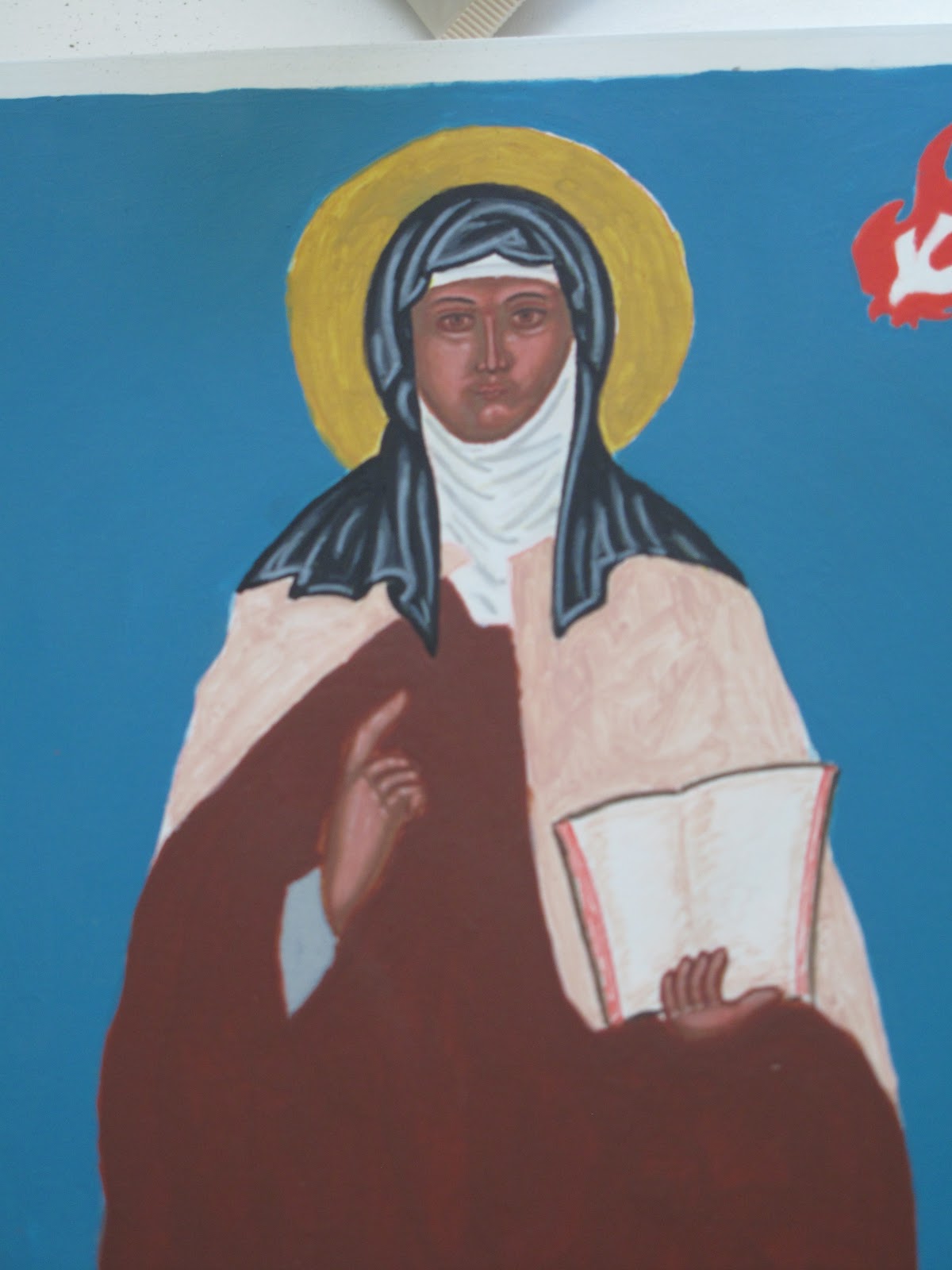
Icon of St. Teresa of Avila, step 4

In her section on the Fourth Dwelling Places in The Interior Castle, St. Teresa draws a distinction between two movements in the life of prayer: consolations and spiritual delights.  Basically, consolations have their origin in us.  Consolations are experiences that are acquired through our own effort – our petitions and our prayers.  They move from us to God and as long as they end in God they are good and beneficial. 
Spiritual delights, on the other hand, have their origin in God and move to us.  Spiritual delights are specifically movements of God’s grace that catch us and are not controlled by us.  They come in God’s time and in God’s plan.  Spiritual delights bring a peace and stillness to the soul that fulfills and expands our hearts.  They can even come in the busiest and noisiest of circumstances.  For a moment, even as we might be busy about other things and thoughts, we are brought to a different level of awareness.  (As I read this section by Teresa I was reminded of the distinction laid out by Josef Pieper between acquired knowledge and received knowledge in Leisure as the Basis of Culture.  I think that a connection can be made at this juncture between Teresa’s thought and that of Pieper but this is not the place for that.) 
There is much to reflect upon in this distinction of the two movements of prayer but one thought that strikes me is that spiritual delights remind us that God is active in our lives and that there is such a thing as providence.  There is a form of Christian thought that says God created us and the world, God saved us from sin, God has given us salvation in Christ and his word in Scripture and now it is up to us to take all this and live a good life basically on our own.  God is God yet God remains separate and distinct and not really active in my life.  Acknowledged or not, I think that many people have this perspective on the Christian life.  It is a “Christianized” form of secularism – God is acknowledged but God really does not move within the secular realm. 
Spiritual delights stand in opposition to this take on the Christian faith.  They demonstrate that God is active and that God moves as God so chooses. 
Not too long ago I read an observation which held that in the West we are all “adult children of the Enlightenment,” which means we have all been washed thoroughly in a perspective of reality that is quite comfortable with keeping God “out there” and us “here”.  Teresa was never a child of the Enlightenment and her writings give us a different and needed perspective.  In fact, I would contend that any Catholic who is worth his or her salt and understands what sacrament and grace are all about would never be truly comfortable in the restrictive confines of a worldview that too readily separates the sacred and the secular.
Isn’t it interesting how revolutionary prayer is when we really delve into it?  Oftentimes we have  an image of the revolutionary as the protester on the street shouting his or her slogan and carrying his or her particular sign but in essence working out of the same perspective as the ones they are protesting against.  Maybe the real revolutionaries are monastics and those people truly dedicated to the life of prayer and the true hotbeds of revolutionary dissent are to be found in monasteries and convents.             

The work of true faith: Eighteenth Sunday in Ordinary Time (B)

On this second Sunday of the five consecutive Sundays when the Church draws from John’s Gospel to reflect on Jesus Christ as the Bread of Life we are given an invitation.  After the feeding of the multitude and our Lord withdrawing for some solitude we are told that the crowds in today’s gospel (Jn. 6:24-35) come in search of him but their intent is not the most sincere and our Lord is aware of this.  Amen, amen, I say to you, you are looking for me not because you saw signs but because you ate the loaves and were filled.

We can live a form of “faith” that holds as its main goal and purpose the desire to be filled.  This approach to faith can take many forms.  The most blatant is the prosperity gospel that reduces Christianity to a commercial exchange between the human and the divine and God to a beneficent loan agent.  “If you have faith, if you live a good life, then God will reward you materially,” is the mantra of the prosperity gospel.  Another mantra is that you can have your best life now.  This take on faith is very popular for many people and one can see why – it promises a comfortable materialistic approach to the rewards of faith while ignoring the inconvenience of the cross.  The problem is that it is not christian. 

This is one expression on seeking faith in order to be filled but there are others.  Many of which are found and promoted even within many churches today.  Another expression is seen in equating real faith with an emotional high gained from a certain type of worship or retreat experience.  It is only faith if I feel it and it fills me up.  A further expression (closely linked to the previous two) is the Jesus who satisfies my every need and who shelters me from any real problem, hurt, crisis or need in life. 

There is a common thread that runs through all these forms of faith based in the desire to be filled.  Despite often loud attestations to the contrary which proclaim Jesus as Lord these approaches actually have the person him or herself as the center of existence and Jesus as just the means to the end of my material well-being, my emotional well-being, my personal sanctity and my eternal glory.  The focus is not so much on Jesus as it is on me.

The gospel invitation which we are given today is to move beyond this narrow faith seeking to be filled in order to find true faith and true relationship with Christ.  After chiding the crowds for the real reason why they sought him out Jesus goes on to say, Do not work for food that perishes but for the food that endures for eternal life, which the Son of Man will give you.  When the crowds ask for this real food, this true bread, our Lord says, I am the bread of life; whoever comes to me will never hunger, and whoever believes in me will never thirst.

True faith is not found in using Jesus as a means to personal satisfaction but in seeking a living relationship with Christ and in committing ones life to do the very real work of acknowledging him as Lord.  Yes, there is an aspect of “work” to faith.  Faith requires decision, commitment, toil, choices, and abandonment and sometimes even going against the stream, risking to be unpopular and even be persecuted for what one holds to be true.  This is the work of faith – we see it in the lives of those first disciples and the same invitation is given to us today.

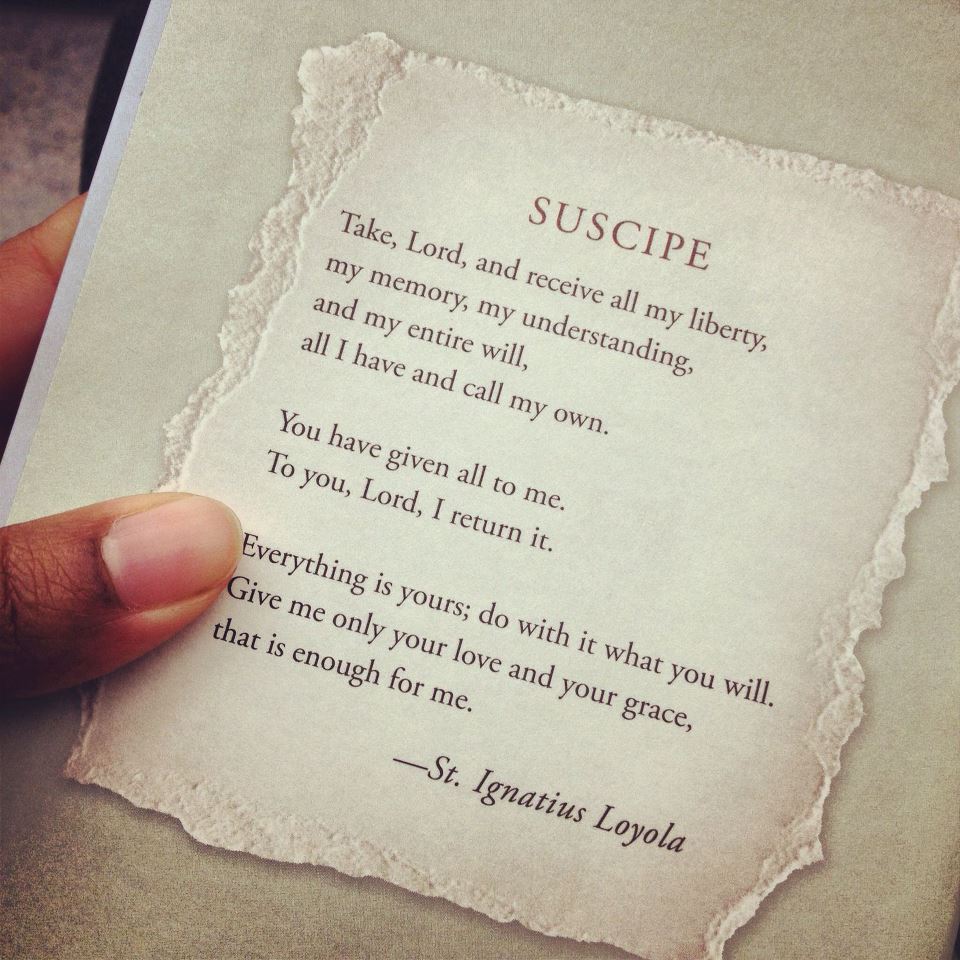
In contradiction to faith which seeks to be filled it is worthwhile to conclude with a prayer which expresses the work of true and mature faith.  This is the Suscipe of St. Ignatius of Loyola.  Notice that where the faith of the crowd can only ask what it can get from Christ; this faith asks for the grace to give more for Christ.  I would contend that only someone who had truly accepted and lived the gospel invitation of seeking a living relationship with Christ could write this prayer.

St. Ignatius and all holy men and women who accepted our Lord’s invitation to faith and encounter with Him, please pray for us.

Take, Lord, and receive all my liberty,
my memory, my understanding,
and my entire will,
all I love and call my own.

You have given it all to me.
To you, Lord, I return it.

Everything is yours; do with it what you will.
Give me only your love and grace,
that is enough for me.     


Feast of St. Ignatius and Seminarian retreat

Today is the Feast day of St. Ignatius.  I have borrowed the above photo from “Pray as You Go”. 

This prayer of St. Ignatius is beautiful in its truth and simplicity.

Today also begins our diocesan summer seminarian retreat/gathering.  Please keep our seminarians in your prayers over these next few days.  Please also prayer for all our young people to be open to God’s call in their lives.  

This coming fall we will have nineteen seminarians studying for our diocese! 

Prayer and the poor things we have to offer: Seventeenth Sunday in Ordinary Time (B)

It is always worthy to note that every facet of the gospel is worth reflecting upon and this even applies to space and location within the biblical narrative.

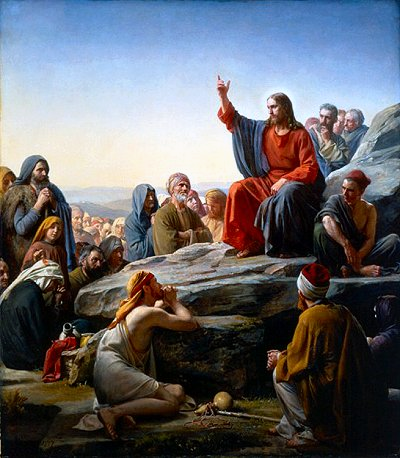
Biblical commentators have noted that in the time of Jesus it was the custom that teachers sat when they gave instruction.  In the gospel passage for this Sunday (Jn 6:1-5), John tells us that the Lord sat down with his disciples, he was preparing to teach.  But there is also something else worthy of note; Jesus went up on the mountain…  Jesus neither remains below – focused solely on his immediate work, living a self-centered existence in the midst of others – nor does he remain on high – seeking to escape reality and others in a one-on-one relationship with God.  Jesus ascends the mountain to be just a little bit higher; he needs to encounter God, and from there he can see men and women better. 

There is an important teaching here for Christians.  Only by living in an ongoing and daily encounter with God and by welcoming God’s compassion in our lives is it possible to look upon people with open eyes and to fully understand their needs.  In John’s account of this scene, it is Jesus who first raises his eyes and sees the people coming and who first recognizes that they were hungry and needed food.  Jesus then prods his disciples, Where can we buy enough food for them to eat?

Time spent daily in prayer does not remain solely within, maturing our own relationship with God (which is wonderful).  Daily prayer also directs our gaze outward – opening our eyes to recognize the needs of others and sharing compassion to help feed their hunger.  Prayer helps to mature us within and mature us without through our ability to relate honestly and compassionately with others.   

It is in this “sharing compassion” that another miracle takes place.  We are told that in the face of this overwhelming crowd and their need, the disciples come to realize that there is one boy with five barley loaves and two fish.  (The barley loaf of bread was the food of the poor because it was not the best bread nor the most flavorful.)  The disciples, informed more by the sad realism and practicality of our world are ready to give up and wash their hands of the crowd by encouraging that they be sent away.  Everyone left to forage on his or her own.  But our Lord is formed more by God’s word than this sad realism and he has the people recline on the grass.  He blesses the bread and with these five poor loaves he feeds the multitude! 

In essence we are all like that young boy.  We do not have much and what we do have is often quite poor – the little love and compassion we have, the little time we think we can spare, the little attention we can give, the little desire – yet, if we give it to the Lord then he can take it, bless it and use it to feed a multitude.  The key to this equation is our putting the “little” we have into the Lord’s hands and not seeking to hold on to it for ourselves.  An often unremarked upon part of this gospel scene is that the young boy did hand over his own meager meal.  He could have said, “No.  I have mine now you get yours.” but he did not.  He handed over the little he did have into the Lord’s hands and the multitude was fed. 

Living in a daily encounter with God in prayer and giving over the little that we do have – two good lessons for our reflection on this Sunday.    


Church, forget not your power! (Sixteenth Sunday in Ordinary Time – B)

The Gospel passage for this Sunday (Mk. 6:30-34) has the apostles returning to the Lord after having been sent out on mission to proclaim the coming of the Kingdom of God, to heal the sick and to aid the weak and the poor.  The evangelist makes note of a “power” being conferred on the apostles in order to acomplish these tasks.  It is quickly realized that the power mentioned here is neither economic nor political because those first disciples clearly had neither.  The “power” that the disciples went forth with were obedience to Jesus, the proclamation of his words and repeating the Lord’s gestures of mercy.  Through these simple powers great things happened and the apostles return full of excitement to share their experiences.  We can imagine the affectionate expression on Jesus’ face on their return and in their recounting of what had happened. 

Today, the Gospel gives us a different way than just the economic and political to affect the world.  This is a needed message for our time so steeped in materialism.  This influence of materialism can be witnessed in society’s fixation with the “material” power of economics and politics as the only ways to really get things done.  What the Gospel offers is a different way and a way that is more authentic and more human.  It is a power that truly heals and touches the human heart.

In our Christian heritage there is a famous quote that states, “Christian, forget not your dignity!”  In relation to today’s Gospel I think we can say, “Church, forget not your power!”  I am not saying that there is no place for economics or politics – lets not be naive – but also lets not forget that the true power of the Church resides in neither of these.

The power of the Christian community (the power to which the Church alone is the steward) is threefold:

1. obedience to Jesus,
2. the proclamation of his words,
3. repeating the Lord’s gestures of mercy. 

Obedience to Jesus.  Jesus is Son of God, Son of Man and Lord of history.  Why do we keep searching for other lords and other messiahs?  Yet, we do.  There are great men and great women throughout history yet none other is Son of God and Son of Man.  The primary witness of the disciples is found not in so much of what they said but in what they did.  They remained with the Lord.  They returned to him (as we see in today’s Gospel).  When they wandered and stumbled they turned back.  Even when they scattered from the cross; they gathered together again in the locked room.  In times of triumph, times of struggles, and times of uncertainty the disciples remained with the Lord.  There is a power found in obedience to the Lord.

The proclamation of Christ’s words.  There are many great ideas, theories and achievement throughout human history and these, rightly, can amaze and astound us.  We celebrate what is good and true.  But even as the Church can and should learn from these achievements she must remember that the words which she has to share are authentic, true and needed for every place and age.  They are words that truly bring life.  The words are not of our own making; rather they have been entrusted and given to us.  We are to speak Christ’s words to our world.  Elsewhere in the Gospel our Lord tells us that no one puts a light under a bushel basket yet how often are we tempted to give the Gospel second place in our lives to the latest theory, psychology, philosophy or social fad?  When we do so are we not, in essence, placing a bushel basket over the light of the Gospel?  The words of Christ truly heal because Christ alone is the Lord of life.

The Lord’s gestures of mercy.  Our Lord knew the power of gesture: he writes in the sand, he touches the leper, he sits down at the well with the samaritan woman, he heals the demoniac, he feeds the five thousand.  It is interesting to note how our Lord’s gestures were directed toward the expression of mercy.  Even the cleansing of the Temple can be seen as the desire to clear away a crushing and deadening legalism in order that God’s house might once again be seen as a house of mercy.  The Church is at its best when it lives our Lord’s gestures of mercy – when the untouchable are touched, when the hungry are fed when the sinner is forgiven.  These gestures might not make the evening news or any of the plethora of our society’s award shows but they are true, they are noted by heaven and they bring hope and healing to our world.

At the end of today’s gospel passage we are told that when Jesus disembarked from the boat and saw the vast crowd his heart was moved with pity.  The people were starving.  They were tired of that which failed to satisfy.  We, today, are tired of that which fails to satisfy.  Salvation does not come through politics nor does it come through the economy.  Salvation comes through mercy – God’s mercy at work in our world, our hearts and our lives. 

Christian, forget not your dignity!  Church, forget not your power! 


Icon of St. Teresa of Avila, step 3

I have been taught that in iconography you should write the face first.  (I must admit that I do not always follow this rule.)  But with this icon I did.

I once heard an interview with an artist who said that we are not born with a face; rather we craft our faces over the course of a lifetime of choices, smiles, tears, expressions and struggles.  He went on to say that it is really not until our forties that our face begins to be our own – what we have made of it.  I like this thought.  We grow into and mold our face and therefore our face becomes a true expression of who we are as a person rather than just a mask we wear.

In her reflection on the “Second Dwelling Places” in The Interior Castle Teresa warns about the danger of seeking spiritual consolation too early in the journey of prayer. 

Even though I’ve said this at other times, it’s so important that I repeat it here: it is that souls shouldn’t be thinking about consolations at this beginning stage.  It would be a very poor way to start building so precious and great an edifice.  If the foundation is on sand, the whole building will fall to the ground … It is an amusing thing that even though we still have a thousand impediments and imperfections and our virtues have hardly begun to grow – and please God they may have begun – we are yet not ashamed to seek spiritual delights in prayer and to complain about dryness.  May this never happen to you, Sisters.  Embrace the cross your Spouse has carried and understand that this must be your task.  Let the one who can do so, suffer more for Him; and she will be rewarded that much more.  As for other favors, if the Lord should grant you one, thank Him for it as you would for something freely added on.

We like consolation and we like it now!  In fact, I know whole ministries that our based on this premise (and they are quite popular).  But Teresa’s words of caution are very appropriate here.  Just as a human body does not grow and become healthy if its whole diet consists of sweets and desserts so the spiritual person does not mature in his or her faith by seeking consolation after consolation.  The cross must be embraced because the truth is that there are a thousand impediments and imperfections within each of us.  Lets be honest is this regard.

To return to the thought of the artist – it is in embracing our crosses in hope and in love (and also enjoying the consolations that do come along in God’s time) that we do the work of crafting our faces in order that our face rather than being just a mask might truly come to reveal who we are as a mature human person.   

Icon of St. Teresa of Avila, step 2

I have put down the base colors for the icon of St. Teresa of Avila. 

In iconography you put down the darker colors first and then bring forth the lighter colors.  In iconography it is not so much that light shines on the individual from without rather the light is meant to emanate from within the saint or our Lord.  The light of God’s grace transforms and transfigures from within and shines forth.

Also, iconography is not so much concerned with perspective as we are so often used to in western classical art.  The purpose of the icon is to bring the viewer into a spiritual encounter with the person pictured in the icon.  It can be said that it is not so much us who view the image as it is the one presented in the icon who is looking at us.  Perspective, in iconography, is reversed – the icon watches us. 

In the beginning of The Interior Castle St. Teresa reminds us that the only door of entry into true knowledge of self and of God is “prayer and reflection”.

Teresa wisely cautions that self-knowledge must be held in a creative tension with the truth of God.

If we are always fixed on our earthly misery, the stream will never flow free from the mud of fears, faintheartedness, and cowardice…

So it is with the soul in the room of self-knowledge; let it believe me and fly sometimes to ponder the grandeur and majesty of its God.  Here it will discover its lowliness better than by thinking of itself (solely)…

In my opinion we shall never completely know ourselves if we don’t strive to know God.  By gazing at His grandeur, we get in touch with our own lowliness; by looking at His purity, we shall see our own filth; by pondering His humility, we shall see how far we are from being humble.

Two advantages come from such activity.  First, it’s clear that something white seems much whiter when next to something black, and vice versa with the black next to the white.  The second is that our intellects and wills, dealing in turn now with self now with God, become nobler and better prepared for every good.

Finally, for this post at least, the saint offers this thought: While we are on this earth nothing is more important to us than humility.  

Amen, St. Teresa, amen.                

15th Sunday of Ordinary Time (B): Love and freedom from death, guilt and ego

st1\:*{behavior:url(#ieooui) }

“Return of the Prodigal Son” by Rembrandt
Saint Paul has written that God chose us in Christ in order to be full of love.  Here is where our religion begins.  It has been noted that the first Christians were just like the people around them: a mixture of rich and poor, weak and strong, male and female.  One could not tell the difference just by looking.  But, as a group, the Christians were noted for their care for others and for their joy. 

The original Christians were known for their taking care of others.  Especially others that the rest of society did not care for.  They buried the unknown poor, they cared for the sick.  They cared for the beggars.  Most of all, they cared for one another – sharing all so that no one was in need.  Many groups in history are known for power, strength, violence and bravery.  Few are known for how they loved each other.  This is the witness of our faith. 

Those first Christians were also known for their joy.  Joy is the infallible sign of God’s presence – it goes beyond happiness (which is having the world as we would have it) toward being in tune with the world as God would have it.  We find joy when we live as God would have us live.  

The first Christians shared all the conditions and struggles of life that their neighbors shared (and we still do).  We share the struggles, uncertainties and pains of this world.  Where then does our joy come from?  It comes from being freed to love and rejoice because, in Christ, we are freed from the three chains of death, guilt and ego.

We all fear death whether we acknowledge it or not and most of our sins come from this deep fear of diminishment, loss and ultimately oblivion.  But, as Christians, we know someone who once was dead and now lives.  We can boast, “Death, where is your sting?”

As Christians we are also freed from guilt.  We all know and bear this misery.  It is the felt knowledge that we have done what we should not and that we have not done what we should.  And even when we are not personally guilty of a specific sin we do share in the wholesale guilt of the human race.  And no human can forgive us, because we all share in sin.  But God can forgive and God has in Christ.  In Christ our guilt is wiped away – replaced by God’s mercy. 

Finally, the Christian is freed from the ego.  We are each both blessed and cursed by being a unique individual.  We can be so obsessed about taking care of ourselves and living in our own bubble that we forget others and forget the great mystery that it is only in dying to self that we rise to new life.  Through Christ we have learned that we save ourself by losing ourself.  Maturity comes when I realize that my life is not just about me.

In our care and in our joy we, as Christians, are known.  We love because, in Christ, we have been loved and freed from death, from guilt and from the ego.  This is the witness of our faith.  

See, how much these Christians love one another!  Hopefully, this will one day be said of our generation of Christians!     

Icon of St. Teresa of Avila

I started cleaning and organizing my office the other day which is always a sign that something is coming…

I have felt a desire as of late to write another icon but I have not been able to decide on a subject.  But recently it has come into my prayer and heart to write an icon of St. Teresa of Avila.

St. Teresa has always been one of my favorite saints – she was a contemplative, a pragmatic and someone not to be crossed lightly all rolled up into one.

During seminary I read through a good bit of her writings and received much spiritual nourishment.  Maybe its time I pick up some of her writings again…  Maybe eighteen years of priesthood will give me a different perspective.

I have cobbled together an icon to write.  In the center stands St. Teresa, in her left hand she holds an open book representing her writing.  (I have not yet decided on a quote.)  Her right hands points to the Holy Spirit  over her left shoulder.  While researching the icon I noticed that in many portrayals of the saint the Holy Spirit is often pictured.  On the right of the saint in the background stands a representation of the Interior Castle (in reference to her writing on mystical prayer).

I have placed St. Teresa on a bank below which will be a stream.  One summer day back when I was a seminarian reading St. Teresa’s writings I took an afternoon nap and in a dream I found myself on one side of a stream and on the other side stood a beautiful and dignified woman in a religious habit.  She smiled at me.  To this day I think it was St. Teresa so I have decided to add the stream to this icon.

I do not think that this is an icon that I will give away.

I will post pictures and commentary as the icon progresses…