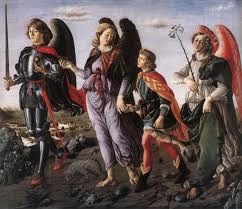

Feast of the Archangels – September 29th

 From the Office of Readings for the Feast of the Archangels:

Now a great sign appeared in heaven: a woman, adorned with the sun, standing on the moon, and with the twelve stars on her head for a crown. She was pregnant, and in labour, crying aloud in the pangs of childbirth. Then a second sign appeared in the sky, a huge red dragon which had seven heads and ten horns, and each of the seven heads crowned with a coronet. Its tail dragged a third of the stars from the sky and dropped them to the earth, and the dragon stopped in front of the woman as she was having the child, so that he could eat it as soon as it was born from its mother. The woman brought a male child into the world, the son who was to rule all the nations with an iron sceptre, and the child was taken straight up to God and to his throne, while the woman escaped into the desert, where God had made a place of safety ready, for her to be looked after in the twelve hundred and sixty days.


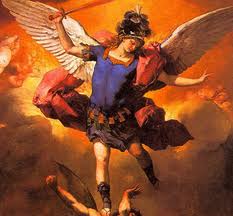
Archangel Michael


And now war broke out in heaven, when Michael with his angels attacked the dragon. The dragon fought back with his angels, but they were defeated and driven out of heaven. The great dragon, the primeval serpent, known as the devil or Satan, who had deceived all the world, was hurled down to the earth and his angels were hurled down with him. Then I heard a voice shout from heaven, ‘Victory and power and empire for ever have been won by our God, and all authority for his Christ, now that the persecutor, who accused our brothers day and night before our God, has been brought down. They have triumphed over him by the blood of the Lamb and by the witness of their martyrdom, because even in the face of death they would not cling to life. Let the heavens rejoice and all who live there; but for you, earth and sea, trouble is coming – because the devil has gone down to you in a rage, knowing that his days are numbered.’


As soon as the devil found himself thrown down to the earth, he sprang in pursuit of the woman, the mother of the male child, but she was given a huge pair of eagle’s wings to fly away from the serpent into the desert, to the place where she was to be looked after for a year and twice a year and half a year So the serpent vomited water from his mouth, like a river, after the woman, to sweep her away in the current, but the earth came to her rescue; it opened its mouth and swallowed the river thrown up by the dragon’s jaws. Then the dragon was enraged with the woman and went away to make war on the rest of her children, that is, all who obey God’s commandments and bear witness for Jesus. (Revelation 12:1-17)

From a sermon of Pope St Gregory the Great:

The word “angel” denotes a function rather than a nature

You should be aware that the word “angel” denotes a function rather than a nature. Those holy spirits of heaven have indeed always been spirits. They can only be called angels when they deliver some message. Moreover, those who deliver messages of lesser importance are called angels; and those who proclaim messages of supreme importance are called archangels. And so it was that not merely an angel but the archangel Gabriel was sent to the Virgin Mary. It was only fitting that the highest angel should come to announce the greatest of all messages.


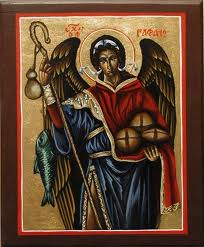
Archangel Raphael


Some angels are given proper names to denote the service they are empowered to perform. In that holy city, where perfect knowledge flows from the vision of almighty God, those who have no names may easily be known. But personal names are assigned to some, not because they could not be known without them, but rather to denote their ministry when they came among us. Thus, Michael means “Who is like God”; Gabriel is “The Strength of God”; and Raphael is “God’s Remedy.”


Whenever some act of wondrous power must be performed, Michael is sent, so that his action and his name may make it clear that no one can do what God does by his superior power. So also our ancient foe desired in his pride to be like God, saying: I will ascend into heaven; I will exalt my throne above the stars of heaven; I will be like the Most High. He will be allowed to remain in power until the end of the world when he will be destroyed in the final punishment. Then, he will fight with the archangel Michael, as we are told by John: A battle was fought with Michael the archangel.


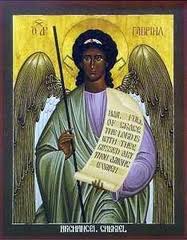
Archangel Gabriel


So too Gabriel, who is called God’s strength, was sent to Mary. He came to announce the One who appeared as a humble man to quell the cosmic powers. Thus God’s strength announced the coming of the Lord of the heavenly powers, mighty in battle. Raphael means, as I have said, God’s remedy, for when he touched Tobit’s eyes in order to cure him, he banished the darkness of his blindness. Thus, since he is to heal, he is rightly called God’s remedy.

On the front porch with De Caussade

I took advantage of the fact that since I had no parishes to fill in for Mass this morning I could sit out on the front porch of the Center, read some Abandonment to Divine Providence by Jean-Pierre De Caussade, drink tea and watch the bumble-bees and butterflies dance around the butterfly bush. 

This was all the more pleasant by the fact that I was kept awake into the wee hours of the morning by the sounds of a college party across the street.  As I sat there watching the butterflies and bees and the beauty of the sunlight shining through the branches and flowers of the bush I came to the realization that yes, let the youth have their late night parties.  I will enjoy the peace and serenity of the morning.  The youth do not yet know what they are missing.  Hopefully, time and experience will help mature their awareness. 

A thought by De Caussade:

Thus, beloved souls, you cannot know from where you came nor where you are going; nor can you know from what idea of God you have been produced nor to what end it is leading you.  For you there remains only a passive self-abandonment, carrying on without thinking and concerned with no models or examples of any particular mode of spirituality.  You must act when it is time for action and stop when it is time to stop.  In this self-abandonment you read or put books aside, talk to people or keep silent, write or drop your pen, and never know what will follow.  Finally, after several transformations, the formed and finished soul, now endowed with wings, flies up to heaven, but leaves on earth a fertile seed to work in other souls. 


Twenty-Sixth Sunday in Ordinary Time (A) – pie-crust promises

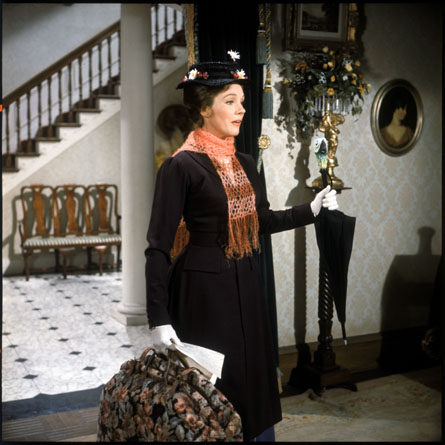
In the classic movie, “Mary Poppins”, at the end of the first day, Mary is putting her two young charges to bed. The brother and sister are so excited from the events of the day that they ask the nanny, “You will never leave us, will you?” And the young boy quickly adds, “Will you stay if we promise to be good?” To this second question the wise nanny responds, “That is a pie-crust promise. Easily made and easily broken.”

“That is a pie-crust promise. Easily made and easily broken.” I like that phrase and it connects right with today’s gospel (Mt. 21:28-32). “Yes, Father,” says the second son “I will go out and work in the vineyard.” He promises, but he does not go – a pie-crust promise. It cannot be that way with us. Discipleship is a lived reality – a lived response to the risen Lord who is just as present to us today as any of the people we now see around us with our physical eyes.

Also, just as we as disciples are not to be about “pie-crust” promises neither are we to be about blaming others. This is another teaching from today’s readings. Ezekiel, in our first reading (Ez. 18:25-28), offers his prophetic challenge during a specific time frame in the history of Israel. Israel had fallen, the people had been deported to Babylon and sitting by the river Chuza they were left wondering how this could have ever happened. What had led up to this catastrophe? Whose fault was it? Where is our scapegoat? Surely, they concluded, it must have been our parents, our grandparents. They had not practiced their faith rightly and now God is punishing us for their sins. Yes, it is their fault!

Ezekiel, with the courage of a prophet, answers back, “No, that is wrong”. Or, in other words, “stop trying to pass the buck”. “If someone commits iniquity and dies it is because he committed the iniquity. If he turns away from iniquity and does good, then he shall live.” It is no one else’s fault but how often do we hear or maybe even say the opposite. “He or she made me do it. That person is the one at fault!” This has been the line from the beginning, Adam said to God: “Eve made me do it!” Then Eve said to God, “The serpent made me do it.” The truth is, no one makes us do anything – we choose. What we have a selective memory about though is that with choices come consequences – when the consequences are in our favor we remember and celebrate our choice but when the consequences are not pleasant we grumble and complain.

No pie-crust promises. No blaming others. Discipleship calls us to an integrity and authenticity of living but we know that these temptations are there.  How might we find the strength needed to move beyond these temptations? The Letter to the Philippians has some good words of advice for all of us, “Have in you the same attitude that is also in Christ Jesus.” In other words, “Humbly regard others as more important than yourselves, each looking out not for his own interests, but for those of others.” As we adopt this attitude of Christ Jesus we gain that integrity of living which moves us beyond the temptations of pie-crust promises and the blaming of others. Humility is indeed the needed remedy to these two temptations.

Christ emptied himself and took the form of a slave – humbling himself and in this is found the path to true life.

Feast of the Korean Martyrs

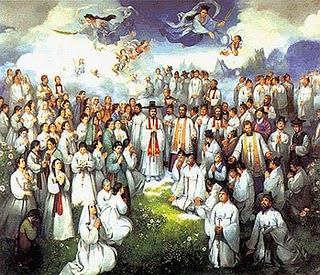
Today the Church celebrates the feast of the Korean Martyrs – Andrew Kim Taegon, Paul Chong Hasang and their companions.  Between 1839 and 1867, one hundred and three men and women gave their lives in witness for their faith in Christ in Korea. 

The Gospel reading for today is taken from Luke 8:19-21,

The mother of Jesus and his brothers came to him but were unable to join him because of the crowd.  He was told, “Your mother and your brothers are standing outside and they wish to see you.”  He said to them in reply, “My mother and my brothers are those who hear the word of God and act on it.”

In some ways our Lord’s response is tongue-in-cheek in that the one who truly accepted the word of God and said “yes” with her whole being was Mary herself.  This passage rather than diminishing Mary in fact honors her and calls us all to the awareness of how we also are called to be brothers and sisters to the Lord. 
 
We, likewise, are to receive God’s word, allow God’s word into our very lives and give birth to God’s word by the lives we live and the actions we do. 
 
Andrew, Paul and all their companions were brothers and sisters to our Lord in this true sense of the term and our world and Church are indeed better for their witness!
 
Sts. Andrew Kim Taegon,  Paul Chong Hasan and all your companions, pray for us! 

Twenty-Fifth Sunday in Ordinary Time (A) – Goats in a Tree

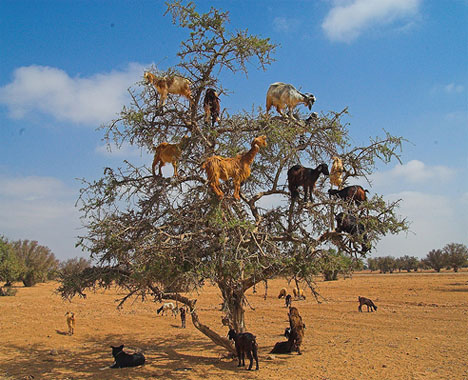
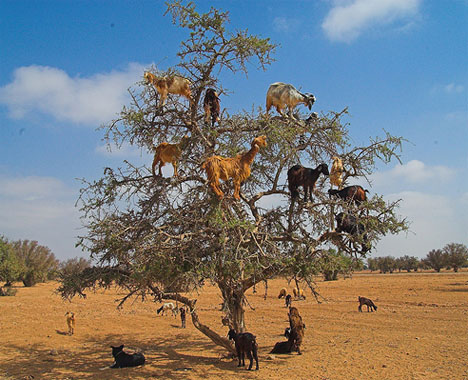
It is interesting what you can find on the internet and what you can be led to.  This last week I learned about the tree-climbing goats of Morocco via the internet.  (This sounds random and it is, but trust me, there is a point.) 

I was on the internet and on my screen appeared a link to an upcoming show about goats that climb trees.  Curious person that I am, I clicked the link and I was taken to a page showing a number of pictures of trees with goats amidst their branches.  At first I thought that these photos must be doctored and cannot be real but there was a further link to Youtube videos showing these goats climbing up the trees, moving around and balancing on the limbs and then scampering down off the trees.  The story is that there is a certain type of berry or fruit that these trees produce that the goats crave and over time they have adapted and have developed the ability to climb these trees in order to get at the fruit.  But, the image of these goats perched in trees is kind of surreal – two very ordinary things (goats and trees) brought together in a totally unexpected way that makes one do a double take and even question ones perception. 

The parables of our Lord operate in a similar way I believe.  Our Lord takes common, everyday realities that we are all familiar with but then puts a spin on them that leaves one doing a mental double take and re-evaluating our perceptions.  Similar to seeing goats perched in a tree.  Take for example this Sunday’s parable (Mt. 20:1-16).  We can easily imagine the landowner and the laborers.  We understand what work is and what it means to give someone a fair wage for a day’s work.  But then there is this “spin” at the end.  Those laborers who worked only one hour get paid the same amount as those who put in a full day’s work.  And we are left with the response of the landowner, “Are you envious because I am generous?”

In regards to parables we need to realize that approaching a parable like a math problem to be figured out is like attending a symphony and choosing to focus so intently on the words in the program that you totally miss the music.  Parables are not meant to be “solved” but to be entered into and lived in and as we do this we are brought to greater awareness and perception. 

As I have sat with this parable this last week I have been led to realize that probably about ninety-five percent of the life of faith and discipleship is just about showing up – whether it be at the start of the day or the end of the day.  If we just “show up” then God will do the rest – whether it is making the decision to go to church, to get involved in that service project, to take time daily for prayer and Scripture reflection, to make the decision to be available and attentive to our family and neighbor.  If we just “show up” like the laborers in the market-place then God will do the rest.  But it is important to note that showing up is not just a physical thing but must truly occur within ourselves.  It is the decision to be truly present to the other. 

It can be said that really everything that we do as Church – from worship to sacraments and liturgy, to service and care for others, to the reality of community, to private prayer and devotion – is about showing up for the encounter with Christ.  If we just “show up” then God will do the rest. 

“Are you envious because I am generous?” asks our Lord.

When it comes to the parables, it is all about the goats in the tree. 

The Feast of the Triumph of the Cross – "life is Christ, and death is gain"

Scripture informs Scripture. 

This morning I was praying over the readings for this coming Sunday (25th in Ordinary time, Cycle A) while also reflecting on the readings for today’s Feast of the Triumph of the Cross.  During the course of these reflections I was struck by St. Paul’s words in the Letter to the Philippians (from Sunday’s readings); “For to me life is Christ, and death is gain.” (Phil. 1:21)

This succinct phrase (only possible to achieve, I believe, by the mystery of lived experience) sheds light on today’s Feast of the Triumph of the Cross.

Paul, it seems, is grappling with the mystery of the cross in the life of discipleship.  Our Lord has said that if we truly wish to be his disciples then we must pick up our cross and follow after him. 

There are many versions of the gospel being proclaimed today that omit or outright deny the mystery of the cross in the life of discipleship.  And many people flock to this message.  But it is an empty message. 

The cross must be embraced in the life of discipleship and its wisdom must be learned if we would truly disciples be.   

"Faith" – Jean Pierre de Caussade

I am currently reading and reflecting upon Fr. Jean-Pierre de Caussade’s spiritual treatise,  Abandonment to Divine Providence.  In it I have found one of the most beautiful and succinct summations of the action of faith in our lives that I have ever read.  Below is the text.

If we never ceased to live the life of faith, our intercourse with God would never be interrupted and we should talk with him face to face.  When we speak it is the air which transmits our thoughts and our words, and so all our actions and our sufferings would be the medium through which we heard the expression of God’s will.  They would, as it were, give his Word substance and visible expression, and all that happened to us would be seen as holy and most excellent.  God in his glory will give us this union in heaven; here on earth we can enjoy it by faith.  The only difference is the way it is given to us.  

It is faith which interprets God for us.  Without its light we should not even know that God was speaking, but would hear only the confused, meaningless babble of creatures.  As Moses saw the flame of fire in the bush and heard the voice of God coming from it, so faith will enable us to understand his hidden signs, so that amidst all the apparent clutter and disorder we shall see all the loveliness and perfection of divine wisdom.  Faith transforms the earth into paradise.  By it our hearts are raised with the joy of our nearness to heaven.  Every moment reveals God to us.  Faith is our light in this life.  By it we know the truth without seeing it, we are put in touch with what we cannot feel, recognize what we cannot see, and view the world stripped of all it superficialities.  Faith unlocks God’s treasury.  It is the key to all the vastness of his wisdom.  The hollowness of all created things is disclosed by faith, and it is by faith that God makes his presence plain everywhere.  Faith tears aside the veil so that we can see the everlasting truth.   

God’s Will


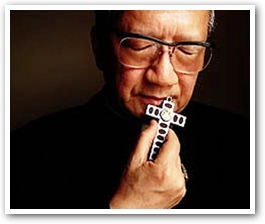
Cardinal Francis Xavier Nguyen Van Thuan


“Your responsibilities indicate the will of God for you at the present moment.”

“The worker will become a saint in the workplace, the soldier will become a saint in the army, the patient will become a saint in the hospital, the student will become a saint through studies, the farmer will become a saint on the farm, the priest will become a saint through his ministry as a priest, and the public servant will become a saint in the government office.  Every step on the road to holiness is a step of sacrifice in the performance of one’s mission in life.”  (Quotes taken from The Road of Hope by Cardinal Francis XavierNguyen Van Thuan)

I have not written much on my blog these past couple of weeks because the responsibilities of my ministry at the Catholic Center with the start up of another year and Vocation work as well as my responsibility of caring for my ailing mother (who had a recent setback but now is in a rehab facility working to get her strength back and possibly return home) have been forefront for me. 
Before all this happened I began re-reading Cardinal Van Thuan’s book The Road of Hope.  His words have been a source of hope and strength for me.  
God’s will for us is indeed found in our responsibilities of the present moment. 

Twenty-First Sunday in Ordinary Time (A): Welcoming Christ and the power of the keys

There are a number of lessons to be learned from today’s gospel passage (Mt. 16:13-20).  And as we reflect on this passage it is helpful to recognize the context in which it occurs.  After feeding the multitude and curing many people our Lord finds himself practically alone.  The crowd seems to be present when there is healing from illness and when there is food but then the crowd dwindles.  In a sense, our Lord, in this passage is left almost defeated.  After having so many around, he is now left alone – only with his small group of disciples.  Here is an important point to remember – the ways of God are not our ways.  God will not force his Kingdom.  Christ will usher in the Kingdom of God not through our world’s understanding of power, success and accomplishment but according to God’s terms.  
So, after the crowds have dwindled away, our Lord turns to this small and less-than-perfect grouping of disciples and asks, “Who do people say that the Son of Man is?”  Then, he looks directly to them and asks, “Who do you say that I am?”  Our Lord is seeking to move this small band of followers beyond the limits of the world’s thought (in this case, the awaited messiah as a military leader and conqueror) into the truth of the Kingdom of God.  If they are to be his disciples they must begin to grasp the ways and the movements of God’s Kingdom.  
Peter, speaking for the community of disciples, responds, “You are the Christ, the Son of the living God.”  “Blessed are you, Simon son of Jonah.  For flesh and blood has not revealed this to you, but my heavenly Father.”  There is an important spiritual lesson here – Peter was not perfect when he made this proclamation of truth.  In fact, in the very next chapter Peter rebukes our Lord and is himself reprimanded.  “Get behind me Satan!  You are thinking not as God does but as human beings do!”  The lesson is this: in the spiritual life it is more important to cling to Jesus rather than to seek to make ourselves perfect in the hopes of winning his acknowledgement.  We forget this all the time.  We want to have everything “perfect” – nice and neat – before we invite Jesus in.  Jesus does not expect everything to be perfect.  He just wants to be invited in!  Just let him in and then, by his presence, all will begin to be healed!
When we allow Jesus in. When, in our heart, we are able to proclaim, “You are the Christ, the Son of the living God.”, the gain the true power of the keys of the Kingdom.  The power to “loose” and to “bind”.  The power to loosen the bonds that hold us tight to our selfishness, our own love of self, our hurts and our grudges.  These are the bonds that make us violent and like a slave.  When we let Christ in we learn to bind ourselves to that which gives true life – friendship, solidarity, integrity and service.  We bind ourselves to the ways of the Kingdom.  
In and through Christ, whatever we bind on earth will be bound in heaven.  Whatever we loose on earth will be loosed in heaven.