True Beauty

Our society suffers from a deprivation of true beauty. This may sound strange to say in a culture that is so visual and becoming more so by each passing day but this is exactly the crux of the matter. We are glutted with false beauty and deprived of true beauty. 24/7 images are thrown at us purporting to represent true beauty, but in fact they do not. Our souls are left famished. False beauty empties the soul just as it promises to bring fulfillment. (It can be compared to that sick-in-the-gut feeling left over after having downed a bag of potato chips when you could have had an apple instead.)

True beauty is witnessed to by the presence of joy, which false beauty can never summon. True beauty fulfills the heart and remains after the flash and glitz of false beauty has faded. True beauty is often simple and quiet and ordinary. It is a source of life.
Iconography teaches us the language of true beauty and it helps to renew our vision – our ability to once again see and recognize beauty that fulfills the soul. Iconography is a gift from the East given exactly when we need it. Iconography – I am convinced – can help heal a soul emptied by false beauty … if one is willing to learn its language.

Elizabeth’s Comfort

Blessed are you who believed that the Lord’s word would come true! (Lk. 1:45)

Words spoken by Elizabeth to Mary. Words that were all the more meaningful because they were spoken by someone who herself was living what she said.

Through the process of writing this icon of the Visitation I have gained a different appreciation of this woman Elizabeth. Before, Elizabeth was just another name in the nativity story for me – a minor character in the background. Really though no one is ever minor in Scripture and when we focus our attention on these “minor characters” we quickly learn that they have some amazing truths to share. Elizabeth has shared some of her truths and has become a woman of deep and strong faith for me, unique in her interaction with the mother of our Lord. I wonder if this might be the real driving force behind the young Mary making the journey to visit her cousin.

Certainly we can allow Mary that very human predilection of maintaining a variety of motives – conscious and unconscious. Maybe just as much as going to help her cousin in her pregnancy, Mary made the journey in order to be supported by her older cousin. I do not think that it is implausible to hold that Mary needed the wisdom, the practical faith, patience and encouragement that Elizabeth alone had to offer. Maybe in those three months Elizabeth helped to answer some of the questions remaining in Mary’s heart just as much as Mary helped Elizabeth in the remaining months of her pregnancy. The two women needed one another.

It is something to think about – the young Mary needing the help of another. Very often in our imagery Mary is the mother alone with her divine son or the mother giving aid to us wandering pilgrims. But here Mary is the one receiving comfort and encouragement from another. It is very touching and tender. It is very human. The moment is graced.

Elizabeth’s Insight

Luke tells us that immediately after hearing Mary’s greeting, Elizabeth, filled with holy spirit, correctly interprets the movement of joy of the child in her own womb and asks, “How is it that the mother of my Lord comes to me?” (Lk. 1:43) Here in this one short verse is found a rich testament to the insight of faith. Elizabeth gives witness to the lordship of Mary’s child before Mary even has a chance to say a word regarding her own pregnancy.

Elizabeth in this moment is granted insight that she could not have arrived at on her own. (Insight which is similar to that given Peter when Jesus asks his disciples, “And who do you say that I am?”)

The insight is both unmerited and prepared for. God does not force our wills but this does not mean that God will not cooperate with and grant insight and understanding to a will that is well-disposed.

In the fifth verse of his first chapter, Luke tells us that both Elizabeth and her husband Zechariah were of the priestly clan. Further, “both … were upright in the eyes of God and lived blamelessly in accordance with all the laws and commands of the Lord…” (Lk. 1:6)

Elizabeth is a person of faith. She is someone who has chosen to orient her life toward the fixed point of God. Through a lifetime of habit and choices Elizabeth has disposed her will toward God’s revelation. She is prepared to receive when the moment arrives and it arrives with Mary’s greeting.

God will give insight and awareness that the world cannot afford if one is well-disposed and willing to receive. Elizabeth is a witness to the wisdom of the heart that prays.

Peace

The icon speaks of the possibility of peace but it also instructs that true peace can only be achieved in the willingness to encounter the other.

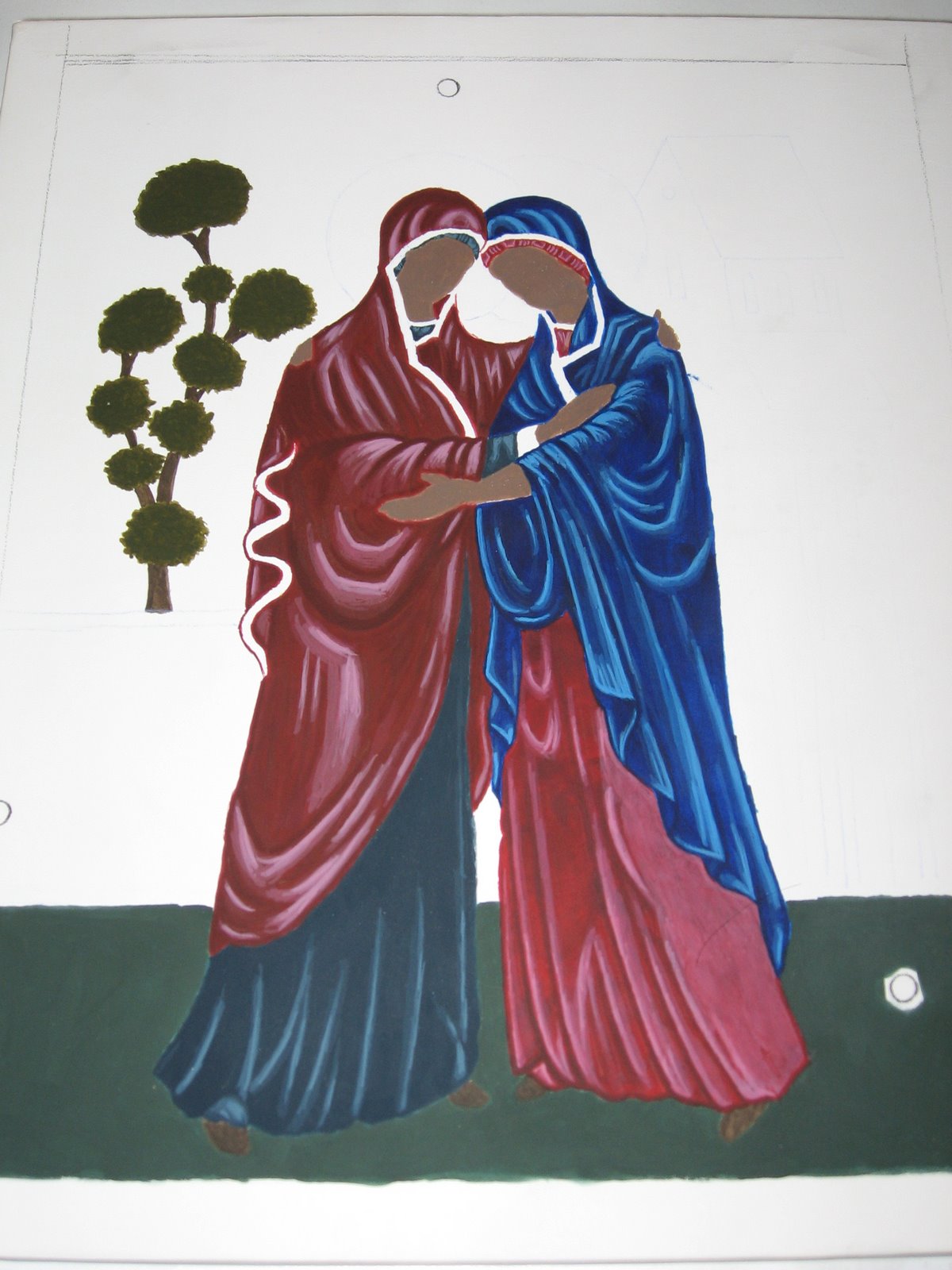
We need to move beyond the walls of fear that we construct in order to meet the other in friendship and in welcome. It is telling that the place of encounter between Mary and Elizabeth in this icon is outside the walls (this will become more apparent as the icon develops).

I remember the words of one of the chief rabbis of Jerusalem speaking at the Assisi gathering for peace held in Washington, D.C. a couple of years ago (a gathering coordinated by the Sant’Egidio community). Speaking about the possibility of peace the rabbi remarked, “We can only give that which we ourselves already have. How can we expect to give peace if we, ourselves, do not already have peace in our hearts?”

Before we can build peace in our world, we must welcome peace into our own hearts, each and every one of us. Yes, there are walls in our world that separate but there are just as many walls within our own hearts and these also are tall and strong. The work of peace begins within.

One name we give the Messiah (whom we await in Advent) is “Prince of Peace”. He can help us remove the walls but only if we welcome him, only if we let him in.

Elizabeth’s loving embrace and welcome of Mary and her child instructs us in the way of peace.

Elizabeth was filled with holy spirit, and giving a loud cry, said,
“You are most blessed among women and
blessed is the fruit of your womb!” (Lk. 1: 41-42)

The Embrace

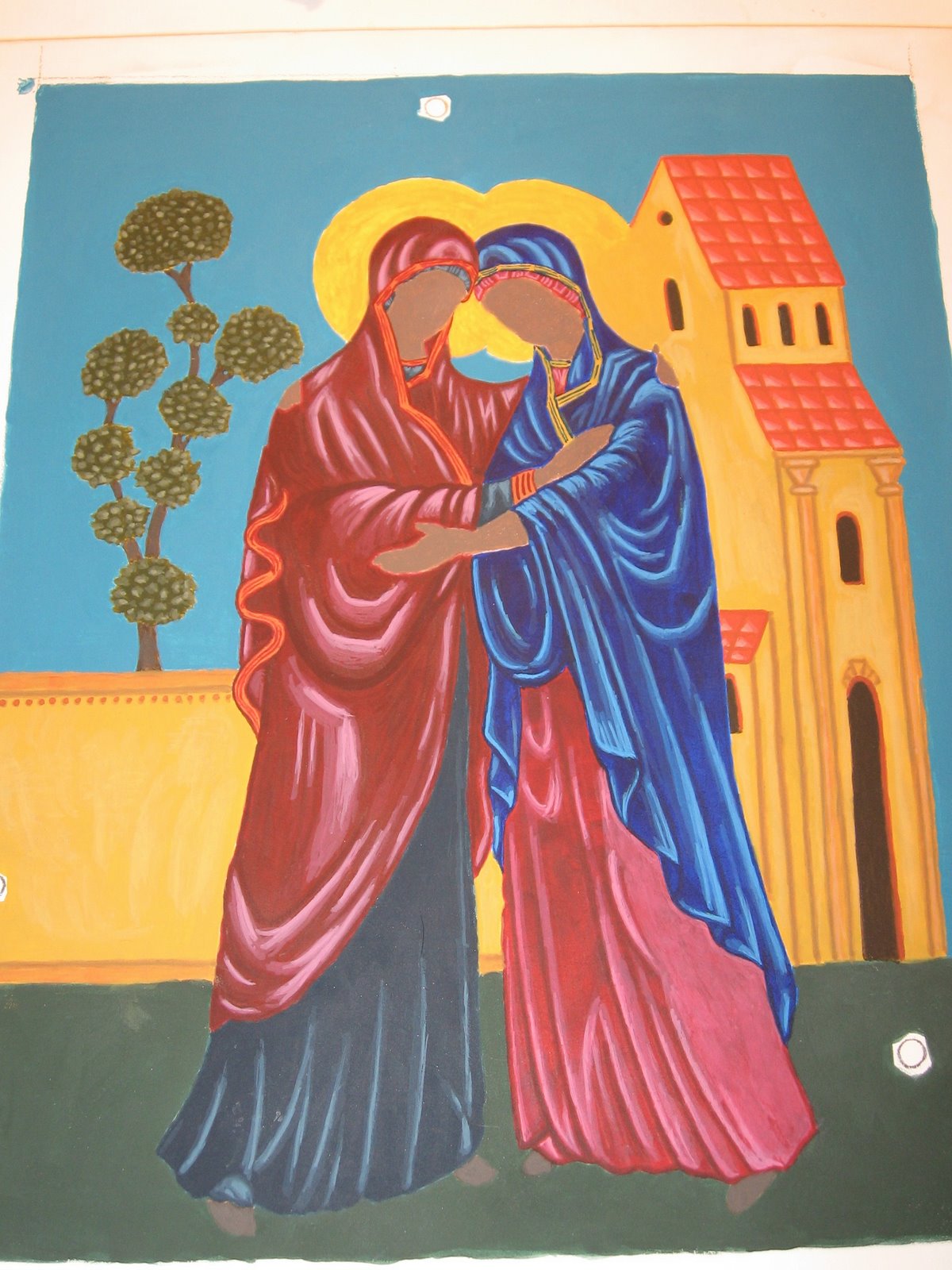
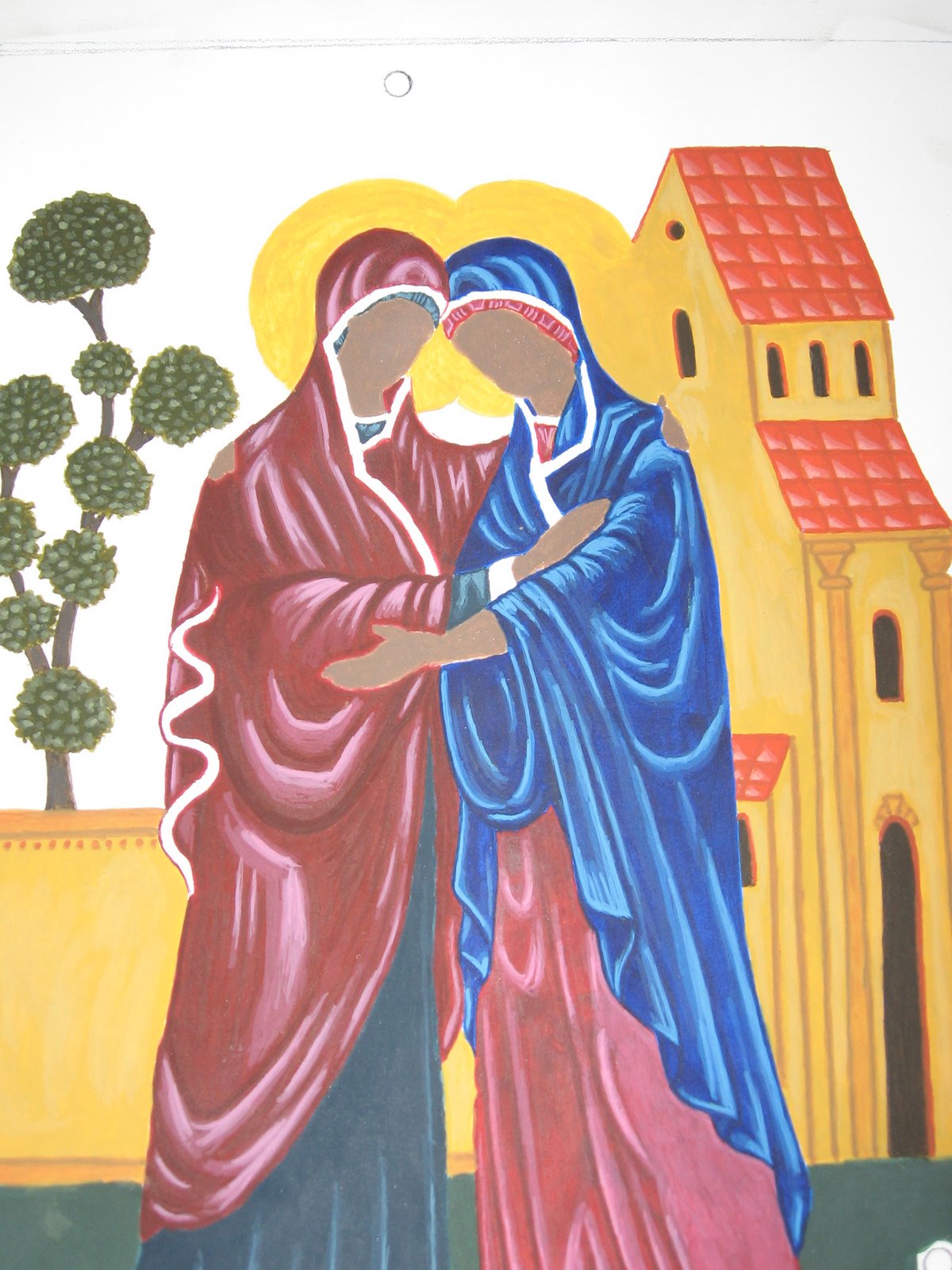
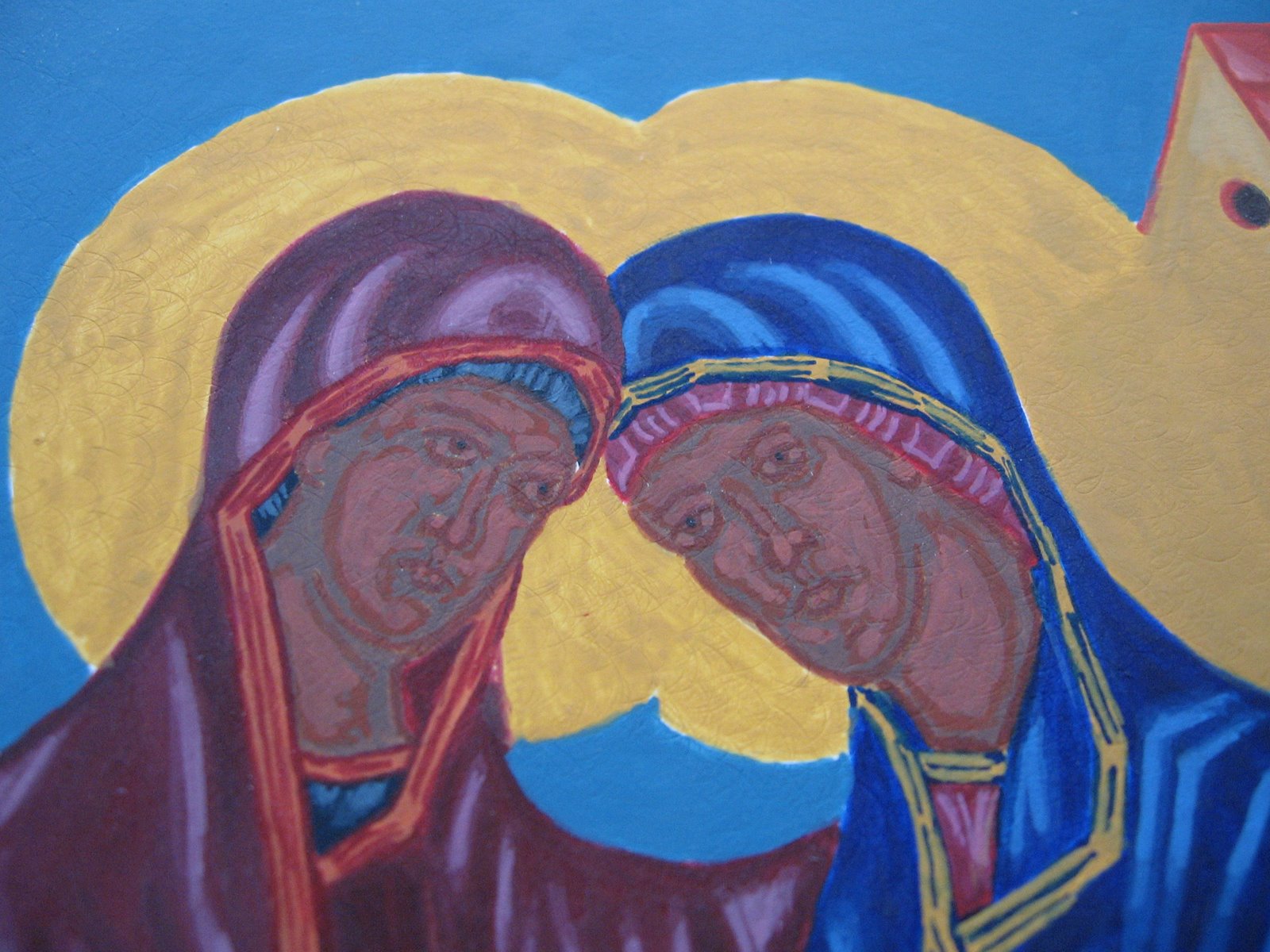
I have altered the icon from the original, not intentionally though. In the original icon – on Elizabeth’s left arm that embraces Mary there is a red sleeve. I did not notice this in the original image I copied from and left the sleeve out. Now Elizabeth’s arm is bare – the sleeve pushed up. I like this though. We “roll up” our sleeves when we are busy, when we have work to do. I can imagine Elizabeth busy about the work of the day when Mary arrives. Immediately this work is left behind as Elizabeth embraces her cousin in welcome!

Both of these women knew full well the daily realities of life. Both lived in a setting that our society would classify as “third world” and thus consider of little importance and find easy to ignore.

But God does not think as we think and neither does God assign value as we do. For God, this encounter between two poor women in a third world country is of supreme value.

Here is a prayer experiment to help put the image in the context of our day. In prayer, imagine the setting not being what is found in the icon but the scene of a refugee settlement camp in one of the countries of Africa. Both Mary and Elizabeth’s skin is of a darker hue and they are members of a tribe forced to flee their country due to the threat of genocide. For weeks they have been separated from one another and finally (after searching non-stop) they find one another in the chaos of the camp. Imagine the joy and the love and the peace of that moment even as chaos and despair seem to swirl around them.

This encounter, for God, is of utmost importance; no matter if the world deems it of any significant value.

Part of the task put before us during the Advent season is to learn to see as God sees and to learn to value as God values.

The Tree

“… the most important tree in the desert is the tree of genealogy. Every tribe is a tree, and man in the desert defines himself as a branch of the tree. … The branch cannot have life without the tree nor the tree without roots or the stable foundation in time. … Man is therefore man only by reason of his genealogy.” (Professor Wael Farouq – professor of Arabic at the American University in Cairo – quoted by Archbishop Migliori, “Catholicism and Islam: Points of Convergence and Divergence”, Origins, Vol. 37, No. 26)

Behind Mary stands a tree. I do not think that this tree is just for decoration nor is it there just to fill up space and balance the icon.

If we affirm that Jesus Christ is fully human then we must allow for all the constitutive elements of what it means to be “human” – one of these being genealogy. “Man is therefore man only by reason of his genealogy.”

The tree witnesses to the genealogy of Jesus – a genealogy which Matthew in the first chapter of his gospel takes great pains to lay out and to present. Jesus is both son of David (in the particularity of God’s covenant with Israel) and son of Abraham (in the universality of God’s Kingdom). Because of this “both”, the life of the Christian is a life lived in the dynamic tension between both the particular and the universal dimensions of God’s Kingdom.

What is also of importance to note in Matthew’s tracing of Jesus’ family tree is how intimately God is involved from the beginning. Throughout the centuries, God both nourishes and prunes this tree and in either circumstance God is there, God is involved.

Before demanding obedience to His will, before the dynamic interplay of faith and reason – God seeks relationship with us. This seems to be the primary move on God’s part. God enters into human history. God does not seem to be content to be just creator at the beginning and judge at the end. God enters into the very scene itself and, again and again, plays a dynamic role. This is true in the history of our world and in the history of our lives. God moves in our lives – often in ways unseen and unnoticed but true nonetheless – both nourishing and pruning.

The icon reminds us that God prepares the tree for its fullest flowering – the very Word made flesh.

From the stump of Jesse a shoot will come forth;
from his roots a branch will grow and bear fruit.

(Isaiah 11:1)

From Darkness to Light

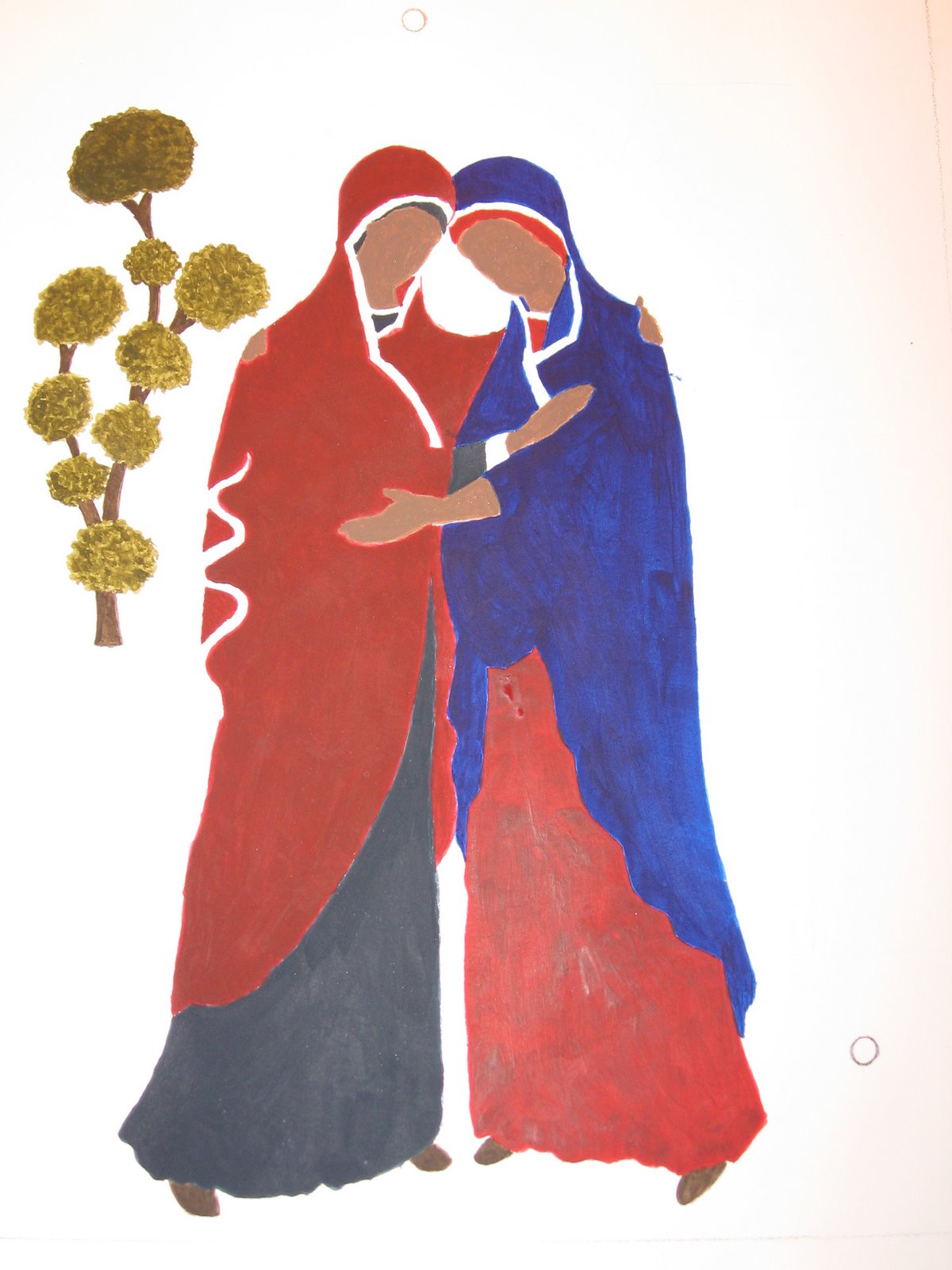
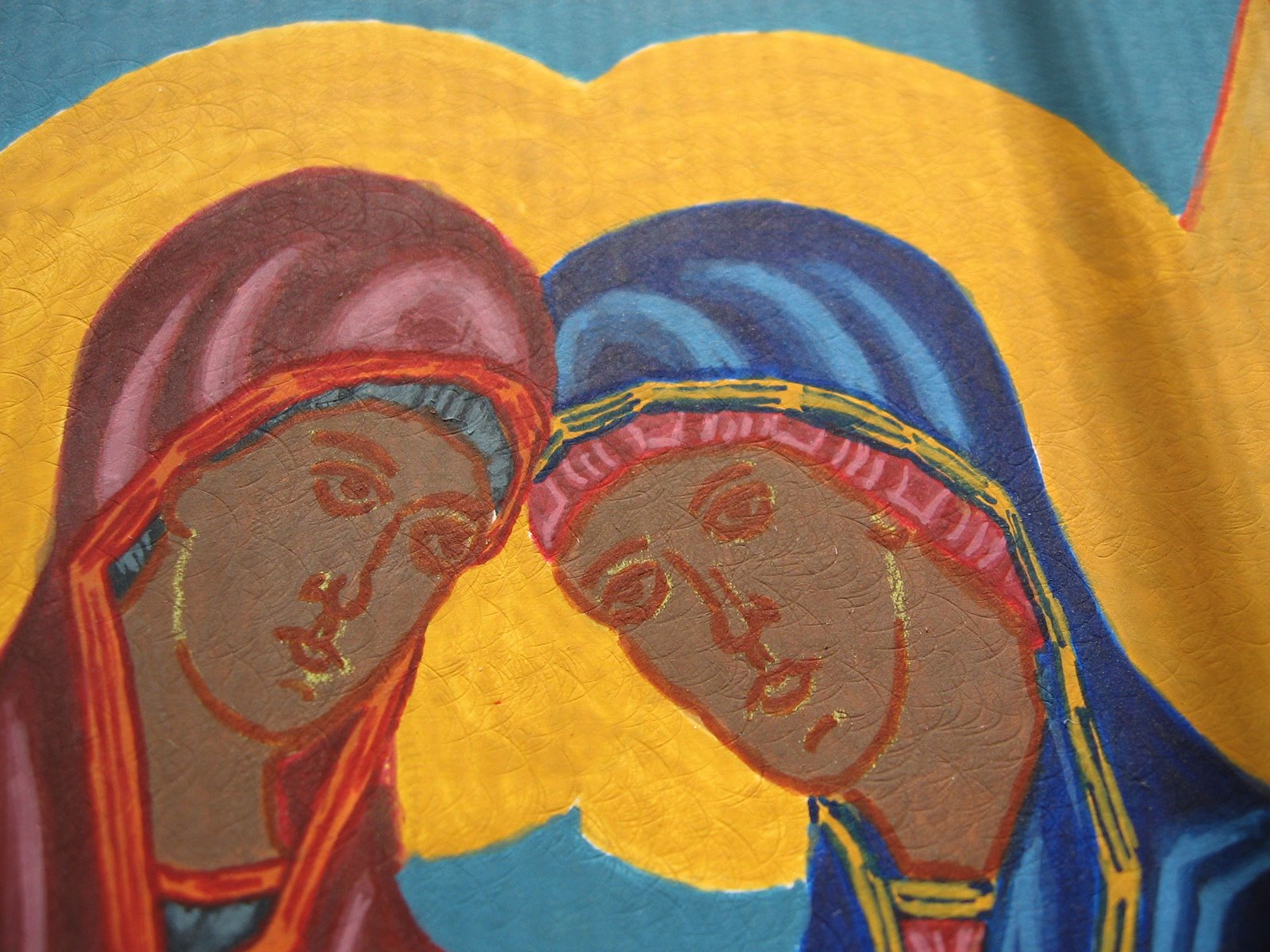
The first step in applying the colors for an icon is to paint the darker, base colors. From this base you then “build up” – adding lighter shades in order to bring depth and movement to the image.

It is a valid art technique and, for iconography, it lends itself to a spiritual/theological interpretation. The interpretation being that the very life of the Christian is a life of being transformed from darkness to light or from glory to glory.

In Western Christianity we have tended to primarily emphasize the atoning and redemptive aspect of our faith (Christ took on the weight of our sin thereby setting us free) often to the diminishment of the transfigurative aspect of the Christian life – an aspect that Eastern Christianity has maintained in its thought. Through Christ (which means living the Christian life; i.e. receiving the sacraments, loving God and neighbor, worshiping God, living community, serving others, etc.) we are transfigured. We are changed from glory to glory. It could be said that living these aspects of the Christian life allows Christ the brush strokes necessary to make of our very lives an icon to God’s glory – bringing depth and beauty to our existence and revealing, through us, God’s Glory to the world.

Advent as a season of hope is a perfect time to deeply reflect on this transfigurative dimension of our Christian faith. This transfiguration has begun through our baptisms and it continues here and now.

Two verses from St. Paul’s Second Letter to the Corinthians can aid us in reflecting on the transfigurative dimension of our lives in Christ.

So, with unveiled faces, we all reflect the Glory of the Lord, while we are transformed into his likeness and experience his Glory more and more by the action of the Lord who is spirit.
(2 Cor. 3:18)

God who said, ‘Let the light shine out of darkness’, has also made the light shine in our hearts to radiate and to make known the Glory of God, as it shines in the face of Christ. (2 Cor. 4:6)

Second Sunday of Advent (A)

Dr. Martin Luther King Jr. once offered these words of reflection,

Despite the fact that all to often people see in the church a power opposed to any change, in fact, the church preserves a powerful ideal which urges people toward the summits and opens their eyes as to their own destiny. From the hot spots of Africa to the black areas of Alabama, I have seen men and women rising and shaking off their chains. They have just discovered they were God’s children, and that, as God’s children, it was impossible to enslave them.

The church preserves a powerful ideal which urges people toward the summits… When we are Church at its best we realize that this ideal is neither of our own making nor of our crafting. We neither own nor control this message, in fact, as its servants we realize that we have been entrusted with it solely in order to be good and wise stewards (of whom there will be an accounting one day). This ideal – the proclamation of being sons and daughters of God – is not a hope invented but rather a hope received.

John the Baptist throughout his life and proclamation knew this distinction and it was based on this awareness that he condemned the religious authorities of his day who lived on the illusion of controlling the way to righteousness. John knew the source of the Kingdom – it did not lie within the control of the religious establishment nor did it lie within himself and his own charisma – it lay within God’s action and God’s movement. The Kingdom was grounded in God’s prerogative. “I baptize with water … the one who is coming after me is mightier than I. I am not worthy to carry his sandals. He will baptize you with the Holy Spirit and with fire…”

The season of Advent invites us to recognize the true source of the “ideal” that we hold and proclaim as Church. It is not a hope invented but a hope received. If it were invented then we would be the most pitiable of people. God has chosen to move specifically within human history. God has come to us. Only in the realization of this amazing truth is it possible to sing, “Justice shall flourish in his time and fullness of peace forever.”

The recognition of hope received though does not lessen the responsibility on our part as Church. Isaiah’s prophecy and description of the Anointed One also contains within it our mission as Church as well. As we receive; we are to proclaim. As we know; we are to live.

They had just discovered they were God’s children, and that, as God’s children, it was impossible to enslave them.

Hope received, not invented, is the Advent proclamation and it is the source of the beauty of peace.

I have seen men and women rising and shaking off their chains – they discovered that they were God’s children.

A note on terminology

Some people have asked about the use of the term “write” in relation to the drawing and painting of an icon.

The term “write” is used because an icon is considered to be an expression of visual theology. So, this being the context, it is correct to say that one is “writing” an icon. (This is much to the chagrin of my brother John – the journalist and writer.)
Further, through the medium of image and symbol not only does the icon express great truths of our faith but it also brings one into a living encounter with those truths. It can be said that it is just as much the icon that observes us as it is we who take in the icon.
Here, a key distinction in perception might be helpful. In standing before an icon a person is not viewing a static, passive object that one then assimilates by his or her own powers – similar to reading a textbook in order to solely draw out what one needs to know. In coming before an icon one is fundamentally entering into an encounter and a dialogue with a reality that is active and present and that has something to say and teach what we need to hear.
In iconography the active agent is not just the viewer – it is also the icon itself. The icon invites one into the openness of a dialogue between a person and the eternal.
Theology is the dialogue between the soul and God who has fully and definitively revealed Himself in Jesus Christ – the Logos, the Word “made flesh” – and who communicates Himself to us through our senses, our conscience and our reason. Jesus is the primary and fullest image (icon) of God the Father. “He (Christ) is the image of the unseen God, … for God was pleased to let fullness dwell in him.” (Col. 1:15, 19). The theology of iconography springs from the incarnation – the choice of God to become en-fleshed. All this being said; when one paints an icon, one is “writing” a theology of God and salvation – a theology that has its roots in nothing less than the incarnation itself.

The Ordinariness of it All

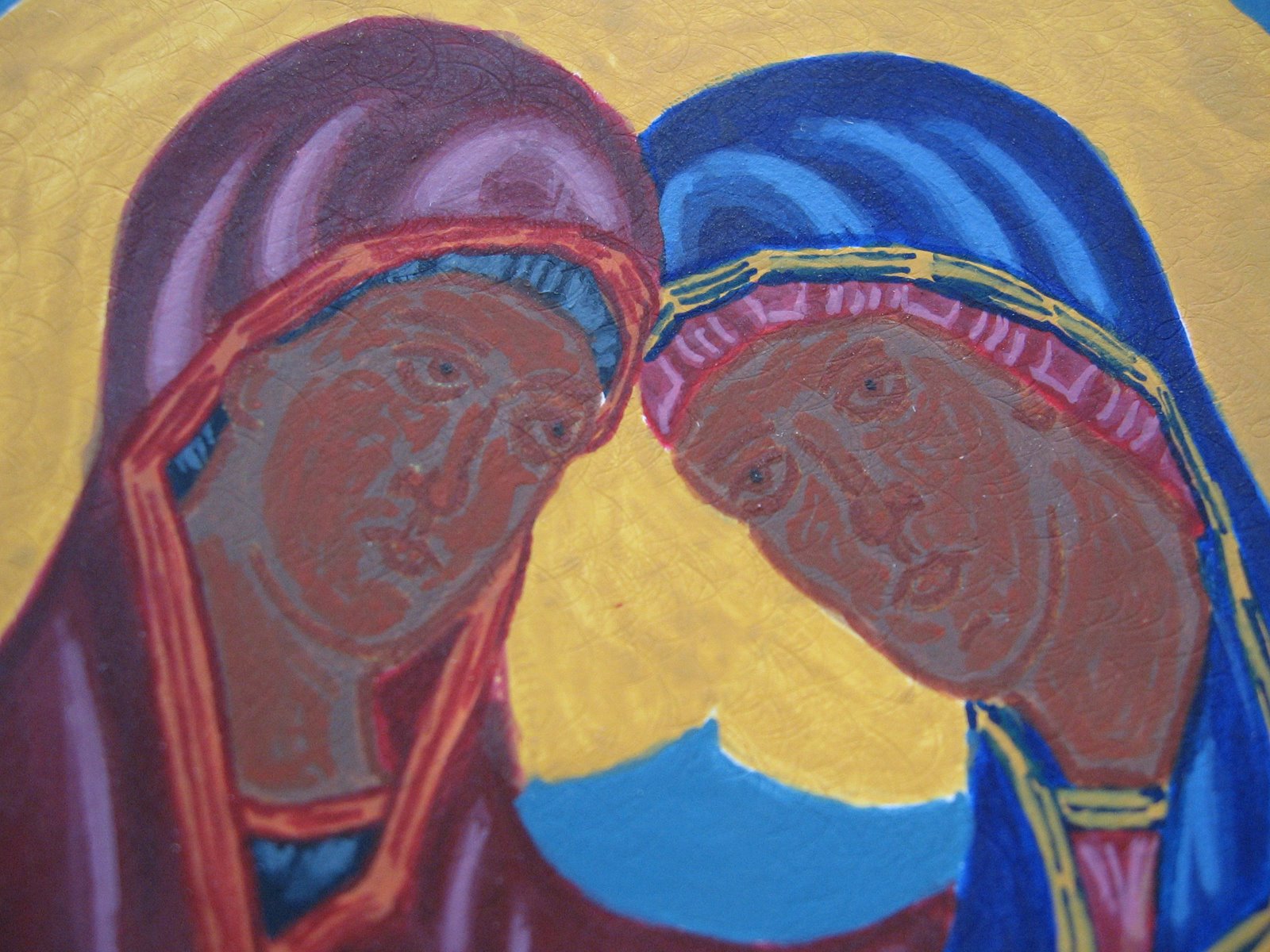
The scene portrayed is actually quite common. It is nothing really extraordinary – two friends embracing. The spectacle is repeated each day in a thousand different ways and contexts. It happens at airports, in driveways, at parties – to mention just a few contexts. In fact the occurrence is so common as often to be overlooked and passed over by the bystander.

But for the ones within the embrace, in whatever setting, there is found a deep joy and communion of heart.

There is a deep tenderness and understanding in this specific encounter between Mary and Elizabeth. It is, I believe, a silent moment. The very foundation of the world has been shaken and these two women know it. In fact, they are at the very epicenter.

The world rushes by – not even noticing these two women in the embrace. What is so special about it? It happens all the time. What the world fails to see and what these two women know is that everything has changed. The world and all its structures has been turned on its head.

A new communion has been established between God and us, and therefore, between me and you.

I have just seen that if one traces the outer edges of the two halos and carries the tracing down to where the arms cross then the image of a heart is drawn.