Tags
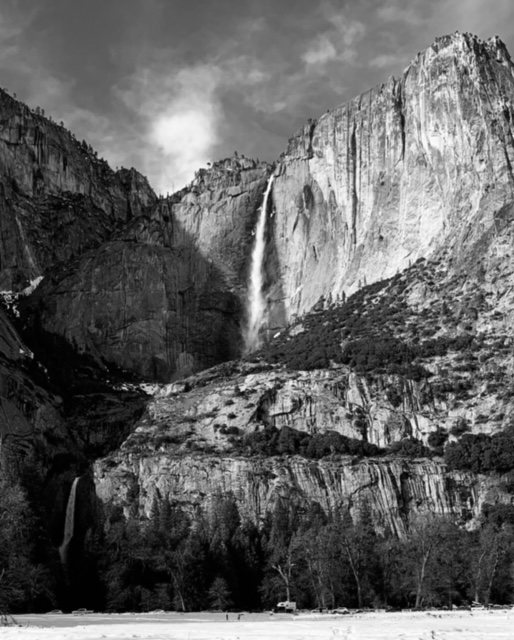
Last week I spent four days in Yosemite National Park continuing my quest to visit all of our country’s national parks. (I am now at twenty-six parks visited.) Each park – I have found – has its own particular beauty and awe. What most struck me in Yosemite was Yosemite Valley itself. Via the entrance road from El Portal, you weave into the valley catching hints of the surrounding mountains through the standing ponderosa pine trees. Yet, it is only within the valley that you are brought into a full awareness of the enormity of the surrounding cliffs and mountains that loom large over the fields, river and forests. One would think that the sheer cliffs and mountain rockfaces would weigh down on the valley and any person within it but the opposite is the case. El Capitain and Half-Dome continually pull one’s line of sight upwards and beyond oneself. Yosemite Falls and Bridalveil Falls, even as they drop into the valley, beckon the viewer to look up to the source of their waters. Even the tall ponderosa pines direct one towards the sky and what is above. Every aspect within this valley draws the person upwards.
John Muir named Yosemite Valley, “Nature’s Cathedral” and I cannot help but believe this upward movement of the valley is part of what Muir experienced himself and what, at least partly, stands behind his designation. Cathedrals and basilicas – by design – are meant to draw the person upwards into the transcendent and that which is beyond oneself. Interesting note – the basilica I found myself just naturally beginning to remember while standing in Yosemite Valley was La Sagrada Familia in Barcelona. On a tour of the famous basilica a number of years ago, I remember our group’s tour guide remarking how Antoni Gaudi based the design of the church not so much on the foundation sunk in the earth but rather on the movement of being drawn upward and this is witnessed to throughout the architecture. I have no idea if Gaudi knew anything about Yosemite Valley but I believe what he sought to express through his design of La Sagrada Familia finds deep natural resonance in the wonder and upward movement of Yosemite Valley.
Both John Muir and Antoni Gaudi were men steeped in the Christian faith. Muir’s father was a presbyterian minister who raised his children on the words of Scripture. Gaudi was a devoted Catholic whose life and work were guided by his faith. Both men were also devoted to the beauty of creation. Gaudi saw his basilica as a reflection of creation and the wonder that the Creator has entered within creation by the incarnation. Muir’s life was marked by an Old Testament prophet’s zeal for creation and humanity’s responsibility to be good stewards of what has been entrusted to us.
The fact that both of these men – coming from different parts of the world and from different life experiences – each had a sense of the wonder of creation and its upward movement AND were steeped in the language and thought of Christianity is no coincidence I believe. The language of Scripture which speaks of both creation and Creator, the awareness of the sublime wonder of the incarnation and resurrection and the hunch of what that implies for all of creation as well as a felt knowledge of grace in ones own life were all truths deeply embedded in each of these men (given ample witness in their work and words) and this is what gave them both the intuition required to sense the upward movement of a creation both weighed in reality and set free by grace as well as the words needed to give voice to that movement whether that be through the language of soaring architecture or the stirring words of essay, written letter or fireside conversations with an American president.
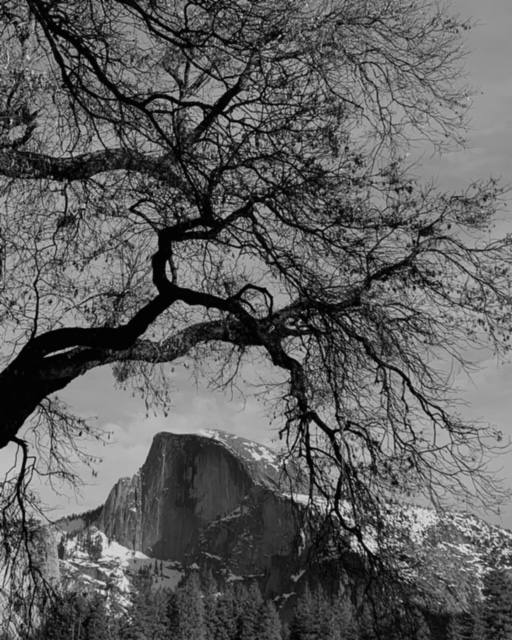
Christianity, when not manipulated by a perverse ideology of selfish domination, offers a person the awareness needed to truly listen to the heart of creation. This is expressed throughout the scope of Scripture and witnessed by a Savior who himself was fully attuned to all of the wonder and nuances of creation – just reflect on how he continually drew on creation to teach us about the Kingdom.
John Muir heard the heart of creation reverberating through Yosemite Valley. Antoni Gaudi heard the heart of creation and gave it voice in the soaring spires of La Sagrada Familia. Another Christian by the name of Paul also heard it and this reflection will end with his words:
“For creation awaits with eager expectation the revelation of the children of God; for creation was made subject to futility, not of its own accord by because of the one who subjected it, in hope that creation itself would be set free from slavery to corruption and share in the glorious freedom of the children of God. We know that all of creation is groaning in labor pains even until now.” (Rom. 8:19-22)
 It is interesting how some things stay with us and even become operating principles in our lives.
 What is best for the environment? This is a question I find myself continually returning to after reading Pope Francis’ encyclical “Laudato Si” as well as my own growing interest in protecting and safe-guarding creation. Do the plants and shrubs we favor around churches help benefit the environment or do they just look nice from our human perspective? Can our parish grounds themselves become places that benefit and support creation? A couple of years ago now I planted two butterfly bushes in front of our Parish Life Center because they fit and enhance the space, they are low maintenance and hardy and, in regards to this question, they are a benefit to bees and butterflies. A simple choice in a planting can have ripples of effect.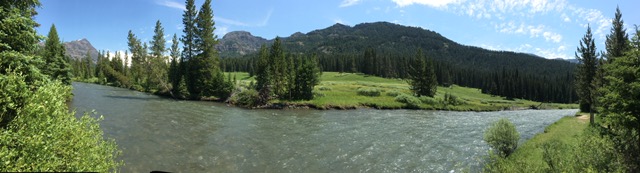
 Wolves (for which I have always had an interest in since I was a child) were my main interest in visiting Yellowstone but during these days I was also thrilled to view numerous black bears (a few with cubs), bison, elk, mule deer, bighorn sheep, pronghorn, an osprey nest inhabited by mother, father and two chicks, foxes, coyotes, badgers, a bald eagle flying and numerous smaller animals and birds.
![IMG_5641[3392]](https://thealternatepath.org/wp-content/uploads/2017/07/img_56413392.jpg) For a week, I was “unplugged” – to some degree. Other than sharing some pictures on Facebook and Instagram and talking with the people I met or was around during the day I had no idea what was going on in the world. I would rise early to get into the park before the heat of the day became too oppressive, return to Gardner for lunch and a short siesta and then return into the park not to leave until late in the evening.
For a week, I was “unplugged” – to some degree. Other than sharing some pictures on Facebook and Instagram and talking with the people I met or was around during the day I had no idea what was going on in the world. I would rise early to get into the park before the heat of the day became too oppressive, return to Gardner for lunch and a short siesta and then return into the park not to leave until late in the evening.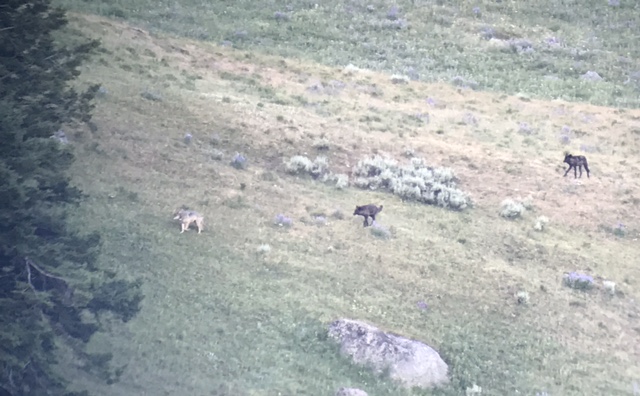 Although I have an interest in wolves and have now spotted three packs during my two visits to Yellowstone I do not think I have some “mystical” connection with them because the wolves are unconcerned about me and that is the way it should be. The wolves are just out there being wolves and if something were to happen and all of sudden humanity disappeared from the face of the earth the wolves, bears, bison, elk and all animals would just continue continuing on. But the wolves and other animals are of concern to me and that is what makes me human.
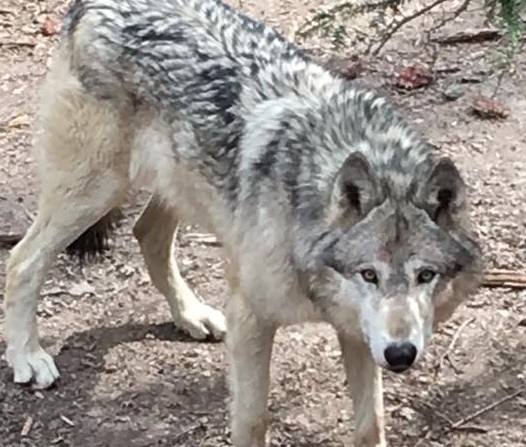 For close to a year now I have been volunteering at the wolf habitat in Bays Mountain Park in Kingsport, TN. The wolf habitat has been around for a few decades and currently is home to ten wolves. When my schedule allows, I go to assist with the feeding of the wolves which occurs twice a week. We do not go inside the enclosure but rather toss the food in. It is only the naturalists who can go in with the wolves and even then only under the strictest guidelines.
 Like the whole nation I gasped when I saw the video of the little boy in the enclosure with the gorilla. Sadly, I have also watched as the ensuing social media debate has seemed to devolve to either “team human” or “team animal” as if those are the only two options and that they have to be opposing by nature. Can we just be okay with acknowledging the tragedy all around and leave it at that? It is tragic that the child fell into the enclosure and could have been seriously harmed. It is tragic that the zookeepers (the very people who knew, cared for and protected the gorilla) had to make a gut-wrenching and quick decision that I know I would not want to have to make. It is tragic that the gorilla was shot and killed. It is easy for everyone else not there – now after a continuous loop of the video has been played and scrutinized by the media for days – to be an arm-chair quarterback. The reality of the situation was not easy; it was tragic. Sadly, life is sometimes tragic.
 It is said that old heresies never die; they just keep coming back in different forms. There is truth to this and I find it revealed in the pervasive spirit of Gnosticism present in our culture and time – specifically, Gnosticism’s denial of nature and creation. Historically, Gnosticism was a blending of aspects of Christianity, philosophy, and Eastern mystery religions that challenged the orthodox faith in its first centuries. Gnosticism highlighted secret knowledge as key to salvation as well as denigrating what it saw as the shackle or prison of creation and the physical body. The early Church had to answer the distortions of Gnosticism and it did so by maintaining the continuity of the same God revealed in the Old and New Testaments and holding to the profound truth of the incarnation.
 The Alternate Path