
• About The Alternate Path

The Alternate Path

~ Thoughts on Walking the Path of Christian Discipleship

The Alternate Path

Monthly Archives: January 2024

Holiness is not stingy. Holiness gives and welcomes. A homily for the second Sunday of Ordinary Time – B

13 Saturday Jan 2024

Posted by mcummins2172 in Uncategorized

≈ Leave a comment

Tags

Bible, Christian life, Christianity, disciple, discipleship, faith, gospel, Jesus, john, Second Sunday in Ordinary Time, vocations to priesthood and religious life
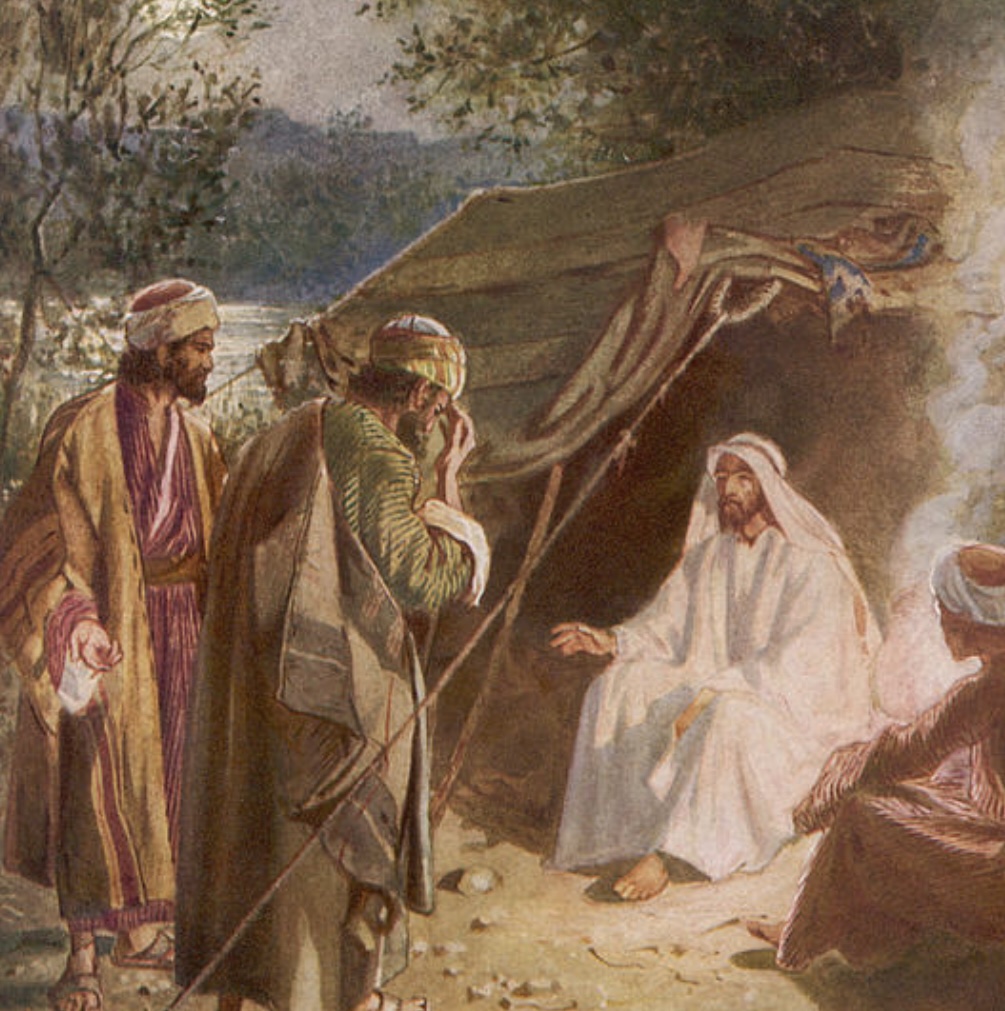
“Andrew taking Simon to meet Jesus” by Mary Evans. Image may be subject to copyright. 

Holiness and the life of grace are not stingy.  Holiness gives and it welcomes. This is my personal learning from the Advent and Christmas seasons. 

When I placed myself in prayer in the manger scene, Joseph and Mary did not just allow me to gaze upon the child, they welcomed me to hold the babe in my own arms.  They did not hesitate in inviting me to hold the child.  When I watched as Simeon and Anna rejoiced in encountering the newborn Messiah in the Temple, they both welcomed me into that joy and hope fulfilled.  When I prayed over Matthew’s account of the three magi journeying to find the newborn king, I found myself eagerly welcomed by the three wise men to journey with them. 

Holiness and the life of grace are not stingy.  Holiness and the life of grace welcomes, invites and encourages.  It does not seek to keep for itself. We find this is today’s gospel ((Jn. 1:35-42) also.  John the Baptist, the one who was declared the greatest of those born of women by our Lord, eagerly points out Jesus as the Lamb of God to his own disciples, not a bit concerned if that means he and his own proclamation would be lessened.  “Behold, the Lamb of God!”  John’s two disciples begin to follow Jesus and John does not begrudge this.  

The holiness of Jesus also gives and welcomes – and this is the deep truth of today’s gospel.  Jesus asks John’s disciples, “What are you looking for?”  “Rabbi,” they answer, “where are you staying?”  Jesus says, “Come, and you will see.”  We are told that they stay with him that day and then they too rush out to invite others.  “We have found the Messiah!” 

“Where are you staying?”  “Come, and you will see.”  It was more than an invitation to a specific physical place.  Elsewhere in the gospel, Jesus says that the Son of Man has no place to lay his head.  The invitation of “come and see” is an invitation by our Lord into that deepest place where he truly resides.  It is an invitation into his very relationship with the Father.  It is an invitation freely given and those two disciples, even in their imperfections and lack of understanding, are both freely welcomed.  It is precisely this new experience of being welcomed into the Son’s relationship to the Father that impels those two disciples to then immediately go forth themselves and invite others to know what they have found.    

Holiness is not stingy. Holiness does not begrudge. It does not try to keep all for itself. Today’s gospel invites us to that same honesty of heart that the two disciples of John had.  “Rabbi, where are you staying?”  Today’s gospel invites us to the same courage and faith that the two disciples had when Jesus responds, “Come, and you will see.” The gospel invites us to also go to that place where our Lord abides in his relationship with the Father and to know that we – even in our imperfections – are indeed welcome. 

Andrew first went and found his brother Simon and brings him to where Jesus is staying.  Jesus looks at him and says, “You are Simon the Son of John: you will be called Cephas (Peter)”,

Life changes when we go to where Jesus resides.  Life changes when we come to know that we also are welcomed into the Son’s relationship with the Father. 

The Feast of the Epiphany – awe, sacrifice and wisdom

07 Sunday Jan 2024

Posted by mcummins2172 in Uncategorized

≈ Leave a comment

Tags

Adoration of the Magi, Advent, Christianity, Christmas, Epiphany, magi, Three Kings, worship

Image may be subject to
copyright

The other day I was listening to the “Voices of Greater Yellowstone” podcast.  The current episode is an interview with the wildlife photographer Ronan Donovan and his sharing about the use of images to tell stories.  At one point in the interview the subject of awe was discussed and the photographer, sharing from his experience of travelling to some of the remotest regions of the world and having amazing encounters with wildlife, shared that he believes awe (this is my paraphrase) is connected to those moments when we forget self and are caught up into something so much more bigger than us.  That sense of awe and wonder is connected to those moments in life. 

The three magi were caught up in awe.  They saw the star, they interpreted that something much bigger than themselves and their particular tribe, culture and nation was at work.  After all, they journeyed to a foreign land to give homage to a newborn foreign king.

Awe allowed the magi to do two important things that are relevant for all believers in every age.  Awe allowed the magi to choose sacrifice over comfort and to choose wisdom over knowledge.  

It had to have been a sacrifice for the magi to depart their native land in order to undertake a journey of unknown length following a star in hopes of finding a newborn king.  Such a journey requires sacrifice and probably even brought some ridicule.  In contrast, the priests and scribes of Herod’s court, the very ones to whom the Messiah is promised, would not even set out to the nearby Bethlehem.  It seems that for them the comfort of the court was much more important than the sacrifice of the journey.  Allowing their hearts to be captured by awe, the magi chose sacrifice and this is to their everlasting credit.

The chief priests and scribes had knowledge.  When asked, they were able to point to the passage that the newborn king was to be born in Bethlehem but knowledge does not equal wisdom.  In the first chapter of the Book of Wisdom we read, For the holy spirit of (wisdom) flees deceit and withdraws from senseless counsels and when injustice occurs it is rebuked.  Wisdom is tied to integrity of life.  Knowledge is not.  One can be knowledgeable about something – even the things of faith – without integrity of life but one cannot possess wisdom without integrity. The magi left the deceit and senseless counsels of Herod’s court and did not return there.  They went home a different way.  The magi chose integrity of life and by this they welcomed wisdom. 

Awe – those moments when we forget self and are caught up into something so much bigger than ourselves.  Awe allows for the saving choices of sacrifice and wisdom.  Like the magi, we also are invited to be overjoyed at seeing the star and to set out on the journey of encountering the newborn king. The end of the Christmas season is really just the beginning of the awe-filled journey of coming to know Christ more truly, love him more dearly and follow him more closely. 

Blessings – a reflection on “Fiducia supplicans”

06 Saturday Jan 2024

Posted by mcummins2172 in Uncategorized

≈ Leave a comment

Tags

catholic, Christ, Christianity, Church, discipleship, Fiducia supplicans, news, Pastoral blessings, Pope Francis

Christ healing woman with a flow of blood. Catacombs of Marcellinus and Peter. Rome, 4th century. Image may be subject to copyright. 

There was a woman afflicted with hemorrhages for twelve years.  She had suffered greatly at the hands of many doctors and had spent all that she had.  Yet she was not helped but only grew worse.  She had heard about Jesus and came up behind him in the crowd and touched his cloak.  She said, “If I but touch his clothes, I shall be cured.”  Immediately her flow of blood dried up.  She felt in her body that she was healed of her affliction.  Jesus, aware at once that power had gone out from him, turned around in the crowd and asked, “Who has touched my clothes?”  But his disciples said to him, “You see how the crowd is pressing upon you, and yet you ask, ‘Who touched me?’”  And he looked around to see who had done it.  The woman, realizing what had happened to her, approached in fear and trembling.  She fell down before Jesus and told him the whole truth.  He said to her, “Daughter, your faith has saved you.  Go in peace and be cured of your affliction.”  (Mk. 5:25-34)

There has been a lot of talk about blessings in the Catholic Church these past few weeks since the issuance of Fiducia supplicans.  The concern seems to center upon what is the nature of a blessing and is every blessing offered by a member of the clergy a tacit sign of approval of the supplicant’s state of life, in particular couples in irregular situations.    

My reading of the document as well as the recent clarification issued is that no, every blessing offered is not a sign of approval and (this is what I find freeing about the declaration) it does not weigh upon the clergy to determine a person’s precise moral state when offering a “pastoral” blessing as opposed to a blessing given in a liturgical context. 

When a couple comes forward to get married in the Catholic Church there is a process of determining the couples’ freedom to enter into marriage as well as their readiness and this is appropriate as that sacramental celebration is tied to our Church’s teaching about the nature of marriage.  Liturgical blessings carry the weight of the Church’s teaching and are public in nature so, yes, it is on the church’s minister to ensure that blessings offered in a liturgical context are not in contradiction to the teaching of the Church. 

But blessings offered in a liturgical context are not the only type of blessing.  This is the key distinction offered by Fiducia supplicans.  Pastoral blessings which, the declaration specifies, are more private in nature and occur in the moment, do not carry the same weight of responsibility upon the clergy.  As I have read the declaration, the recent clarification and differing commentary I have been drawn to the gospel passage shared above.  It was a very public moment – the crowd was pressing in upon Jesus.  Our Lord knew nothing about the lady and her state in life.  Her faith and trust merited the outpouring of blessing and healing and our Lord confirms this, “Daughter, your faith has saved you.  Go in peace and be cured of your affliction.”

A couple of days before Fiducia supplicans was issued,I was in the neighborhood Lowe’s store in search of bird seed.  At one point, gawking in front of the plethora of Christmas yard art decorations, I was approached by a woman with a small child.  The woman, in broken English, asked for a blessing.  I had never met this woman.  I did not have to ask about her state in life.  I did not have to ask about her marital status nor did I ask if she was in a state of grace.  Standing in the aisle at Lowe’s, I responded to her request and I prayed a simple blessing.  It was certainly a public space but also a very private moment – a simple blessing that I think went unnoticed by the other shoppers milling about.   

The distinction in blessings made by Fiducia supplicans is valid and it is also freeing.  It is not on the clergy, in that moment, to have to carry the weight of judge rather, it is enough to be a humble believer and shepherd.  Might pastoral blessings and their true intent be misused?  Possibly, but any misuse does not necessarily discredit the valid request and the valid giving of a pastoral blessing – a cry for God’s mercy. 

I understand that these thoughts are written in the context of U.S. culture with the freedoms that we enjoy and value and that there are different contexts in different cultures that clergy need to honestly weigh out and consider.  God’s blessings and guidance upon those shepherds as they strive to care for the flock entrusted to their care.

There are moments for the clergy to be judge, safeguarding what the Church treasures.  Fiducia supplicans affirms this but the declaration also teaches that there are moments for the clergy to be fellow believers themselves who are also shepherds trusting in the abundant mercy of a God who works in ways we cannot even imagine. 

Follow The Alternate Path on WordPress.com

Enter your email address to follow this blog and receive notifications of new posts by email.

Previous Posts

  • December 2025
  • November 2025
  • August 2025
  • April 2025
  • February 2025
  • January 2025
  • December 2024
  • August 2024
  • July 2024
  • June 2024
  • May 2024
  • April 2024
  • March 2024
  • February 2024
  • January 2024
  • December 2023
  • November 2023
  • October 2023
  • August 2023
  • July 2023
  • May 2023
  • February 2023
  • January 2023
  • December 2022
  • August 2022
  • July 2022
  • April 2022
  • January 2022
  • December 2021
  • September 2021
  • August 2021
  • July 2021
  • May 2021
  • April 2021
  • January 2021
  • December 2020
  • November 2020
  • October 2020
  • August 2020
  • July 2020
  • May 2020
  • April 2020
  • March 2020
  • February 2020
  • December 2019
  • October 2019
  • September 2019
  • August 2019
  • July 2019
  • May 2019
  • April 2019
  • March 2019
  • February 2019
  • December 2018
  • November 2018
  • October 2018
  • August 2018
  • July 2018
  • June 2018
  • April 2018
  • March 2018
  • February 2018
  • January 2018
  • December 2017
  • November 2017
  • September 2017
  • August 2017
  • July 2017
  • June 2017
  • May 2017
  • April 2017
  • March 2017
  • February 2017
  • January 2017
  • December 2016
  • November 2016
  • October 2016
  • September 2016
  • August 2016
  • July 2016
  • June 2016
  • May 2016
  • April 2016
  • March 2016
  • February 2016
  • January 2016
  • December 2015
  • November 2015
  • October 2015
  • September 2015
  • August 2015
  • June 2015
  • May 2015
  • April 2015
  • March 2015
  • February 2015
  • January 2015
  • December 2014
  • November 2014
  • October 2014
  • September 2014
  • August 2014
  • July 2014
  • June 2014
  • May 2014
  • April 2014
  • March 2014
  • February 2014
  • January 2014
  • December 2013
  • November 2013
  • October 2013
  • September 2013
  • August 2013
  • July 2013
  • June 2013
  • May 2013
  • April 2013
  • March 2013
  • February 2013
  • January 2013
  • December 2012
  • November 2012
  • October 2012
  • September 2012
  • August 2012
  • July 2012
  • June 2012
  • May 2012
  • April 2012
  • March 2012
  • February 2012
  • January 2012
  • December 2011
  • November 2011
  • October 2011
  • September 2011
  • August 2011
  • July 2011
  • June 2011
  • May 2011
  • April 2011
  • March 2011
  • February 2011
  • January 2011
  • December 2010
  • November 2010
  • October 2010
  • September 2010
  • August 2010
  • July 2010
  • September 2008
  • August 2008
  • April 2008
  • March 2008
  • February 2008
  • January 2008
  • December 2007
  • November 2007
  • October 2007
  • September 2007

Popular Posts

  • thealternatepath.org/wp-c…
  • thealternatepath.org/wp-c…

Blog at WordPress.com.

  • Subscribe Subscribed
    • The Alternate Path
    • Join 156 other subscribers
    • Already have a WordPress.com account? Log in now.
    • The Alternate Path
    • Subscribe Subscribed
    • Sign up
    • Log in
    • Report this content
    • View site in Reader
    • Manage subscriptions
    • Collapse this bar
 

Loading Comments...