 One thing that the Scriptures do not shy away from presenting is tragedy. We like tragedy when it is on the screen or in a play but not so much in our lives. This is partly why we invest in IRA’s. Yet, tragedy is a part of life (Sacred Scripture knows this) and no one gets through this life without experiencing tragedy in one form or another.
Here is an interesting fact. The word “tragedy” is rooted in two Greek words which mean “goat song”. The thought is that the word comes out of ancient Greek drama where the chorus was dressed like satyrs, who in Greek mythology were goat-like woodland deities. A tragedy is a goat song.
Our Lord makes use of tragedy throughout his parables and teachings and today’s gospel is one example. The story of the rich man planning to build bigger storage bins and then be set for many years to come is both tragic and ironic. Just as the man is planning and dreaming, God knows that very night his life will be demanded of him.
There is tragedy in life. We all, in one form or another and at one time or another, will have to sing the goat song. Maturing in life and maturing in faith is coming to both recognize this and accept it. In both the recognition and acceptance of tragedy there is a hard fought maturity and wisdom gained that can never be pretended. This is why Scripture does not shy away from presenting tragedy. It is why in the first reading we hear from that great reflection on “vanity of vanities”. Tragedy has a way (unlike any other) of breaking through the illusions of life, the vanities that we all like, the vanities that keep us comfortable but stifled and that ultimately can impede us from the growth that is necessary.
Certainly part of the mystery of the cross is tragedy. It is the greatest tragedy in human history that the one man without sin publically died the death of a sinner, but God has a way of overcoming and transforming from within. The cross does not say that the Christian will never experience tragedy. That is an immature faith, yet it is preached and popular. The cross says that even in the midst of tragedy God is there for us. God can reside in tragedy because God has entered into the tragedy of the cross. Even in the tragic moments of our lives, God is there for us – willing to walk beside us and give us his grace, his strength, his love and his consolation and hope.
At the end of the parable God says, “You fool, this night your life will be demanded of you; and the things you have prepared, to whom will they belong?” God’s use of the term “fool” is not necessarily a condemnation of the man himself. How often do friends say to one another, “Don’t be a fool!”? Love allows for the freedom to point out foolishness. The foolishness of the man’s plans and attitude is what is subject to condemnation by God. How often are we, through our assumptions and attitudes, fools before God, but God still loves us.
“Thus it will be for all who store up treasure for themselves but are not rich in what matters to God.” In this context what does it mean to be “rich in what matters to God”? Here it is the awareness and the faith needed to know that, yes, there will be tragedy in life yet even in the midst of tragedy, God is God for us. We will each have to sing the goat song at some point but God – in his love and his willingness to embrace the tragedy of the cross – can even make of that something beautiful and graced.
If God is for us, who can possibly be against us?
 Our nation has been reflecting on the 50th anniversary of the Apollo moon landing. Where were you when man first stepped on the moon? I was one-year-old. I don’t remember much about it. It is fitting and right to have this reflection. It was and remains one of our nation’s greatest accomplishments and not just for what was achieved but how it was achieved. A goal was set and as a nation we rallied around that goal and we devoted the resources, the time, the energy, the skill needed to achieve that goal. In a sense, it was not just one man who took that first step on the moon but a whole nation. It was a great moment and will hopefully be one of continuing moments in humanity’s outreach into space.
 The longest pedestrian suspension bridge in North America is set to open later this month in our own Gatlinburg, TN. The bridge stretches nearly 700 ft. and is suspended 150 feet high. Apparently, it has glass panels as flooring in the middle of the expanse. I’ve been hearing people talk about it and have been seeing things on the news about it. Would you walk across it?
 In a recent interview on the life of faith and discipleship, Pope Francis shared an expression often used in Argentina – the expression is “primerea”. “…the Lord ‘primerea,’ anticipates us, waits for us; we sin and He is waiting to forgive us. He is waiting to welcome us, to give us His love, and each time faith grows.”
 What was our Lord writing on the ground with his finger? No one really knows but it is an interesting addition that the gospel writer makes to this narrative and it does lead one to wonder. What was he tracing on the ground?
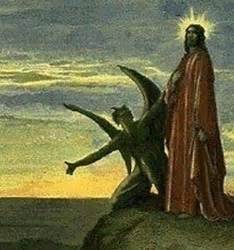 Have you ever noticed that each of our Lord’s temptations in Luke’s Gospel is a temptation to something within the immediate and that our Lord responds to each temptation by his hope in the future? That Jesus responds by not getting stuck in the immediate but by looking beyond the immediate to the infinite?
 “What does discipleship look like?’’ This was a question we were asked again and again in theology studies. What does it look like? How do disciples act in the world? How does one show that he or she is a follower of Christ?
 As some of you know I recently went to Yellowstone National Park and led a retreat there. Before and after the retreat I had free days so I took advantage of those days and went on some hikes. The first day going in I stopped at the ranger station just to check on things and make sure there were no concerns about the trails I was considering. The ranger suggested that I download the Yellowstone Park app as it would be a help to me. I took his advice and downloaded the app. It was a great help. What they have done at Yellowstone (and I am not sure if this is at other parks or not) is that they have mapped out every trail in the park on this app. Not only that, but when you go out on the trail you take your phone with you, switch it to airplane mode so that it is not continually searching for coverage and draining your battery and with GPS the phone shows you via a little dot on the screen exactly where you are at on the trail. One phone in the vast expanse of Yellowstone communicating with some satellite in the sky telling you exactly where you are at and which way to turn when the trail splits. I just find that level of technology, connection and focus amazing!
 Mary Lou was a woman I came to know in a previous assignment. She has since passed away. May she rest in peace. Mary Lou was one of those people who had the gift and (I think) the discipline of hospitality. Whether she was receiving one guest for a simple visit or a party of fifteen for a dinner, she knew how to welcome people, put them at ease and (in a good sense, never overbearing) see that their needs were met. I think that she saw hospitality as a holy act – a way of discovering and acknowledging the good in the other person. When you left Mary Lou’s house you were nourished on a multitude of levels.
 (This homily is geared toward our parish “Growing in Faith Day”. It focuses on the gifts of community, faith and the Eucharist.)
 The Alternate Path