• About The Alternate Path

The Alternate Path

~ Thoughts on Walking the Path of Christian Discipleship

The Alternate Path

Category Archives: Uncategorized

"Give Me Your Eyes" and "Jesus, Join My Life to Yours"

11 Friday Feb 2011

Posted by mcummins2172 in Uncategorized

≈ Leave a comment

Jesus, Join My Life to Yours

I want to unite my life to your life,
my thoughts to your thoughts,
my affections to your affections,
my heart to your heart,
my works to your works,
my whole self to your self,
in order to become through this union
more holy and more pleasing in the sight of your Father
and in order to make my life
more worthy of your grace
and of the reward of eternity. 

I want to join your intentions to my intentions,
the holiness of your actions to mine
and the excellence of your lofty virtues
to the lowliness of mine.

For example, when I pray,
I will join the holiness of your prayer to mine;
in the totality of my life as well as in its every detail,
I will join the whole breadth and height
     of your divine intentions
to whatever I have to do or to suffer.
I will join, if possible, your looks to my eyes,
your holy words to my tongue,
your meekness to my gentleness,
your humiliations and self-emptying to my humility,
in a word, your whole divine spirit to my actions:
and when, in some one of my works,
I discover something not inspired by your spirit
and which proceeds rather from my self-centeredness
or from some poorly mortified affection,
I will renounce it and disown it with my whole heart.
No, my Jesus, I promise myself to have nothing in me
     which is not in union with your lofty virtues. 
                                           (Jean-Pierre Medaille, SJ)

The intentional ignorance of proselytism

07 Monday Feb 2011

Posted by mcummins2172 in Uncategorized

≈ Leave a comment

Ignorance of the Catholic faith I can accept.  Intentional ignorance and the effort to proselytize Catholics I have no respect for.  Simple ignorance is a weakness, a lack of true knowledge that can be addressed through education.  Intentional ignorance and proselytizing is a conscious avoidance of the truth and fundamentally a disrespect to the other person which masquerades under the guise of christian care.   

You would think that having grown up in East Tennessee and now serving as a priest for fifteen years here I would not even bat an eye at the efforts by some groups to proselytize Catholics (being so used to it) but I am still taken aback whenever I encounter it.  I think because it runs so counter to a sense of respect for the other person that is deeply ingrained in the Catholic understanding and because these efforts are so often so blatant and “in your face” as if these groups actually think they are outsmarting and pulling one over on us poor Catholics.

I believe they think they are getting away with it because the Church does not respond in kind to their proselytizing efforts.  What they fail to realize is that the Church’s decision to not play the game is not a demonstration of the Church’s obliviousness but rather a demonstration of its true discipleship.  The Church is fully aware of what these groups are about but just because they choose these tactics does not mean that we have to.  The temptation is certainly there to respond in kind.  Like James and John we also might want to call down “fire from heaven” (Lk 9:54) but again and again throughout its teaching and documents on evangelization and mission the Church denounces proselytism and its methods because, at heart, these techniques and the mindset that form their foundation are a denial both of the dignity of the other person and of true christian discipleship.

Below is a list of some of the tactics of proselytism with my own thoughts offered in brackets:

• an unjust criticism and ridicule of Churches and their religious practices; (This might come out in blatant scoffing, promoting a superficial view of the Church as outdated or be expressed through pointed questions asked in “concern” but if one is attentive you quickly realize that the desire to actually listen to and even receive the answers given is lacking.  There is no true dialogue if the other is unwilling to listen and possibly even have his or her own perceptions challenged.)

• the use of moral compulsion and psychological pressure through certain publicity techniques in the communications’ media; (Emotion-filled worship services making use of hi-tech gadgetry and advertising methods is a common technique.  It should be noted that this was also a favorite method used by the Nazi propaganda machine in Germany.  I have a friend who has attended some of these types of services and he describes them as being “an inch wide and an inch deep”.  If you ever happen to be in one look around and see if his description is accurate.) 

• the explicit or implicit offer to help in areas of education and health as well as in material and financial assistance, as a means to create dependency; (The intention here is key.  The help offered is not freely given but it comes with strings attached.  Because of these “strings” it is completely legitimate to ask what is the real motive.) 

• attitudes and practices which exploit people’s needs, psychological weakness or lack of education, especially in situations of exhaustion and desperation, with no respect for human freedom and dignity.  (Any form of manipulation is a denial of human dignity and it has nothing to do with the christian message.)

These points are taken from “Encounter with the Living Jesus Christ: The Way to Conversion, Communion and Solidarity in America” (Vatican City, 1997).

What then to do in response?  There are some things we can do but, it must be noted, they are all “choices for” and not “decisions against”.  Again, we must avoid the temptation of James and John.  As Christians we are fundamentally for Christ and the fullness of the gospel rather than being against anything.   

Be Church in all its fullness, follow Christ in authentic and mature discipleship and promote a true and full understanding of Sacred Scripture and when encountering proselytizing groups say, “God bless you.  Now go away and let me get on with my life.  When you are able to enter into true dialogue then we can talk.” 

In the end all will be revealed and that which is lacking will be made known.

A further note: As I have continued to reflect on this topic I realized that proselytism and its tactics can be applied not just to certain religious groups but also to certain strains of secularism.  Just as there can be religious proselytizers there can also be secular proselytizers, both of which by their tactics deny respect for the other person.      

Salt and Light: Fifth Sunday in Ordinary Time (A)

04 Friday Feb 2011

Posted by mcummins2172 in Uncategorized

≈ Leave a comment

In Matthew 5:13-16, our Lord gives us two very distinctive images for what it means to live the life of discipleship – salt and light. We can say that part of the distinctiveness of these images is that both express a sense of “straightforwardness”.

The taste of salt is immediately known. It is not a flavor content to hide under other flavors. When salt is there the effect on the taste of something in unmistakable. The same can be said for light. It also is immediate in its effect. Either it is there or it is not. When light shines in a dark space it is known. Both salt and light are straightforward in their nature.

St. Augustine, in a commentary on psalm 112 (the psalm which we hear this Sunday) reflects on the similar straightforward nature of discipleship. Augustine contrasts the straightforwardness of the disciple with the ones who stumble in their envy of the sinner or who feel that their good deeds perish and are of no worth unless they receive some perishable reward in return – such as acknowledgement and the flattery of others. But the disciple who is straightforward is the one who does the good because it is the right thing to do – whether noticed by others or not. The disciple “neither seeks the approval of other people nor covets earthly riches…”

Augustine goes on to note that Psalm 112 proclaims that “glory and wealth are in the house of the just one…” Augustine comments that this “house” of the just one is in fact his or her heart and it is there that the just one dwells in a richer style than anything this world can afford. The “glory and wealth” of the just one is his or her righteousness before God. This is a “house” that no thief can break into and a “wealth” that can never be stolen.

In his words to his disciples our Lord is very specific. “You are the salt of the earth…” “You are the light of the world…” This straightforward nature of discipleship is already within – it has been placed there by God’s grace in baptism; we are sons and daughters of God! This truth does not have to be earned or gained. It is already present in the very makeup of who we are!

We, on our part, have to trust, believe and live it out. We must overcome the temptation to limit ourselves by the narrow horizons that we, our world and our own painful experiences set. “Salt losing its taste…”, and “light being hidden under the bushel basket” is, in fact, our giving in to our limited horizons and not living according to fullness of God’s horizon. As Nelson Mandela once remarked, “Our playing small does not serve the will of God!”

We are the salt of the earth … we are the light of the world … we are straightforward in our living according to the horizon that God has set for us.

The Feast of the Presentation and this little light of mine

03 Thursday Feb 2011

Posted by mcummins2172 in Uncategorized

≈ Leave a comment

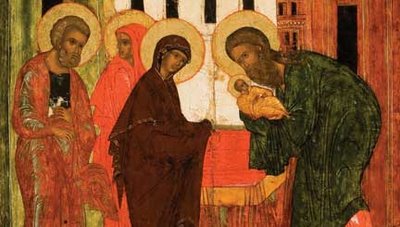
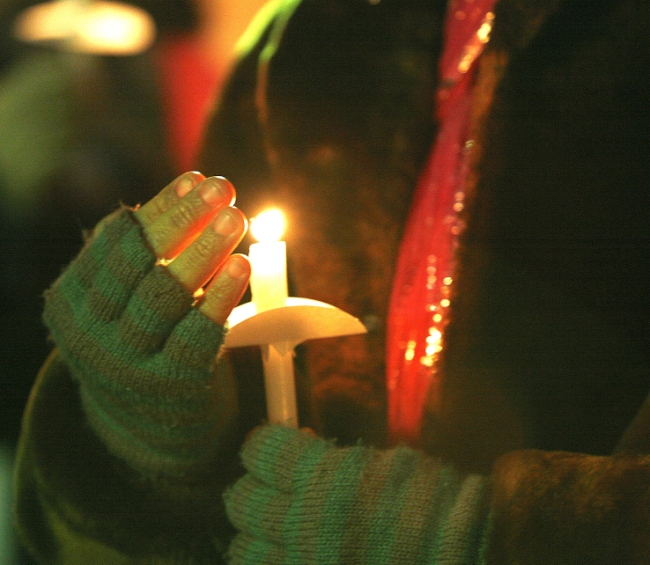
Every February 2nd the Church celebrates the Feast of the Presentation of the Lord.  On this day we remember Joseph and Mary bringing the infant Jesus to the temple according to the law of the Lord (Luke 2:22-40).  It is an ancient custom to bless candles on this feast.  The blessed candles are then used throughout the year.  The candles and their symbolism and significance work on many levels. 

Just as Joseph and Mary carried the infant Jesus (the light of the world) into the temple so we now, through our baptisms, carry the light of Christ within us.  Sometimes this light burns strong and true but there are times when the light seems weak and close to going out.  These can be times of struggle and difficulty.  In these moments we might wonder how we can keep the light of faith lit when there seems to be such upheaval all about.  
The antiphon used for the feast’s responsorial psalm (Ps. 24) is significant in this regard I believe.  The antiphon says, “Who is the king of glory?  It is the Lord!”  If we hold fast to this proclamation and enthrone it in our hearts then no matter how much circumstances and the world rage around us the light that is within us will remain.  It will never be extinguished.  In this proclamation all things are put in proper perspective.  God is God and all else is not.  The light will remain and we ourselves will shine with the light of Christ.  
Reflecting on this feast and the light of Christ, Blessed Guerric of Igny offers these words: “Come then, my brethren, give an eye to that candle burning in Simeon’s hands.  Light your candles too by borrowing from that Light; for these candles I speak of are the lamps which the Lord orders us to have in our hands.  Come to him and be enlightened, so as to be not merely carrying lamps but to be very lamps yourselves, shining inside and out, for yourselves and for your neighbors.  Be a lamp then in heart, in hand, in lips.”   

Friday fast for vocations

01 Tuesday Feb 2011

Posted by mcummins2172 in Uncategorized

≈ Leave a comment

In some ways I hesitate to share this post because I am aware of our Lord’s admonition in the sixth chapter of Matthew’s gospel:

When you fast, do not look gloomy like the hypocrites.  They neglect their appearance, so that they may appear to others to be fasting.  Amen, I say to you, they have received their reward.  But when you fast, anoint your head and wash your face, so that you may not appear to be fasting, except to your Father who is hidden.  And your Father who sees what is hidden will repay you.  (Mt. 6:16-18)

But I trust in our Lord’s benevolence and if I err in sharing these thoughts for other people’s consideration then I call upon God’s mercy. 

A few months ago I determined through prayer and its insight to commit every Friday as a day of fasting and abstinence from eating meat.  I talked this decision over with my spiritual director and I have determined that there are three compelling motives that have brought me to this decision: 1. a desire to grow closer to Christ 2. my role as vocation director and a fast specifically for vocations to priesthood and the consecrated life 3. a way of sharing in the repentance of the Church for the recent scandals that have wounded the body of Christ.

In many of his words regarding the clergy scandals our Holy Father has called for a renewed spirit of repentance within the whole church.  I believe that we must be sincere in this.  Sincere repentance can help heal the wounds that afflict the Church and we all, as members of the Church, have a role to play.

In my new ministry as Vocation Director for our diocese I am finding that there is much to do but the ministry must be about more than just “doing” because vocations cannot be programmed, designed nor produced.  Vocations are a response of the heart to the call of Christ.  This one day of the week I offer up my little discomfort that hearts might be open and willing to respond to God’s call.

I want to draw closer to Christ and yet I resist.  Fasting helps me to recognize all the ways (some big, some small) that I resist.  Fasting helps to clarify my thoughts and focus my attention and realize what is of true and lasting worth.  I have found that when I fast I am less caught up in my own illusions and I notice things more.

Talking about noticing things…  A little aside here – when I first began this weekly fast there were a number of weeks that I had to travel and I happened to find myself in airports on a few Fridays.  I quickly came to realize (as I walked from gate to gate with a growling stomach) how a considerable amount of square footage in airport terminals is dedicated to the selling of food and beverages and how there seems to be an efficiency in getting the smells of cooking food out into the terminal!  Lord, lead me not into temptation and help me walk by that Cinnabon stand!

I offer these thoughts for consideration.  There is a value to fasting.  God can take the littlest thing we have to offer and can do great things with it!   

Scripture, community and the error of fundamentalism

01 Tuesday Feb 2011

Posted by mcummins2172 in Uncategorized

≈ Leave a comment

As I shared in a previous blog, for the past few weeks I have been working through “Verbum Domini” (Pope Benedict’s post-synodal exhortation offered at the close of the synod of bishops gathering last fall focusing on the word of God in the life and mission of the Church).  It is a wonderful document and it is giving me much to reflect upon.  One of the themes that finds expression again and again throughout the exhortation is the indispensable role of the Church community itself in the authentic interpretation of Scripture. 

I would like to bring this theme out by quoting two passages that can (in some ways) be seen as in a dynamic tension with one another.  The first has to do with the error of the fundamentalist approach to Scripture and the second brings out the role of the community.  The quotes are found below under their appropriate heading:

The fundamentalist interpretation of sacred Scripture

The attention we have been paying to different aspects of the theme of biblical hermeneutics now enables us to consider a subject which came up a number of times during the Synod: that of the fundamentalist interpretation of sacred Scripture.  The Pontifical Biblical Commission, in its document “The Interpretation of the Bible in the Church,” has laid down some important guidelines. Here I would like especially to deal with approaches which fail to respect the authenticity of the sacred text, but promote subjective and arbitrary interpretations. The “literalism” championed by the fundamentalist approach actually represents a betrayal of both the literal and the spiritual sense, and opens the way to various forms of manipulation, as, for example, by disseminating anti-ecclesial interpretations of the Scriptures. “The basic problem with fundamentalist interpretation is that, refusing to take into account the historical character of biblical revelation, it makes itself incapable of accepting the full truth of the incarnation itself. As regards relationships with God, fundamentalism seeks to escape any closeness of the divine and the human … for this reason, it tends to treat the biblical text as if it had been dictated word for word by the Spirit. It fails to recognize that the word of God has been formulated in language and expression conditioned by various periods”.  Christianity, on the other hand, perceives in the words the Word himself, the Logos who displays his mystery through this complexity and the reality of human history.  The true response to a fundamentalist approach is “the faith-filled interpretation of sacred Scripture”. This manner of interpretation, “practised from antiquity within the Church’s Tradition, seeks saving truth for the life of the individual Christian and for the Church. It recognizes the historical value of the biblical tradition. Precisely because of the tradition’s value as an historical witness, this reading seeks to discover the living meaning of the sacred Scriptures for the lives of believers today”, while not ignoring the human mediation of the inspired text and its literary genres…

The role of community in authentic interpretation of Scripture

In this regard, however, one must avoid the risk of an individualistic approach, and remember that God’s word is given to us precisely to build communion, to unite us in the Truth along our path to God. While it is a word addressed to each of us personally, it is also a word which builds community, which builds the Church. Consequently, the sacred text must always be approached in the communion of the Church. In effect, “a communal reading of Scripture is extremely important, because the living subject in the sacred Scriptures is the People of God, it is the Church… Scripture does not belong to the past, because its subject, the People of God inspired by God himself, is always the same, and therefore the word is always alive in the living subject. As such, it is important to read and experience sacred Scripture in communion with the Church, that is, with all the great witnesses to this word, beginning with the earliest Fathers up to the saints of our own day, up to the present-day magisterium”.

For this reason, the privileged place for the prayerful reading of sacred Scripture is the liturgy, and particularly the Eucharist, in which, as we celebrate the Body and Blood of Christ in the sacrament, the word itself is present and at work in our midst. In some sense the prayerful reading of the Bible, personal and communal, must always be related to the Eucharistic celebration. Just as the adoration of the Eucharist prepares for, accompanies and follows the liturgy of the Eucharist, so too prayerful reading, personal and communal, prepares for, accompanies and deepens what the Church celebrates when she proclaims the word in a liturgical setting.

There is much to reflect upon in these two passages.  I find the recognition of the fundamentalist interpretation making itself “incapable of accepting the full truth of the incarnation” due to its refusal to acknowledge the historical character of biblical revelation to be very compelling.  This is probably because I once witnessed this incapability on display.

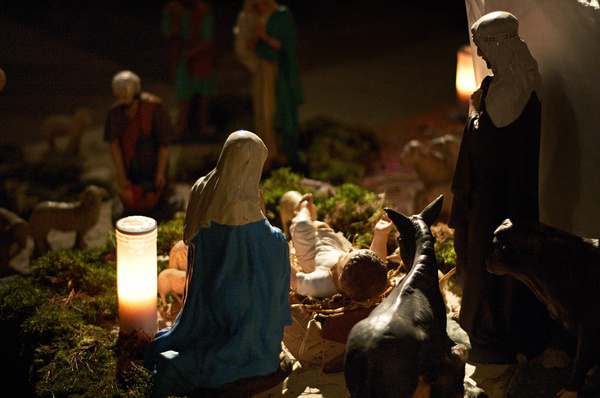
A few years ago I was pastor to a Catholic Church in a small town.  The town was full of churches, many of which were fundamentalist.  Every Christmas the churches would put out their nativity scenes for all to see.  One Christmas one of the larger downtown churches did not put out a nativity scene but simply a crib with a babe in it and a large depiction of an open Bible behind the crib.  That was all – no Mary, no Joseph, no shepherds, no angels, no animals – just an infant alone in a crib in the dead of winter.  Every time I drove by the display I felt like I should call the Department of Child Services!

Now, to give the church credit, I do see the message that they were trying to make about the centrality of God’s word.  But, it was an approach to Scripture that missed the mark.  The understanding of Scripture behind that lone crib was an expression of a theology incapable of accepting the full truth of the incarnation and therefore unable to accept the radical closeness of the divine and the human which is at the heart of the Christian revelation.  The nativity scene intimately demonstrates the closeness of the divine and human that we have in Jesus Christ.  The eternal Word did not come into the world self-sufficient but rather emptied himself and became a helpless infant in need of a mother, an earthly father, care and protection.  In need of our help!  The nativity scene is the very proclamation of the incarnation!

The error of fundamentalism is a denial of the incarnation.

This denial of the incarnation is also a denial of the church.  If we cannot even acknowledge the intimate union of the divine and the human in Christ then how can we ever acknowledge the value of the Church and the graced interaction of the divine and human in the Body of Christ?  Fundamentalism refuses to acknowledge how it was the early Christian worshipping community itself and its experiences that formed what we now know as Sacred Scripture.   God does not disdain “the human mediation of the sacred text…”   God is not jealous.  Human mediation in no way denies the glory of God – in fact it reveals it enfleshed!

Because the fundamentalist interpretation of Scripture is anti-incarnational it is therefore anti-ecclesial.  Everything devolves to a personal interpretation.

“Verbum Domini” calls us to the richness and beauty of an authentic approach to Scripture which is an approach grounded in the incarnation and in communion with the Church     

  

Fourth Sunday in Ordinary Time: Seeking God

28 Friday Jan 2011

Posted by mcummins2172 in Uncategorized

≈ Leave a comment

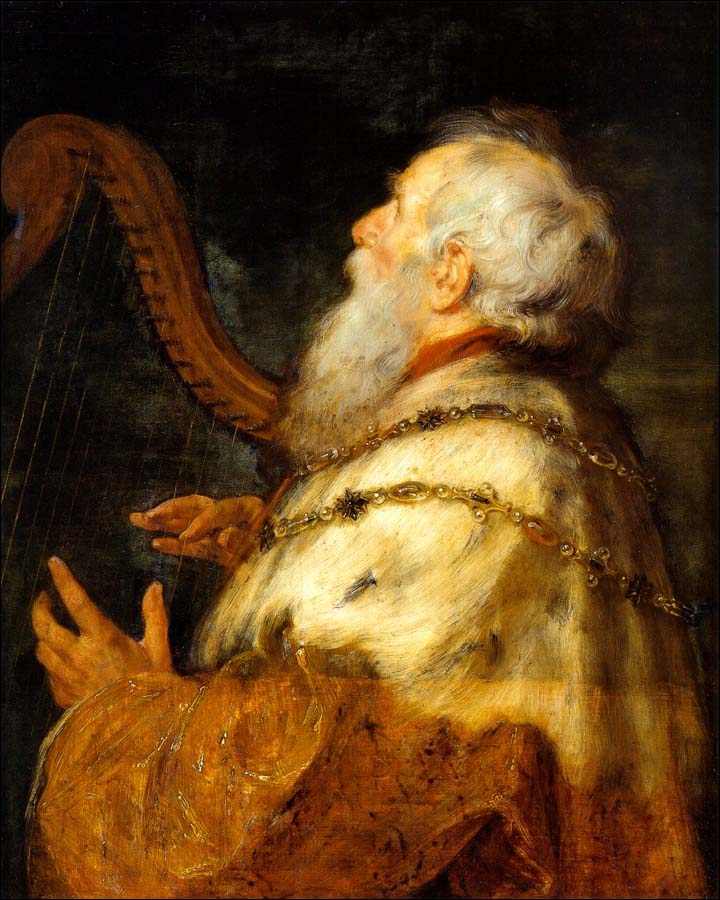
St. Augustine in reflecting on psalm 146 points out that, “A psalm is not a song like any other; it is sung to the accompaniment of a psaltery.” (A psaltery is a musical instrument similar to harp. It was designed to accompany song.) “Anyone who sings psalms does not therefore use the voice alone; he takes up the instrument known as the psaltery and, with the aid of his hands, harmonizes it with his voice. What about you? Do you want to sing and play psalms, which are praises to God? Then not only must your voice sing God’s praises, but your actions must keep in tune with your voice.”  (Taken from Expositions of the Psalms, New City Press, 2004)

In the first reading from the prophet Zephaniah, we hear these words, “Seek the Lord, all you humble of the earth…” But then the prophet goes on specifically to say, “seek justice, seek humility…” “Where is God?” “How might I grow in relationship with God?” These are two common questions of life and of the journey of faith. Both Augustine and Zephaniah advise that the starting point in answering these questions is to look at how we are living our lives.

If we praise God with our lips but our actions remain silent then we are out of tune. If we seek God but deny justice to our neighbor and puff ourselves up with pride then we will get nowhere. “If you want to praise God,” writes Augustine, “do not sing with your tongue alone but take up the psaltery of good actions as well…”

True praise of God consists of both voice and life.

It has been noted that in the Beatitudes we find a portrait of Christ. Jesus fully personifies each beatitude and in that he is “blessed”. In light of our analogy of psalm and psaltery we can also say that in the Beatitudes we hear the tune of Christ where voice and life are in harmony.

In each beatitude there is a choice made and an action taken. The choice and action is to turn toward God in every situation. In the time of sorrow – to seek God. In the time of confrontation and tension – to seek God. In the time of trial – to seek God. Tuning not just our words but our actions and our very lives toward Christ and in this we are “blessed” because God is encountered.

The insight of Augustine and Zephaniah is the same truth expressed in the Beatitudes – to begin seeking God we must look at how we are living our lives.

The Word of God and Vocations

28 Friday Jan 2011

Posted by mcummins2172 in Uncategorized

≈ Leave a comment

For a few weeks now I have been working through “Verbum Domini” (Pope Benedict’s post-synodal apostolic exhortation on the word of God and the Church).  I have been reading this as I exercise on the stationary bike and the elliptical machine at the gym on campus.  I am sure it is quite the sight for others in the gym! 

The exhoration is very rich and is giving me much to mull over – some of which will make it into future blogs I am sure – but today a passage that caught my attention dealt with the word of God and Vocations.  Below is the passage.

In stressing faith’s intrinsic summons to an ever deeper relationship with Christ, the word of God in our midst, the Synod also emphasized that this word calls each one of us personally, revealing that life itself is a vocation from God. In other words, the more we grow in our personal relationship with the Lord Jesus, the more we realize that he is calling us to holiness in and through the definitive choices by which we respond to his love in our lives, taking up tasks and ministries which help to build up the Church. This is why the Synod frequently encouraged all Christians to grow in their relationship with the word of God, not only because of their Baptism, but also in accordance with their call to various states in life.

Here we touch upon one of the pivotal points in the teaching of the Second Vatican Council, which insisted that each member of the faithful is called to holiness according to his or her proper state in life.[263] Our call to holiness is revealed in sacred Scripture: “Be holy, for I am holy” (Lev 11:44; 19:2; 20:7). Saint Paul then points out its Christological basis: in Christ, the Father “has chosen us before the foundation of the world, that we should be holy and blameless before him” (Eph 1:4). Paul’s greeting to his brothers and sisters in the community of Rome can be taken as addressed to each of us: “To all God’s beloved, who are called to be saints: grace to you and peace from God our Father and the Lord Jesus Christ!” (Rom 1:7).

The exhortation can be viewed as a summons for the whole Church to continuously encounter the word of God but this passage speaks specifically to the word of God, vocation and its discernment.  In Scripture we encounter the living Lord and he speaks to our heart; so by growing “in relationship with the word of God” we necessarily grow in awareness of our vocation, our calling in life. 

We can readily call to mind the witness of various saints throughout the ages whose vocation was made clear through the proclamation of and encounter with a scripture passage.  I think of St. Anthony of the desert and St. Augustine; both of whose stories make a dramatic turn through an encounter with the word of God. 

The Holy Father points out that the synod specifically stressed that the word of God, “calls each one of us personally“.  God’s word is, indeed, alive and it does speak to the heart and when we approach God’s word authentically, respectfully, prayerfully and within the proper context of church then great insight and sure knowledge will be gained regarding God, faith and even our vocation. 

To help discern a vocation – spend some time daily with Scripture.  Let it speak to you and see where it leads.      

The March for Life and why I go

26 Wednesday Jan 2011

Posted by mcummins2172 in Uncategorized

≈ Leave a comment

This last Sunday I and some others members of the Catholic Center boarded a bus to Washington, D.C. at 5:00 a.m. to attend the national March for Life.  We joined with one hundred and sixty other people on this trip organized by Chattanoogans for Life.  The March is held every year on the anniversary of the Roe v. Wade decision which legalized abortion on demand in our nation.  Since that decision fifty million unborn children have been aborted.

This is the ninth March that I have attended.  It is always a whirlwind trip and very tiring.  You ride up, some years you are able to make the Vigil Mass held in the Basilica of the Immaculate Conception, you sleep on a gym floor, you rise very early the next day to get ready and to get your things packed up and thrown back on the bus, you get to the site of the Rally and Mass and then you go to the Mall for the speeches (standing quite a while in the cold), then the March (which itself takes time to just get started because – I have noticed – the crowd is always much larger than that which is reported by the media and it takes a while to get such a large group moving together.)  After the March you pack into Union Station with thousands of other marchers.  You take a train to your bus and then you are back on the road again.  This year our group was dropped off at the Kingsport exit at 3:30 a.m. Tuesday morning.

All of this begs the question; “Why?” – and believe me it is a question I asked myself as I dealt with lack of sleep and a crick in my neck from trying to sleep on a bus.  As I reflected on this question two people came to my mind and I believe that this year I marched for them.

The first is Sophie.  Sophie is four years old and I had the privilege to hold her in my arms the day of her birth.  In many ways I consider her my spiritual grandchild.  I have known Sophie’s dad (Brad) since my first assignment when he was in the youth group.  Brad and Hannah (Sophie’s mom) actually met at a youth retreat and they like to joke that I was a little frustrated with them at the retreat because they were more focused on one another than on the retreat itself.  Go figure…  I was the celebrant at their wedding.  I was there the day Sophie was born and I was the celebrant for her baptism.  Sophie and I go way back. 


Brad, Hannah and Sophie

Whenever I visit their family the first words I hear from Sophie are always, “Fr. Michael, lets go play.”  Obviously, I cannot refuse – Brad and Hannah just smile and roll their eyes – and the next twenty minutes are spent with me usually sitting on the floor playing with dolls or with the latest game.  Of course, Sophie makes the rules.

Sophie is not perfect (she is a typical four year old and she has her moments – as Brad and Hannah will attest) but she brings great joy to my heart.  I find the world a brighter place knowing that she and her family are out there.  The world would not be as bright without her.  I marched for Sophie this year and I marched for all the children who we will never know.

Secondly, I marched for a lady whom I will name “Rachel” and her tragic story.  A while back I got to know Rachel through my ministry.  She was a very accomplished person – successful in her career, well thought of and respected.  Yet, in her heart there was a deep hurt.  Over time Rachel shared with me that she had procured two abortions and how she now truly regretted those decisions.  She had confessed both abortions but the pain remained.  We talked about regret and contrition, mercy and forgiveness and God’s love for her and her two children.  A number of times I encouraged her to attend a “Project Rachel” retreat (a retreat that helps women and men find forgiveness and healing after an abortion).  She never seemed to find the time to attend the retreat but she did find great consolation in the knowledge that God had not forgotten her children.  Rachel committed suicide.  To this day I believe that the pain was just too much for her to bear.  She once told me that one of the great pains of the abortion myth is that you are not even allowed to grieve.  “Its not a person, its just a bunch of cells – so put those thoughts away” was the message she was left with; yet those thoughts would not go away.  Rachel was not even allowed the opportunity to mourn.  I marched for Rachel and I realized that the world is not as bright without her.

I marched for my friends and I will continue to march until we as a nation realize that there is a better way and that where we are now is just not acceptable.         


The joy of vocation – loving that which is "worthy of love"

21 Friday Jan 2011

Posted by mcummins2172 in Uncategorized

≈ 1 Comment


With a little friend at an orphanage in Quito, Ecuador

 I want to let you in on a little known secret.  Priests and religious enjoy their lives and the numbers are there to prove it!  Consistently in surveys measuring job satisfaction and fulfillment Catholic priests and religious score in the very top percentile reporting overwhelming satisfaction with what they do.  Even in the midst of the scandals, even in the midst of what many people see as the deprivations and burdens of the life of the priest and religious; overwhelming satisfaction continues to be reported in survey after survey.  Why is this?
 
On the surface and as the world measures things it does not make sense.  One certainly does not get rich in working for the Church so satisfaction cannot be measured by comfort and things acquired.  The hours are definitely long and unpredictable.  Control of ones schedule is often thrown out the window.  Control of ones own life, for that matter, also is gone.  Participating in tense moments is a daily occurrence.  Privacy often takes a backseat to being a public person.  The automatic prestige once given clergy and religious is a thing of the past.  Often, one has to deal with unrealistic demands and expectations.  Yet, priests and religious consistently report overwhelming satisfaction in what they do … why?  

“But the person who is truly happy is not so much the one who has what he or she loves, but the one who loves what is worthy of love…” (St. Augustine of Hippo)  These words by the bishop of Hippo – a man intimately familiar with all the above struggles of the priest and religious (and even more so) – bring us, I believe, to the reason.  And, further, the joy found in the lives of priests and religious witnesses to the wisdom and truth of Augustine’s insight.   

The priest and religious – even in their stumbling humanity – strives to love that which is “worthy of love” – Christ and His Church.  (One cannot truly love Christ without also loving that which Christ himself loves – the Church.)

I say “stumbling” because I know that from my own experience – every day I stand in need of God’s mercy, love and guidance – and yet I have been graced to love that which is indeed worthy of love.  Despite all the above – and paradoxically, even through all the above – the very life of the priest and religious witnesses that there is indeed a joy which comes from striving to love that which is worthy of love!  It is indeed a joy that goes beyond this world and beyond anything one may be having to endure in the moment. 

God blesses with an abundance of joy the one who strives toward him!

Happiness is found in loving that which is worthy of love!    

← Older posts
Newer posts →
Follow The Alternate Path on WordPress.com

Enter your email address to follow this blog and receive notifications of new posts by email.

Previous Posts

  • May 2026
  • April 2026
  • March 2026
  • December 2025
  • November 2025
  • August 2025
  • April 2025
  • February 2025
  • January 2025
  • December 2024
  • August 2024
  • July 2024
  • June 2024
  • May 2024
  • April 2024
  • March 2024
  • February 2024
  • January 2024
  • December 2023
  • November 2023
  • October 2023
  • August 2023
  • July 2023
  • May 2023
  • February 2023
  • January 2023
  • December 2022
  • August 2022
  • July 2022
  • April 2022
  • January 2022
  • December 2021
  • September 2021
  • August 2021
  • July 2021
  • May 2021
  • April 2021
  • January 2021
  • December 2020
  • November 2020
  • October 2020
  • August 2020
  • July 2020
  • May 2020
  • April 2020
  • March 2020
  • February 2020
  • December 2019
  • October 2019
  • September 2019
  • August 2019
  • July 2019
  • May 2019
  • April 2019
  • March 2019
  • February 2019
  • December 2018
  • November 2018
  • October 2018
  • August 2018
  • July 2018
  • June 2018
  • April 2018
  • March 2018
  • February 2018
  • January 2018
  • December 2017
  • November 2017
  • September 2017
  • August 2017
  • July 2017
  • June 2017
  • May 2017
  • April 2017
  • March 2017
  • February 2017
  • January 2017
  • December 2016
  • November 2016
  • October 2016
  • September 2016
  • August 2016
  • July 2016
  • June 2016
  • May 2016
  • April 2016
  • March 2016
  • February 2016
  • January 2016
  • December 2015
  • November 2015
  • October 2015
  • September 2015
  • August 2015
  • June 2015
  • May 2015
  • April 2015
  • March 2015
  • February 2015
  • January 2015
  • December 2014
  • November 2014
  • October 2014
  • September 2014
  • August 2014
  • July 2014
  • June 2014
  • May 2014
  • April 2014
  • March 2014
  • February 2014
  • January 2014
  • December 2013
  • November 2013
  • October 2013
  • September 2013
  • August 2013
  • July 2013
  • June 2013
  • May 2013
  • April 2013
  • March 2013
  • February 2013
  • January 2013
  • December 2012
  • November 2012
  • October 2012
  • September 2012
  • August 2012
  • July 2012
  • June 2012
  • May 2012
  • April 2012
  • March 2012
  • February 2012
  • January 2012
  • December 2011
  • November 2011
  • October 2011
  • September 2011
  • August 2011
  • July 2011
  • June 2011
  • May 2011
  • April 2011
  • March 2011
  • February 2011
  • January 2011
  • December 2010
  • November 2010
  • October 2010
  • September 2010
  • August 2010
  • July 2010
  • September 2008
  • August 2008
  • April 2008
  • March 2008
  • February 2008
  • January 2008
  • December 2007
  • November 2007
  • October 2007
  • September 2007

Popular Posts

  • thealternatepath.org/wp-c…
  • thealternatepath.org/wp-c…
  • thealternatepath.org/wp-c…

Blog at WordPress.com.

  • Subscribe Subscribed
    • The Alternate Path
    • Join 156 other subscribers
    • Already have a WordPress.com account? Log in now.
    • The Alternate Path
    • Subscribe Subscribed
    • Sign up
    • Log in
    • Report this content
    • View site in Reader
    • Manage subscriptions
    • Collapse this bar