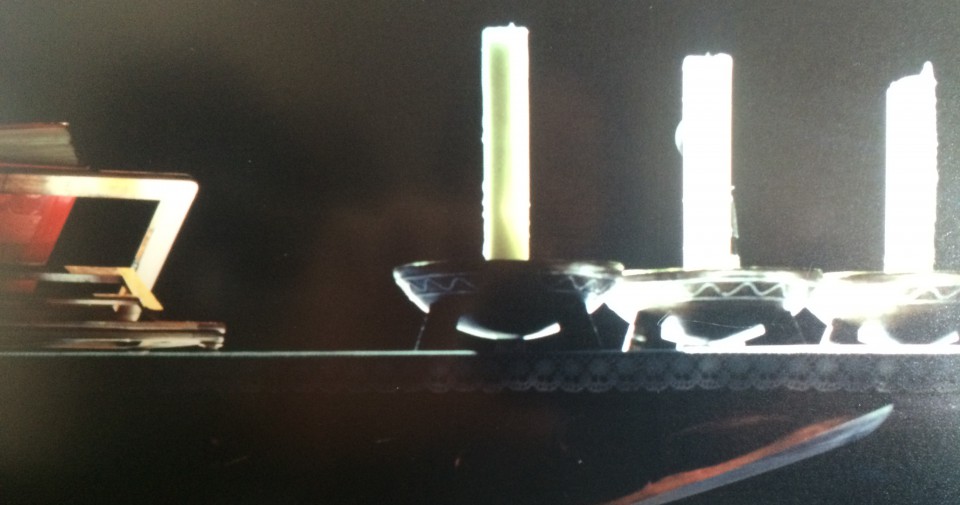
The Eucharist and the Burning Bush of Exodus: Feast of the Most Holy Body and Blood of Christ

Recently, Pope Francis offered these words during his Sunday Angelus address. 
Every Sunday we go to Mass, we celebrate the Eucharist together and the Eucharist is like the ‘burning bush’ in which the Trinity humbly dwells and communicates itself: this is why the Church has placed the feast of the Body of the Lord after that of the Trinity.

The Holy Father has given us some wonderful images to reflect upon on this Feast of the Body and Blood of Christ (traditionally known as Corpus Christi). 
If we look to the third chapter of Exodus (verses 1-6) we read of Moses’ encounter with God revealed in the burning bush.
Meanwhile Moses was tending the flock of his father-in-law Jethro, the priest of Midian. Leading the flock beyond the wilderness, he came to the mountain of God, Horeb.   There the angel of the Lord appeared to him as fire flaming out of a bush.   When he looked, although the bush was on fire, it was not being consumed. So Moses decided, “I must turn aside to look at this remarkable sight. Why does the bush not burn up?” When the Lord saw that he had turned aside to look, God called out to him from the bush; “Moses! Moses!” He answered, “Here I am.” God said: “Do not come near! Remove your sandals from your feet, for the place where you stand is holy ground!”   “I am the God of your father, he continued, “the God of Abraham, the God of Isaac, and the God of Jacob.”  Moses hid his face, for he was afraid to look at God. 
We are told that Moses wonders why the bush is not consumed and only after he decides to “turn aside and look” does God speak to him.  God waits for the moment when we are ready for him to speak to us.  We, for our part, must learn how to “turn aside” from all that distracts us, from the illusions, sad logic and passing fancies of our world in order to then be ready to encounter God.  God is present and is waiting to reveal himself if we just turn aside to look.  In the Eucharist – celebrated on the altar, reserved in the tabernacle – the fullness of Christ is present.  On every altar during the celebration of the Eucharist and in every tabernacle we can say that the burning bush is present waiting for us to just turn aside and look. 
The bush was not consumed.  God is not opposed to creation nor limited as creation is limited.  The presence of God does not negate my freedom nor does it negate my possibility.  God is not simply another actor within creation whose very presence necessarily limits my own space.  God is rather the source of all creation, the one who is pure love and who is non-competitive with his creation.  Christ is fully present within the Eucharist.  The bread and wine truly becomes the body and blood of Christ yet it is neither consumed nor lost.  When we receive the Body and Blood of Christ, we also are neither consumed nor lost nor oppressed; rather we are transformed into the very thing which we consume.  Through the presence of God, we are fulfilled. 
“Remove your sandals from your feet; for the place where you stand is holy ground!”  The Eucharist is holy.  This is why we reverence it, adore it, place it in a special place of reservation and come before it in prayer.  Our sandals are what carry us through our day-in and day-out lives.  Our sandals are the mundane and profane trappings of life (profane not in the sense of “anti-sacred” but rather in the sense of common and ordinary).  We are meant to remove our sandals, we are meant for more than just the ordinary!  We are meant for relationship with God!  In the Eucharist we meet Christ, we know him and we receive him.  The fullest form of friendship and communion is given to us in the Eucharist.
“I am the God of your father,” he continued, “the God of Abraham, the God of Isaac, and the God of Jacob.”  Just as we receive Christ in the Eucharist so do we regain ourselves.  Moses had forgotten who he was, God remembered for him.  “I am the God of your father…”  Life can wear down, confuse and distract.  We need food for the journey.  We need help remembering who we are.  In receiving the Eucharist we are reminded again of who we are – a child of God, beloved of the Father, brother and sister to Christ our Lord!  And once we encounter God and remember who we are then we are ready for mission in our world.  Moses needed to know who he was before he could ever go before Pharaoh.  The same is true for us.  Before the pharaohs of our world (violence, sin, greed and all the sad logics that seek to divide and oppress life) we need to be constantly reminded of who we are, who our brothers and sisters are and who our Father is. 
Jesus said to the crowds: “I am the living bread that came down from heaven; whoever eats this bread will live forever; and the bread that I will give is my flesh for the life of the world.” (Jn. 6:51)
“…the Eucharist is like the ‘burning bush’ in which the Trinity humbly dwells and communicates itself.” 

Pope Francis, the Community of Sant’Egidio and their mutual friend

This coming Sunday (May 15th), Pope Francis will visit with the Community of Sant’Egidio at the Basilica of Santa Maria in Trastavere in Rome and will then walk a block to the Chapel of Sant’Egidio where the community is headquartered.  The heart of this visit by the Bishop of Rome will be an encounter with the poor.  Pope Francis’ friendship with and care for the poor is well known and is shared by the Community of Sant’Egidio.  When Andrea Riccardi along with a group of his friends in 1968 (all young high school students) heeded the summons of the Second Vatican Council to pick up the Gospel and read they quickly discerned that to be a Christian meant to be friends with the poor.  This realization led them to the slums of Rome where they began the first “School of Peace” – a daycare for the children of poor families.  Since then the Community has continued to walk with the poor and forgotten around the world and continues to learn the lessons that only the poor can offer any disciple of Christ. 
In one sense it is no wonder that Pope Francis and the Community of Sant’Egidio are having this encounter because it is the poor who are bringing them together.  It is like a mutual friend saying, “Come, I really want you to meet someone!”  The poor are the mutual friend bringing the two together.  Truth be told, this is not the first encounter of Pope Francis with the community.  Pope Francis has been a friend to the community since his days in Argentina.  In his role as cardinal of Buenos Aires he was supportive and encouraging of the work of the community.  But, even more so, he has himself been a friend of the poor throughout his own priesthood and life of faith.  From his biography we learn that Cardinal Bergoglio was not adverse to the slums and, in fact, that he encountered his Lord and Savior in the faces of his poor friends, brothers and sisters.  Pope Francis also walks with the poor and has learned the lessons that they alone have to offer.  
Being brought together by their mutual friend the poor is the key, I believe, to this coming encounter between the Bishop of Rome and this particular community of disciples.  Many people are talking about the “Francis effect” – meaning how Pope Francis has caught the attention and imagination of the world.  A danger in such talk is to try to determine his “technique” or, maybe worse, create a narrative which proposes a technique which can then be learned and copied.  I do not think Pope Francis has a technique in this regard; I think he just has friends and he loves his friends and wants to be with them.  Pope Francis is authentic and authenticity always attracts. 
As a diocesan priest and a member of the Community of Sant’Egidio I have found that my own priesthood and life of faith has been strengthened and often reinvigorated by my friendship with the poor.  The key word is “friendship”.  The poor are not clients, they are not a once or twice a year encounter (usually around the holidays), they are not a service project rather they are friends and this has implications.  I want to be with my friends, I enjoy their company, I do not have to pretend I can solve their problems it is enough just to be together, I trust that they also have something to offer me.  One of the greatest gifts that the poor have to give is the desire to just be together.  “When are you coming back?” is a question often asked by my poor friends.  
Currently, I am in a time of transition in my priesthood.  I am returning to parish ministry after seven years in specialized ministry.  A year ago I was also reassigned to a different part of my diocese (an area from which I am now moving).  The gathering of Sant’Egidio that I had begun at a Newman Center in this new location was just beginning its service and friendship with the poor in a low-income residence when we had to cease for summer break.  I find that my own priesthood and discipleship is not as strong and resilient and is easily turned inward when I do not have a continuing and faithful relationship with the poor.  There is a lesson here, I believe, both for the priest and the parish and it is a lesson that I have heard both Pope Francis and the Community share.  We can easily turn inward and become self-absorbed and stagnant in the life of faith and we therefore need something that continually turn us away from self and toward others and this means more than just our own particular circle of friends.  The poor do this and it is not a technique, it is an encounter.  It is friendship. 
Once settled, I hope to begin a gathering of Sant’Egidio in my new assignment.  I will do this both for the parish and for my own discipleship.  As I look to my new assignment and as I look to this upcoming meeting of Pope Francis and the Community by their mutual friend I wonder how things in the parish might be different as we realize friendship with the poor.  As Pope Francis has often said, “A Church of the poor and for the poor.”  I do not have the full answer to this but I am willing to find out. 
(If you are interested, the meeting of Pope Francis with the Community of Sant’Egidio will be live streamed on Sunday, May 15th, beginning around 3 p.m. Rome time.  To watch, go to the community website at www.santegidio.org.)                  

Three deficits brought to light by the Harvard "black mass" incident

It is interesting how an incident can bring seemingly rambling thoughts and intuitions together into clarification.  This has been the case for me as I have reflected upon the whole “black mass” incident at Harvard.  I believe that the proposal for a black mass and how it seemingly developed as well as the uproar it caused in response reveals some very real deficits in our current secular world and understanding.
The first deficit is a lack of comprehension in our society in terms of what defines “religion” and therefore a much needed societal discussion on both “religion” and what constitutes “freedom of religion”.  This is a discussion Americans don’t like to have and prefer to avoid if at all possible.  “You believe what you want and I will believe what I want and we will call it even,” is very much the doctrine of our day.  To some degree there is good in this.  Better tolerance than religious wars.  Yet, when people just assume that a black mass must be tolerated and even condoned by a university then something is lacking in our understanding of religion and religious tolerance.  Here is where things get messy, “religious” groups and activities can and should be evaluated and judged.  Not every group who claim the title “church,” “temple,” “shrine,” etc. should be automatically considered religious and therefore protected under freedom of religion.
We lack the language (and will perhaps?) to enter into this discussion and this is a real deficit in our time.  I am not here proposing a comprehensive answer but I do believe that as a society we need to have the discussion and develop the language and clarification needed.  To this discussion I would add this thought: I think it can be argued that a true religious practice protected by freedom of religion will not need to denigrate another religion in order to fulfill its purpose.  A true religious practice will have the ability to stand on its own merit.  A black mass cannot do this because it is meant, by its very purpose, to be a profanation of the Catholic Mass.  It is meant to be the anti-Catholic Mass.  In the black mass a consecrated host from a Catholic Mass is profaned – somehow a consecrated host has been obtained by either theft or deception and is then desecrated in the black mass.  Therefore, a black mass is not neutral to other religions, specifically Catholicism.  A black mass, in its very structure and purpose, is an act of hatred toward Catholicism.  Because of its inability to stand on its own, it can be held that a black mass should not be considered a religious act protected by freedom of religion.  Further, due to the fact that it’s foundational act is dependent upon an act of deception (falsely acquiring a consecrated host in order to conduct an anti-Mass), it can be demonstrated that it is an act of hate which, although it might be protected under freedom of expression, should never be condoned by a public institution such as Harvard.
The second deficit is an almost criminally negligent naivety about things spiritual and sacramental.  This was witnessed in abundance throughout the Harvard black mass incident.  Apparently the organizers could not even begin to comprehend why desecrating a consecrated host or even reenacting such a desecration (even if the host was not consecrated) would cause such an uproar and reaction from people.  Why should this bother people?  It is just another cultural experience we are exploring, similar to the tea ceremony we also sponsored.  That attitude of “just another cultural experience” demonstrates a profound lack of spiritual and sacramental sensibilities.  If one is seeking a prime example of living in a time dominated by a purely materialist understanding of reality then you need look no further.  This is it.  Further, on the other side, why should we worry about a Satanic Mass?  It is just a cultural expression.  There really is nothing to it after all.  Who believes in the devil anyway?  What real affect can it have?  In this incident we find either total obliviousness to any possibility of a spiritual dimension to reality or, more troubling, an attitude seeking to denigrate a view of life that incorporates the spiritual dimension and those who profess it. 
The third deficit is the university system itself.  Something is fundamentally off-kilter on our college campuses.  The weak response given by the administration at Harvard to the whole black mass incident is one example and it should give people pause.  Yes, I am aware that the university president publicly condemned the choice of the Harvard Extension School’s Cultural Studies Club to co-sponsor a black mass on campus and that she attended a public Eucharistic procession in personal rebuttal to the black mass but does it not demonstrate a deficit in the university system itself that something like this (which can clearly be demonstrated as an act of hate) could not be stopped outright?  Another recent incident that should raise concern is the White House having to call colleges and universities to task for laxity in preventing and truly prosecuting sexual violence incidents on campus.  A further pause can be found by reading College, the Great Unequalizer, a recent opinion piece in the New York Times by Ross Douthat where he highlights the book Paying for the Party by Elizabeth A. Armstrong and Laura T. Hamilton who explore how higher education and the “party-pathway” through college contributes to inequality in our society.  Here is a quote from the article by Douthat regarding the party-pathway as a mechanism of inequality: The losers are students ill equipped for the experiments in youthful dissipation that are now accepted as every well-educated millennial’s natural birthright. The winners, meanwhile, are living proof of how a certain kind of libertinism can be not only an expression of class privilege, but even a weapon of class warfare.  I have witnessed this mechanism of inequality on college campuses and I have counselled its victims.  There is a deficit in our current system of higher education and it needs to be discussed and brought to light.
This black mass incident has brought to light some troubling deficits of understanding in our society; hopefully we can find the backbone to move beyond the superficial to a true discussion that would begin to answer these very real deficits.     


Easter Homily, 2014 – "Christ is risen! Very truly, he is risen!

(Homily given at the Easter Gathering of the Community of Sant’Egidio in the U.S.)
We have arrived at Easter after having followed Jesus in the last days of life.  He welcomed us at the table with great friendship, he bent down before us to wash our feet and he taught us to do likewise one to another.  He gave himself in the bread broken and the wine poured out.  When anguish and sadness weighed heavy in his heart, he wanted us at his side in Gethsemane.  He has indeed given all of his very self for our salvation and we have accompanied him, even to the tomb.  A heavy stone sits in front of the tomb; our Lord is on the other side.  We ask, “Who will roll it away?”
So often, we place too much trust in our own abilities and strengths.  “How might we remove the stone?” we ask.  But now is not the time to trust in our strengths and in our abilities.  Now is the time to trust in God.  Tonight, as family, we are invited to trust in the weak power of love.  It was as a family and in love that the women went to the tomb.  They did not know how the stone would be moved.  They just loved.  They just went.  Love and faith teach us not to trust in our own strength but to trust in God.  Love and faith teach us that life needs God.  Faith and love is to believe that I need God to roll away the stone – the stone that covered the tomb of Jesus and all the stones that cover the tombs of our world and even our own lives.  We need to go to the sepulcher, to go there just as the women did – in faith and love.  Without going to the sepulcher we will not meet the angel nor hear the angel’s message.
Do not be afraid!” says the angel, “I know that you seek Jesus who was crucified.  He is not here, he is risen!”  Whoever seeks Jesus must have no more fear!  Jesus’ tomb was opened – the stone was rolled back – now all the graves will be able to be opened, all the stones of our lives can be rolled back!  There is a force of life and love that emanates from the empty tomb and it is a force that continues to transform all of creation!  
Tonight, we are once again reminded that the darkness of pain and suffering in the world, the darkness of my sin and your sin, has been overcome by the light of the Lord.  The light of our Easter candle is the light of the resurrection!  It is the light that does not diminish just as it is being shared.  This is the light that has entered the darkness and the darkness has not overcome it!  It is the light of the resurrection but in a sense it is a weak light.  For a moment, let us reflect on the entrance of this light into our community.  We held up the Easter candle yet then, one by one, we began to pass that light one to another.  One by one we shared the light.  The light depends upon us; it waits for us to share it. 
One by one, the light grew, one by one the darkness of sin, violence and isolation dissipated.  One by one the risen Lord enters our hearts and breaks the darkness of sin and expels the darkness of fear. 
As for those first disciples, so for us – one by one the light illumines our hearts and one by one, we carry that light back to our cities and towns to help scatter the darkness.  We shine the light of the resurrection through community and family, through friendship with the poor, through prayer, especially as we have been invited this Easter, prayer for the sick and for peace.  
Let us go quickly for we have an appointment to keep – in Galilee!  Tonight, at this gathering, we might as well say in New York, in Boston, in Washington, South Bend, Manchester, Chicago, Minneapolis, Oxford, Seattle, Johnson City, Chattanooga, Rome.  Jesus is waiting for us!  One by one, he is inviting us to find and meet him in these places where life is lived every day.  Where the people are – especially with our friends the poor – the Lord awaits us.  “He is going ahead of you to Galilee; there you will see him.”
This is a momentous time!  There is a decision to be made; we have an appointment that cannot be missed!  Tonight’s celebration marks a new beginning for our lives and the life of our community.  There are so many heavy stones and so much darkness – we all know this – but tonight we sing “Alleluia!” because Christ has risen!  Free from fear and free from darkness we sing, “Christ is risen!  Very truly he is risen!”  That is the song of the community and our song!  The sad logic of sin, death and violence is vanquished.  Let us live the joy of the Gospel!  
The risen one goes ahead of us to Galilee – to each of our towns and cities.  We must remember that we are never alone.  The risen one is already there, waiting for us, waiting to show us the way.  In the gospel we are told that the women left the tomb quickly and as they were running the Lord appeared to them.  Jesus comes to whoever runs toward him!  We need to move, we need to go, and we need to live for others and not for ourselves!  This is the love that can transform our lives and can change the life of our world – one by one.  
Chris is risen!  Let us rise with him and bring the good news to everyone!  Christ is risen!  Truly he is risen! 

Thoughts on the Sunday Readings: Fifth Sunday of Lent (A): Jesus as Saviour, not Superhero.

In this Sunday’s first reading (Ez. 37:12-14), God says, “O my people, I will open your graves and have you rise from them…”  How does God open the grave and overcome death?  Does he snap his fingers?  Does he send a vast multitude of angels upon the earth?  We know that the answer is “no”.  God does neither of these two things.  Rather, the Word becomes flesh – fully human in all things but sin – and this Word died that we might have life.
There is much at work in today’s Gospel (Jn. 11:1-45) – Jesus is certainly suffering for the death of his friend Lazarus whom he loved very much, Jesus is certainly moved by the pain of loss expressed by Martha and Mary and their relatives.  But, I believe that Jesus is also, in the fullness of his humanity, wrestling with his approaching death and the Father’s will.  We all fear death.  This is a universal human reality.  Jesus, being fully human, would not have been exempt from this.  Right before this passage we are told that the Jews were looking to capture Jesus, this is why Jesus goes across the Jordan.  By going back into Judea at this time in order to perform such a public miracle of healing, Jesus was basically signing his own death certificate.  The religious authorities would not let this go unanswered.  This is why Thomas says, “Let us also go, that we may die with him.” 
He knew that death awaited him and he probably knew what type of death.  You know for the first few centuries of Christianity, Christians would not draw images of the crucifixion.  It was too recent and it was too brutal.  Crucifixion was in essence state sponsored terrorism.  It was Rome’s way of saying, “If you mess with us this is what will happen to you.  We will take you, beat you, strip you and hang you for all your family and nation to see until you die an agonizing death.”  This sheer brutality of violence was what awaited Jesus and he knew it.  Yet, he goes back into Judea but as a savior, not as a superhero. 
One of my favorite Lenten images is the painting “Christ in the Desert” by Ivan Kramskoy.  In the painting we have the “fully human” Christ.  He does not have a halo.  There is not a choir of angels around him.  He is not is some majestic pose.  Rather he sits alone in the hot desert.  There is a weariness and fatigue to his posture.  His shoulders are hunched and burdened.  In his expression it is easy to see that he is lost in his own thoughts.  The painting carries with it a sense of grave silence. 
I contrast this image with that of the superhero Iron Man.  In a movie poster I have seen this figure stands tall on his own two feet!  He is all metal and strength!  His eyes gleam forth in vision and leadership!  His weak humanity is completely covered over by a suit of iron.  This is the superhero who rights wrongs and triumphs over evil … or so we are told. 
But Iron Man is a myth and not a savior and Jesus is real and never pretended to be a superhero. 
In Scripture we are told that Christ is like us in all things except sin.  In fact, Paul in his letter to the Philippians tells us that Christ emptied himself and took the form of a servant.  He humbled himself even being obedient unto death.  (Philippians 2:5-11)
If Christ is like us in all things except sin then he is not a man covered in iron but rather a man living in flesh and blood like each one of us.  He knew limits and weariness.  He knew hunger and thirst.  He experienced disappointment, fear, anger and loneliness.  Pope Benedict XVI points out in his second volume of “Jesus of Nazareth” that Jesus knew the whole gamut of human reality even unto infinity precisely because he experienced the full human condition in all its fears, uncertainties and limits without reverting to sin.  The “except sin” of Christ does not shield Jesus from the fullness of the human condition; rather it leads him ever deeper into it.  We are the ones who shield ourselves precisely through our sins. 
Our sins, from the very beginning and even to today, remain a running away from the human condition. 
Why not a superhero?  Why not a man covered in iron to save us? 
Here a poem entitled, Letter to Genetically Engineered Super Humans by Fred Dings might instruct us:
You are the children of our fantasies of form,
our wish to carve a larger cave of light,
our dream to perfect the ladder of genes and climb
its rungs to the height of human possibility,
to a stellar efflorescence beyond all injury and disease,
with minds as bright as newborn suns
and bodies which leave our breathless mirrors stunned.
Forgive us if we failed to imagine your loneliness
in the midst of all that ordinary excellence,
if we failed to understand how much harder
it would be to build the bridge of love between such splendid selves,
to find the path of humility among the labyrinth of your abilities,
to be refreshed without forgetfulness,
and weave community without the thread of need.
Forgive us if you must re-invent our flaws
because we failed to guess the simple fact
that the best lives must be less than perfect. 
Throughout Lent we journey with the savior Christ – human like us in all things except sin.  He is not a superhero nor does he want to be.  In the fullness of the human condition, the much “less than perfect reality”, he turns again and again to God and he binds himself to the Father’s will even to the point of sweating blood in the Garden of Gethsemane.  This is what makes him both savior and brother to us.  In his grace we are now invited to also bind ourselves to God not despite of but through our imperfect human condition and to be restored in relationship to God, to one another and to our very selves. 
Now, as always, we need a savior rather than a superhero.  God says, “O my people, I will open your graves and have you rise from them…”  Jesus says to his disciples, “Let us go into Judea again.”     

Thoughts on the Sunday Readings: Third Sunday of Lent (A): Encountering Christ

The woman at the well did not know who she was talking to.  This is of specific importance in today’s gospel reading (Jn. 4:5-42).  To her this man was some strange Jew – particularly strange in the fact that he would talk to a Samaritan woman.  
A danger in the life of faith is that we turn faith and Jesus himself into an idea.  The problem with that is that in order to grasp an idea you have to have it all figured out.  Also, ideas are passive.  They wait for our acting upon them.  Jesus is not an idea, he is a person and faith is not an ideology, it is an encounter.  People can introduce themselves to us without our expectation.  It happens all the time.  Some person comes up to us on the street or in the store.  People are active.  They can necessitate an encounter.  This is what Jesus did at the well.  “Give me a drink,” he asks of the woman.   
You may have seen the painting of Jesus standing at the door and knocking.  An aspect of that painting is that there is no door handle on Jesus’ side of the door.  He stands waiting.  There is some truth to that depiction of Christ.  In faith there is an element where we have to open the door to Christ and let him into our lives.  But, in light of today’s gospel, this image falls far short.  Christ initiates!  Not only does he not stand meekly rapping on the door, he busts the door down!  “…whoever drinks the water I shall give will never thirst … You are right in saying, ‘I do not have a husband.’  For you have had five husbands, and the one you have now is not your husband.”  We should imagine a stranger approaching us in the supermarket and saying something similar in regards to our life.  How would we respond?  However we might respond, I doubt we would regard that stranger as a passive, shrinking violet.  
The Christ that we proclaim as Christians is a person – a person who once was dead and who now lives.  A person who can enter into our lives however and whenever he so chooses.  Frankly, keeping Christ as an idea can be a mechanism on our part that we deploy to keep Christ and the fullness of the demands of the gospel on our life at bay.  It is much easier to put off an “idea” as a nice thought for “sometime down the road” than it is to put off a person who is staring us in the face and whose presence necessitates a response.  Christ necessitates a response. 
In the fifth chapter of Luke’s gospel we find the call of Simon Peter.  It is interesting to note how Luke presents this call.  Jesus sees two boats on the shore and the fishermen washing their nets.  Luke then writes, “Getting into one of the boats, which was Simon’s, he asked him to put out a little from the land.”   Then after teaching for a while, Jesus says to Simon, “Put out into the deep and lower your nets for a catch.”  In neither instance does Jesus ask permission.  He did not ask Peter’s permission to get into the boat, he just got in.  Then, he tells Peter (an accomplished fisherman) to lower the nets.  Jesus walked into the very midst of Peter’s life, even his livelihood, and totally redirects it.  An idea cannot do this, only a person can.
Keeping Christ as an idea might seem safe and comfortable but it limits and even deadens life.  It was only through her encounter with this man who is Jesus that the woman at the well found healing from the scars she bore and the pain that had hardened her heart.  Freed from that burden she, who had been the outcast of her village, became the messenger who helped to bring her fellow villagers to believe in Christ.  
Jesus is not an idea, he is a person and faith is not an ideology, it is a living encounter.  
The woman said, “I know that the Messiah is coming…”  Jesus responds, “I am he, the one speaking with you.”   


Thoughts on the Sunday readings: Second Sunday of Lent (A): The Transfiguration and the Smallest Mustard Seed of History

While reflecting on the message of the parables in the first volume of his work on Jesus of Nazareth, Pope Emeritus Benedict writes this:
The time of Jesus, the time of the disciples, is the time of sowing and of the seed.  The “Kingdom of God” is present in seed form.  Observed from the outside, the seed is something minuscule.  It is easy to overlook.  The mustard seed – an image of the Kingdom of God – is the smallest of seeds yet it bears the whole tree within it.  The seed is the presence of what is to come in the future.  In the seed, that which is to come is already here in a hidden way.  It is the presence of a promise.  
Further on, Pope Emeritus Benedict will refer to the resurrection of Christ as “the smallest mustard seed of history” precisely because it was so improbable.  Living as Christian disciples nearly two thousand years after the fact, we can – on the surface – find this statement to be counterintuitive.  “What does he mean that the resurrection is the smallest mustard seed of history?”  We know and we claim the resurrection to be the defining point of all human history yet Pope Emeritus Benedict is getting at an extremely fine point here.  The resurrection of Christ is a seed and it is the smallest of seeds because at no other time in all of human history had the stone of the tomb been rolled away nor had any human person been resurrected to eternal life.  In this “seed” death is conquered and the tomb is emptied!  And the seed bears fruit!    
The seed of the resurrection “bears the whole tree within it” and “is the presence of what is to come in the future”.  The mystery of the Transfiguration (Mt. 17:1-9), which we reflect upon this second Sunday of Lent, is itself a foreshadowing and a glimpse of the fullness of what is to come! 
Throughout Scripture we find that God is a gardener and has the patience and deliberateness of a gardener.  In the account of creation itself we see that God plants all of creation and takes great delight in it.  A little further on in Genesis – from this Sunday’s first reading – (Gen. 12:1-4a) we find that God chooses a people and plants them in human history.  From the littlest seed of Abram’s faith, God will make a great nation …, from which all the communities of the earth shall find blessing.  Centuries later, our Lord (a son of this great nation promised to Abram) takes Peter, James and John up on a high mountain and is transfigured before them.  Moses and Elijah appearing beside him – Jesus is the fulfillment of the law and the prophets!  It could be said that God has so cultivated creation and human history that now this “seed” who bears all of the fullness of the Kingdom of God within himself and who is indeed the fullness of what is to come in the Kingdom is brought forth and is preparing to die that we might have life!  
Is it no wonder that those three disciples fall prostrate and are caught in fear at the enormity of the vision presented before their eyes?  In any icon of the Transfiguration you will see that Peter, James and John are cowering, even turning away and hiding their faces.  The vision terrifies in its magnificence, wonder and beauty!  God is at work and in the transfiguration we are afforded the slightest glimpse of this work!  …then from the cloud came a voice that said, “This is my beloved Son, with whom I am well pleased; listen to him.” 
So … what are we disciples of Christ in 2014 to do?  I would say that the Gospel calls us to hold fast to this smallest mustard seed of history!  In many ways the truth of Christ still remains small and perhaps it always will this side of history.  Many people still scoff and deride Christ and his message, the violence of this world rages, fear and the constant message of “Save yourself!” abounds in our time.  Yet, as Christians we hold to something different and by this we set our lives and our hope.  I would also say that the Gospel calls us to train our sight by this smallest mustard seed of history.  Christ is bringing about the Kingdom; God is at work healing his creation.  The powers of the world desperately want to claim all our attention for fear that we notice what God is doing.  When we recognize God at work, the powers of the world lose any and all illusion of authority. 
Christians, turn toward the Transfiguration and away from the false illusions of our time!  Hold fast to Christ and train your sight to the healing work of the smallest mustard seed of history!  
“This is my beloved Son, with whom I am well pleased; listen to him.”

Being Radical: Choosing to Live within the Context of Creation

Tags

, , , , ,

026 (3).JPGIt is said that old heresies never die; they just keep coming back in different forms.  There is truth to this and I find it revealed in the pervasive spirit of Gnosticism present in our culture and time – specifically, Gnosticism’s denial of nature and creation.  Historically, Gnosticism was a blending of aspects of Christianity, philosophy, and Eastern mystery religions that challenged the orthodox faith in its first centuries.  Gnosticism highlighted secret knowledge as key to salvation as well as denigrating what it saw as the shackle or prison of creation and the physical body.  The early Church had to answer the distortions of Gnosticism and it did so by maintaining the continuity of the same God revealed in the Old and New Testaments and holding to the profound truth of the incarnation.
Now, jump ahead to America in 2014.  It seems a contradiction and an irony that in a time that prides itself on being increasingly “ecologically conscious” we find the re-emergence of the gnostic temptation of denigrating and fleeing creation but this, I would propose, is exactly what is happening.  We find this temptation to flee the “confines” of creation all around us; i.e. trends in body modification from covering the body in tattoos to the extremes of plastic surgery and body building (as noted by Jared Zimmerer in his post “Desire and the Human Form”for Word on Fire), the now felt need for a plethora of distinctions in gender identification (apparently the biological stamp of “male” and “female” no longer suffices and gender can be determined distinct from biology and creation), the temptation to play God and use advances in technology and scientific understanding to craft babies to our liking, the stubborn refusal to admit that climate is changing and that humanity has a role to play in this (here I would refer readers to the encyclical “Caritatis in Veritate” by Pope Benedict as well as his Message for the Celebration of the World Day of Peace – January 1,2010).  What is common in all of these (and many more) seeming disparate social trends?  I would argue that one element held in common is the gnostic trend to seek to flee the confines of creation.
In this context what then is the Christian to do?  Be radical; make the choice to live within the reality of nature.  Here is a point to reflect upon: for those who participate and pray the Liturgy of the Hours, look through your Breviary and notice how many of the opening songs of morning and evening prayer refer to creation and grace … and the two are not opposed!  This is the genius of Christianity on display and the prayer of the Church is teaching us an essential truth!  Grace does not abolish creation nor does it overcome it; grace sustains creation, peacefully enters within creation, heals creation and works with creation.  Creation is not to be fled from but rather embraced because within the very “confines” of creation, God’s grace is at work and to be found!  Any attempt to flee creation is based on error and confusion.
Here are some thoughts (not a definitive and exhaustive list) on what it means to be radical and actually seek to live within the reality of creation.
Accept yourself for who you are and others for who they are.  Throughout Scripture we are reminded again and again that God is the creator and that God loves his creation.  That includes you, me and every other person.  Yes, there is the reality of sin and our need for a savior but the savior has come and his healing grace is offered.  Allow God’s gentle grace to work in your life.  Part of living with this gentle grace, I believe, is to not give in to the common temptation to affix a label to oneself or others.  The human person is an ever-dynamic mystery; labels cut off mystery.  Be willing to live in this mystery and trust that God is at work.
Celebrate the sacraments.  Sacraments reveal in an utterly unique way the reality of grace working through creation and not opposed to creation.  Learn the wisdom of the sacraments not in an attempt to “figure it out” but rather to live in the mystery and through them to be brought to deeper understanding.
Develop a mature understanding of Scripture, especially the Gospels.  Gone are the days when Christians could get by on leaving the Scriptures to the “professionals”.  A part of every day should be spent with the Scriptures, particularly the Gospels.  Notice how creation plays a major part throughout the Gospel story, i.e. Jesus walking on water, the star of Bethlehem, Jesus teaching on the lilies of the field, Jesus and the disciples walking on the road, the bread and wine used for the last supper – the list could go on and on.
Fast.  Hunger has a way of clarifying priorities and through fasting we are quickly reminded that we are embodied beings.
Develop healthy friendships.  True and healthy friendships, though often rare, are a gift from God.  Friendship helps to anchor us in ourselves and in our world.
Turn off the TV and social media.  Entertainment and social media certainly have their place and can be beneficial tools in helping to enlighten and educate the human spirit but my experience has shown when not used in a measured and balanced way they quickly lead to isolation, superficial relationships and a chronic cynicism and jeering attitude which stunt maturity and are besetting sins of our time.
Enjoy nature.  Creation gives glory to the Creator.  Creation also teaches, gives insight and enables us to gain perspective.
Practice humility and through this practice realize that we are part of something much bigger than ourselves.
Not long ago I was out for a walk in the mountains, coming over a rise I was met by a herd of at least eight deer peacefully and calmly grazing in a field and drinking water from a stream.  They noticed me but rather than seeming startled and bounding away they calmly moved off into the woods.  It was a beautiful sight and a gift.  Like the deer that yearns for running streams so my soul thirsts for you my God.
Creation is not to be fled from.  Be radical!  Choose to live within the context of creation!

Thoughts on the Sunday readings: Seventh Sunday (A): The Law of Generosity

The “eye for an eye” teaching that our Lord refers to in today’s gospel (Mt. 5:38-48) was actually an attempt to restrict violence in a time when revenge was indiscriminate and excessive.  In the revenge culture of the time not only was it the perpetrator of a violent act who became a possible target for reprisal but any member of the same family, clan, ethnic group or even someone “thought” to be responsible or connected.  The culture of revenge was excessive.  Sadly, the same mentality of revenge is still present and active in our world today.  
An “eye for an eye” therefore was an attempt to limit the continuous cycle of revenge and violence.  For our Lord though it was not enough.  His desire is not just to limit the cycles and structures of violence but to heal the human heart from which all evil desires spring.  Evil and violence can never overcome evil and violence, even when co-opted for a good.  Dr. Martin Luther King Jr. had an astute awareness of this truth.  In his writings and speeches we certainly find the call to end the massive injustices that the African-American community faced but we also find Dr. King reflecting on how the path of non-violence was also meant as a means to help heal those white brothers and sisters whose hearts were hardened by racism and prejudice.  
God says to Moses, Be holy, for I, the Lord, your God, am holy.  You shall not bear hatred for your brother or sister in your heart.  Though you may have to reprove your fellow citizen, do not incur sin because of him.  Take no revenge and cherish no grudge against any of your people.  You shall love your neighbor as yourself.  (Lv. 19:1-2, 17-18)
In contrast to the law of co-opted violence, our Lord calls us to the law of abundant generosity – to be holy as God is holy, who makes the sun to rise on the bad as well as the good.  God is love; he is abundant in his mercy.  Our Lord is not naïve; he knows the full weight of evil and violence.  On the cross, Jesus took on the full weight of sin and its structures.  
In the law of abundant generosity, Jesus is calling us to a pragmatism of generosity.  Evil and violence cannot heal the human heart (even when co-opted in an attempt for the good).  Evil and violence cannot end the cycles of revenge and violence … only love can.  When someone strikes you on one cheek, turn the other one.  When someone wants your tunic, give your cloak as well.  When someone presses you into service for one mile, go for two.  Our Lord proposes to us the pragmatism of generosity.  It is through this pragmatism that is found true healing for hearts that are wounded and hardened.  
There is a story told of a painter who arrived one day in a small town and set himself up in the town square offering portrait paintings. For a few days he sat in the square with no one purchasing a portrait.  On the fourth day the artist approached the town drunk (whom he had noticed earlier) and said, “Listen, come and let me paint your portrait.  I need to keep my skills up and at the end you will have a free portrait.”  The man agreed.  He sat in the portrait chair and straightened himself up as best he could.  The painter looked at him silently, reflected for a few moments, smiled and began to paint.  The painting continued for a few days but the painter would never allow the man to view the painting while it was in progress.  Finally, the portrait was completed.  The painter handed the portrait to the man and the man’s mouth fell open.  Pictured in the painting was not a town drunk but an accomplished man – there was a gleam in his eyes, he held a steady gaze.  Instead of scruffy clothes and a disheveled appearance, the man was clean shaven and wore a nice suit.  “What is this?” demanded the man, “You have not painted me.”  “You are right,” replied the painter calmly, “I have not painted you as you now are but as the man whom you might become.”
The pragmatism of generosity sees and responds to the other person in terms of who he or she is meant to be.  Jesus calls us to live this law of generosity – to be holy as God is holy.

Notes on Preaching, #4 "The Joy of the Gospel"

Pope Francis, in his continuing reflection on the act of preaching in Evangelii Gaudium, puts forward the image of a “mother’s conversation.”  I find the image of the mother’s conversation to be striking by the sheer fact that it is a reality that probably 99.9% of humanity has experience with yet, because it is so common, it often goes unreflected upon.  The Holy Father, in just a few short paragraphs, explores the dynamics of this form of conversation and presents it as a worthwhile model for all preachers to learn from.
We said that the people of God, by the constant inner working of the Holy Spirit, is constantly evangelizing itself.  What are the implications of this principle for preachers?  It reminds us that the church is a mother and that she preaches in the same way that a mother speaks to her child, knowing that the child trusts that what she is teaching is for his or her benefit, for children know that they are loved. (EG, 139)  
There are two principles at play here which are of immense importance for preachers: 1. the love of a mother and 2. the awareness (sometimes awe, wonder and even concern) of life unfolding in the other. 
First, the love of a mother.  The love of a mother is unconditional, it cannot be faked and love ideally undergirds all the interacting and relationships of a family.  St. Thomas Aquinas defined love as willing the good of the other as other.  This is a good principle on which to base the preaching moment.  The homily should be seen as an act of love, a giving of self, just as a mother giving advice, offering comfort or even challenging a son or daughter is an act of love.  But the love is critical.  If the love is absent then the words ring empty and they produce no lasting fruit.  Just as a mother gives of her very self (even to the point of losing self) for her child then the preacher should see in the act of preaching a giving of self.  Just as a mother would not hold back any of herself for the sake of her child then why should a preacher?
Yet, there are different levels to giving self in love.  Not every moment of a mother’s love is giving physical birth to a child nor is every homily that a preacher gives the Easter homily.  Just as a mother’s love is found in the daily and often unnoticed tasks so can a preacher’s love be expressed convincingly in the weekday, simple homily.  What is key is the love being present (the love on the preacher’s part both for God’s word and God’s people).  A mother’s fundamental concern when conversing with her child is neither to win admiration for a cleverly concocted argument nor to impress by her intellect but to love, to will the good of her child.  The focus of the preacher should not be to win a reputation for his own erudition but to will the good of the community through the homiletic act.  I would say that a preacher has done his job when a community leaves church spending less time thinking about him and more time thinking about themselves in the light of Christ.   
Second, the awareness of life unfolding in the other.  We said that the people of God, by the constant inner working of the Holy Spirit, is constantly evangelizing itself … Moreover, a good mother can recognize everything that God is bringing about in her children, she listens to their concerns and learns from them. (EG, 139)  The mother is the first and primary witness of life moving and unfolding in her child.  I would think that it is an amazing and awe-filled thing to behold.  But just as she watches this life unfolding in the beloved she then learns and she adjusts because where the child is today is not where he or she was yesterday.  Here, I believe that Pope Francis is saying that the preacher needs to have the same attentiveness toward his community and the Spirit at work in the community that a mother has toward her child and the movement and growth of life in her child.  The spirit of love that reigns in a family guides both mother and child in their conversations; therein they teach and learn, experience correction and grow in appreciation of what is good. (EG, 139)  
The mother, herself, grows in this dynamic of growth in her child; the preacher, himself, grows in learning to recognize the Spirit at work in his community!  There is a great mystery at work here and I believe it relates to the scriptural image of the sower who sows the seed but then goes to bed and knows not how the seed takes root and grows.  The preacher/the community, the mother/the child – all together – are caught up in this great mystery of the Spirit at work and each must step back and be attentive to how the Spirit is moving and then (trying neither to obstruct nor control) allow the Spirit to work through her or him.
In these short paragraphs and by use of the image of the mother’s conversation, Pope Francis is putting forward the living context of the homily.  The context that allows for a living and effective homily is not a preacher isolated and removed writing down his own thoughts for the edification of the community.  The context that allows a homily to be living and effective is that of family, relationship, conversation and love where all seek to be attentive to the movement of the Spirit.