Church, forget not your power! (Sixteenth Sunday in Ordinary Time – B)

The Gospel passage for this Sunday (Mk. 6:30-34) has the apostles returning to the Lord after having been sent out on mission to proclaim the coming of the Kingdom of God, to heal the sick and to aid the weak and the poor.  The evangelist makes note of a “power” being conferred on the apostles in order to acomplish these tasks.  It is quickly realized that the power mentioned here is neither economic nor political because those first disciples clearly had neither.  The “power” that the disciples went forth with were obedience to Jesus, the proclamation of his words and repeating the Lord’s gestures of mercy.  Through these simple powers great things happened and the apostles return full of excitement to share their experiences.  We can imagine the affectionate expression on Jesus’ face on their return and in their recounting of what had happened. 

Today, the Gospel gives us a different way than just the economic and political to affect the world.  This is a needed message for our time so steeped in materialism.  This influence of materialism can be witnessed in society’s fixation with the “material” power of economics and politics as the only ways to really get things done.  What the Gospel offers is a different way and a way that is more authentic and more human.  It is a power that truly heals and touches the human heart.

In our Christian heritage there is a famous quote that states, “Christian, forget not your dignity!”  In relation to today’s Gospel I think we can say, “Church, forget not your power!”  I am not saying that there is no place for economics or politics – lets not be naive – but also lets not forget that the true power of the Church resides in neither of these.

The power of the Christian community (the power to which the Church alone is the steward) is threefold:

1. obedience to Jesus,
2. the proclamation of his words,
3. repeating the Lord’s gestures of mercy. 

Obedience to Jesus.  Jesus is Son of God, Son of Man and Lord of history.  Why do we keep searching for other lords and other messiahs?  Yet, we do.  There are great men and great women throughout history yet none other is Son of God and Son of Man.  The primary witness of the disciples is found not in so much of what they said but in what they did.  They remained with the Lord.  They returned to him (as we see in today’s Gospel).  When they wandered and stumbled they turned back.  Even when they scattered from the cross; they gathered together again in the locked room.  In times of triumph, times of struggles, and times of uncertainty the disciples remained with the Lord.  There is a power found in obedience to the Lord.

The proclamation of Christ’s words.  There are many great ideas, theories and achievement throughout human history and these, rightly, can amaze and astound us.  We celebrate what is good and true.  But even as the Church can and should learn from these achievements she must remember that the words which she has to share are authentic, true and needed for every place and age.  They are words that truly bring life.  The words are not of our own making; rather they have been entrusted and given to us.  We are to speak Christ’s words to our world.  Elsewhere in the Gospel our Lord tells us that no one puts a light under a bushel basket yet how often are we tempted to give the Gospel second place in our lives to the latest theory, psychology, philosophy or social fad?  When we do so are we not, in essence, placing a bushel basket over the light of the Gospel?  The words of Christ truly heal because Christ alone is the Lord of life.

The Lord’s gestures of mercy.  Our Lord knew the power of gesture: he writes in the sand, he touches the leper, he sits down at the well with the samaritan woman, he heals the demoniac, he feeds the five thousand.  It is interesting to note how our Lord’s gestures were directed toward the expression of mercy.  Even the cleansing of the Temple can be seen as the desire to clear away a crushing and deadening legalism in order that God’s house might once again be seen as a house of mercy.  The Church is at its best when it lives our Lord’s gestures of mercy – when the untouchable are touched, when the hungry are fed when the sinner is forgiven.  These gestures might not make the evening news or any of the plethora of our society’s award shows but they are true, they are noted by heaven and they bring hope and healing to our world.

At the end of today’s gospel passage we are told that when Jesus disembarked from the boat and saw the vast crowd his heart was moved with pity.  The people were starving.  They were tired of that which failed to satisfy.  We, today, are tired of that which fails to satisfy.  Salvation does not come through politics nor does it come through the economy.  Salvation comes through mercy – God’s mercy at work in our world, our hearts and our lives. 

Christian, forget not your dignity!  Church, forget not your power! 


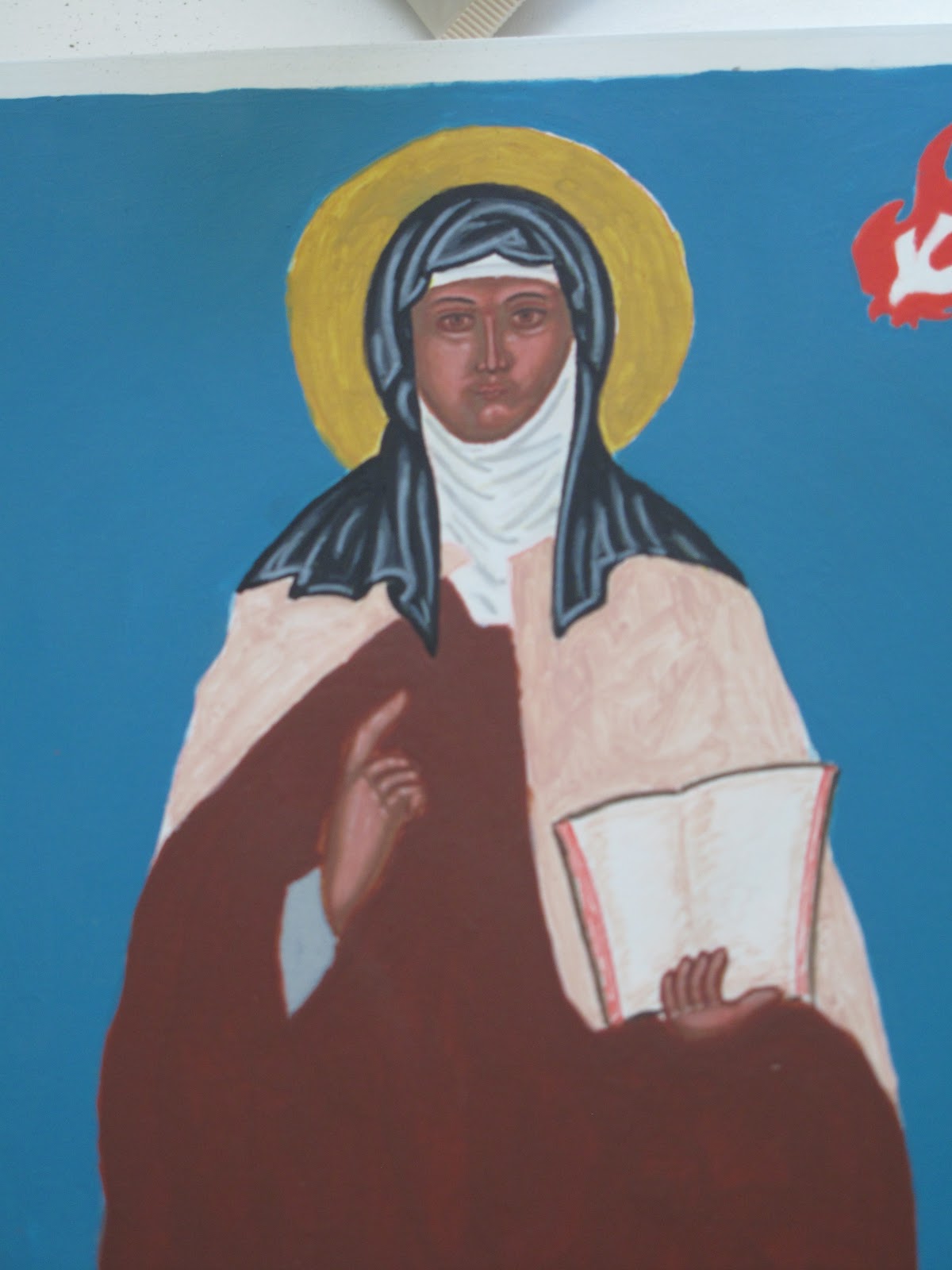
Icon of St. Teresa of Avila, step 3

I have been taught that in iconography you should write the face first.  (I must admit that I do not always follow this rule.)  But with this icon I did.

I once heard an interview with an artist who said that we are not born with a face; rather we craft our faces over the course of a lifetime of choices, smiles, tears, expressions and struggles.  He went on to say that it is really not until our forties that our face begins to be our own – what we have made of it.  I like this thought.  We grow into and mold our face and therefore our face becomes a true expression of who we are as a person rather than just a mask we wear.

In her reflection on the “Second Dwelling Places” in The Interior Castle Teresa warns about the danger of seeking spiritual consolation too early in the journey of prayer. 

Even though I’ve said this at other times, it’s so important that I repeat it here: it is that souls shouldn’t be thinking about consolations at this beginning stage.  It would be a very poor way to start building so precious and great an edifice.  If the foundation is on sand, the whole building will fall to the ground … It is an amusing thing that even though we still have a thousand impediments and imperfections and our virtues have hardly begun to grow – and please God they may have begun – we are yet not ashamed to seek spiritual delights in prayer and to complain about dryness.  May this never happen to you, Sisters.  Embrace the cross your Spouse has carried and understand that this must be your task.  Let the one who can do so, suffer more for Him; and she will be rewarded that much more.  As for other favors, if the Lord should grant you one, thank Him for it as you would for something freely added on.

We like consolation and we like it now!  In fact, I know whole ministries that our based on this premise (and they are quite popular).  But Teresa’s words of caution are very appropriate here.  Just as a human body does not grow and become healthy if its whole diet consists of sweets and desserts so the spiritual person does not mature in his or her faith by seeking consolation after consolation.  The cross must be embraced because the truth is that there are a thousand impediments and imperfections within each of us.  Lets be honest is this regard.

To return to the thought of the artist – it is in embracing our crosses in hope and in love (and also enjoying the consolations that do come along in God’s time) that we do the work of crafting our faces in order that our face rather than being just a mask might truly come to reveal who we are as a mature human person.   

Icon of St. Teresa of Avila, step 2

I have put down the base colors for the icon of St. Teresa of Avila. 

In iconography you put down the darker colors first and then bring forth the lighter colors.  In iconography it is not so much that light shines on the individual from without rather the light is meant to emanate from within the saint or our Lord.  The light of God’s grace transforms and transfigures from within and shines forth.

Also, iconography is not so much concerned with perspective as we are so often used to in western classical art.  The purpose of the icon is to bring the viewer into a spiritual encounter with the person pictured in the icon.  It can be said that it is not so much us who view the image as it is the one presented in the icon who is looking at us.  Perspective, in iconography, is reversed – the icon watches us. 

In the beginning of The Interior Castle St. Teresa reminds us that the only door of entry into true knowledge of self and of God is “prayer and reflection”.

Teresa wisely cautions that self-knowledge must be held in a creative tension with the truth of God.

If we are always fixed on our earthly misery, the stream will never flow free from the mud of fears, faintheartedness, and cowardice…

So it is with the soul in the room of self-knowledge; let it believe me and fly sometimes to ponder the grandeur and majesty of its God.  Here it will discover its lowliness better than by thinking of itself (solely)…

In my opinion we shall never completely know ourselves if we don’t strive to know God.  By gazing at His grandeur, we get in touch with our own lowliness; by looking at His purity, we shall see our own filth; by pondering His humility, we shall see how far we are from being humble.

Two advantages come from such activity.  First, it’s clear that something white seems much whiter when next to something black, and vice versa with the black next to the white.  The second is that our intellects and wills, dealing in turn now with self now with God, become nobler and better prepared for every good.

Finally, for this post at least, the saint offers this thought: While we are on this earth nothing is more important to us than humility.  

Amen, St. Teresa, amen.                

15th Sunday of Ordinary Time (B): Love and freedom from death, guilt and ego

st1\:*{behavior:url(#ieooui) }

“Return of the Prodigal Son” by Rembrandt
Saint Paul has written that God chose us in Christ in order to be full of love.  Here is where our religion begins.  It has been noted that the first Christians were just like the people around them: a mixture of rich and poor, weak and strong, male and female.  One could not tell the difference just by looking.  But, as a group, the Christians were noted for their care for others and for their joy. 

The original Christians were known for their taking care of others.  Especially others that the rest of society did not care for.  They buried the unknown poor, they cared for the sick.  They cared for the beggars.  Most of all, they cared for one another – sharing all so that no one was in need.  Many groups in history are known for power, strength, violence and bravery.  Few are known for how they loved each other.  This is the witness of our faith. 

Those first Christians were also known for their joy.  Joy is the infallible sign of God’s presence – it goes beyond happiness (which is having the world as we would have it) toward being in tune with the world as God would have it.  We find joy when we live as God would have us live.  

The first Christians shared all the conditions and struggles of life that their neighbors shared (and we still do).  We share the struggles, uncertainties and pains of this world.  Where then does our joy come from?  It comes from being freed to love and rejoice because, in Christ, we are freed from the three chains of death, guilt and ego.

We all fear death whether we acknowledge it or not and most of our sins come from this deep fear of diminishment, loss and ultimately oblivion.  But, as Christians, we know someone who once was dead and now lives.  We can boast, “Death, where is your sting?”

As Christians we are also freed from guilt.  We all know and bear this misery.  It is the felt knowledge that we have done what we should not and that we have not done what we should.  And even when we are not personally guilty of a specific sin we do share in the wholesale guilt of the human race.  And no human can forgive us, because we all share in sin.  But God can forgive and God has in Christ.  In Christ our guilt is wiped away – replaced by God’s mercy. 

Finally, the Christian is freed from the ego.  We are each both blessed and cursed by being a unique individual.  We can be so obsessed about taking care of ourselves and living in our own bubble that we forget others and forget the great mystery that it is only in dying to self that we rise to new life.  Through Christ we have learned that we save ourself by losing ourself.  Maturity comes when I realize that my life is not just about me.

In our care and in our joy we, as Christians, are known.  We love because, in Christ, we have been loved and freed from death, from guilt and from the ego.  This is the witness of our faith.  

See, how much these Christians love one another!  Hopefully, this will one day be said of our generation of Christians!     

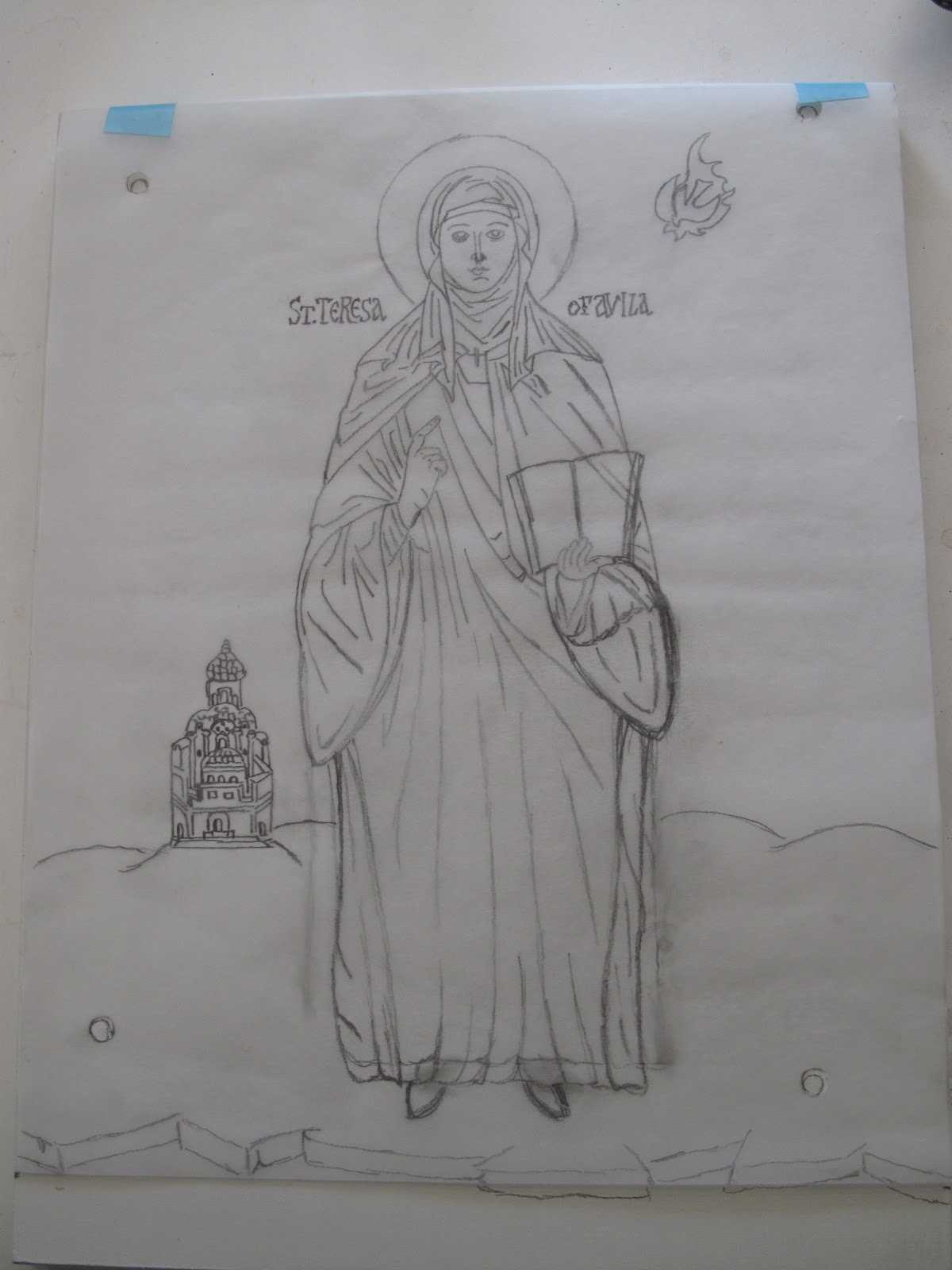
Icon of St. Teresa of Avila

I started cleaning and organizing my office the other day which is always a sign that something is coming…

I have felt a desire as of late to write another icon but I have not been able to decide on a subject.  But recently it has come into my prayer and heart to write an icon of St. Teresa of Avila.

St. Teresa has always been one of my favorite saints – she was a contemplative, a pragmatic and someone not to be crossed lightly all rolled up into one.

During seminary I read through a good bit of her writings and received much spiritual nourishment.  Maybe its time I pick up some of her writings again…  Maybe eighteen years of priesthood will give me a different perspective.

I have cobbled together an icon to write.  In the center stands St. Teresa, in her left hand she holds an open book representing her writing.  (I have not yet decided on a quote.)  Her right hands points to the Holy Spirit  over her left shoulder.  While researching the icon I noticed that in many portrayals of the saint the Holy Spirit is often pictured.  On the right of the saint in the background stands a representation of the Interior Castle (in reference to her writing on mystical prayer).

I have placed St. Teresa on a bank below which will be a stream.  One summer day back when I was a seminarian reading St. Teresa’s writings I took an afternoon nap and in a dream I found myself on one side of a stream and on the other side stood a beautiful and dignified woman in a religious habit.  She smiled at me.  To this day I think it was St. Teresa so I have decided to add the stream to this icon.

I do not think that this is an icon that I will give away.

I will post pictures and commentary as the icon progresses… 

Homosexuality and the Church: to resolutely approach Christian perfection

In his newly released book, Catholic Teaching on Homosexuality: New Paths to Understanding, Fr. Lou Cameli holds a creative tension between the full teaching of the Catholic Church on human sexuality and a pressing pastoral need of our time.  He is able to do this because he situates the Church’s teaching on homosexuality within the larger positive teaching on chastity and he takes seriously the possibility of Christian perfection in the life of the homosexual person as laid out by the Catechism of the Catholic Church when it teaches:

2359 Homosexual persons are called to chastity. By the virtues of self-mastery that teach them inner freedom, at times by the support of disinterested friendship, by prayer and sacramental grace, they can and should gradually and resolutely approach Christian perfection.  (Emphasis mine.)

Fr. Cameli writes his book both as an accomplished theologian and as a pastor.  He demonstrates that there has been a large gap in the Church’s approach to the homosexual person: the Church often seen as condemning the physical/genital act of homosexual sex (and often the person) while neglecting to provide the support and encouragement the homosexual man and woman needs in their desire to grow in Christian perfection. 
Catholic Teaching on Homosexuality begins a discussion on how the homosexual person might work to foster intimacy, friendship and generativity within his or her life and how the Church by being “church” can and should offer support and encouragement.
Fr. Cameli boldly takes on a pressing pastoral need in our Church and society that, frankly, many others would not touch with a ten-foot pole.  His fidelity to the full teaching of the Catholic Church and his pastoral desire to care for souls remains at the heart of his book.  His thoughts and insights will enlighten the reader’s understanding of a very complex and often painful topic. 
In the end the author does what theologians aspire to; he advances the discussion in a pastorally and theologically consistent manner.
The book is published by Ave Maria Press.  Click the below book title for the link:

“Catholic Teaching on Homosexuality” 

(In the interest of full disclosure, Fr. Cameli was my spiritual director in seminary and remains a good friend.) 

P.S. I would encourage all who are interested to take the time to read and reflect upon the entire section on chastity as found within the Catechism of the Catholic Church in order to see how the Church’s teaching on homosexuality as well as all sexual expression falls within a larger framework.  The section on chastity is found under the reflection on the sixth commandment, Thou shalt not commit adultery (CC # 2331-2391). 

The Supreme Court, the U.S. Catholic Bishops and the Fortnight for Freedom

Yesterday, the Supreme Court of the United States ruled that the Patient Protection and Affordable Care Act (ACA) does not violate the Constitution and should be upheld.  

Where does this leave Catholics in the national healthcare debate and in the midst of the Fortnight for Freedom? 

Well, from my reading at least, it leaves us where we have been in our support of rights of conscience and it leaves us hopeful that the HHS mandate (a component of ACA) can be rectified. 

It is important to sift through the political partisanship regarding this issue and remind ourselves that the U.S. Catholic Bishops and the Catholic Church has been supportive of the idea of comprehensive health care reform for close to a century, especially reform that would aid the poor and the most vulnerable in our society.  The United States Conference of Catholic Bishops (USCCB) has not joined in efforts to repeal the Affordable Care Act in its entirety rather the bishops have chosen to focus on correcting three fundamental flaws that are found within the ACA. 

1. Failure of the ACA to provide for adequate conscience protection (i.e. the HHS mandate). 
2. The ACA allowing use of federal funds for abortion which contradicts longstanding federal policy.
3. The unfair treatment of immigrant workers and their families who are not allowed to purchase health care coverage under ACA. 
(Please refer to the below statement by the USCCB which lists these three areas of concern.) 

From statements made by different justices in yesterday’s ruling we can be hopeful that the attempt to repeal the HHS mandate stands a good probability of being successful.  (Please refer to the article linked below.) 

So, we remain where we have been and we will continue the work that needs to be done.  The lawsuits launched by the forty plus Catholic dioceses, hospitals, charity offices and universities will go forward.

Finally, it is important to note that the Supreme Court ruling does not state that the Affordable Care Act is good law in itself; it just states that the Affordable Care Act does not violate the Constitution of the United States.  The Supreme Court recognizes its role and its limits.  It is up to others – politicians and the people who elect them – to make good law.  The ongoing work of the USCCB in this regards and the Fortnight for Freedom are attempts to rouse the conscience of our nation to make and establish good law.   

Statement by the U.S. Conference of Catholic Bishops

“Court Ruling allows Religious Freedom lawsuits to proceed with hope”    


St. Gregory of Nyssa on discernment

These words from St. Gregory of Nyssa are helpful in the discerning of a vocation. Discernment of vocation, if it is to be authentic, must not just remain in ones thoughts but must be carried forth into words and action.

From a treatise on Christian Perfection by Saint Gregory of Nyssa, bishop.

Christ should be manifest in our whole life

The life of the Christian has three distinguishing aspects: deeds, words and thought. Thought comes first, then words, since our words express openly the interior conclusions of the mind. Finally, after thoughts and words, comes action, for our deeds carry out what the mind has conceived. So when one of these results in our acting or speaking or thinking, we must make sure that all our thoughts, words and deeds are controlled by the divine ideal, the revelation of Christ. For then our thoughts, words and deeds will not fall short of the nobility of their implications.

What then must we do, we who have been found worthy of the name of Christ? Each of us must examine his thoughts, words and deeds, to see whether they are directed toward Christ or are turned away from him. This examination is carried out in various ways. Our deeds or our thoughts or our words are not in harmony with Christ if they issue from passion. They then bear the mark of the enemy who smears the pearl of the heart with the slime of passion, dimming and even destroying the luster of the precious stone.

On the other hand, if they are free from and untainted by every passionate inclination, they are directed toward Christ, the author and source of peace. He is like a pure, untainted stream. If you draw from him the thoughts in your mind and the inclinations of your heart, you will show a likeness to Christ, your source and origin, as the gleaming water in a jar resembles the flowing water from which it was obtained.

For the purity of Christ and the purity that is manifest in our hearts are identical. Christ’s purity, however, is the fountainhead; ours has its source in him and flows out of him. Our life is stamped with the beauty of his thought. The inner and the outer man are harmonized in a kind of music. The mind of Christ is the controlling influence that inspires us to moderation and goodness in our behavior. As I see it, Christian perfection consists in this: sharing the titles which express the meaning of Christ’s name, we bring out this meaning in our minds, our prayers and our way of life.

Mom’s illness and finding God

For four years now I have been the primary caregiver for my mom.  I have worked to get her settled into her independent living apartment.  I have taken her to appointments with her doctors and I have run to the pharmacy for her medicine and to Wal-Mart for the finch socks she likes to hang outside on her porch.  I have sat with her many Saturday nights watching Lawrence Welk and the British comedies that she loves.  I have also made many trips to the emergency room in the middle of the night when she has struggled for breathe or has fallen.  I have watched as her health has continued to ebb away bit by bit.

My mother suffers from COPD brought on by a lifetime of smoking as well as severe arthritis in her back and a scarred artery attached to her heart.  I do not fully understand all the complexities of her health situation but I know that all this together is something she can never really recover from and will only get worse over time.

In the past two weeks things have gotten worse. 

It began with her falling.  One such fall landed her in the ER with a cut on her head and the need to get staples.  Not a week later she was back in the hospital due to severe pain.  That hospital kept her for a few days and discharged her to a long-term health care facility.  Not two days later, mom was back in the emergency room of a different hospital due to extreme pain.  It is a hard thing to hear your eighty-four year old mother scream out in pain while powerless to do anything.  After a series of tests it was determined that mom had some stones causing blockage in her bile duct.  Due to the frailty of her health the doctors decided on a two-step process.  For the first step they went in her side and inserted a valve in order to drain out the backed-up fluid.  Today, for the second step they went in and dislodged the stones.  This second procedure seems to have worked.  Hopefully, mom will now begin to improve.

As I reflect on these recent occurrences I have realized that there are some spiritual lessons to be found within the journey of these past two weeks.   

1.  The beauty of the Jesus Prayer.  A number of nights my mother was in severe pain.  She had taken some medicine but the pain remained.  As a way to ease the pain and also help her breathing we began to say the Jesus Prayer together.  Breathing in we would say, “Lord Jesus Christ, Son of God…” and breathing out we would say, “…have mercy on me a sinner.”  This prayer helped to ease her pain and her fear while also helping to ease her into slumber.  The prayer helped to ease my own heart also.  One night I continued the prayer for her in her dark room for a good while after she had drifted off.  Later when the pain had intensified mom shifted the prayer to, “Thank you Jesus.  I love you.”  I found this shift to be very meaningful.    

2.  The beauty of human touch.  In the moments of mom’s intense pain one thing that seemed to help ease her was human touch.  Whether it was holding hands, rubbing her back or stroking her hair these simple acts brought some needed ease to mom.  In the midst of her pain I noticed that mom kept reaching out to grasp the hands of others.  There is a comforting power and grace in human touch.     

3.  The beauty of trusting God.  These family emergencies never arrive at a good time.  When mom entered the hospital for the second time I was scheduled to attend a national campus ministry conference for which I was part of the presenting team.  It worked out that my oldest brother was able to arrange to come home for the week to stay with my mother yet I was still torn in the thought of leaving at such a time.  The comment of a friend helped to ease my heart.  “Your brother needs this time with your mother.” was what she said.  God’s ways are not our ways and God’s Spirit moves as he so chooses.  This comment helped me to realize that God is here in the very uncertainty of this situation for my mother, for me and also for my brother.  It is important to let God be God and also to let God be God for others as he so chooses and as they need.  Sometimes it is just not about me.   

4.  The beauty of Church.  Throughout this experience the beauty and value of Church has been on full display.  Prayers being offered from all over the diocese and around the nation … priest friends calling to offer support and visiting my mother … parishioners offering advise and support … parish nurses providing invaluable service and advice … doctors and health-care professionals who happen to be Catholic taking an extra care for mom.  Church has been present throughout and has been a great witness to my brothers and I.  Church is at its best in moments of pain and comfort and we have seen this.

The journey is not over but it is comforting to know that it is never walked alone and God is present.