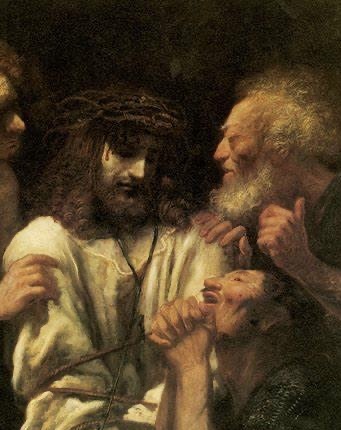
Good Friday invites us to stand in that place where Jesus stood.
In Isaiah 50:5-6 we hear of this place from the very mouth of the suffering servant. And I have not rebelled, have not turned back. I gave my back to those who beat me, my cheeks to those who plucked my beard; my face I did not shield from buffets and spitting.
In the Garden of Eden, through pride, we rebelled, and we turned back from God’s will for us, but Jesus does neither. In his passion and in the fullness of his humanity, Jesus stands in that place where we failed. Jesus obeys the will of the Father. He neither rebels nor does he turn back.
How do we respond to insult, mockery, abuse, disregard and violence? Is not our first inclination to respond in kind? If you insult me, then get ready for my insult back! If you hurt me then I will hurt you even more! We see this sad logic at play throughout human history and throughout our world today. But Jesus does not buy into this sad logic. Jesus does not rebel, he does not go against the will of the Father. Jesus does not disobey God’s law; he does not respond to violence directed towards him in whatever form with violence in return.
Nor does Jesus turn back. Again, in the fullness of his humanity, he remains in the Father’s will even as he is betrayed, insulted, mocked, scourged, slandered, tossed between Pilate and Herod and disregarded by so many even as he hung on the cross for us. Jesus remained, he took all the violence and spite that was thrown at him. Could any of us have done this? Would our inclination not have been to fall back, to get away from such pain?
This is the place where Jesus stood, neither rebelling nor falling back. Jesus stood fully in this place where we failed and he did what we could not. Jesus obeyed, trusting in the love of the Father.
Good Friday invites us to stand in this place where Jesus stood. It is only in grace that we can do this but that grace has been given now in Christ.
And a deeper truth, when (in grace) we are able to stand in that place where Jesus stood – neither rebelling nor falling back when violence is directed at us – we will find that Jesus stands there with us. That very place becomes a place of encounter with our Lord where we know his companionship, his friendship and his love. It becomes a place of blessing rather than a curse.
Good Friday invites us to stand in that place where Jesus stood.
In his recent homily (found on Word on Fire) for the third Sunday of Lent, Bishop Robert Barron offers succinct reflections on each of the Ten Commandments. He rightly (I believe) connects the breaking of the Eighth Commandment, “You shall not bear false witness against your neighbor” with the sin of calumny. Calumny, the willful spreading of false statements about another person in order to damage their reputation, is rife within our society and given safe haven, it seems, especially on social media. Bishop Barron, both in his insight as a theologian and pioneer in ministry via social media, is in a unique vantage point to note this besetting sin of our age and to call it out. Which he does.
The point of reflection for this post is how are we to handle calumny when it comes our way? Which, more than likely, it will at some point or even points within our lives. I offer four thoughts for consideration.
First, be grateful. Yes, it’s a paradox but we have a God who delights in paradox and frankly, life if full of paradoxes. The silver lining in the dark cloud of calumny is that you quickly learn who your true friends are. “A faithful friend is a sturdy shelter: he that has found one has found a treasure” (Sirach 6:14). Isn’t it best to know where the sturdy shelter is during a time of turmoil than be left out in the cold by false friends who turn away from you just because of something they have heard or something that they suppose to be true about you which is not? Calumny can actually clear the weeds of false friendship out of one’s life which makes the true, faithful friend all the more apparent and valued. Being receptive to the lies of calumny also demonstrates a profound lack of intelligence. Judging another person because of what others say before even knowing the person oneself or even choosing to believe lies about another person rather than one’s own experience of the person is intellectual sloth, plain and simple. Who wants a stupid friend? There is a silver lining.
Second, be civil. If calumny is a besetting sin of our time, if there are victims of calumny then that means there are perpetrators of calumny. I call them “wormtongues” after the pathetic character in J.R.R. Tolkien’s “Lord of the Rings”. (Grima Wormtongue is the court official who whispered lies into the ears of King Theoden in order to steal away life and keep the king paralyzed in doubt.) Wormtongues lack true moral authority and courage (think of internet trolls) and they think that the way to build themselves up is to tear other persons down. Don’t sink to the level or actions of wormtongues. Don’t be naïve to them or their machinations, know them for who they are, but be civil in the face of their incivility. Choosing to respond civilly even in the face of hostility and lies is an act of moral courage and strength. Be civil.
Be faithful. Here we encounter a deep mystery of our faith. Not only do we have a God who is Truth and who calls us to live in truth in our relationships and to not bear false witness but we have a God who also fully endured the scourge of calumny himself. Jesus, throughout his ministry, had to endure the whispers of lies and doubts about who he was and his true motives. “He casts out demons by the ruler of the demons.” (Mt. 9:34) This whispering became a consistent and hellish roar directed straight at our Lord throughout his passion from the agony in the garden and the running away of the disciples to the mocking of the soldiers during the scourging to the crowd calling for his death to insults even as he hung on the cross, “Come down from the cross, if you are the Son of God!” (Mt. 27:40). Jesus knows full well the pain of calumny.
Here is a spiritual exercise for those times when one is experiencing the pain of calumny: pray over a Gospel passage where Jesus is enduring the pain of calumny, place yourself in the scene and just be there as faithful friend for our Lord. We cannot take the pain away, but Jesus so values our presence and our friendship. Just be there in that moment as friend for Jesus. Graces will come from that prayer.
Finally, be open to leaving by knowing your fixed point. Throughout his ministry, Jesus moved from town to town, sometimes because he knew that forces were aligning against him and lies were being told but that his hour had not yet come. Throughout all this movement, Jesus always remained rooted in his relationship with the Father. His relationship with the Father was his fixed point. When we know our fixed point everything else becomes secondary. As Christians, our fixed point is that each of us is a beloved child of God with a dignity and worth. If this is not being respected, if lies are being told, then we have the freedom to move on from a particular group and its relationships, from a specific social setting and even from a certain location. Knowing our fixed point brings a freedom that the sin of calumny cannot overcome.
Calumny is a sin and it is a besetting sin of our time. It is a sin that will probably come our way in one form or another but it can be endured with dignity and grace and we can know that our Lord, who himself endured the pain of calumny, walks with us in friendship and that this too shall pass.
Finally, if you are a wormtongue, if you are a perpetrator of calumny, stop it. You are breaking the Eighth Commandment which is a sin before God for which you will be held accountable. You are tearing your brother and sister down; you are helping to tear our society apart and you are demeaning yourself in the process and that is pathetic. Don’t be a wormtongue. There is no dignity in being a wormtongue.
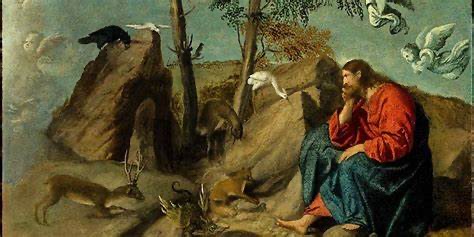
In their presentation of the temptation of Jesus, Luke and Matthew lean on the imagery of Israel’s experience of the forty years in the desert. Luke and Matthew present Jesus as the new Israel, the Israel who remains faithful to God’s covenant. Mark – on the other hand – in his two short verses (Mk. 1:12-14) draws on a different source. Mark goes to the very beginning of creation and draws on the imagery of Jesus as the new Adam. Jesus, we are told, is “among wild beasts” not in fear and trepidation but rather walking freely in their midst and company just as Adam and Eve had walked freely before the Fall. “Angels ministered to Jesus,” just as God walked in the cool of the evening in the garden and spoke freely with Adam and Eve.
Within the first chapter of his gospel, Mark is teaching that Jesus is the new Adam who restores that original unity and harmony to all creation that sin had fractured and broken. Where Adam and Eve had succumbed to the temptation of Satan in the beauty of the garden; Jesus triumphs over Satan’s temptations in the barrenness of the desert.
This is why Satan and all the demons take fright, tremble and beg not to be cast out before the power and authority of Jesus throughout the remainder of the gospels up until Satan attempts his great counterattack in the passion of our Lord but it is in that final move that Satan is dealt his defeat and our Lord’s full triumph is realized.
In the desert (in these two short verses in Mark’s gospel) Jesus frees himself from Satan in order to then begin the work of freeing all of humankind. Jesus had to face Satan before he could begin his public ministry. This is why Scriptures says that the Holy Spirit “drove” Jesus into the desert. It is in the desert, faced with the temptations, that Jesus overcomes sin. It is in the desert that Jesus chooses his relationship with the Father above all else. It is within the arena of human free will that Jesus meets and conquers Satan in the desert. Adam and Eve misused their freedom. They chose to disobey; sin was released and the human will was corrupted. Jesus obeys. Jesus says a free “yes” to the will of the Father. It is in Jesus that a human will expands to fully welcome the entire will of the Father (paraphrased from The Holy Spirit in the Life of Jesus by Cardinal Raniero Cantalamessa). The domination of Satan over human will is destroyed.
What does this mean for us on this first Sunday of Lent in 2024? It means that sin is not inevitable. It means that our will is not the plaything of the devil. It means that now in Jesus, we too can say “yes” to God. It means that we also can welcome the will of God into our wills. It means that we too can begin, even now, to know that authenticity and integrity of life that God intends for his creation rather than living just by the brokenness and pain of sin.
What does it mean? It means everything.
Jesus is the new Adam. Jesus is the one who restores unity and authenticity to all of creation and to each of our lives. This first Sunday of Lent invites us to welcome Jesus and learn from him how to also say “yes” to the will of the Father.
At one point in his book, “Jesus, Present Before Me,” Fr. Peter John Cameron shares the story of a young priest who served as a chaplain to Ground Zero immediately after the terrorist attacks of September 11th. One of the duties the priest had was serving in the makeshift morgue that was set up in a tent to receive the remains of the victims. It is easy to imagine the frenzied activity and the number of busy rescue workers intent on their mission but what the priest found amazing was that whenever a new body would arrive at the tent all the work, talking and activity would halt, the workers would gather in a circle with the priest around the body and the workers would bow their head and they would wait for a prayer from the priest. Even in the deep trauma and pain of that moment, the people recognized that there was something “more” that was stronger even than death.
The leper in today’s gospel (Mk. 1:40-45), even if he could not specifically say why, recognized that there was something “more” in Jesus. We heard in the first reading from the Book of Leviticus how lepers were looked upon and treated at this time in history. There was no cure for leprosy in the time of Jesus. Leprosy is a horrible disease that, if untreated, ultimately ends in death. People feared the disease and they wanted nothing to do with lepers. Lepers were cast out; they were ostracized and they were isolated. But the leper saw something in Jesus that was more than both his disease and the ostracization he knew. The leper trusted in this “more”.
The leper falls at the feet of Jesus and he begs, “If you wish, you can make me clean.” A simple request made in faith.
Jesus touches the man afflicted with leprosy. This is no small thing. By this simple action Jesus demonstrates that he is not bound by the fear and prejudice of his time. Jesus also knows that something “more” is at work in this moment – the will of his Father that all might be saved. Jesus recognizes the inbreaking of the Kingdom where all illness and all injustice is to be wiped away. In the simple act of touching the leper and by saying, “I do will it. Be made clean,” Jesus brings this poor man afflicted with leprosy to his Father, the Father receives the man and – healed and restored – returns the man to the Son.
I’ve had a realization following my recent trip out west. On my trip I visited Grand Canyon National Park, Zion National Park and Bryce Canyon National Park. I saw the grandeur and experienced the serenity of those amazing places and then I ended all of that with an evening in Las Vegas before my flight home the next day. That evening, I walked along the main strip gawking at all the lights, sights and sounds of that city. Contrasting the parks and the city, I came to this realization, God does not need spectacle to accomplish his will. We might need spectacle, in many ways it seems we crave it (i.e. Las Vegas), but God does not because God is the source of all that is, plain and simple.
There is “more” in Christ. The leper saw it and this “more” is encountered and made known in the simple. The simple act of the bowing of heads in prayer even in the midst of death and destruction, the simple act of faith, “If you wish, you can make me clean,” and the simple act of touching another person in love and care.
There is “more” in Christ and this more is encountered in the simple rather than in the spectacle.
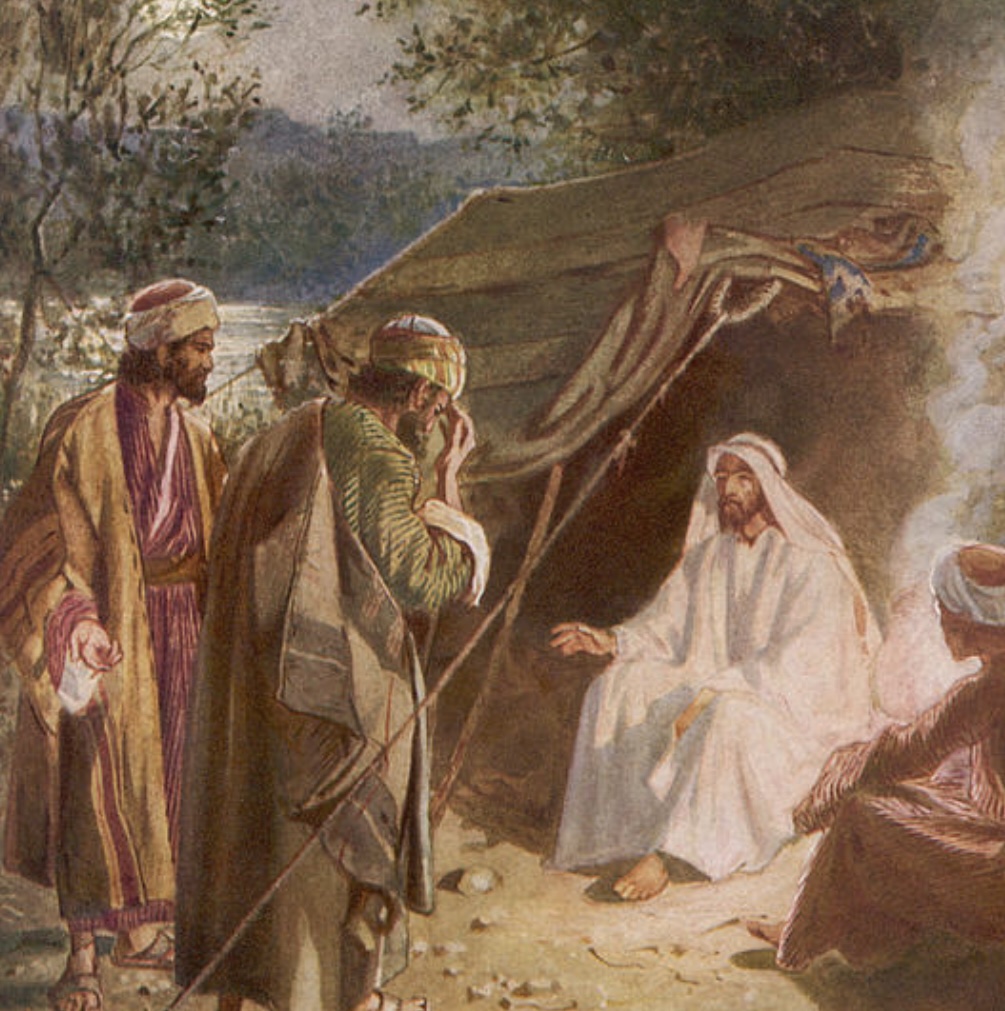
“Andrew taking Simon to meet Jesus” by Mary Evans. Image may be subject to copyright.
Holiness and the life of grace are not stingy. Holiness gives and it welcomes. This is my personal learning from the Advent and Christmas seasons.
When I placed myself in prayer in the manger scene, Joseph and Mary did not just allow me to gaze upon the child, they welcomed me to hold the babe in my own arms. They did not hesitate in inviting me to hold the child. When I watched as Simeon and Anna rejoiced in encountering the newborn Messiah in the Temple, they both welcomed me into that joy and hope fulfilled. When I prayed over Matthew’s account of the three magi journeying to find the newborn king, I found myself eagerly welcomed by the three wise men to journey with them.
Holiness and the life of grace are not stingy. Holiness and the life of grace welcomes, invites and encourages. It does not seek to keep for itself. We find this is today’s gospel ((Jn. 1:35-42) also. John the Baptist, the one who was declared the greatest of those born of women by our Lord, eagerly points out Jesus as the Lamb of God to his own disciples, not a bit concerned if that means he and his own proclamation would be lessened. “Behold, the Lamb of God!” John’s two disciples begin to follow Jesus and John does not begrudge this.
The holiness of Jesus also gives and welcomes – and this is the deep truth of today’s gospel. Jesus asks John’s disciples, “What are you looking for?” “Rabbi,” they answer, “where are you staying?” Jesus says, “Come, and you will see.” We are told that they stay with him that day and then they too rush out to invite others. “We have found the Messiah!”
“Where are you staying?” “Come, and you will see.” It was more than an invitation to a specific physical place. Elsewhere in the gospel, Jesus says that the Son of Man has no place to lay his head. The invitation of “come and see” is an invitation by our Lord into that deepest place where he truly resides. It is an invitation into his very relationship with the Father. It is an invitation freely given and those two disciples, even in their imperfections and lack of understanding, are both freely welcomed. It is precisely this new experience of being welcomed into the Son’s relationship to the Father that impels those two disciples to then immediately go forth themselves and invite others to know what they have found.
Holiness is not stingy. Holiness does not begrudge. It does not try to keep all for itself. Today’s gospel invites us to that same honesty of heart that the two disciples of John had. “Rabbi, where are you staying?” Today’s gospel invites us to the same courage and faith that the two disciples had when Jesus responds, “Come, and you will see.” The gospel invites us to also go to that place where our Lord abides in his relationship with the Father and to know that we – even in our imperfections – are indeed welcome.
Andrew first went and found his brother Simon and brings him to where Jesus is staying. Jesus looks at him and says, “You are Simon the Son of John: you will be called Cephas (Peter)”,
Life changes when we go to where Jesus resides. Life changes when we come to know that we also are welcomed into the Son’s relationship with the Father.
The other day I was listening to the “Voices of Greater Yellowstone” podcast. The current episode is an interview with the wildlife photographer Ronan Donovan and his sharing about the use of images to tell stories. At one point in the interview the subject of awe was discussed and the photographer, sharing from his experience of travelling to some of the remotest regions of the world and having amazing encounters with wildlife, shared that he believes awe (this is my paraphrase) is connected to those moments when we forget self and are caught up into something so much more bigger than us. That sense of awe and wonder is connected to those moments in life.
The three magi were caught up in awe. They saw the star, they interpreted that something much bigger than themselves and their particular tribe, culture and nation was at work. After all, they journeyed to a foreign land to give homage to a newborn foreign king.
Awe allowed the magi to do two important things that are relevant for all believers in every age. Awe allowed the magi to choose sacrifice over comfort and to choose wisdom over knowledge.
It had to have been a sacrifice for the magi to depart their native land in order to undertake a journey of unknown length following a star in hopes of finding a newborn king. Such a journey requires sacrifice and probably even brought some ridicule. In contrast, the priests and scribes of Herod’s court, the very ones to whom the Messiah is promised, would not even set out to the nearby Bethlehem. It seems that for them the comfort of the court was much more important than the sacrifice of the journey. Allowing their hearts to be captured by awe, the magi chose sacrifice and this is to their everlasting credit.
The chief priests and scribes had knowledge. When asked, they were able to point to the passage that the newborn king was to be born in Bethlehem but knowledge does not equal wisdom. In the first chapter of the Book of Wisdom we read, For the holy spirit of (wisdom) flees deceit and withdraws from senseless counsels and when injustice occurs it is rebuked. Wisdom is tied to integrity of life. Knowledge is not. One can be knowledgeable about something – even the things of faith – without integrity of life but one cannot possess wisdom without integrity. The magi left the deceit and senseless counsels of Herod’s court and did not return there. They went home a different way. The magi chose integrity of life and by this they welcomed wisdom.
Awe – those moments when we forget self and are caught up into something so much bigger than ourselves. Awe allows for the saving choices of sacrifice and wisdom. Like the magi, we also are invited to be overjoyed at seeing the star and to set out on the journey of encountering the newborn king. The end of the Christmas season is really just the beginning of the awe-filled journey of coming to know Christ more truly, love him more dearly and follow him more closely.
Christ healing woman with a flow of blood. Catacombs of Marcellinus and Peter. Rome, 4th century. Image may be subject to copyright.
There was a woman afflicted with hemorrhages for twelve years. She had suffered greatly at the hands of many doctors and had spent all that she had. Yet she was not helped but only grew worse. She had heard about Jesus and came up behind him in the crowd and touched his cloak. She said, “If I but touch his clothes, I shall be cured.” Immediately her flow of blood dried up. She felt in her body that she was healed of her affliction. Jesus, aware at once that power had gone out from him, turned around in the crowd and asked, “Who has touched my clothes?” But his disciples said to him, “You see how the crowd is pressing upon you, and yet you ask, ‘Who touched me?’” And he looked around to see who had done it. The woman, realizing what had happened to her, approached in fear and trembling. She fell down before Jesus and told him the whole truth. He said to her, “Daughter, your faith has saved you. Go in peace and be cured of your affliction.” (Mk. 5:25-34)
There has been a lot of talk about blessings in the Catholic Church these past few weeks since the issuance of Fiducia supplicans. The concern seems to center upon what is the nature of a blessing and is every blessing offered by a member of the clergy a tacit sign of approval of the supplicant’s state of life, in particular couples in irregular situations.
My reading of the document as well as the recent clarification issued is that no, every blessing offered is not a sign of approval and (this is what I find freeing about the declaration) it does not weigh upon the clergy to determine a person’s precise moral state when offering a “pastoral” blessing as opposed to a blessing given in a liturgical context.
When a couple comes forward to get married in the Catholic Church there is a process of determining the couples’ freedom to enter into marriage as well as their readiness and this is appropriate as that sacramental celebration is tied to our Church’s teaching about the nature of marriage. Liturgical blessings carry the weight of the Church’s teaching and are public in nature so, yes, it is on the church’s minister to ensure that blessings offered in a liturgical context are not in contradiction to the teaching of the Church.
But blessings offered in a liturgical context are not the only type of blessing. This is the key distinction offered by Fiducia supplicans. Pastoral blessings which, the declaration specifies, are more private in nature and occur in the moment, do not carry the same weight of responsibility upon the clergy. As I have read the declaration, the recent clarification and differing commentary I have been drawn to the gospel passage shared above. It was a very public moment – the crowd was pressing in upon Jesus. Our Lord knew nothing about the lady and her state in life. Her faith and trust merited the outpouring of blessing and healing and our Lord confirms this, “Daughter, your faith has saved you. Go in peace and be cured of your affliction.”
A couple of days before Fiducia supplicans was issued,I was in the neighborhood Lowe’s store in search of bird seed. At one point, gawking in front of the plethora of Christmas yard art decorations, I was approached by a woman with a small child. The woman, in broken English, asked for a blessing. I had never met this woman. I did not have to ask about her state in life. I did not have to ask about her marital status nor did I ask if she was in a state of grace. Standing in the aisle at Lowe’s, I responded to her request and I prayed a simple blessing. It was certainly a public space but also a very private moment – a simple blessing that I think went unnoticed by the other shoppers milling about.
The distinction in blessings made by Fiducia supplicans is valid and it is also freeing. It is not on the clergy, in that moment, to have to carry the weight of judge rather, it is enough to be a humble believer and shepherd. Might pastoral blessings and their true intent be misused? Possibly, but any misuse does not necessarily discredit the valid request and the valid giving of a pastoral blessing – a cry for God’s mercy.
I understand that these thoughts are written in the context of U.S. culture with the freedoms that we enjoy and value and that there are different contexts in different cultures that clergy need to honestly weigh out and consider. God’s blessings and guidance upon those shepherds as they strive to care for the flock entrusted to their care.
There are moments for the clergy to be judge, safeguarding what the Church treasures. Fiducia supplicans affirms this but the declaration also teaches that there are moments for the clergy to be fellow believers themselves who are also shepherds trusting in the abundant mercy of a God who works in ways we cannot even imagine.
In my office hangs a painting by the artist Janet McKenzie. The painting is entitled, “Mother and Child” but knowing the artist’s tradition of depicting the Holy Family via marginalized peoples and groups, I easily see within the painting a depiction of Mary and the young Jesus.
Here is what I see in the painting.
The young Jesus’ eyes are turned downward towards a flower he holds in his hands. He does not look forward. His time of mission has not yet arrived. He is now in the quiet time of growing and learning the hope and faith of the people of Israel and his mother and foster-father are the ones chosen to teach and guide him. His time of mission will come – as he contemplates the flower he holds – but for now he is in the care and love of his earthly parents.
He is partially wrapped in the cloak of his mother. There is a protective tenderness seen here. It is a worthy prayer to ask Mary to be always kept within the mantle of her protection. Mary is the new Eve who crushes the head of the serpent. In tender love she protects all those who turn to her.
In her eyes and straight posture is found strength, resolve and freedom. Mary is not bent in on herself in sin. She stands fully before God in her dignity and worth as the handmaid of the Lord. Her steady gaze invites the viewer into the same trust in God and freedom that she knows. True freedom is found and fulfilled in saying “yes” to the will of God.
I do not know the full intent of the artist in placing the young Jesus as she does before Mary but I see within the placement of the two a reflection of the strength of a mother bison protecting her calf. This is said to give full honor. The strength of the bison is a powerful and noble thing. Mary’s strength of love for her son is an unmovable and unstoppable force.
The white of her cloak echoes the stars in the cloak of our Lady of Guadalupe.
Behind the two figures are seen colors and animals important and sacred to the Native American peoples revealing that Mary is mother to all tribes and nations just as her son is Lord and Savior to all peoples.
I pray before this image. In it I find comfort and resolve and I hear the invitation to freedom found in saying “yes” to God’s will.
Once, when I was assigned in Chattanooga, I had the experience of driving by the regional airport just as Air Force One took off in flight. The president had been in the city promoting an industry and now he was leaving for his next destination. The sight of the plane filled my car window as it was directly in front of me and only a couple of hundred feet above me. Air Force One certainly grabs your attention and this is intentional. The plane is a visual statement about the power and the authority of the President of the United States.
This is what we expect from the ruling powers of our world, whether it be the office of a president, a king or queen, a royal family, a dictator or a tyrant. These authorities want us to look toward them and for the whole world to see in the trappings of their office – whether that be a plane, a crown, a missile launch – a statement of their power and authority. The ruling powers of the world want us to see them. They want our attention, and they want to be noticed.
Our faith and today’s gospel (Mt. 25:31-46) tell us that when Christ returns in glory all nations and peoples will be assembled before him but until that great and final day, our humble king wants us to turn our attention elsewhere. Our Lord wants us to look upon our brothers and sisters in need. Jesus wants us to see the least ones. Both those persons judged righteous and those persons judged unrighteous in today’s gospel ask the same question, “Lord, when did we see you…” Jesus’ answer is that when we allow ourselves to look upon the one who is hungry, thirsty, the stranger, naked, ill or in prison and then act in compassion we encounter him and we are judged righteous. When we do not allow ourselves to see, when we do not act in compassion then a harsh judgment follows.
It all starts with seeing and Jesus proclaims the importance of being willing to see the other, especially the least among us, throughout his ministry.
In the midst of the crowded Temple with people moving back and forth and all sorts of commotion, we are told that Jesus spotted the poor widow giving not from her surplus but from her poverty (Lk. 21:1-4). He saw her and he points her out to his disciples who were there present with him, and he points her out to us. Jesus saw her.
Jesus asks Simon the Pharisee (Lk. 7:36-50), “Do you see this woman?” referring to the woman who had come into the dinner party uninvited, a woman seeking mercy who was bathing the feet of Jesus with her tears. Simon did not “see” the woman because in his heart he had already judged her a sinner not worthy of his attention. Jesus forgives the woman her many sins and tells her to then, “go in peace” while it seems Simon and the other guests at table remain locked in their inability to see.
Jesus, in the parable of the rich man and the poor beggar Lazarus (Lk. 16:19-31), tells us that the rich man easily did not see the poor beggar lying at his doorstep and only after they both die does the rich man finally notice Lazarus, now at rest with Abraham, and then it is only to request that Lazarus be sent on an errand for him! The rich man, both in life and then in death, did not “see” Lazarus and this led to his ruin.
Our Lord, who will come again in glory and before whom all the nations will be gathered, is quite clear regarding our pilgrimage through this world and where we should direct our attention – the royal road for entrance into the fullness of the Kingdom of God is found in being willing to see the least among us and to then act in compassion.
This last week I bought a 1935 buffalo nickel for $3.00 in an antique store. The nickel has the image of an American Indian on one side and on the other side it has the image of a buffalo. I like the coin because it is a piece of American history and it is a reflection of our nation’s complicated story with both the indigenous peoples and the buffalo – a story that is far from over and continues.
(A funny story to share regarding a priest who has now gone home to God. This priest was known for being very, very frugal with money, so frugal in fact that people joked that if he ever had a buffalo nickel, he would squeeze it so tight that the Indian would end up riding the buffalo! But I digress.)
In answer to the Pharisee’s question about the lawfulness of paying the census tax to Caesar or not in today’s gospel (Mt. 22:15-21) our Lord asks to see a Roman coin. Remember that “census” is about citizenship and being a subject. Subjects pay tax to the authority that rules and governs, whether that be a government, a king or an empire. On the coin is an image of Caesar with his inscription. This is more than the image of George Washington on our dollar bill. Caesar was considered a god in the empire. In fact, the common greeting that subjects would give one another in the Roman Empire was, “Caesar is Lord!” When the first Christians began to greet one another with, “Christ is Lord!” they were doing something very intentional and even dangerous as the Roman authorities would regard such a greeting as an act of treason. The first Christians gave this greeting precisely because they had learned what our Lord was teaching in this gospel passage.
“Repay to Caesar what belongs to Caesar (let him and all the powers of the world have their piece of dead metal) and to God what belongs to God.” If the coin belongs to Caesar because it bears his image, then what belongs to God because it bears his image? Genesis 1:27 gives the answer, “God created man in his image, in the divine image he created him; male and female he created them.” We bear the image of God; we belong to God and while we walk this earth, yes, with earthly citizenship and responsibilities, we know that our true citizenship is in the Kingdom of God and we strive to live our lives by God’s truth. We must repay to God what belongs to God.
There is another truth to our Lord’s answer that we need to let sink into our hearts. God desires us, each one of us. God desires the unique image of himself that he has crafted within each one of us. God rejoices as we receive his love and as our own unique image of him begins to grow and shine! We are not meant to repay half-heartedly nor grudgingly the image that God has placed within each of us but rather repay it back in abundance and love. We do this by receiving God’s love and living in that love. We come from God, we are with God and we are in journey back to God!
Census is about citizenship; it is about being a subject of a kingdom. Our citizenship is in the Kingdom of God and even now, we strive to live by the light of God’s Kingdom. Repay to God what belongs to God.