There is a story told in the Lakota tribe of the Man who Spoke Softly. (Taken from The Lakota Way by Joseph M. Marshall III.)
In a certain village there was a leader, a headman, who was respected for his quiet ways and good decisions. He never sought to become a leader but as a young man he proved that he could think clearly and act calmly on the battlefield. He was a good provider for his family and he took care of the helpless ones. For these reasons the people asked him to be their leader and he reluctantly agreed. As leader, he made good decisions and always spoke the truth in council meetings and under his leadership the village prospered and grew strong.
Two generations grew up under his leadership and the man was getting on in years. There were a few young men in the village who yearned for a new leader. They wanted someone with more daring and flair – more fitting to their prosperous village, they thought. They had forgotten it was the headman’s leadership that grew their village.
The young men formed a plan. They would catch a small bird and one of them – in front of the whole village – would question the headman. “Grandfather, I have a bird in my hand. You are wise. Is the bird dead or alive?” If the headman answered “alive” then the young man would crush the bird and kill it before opening his hand. If the headman said “dead” then the young man would open his hand and the bird would fly free. Either way, they thought, the headman would be shown to be weak and uncertain.
So, on the morning of an important tribal gathering when all the people were gathered, one of the young men called out in a loud voice to the headman. “Grandfather, I have an important question. I have a bird in my hand. Since you are wise, is the bird dead or alive?’
A hush fell over the people. They knew that some of the young men were wanting new leadership and some wondered if the young men were right. They waited for the headman’s answer.
The old headman approached the young man with the question. He stood quietly, seeming to study the ground as the people whispered. Finally, the headman turned to the young man and smiled patiently and spoke firmly and gently as he always did when something important was to be said.
“Grandson,” he said, “the answer is in your hands.”
The story invites us to look into what is in our hearts. It is the same invitation that Jesus gives in today’s gospel; the invitation to move beyond the blind ritualism of the Pharisees that focused solely on external actions – This people honors me with their lips, but their hearts are far from me… – in order to see where ones heart is.
Are our hearts in living relationship with God? The answer is, and will always be, in our hands.
St. James, in his letter, gives good advice on how to keep our hearts in living relationship with the Father.
Humbly welcome the word that has been planted in you and is able to save your souls.
Be doers of the word and not hearers only, deluding yourselves.
Religion that is pure and undefiled before God and Father is this: to care for orphans and widows in their affliction and to keep oneself unstained by the world. (James 1:17-18, 21b-22, 27)
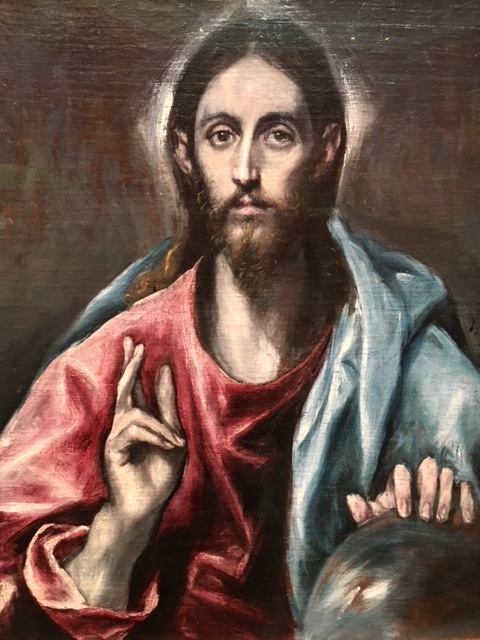
Christ the Saviour by El Greco. Image may be subject to copyright
The Gospel passage for this Sunday (Mk. 6:30-34) has the apostles returning to the Lord after having been sent out on mission to proclaim the coming of the Kingdom of God, to heal the sick and to aid the weak and the poor. The evangelist makes note of a “power” being conferred on the apostles in order to accomplish these tasks. The power mentioned here is not a worldly power because those first disciples had no such power. They had neither wealth nor influence. The “power” that the disciples went forth with were obedience to Jesus, the proclamation of his words and repeating the Lord’s gestures of mercy. Through these simple powers great things happened and the apostles return full of excitement to share their experiences.
In our Christian tradition there is a famous quote that states, “Christian, forget not your dignity!” In relation to today’s Gospel, I think we can say, “Church, forget not your power!”
The power of the Christian community is threefold: 1. obedience to Jesus, 2. the proclamation of his words, 3. repeating the Lord’s gestures of mercy.
Obedience to Jesus. Jesus is Son of God, Son of Man and Lord of history. Why do we keep searching for other lords and other messiahs? Yet, we do. There are great men and great women throughout history yet none of these people are Son of God and Son of Man. The witness of the disciples is found both in what they said and in what they did. They remained with the Lord. They returned to him (as we see in today’s Gospel). When they wandered and stumbled, they turned back. Even when they scattered from the cross; they gathered together again in the locked room. In times of triumph, times of struggles, and times of uncertainty the disciples remained with the Lord. There is a power found in obedience to the Lord.
The proclamation of Christ’s words. There are many great ideas, theories and achievement throughout human history and these amaze and astound us. We celebrate what is good and true. But even as the Church can and should learn from these achievements, we must remember that the words that we have to share are authentic, true and needed for every place and age. They are words that truly bring life. The words are not of our own making; rather they have been entrusted and given to us. We are to speak Christ’s words to our world. Elsewhere in the Gospel our Lord tells us that no one puts a light under a bushel basket yet how often are we tempted to give the Gospel second place in our lives to the latest theory, psychology, philosophy or social fad? When we do so are we not, in essence, placing a basket over the light of the Gospel? The words of Christ truly heal because Christ alone is the Lord of life.
The Lord’s gestures of mercy. Jesus knew the power of gesture: he writes in the sand, he touches the leper, he sits down at the well with the Samaritan woman. It is interesting to note how our Lord’s gestures were ever directed toward mercy. The Church is at its best when it lives our Lord’s gestures of mercy – when the person seen as untouchable is touched, when the hungry are fed and when the sinner is forgiven. These gestures will not make the evening news but they are true and they bring hope and healing to our world.
At the end of today’s gospel passage, we are told that when Jesus saw the crowd his heart was moved with pity. The people were starving. They were tired of that which failed to satisfy. We, also, are tired of that which fails to satisfy. Salvation does not come through the powers of our world. Salvation comes through God’s mercy at work in our world, our hearts and our lives.
Christian, forget not your dignity! Church, forget not your power!
A priest friend of mine tells the story that when he was in high school, he had a friend by the name of Carl that he hung around with. Carl, it seems, could be kind of high maintenance and awkward, often saying inappropriate things at the worst times. Carl was hanging around the house one day and was going on and on about wanting to go out and do something. Finally, my friend, who was not in the best of moods having to put up with Carl, had enough of this and was quite rude in telling Carl to stop bothering him and that he was not going to go out! After Carl left, my friend’s mother – who had heard all of the exchange – came to my friend and said, “You need to be nicer to Carl. He has been a good friend to you for a long time.” Parents have a way of saying things that just stay with you and my priest friend still remembers what his mother said. The story resonates with me because I once had a similar situation when I was in high school and took a friendship for granted.
One of the truths of this little story is that friendship takes work, friendship is going to challenge us and friendship is sometimes going to make us do things that we would rather not do. The old hymn tells us that we all have a friend in Jesus and this is true. There is no one who will ever love us like Jesus loves us. There is no one who will ever be as faithful to us as Jesus is faithful but we all know that sometimes it is hard to listen to Jesus because Jesus will challenge us, Jesus will make us take a serious look at our ways and our attitudes, Jesus will be present to us in a fullness of love that we may not feel we deserve. Sometimes it is hard to go to Jesus, sometimes it is hard to come to Mass, but this is where the challenge of my friend’s mother comes in for all of us, “You need to go. He has been a good friend to you for a long time.”
We often talk about and reflect on what it means for us to receive the Eucharist – the very Body and Blood of Christ – and this is appropriate. We receive Jesus himself! We are being transformed, nourished and strengthened through this receiving of the Eucharist, being and becoming a part of the Body of Christ. But, I think another question worthy of reflecting upon is, What does it mean to Jesus for us to receive the Eucharist? This past Holy Thursday, I was struck with this question and the awareness that came from it. For Jesus, it means everything! Jesus loved his disciples to the very end and even as he accepted the will of the Father to walk to Calvary and the cross, he so wanted to remain with his friends. His giving the Eucharist is his remaining with us. Jesus is that greatest of friends who truly wants to remain with us, to be with us. In the Eucharist, he gives himself to us. What does it mean to Jesus? I think it means everything.
One further thought. The Church teaches that it is a sin to miss Sunday Mass – a sin that must be confessed. The Church also teaches that the Eucharist should be received at least once a year. The Eucharist can be received more often and should if possible but at least once a year. Holding these teachings together, the Church is telling us about the importance of the Eucharist as well as the importance of coming together, gathering together in worship. Being community and church is important. I share this because I believe that we are living in an epidemic of isolation. People are more and more isolated from one another and because of this bad things are happening. Studies are coming forward that are demonstrating that the more isolated a person is the less quality of life and quantity of life that person has.
It is important to be Church. It is important to receive the Eucharist. The Eucharist is the sacrament of unity. The Eucharist calls us together and this is truly needed in our lives and in our times. Are we who gather for worship perfect? No. Do we have a perfect friend in Jesus? Yes. And for our friend it means everything that we receive and welcome him in the Eucharist – his very body and his very blood.
“Soldiers for Christ” is a term used in our Christian life of faith but it is an ambiguous term in that it lends itself to different meanings for different people and it is an image that can be depicted and has been depicted in a variety of ways. There are references to being “soldiers for Christ” (2 Tim 2:3) and putting on “the armor of God” (Eph. 6:11-17) in scripture and these passages highlight the resolve and determination that the life of faith demands. Jesus never denounced military service; at one point he commends the faith of the Roman centurion (Mt. 8:5-13) and he made use of military images in his teaching (i.e. Mt. 14:31-33) but Jesus himself never used the term “soldier” in reference to his followers.
My fallback for direction in the use of this term and its imagery is the “Standard of Christ” that St. Ignatius of Loyola speaks of in his spiritual exercises. St. Ignatius came from a military background. He knew the role that the lifted military standard or banner played in relaying orders and focusing the movement of soldiers across the chaos of a battlefield before there was any form of electronic communication. Soldiers in St. Ignatius’ time knew to focus on their standard as the success of the battle and their very lives depended upon it.
In the exercises, St. Ignatius encourages us to reflect on the two standards: the standard of Christ and the standard of Satan. The standard of Satan is marked by riches, desire for vain honor and surging pride. In contrast, the standard of Christ calls forth three steps: “the first, poverty in opposition to riches; the second, reproaches or contempt in opposition to honor from the world; and the third, humility in opposition to pride.” (SE 146) It is in these three steps that the good soldier rallies under the standard of Christ and knows success in the battle with the powers of the world.
“Poverty in opposition to riches.” When the world says, “More is better.” the soldier under the standard of Christ learns that less is enough and that choosing the less leads to a joy that the world cannot offer. Those who place themselves under the standard of Christ are called to learn and grow in appreciation of both the material and spiritual poverty that Jesus himself exemplified in order to learn reliance on God and to grow in relationship with God. Why are you anxious about clothes? Learn from the way the wild flowers grow. They do not work or spin. But I tell you that not even Solomon in all his splendor was clothed like one of them. If God so clothes the grass of the field, which grows today and is thrown into the oven tomorrow, will he not provide for you, O you of little faith? (Mt. 6:28-30) A mark of the soldier of Christ is the ability and the desire to choose the less, just as Jesus did.
“Reproaches or contempt in opposition to honor from the world.” Just as Jesus himself was doubted, viewed with suspicion, misunderstood, the subject of slander, mockery and ridicule so will the soldier, who freely stands under the standard of Christ, be. The disciple is not one who willingly seeks these things out nor revels in them (a badge of honor quickly leading into the sin of pride) but rather, learns that there are abundant graces received when one can walk through such moments as they come in faith and trust. The disciple knows, that by so doing, he or she is walking where Jesus walked and that Jesus, himself, is present in companionship. There is grace to be found when one is misunderstood, rejected and viewed in contempt for holding true to Jesus. Whether or not it is recognized and valued by friend, stranger or neighbor, it is recognized and valued by Jesus and Jesus makes himself known to those who walk through reproaches and contempt for him. The true soldier remains close to Jesus and patiently endures the storm if needed.
“Humility in opposition to pride.” The eternal Word let go of glory and humbly took the form of a slave being born of a virgin. Jesus embraced humility throughout his life and ministry upon this earth. Jesus washed the feet of his disciples and he humbly bore the weight of the cross. In humble acceptance to the will of the Father, he even embraced death on the cross. Humility is the road that Jesus himself walked and it is the disciple’s royal road of return to the Father. It is within the humble heart alone that the Father, Son and Holy Spirit make their dwelling-place. Whoever loves me will keep my word, and my Father will love him, and we will come to him and make our dwelling with him. (Jn. 14:23) Soldiers for Christ come to know humility both as a needed virtue and as a privileged place of encounter with the Triune God.
What does it mean to be a soldier for Christ? St. Ignatius, through his Spiritual Exercises, gives us a good understanding. The soldier for Christ is the one who remains under the Standard of Christ. The soldier for Christ is the one who learns the value of poverty, the value of reproaches and contempt and the value of humility.
Icon of the Resurrection of Christ. Image may be subject to copyright
What images does homecoming call to mind? A student coming home for the first time since leaving for studies. A soldier coming home after a long and dangerous deployment. A family, after a while apart, being able to come together for a holiday celebration. Young parents bringing their newborn son to meet his grandparents for the first time. Dear friends meeting up for some time together. A child who had been lost in addiction but now sober being welcomed back home. A tired spouse making it home after a long time away due to work.
As we think of homecoming in all of its different forms there are some things that are consistent – there is joy, relief, welcome, laughter, peace, tears and embracing.
In his resurrection and ascension, Jesus returns home to the Father. What joy there must have been – what laughter, relief, love and embracing! The risen Jesus returns having fulfilled his mission. It is in the Letter to the Philippians that we find the hymn singing of this mission, the hymn that goes back to the first generation of disciples. Jesus, who though in the form of God, did not regard equality with God something to be grasped but rather emptied himself and took the form of a slave. Being born in our likeness, Jesus humbled himself and was obedient even to death on a cross.
Jesus, the Son who emptied himself, stood in the place where we failed and he did not fail. Where we failed through our pride in the Garden of Eden and chose to disobey, Jesus – in his humanity – obeyed. Jesus did not rebel, he did not fall back. Jesus obeyed the will of the Father. Jesus stood in that place where we failed and he trusted in the love of the Father, even to death on the cross.
What joy must have been in the risen Lord’s heart as he returned to the Father! Coming home to Abba! Through his obedience, Jesus healed what had been broken by our disobedience. Jesus is the risen Good Shepherd, carrying back to the Father what had been lost. The risen Lord carries us home to the Father! The joy in our Lord’s heart is now also our joy! We were lost and now we are found! Now, we can return to the Father’s house! Sin, death and the isolation of the tomb are not our destiny. We are meant for life with the Father and, in his resurrection, Jesus goes to prepare a place for us! This is our Easter joy! Jesus’ joy is our joy – we can go home!
And God the Father’s joy. (We often don’t give enough thought to this.) God the Father who cannot abide sin or death can now – in the return of the Son who conquered sin through his humanity – once again embrace us just as he embraces the Son. This is the joy of the Father and this is the gift of the risen Son to the Father! What pain there is in the heart of a parent when there exists a separation between parent and child. What deep pain. With the separation of sin overcome; the Father can once again embrace us. The Father can once again welcome us home! The heart of the Father rejoices in the return of his Son!
Easter is homecoming! The joy of the risen Son fulfilling his mission and returning to the embrace of the Father. Our joy in being brought home in the embrace of the risen Son with the Father. The Father’s joy in embracing and welcoming us home!
In my Father’s house there are many dwelling places … if I go and prepare a place for you, I will come back again and take you to myself, so that where I am you also may be. (Jn. 14: 2-3)
Once, when I was assigned in Chattanooga, I had the experience of driving by the regional airport just as Air Force One took off in flight. The president had been in the city promoting an industry and now he was leaving for his next destination. The sight of the plane filled my car window as it was directly in front of me and only a couple of hundred feet above me. Air Force One certainly grabs your attention and this is intentional. The plane is a visual statement about the power and the authority of the President of the United States.
This is what we expect from the ruling powers of our world, whether it be the office of a president, a king or queen, a royal family, a dictator or a tyrant. These authorities want us to look toward them and for the whole world to see in the trappings of their office – whether that be a plane, a crown, a missile launch – a statement of their power and authority. The ruling powers of the world want us to see them. They want our attention, and they want to be noticed.
Our faith and today’s gospel (Mt. 25:31-46) tell us that when Christ returns in glory all nations and peoples will be assembled before him but until that great and final day, our humble king wants us to turn our attention elsewhere. Our Lord wants us to look upon our brothers and sisters in need. Jesus wants us to see the least ones. Both those persons judged righteous and those persons judged unrighteous in today’s gospel ask the same question, “Lord, when did we see you…” Jesus’ answer is that when we allow ourselves to look upon the one who is hungry, thirsty, the stranger, naked, ill or in prison and then act in compassion we encounter him and we are judged righteous. When we do not allow ourselves to see, when we do not act in compassion then a harsh judgment follows.
It all starts with seeing and Jesus proclaims the importance of being willing to see the other, especially the least among us, throughout his ministry.
In the midst of the crowded Temple with people moving back and forth and all sorts of commotion, we are told that Jesus spotted the poor widow giving not from her surplus but from her poverty (Lk. 21:1-4). He saw her and he points her out to his disciples who were there present with him, and he points her out to us. Jesus saw her.
Jesus asks Simon the Pharisee (Lk. 7:36-50), “Do you see this woman?” referring to the woman who had come into the dinner party uninvited, a woman seeking mercy who was bathing the feet of Jesus with her tears. Simon did not “see” the woman because in his heart he had already judged her a sinner not worthy of his attention. Jesus forgives the woman her many sins and tells her to then, “go in peace” while it seems Simon and the other guests at table remain locked in their inability to see.
Jesus, in the parable of the rich man and the poor beggar Lazarus (Lk. 16:19-31), tells us that the rich man easily did not see the poor beggar lying at his doorstep and only after they both die does the rich man finally notice Lazarus, now at rest with Abraham, and then it is only to request that Lazarus be sent on an errand for him! The rich man, both in life and then in death, did not “see” Lazarus and this led to his ruin.
Our Lord, who will come again in glory and before whom all the nations will be gathered, is quite clear regarding our pilgrimage through this world and where we should direct our attention – the royal road for entrance into the fullness of the Kingdom of God is found in being willing to see the least among us and to then act in compassion.
This last week I bought a 1935 buffalo nickel for $3.00 in an antique store. The nickel has the image of an American Indian on one side and on the other side it has the image of a buffalo. I like the coin because it is a piece of American history and it is a reflection of our nation’s complicated story with both the indigenous peoples and the buffalo – a story that is far from over and continues.
(A funny story to share regarding a priest who has now gone home to God. This priest was known for being very, very frugal with money, so frugal in fact that people joked that if he ever had a buffalo nickel, he would squeeze it so tight that the Indian would end up riding the buffalo! But I digress.)
In answer to the Pharisee’s question about the lawfulness of paying the census tax to Caesar or not in today’s gospel (Mt. 22:15-21) our Lord asks to see a Roman coin. Remember that “census” is about citizenship and being a subject. Subjects pay tax to the authority that rules and governs, whether that be a government, a king or an empire. On the coin is an image of Caesar with his inscription. This is more than the image of George Washington on our dollar bill. Caesar was considered a god in the empire. In fact, the common greeting that subjects would give one another in the Roman Empire was, “Caesar is Lord!” When the first Christians began to greet one another with, “Christ is Lord!” they were doing something very intentional and even dangerous as the Roman authorities would regard such a greeting as an act of treason. The first Christians gave this greeting precisely because they had learned what our Lord was teaching in this gospel passage.
“Repay to Caesar what belongs to Caesar (let him and all the powers of the world have their piece of dead metal) and to God what belongs to God.” If the coin belongs to Caesar because it bears his image, then what belongs to God because it bears his image? Genesis 1:27 gives the answer, “God created man in his image, in the divine image he created him; male and female he created them.” We bear the image of God; we belong to God and while we walk this earth, yes, with earthly citizenship and responsibilities, we know that our true citizenship is in the Kingdom of God and we strive to live our lives by God’s truth. We must repay to God what belongs to God.
There is another truth to our Lord’s answer that we need to let sink into our hearts. God desires us, each one of us. God desires the unique image of himself that he has crafted within each one of us. God rejoices as we receive his love and as our own unique image of him begins to grow and shine! We are not meant to repay half-heartedly nor grudgingly the image that God has placed within each of us but rather repay it back in abundance and love. We do this by receiving God’s love and living in that love. We come from God, we are with God and we are in journey back to God!
Census is about citizenship; it is about being a subject of a kingdom. Our citizenship is in the Kingdom of God and even now, we strive to live by the light of God’s Kingdom. Repay to God what belongs to God.
The statue of the Madonna and Child is from my home growing up. It belonged to my parents and sat in our living room on a table that served, for all intents and purposes although we never named it, as our home altar. On the table was found this statue, our family Bible, various little statues and holy cards and baptismal candles. Every day growing up I would see this statue – usually just passing by on my way to whatever I was up to but the statue was always there and remains with me to this day.
I have always appreciated the tenderness expressed by the statue. Mary cradles her infant son and holds him close to her breast. Her head leans in towards him and his towards her. There is a familiarity and an intimacy and she presents her child to the world. Here is the Son of God born of a humble woman in a small part of vast empire. He will save us from our sins,
The holy card is from the Basilica of Santa Maria in Trastevere in Rome. The basilica is one of the oldest churches in Rome and the first to be dedicated to Mary. The card depicts an image from the mosaic of the Dormition of Mary. The dormition of Mary is the Eastern Church’s celebration of the great mystery of the Virgin Mary being taken body and soul into the fullness of the Kingdom of God. In the West, we focus on the Assumption of Mary and our images depict that. In the Eastern Church the focus is on the Dormition – or Mary’s falling asleep to then be taken up into the Kingdom – and their images depict this. It is the same mystery we celebrate. Immaculate Mary, mother of the Incarnate Word, is brought into the fullness of God’s Kingdom. Where she has been brought, we have the hope to also follow.
In the icon of the Dormition of Mary it is common to see Mary asleep in her passing surrounded by the twelve apostles and in the icon is also represented the risen Christ tenderly holding the soul of his mother. The iconographic tradition is to depict the soul – an immaterial reality – as a person wrapped almost like a child in swaddling clothes. The son holds the mother in anticipation of uniting soul and body in the glory of the resurrection.
There is a tenderness here too. The Son, in love, holds the mother again in an expression of familiarity and intimacy. Mary is wrapped in white which is an expression of the glory of the resurrection where all sin, death and darkness is overcome! Christ holds Mary out also as a sign of hope for all the world. Mary is the first to be brought into the glory of Christ’s resurrection. A hope that every Christian now carries through baptism.
One truth of these images and of today’s Feast of the Assumption is the tenderness of God as well as the value of tenderness in the Christian life. God welcomed the tender love of a humble woman and, in return, Christ tenderly welcomes his mother home.
We often underrate the importance of tenderness in life, I believe. But tenderness, as depicted, stands at the heart of the relation of Christ to his mother and, it seems, also at the heart of our Lord’s relationship to every believer. We have a tender God, a tender Savior. This is important because tenderness gives birth to hope and hope produces perseverance. We all need tenderness on the journey of faith. Tenderness keeps us moving forward toward the fullness of the Kingdom of God that awaits us and that also beckons us.
Two images – a statue and a holy card – showing the truth of tenderness and giving a hope that endures.
Holy Mary, tender mother of our Savior, pray for us!
This week the world has given us the tale of two crowds for our consideration.
The first crowd was a group of a few thousand people brought together at Union Square in Manhattan on Friday afternoon by the internet streamer and influencer Kai Cetan. The people came for a hyped giveaway hoping for free PlayStations, computers and other devices. The crowd quickly turned unruly – climbing on vehicles, hurling chairs and throwing punches. The police were called in and only after a number of hours were they able to disperse the crowd and bring calm back to the area. Kai Cetan is now charged with inciting a riot.
The second gathering is going on right now in Lisbon, Portugal. Over four hundred thousand young people representing every nation in the world except one (Maldives) are gathering these days for World Youth Day. These young adults are gathering with Pope Francis, cardinals, bishops, priests and religious from around the world. Rather than unrest and rioting; this gathering is marked by prayer, song, service to others and worship.
The two crowds are certainly set apart by their actions but also by what brings them together and their focus.
A craving for material things and the need to be near the pseudo-celebrity of a social media influencer brought the first crowd together. My hunch is that people saw the crowd gathered while realizing the limited number of items to be given away with the result being that the energy of the excitement of getting something for free quickly turning into a riot. Hence the charge of “inciting a riot”. In this crowd, people saw one another solely as competition for something they wanted.
The focus of World Youth Day is not for a “thing” nor for the hollow fame of an influencer, the focus of the gathering of four hundred thousand in Lisbon is on the Lord of Life and an authentic encounter with Him. In this gathering, the participants recognize one another not as competitors for things but as brothers and sisters in the great family of God – a family which crosses all borders, nationalities, languages and social divisions. The participants at World Youth Day are gathered in Christ.
Today’s Feast of the Transfiguration focuses our eyes on Christ. Jesus is revealed as the long-awaited Messiah as prophesied by Daniel (Daniel 7:9-10, 13-14) and witnessed to by the presence of Moses and Elijah gathered with Jesus on the mountain (Mt. 17:1-9). The voice of the Father is heard by Peter, James and John and the same truth is proclaimed to us today, “This is my beloved Son, with whom I am well pleased; listen to him.”
Listen to Jesus. Stay focused on Jesus throughout the journey of life. Do not seek after things that do not last and that fail to satisfy. Such things only end in ruin and hurt. Stay focused on the Lord of Life and, by so doing, receive life in abundance.
The world has put before us the tale of two crowds this week. In one is found only self-centeredness and rioting. In the other is found true community, life, hope and joy. Choose wisely.
“This is my beloved Son, with whom I am well pleased; listen to him.”
I recently heard these words offered at a symposium on the priesthood and they ring true – not just in the life of the priest but in all of what it means to be Christian and to be Church.
If there is a “theme” in my own spiritual journey over the past few years it is that of a growing awareness of the Holy Spirit and relationship with the Holy Spirit – trust in the Spirit, awareness of the Spirit, crying out to the Holy Spirit, delight in the Holy Spirit, fear of wounding my relationship with the Holy Spirit, awe and wonder at the movement of the Holy Spirit, learning to rejoice in that which the Spirit rejoices in and allowing the Holy Spirit to lead me into truth.
I love the Holy Spirit.
The days between Ascension and Pentecost are a privileged time to receive the Holy Spirit as a welcome guest in our hearts. The words, “welcome guest,” are key here I believe. The Holy Spirit is not an automatic in the life of the Christian and should never be thought of in such a manner. Nor is the Spirit passive. The Holy Spirit chooses and is active. Although the Holy Spirit can and does work through very limited means (I use myself in my priesthood as an example here), the Spirit chooses how to move, where to move and where to abide and in what degree of fullness. The Holy Spirit will not abide in fullness with neither sin nor duplicity.
In grace we must always strive to make of our hearts a worthy place to receive this “welcome guest”. How so? Striving to keep our will and actions sincere, honest, pure and humble. Remaining focused on Christ as Lord and Savior and showing reverence to the image and likeness of God found in every person.
A sure way to experience the withdrawal of the Holy Spirit is to try to use another person in any way, shape or form. This was an abiding sin of the rich man in the parable that our Lord gave us of the rich man and the poor beggar Lazarus. Even in the torment of afterlife; the unnamed rich man, rather than rejoicing in seeing the poor beggar Lazarus resting now in the bosom of Abraham, wanted to use the very one whom he had ignored and stepped over during his life to be sent on an errand for him to warn his brothers. The rich man is denied. One wonders what would have happened if the rich man had rather said, “I rejoice in seeing Lazarus, whom I now recognize as a brother and who knew such pain in life, now resting in the peace of God’s love.” Some scholars suggest that the sin of Judas (who believed Jesus was the Messiah but who felt Jesus wasn’t acting swift or sure enough in his view) was to try to force the hand of Jesus to show his messiahship, in other words – use him, by handing him over to the authorities. In John’s account of the Last Supper, we are told that Satan enters into the heart of Judas and that he departs into the darkness of night. To use another while neither respecting nor reverencing the image of God in which that person is made is a sin that God will not abide.
In all things, we must continually strive, by avoiding that which grieves the Holy Spirit and doing that which pleases the Holy Spirit, to make of our hearts truly a place of welcome for this most honored of guests!
I want to end this post by sharing a reflection by Cardinal Cantalamessa given in his book, “The Holy Spirit in the Life of Jesus’. The quote is long but I share it because these words helped to enliven my heart to a deeper awareness of the Holy Spirit. Cardinal Cantalamessa writes,
But an unbidden question springs to mind: why the long interval between the moments when Jesus received his anointing in the Jordan and when, on the cross and at Pentecost, the outpouring of the Spirit occurred? And why does St. John the Evangelist say that the Holy Spirit could not be given while Jesus “had not yet been glorified”? St. Irenaeus gives the answer: the Holy Spirit had first to become accustomed to dwelling among human beings; he had, so to speak, to be humanized and historicized in Jesus, so as to be able, one day, to sanctify all human beings from within their human condition while respecting the times and modes of human behavior and suffering. “The Holy Spirit,” he writes, “descended upon the Son of God, made the Son of man, becoming accustomed (adsuescens) in him to dwell and rest among the human race, so as to be able to work the Father’s willin them and renew them from their old habitsinto the newness of Christ.” Through Jesus, the Spirit is able to make grace “take root” in human nature; in Jesus who has not sinned, the Spirit can “come down and remain” (John 1:33), and get used to staying among us, unlike in the Old Testament where his presence in the world was only occasional. In a sense, the Holy Spirit becomes incarnate in Jesus of Nazareth, even if in the case of “becomes incarnate” means something different, i.e., “comes to dwell in a physical body.” “Between us and the Spirit of God,” writes Cabasilas, “there was a double wall of separation: that of nature and that of the will corrupted by evil; the former was taken away by the Savior with his incarnation (and, we may add, with his anointing) and the latter with his crucifixion, since the cross destroyed sin. Both obstacles being removed, nothing further can now impede the outpouring of the Holy Spirit on all flesh.”
The same author explains how the wall of separation constituted by nature, that is, by the fact that God is “spirit” and we are “flesh,” came to be removed. The Savior’s human nature, he says, was like an alabaster vessel which in one way contained the fullness of the Spirit, but in another way prevented this perfume from spreading abroad. Only if, by some miracle, the alabaster vessel were itself transformed into perfume would the perfume inside no longer be separated from the outside air and no longer stay shut up in the only vessel to contain it. Now, this was exactly what took place during Jesus’ life on earth: the alabaster vessel, which was the pure human nature of the Savior, was itself changed into perfume; in other words, by virtue of his full and total assent to the Father’s will, the flesh of Christ gradually became spiritualized, until at the resurrection it became “a spiritual body” (1 Cor. 15:44), the “Christ according to the Spirit” (cf. Rom. 1:4). The cross was the moment when the last barrier fell; the alabaster vessel was then shattered, as at the anointing at Bethany, and the Spirit poured out, filling, “the whole house,” that is to say the entire Church, with perfume. The Holy Spirit is the trail of perfume Jesus left behind when he walked the earth! The martyr St. Ignatius of Antioch admirably combines the two moments we have been considering – that of the anointing and that of the outpouring of the Spirit – where he writes: “The Lord received a perfumed (myron) ointment on his head, so that he could breathe incorruptibility on the Church.”





 The Alternate Path