This last week I bought a 1935 buffalo nickel for $3.00 in an antique store. The nickel has the image of an American Indian on one side and on the other side it has the image of a buffalo. I like the coin because it is a piece of American history and it is a reflection of our nation’s complicated story with both the indigenous peoples and the buffalo – a story that is far from over and continues.
(A funny story to share regarding a priest who has now gone home to God. This priest was known for being very, very frugal with money, so frugal in fact that people joked that if he ever had a buffalo nickel, he would squeeze it so tight that the Indian would end up riding the buffalo! But I digress.)
In answer to the Pharisee’s question about the lawfulness of paying the census tax to Caesar or not in today’s gospel (Mt. 22:15-21) our Lord asks to see a Roman coin. Remember that “census” is about citizenship and being a subject. Subjects pay tax to the authority that rules and governs, whether that be a government, a king or an empire. On the coin is an image of Caesar with his inscription. This is more than the image of George Washington on our dollar bill. Caesar was considered a god in the empire. In fact, the common greeting that subjects would give one another in the Roman Empire was, “Caesar is Lord!” When the first Christians began to greet one another with, “Christ is Lord!” they were doing something very intentional and even dangerous as the Roman authorities would regard such a greeting as an act of treason. The first Christians gave this greeting precisely because they had learned what our Lord was teaching in this gospel passage.
“Repay to Caesar what belongs to Caesar (let him and all the powers of the world have their piece of dead metal) and to God what belongs to God.” If the coin belongs to Caesar because it bears his image, then what belongs to God because it bears his image? Genesis 1:27 gives the answer, “God created man in his image, in the divine image he created him; male and female he created them.” We bear the image of God; we belong to God and while we walk this earth, yes, with earthly citizenship and responsibilities, we know that our true citizenship is in the Kingdom of God and we strive to live our lives by God’s truth. We must repay to God what belongs to God.
There is another truth to our Lord’s answer that we need to let sink into our hearts. God desires us, each one of us. God desires the unique image of himself that he has crafted within each one of us. God rejoices as we receive his love and as our own unique image of him begins to grow and shine! We are not meant to repay half-heartedly nor grudgingly the image that God has placed within each of us but rather repay it back in abundance and love. We do this by receiving God’s love and living in that love. We come from God, we are with God and we are in journey back to God!
Census is about citizenship; it is about being a subject of a kingdom. Our citizenship is in the Kingdom of God and even now, we strive to live by the light of God’s Kingdom. Repay to God what belongs to God.
In the time of Jesus, as there are now, there were faith-healers and people who claimed to have power over demons who could be hired and, for the right amount of money, would pretend to heal someone or cast out demons. These people were charlatans, but people would pay the money in a desperate attempt to bring healing to a loved one. These supposed “healers” took advantage of people in their suffering and what they offered was not real faith but rather magic – the illusion of healing that was not real.
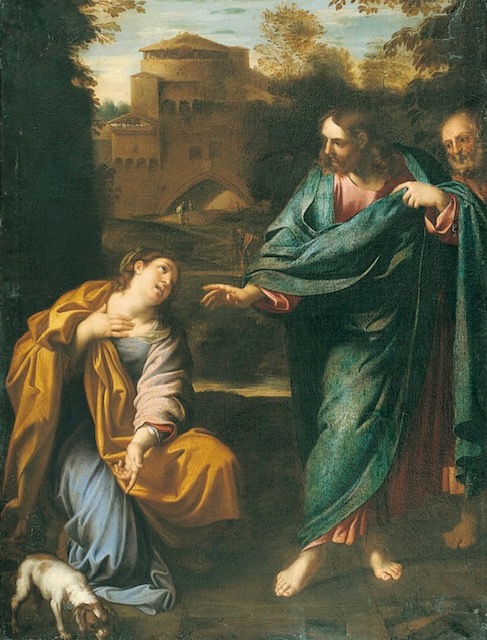
Our Lord knew of these faith-healers and how they operated. He also saw how they took advantage of people. The Canaanite woman also knew of these faith-healers and the promises they made. It is possible that she had already paid faith-healers in attempts to bring healing to her daughter but all to no success.
This context helps to explain this interaction of Jesus with the Canaanite woman.
This woman, who has heard of the man Jesus and who initially sees him as just another faith-healer, calls out on behalf of her daughter and, more than likely, she is willing to pay the cost that Jesus will demand. The disciples, as observant Jews could not abide faith-healers, they know that Jesus was not a faith-healer and they do not want to be associated with faith-healers so they ask Jesus to send the woman away because she, “keeps calling after us”.
Jesus knows that he is not a charlatan and he knows that this woman is looking to hire him and that she wants a magical healing for her daughter and so he says, “I was sent only to the lost sheep of the house of Israel.” Jesus has a mission from the Father and he is not for hire for magical healings.
But then something happens. The scripture says that the woman, “came to Jesus and did him homage”. The word “homage” is important here. “Homage” implies faith, it implies kneeling in wonder and need before the divine mystery. The woman does not come to Jesus to offer what she will pay him as one would when bargaining with a faith-healer, rather she gives him not money but “homage”.
What changed for the woman? Was it her desperation for her daughter, was it an intuition in her soul that something was different about this man named Jesus, was it the movement of the Holy Spirit in the woman’s heart? Something changed and Jesus sees it.
Jesus then tests it to make certain. “It is not right to take the food of the children and throw it to the dogs.” Now, in this new moment, the woman responds, “Please, Lord, for even the dogs eat the scraps that fall from the table of their masters.” The woman shows her faith.
Satisfied and probably with an abundance of joy in his divine heart, Jesus answers, “O woman, great is your faith! Let it be done for you as you wish!”
Jesus is not a faith-healer for hire. Jesus does not deal in the illusion of magic. Jesus comes looking for faith in our hearts and it is in faith that our Lord meets us and brings the healing that only he can give.
Magic is an illusion. Faith is real and it is only in faith that Jesus encounters us.
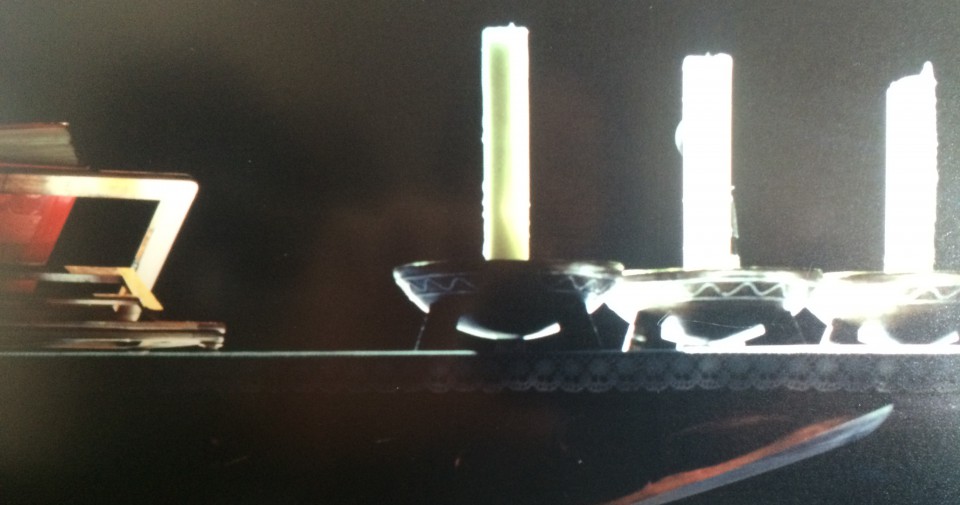
The statue of the Madonna and Child is from my home growing up. It belonged to my parents and sat in our living room on a table that served, for all intents and purposes although we never named it, as our home altar. On the table was found this statue, our family Bible, various little statues and holy cards and baptismal candles. Every day growing up I would see this statue – usually just passing by on my way to whatever I was up to but the statue was always there and remains with me to this day.
I have always appreciated the tenderness expressed by the statue. Mary cradles her infant son and holds him close to her breast. Her head leans in towards him and his towards her. There is a familiarity and an intimacy and she presents her child to the world. Here is the Son of God born of a humble woman in a small part of vast empire. He will save us from our sins,
The holy card is from the Basilica of Santa Maria in Trastevere in Rome. The basilica is one of the oldest churches in Rome and the first to be dedicated to Mary. The card depicts an image from the mosaic of the Dormition of Mary. The dormition of Mary is the Eastern Church’s celebration of the great mystery of the Virgin Mary being taken body and soul into the fullness of the Kingdom of God. In the West, we focus on the Assumption of Mary and our images depict that. In the Eastern Church the focus is on the Dormition – or Mary’s falling asleep to then be taken up into the Kingdom – and their images depict this. It is the same mystery we celebrate. Immaculate Mary, mother of the Incarnate Word, is brought into the fullness of God’s Kingdom. Where she has been brought, we have the hope to also follow.
In the icon of the Dormition of Mary it is common to see Mary asleep in her passing surrounded by the twelve apostles and in the icon is also represented the risen Christ tenderly holding the soul of his mother. The iconographic tradition is to depict the soul – an immaterial reality – as a person wrapped almost like a child in swaddling clothes. The son holds the mother in anticipation of uniting soul and body in the glory of the resurrection.
There is a tenderness here too. The Son, in love, holds the mother again in an expression of familiarity and intimacy. Mary is wrapped in white which is an expression of the glory of the resurrection where all sin, death and darkness is overcome! Christ holds Mary out also as a sign of hope for all the world. Mary is the first to be brought into the glory of Christ’s resurrection. A hope that every Christian now carries through baptism.
One truth of these images and of today’s Feast of the Assumption is the tenderness of God as well as the value of tenderness in the Christian life. God welcomed the tender love of a humble woman and, in return, Christ tenderly welcomes his mother home.
We often underrate the importance of tenderness in life, I believe. But tenderness, as depicted, stands at the heart of the relation of Christ to his mother and, it seems, also at the heart of our Lord’s relationship to every believer. We have a tender God, a tender Savior. This is important because tenderness gives birth to hope and hope produces perseverance. We all need tenderness on the journey of faith. Tenderness keeps us moving forward toward the fullness of the Kingdom of God that awaits us and that also beckons us.
Two images – a statue and a holy card – showing the truth of tenderness and giving a hope that endures.
Holy Mary, tender mother of our Savior, pray for us!
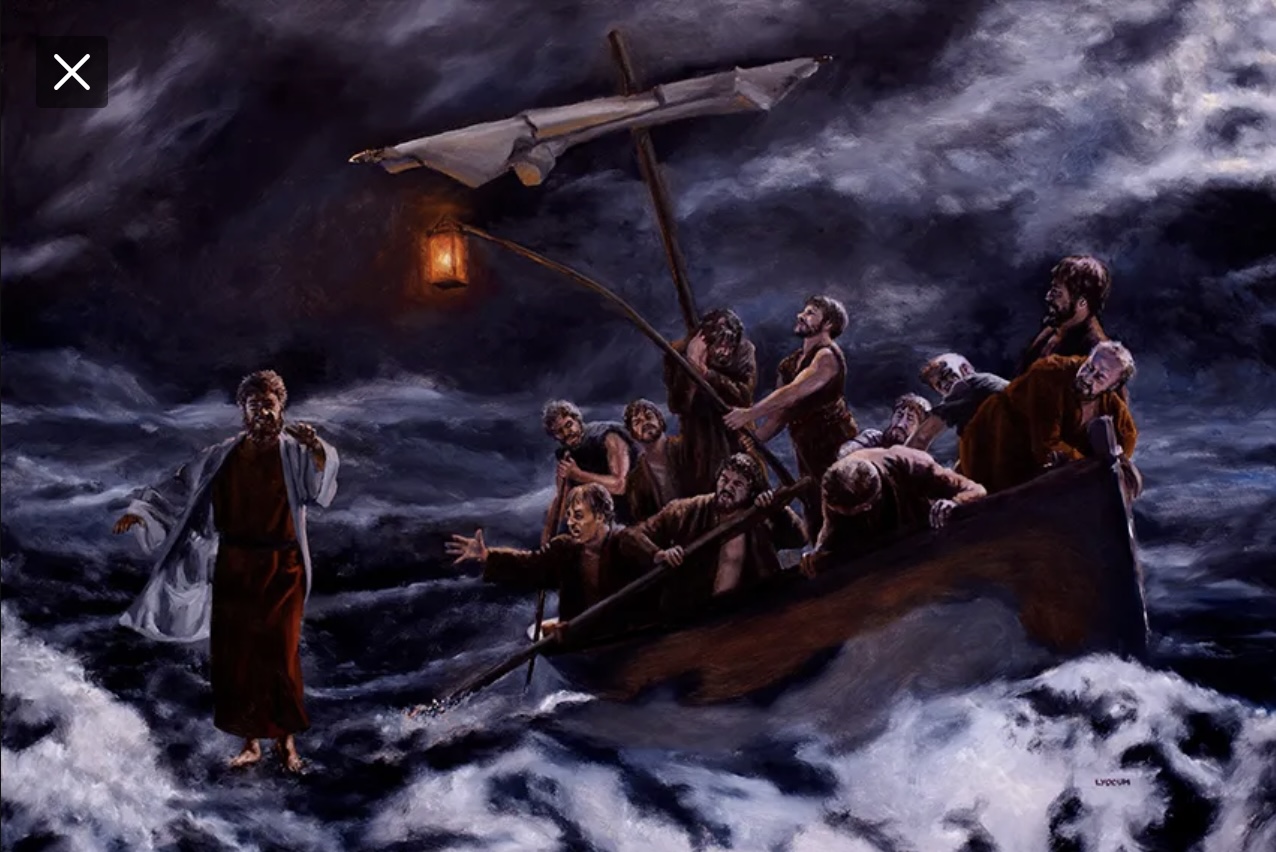
“Peter walking on the Water” by Lester Yokum. Image may be subject to copyright.
My friends, there is a simple truth found in today’s gospel that is worthy of our reflection.
We are told that the disciples are in the boat in the middle of the night and are being tossed about by the waves of the sea. The disciples are caught in fear and dread. Our Lord comes towards them walking on the water. Jesus calls to them and tells them to not be afraid and in response Peter cries, “Lord, if it is you, command me to come to you on the water.”
“Command me.”
Peter does not say, “Lord, calm the sea.”. Peter does not say, “Lord, take away this storm.” Nor does Peter remain in the little safety of the boat, waiting for the Lord to arrive. Peter says, “command me to come to you on the water.” Peter (in his cry to the Lord, in his prayer) is asking for the grace to look beyond the crashing waves, to move beyond the limits of his own fear and to have the faith to walk towards Jesus on the water.
This is the truth – there will be storms in life, there will be struggles and pain and doubt. We will know fear and uncertainty. The waves of life can be strong, high and crushing and it might even seem like everything is going to be lost. The temptation in such moments is to pray to God to take away the storm, to calm the waters and to right whatever is the wrong that we are facing. But is that the right prayer?
The prayer that Peter made was not to take away the storm but to have the faith to walk through the storm, the faith to keep his eyes on Jesus even in the midst of the storm. The gospel gives no indication that the sea calmed while Peter walked on the water. The waves still crashed but Peter did walk on the water and when his faith faltered, Jesus was there to lift him up and save him.
My friends, the right prayer may not always be “Lord, take this storm away. Take away this struggle. Take away my fear.” The right prayer may be, “Lord, give me the faith to walk through this storm trusting that you walk with me and that you are with me to protect me.”
“Lord, if it is you, command me to come to you on the water.”
I recently heard these words offered at a symposium on the priesthood and they ring true – not just in the life of the priest but in all of what it means to be Christian and to be Church.
If there is a “theme” in my own spiritual journey over the past few years it is that of a growing awareness of the Holy Spirit and relationship with the Holy Spirit – trust in the Spirit, awareness of the Spirit, crying out to the Holy Spirit, delight in the Holy Spirit, fear of wounding my relationship with the Holy Spirit, awe and wonder at the movement of the Holy Spirit, learning to rejoice in that which the Spirit rejoices in and allowing the Holy Spirit to lead me into truth.
I love the Holy Spirit.
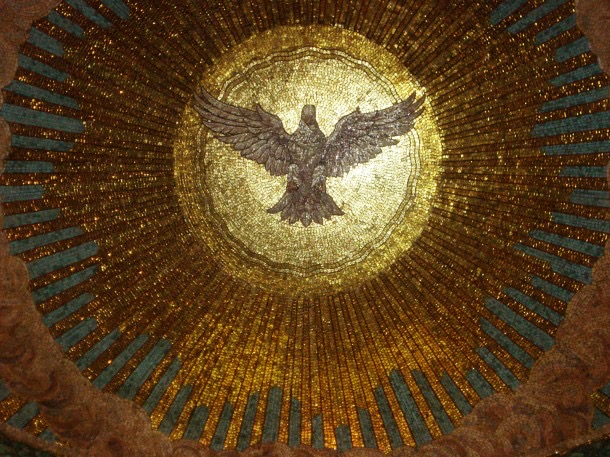
The days between Ascension and Pentecost are a privileged time to receive the Holy Spirit as a welcome guest in our hearts. The words, “welcome guest,” are key here I believe. The Holy Spirit is not an automatic in the life of the Christian and should never be thought of in such a manner. Nor is the Spirit passive. The Holy Spirit chooses and is active. Although the Holy Spirit can and does work through very limited means (I use myself in my priesthood as an example here), the Spirit chooses how to move, where to move and where to abide and in what degree of fullness. The Holy Spirit will not abide in fullness with neither sin nor duplicity.
In grace we must always strive to make of our hearts a worthy place to receive this “welcome guest”. How so? Striving to keep our will and actions sincere, honest, pure and humble. Remaining focused on Christ as Lord and Savior and showing reverence to the image and likeness of God found in every person.
A sure way to experience the withdrawal of the Holy Spirit is to try to use another person in any way, shape or form. This was an abiding sin of the rich man in the parable that our Lord gave us of the rich man and the poor beggar Lazarus. Even in the torment of afterlife; the unnamed rich man, rather than rejoicing in seeing the poor beggar Lazarus resting now in the bosom of Abraham, wanted to use the very one whom he had ignored and stepped over during his life to be sent on an errand for him to warn his brothers. The rich man is denied. One wonders what would have happened if the rich man had rather said, “I rejoice in seeing Lazarus, whom I now recognize as a brother and who knew such pain in life, now resting in the peace of God’s love.” Some scholars suggest that the sin of Judas (who believed Jesus was the Messiah but who felt Jesus wasn’t acting swift or sure enough in his view) was to try to force the hand of Jesus to show his messiahship, in other words – use him, by handing him over to the authorities. In John’s account of the Last Supper, we are told that Satan enters into the heart of Judas and that he departs into the darkness of night. To use another while neither respecting nor reverencing the image of God in which that person is made is a sin that God will not abide.
In all things, we must continually strive, by avoiding that which grieves the Holy Spirit and doing that which pleases the Holy Spirit, to make of our hearts truly a place of welcome for this most honored of guests!
I want to end this post by sharing a reflection by Cardinal Cantalamessa given in his book, “The Holy Spirit in the Life of Jesus’. The quote is long but I share it because these words helped to enliven my heart to a deeper awareness of the Holy Spirit. Cardinal Cantalamessa writes,
But an unbidden question springs to mind: why the long interval between the moments when Jesus received his anointing in the Jordan and when, on the cross and at Pentecost, the outpouring of the Spirit occurred? And why does St. John the Evangelist say that the Holy Spirit could not be given while Jesus “had not yet been glorified”? St. Irenaeus gives the answer: the Holy Spirit had first to become accustomed to dwelling among human beings; he had, so to speak, to be humanized and historicized in Jesus, so as to be able, one day, to sanctify all human beings from within their human condition while respecting the times and modes of human behavior and suffering. “The Holy Spirit,” he writes, “descended upon the Son of God, made the Son of man, becoming accustomed (adsuescens) in him to dwell and rest among the human race, so as to be able to work the Father’s willin them and renew them from their old habitsinto the newness of Christ.” Through Jesus, the Spirit is able to make grace “take root” in human nature; in Jesus who has not sinned, the Spirit can “come down and remain” (John 1:33), and get used to staying among us, unlike in the Old Testament where his presence in the world was only occasional. In a sense, the Holy Spirit becomes incarnate in Jesus of Nazareth, even if in the case of “becomes incarnate” means something different, i.e., “comes to dwell in a physical body.” “Between us and the Spirit of God,” writes Cabasilas, “there was a double wall of separation: that of nature and that of the will corrupted by evil; the former was taken away by the Savior with his incarnation (and, we may add, with his anointing) and the latter with his crucifixion, since the cross destroyed sin. Both obstacles being removed, nothing further can now impede the outpouring of the Holy Spirit on all flesh.”
The same author explains how the wall of separation constituted by nature, that is, by the fact that God is “spirit” and we are “flesh,” came to be removed. The Savior’s human nature, he says, was like an alabaster vessel which in one way contained the fullness of the Spirit, but in another way prevented this perfume from spreading abroad. Only if, by some miracle, the alabaster vessel were itself transformed into perfume would the perfume inside no longer be separated from the outside air and no longer stay shut up in the only vessel to contain it. Now, this was exactly what took place during Jesus’ life on earth: the alabaster vessel, which was the pure human nature of the Savior, was itself changed into perfume; in other words, by virtue of his full and total assent to the Father’s will, the flesh of Christ gradually became spiritualized, until at the resurrection it became “a spiritual body” (1 Cor. 15:44), the “Christ according to the Spirit” (cf. Rom. 1:4). The cross was the moment when the last barrier fell; the alabaster vessel was then shattered, as at the anointing at Bethany, and the Spirit poured out, filling, “the whole house,” that is to say the entire Church, with perfume. The Holy Spirit is the trail of perfume Jesus left behind when he walked the earth! The martyr St. Ignatius of Antioch admirably combines the two moments we have been considering – that of the anointing and that of the outpouring of the Spirit – where he writes: “The Lord received a perfumed (myron) ointment on his head, so that he could breathe incorruptibility on the Church.”
I am not a Marxist. (How is that for an opening line?) But I do believe that Marx was right about one thing – the economy matters. Neither our individual lives nor the life of society occur within a vacuum. There are many factors which influence and even shape us and the economy is one of the major influencers. Economy carries both positive and negative influence in our lives and it is both critical and helpful to acknowledge this.
Today’s feast – the Feast of the Holy Family – naturally leads us into a reflection on what it means to be family. As Church we proclaim the importance of family and how family is the foundation of society. As Church we strive to build up, support and strengthen families in their particular vocation and witness to our world. This is all true and good, but in order to truly fulfill these goals we also have to be willing to acknowledge and be aware of the context of our times in which families find themselves. Part of this context is economy and its influence.
A number of years ago I came across the book, “Following Christ in a Consumer Society” by John Kavanaugh S.J. Writing the first edition of the book in 1981, Kavanaugh was quite prescient in his awareness and understanding of how the economy was having and would have ongoing impact on our lives, including the life of the family. Here is a quote from the book:
When people, at least on a per capita basis, have most of their needs fulfilled, how are you going to get them to continually want and buy more? Is it possible that it would be more financially rewarding if people were conditioned to be dissatisfied cravers rather than appreciators of the earth? Does one buy more if one appreciates and relishes things, or if one is continually dissatisfied and distressed and craving? Is it profitable that dissatisfaction be induced into the life-consciousness of a people? Will the stimulation of anxiety and tension (closely associated with the experience of need) be economically desirable? Will persons buy and consume more if they have been taught to be unhappy, to be distressed, to be unsure about personal identity, sexuality, and relationships?
Another way of putting this problem of the commodity formation of self-consciousness is to suggest what kinds of behavior are not “good new for business.” Let us suppose that you are a married person with children. If you are relatively happy with your life, if you enjoy spending time with your children, playing with them and talking with them; if you like nature, if you enjoy sitting in your yard or on your front steps, if your sexual life is relatively happy, if you have a peaceful sense of who you are and are stabilized in your relationships, if you like to pray in solitude, if you just like talking to people, visiting them, spending time in conversation with them, if you enjoy living simply, if you sense no need to compete with your friends or neighbors – what good are you economically in terms of our system? You haven’t spent a nickel yet.
This is the context in which families find themselves – the very air they breathe – as they strive to be all that family entails.
Both of my parents were life-long smokers (a factor that was a contributing cause in both of their deaths). It was only when I got to college seminary that I realized it was possible to live in an environment that did not have the continual haze of cigarette smoke. I also soon realized the health benefits of living in an environment free of second-hand smoke. Our society has also learned these benefits and promotes these benefits through a variety of laws and ordinances prohibiting second-hand smoke.
To promote family while not acknowledging the influences which weigh upon family is like trying to encourage people in maintaining a healthy lifestyle in a smoke-filled room. Life does not occur within a vacuum. Context matters and economy (positive and negative) is part of this context. Economy influences.
Ours is not the first generation to be influenced by economy. Economy (in all of its different forms and developments) has been an influence since day one. The Holy Family lived with the influence of economy, the families of medieval serfs lived with the influence of economy, modern day men and women live with this influence. What is unique, I think, about our time though is the depth of influence and continual presence and impact the economy has in our lives through our cell phones, social media in all of its forms and the internet. It is unrelenting and is now moving into the virtual and trying to take us with it.
What can Church and family do within this smoke-filled room? Here are some initial thoughts. First acknowledge that there is smoke. Economy is an influencer and not all of the influence is good. We need to be honest about this. Second, always proclaim and uphold the dignity of the human person and demand that this dignity be respected in all contexts, especially in those of economy. Third, individually, begin to open some doors and windows in your life to both clear the smoke and let fresh air in. How? Do the things Kavanaugh lists in the second paragraph quoted above: go for a hike (one of my favorites), enjoy time with your kids and talking with other people, pray, live simply, put the cell phone away every now and then. Strive to be an appreciator of the goods of the earth. Do the things where you don’t have to spend a nickel and enjoy it.
The fact that God chose to be born and then grow up within the context of human family has much to teach us. St. Paul VI encouraged us to always be willing to go to the “school of Nazareth” and learn from the Holy Family in their love for and interaction with one another. It is interesting to note that the origin of the word “economy” is rooted in Greek meaning, “the management of a household or home”. The Holy Family can help us learn how to truly navigate all of the contexts and influences in which we find ourselves while remaining family – rooted in and formed by that greater economy of salvation found and known through Christ our Lord.
After listing the genealogy of Jesus in the first chapter of his gospel, Matthew tells us how the birth of our Lord came about and how the humble carpenter Joseph plays a key role but not in any sort of way that he could ever have expected. After deciding to spare Mary shame and to divorce her quietly, Joseph is visited by an angel in his dream. The context of “within a dream” is important because by letting Joseph know that Mary is with child through the Holy Spirit, the angel is inviting Joseph to set aside his own dreams in favor of God’s dream.
Surely Joseph had dreams and plans regarding his marriage to Mary and what their life together would be like. Surely Joseph found great anticipation and joy in those dreams but then he was thrown the biggest curveball in all of human history – his betrothed was with child, the infant was the Word incarnate and now his dreams must give way to God’s dream.
Joseph is considered the patron saint of a happy death because tradition holds that when he died (sometime between the finding of the young Jesus in the Temple and before the beginning of our Lord’s public ministry) Joseph had at his bedside both our Lord and our Lady. St. Joseph is also considered the protector of the Universal Church as he took on the duty and responsibility of protecting the newborn Christ and his mother. There are many titles given to this amazing saint and each title offers a different glimpse of his sanctity. The first chapter of Matthew offers another title worthy of consideration I believe – St. Joseph, the patron saint of handling the curveballs of life!
Life throws curveballs and they come at us at unexpected times and in many varied ways – an illness in the family, the loss of a job, the need to move, interrupted plans and projects, an unexpected pregnancy, even a random encounter with a stranger can turn things upside down! These curveballs come in many shapes and sizes and they all demand that we set aside our dreams and plans in favor of the needs of the situation and the needs of another person(s).
It is good to have Joseph with us in these moments. He shows that these moments can be navigated through in faith and in hope.
Joseph offers three lessons for the curveball moments of life.
The first is not to react in frustration and agitation (a common and often kneejerk response in such moments) but rather to step back, take a deep breath and choose to act in care for all involved. Joseph did this. Before the angel even visited him in his dream to announce God’s plan, Joseph finds out that his betrothed is with child. Joseph must have experienced pain, shame and a sense of betrayal in this moment. Yet, he does not react out of all of that. Joseph falls back on his faith and his honest care for Mary and he chose to act out of that space. He decides not to expose her to shame. Even in his pain he acts in care for the very one who it seems (on the surface) betrayed him. Joseph teaches that when life throws a curveball don’t react – rather step back, take a deep breath and act in care.
The second lesson is to listen. God is present even in the curveballs of life. God has a word to share even in such moments. We are told that Joseph was a righteous man – a righteous person lives in relationship with God which means a person who has learned that God is present in all moments of life and who has learned to search for the voice of God in all situations. Joseph listened to the message of the angel in his dream and he accepted that message. Even in the curveballs that life throws at us, God is present. Joseph teaches us to listen for what God is saying even in such moments.
Thirdly, Joseph (after listening) acts in faith. Faith means to be willing to just take the next step. Faith does not mean we know exactly how things will work out. Faith means we take the next step precisely because we trust in God and His will for us. Joseph did this. Joseph did not know how it would all end. Joseph did not fully understand all that was going on and neither was he given the whole picture but he trusted and in that trust he decided to act in faith. Joseph received Mary into his home.
Three solid lessons for handling the curveballs that life can throw at us: don’t react but rather act in care, listen for the voice of God in the moment and then act in faith, take that next step.
St. Joseph, patron saint of handling the curveballs of life, pray for us!
In the “dog days” – the time before the arrival of horses and guns – the Pikunii people (one branch of the Blackfeet nation served by our sister parish in Montana) used fire carriers made of hollowed-out bison horns to carry burning coals from one camp to the next in order to once again enkindle fire at the new campsite. The persons chosen to carry the fire for the tribe were well respected members of the tribe who were known to be both mature and responsible. To carry the coals was a critically important task because in many ways the life of the tribe (fire for warmth and for cooking) depended on these coals being safely transferred from camp to camp. The coals had to be both protected as well as kept burning just enough through the journey so as not to go out.
In the coals was also seen a connection to the past as the coals being carried were seen as coming from and connected to all of the campfires at all the campsites the people had made throughout their history. The fire journeyed with the people.
The tribes carried these coals with the greatest of care.
How do we view the “Our Father”? Is it just some interesting words, a nice part of our worship, nice thoughts given us by Jesus to think about or do we see it for what it truly is – fire.
The “Our Father” is fire.
It is a fire that we could not get on our own. Tertullian wrote, “The expression God the Father had never been revealed to anyone. When Moses himself asked God who he was, he heard another name. The Father’s name has been revealed to us in the Son, for the name ‘Son’ implies the new name ‘Father’.” (CCC #2779) Jesus alone brings this name to us and he gives this name and his prayer to us now through our adoption as sons and daughters of God. Jesus entrusts this fire to each of us and he invites us into this relationship that is now – through grace – our common patrimony. Now, we each must carry this fire throughout the journey of our lives. We must cherish this fire, tend it, protect it and allow it to protect and nourish us.
In the very beginning of the Church, Christians would stop and pray the “Our Father” three times each day. They recognized that this fire that they held (which we now hold) pushes back the darkness of evil, sin and lies. It overcomes the great deceiver and his lies. It nourishes and brings refreshment to our weary and thirsting souls and it warms and protects us from the cold pain of injustices endured in our world.
The Pikunii chose only those persons who were mature and responsible enough to carry the fire for the tribe. This fire given to us by Christ both matures us and is received by us more fully as we mature in the journey of faith and discipleship. The words of the Our Father are the same today that I first learned when I was five years old but the fire that I carry in those words today is very different – it has now been tended through all of the experiences, joys and struggles of fifty-four years of life. It is the same for each of us, if we tend this fire that has been given us and if we also allow this fire to warm, nurture and mature us.
How do we view the “Our Father”? It is fire. A fire given to each of us through our baptisms to carry and protect throughout the journey of our lives.
The early Church wrestled with the Christological controversies like their lives depended on it. The truth is that our lives (and salvation) do. Unless Jesus is fully God, we are not saved. Unless Jesus is fully human, we are not saved. The chasm created by our turning away from God (because it is God we have turned from) is impossible for any creature (human or angelic) to bridge. Only God can heal that divide. Hence, the savior must be fully God. The original offense – the turning away – is on our part. We are the ones who turned our back on God. We must be the one who makes amends. Hence, the savior must be fully human. The savior must overcome our prideful disobedience by his humble obedience to the Father. Jesus – fully God and fully human – did this.
For centuries the Church (guided by the Holy Spirit) wrestled this out and from this effort and inspiration was born the Apostles’ and Nicene Creeds – guardrails to keep us on the way of truth. But guardrails are not the road nor are they meant to be. Guardrails serve their purpose by keeping the traveler on the right path and protecting the traveler from the misfortunes and the dangers of going off course. This is their purpose and the creeds do this but they do not answer every single question nor are they meant to. There is still so much more to learn and to be brought to deeper understanding on.
Being fully God and fully human, how does the savior overcome our disobedience by his obedience? Both in the emptying of his divine sonship and in the humility of his humanity, I believe.
Here, the Christ Hymn of Philippians 2 (a hymn sung by the first generation of disciples) is of critical importance.
Have among yourselves the same attitude that is also yours in Christ Jesus,
Who, though he was in the form of God,
did not regard equality with God
something to be grasped.
Rather, he emptied himself,
taking the form of a slave,
coming in human likeness,
and found human in appearance,
he humbled himself,
becoming obedient to death,
even death on a cross.
Because of this, God greatly exalted him
and bestowed on him the name
that is above every name,
that at the name of Jesus
every knee should bend,
of those in heaven and on earth
and under the earth,
and every tongue confess that
Jesus Christ is Lord,
to the glory of God the Father. (Phil. 2:5-11, NAB)
The glory of the divine Sonship is present in Jesus but it is an emptying presence. It is freely let go of. This letting go allows Jesus, in the humility of his humanity, the “space” to fully exercise his will in obedient response to the prompting and guidance of the Holy Spirit. The Holy Spirit – who is the love of the Father and the Son – fully indwells within Jesus who is without sin. And Jesus (without sin) in the humility of his humanity continually and fully makes the choice to respond to the prompting and guidance of the Holy Spirit.
In this the salvation won by Christ is an exercise of his divine Sonship in the sense of continually emptying himself of the glory of God in order that in the humility of his humanity Jesus might authentically exercise that human obedience in which we failed.
To be fully human means to grow in understanding and therefore not always fully know and comprehend, to authentically exercise trust and faith even in the darkest and most despairing moments, to be guided by the Holy Spirit through one’s own prayer, scripture, worship and the Spirit speaking through other persons and circumstances. Jesus did all of this even to death on a cross.
The miracles of Jesus (the signs) can be understood then not as the exercise of the power of his divine Sonship in the worldly sense of “will to power” but rather the exact opposite – an emptying of his equality with God in order that in the obedience of his sinless humanity the Holy Spirit might fully work through him and now, through Christ, even in others. In the Last Supper discourse, before the promise of the sending of the Holy Spirit, Jesus says, Amen, amen, I say to you, whoever believes in me will do the works that I do, and will do greater ones than these because I am going to the Father. (Jn. 14:12)
It is only in Jesus’ ascending to the Father, that the Holy Spirit (who had been fully indwelling in the Son) can now be poured forth upon and begin to dwell within us who have been washed clean through the obedience of Christ. Now the Holy Spirit can begin to work through us if we take on the same attitude that was in Christ Jesus. If we learn (through grace) willed self-emptying, then the Holy Spirit can move through even the humility of our own humanity and we can learn to hear and be docile (obedient) to the promptings of the Holy Spirit in our lives.
In the self-emptying of his equality with God and in the humility of his humanity Jesus exercises the obedience that overcomes the effects of our original disobedience.
Have among yourselves the same attitude that is also yours in Christ Jesus.
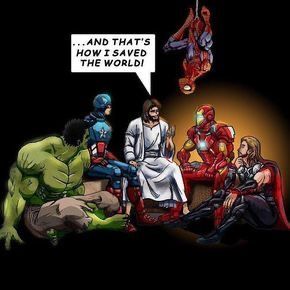
I have a confession to make … I am not a fan of superhero movies. Don’t get me wrong, they can be entertaining (a good escape for a couple of hours) and the special effects are amazing but they are really just the same story over and over again – just repackaged. Also, and here I will admit I may be reading too much into things, I feel that all of these superhero movies are grooming their audience (us) into the belief that we need a superhero to come along and save us when that is neither reality nor what we truly need.
St. Paul did not need superheroes. He had a Savior. The Savior is real, superheroes are made up. Paul instructs us in his letter to the Corinthians (Cor. 12:12-30) that we – through our baptism – are all part of the Body of Christ. Christ is the head and we are the body. We each have a role to play, we each have gifts to give. Every member of the Body of Christ contributes – in his or her own unique way – to the building up of the Body of Christ and to the mission of the Body of Christ in our world. We do not need a superhero to save us. We have a Savior and he has made us into his body.
The Church ministers best as “Church”. As the “Body of Christ” in our world we are each to live our faith which means each of us taking responsibility for our faith and not waiting for some superhero to come along and save us. Ever notice that in superhero movies – the hero swoops in, saves the day and then flies off. There really is no relationship between hero and those who are saved. Having a Savior, on the other hand, implies an ongoing relationship which does put honest demands on us and honest responsibilities which we must strive to live.
The Church ministers best as “Church”. The Church has done this in the pro-life movement. From day one, the Church has been consistent in the message of the dignity of life in the womb and the dignity of the woman who carries that life. All together the Church promotes life. Clergy and laity in a variety of ways and settings and as different parts of the body of Christ does this. The Church has been and will always be pro-life. It is quite likely that Roe v. Wade will be struck down in some form or fashion soon. It should be struck down. It is a horrific law that has killed millions and destroyed millions of lives. But the work of defending life will continue and we will do that work as church – helping those persons with unplanned pregnancies, caring for both children and parents, defending the dignity of the life of every person and working to ensure that dignity on all levels.
Pope Francis, in his unique role as the successor to St. Peter, has invited each of us as members of the Body of Christ universal to listen to one another and to listen to the Holy Spirit by sharing our thoughts through the Synod process. If you have not already done so, take the time to participate in the survey and attend one of the listening sessions that will soon be occurring in our parish. The key word is “listening”. We each are a part of the body; we each have a voice to share. It does not mean we will each get our way or our thought is necessarily the “correct” one. It does not work that way in the body, St. Paul demonstrates that, but we each are called to listen and to share.
St. Dominic Church has ministered as “Church” powerfully in the ministry of St. Dominic School. It is no easy thing to support and run a school. What other churches in our area are doing it? But this parish church – all of us together, in different ways and in different roles – has said that this is an important ministry that builds up generations and we will continue to strive to uphold and strengthen this ministry. As Church this is being done.
The Church ministers best as “Church”.
Not to pit movie genres against one another but there is a wonderful line from one of the Harry Potter movies. Dumbledore – the wise wizard – at one point remarks off-handedly, “I’ve never had much use for heroes.” (Whenever I see someone trying to market himself or herself as a “hero” that others should look up to that, for me, is a huge red flag that makes me wonder what happened in that person’s childhood years.)
We don’t need superheroes who are not real. We have a Savior and he has made us into his body. The Church ministers best as “Church”.




 The Alternate Path