
Tags
catholic, Christ, Christianity, Church, discipleship, Fiducia supplicans, news, Pastoral blessings, Pope Francis

There was a woman afflicted with hemorrhages for twelve years. She had suffered greatly at the hands of many doctors and had spent all that she had. Yet she was not helped but only grew worse. She had heard about Jesus and came up behind him in the crowd and touched his cloak. She said, “If I but touch his clothes, I shall be cured.” Immediately her flow of blood dried up. She felt in her body that she was healed of her affliction. Jesus, aware at once that power had gone out from him, turned around in the crowd and asked, “Who has touched my clothes?” But his disciples said to him, “You see how the crowd is pressing upon you, and yet you ask, ‘Who touched me?’” And he looked around to see who had done it. The woman, realizing what had happened to her, approached in fear and trembling. She fell down before Jesus and told him the whole truth. He said to her, “Daughter, your faith has saved you. Go in peace and be cured of your affliction.” (Mk. 5:25-34)
There has been a lot of talk about blessings in the Catholic Church these past few weeks since the issuance of Fiducia supplicans. The concern seems to center upon what is the nature of a blessing and is every blessing offered by a member of the clergy a tacit sign of approval of the supplicant’s state of life, in particular couples in irregular situations.
My reading of the document as well as the recent clarification issued is that no, every blessing offered is not a sign of approval and (this is what I find freeing about the declaration) it does not weigh upon the clergy to determine a person’s precise moral state when offering a “pastoral” blessing as opposed to a blessing given in a liturgical context.
When a couple comes forward to get married in the Catholic Church there is a process of determining the couples’ freedom to enter into marriage as well as their readiness and this is appropriate as that sacramental celebration is tied to our Church’s teaching about the nature of marriage. Liturgical blessings carry the weight of the Church’s teaching and are public in nature so, yes, it is on the church’s minister to ensure that blessings offered in a liturgical context are not in contradiction to the teaching of the Church.
But blessings offered in a liturgical context are not the only type of blessing. This is the key distinction offered by Fiducia supplicans. Pastoral blessings which, the declaration specifies, are more private in nature and occur in the moment, do not carry the same weight of responsibility upon the clergy. As I have read the declaration, the recent clarification and differing commentary I have been drawn to the gospel passage shared above. It was a very public moment – the crowd was pressing in upon Jesus. Our Lord knew nothing about the lady and her state in life. Her faith and trust merited the outpouring of blessing and healing and our Lord confirms this, “Daughter, your faith has saved you. Go in peace and be cured of your affliction.”
A couple of days before Fiducia supplicans was issued,I was in the neighborhood Lowe’s store in search of bird seed. At one point, gawking in front of the plethora of Christmas yard art decorations, I was approached by a woman with a small child. The woman, in broken English, asked for a blessing. I had never met this woman. I did not have to ask about her state in life. I did not have to ask about her marital status nor did I ask if she was in a state of grace. Standing in the aisle at Lowe’s, I responded to her request and I prayed a simple blessing. It was certainly a public space but also a very private moment – a simple blessing that I think went unnoticed by the other shoppers milling about.
The distinction in blessings made by Fiducia supplicans is valid and it is also freeing. It is not on the clergy, in that moment, to have to carry the weight of judge rather, it is enough to be a humble believer and shepherd. Might pastoral blessings and their true intent be misused? Possibly, but any misuse does not necessarily discredit the valid request and the valid giving of a pastoral blessing – a cry for God’s mercy.
I understand that these thoughts are written in the context of U.S. culture with the freedoms that we enjoy and value and that there are different contexts in different cultures that clergy need to honestly weigh out and consider. God’s blessings and guidance upon those shepherds as they strive to care for the flock entrusted to their care.
There are moments for the clergy to be judge, safeguarding what the Church treasures. Fiducia supplicans affirms this but the declaration also teaches that there are moments for the clergy to be fellow believers themselves who are also shepherds trusting in the abundant mercy of a God who works in ways we cannot even imagine.


 The longest pedestrian suspension bridge in North America is set to open later this month in our own Gatlinburg, TN. The bridge stretches nearly 700 ft. and is suspended 150 feet high. Apparently, it has glass panels as flooring in the middle of the expanse. I’ve been hearing people talk about it and have been seeing things on the news about it. Would you walk across it?
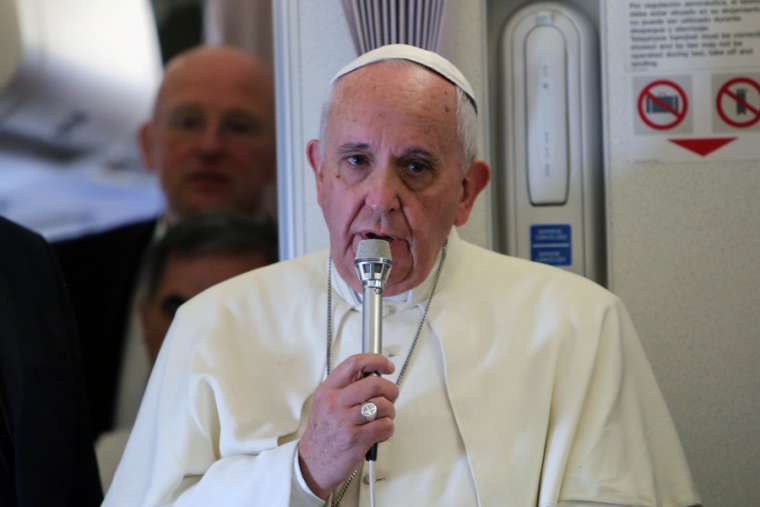 When questioned about the accusations in the letter written by Archbishop Carlo Viganó on the return flight to Rome after the World Meeting of Families in Ireland, Pope Francis did something quite revolutionary I think. He did not just say, “I will not say a single word on this” as many people have been focusing on. He went on to do something else, he opened a door and he made an invitation.
 For a couple of weeks now I have been leading a weekly discussion group on Pope Francis’ recent Apostolic Exhortation “Rejoice and Be Glad”. In this exhortation, the Holy Father is encouraging every member of the Church to recognize and embrace his or her own unique call to holiness. The exhortation is a wonderful document and, I believe, it shows forth Pope Francis’ training as a retreat director steeped in the Ignatian practice of discernment.
 It is interesting how some things stay with us and even become operating principles in our lives.
 What is best for the environment? This is a question I find myself continually returning to after reading Pope Francis’ encyclical “Laudato Si” as well as my own growing interest in protecting and safe-guarding creation. Do the plants and shrubs we favor around churches help benefit the environment or do they just look nice from our human perspective? Can our parish grounds themselves become places that benefit and support creation? A couple of years ago now I planted two butterfly bushes in front of our Parish Life Center because they fit and enhance the space, they are low maintenance and hardy and, in regards to this question, they are a benefit to bees and butterflies. A simple choice in a planting can have ripples of effect.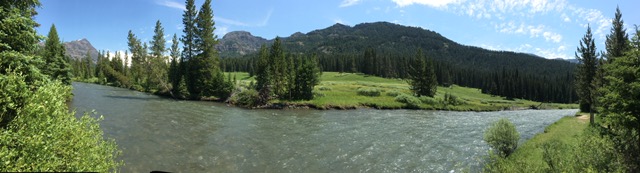
 Wolves (for which I have always had an interest in since I was a child) were my main interest in visiting Yellowstone but during these days I was also thrilled to view numerous black bears (a few with cubs), bison, elk, mule deer, bighorn sheep, pronghorn, an osprey nest inhabited by mother, father and two chicks, foxes, coyotes, badgers, a bald eagle flying and numerous smaller animals and birds.
![IMG_5641[3392]](https://thealternatepath.org/wp-content/uploads/2017/07/img_56413392.jpg) For a week, I was “unplugged” – to some degree. Other than sharing some pictures on Facebook and Instagram and talking with the people I met or was around during the day I had no idea what was going on in the world. I would rise early to get into the park before the heat of the day became too oppressive, return to Gardner for lunch and a short siesta and then return into the park not to leave until late in the evening.
For a week, I was “unplugged” – to some degree. Other than sharing some pictures on Facebook and Instagram and talking with the people I met or was around during the day I had no idea what was going on in the world. I would rise early to get into the park before the heat of the day became too oppressive, return to Gardner for lunch and a short siesta and then return into the park not to leave until late in the evening.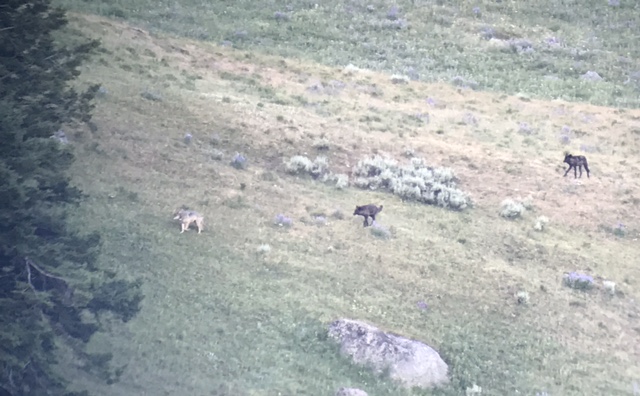 Although I have an interest in wolves and have now spotted three packs during my two visits to Yellowstone I do not think I have some “mystical” connection with them because the wolves are unconcerned about me and that is the way it should be. The wolves are just out there being wolves and if something were to happen and all of sudden humanity disappeared from the face of the earth the wolves, bears, bison, elk and all animals would just continue continuing on. But the wolves and other animals are of concern to me and that is what makes me human.
 Both of my parents were converts. My father grew up in the Presbyterian Church and my mother grew up as a Southern Baptist. There is a story told in my family that once, not long after my father’s conversion, my two great aunts from Mississippi (both spinsters and staunch Presbyterians to boot) visited my grandfather. Noticing some dust on the cover of the family bible, one great aunt is said to have remarked, “I guess if this Bible cover was not so dusty Jack would never have converted.” I am not sure how my grandfather and grandmother replied although I would wager that a bit of a chill went through the room.
 The Alternate Path