• About The Alternate Path

The Alternate Path

~ Thoughts on Walking the Path of Christian Discipleship

The Alternate Path

Author Archives: mcummins2172

A Gospel passage in three movements: Twenty-Third Sunday in Ordinary Time (B)

09 Sunday Sep 2012

Posted by mcummins2172 in 23rd sunday in Ordinary Time (B), frienship with Christ, homily, listening, speaking correctly

≈ Leave a comment

In this Sunday’s gospel passage (Mk. 7:31-37) there are three “movements” worthy of reflecting upon.  This passage tells the good news of how Jesus cured the deaf man with the speech impediment and it is worthy to note how our Lord heals the man. 

The first movement is that Jesus takes the man away by himself.  He took him off by himself away from the crowd.  Jesus welcomes this poor man.  He teaches by way of action what James is later to write in his letter (James 2:1-5); …show no partiality as you adhere to the faith in our glorious Lord Jesus Christ.  It is certainly true that God shows no preference between people but we see throughout Scripture that the heart of God leans in a special way toward the poor and the weak. 

Jesus welcomes this man and he takes him off to the side as if to stress the need of a personal relation and encounter with Christ as the foundation of any true healing.  Miracles, it has been noted, “occur in the realm of a deep friendship and trust in God.”  It is true that God respects our freedom enough to not force his love on us but it is also equally true that the respect must go both ways.  Neither God nor his love is a genie to be summoned on command by our whims and needs.  The love and grace of God and the miracles of God in life are dependent (to a considerable extent) upon our friendship with and trust in God.

Jesus then, following ancient custom, puts his finger in the man’s ears and then (with saliva) touches the man’s tongue.  These are the second and third movements respectively. 

Jesus touches the man’s ears.  Each person needs to be “open” to hearing the Word of God.  In our distracted world we need to learn how to cultivate the art of listening, especially listening for the Word of God as it comes to us.  This art implies the willingness to live with an open heart and a humble and receptive spirit.  I think in times past we could almost coast on this because times and circumstances lent themselves to the art of listening.  I do not think we can say this anymore.  There are too many distractions.  We must be intentional about creating in our lives and in our world environments (even pockets) of quiet in order that the discipline of listening and real encounter with another can be developed and grow.  This certainly applies to our faith life and our relationship with Christ. 

(At this point, I want to take an aside and point to two things beginning this week at the Catholic Center that relate here.  The first is Monday morning prayer on campus which will be held every Monday at 7:15 a.m.  Each month we will explore a different prayer form together.  The second is Wednesday Adoration of the Blessed Sacrament which our Graduate Student/Young Adult group is organizing which will be held every Wednesday from 3:00 to 5:00 p.m.  These are both moments to just listen and to be with the Lord.)

Jesus touches the man’s tongue, looks up to heaven, groans and says, Ephphatha! or “Be opened!”.  And immediately the man’s ears were opened, his speech impediment was removed, and he spoke plainly.  In the fact that we are told that the man was able to speak plainly we can see that the miracle proclaimed in this passage concerns not just the restoration of speech but really the ability to speak correctly.  Words carry great power.  We find this throughout Scripture from the very beginning in the creation account where we are told that God spoke and it came to be to John’s reflection of Jesus being the Logos or Word of the Father.  Our words can participate in the very creativity of God or they can be misused in order to harm, to do evil and to create nothing but division. 

For our words to be purified, for them to participate in the very creativity of God and not be malicious nor deceitful then we must first of all (as noted above) listen to the Word of God.  Our words can do great good but they can also do great harm.

Three movements: truly encountering and living in friendship with Christ, listening to the Word of God and learning to speak correctly.           


Hearts open to God: Twenty-Second Sunday in Ordinary Time (B)

01 Saturday Sep 2012

Posted by mcummins2172 in 22nd Sunday in Ordinary Time (B), heart, homily, open to God, ritual

≈ Leave a comment

Statue of Christ the Redeemer in Rio de Janeiro, Brazil

It is helpful in today’s gospel passage (Mk. 7:1-8, 14-15, 21-23) to distinguish what our Lord is condemning from what he is not condemning.  Our Lord is not condemning ritual action per se.  We realize this if we call to mind elsewhere in the Gospel where our Lord states that he has come not to abolish but to fulfill the law.  What our Lord is condemning in this gospel passage is the temptation to keep our hearts distant from God. 

This temptation can take a variety of forms.  One form is indeed to cloak itself in a form of religious ritualism that really misses the mark.  Here our Lord quotes Isaiah, “This people honors me with their lips, but their hearts are far from me; in vain do they worship me, teaching as doctrines human precepts.”  You disregard God’s commandments but cling to human tradition.  This misuse of ritual as a means to hide our hearts from God rather than the proper exercise of ritual which guides one to an encounter with the Divine can often be seen in the tendency to (as a friend of mine would say) “major in the minors.”  This means to get lost in an over focus on what is of little importance while neglecting the loftier things.  In our first reading for the Sunday (Dt. 4:1-2, 6-8), Moses reminds Israel that the statutes and commandments of the Lord are given that they might have life.  The commandments are given in order that the Israelites might live with hearts open to an encounter with God.

This is one way of keeping our hearts distant from God but there is another way which is quite prevalent today and also worthy of note.  This second way of keeping our hearts distant from God is witnessed in a lack of respect for ritual.  This can be heard often in the critique that the Catholic and Orthodox Church are just about “dead ritual” that has no real value in the true Christian life.  This perception demonstrates a profound ignorance both about the sense of God in one’s life and also often an over-inflated sense of self.  Downplaying the awareness of God as the transcendent mystery while inflating our own ego (which I would argue often happens in many Christian circles today) is another way of keeping our hearts distant from God.  One might profess relationship with Christ but it is, in fact, easy here to keep ones heart distant through both an over focus on self and a viewing of God as just being the means by which I and my needs are satisfied.

Ritual, when properly lived, reminds us that it is God we are approaching.  Ritual calls forth respect in regards to what we are about and also to Whom we are addressing ourselves.  Ritual, through its concrete action, opens our hearts to an encounter with the Divine Mystery.  Ritual, truly lived, recognizes God as God and reminds us of our proper place in this encounter.

Both ritualism and the denial of any value to ritual can be used to cloak the same sin: keeping our hearts distant from God.  Today, Christ invites us to do a little heart surgery in our lives – to acknowledge the root of our sins and to acknowledge that these sins grow in our lives and in our world precisely in relation to how much we keep our hearts distant from God. 

From within people, from their hearts, come evil thoughts, unchastity, theft, murder, adultery, greed, malice, deceit, licentiousness, envy, blasphemy, arrogance, folly.  All these evils come from within and they defile. 

“By affirming this, Jesus clarifies that evil does not grow by chance, as if it was the fruit of a blind destiny.  Evil has its own soil that is the heart.  And it has also its farmers: men and women.  Each person is a farmer, at times very active, of small or large quantities of bitter grass in our hearts, grass that often poisons our lives and the lives of others.”  (Bishop Vincenzo Paglia, The Word of God Everyday)

We are responsible for the bitterness in our world and also, often, in our lives.  No one is exempt.  But, just as we can be farmers in our hearts sowing bitter grass, we can also be farmers sowing that which is true and good – solidarity, compassion, patience, humility, piety, mercy and forgiveness.  Our Lord knows that it all happens in the heart and the first step is to stop keeping our hearts distant from God.  In all times and seasons, we ought to welcome the word of the Gospel and the grace of God into our hearts. 

In his letter, the apostle James gives us this wise advice: …welcome with meekness the implanted word that has the power to save your souls.  But be doers of the word, and not hearers who deceive themselves.        

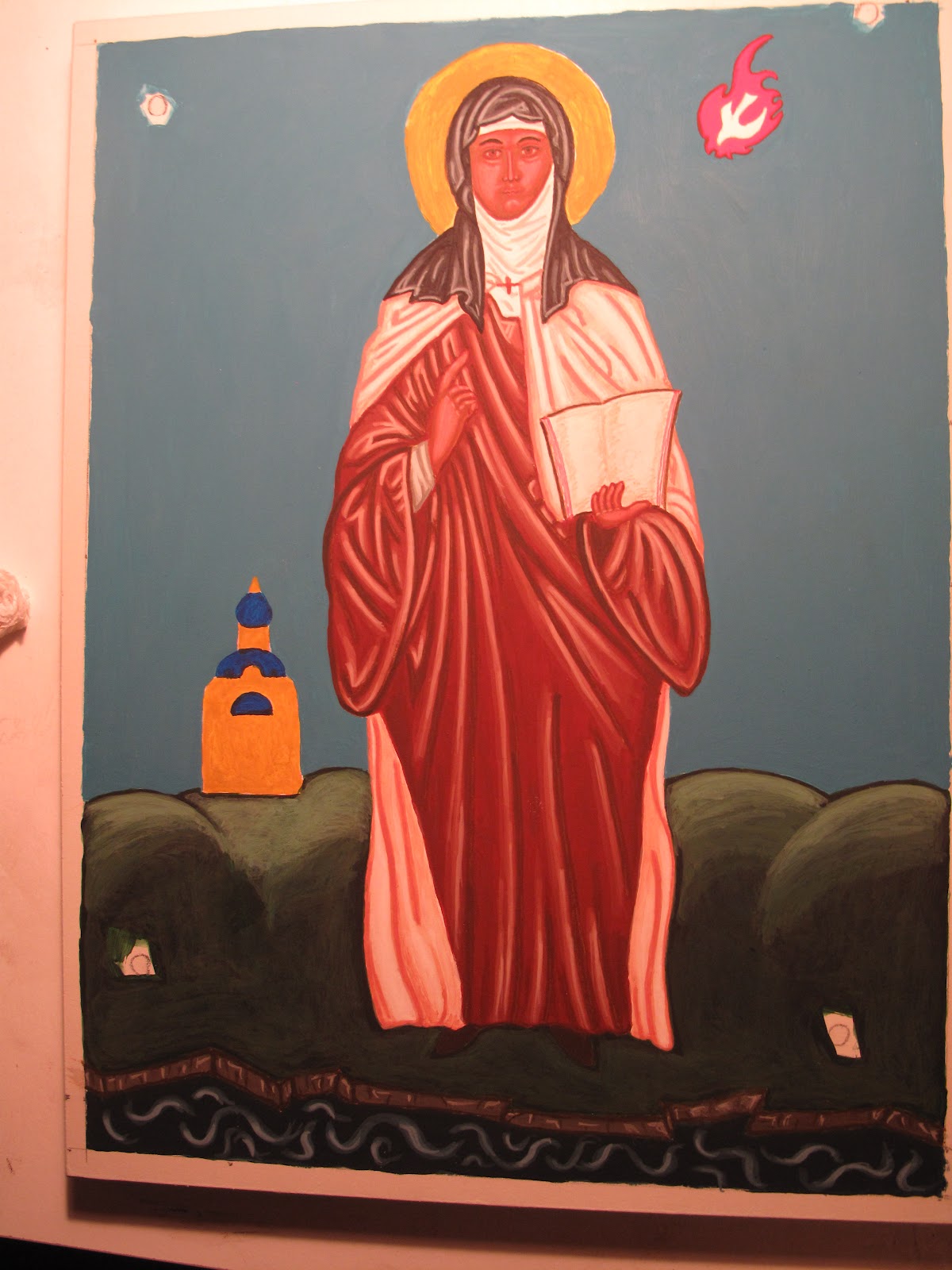
Icon of St. Teresa of Avila, final

31 Friday Aug 2012

Posted by mcummins2172 in contemplation, icon, prayer, St. Teresa of Avila

≈ 1 Comment

I have completed my icon of St. Teresa of Avila and I am pleased with the way it has turned out.  Behind the saint is a representation of the Interior Castle – St. Teresa’s image for the stages of prayer and contemplation and how we encounter God through our own thoughts and imaginings and even going beyond these to that still point where we realize all is grace and pure gift from God.  St. Teresa has much to teach us. 

Recently I picked up a wonderful book on iconography entitled Hidden and Triumphant: The Underground Struggle to Save Russian Iconography.  The book is written by Irina Yazykova and it presents the story of how courageous men and women kept the art and prayer of iconography alive during the years and persecution of the communist Soviet regime. 

At one point in the introduction the author shares the description of iconography as being “contemplation in colors”.  I think that this is a wonderful description for the work of iconography and I know that it is a description that I will continue to reflect on and draw insight from. 

Feast of the Beheading of John the Baptist: John’s birth

29 Wednesday Aug 2012

Posted by mcummins2172 in eternal life, hope, John the Baptist, resurrection

≈ Leave a comment

August 29th is the feast of the Beheading of St. John the Baptist. 

In its calendar of saints, the Church commemorates the day of death. This is done to acknowledge the day of the saint’s “birth” into eternal life – when the saint passes from this world of pilgrimage to the full life of eternity in Christ. This reminds us of our belief as Christians that death is not the end (Christ’s resurrection has conquered death) and also encourages us while we are on pilgrimage to keep our eyes fixed on the full horizon that we are called to and meant for by God and to live our lives accordingly and in hopeful expectation!

Below is the homily of St. Bede the Venerable for this day:  

As forerunner of our Lord’s birth, preaching and death, the blessed John showed in his struggle a goodness worthy of the sight of heaven. In the words of Scripture: “Though in the sight of men he suffered torments, his hope is full of immortality.” We justly commemorate the day of his birth with a joyful celebration, a day which he himself made festive for us through his suffering and which he adorned with the crimson splendour of his own blood. We do rightly revere his memory with joyful hearts, for he stamped with the seal of martyrdom the testimony which he delivered on behalf of our Lord.

There is no doubt that blessed John suffered imprisonment and chains as a witness to our Redeemer, whose forerunner he was, and gave his life for him. His persecutor had demanded not that he should deny Christ, but only that he should keep silent about the truth. Nevertheless, he died for Christ. Does Christ not say: I am the truth? Therefore, because John shed his blood for the truth, he surely died for Christ.

Through his birth, preaching and baptizing, he bore witness to the coming birth, preaching and baptism of Christ, and by his own suffering he showed that Christ also would suffer.

Such was the quality and strength of the man who accepted the end of this present life by shedding his blood after the long imprisonment. He preached the freedom of heavenly peace, yet was thrown into irons by ungodly men; he was locked away in the darkness of prison, though he came bearing witness to the Light of life and deserved to be called a bright and shining lamp by that Light itself, which is Christ. John was baptized in his own blood, though he had been privileged to baptize the Redeemer of the world, to hear the voice of the Father above him, and to see the grace of the Holy Spirit descending upon him. But to endure temporal agonies for the sake of the truth was not a heavy burden for such men as John; rather it was easily borne and even desirable, for he knew eternal joy would be his reward.

Since death was ever near at hand through the inescapable necessity of nature, such men considered it a blessing to embrace it and thus gain the reward of eternal life by acknowledging Christ’s name. Hence the apostle Paul rightly says: “You have been granted the privilege not only to believe in Christ but also to suffer for his sake.” He tells us why it is Christ’s gift that his chosen ones should suffer for him: The sufferings of this present time are not worthy to be compared with the glory that is to be revealed in us.

The Eucharist and friendship with Jesus, part 3 – Twenty-first Sunday in Ordinary Time (B)

25 Saturday Aug 2012

Posted by mcummins2172 in 21st Sunday in Ordinary Time (B), bread of life, Eucharist, friendship, humility

≈ Leave a comment

With this Sunday’s gospel reading (Jn. 6:60-69) we come to the end of our five week collective reading of the sixth chapter of John and our reflection on Christ as the Bread of Life.  In many ways today we are given a very vulnerable scene.  Christ has just laid out the teaching of his being the bread of life and people needing to eat of his flesh and drink of his blood.  It was a difficult teaching for many of his followers.   

Many of Jesus’ disciples who were listening said, “This saying is hard; who can accept it?” … As a result of this, many of his disciples returned to their former way of life and no longer accompanied him.

The scene is striking in many ways.  Jesus is vulnerable and he is willing to remain in that vulnerability out of his love for us and the Father and his desire for our friendship and not our fear.  Because of this he is willing to accept the poverty of seeing people walk away.  (There is a great lesson here, I believe, for all persons who are involved in ministry and for any Christian disciple in general.  Authentic ministry and witness means accepting and embracing this poverty.  We do not manipulate people, we do not buy their allegiance or their participation through the latest gadget or trend.  Like Christ, we simply offer what we know and what we have and we love people enough to allow them their freedom.)

Our Lord then turns to the Twelve: Do you also want to leave?  Simon Peter answered him, “Master, to whom shall we go?  You have the words of life.  We have come to believe and are convinced that you are the Holy One of God.”  

Now, I do not believe that when Peter made this reply he had a full understanding of transubstantiation worked out in his thoughts.  More than likely, he also probably found our Lord’s words confusing and troubling and the thought was also probably there that, “… maybe it is time to just walk away.”  But he doesn’t.  Even in the uncertainty of the moment and not fully understanding, Peter makes that very remarkable reply, “Master, to whom shall we go?  You have the words of life.  We have come to believe and are convinced that you are the Holy One of God.”

These are words of faith and they are also words of humility – the two are connected.  St. Teresa of Avila, in her book The Interior Castle, makes a profound and foundational observation regarding the spiritual life that is helpful here, I believe, “While we are on this earth nothing is more important to us than humility.”  Humility is a key component of faith and, in fact, it is a key component of true friendship.  No humility, no friendship.  Peter does not work it all out on his own and then come to Jesus fully informed and ready to commit himself.  Rather, Peter remains with Jesus even in the midst of the uncertainty because in his humility he has come to realize and accept that Jesus does indeed have the words of life and it is by remaining with Jesus that he is brought to greater and greater faith and understanding!

The key is humility and the willingness to just remain with Jesus.

It has been noted that beyond the murmuring about eating the flesh and drinking the blood is the heart of the issue that just proved too much for people and so they walked away: this being the choice of an exclusive intimacy with God through a personal relationship with Jesus.  Peter both makes this choice for himself and proclaims it in his reply to the Lord: “We have come to believe and are convinced that you are the Holy One of God.”

All of our Lord’s discourse on his being the bread of life is offered and then it is summed up and accepted in the reply of Peter.  It all comes back to humility, to faith and the willingness to remain with Christ and to have friendship and intimacy with Christ.   

“Master, to whom shall we go?  You have the words of life.  We have come to believe and are convinced that you are the Holy One of God.” 


The Eucharist and friendship with Jesus, part 2 – Twentieth Sunday in Ordinary Time (B)

18 Saturday Aug 2012

Posted by mcummins2172 in 20th Sunday in Ordinary Time (B), bread of life, Eucharist, Fr. Lou Cameli, friendship

≈ Leave a comment

During these weeks when we as the Church have been drawing from the sixth chapter of John’s gospel and reflecting on Christ as the bread of life, I have become more and more aware of how Eucharist and friendship with Christ must be held together and that the starting point for a true understanding of Eucharist is relationship with Christ.  The two are that closely bound and connected.  In fact, I do not think that one can have a full understanding of Eucharist apart from relationship with Christ.  We can talk about transubstantiation, real presence and the matter and form of the sacrament (which are all valid points and have their place) till the cows come home but without relationship with Christ all the talk does not really amount to much.

A number of years ago, I saw a saying on a roadside church sign that has remained with me, “People will not care about how much you know until they know how much you care.”  God, I think, understands this.  In the Eucharist God reveals the depth of his love.  Christ freely and totally gives his own body and blood that we might have life.

Amen, amen, I say to you, unless you eat the flesh of the Son of Man and drink his blood, you do not have life within you.  Whoever eats my flesh and drinks my blood has eternal life, and I will raise him on the last day.  For my flesh is true food, and my blood is true drink.  Whoever eats my flesh and drinks my blood remains in me and I in him. 

This word “life” is of utmost importance.  We live in a time that says we must get the most out of every moment and that this is where true life is to be found.  Today, our faith gives us the same invitation:

Brothers and sisters: Watch carefully how you live, not as foolish persons but as wise, making the most of every opportunity, because the days are evil.  Therefore, do not continue in ignorance, but try to understand what is the will of the Lord.  (Eph. 5:15-16)

Wisdom has built her house … “Let whoever is simple turn in here”; to the one who lacks understanding, she says, “Come, eat of my food, and drink of the wine I have mixed!  Forsake foolishness that you may live; advance in the way of understanding.”  (Proverbs 9:1,5-6)

Notice how in both these passages and in today’s gospel (Jn. 6:51-58) life is achieved through relationship – entering Wisdom’s house, seeking God’s will, eating the flesh and drinking the blood of Christ in order to remain in Christ and for Christ to remain in us.

I have just finished reading a new book put out by my friend Fr. Lou Cameli entitled; Bread of Life: Exploring the Presence of Eucharist in Our Lives.  The book is quite good and I highly recommend it but here I want to bring out two points that Fr. Cameli makes in his book. 

First, in the book, Fr. Cameli explores in detail the sixth chapter of John’s gospel and he reminds us that in this chapter as Jesus is expounding on his being the bread of life he is (in fact) in dialogue with a “more and more concentrated set of interlocutors”.  At first Jesus is talking with a crowd, then it is his disciples, then it is the Twelve and, I would say, finally Jesus is in dialogue with you and me.  The invitation that Jesus has put out there for the people has become too much, too intense – many people walk away.  Jesus puts the same question to each of us; Do you also wish to go away?  It is a question of relationship, of friendship.  It is a question that only each one of us can answer for himself or herself but notice how Christ as the bread of life and relationship/friendship are intertwined and connected.  

Throughout his book, Fr. Cameli reflects on the importance of the Eucharist yet also how that importance has seemed to dim in the life of faith for so many people.  Many people, many Catholics, just do not seem to think that the Eucharist is that important.  Fr. Cameli wrestles with the question but he does not give a pat answer because there is none.  Rather, Fr. Cameli shares his own “Eucharistic Autobiography” – how the Eucharist has been experienced throughout his life and how the Eucharist has, in turn, shaped his life.  He concludes his autobiography with these words:

So, the critical importance of the Eucharist happened for me, because the Eucharist became important at important junctures of my life and in the ordinary rhythm of daily life.  I understand how those who have not had this blessed experience would neither know the Eucharist nor find it that important.  There is a circularity here in the logic of this relationship: it is central because it becomes central; it remains peripheral because it remains peripheral.  The spiritual or formational challenge is to break into this circle of relationship and to begin to practice familiarity. 

The language is relational – friendships become important to us because we allow them to become central to our lives.  The Eucharist becomes central because we allow it to become central.

Throughout this chapter of John’s gospel as Jesus speaks of himself as the bread of life we also find him inviting us to relationship and friendship; even to the point of accepting the poverty of seeing people walk away.  Do you also wish to go away?

Amen, amen, I say to you, unless you eat the flesh of the Son of Man and drink his blood, you do not have life within you.  


Icon of St. Teresa of Avila, step 5

08 Wednesday Aug 2012

Posted by mcummins2172 in authenticity, humility, icon, St. Teresa of Avila

≈ Leave a comment

In her reflection on the First Dwelling Places in The Interior Castle, St. Teresa offers this bit of sound spiritual advice: While we are on this earth nothing is more important to us than humility.  I have decided to make this the quote for the icon, although I had to shorten it as you can see above.

Humility has its roots in the word humble meaning “close to the ground”.  Humble is rooted in the Old French word umble coming from Latin humilis meaning “low, lowly”.  Further, humilis is a derivative of humus meaning “earth”.

“To be humiliated” means to be brought low by either another person or circumstance, brought back down to earth (this might be a good thing or not depending on the circumstance and ones viewpoint).  To strive for humility (as Teresa suggests throughout her writings) is to acknowledge the truth of who we are before one another and before God.  Humility leads to authenticity.

In iconography one of the three colors mixed to create the proplasma (which is the base color for flesh) is olive green.  When we look at a person’s face we can see tints of green.  I think this might be where the saying, “green with envy” has its start.  The awareness of the need for green to form the base of flesh in iconography is a visual teaching on our connection to earth (humus) and our need for humility in life. 

St. Teresa’s advice is sound for all persons, all circumstances and especially our day and age. 

Authenticity in who we are and in our relationships with one another and even with God can only be achieved when we cultivate humility in our lives.               

Icon of St. Teresa of Avila, step 4

06 Monday Aug 2012

Posted by mcummins2172 in consolation, prayer, revolutionary, spiritual delights, St. Teresa of Avila

≈ Leave a comment

In her section on the Fourth Dwelling Places in The Interior Castle, St. Teresa draws a distinction between two movements in the life of prayer: consolations and spiritual delights.  Basically, consolations have their origin in us.  Consolations are experiences that are acquired through our own effort – our petitions and our prayers.  They move from us to God and as long as they end in God they are good and beneficial. 
Spiritual delights, on the other hand, have their origin in God and move to us.  Spiritual delights are specifically movements of God’s grace that catch us and are not controlled by us.  They come in God’s time and in God’s plan.  Spiritual delights bring a peace and stillness to the soul that fulfills and expands our hearts.  They can even come in the busiest and noisiest of circumstances.  For a moment, even as we might be busy about other things and thoughts, we are brought to a different level of awareness.  (As I read this section by Teresa I was reminded of the distinction laid out by Josef Pieper between acquired knowledge and received knowledge in Leisure as the Basis of Culture.  I think that a connection can be made at this juncture between Teresa’s thought and that of Pieper but this is not the place for that.) 
There is much to reflect upon in this distinction of the two movements of prayer but one thought that strikes me is that spiritual delights remind us that God is active in our lives and that there is such a thing as providence.  There is a form of Christian thought that says God created us and the world, God saved us from sin, God has given us salvation in Christ and his word in Scripture and now it is up to us to take all this and live a good life basically on our own.  God is God yet God remains separate and distinct and not really active in my life.  Acknowledged or not, I think that many people have this perspective on the Christian life.  It is a “Christianized” form of secularism – God is acknowledged but God really does not move within the secular realm. 
Spiritual delights stand in opposition to this take on the Christian faith.  They demonstrate that God is active and that God moves as God so chooses. 
Not too long ago I read an observation which held that in the West we are all “adult children of the Enlightenment,” which means we have all been washed thoroughly in a perspective of reality that is quite comfortable with keeping God “out there” and us “here”.  Teresa was never a child of the Enlightenment and her writings give us a different and needed perspective.  In fact, I would contend that any Catholic who is worth his or her salt and understands what sacrament and grace are all about would never be truly comfortable in the restrictive confines of a worldview that too readily separates the sacred and the secular.
Isn’t it interesting how revolutionary prayer is when we really delve into it?  Oftentimes we have  an image of the revolutionary as the protester on the street shouting his or her slogan and carrying his or her particular sign but in essence working out of the same perspective as the ones they are protesting against.  Maybe the real revolutionaries are monastics and those people truly dedicated to the life of prayer and the true hotbeds of revolutionary dissent are to be found in monasteries and convents.             

The work of true faith: Eighteenth Sunday in Ordinary Time (B)

04 Saturday Aug 2012

Posted by mcummins2172 in 18th Sunday in ordinary time (B), faith

≈ Leave a comment

On this second Sunday of the five consecutive Sundays when the Church draws from John’s Gospel to reflect on Jesus Christ as the Bread of Life we are given an invitation.  After the feeding of the multitude and our Lord withdrawing for some solitude we are told that the crowds in today’s gospel (Jn. 6:24-35) come in search of him but their intent is not the most sincere and our Lord is aware of this.  Amen, amen, I say to you, you are looking for me not because you saw signs but because you ate the loaves and were filled.

We can live a form of “faith” that holds as its main goal and purpose the desire to be filled.  This approach to faith can take many forms.  The most blatant is the prosperity gospel that reduces Christianity to a commercial exchange between the human and the divine and God to a beneficent loan agent.  “If you have faith, if you live a good life, then God will reward you materially,” is the mantra of the prosperity gospel.  Another mantra is that you can have your best life now.  This take on faith is very popular for many people and one can see why – it promises a comfortable materialistic approach to the rewards of faith while ignoring the inconvenience of the cross.  The problem is that it is not christian. 

This is one expression on seeking faith in order to be filled but there are others.  Many of which are found and promoted even within many churches today.  Another expression is seen in equating real faith with an emotional high gained from a certain type of worship or retreat experience.  It is only faith if I feel it and it fills me up.  A further expression (closely linked to the previous two) is the Jesus who satisfies my every need and who shelters me from any real problem, hurt, crisis or need in life. 

There is a common thread that runs through all these forms of faith based in the desire to be filled.  Despite often loud attestations to the contrary which proclaim Jesus as Lord these approaches actually have the person him or herself as the center of existence and Jesus as just the means to the end of my material well-being, my emotional well-being, my personal sanctity and my eternal glory.  The focus is not so much on Jesus as it is on me.

The gospel invitation which we are given today is to move beyond this narrow faith seeking to be filled in order to find true faith and true relationship with Christ.  After chiding the crowds for the real reason why they sought him out Jesus goes on to say, Do not work for food that perishes but for the food that endures for eternal life, which the Son of Man will give you.  When the crowds ask for this real food, this true bread, our Lord says, I am the bread of life; whoever comes to me will never hunger, and whoever believes in me will never thirst.

True faith is not found in using Jesus as a means to personal satisfaction but in seeking a living relationship with Christ and in committing ones life to do the very real work of acknowledging him as Lord.  Yes, there is an aspect of “work” to faith.  Faith requires decision, commitment, toil, choices, and abandonment and sometimes even going against the stream, risking to be unpopular and even be persecuted for what one holds to be true.  This is the work of faith – we see it in the lives of those first disciples and the same invitation is given to us today.

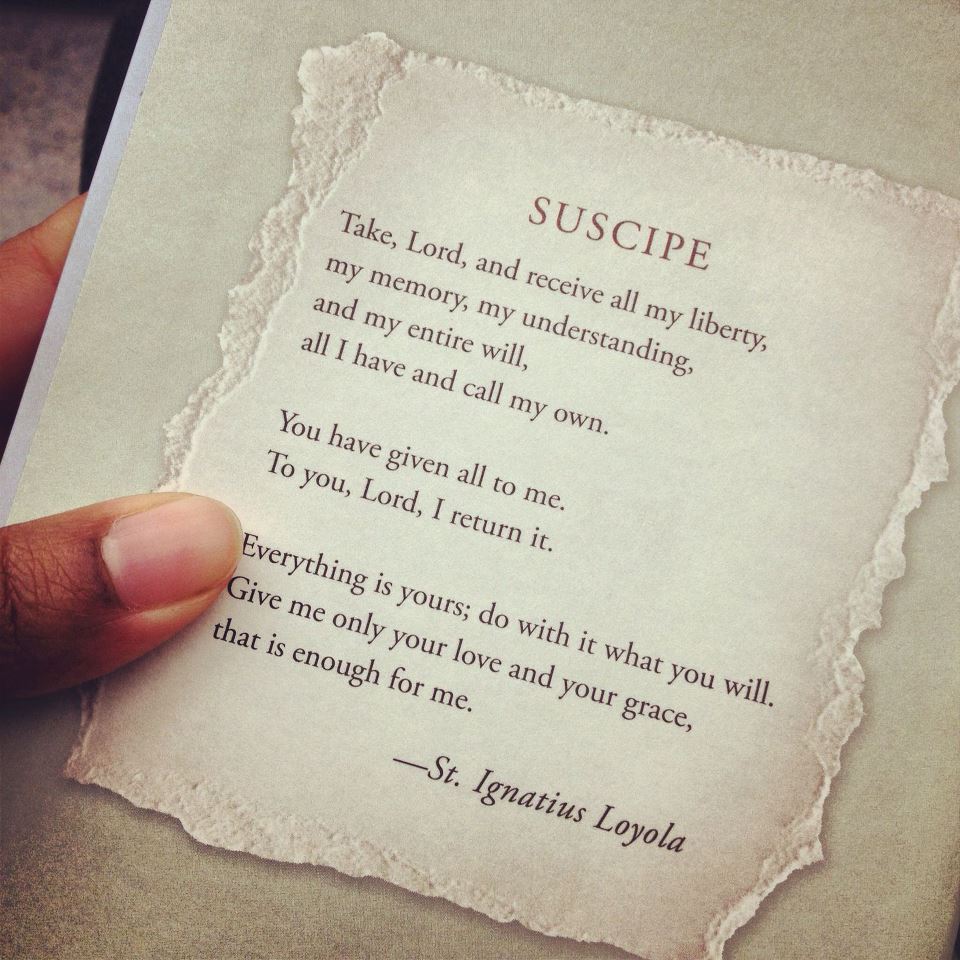
In contradiction to faith which seeks to be filled it is worthwhile to conclude with a prayer which expresses the work of true and mature faith.  This is the Suscipe of St. Ignatius of Loyola.  Notice that where the faith of the crowd can only ask what it can get from Christ; this faith asks for the grace to give more for Christ.  I would contend that only someone who had truly accepted and lived the gospel invitation of seeking a living relationship with Christ could write this prayer.

St. Ignatius and all holy men and women who accepted our Lord’s invitation to faith and encounter with Him, please pray for us.

Take, Lord, and receive all my liberty,
my memory, my understanding,
and my entire will,
all I love and call my own.

You have given it all to me.
To you, Lord, I return it.

Everything is yours; do with it what you will.
Give me only your love and grace,
that is enough for me.     


Feast of St. Ignatius and Seminarian retreat

31 Tuesday Jul 2012

Posted by mcummins2172 in retreat, seminarians, St. Ignatius of Loyola, Suscipe, vocations

≈ Leave a comment

Today is the Feast day of St. Ignatius.  I have borrowed the above photo from “Pray as You Go”. 

This prayer of St. Ignatius is beautiful in its truth and simplicity.

Today also begins our diocesan summer seminarian retreat/gathering.  Please keep our seminarians in your prayers over these next few days.  Please also prayer for all our young people to be open to God’s call in their lives.  

This coming fall we will have nineteen seminarians studying for our diocese! 

← Older posts
Newer posts →
Follow The Alternate Path on WordPress.com

Enter your email address to follow this blog and receive notifications of new posts by email.

Previous Posts

  • March 2026
  • December 2025
  • November 2025
  • August 2025
  • April 2025
  • February 2025
  • January 2025
  • December 2024
  • August 2024
  • July 2024
  • June 2024
  • May 2024
  • April 2024
  • March 2024
  • February 2024
  • January 2024
  • December 2023
  • November 2023
  • October 2023
  • August 2023
  • July 2023
  • May 2023
  • February 2023
  • January 2023
  • December 2022
  • August 2022
  • July 2022
  • April 2022
  • January 2022
  • December 2021
  • September 2021
  • August 2021
  • July 2021
  • May 2021
  • April 2021
  • January 2021
  • December 2020
  • November 2020
  • October 2020
  • August 2020
  • July 2020
  • May 2020
  • April 2020
  • March 2020
  • February 2020
  • December 2019
  • October 2019
  • September 2019
  • August 2019
  • July 2019
  • May 2019
  • April 2019
  • March 2019
  • February 2019
  • December 2018
  • November 2018
  • October 2018
  • August 2018
  • July 2018
  • June 2018
  • April 2018
  • March 2018
  • February 2018
  • January 2018
  • December 2017
  • November 2017
  • September 2017
  • August 2017
  • July 2017
  • June 2017
  • May 2017
  • April 2017
  • March 2017
  • February 2017
  • January 2017
  • December 2016
  • November 2016
  • October 2016
  • September 2016
  • August 2016
  • July 2016
  • June 2016
  • May 2016
  • April 2016
  • March 2016
  • February 2016
  • January 2016
  • December 2015
  • November 2015
  • October 2015
  • September 2015
  • August 2015
  • June 2015
  • May 2015
  • April 2015
  • March 2015
  • February 2015
  • January 2015
  • December 2014
  • November 2014
  • October 2014
  • September 2014
  • August 2014
  • July 2014
  • June 2014
  • May 2014
  • April 2014
  • March 2014
  • February 2014
  • January 2014
  • December 2013
  • November 2013
  • October 2013
  • September 2013
  • August 2013
  • July 2013
  • June 2013
  • May 2013
  • April 2013
  • March 2013
  • February 2013
  • January 2013
  • December 2012
  • November 2012
  • October 2012
  • September 2012
  • August 2012
  • July 2012
  • June 2012
  • May 2012
  • April 2012
  • March 2012
  • February 2012
  • January 2012
  • December 2011
  • November 2011
  • October 2011
  • September 2011
  • August 2011
  • July 2011
  • June 2011
  • May 2011
  • April 2011
  • March 2011
  • February 2011
  • January 2011
  • December 2010
  • November 2010
  • October 2010
  • September 2010
  • August 2010
  • July 2010
  • September 2008
  • August 2008
  • April 2008
  • March 2008
  • February 2008
  • January 2008
  • December 2007
  • November 2007
  • October 2007
  • September 2007

Popular Posts

  • None

Blog at WordPress.com.

  • Subscribe Subscribed
    • The Alternate Path
    • Join 156 other subscribers
    • Already have a WordPress.com account? Log in now.
    • The Alternate Path
    • Subscribe Subscribed
    • Sign up
    • Log in
    • Report this content
    • View site in Reader
    • Manage subscriptions
    • Collapse this bar