• About The Alternate Path

The Alternate Path

~ Thoughts on Walking the Path of Christian Discipleship

The Alternate Path

Category Archives: Advent

One piece of the puzzle is enough

22 Saturday Dec 2018

Posted by mcummins2172 in Advent, Uncategorized

≈ 2 Comments

Tags

4th Sunday of Advent, Advent, Christianity, faith

Christmas puzzle (2)I go to the YMCA to exercise and for anyone who has been there you know that once you enter the building and head down the main hall there is a lounge area on the left and on a table in this room there is always a puzzle being worked on. I have begun the practice of spending three to five minutes at this puzzle after I exercise and before I leave. My goal is to try to get at least one piece of the puzzle in place. (The last time I was there I got three pieces in … I was quite proud of myself!) I could easily spend hours at this table because I like puzzles but I am learning that there is something good about limiting myself to just one or a few pieces at a time and also seeing how the puzzle comes together as other people also work on it.

If you look at the Scripture readings over these weeks of Advent it is like God putting the pieces of the puzzle together right in front of our eyes – the hopes of Israel, the promise of the prophets, Gabriel appears to Zechariah to announce that he and Elizabeth will have a son, Zechariah doubts and is left mute till the birth of John, Gabriel appears to Mary, Mary believes and she conceives by the Holy Spirit, the angel appears to Joseph in a dream to assuage all of his fears and uncertainties, wise men from the East begin their trek towards Bethlehem. John the Baptist appears on the scene. Piece by piece the puzzle is put together.

But it is one piece at a time. If you look at the passage where Gabriel appears to Zechariah in the temple, the angel announces that Zechariah and Elizabeth will have a son in their old age and that the son will help turn Israel back to God. Gabriel sort of hints at the coming of a Messiah but he does not say it out right. The angel gives Zechariah one piece of the puzzle. That is enough. Gabriel appears to Mary and announces that she will bear a child who will be the son of the Most High and who will reign forever but he does not say how our Lord will accomplish this and how everything will play out. He gives one piece of the puzzle. That is enough. An angel appears to Joseph in a dream to tell him not to fear to take Mary as his wife, that the child is of God and will save the people from their sins. Again, nothing about how this will be accomplished, just one piece of the puzzle. It is enough.

In today’s gospel with Mary visiting Elizabeth we see Luke doing something he likes to do throughout his writings – he brings two people together who each have had an experience of God, who each have a piece of the puzzle. The two come together, they each share their story – their piece – and by so doing, they are brought to a greater understanding and awareness. And in this particular encounter there is an even deeper encounter – the infant in Elizabeth’s womb who will be the great prophet leaps in the presence of the Word made flesh in the womb of Mary and shares his prophetic spirit with his mother who then proclaims, “Blessed are you among women, and blessed is the fruit of your womb. And how does this happen to me, that the mother of my Lord should come to me?”

So often in regards to faith and in regards to live in general we want no loose ends, we want to have it all figured out but this is like trying to grab a sip of water from a fire hose! It doesn’t work that way. One lesson of Advent, one lesson learned from the people of the Advent story – welcome the one piece of the puzzle that God has given us in this moment of our journey and be content with that. Sit with it, appreciate it, wonder over it, learn the lesson it offers, share it and the truth it offers with others and together learn to trust in our own hearts and with one another that God is at work bringing it all together in his way.

One piece of the puzzle. It is enough.

What are the animals in your stable?

09 Sunday Dec 2018

Posted by mcummins2172 in Advent, Uncategorized

≈ 1 Comment

Tags

Advent, Christian life, Christianity, Christmas manger, discipleship, second sunday of Advent

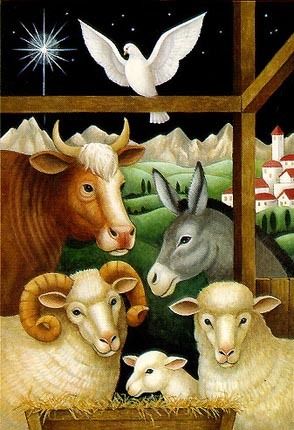
animals in the mangerYou may have noticed that Seth who oversees our parish maintenance has placed the animals in the stable scene outside in front of our church. I appreciated this as the day after he put the figures out I came across this quote from the author Evelyn Underhill,

“Human nature is like a stable inhabited by the ox of passion and the ass of prejudice; animals which take up a lot of room and which I suppose most of us feed on the quiet. And it is there between them, pushing them out, that Christ must be born and in their very manger he must be laid – and they will be the first to fall on their knees before him. Sometimes Christians seem far nearer to those animals than to Christ in his simple poverty, self-abandoned to God.”

The stable scene and the quote prompt a good examination in preparation for the coming Christmas celebration. What are the animals inhabiting the stable of my heart? Truth be told, any person who would say, “I have no animals. My stable is completely clean,” either does not know his or her own heart, is a fool or a liar or maybe a combination of all three. Honestly, what are the animals in the stable of our hearts?

We can even get quite creative in this examination. The ox of passion might be the passion of lust but it also might be the passion of anger, control or narcissism. The ass of prejudice might be prejudice against the one who is different, the stranger or the person I have already judged in my own heart. But there can be other animals. The strutting rooster of pride and arrogance, the fat, squawking hen of gossip, the goat of resentment, the pig of sloth, the farm rat of jealousy… What are the animals in our stables? A good way to prepare for Christmas is to honestly and creatively look within and not be afraid to acknowledge and name those animals that we find within our stables. A spiritual truth – when we can creatively and even mockingly name the animals that mill about in our heart’s stable, they actually begin to lose their power – for example, when we know our pride is at work we can chuckle to ourselves, “there goes that strutting rooster again!”

The quote from Underhill goes further though and brings out another deep dynamic in the Christian mystery when she writes that it is precisely within the stable, between all the animals that reside there, that Christ must be born. It is not we who first make our stables nice, neat and clean in order to then welcome the Christ child; it is the Christ child who first chooses to be born within the crowded mess of both our world’s and hearts’ stables and by his presence brings the light and healing that we yearn for. The Nativity stable continually instructs us to avoid the danger – even heresy (Pelagianism) – of believing that it is we who first cleanse our stables by our own efforts in order to then win and warrant the coming of our savior, the gift of grace. It does not work that way. God first arrives – even into the mess and pressing crowd of our little stables – and this is what brings life and the healing.

Both prophets in today’s readings proclaim this to us. The prophet Baruch proclaims the glory of Jerusalem but specifies that it is a glory that comes from God. “Jerusalem, take off your robe of mourning and misery; put on the splendor of glory from God forever: wrapped in the cloak of justice from God…” The prophet invites Israel to live and rejoice in this gift from God! Even John the Baptist – who is that voice crying out in the desert, who is that one who is sent to prepare the way of the Lord – proclaims that it is the “salvation of God” that all flesh will see. God arrives first. “And it is there between them, pushing them out, that Christ must be born and in their very manger he must be laid…”

Soon Mary and Joseph, the angels and the shepherds and eventually the three kings will also arrive at the stable but before all of that it is worthwhile to just sit and acknowledge the animals in our stables. It is worthwhile to honestly admit their presence and to know that Christ is not put off by them – that he will be born within their midst, that he will be laid in their manger and that the animals – by his presence, healing and grace – will then become the very first to kneel down in adoration.

Advent: Return to the Beginning

05 Saturday Dec 2015

Posted by mcummins2172 in Advent, hope, Uncategorized, Year of Mercy

≈ 1 Comment

Tags

Advent, hope, Mass shooting, sad logic of violence, Year of Mercy

advent wreath 3The week before the first Sunday of Advent I ventured into a local craft store in search of Advent candles.  After inquiry, a sales associate led me to the candles.  We passed one, then two, then three, four and five full aisles of Christmas decorations.  Arriving at the last row she pointed to a small stack of Advent candles on the bottom corner of a shelf.  Quite sad in comparison.  I cannot help but reflect on the symbolism.  As I write this reflection there has been yet another mass shooting in our country.  I do not make this jump from searching for Advent candles to a mass shooting in order to be flippant or sensational, I share it because I believe Advent offers needed lessons for our world today but honestly I fear these lessons may fall on deaf ears because they will require work, sacrifice and even risk on our part.

One of the virtues that Romano Guardini explores in his book Learning the Virtues that Lead You to God is the virtue of patience.  In the course of his reflection he offers these words:

Therefore patience, which always begins again, is a prerequisite if something is to be done.  In “The Imitation of Christ” we find the phrase “Semper incipe!” … At first sight, it is a paradox, for a beginning is a beginning and then we go on.  But that is true only in mechanical matters.  In actual life, beginning is an element that must operate constantly.  Nothing goes on if it does not at the same time begin. 

So he who wishes to advance must always begin again.  He must constantly immerse himself in the inner source of life and arise therefrom in new freedom, in initiative – the power of beginning – in order to make real what he has purposed: prudence, temperance, self-control, or whatever it may be that is to be accomplished.  

Patience with oneself – not carelessness or weakness, of course, but the sense of reality – is the foundation of all progress.  

The wisdom that Guardini offers here is a wisdom found at the heart of the season of Advent.  In Advent, we as Church, “begin again”.  We return to the beginning and we join with the saints of this season (Ss. John the Baptist, Elizabeth, Zechariah, Joseph and Mary) in awaiting the coming of the Messiah.

Advent calls us to honestly acknowledge the darkness and brokenness of our world and our lives not in order to shut down in despair but in order to open a window of hope.  If approached correctly and not rushed through, the season of Advent offers profound lessons to help us learn patience with ourselves and our world.  We recognize that there is something fundamentally broken within ourselves and the human condition that is just not possible for us to heal and fix.  It is too mysterious, too deep and too painful.  Further, we recognize how all of creation stands in need.  We come to learn that the ultimate answer cannot be found in us.  Yet, we also recognize that there is a deep yearning for wholeness within and, if we sit with it long enough, we recognize that this yearning itself has been planted within us by God.  It is part of our makeup, part of the essence of who we are and Scripture tells us that God is a God who does not disappoint.  God will answer our need.  God will answer the deepest need of our world with the coming of Christ in glory in the fullness of all history.  God has answered the hope of the ages with the incarnation of the Son!

“Semper incipe!” is a spiritual truth and we learn it from the Advent saints themselves.  Zechariah and Elizabeth began again when they were reminded that nothing is impossible for God.  Joseph began again when he was reminded that God will act as God so chooses and our job is to trust.  John the Baptist began again when he went into the wilderness to meet the Lord just as the people of Israel had encountered God during their forty years of wandering in the desert.  Mary began again in her profound “Yes” to God – the heart of Israel’s history and hope.

We live in a dark time.  There is much violence, isolation, pain and fear in our world today.  In such times patience is called for all the more.  We must overcome the temptation to rush to judgment, to rush to condemnation, to rush to separation, to rush to retribution.  Patience rightly lived is a needed antidote rather than a weakness.  If we are to move beyond the darkness of these times we can neither naively try to wish it away nor pretend the darkness does not exist, rather we need to be honest about the state of things and then get to work!  And as Guardini rightly notes, patience is the foundation of all true progress.  The saints of Advent were anything but naïve.  They knew the brokenness of their world and their own need and they clearly show the willingness to begin again.

This particular Advent, this season when we as Church return to the beginning, should be different.  This celebration of Advent which marks the beginning of the Jubilee Year of Mercy ought to initiate a transformation in us as Church that will affect our world.  In this will Advent truly be authentic.  No longer can Advent just be my or our personal preparation for the celebration of Christmas, rather Advent must light hope and mercy for our world.  We need to live the anticipation of this Advent not for ourselves but truly for all of our sisters and brothers – especially those who are suffering and forgotten.

Our world is in a dark place.  There is work that needs to be done.  Before we rush to the work, we should return to the beginning and immerse ourselves in that inner source of life which is our faith in the work of God himself.  Patience is the foundation of all true progress.

I would suggest that in a particular way this Advent we stand with the saints of this season and we learn from them how to return to the beginning.  This lesson is too important; too critical to the times we now live in, to bypass.

When all is said and done we may very well recognize that human history was carried neither by the proud nor the arrogant nor the centers of our world’s powers but rather by the patient – the ones who learned how to continually return to the beginning in order to arise in new freedom and new awareness.

Thoughts on the Sunday readings: John the Baptist and Atticus Finch (3rd Sunday of Advent-B)

13 Saturday Dec 2014

Posted by mcummins2172 in Advent, Atticus Finch, Christ, John the Baptist, justice, truth

≈ 1 Comment

The play, “To Kill a Mockingbird” is a story about prejudice and the courage to do what is right.  In the play, Atticus Finch – a lawyer, agrees to defend a young black man (Tom Robinson) when he is unjustly accused of a crime he did not commit.  Racial bigotry is stirred up and Atticus and his family are persecuted for seeking justice for the young man.  Despite the persecution Atticus does fight for justice for Tom but by the end of the trial bigotry and the need to scapegoat win out and the young man is condemned for a crime he did not commit.  After this verdict as Atticus leaves the courtroom and passes his two children, a black minister who is aware of all the factors at play tells the girl and boy to stand because their father is passing, “a good and just man.”

Is not Atticus, in many ways, a figure of John the Baptist?  Atticus can be seen as a man proclaiming the truth even in the face of persecution, misunderstanding and ridicule.  Like John the Baptist, he proclaimed and held to the light even in the very midst of darkness.  Both men faced the same temptations – the temptation to remain quiet, to keep ones head down, to not make waves.  Both also faced the temptation to proclaim oneself.

Throughout the play, Atticus is a soft spoken, humble man even as others talk about all his achievements and abilities.  In his final speech in the courtroom Atticus does not proclaim his own skill as a lawyer nor his gift of rhetoric; rather, he proclaims and points to truth and justice for Tom Robinson.  It was a proclamation to those gathered in the courtroom just as pointed as the cry of the Baptist in the wilderness.

John the Baptist also faced this temptation to proclaim self.  The people were streaming toward John from all over the countryside, there was a deep yearning for the messiah – John knew this and he could have seized all that energy and power!  But he didn’t.  “I am not the Christ,” said John.  “I am the voice of one crying in the desert, make straight the way of the Lord … I am not worthy to untie his sandals.”

John the Baptist was able to do two things extremely well: he was able to look away from himself and he was able to look toward God.  In this he was able to recognize the truth of who he was – a man in need of a savior – and therefore he was able to recognize the true savior when he came (in contrast to the Pharisees).  “I baptize with water; but there is one among you whom you do not recognize, the one who is coming after me, who sandal strap I am not worthy to untie.” (John 1:27)

What John the Baptist and the figure of Atticus proclaim to us is that truth and justice do not lie inherently within ourselves as if they were our own possessions.  They are not part of our constitutional makeup that we can either summon or dispose of at will.  Rather, truth and justice are acquired by us only insofar as we place ourselves in relation to truth and justice itself – whom we proclaim to have a name and a face: Jesus.

As we place ourselves in relation to Christ, we both learn to see anew with eyes enlightened by faith (judging rightly) and our own dignity is found.  The words spoken by the black preacher to the children of Atticus might then be applied to any one of us, “Stand, your father (mother) is passing, a good and just man (woman).”  Whether victorious or not in the realm of worldly success and opinion; could there be any higher compliment?

Come, Lord Jesus and do not delay and, in all things, may we testify to the light! 

The Gifts of Advent

15 Sunday Dec 2013

Posted by mcummins2172 in Advent, humility, mercy, trust

≈ 2 Comments

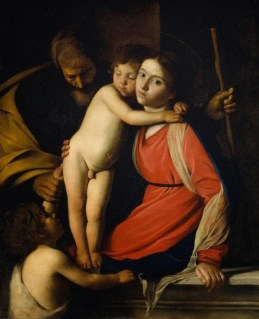
Caravaggio – The Holy Family with the infant St. John the Baptist

It is easy to rush through Advent.  With department store Christmas decorations appearing earlier and earlier each year it is quite easy to jump straight into Christmas mode after the Thanksgiving Day meal it seems.  Why a time of waiting and anticipation?  What is that all about?  After all the big day is Christmas with its exchanging of gifts and (at least for the religiously minded) the beautiful liturgies and reflection on the birth of Christ.  Who needs Advent?

Well, we do and Advent has its own gifts to share if we just take the time to appreciate and receive them.  I can think of three gifts that Advent has to give (similar in number to the gifts of the Magi) and they are gifts brought to us by the key figures of the nativity story – St. Mary, St. John the Baptist and St. Joseph.  
In the first chapter of Luke’s gospel we are told that the angel Gabriel was sent to Mary.  
…he came to her and said, “Greetings, favored one!  The Lord is with you.”  But she was much perplexed by his words and pondered what sort of greeting this might be.  The angel said to her, “Do not be afraid, Mary, for you have found favor with God.  And now you will conceive in your womb and bear a son, and you will call him Jesus.  He will be great, and will be called the Son of the Most High, and the Lord God will give to him the throne of his ancestor David.  He will reign over the house of Jacob forever, and of his kingdom there will be no end.”  The angel said to her, “The Holy Spirit will come upon you, and the power of the Most High will overshadow you: therefore the child to be born will be holy; he will be called Son of God.  And now, your relative Elizabeth in her old age has also conceived a son; and this is the sixth month for her who was said to be barren.  For nothing will be impossible with God.”  Then Mary said, “Here am I, the servant of the Lord; let it be with me according to your word.”  Then the angel departed from her.  
Much has been written of Mary’s “yes” to the angel and to God’s will for her.  Saints have reflected upon how all heaven and creation waited in hushed silence for Mary’s response.  Mary certainly knew the hopes and dreams of her people.  She certainly knew and trusted how God acted throughout the history of Israel. That God could and would act in such a way would not necessarily be a surprise to her but where it would end and the sacrifice it would entail, Mary certainly had no way of knowing and the angel did not share much information in that regard.  Mary did not know that her “yes” that day would lead to her standing at the foot of the cross – the epicenter of God and humanity’s sacrifice for death and sin.  Mary did not know how it would all play out or even what it all meant but she said “yes”.  
Mary brings us the gift of trust and she demonstrates to us that this gift is born out of a sure knowledge and belief of faith and how God has acted throughout history.   In opposition to the primacy of fate lauded in the pagan world; Mary reveals providence.  God is at work and continues to be at work in history and in our lives.  The gift of Mary’s trust also reveals that God wants nothing but what is best for us.  The God of Israel is a loving God and all things in God’s plan lead to fullness of life.  Mary brings us the gift of trust. 
Luke portrays John the Baptist as a relative of Mary and Jesus’.  During the Sundays and weekdays of Advent we read the gospel accounts of John’s ministry.  The gospels tell us that people from all over Judea and Jerusalem were coming to hear John preach and be baptized in his baptism of repentance.  This popularity and esteem of the people is even confirmed by the Pharisees and Sadducees coming out to receive baptism, not because of true conversion but because it looked good before the people.  John sees through this and denounces it.  Not much escaped John the Baptist.  It is in this context of expectation that Luke writes,
As the people were filled with expectation, and all were questioning in their hearts concerning John, whether he might be the Messiah, John answered all of them by saying, “I baptize you with water; but one who is more powerful than I is coming; I am not worthy to untie the thong of his sandals.  He will baptize you with the Holy Spirit and fire.  
The power of the multitude is a great power.  This is lesson 101 in the handbook of politicians, demagogues and tyrants throughout history.  John knew the expectation of the people.  He knew, probably more than any other person, how they were yearning for change.  Probably, he alone at that time in Israel could have tapped into that power.  He could have claimed it for his own and therefore claimed massive power but he did not.  To the crowd and to their desire to proclaim him “messiah,” John simply and humbly said, “I am not he.”  John had the authenticity to know who he was and who he was not.  John the Baptist brings us the gift of humility.  
It is a gift sorely needed in our world today.  The message of our world today, in so many words, is, “Build yourself up.  Claim all that you can.  Focus on yourself, forget everyone else.”  Our world exalts and glamorizes overweening pride.  John, just as much today as in the story of the gospel, stands in contradistinction to this message.  His poverty, simplicity of life, and reliance on the word of God gave birth to a humility and authenticity of personhood that the world cannot give.  In Advent, John the Baptist brings us the gift of humility.  
We have no direct words of St. Joseph.  He is the silent saint but he speaks through his actions.  Matthew, in the first chapter of his gospel, shares this about Joseph, 
Now the birth of Jesus the Messiah took place in this way.  When his mother Mary had been engaged to Joseph, but before they lived together, she was found to be with child from the Holy Spirit.  Her husband Joseph, being a righteous man and unwilling to expose her to public disgrace, planned to dismiss her quietly.  But just when he had resolved to do this, an angel of the Lord appeared to him in a dream and said, “Joseph, son of David, do not be afraid to take Mary as your wife, for the child conceived in her is from the Holy Spirit…”
Notice that even before the first angelic visitation in a dream (there were to be a total of four) Joseph had already decided that he would not expose Mary to public shame and would dismiss her quietly.  This decision on Joseph’s part should not be passed over carelessly.  It reflects his character.  According to the laws and customs of the time, Joseph had every right to have Mary stoned and killed.  Joseph could have acted out of vengeance and hurt pride but he chose not to.  Joseph, at that moment, held the life of Mary and the incarnate Word in her womb in his hands.  Just as Mary’s “yes” allowed the incarnation, Joseph’s “no” to violence and vengeance and “yes” to mercy allowed the incarnation to continue.  Joseph brings us the gift of mercy. 
Matthew writes that Joseph was a righteous man.  Our Lord throughout his ministry and proclamation of the Kingdom of God will again and again proclaim that righteousness is not based on blind observance of the law but on mercy and love.  It was simple human mercy and care that allowed the incarnation to continue.  St. Joseph’s proclamation to us is the gift of mercy.  
The three gifts of Advent: trust, humility and mercy.  As Christians, we receive these gifts by living them out in our lives and extending them to one another.  
Ss. Mary, John the Baptist and Joseph please pray for us.       
Follow The Alternate Path on WordPress.com

Enter your email address to follow this blog and receive notifications of new posts by email.

Previous Posts

  • December 2025
  • November 2025
  • August 2025
  • April 2025
  • February 2025
  • January 2025
  • December 2024
  • August 2024
  • July 2024
  • June 2024
  • May 2024
  • April 2024
  • March 2024
  • February 2024
  • January 2024
  • December 2023
  • November 2023
  • October 2023
  • August 2023
  • July 2023
  • May 2023
  • February 2023
  • January 2023
  • December 2022
  • August 2022
  • July 2022
  • April 2022
  • January 2022
  • December 2021
  • September 2021
  • August 2021
  • July 2021
  • May 2021
  • April 2021
  • January 2021
  • December 2020
  • November 2020
  • October 2020
  • August 2020
  • July 2020
  • May 2020
  • April 2020
  • March 2020
  • February 2020
  • December 2019
  • October 2019
  • September 2019
  • August 2019
  • July 2019
  • May 2019
  • April 2019
  • March 2019
  • February 2019
  • December 2018
  • November 2018
  • October 2018
  • August 2018
  • July 2018
  • June 2018
  • April 2018
  • March 2018
  • February 2018
  • January 2018
  • December 2017
  • November 2017
  • September 2017
  • August 2017
  • July 2017
  • June 2017
  • May 2017
  • April 2017
  • March 2017
  • February 2017
  • January 2017
  • December 2016
  • November 2016
  • October 2016
  • September 2016
  • August 2016
  • July 2016
  • June 2016
  • May 2016
  • April 2016
  • March 2016
  • February 2016
  • January 2016
  • December 2015
  • November 2015
  • October 2015
  • September 2015
  • August 2015
  • June 2015
  • May 2015
  • April 2015
  • March 2015
  • February 2015
  • January 2015
  • December 2014
  • November 2014
  • October 2014
  • September 2014
  • August 2014
  • July 2014
  • June 2014
  • May 2014
  • April 2014
  • March 2014
  • February 2014
  • January 2014
  • December 2013
  • November 2013
  • October 2013
  • September 2013
  • August 2013
  • July 2013
  • June 2013
  • May 2013
  • April 2013
  • March 2013
  • February 2013
  • January 2013
  • December 2012
  • November 2012
  • October 2012
  • September 2012
  • August 2012
  • July 2012
  • June 2012
  • May 2012
  • April 2012
  • March 2012
  • February 2012
  • January 2012
  • December 2011
  • November 2011
  • October 2011
  • September 2011
  • August 2011
  • July 2011
  • June 2011
  • May 2011
  • April 2011
  • March 2011
  • February 2011
  • January 2011
  • December 2010
  • November 2010
  • October 2010
  • September 2010
  • August 2010
  • July 2010
  • September 2008
  • August 2008
  • April 2008
  • March 2008
  • February 2008
  • January 2008
  • December 2007
  • November 2007
  • October 2007
  • September 2007

Popular Posts

  • thealternatepath.org/wp-c…
  • thealternatepath.org/wp-c…
  • thealternatepath.org/wp-c…

Blog at WordPress.com.

  • Subscribe Subscribed
    • The Alternate Path
    • Join 156 other subscribers
    • Already have a WordPress.com account? Log in now.
    • The Alternate Path
    • Subscribe Subscribed
    • Sign up
    • Log in
    • Report this content
    • View site in Reader
    • Manage subscriptions
    • Collapse this bar
 

Loading Comments...