This last week I bought a 1935 buffalo nickel for $3.00 in an antique store. The nickel has the image of an American Indian on one side and on the other side it has the image of a buffalo. I like the coin because it is a piece of American history and it is a reflection of our nation’s complicated story with both the indigenous peoples and the buffalo – a story that is far from over and continues.
(A funny story to share regarding a priest who has now gone home to God. This priest was known for being very, very frugal with money, so frugal in fact that people joked that if he ever had a buffalo nickel, he would squeeze it so tight that the Indian would end up riding the buffalo! But I digress.)
In answer to the Pharisee’s question about the lawfulness of paying the census tax to Caesar or not in today’s gospel (Mt. 22:15-21) our Lord asks to see a Roman coin. Remember that “census” is about citizenship and being a subject. Subjects pay tax to the authority that rules and governs, whether that be a government, a king or an empire. On the coin is an image of Caesar with his inscription. This is more than the image of George Washington on our dollar bill. Caesar was considered a god in the empire. In fact, the common greeting that subjects would give one another in the Roman Empire was, “Caesar is Lord!” When the first Christians began to greet one another with, “Christ is Lord!” they were doing something very intentional and even dangerous as the Roman authorities would regard such a greeting as an act of treason. The first Christians gave this greeting precisely because they had learned what our Lord was teaching in this gospel passage.
“Repay to Caesar what belongs to Caesar (let him and all the powers of the world have their piece of dead metal) and to God what belongs to God.” If the coin belongs to Caesar because it bears his image, then what belongs to God because it bears his image? Genesis 1:27 gives the answer, “God created man in his image, in the divine image he created him; male and female he created them.” We bear the image of God; we belong to God and while we walk this earth, yes, with earthly citizenship and responsibilities, we know that our true citizenship is in the Kingdom of God and we strive to live our lives by God’s truth. We must repay to God what belongs to God.
There is another truth to our Lord’s answer that we need to let sink into our hearts. God desires us, each one of us. God desires the unique image of himself that he has crafted within each one of us. God rejoices as we receive his love and as our own unique image of him begins to grow and shine! We are not meant to repay half-heartedly nor grudgingly the image that God has placed within each of us but rather repay it back in abundance and love. We do this by receiving God’s love and living in that love. We come from God, we are with God and we are in journey back to God!
Census is about citizenship; it is about being a subject of a kingdom. Our citizenship is in the Kingdom of God and even now, we strive to live by the light of God’s Kingdom. Repay to God what belongs to God.
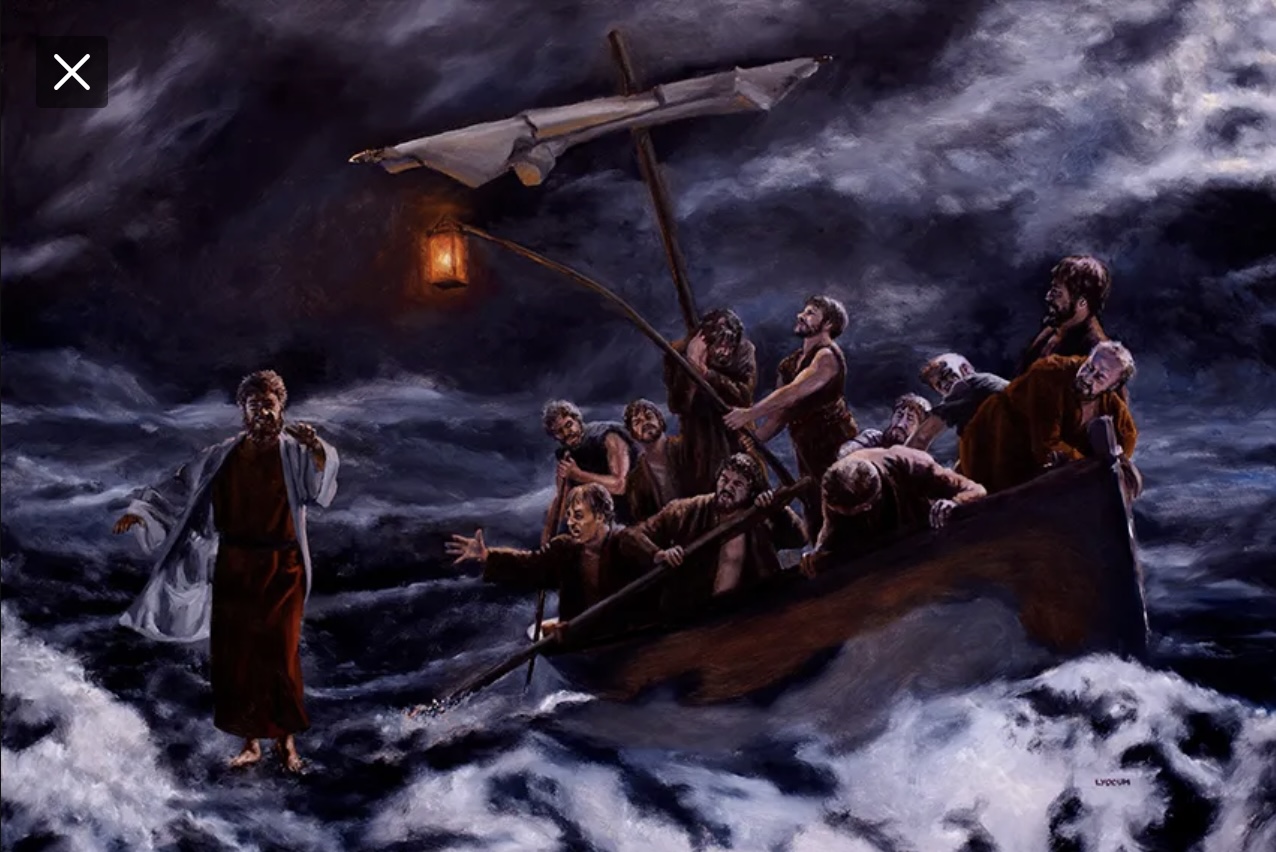
“Peter walking on the Water” by Lester Yokum. Image may be subject to copyright.
My friends, there is a simple truth found in today’s gospel that is worthy of our reflection.
We are told that the disciples are in the boat in the middle of the night and are being tossed about by the waves of the sea. The disciples are caught in fear and dread. Our Lord comes towards them walking on the water. Jesus calls to them and tells them to not be afraid and in response Peter cries, “Lord, if it is you, command me to come to you on the water.”
“Command me.”
Peter does not say, “Lord, calm the sea.”. Peter does not say, “Lord, take away this storm.” Nor does Peter remain in the little safety of the boat, waiting for the Lord to arrive. Peter says, “command me to come to you on the water.” Peter (in his cry to the Lord, in his prayer) is asking for the grace to look beyond the crashing waves, to move beyond the limits of his own fear and to have the faith to walk towards Jesus on the water.
This is the truth – there will be storms in life, there will be struggles and pain and doubt. We will know fear and uncertainty. The waves of life can be strong, high and crushing and it might even seem like everything is going to be lost. The temptation in such moments is to pray to God to take away the storm, to calm the waters and to right whatever is the wrong that we are facing. But is that the right prayer?
The prayer that Peter made was not to take away the storm but to have the faith to walk through the storm, the faith to keep his eyes on Jesus even in the midst of the storm. The gospel gives no indication that the sea calmed while Peter walked on the water. The waves still crashed but Peter did walk on the water and when his faith faltered, Jesus was there to lift him up and save him.
My friends, the right prayer may not always be “Lord, take this storm away. Take away this struggle. Take away my fear.” The right prayer may be, “Lord, give me the faith to walk through this storm trusting that you walk with me and that you are with me to protect me.”
“Lord, if it is you, command me to come to you on the water.”
I recently heard these words offered at a symposium on the priesthood and they ring true – not just in the life of the priest but in all of what it means to be Christian and to be Church.
If there is a “theme” in my own spiritual journey over the past few years it is that of a growing awareness of the Holy Spirit and relationship with the Holy Spirit – trust in the Spirit, awareness of the Spirit, crying out to the Holy Spirit, delight in the Holy Spirit, fear of wounding my relationship with the Holy Spirit, awe and wonder at the movement of the Holy Spirit, learning to rejoice in that which the Spirit rejoices in and allowing the Holy Spirit to lead me into truth.
I love the Holy Spirit.
The days between Ascension and Pentecost are a privileged time to receive the Holy Spirit as a welcome guest in our hearts. The words, “welcome guest,” are key here I believe. The Holy Spirit is not an automatic in the life of the Christian and should never be thought of in such a manner. Nor is the Spirit passive. The Holy Spirit chooses and is active. Although the Holy Spirit can and does work through very limited means (I use myself in my priesthood as an example here), the Spirit chooses how to move, where to move and where to abide and in what degree of fullness. The Holy Spirit will not abide in fullness with neither sin nor duplicity.
In grace we must always strive to make of our hearts a worthy place to receive this “welcome guest”. How so? Striving to keep our will and actions sincere, honest, pure and humble. Remaining focused on Christ as Lord and Savior and showing reverence to the image and likeness of God found in every person.
A sure way to experience the withdrawal of the Holy Spirit is to try to use another person in any way, shape or form. This was an abiding sin of the rich man in the parable that our Lord gave us of the rich man and the poor beggar Lazarus. Even in the torment of afterlife; the unnamed rich man, rather than rejoicing in seeing the poor beggar Lazarus resting now in the bosom of Abraham, wanted to use the very one whom he had ignored and stepped over during his life to be sent on an errand for him to warn his brothers. The rich man is denied. One wonders what would have happened if the rich man had rather said, “I rejoice in seeing Lazarus, whom I now recognize as a brother and who knew such pain in life, now resting in the peace of God’s love.” Some scholars suggest that the sin of Judas (who believed Jesus was the Messiah but who felt Jesus wasn’t acting swift or sure enough in his view) was to try to force the hand of Jesus to show his messiahship, in other words – use him, by handing him over to the authorities. In John’s account of the Last Supper, we are told that Satan enters into the heart of Judas and that he departs into the darkness of night. To use another while neither respecting nor reverencing the image of God in which that person is made is a sin that God will not abide.
In all things, we must continually strive, by avoiding that which grieves the Holy Spirit and doing that which pleases the Holy Spirit, to make of our hearts truly a place of welcome for this most honored of guests!
I want to end this post by sharing a reflection by Cardinal Cantalamessa given in his book, “The Holy Spirit in the Life of Jesus’. The quote is long but I share it because these words helped to enliven my heart to a deeper awareness of the Holy Spirit. Cardinal Cantalamessa writes,
But an unbidden question springs to mind: why the long interval between the moments when Jesus received his anointing in the Jordan and when, on the cross and at Pentecost, the outpouring of the Spirit occurred? And why does St. John the Evangelist say that the Holy Spirit could not be given while Jesus “had not yet been glorified”? St. Irenaeus gives the answer: the Holy Spirit had first to become accustomed to dwelling among human beings; he had, so to speak, to be humanized and historicized in Jesus, so as to be able, one day, to sanctify all human beings from within their human condition while respecting the times and modes of human behavior and suffering. “The Holy Spirit,” he writes, “descended upon the Son of God, made the Son of man, becoming accustomed (adsuescens) in him to dwell and rest among the human race, so as to be able to work the Father’s willin them and renew them from their old habitsinto the newness of Christ.” Through Jesus, the Spirit is able to make grace “take root” in human nature; in Jesus who has not sinned, the Spirit can “come down and remain” (John 1:33), and get used to staying among us, unlike in the Old Testament where his presence in the world was only occasional. In a sense, the Holy Spirit becomes incarnate in Jesus of Nazareth, even if in the case of “becomes incarnate” means something different, i.e., “comes to dwell in a physical body.” “Between us and the Spirit of God,” writes Cabasilas, “there was a double wall of separation: that of nature and that of the will corrupted by evil; the former was taken away by the Savior with his incarnation (and, we may add, with his anointing) and the latter with his crucifixion, since the cross destroyed sin. Both obstacles being removed, nothing further can now impede the outpouring of the Holy Spirit on all flesh.”
The same author explains how the wall of separation constituted by nature, that is, by the fact that God is “spirit” and we are “flesh,” came to be removed. The Savior’s human nature, he says, was like an alabaster vessel which in one way contained the fullness of the Spirit, but in another way prevented this perfume from spreading abroad. Only if, by some miracle, the alabaster vessel were itself transformed into perfume would the perfume inside no longer be separated from the outside air and no longer stay shut up in the only vessel to contain it. Now, this was exactly what took place during Jesus’ life on earth: the alabaster vessel, which was the pure human nature of the Savior, was itself changed into perfume; in other words, by virtue of his full and total assent to the Father’s will, the flesh of Christ gradually became spiritualized, until at the resurrection it became “a spiritual body” (1 Cor. 15:44), the “Christ according to the Spirit” (cf. Rom. 1:4). The cross was the moment when the last barrier fell; the alabaster vessel was then shattered, as at the anointing at Bethany, and the Spirit poured out, filling, “the whole house,” that is to say the entire Church, with perfume. The Holy Spirit is the trail of perfume Jesus left behind when he walked the earth! The martyr St. Ignatius of Antioch admirably combines the two moments we have been considering – that of the anointing and that of the outpouring of the Spirit – where he writes: “The Lord received a perfumed (myron) ointment on his head, so that he could breathe incorruptibility on the Church.”
After listing the genealogy of Jesus in the first chapter of his gospel, Matthew tells us how the birth of our Lord came about and how the humble carpenter Joseph plays a key role but not in any sort of way that he could ever have expected. After deciding to spare Mary shame and to divorce her quietly, Joseph is visited by an angel in his dream. The context of “within a dream” is important because by letting Joseph know that Mary is with child through the Holy Spirit, the angel is inviting Joseph to set aside his own dreams in favor of God’s dream.
Surely Joseph had dreams and plans regarding his marriage to Mary and what their life together would be like. Surely Joseph found great anticipation and joy in those dreams but then he was thrown the biggest curveball in all of human history – his betrothed was with child, the infant was the Word incarnate and now his dreams must give way to God’s dream.
Joseph is considered the patron saint of a happy death because tradition holds that when he died (sometime between the finding of the young Jesus in the Temple and before the beginning of our Lord’s public ministry) Joseph had at his bedside both our Lord and our Lady. St. Joseph is also considered the protector of the Universal Church as he took on the duty and responsibility of protecting the newborn Christ and his mother. There are many titles given to this amazing saint and each title offers a different glimpse of his sanctity. The first chapter of Matthew offers another title worthy of consideration I believe – St. Joseph, the patron saint of handling the curveballs of life!
Life throws curveballs and they come at us at unexpected times and in many varied ways – an illness in the family, the loss of a job, the need to move, interrupted plans and projects, an unexpected pregnancy, even a random encounter with a stranger can turn things upside down! These curveballs come in many shapes and sizes and they all demand that we set aside our dreams and plans in favor of the needs of the situation and the needs of another person(s).
It is good to have Joseph with us in these moments. He shows that these moments can be navigated through in faith and in hope.
Joseph offers three lessons for the curveball moments of life.
The first is not to react in frustration and agitation (a common and often kneejerk response in such moments) but rather to step back, take a deep breath and choose to act in care for all involved. Joseph did this. Before the angel even visited him in his dream to announce God’s plan, Joseph finds out that his betrothed is with child. Joseph must have experienced pain, shame and a sense of betrayal in this moment. Yet, he does not react out of all of that. Joseph falls back on his faith and his honest care for Mary and he chose to act out of that space. He decides not to expose her to shame. Even in his pain he acts in care for the very one who it seems (on the surface) betrayed him. Joseph teaches that when life throws a curveball don’t react – rather step back, take a deep breath and act in care.
The second lesson is to listen. God is present even in the curveballs of life. God has a word to share even in such moments. We are told that Joseph was a righteous man – a righteous person lives in relationship with God which means a person who has learned that God is present in all moments of life and who has learned to search for the voice of God in all situations. Joseph listened to the message of the angel in his dream and he accepted that message. Even in the curveballs that life throws at us, God is present. Joseph teaches us to listen for what God is saying even in such moments.
Thirdly, Joseph (after listening) acts in faith. Faith means to be willing to just take the next step. Faith does not mean we know exactly how things will work out. Faith means we take the next step precisely because we trust in God and His will for us. Joseph did this. Joseph did not know how it would all end. Joseph did not fully understand all that was going on and neither was he given the whole picture but he trusted and in that trust he decided to act in faith. Joseph received Mary into his home.
Three solid lessons for handling the curveballs that life can throw at us: don’t react but rather act in care, listen for the voice of God in the moment and then act in faith, take that next step.
St. Joseph, patron saint of handling the curveballs of life, pray for us!
The early Church wrestled with the Christological controversies like their lives depended on it. The truth is that our lives (and salvation) do. Unless Jesus is fully God, we are not saved. Unless Jesus is fully human, we are not saved. The chasm created by our turning away from God (because it is God we have turned from) is impossible for any creature (human or angelic) to bridge. Only God can heal that divide. Hence, the savior must be fully God. The original offense – the turning away – is on our part. We are the ones who turned our back on God. We must be the one who makes amends. Hence, the savior must be fully human. The savior must overcome our prideful disobedience by his humble obedience to the Father. Jesus – fully God and fully human – did this.
For centuries the Church (guided by the Holy Spirit) wrestled this out and from this effort and inspiration was born the Apostles’ and Nicene Creeds – guardrails to keep us on the way of truth. But guardrails are not the road nor are they meant to be. Guardrails serve their purpose by keeping the traveler on the right path and protecting the traveler from the misfortunes and the dangers of going off course. This is their purpose and the creeds do this but they do not answer every single question nor are they meant to. There is still so much more to learn and to be brought to deeper understanding on.
Being fully God and fully human, how does the savior overcome our disobedience by his obedience? Both in the emptying of his divine sonship and in the humility of his humanity, I believe.
Here, the Christ Hymn of Philippians 2 (a hymn sung by the first generation of disciples) is of critical importance.
Have among yourselves the same attitude that is also yours in Christ Jesus,
Who, though he was in the form of God,
did not regard equality with God
something to be grasped.
Rather, he emptied himself,
taking the form of a slave,
coming in human likeness,
and found human in appearance,
he humbled himself,
becoming obedient to death,
even death on a cross.
Because of this, God greatly exalted him
and bestowed on him the name
that is above every name,
that at the name of Jesus
every knee should bend,
of those in heaven and on earth
and under the earth,
and every tongue confess that
Jesus Christ is Lord,
to the glory of God the Father. (Phil. 2:5-11, NAB)
The glory of the divine Sonship is present in Jesus but it is an emptying presence. It is freely let go of. This letting go allows Jesus, in the humility of his humanity, the “space” to fully exercise his will in obedient response to the prompting and guidance of the Holy Spirit. The Holy Spirit – who is the love of the Father and the Son – fully indwells within Jesus who is without sin. And Jesus (without sin) in the humility of his humanity continually and fully makes the choice to respond to the prompting and guidance of the Holy Spirit.
In this the salvation won by Christ is an exercise of his divine Sonship in the sense of continually emptying himself of the glory of God in order that in the humility of his humanity Jesus might authentically exercise that human obedience in which we failed.
To be fully human means to grow in understanding and therefore not always fully know and comprehend, to authentically exercise trust and faith even in the darkest and most despairing moments, to be guided by the Holy Spirit through one’s own prayer, scripture, worship and the Spirit speaking through other persons and circumstances. Jesus did all of this even to death on a cross.
The miracles of Jesus (the signs) can be understood then not as the exercise of the power of his divine Sonship in the worldly sense of “will to power” but rather the exact opposite – an emptying of his equality with God in order that in the obedience of his sinless humanity the Holy Spirit might fully work through him and now, through Christ, even in others. In the Last Supper discourse, before the promise of the sending of the Holy Spirit, Jesus says, Amen, amen, I say to you, whoever believes in me will do the works that I do, and will do greater ones than these because I am going to the Father. (Jn. 14:12)
It is only in Jesus’ ascending to the Father, that the Holy Spirit (who had been fully indwelling in the Son) can now be poured forth upon and begin to dwell within us who have been washed clean through the obedience of Christ. Now the Holy Spirit can begin to work through us if we take on the same attitude that was in Christ Jesus. If we learn (through grace) willed self-emptying, then the Holy Spirit can move through even the humility of our own humanity and we can learn to hear and be docile (obedient) to the promptings of the Holy Spirit in our lives.
In the self-emptying of his equality with God and in the humility of his humanity Jesus exercises the obedience that overcomes the effects of our original disobedience.
Have among yourselves the same attitude that is also yours in Christ Jesus.
Any interest in wolves will eventually lead a person to Yellowstone National Park and the work of reintroducing wolves into the ecosystem there. It is in this context, that one will hear the term, “trophic cascade”. The term is used to describe an “ecological phenomenon triggered by the addition or removal of top predators which then brings about changes in the relative populations of predator and prey in an area. A trophic cascade often results in dramatic changes in an ecosystem.” (Stephen Carpenter) In the case of Yellowstone, it was the healing of the ecosystem.
When wolves were extirpated from the park in 1926, their natural prey, the elk, increased to unmanageable numbers. There was overgrazing by the elk and the whole ecosystem suffered. Since being returned, the wolves have helped to reduce the number of elk to a number that the ecosystem can actually support. The wolves changed the grazing patterns of the elk so that valleys and riverbanks (where elk are more vulnerable) are no long overgrazed. The wolves have even strengthened the elk in that the wolves cull out the sick and weak elk, thus helping to reduce the risk of spread of disease in a herd. All of these factors have allowed areas that were overgrazed to rebound allowing plant life to again flourish naturally which, in turn, attracts more and varied fauna back into the ecosystem.
All of this cascade of effects from one change.
Here is the connection to the readings. James, in the excerpt from his letter that we just read (James 3:16-4:3), lays out the human condition under sin quite clearly. We are a mix of pride, jealousy, selfishness and envy. We are at war within ourselves and this violence seeps out in many ways. Yet, even in the midst of all of this, we yearn for that “wisdom from above” which is peaceable, pure, gentle, full of mercy and good works. We yearn for this because we know in our deepest core that we are meant for it. We are made and meant for that authenticity of self and life.
In the gospel (Mark 9:30-37) we see this played out in real time. The disciples are confused about what Jesus is telling them and they have fear within them about asking. When the group arrives at the house, we come to learn that they were arguing about who was the greatest disciple among them. The disciples themselves have been caught up in that whole mix of pride, jealousy, selfishness and envy that James laid out in his letter!
Jesus knows full well the human condition. He sees the sad circumstance of the mix of who we are under sin but he also knows the truth of who we are meant to be as children of God. What does he do in the face of all of this? He makes one change. He brings in a child and says, “Whoever receives one child such as this in my name, receives me; and whoever receives me, receives not me but the One who sent me.”
In this one act, Jesus shifts the attention of the disciples away from themselves and towards another. Now, instead of being caught up in the whole mix of pride, jealousy, selfishness and envy; focus is on the other and welcoming the other. Pride is forgotten, jealousy gives way, selfishness and envy are put aside. The shift in focus allows for a whole cascade of effects.
It can all be very daunting when we are honest and recognize the truth of the mix that we are – a good chunk of it which is not so great. Rather than demanding wholesale change which is beyond any of our abilities, the lesson given here by Jesus is to make one change. Do one thing in our lives for the Kingdom. Shift the focus. Welcome one person in the name of Christ. From the one change in our lives for the reign of God there will then come a cascade of effects.
Do one thing.
“…the fruit of righteousness is sown in peace for those who cultivate peace.”
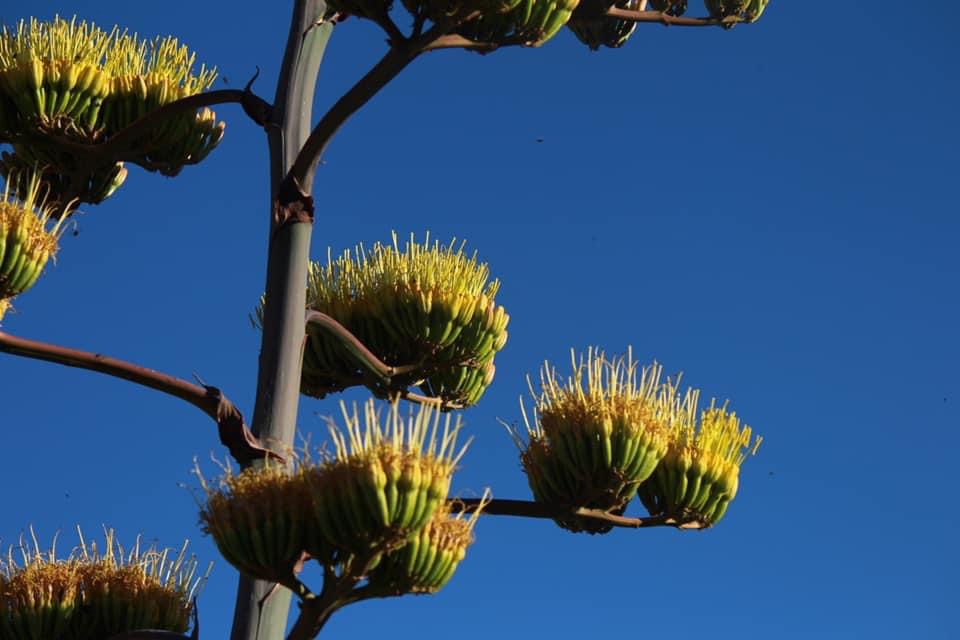
The Century Plant (Agave Americana) is a type of agave plant that is native to northern Mexico and southern Texas. I came across it in my recent travels. It is particularly suited for dry, higher elevations. The plant’s name is a misnomer. It does not live for a century. Generally, it lives between eight and thirty years. When it blossoms, it puts out a single stalk that can rise up to twenty feet from it’s thick, leafy base. Little branches will grow out of the stalk and at the end of each branch a cluster of bright yellow flowers will grow upward – attractive to insects and birds. The sight of these towering plant stalks with their yellow blossoms is quite dramatic against the dry desert landscape. What is also dramatic is that the plant will (for the vast majority) only bloom once – at the end of its lifespan. So, when you are looking upon this amazing spectacle of height, color and beauty you are also looking at a plant that is actively dying.
Our Christian faith is centered around a God who died for us and in that dying revealed the depth and beauty of God’s love. This same God – who died for us – also taught us that – as his disciples – we must pick up our own crosses and follow after him. That to be true disciples we must also go through the journey of “dying to self”.
Can we recognize the beauty in this?
In his second Letter to the Corinthians, Paul writes about the “thorn in the flesh” given to him, “an angel of Satan, to beat me, to keep me from being too elated.” Much ink has been spilt over the centuries arguing what this “thorn” might have been. I do not believe that Paul ever specifically says and he does not have to. It is valid that every person has some things kept between himself/herself and God. Despite what social media tries to impress upon us all, we do not have to be open books to the world in every aspect of our lives.
What Paul does share is that there was a grace and wisdom which he gained from this “thorn”. Paul writes that God responds to his entreaties with, “My grace is sufficient for you, for power is made perfect in weakness.” So, Paul will boast in his weakness, he even goes on to share, “I am content with weaknesses, insults, hardships, persecutions and constraints, for the sake of Christ; for when I am weak, then I am strong.”
Following upon my trip to Big Bend National Park, when I read these words by the apostle I now easily envision the century plant – a witness of life, beauty, height, strength, color even in the very midst of its dying.
Is there a beauty to be found in dying to self? Very much so. It is a real beauty and an authentic beauty and so often (for those with eyes to see) it does stand out from its surroundings in dramatic contrast.
“I am content with weaknesses, insults, hardships, persecutions and constraints, for the sake of Christ; for when I am weak, then I am strong,” writes Paul and writes every disciple (maybe not by word on paper but most importantly by the witness of their life) who undertakes the journey of dying to self.
There is a salvific equation at work in the readings for this first Sunday of Lent and it is important to recognize as we begin this Lenten season and our journey to Easter. The equation is this: we sinned by trying to grasp the glory of God and God saves us by letting go of His glory and becoming a servant.
Adam and Eve are tempted by the serpent in the garden. “You certainly will not die! No. God knows well that the moment you eat of it your eyes will be opened and you will be like gods who know what is good and what is evil.” We try to grasp the glory that is due to God alone. We try to make of ourselves little gods – controlling our world, controlling everything, answerable only to ourselves! It is a form of pride and it is the root of all sin. We sin by trying to claim the glory of God for ourselves.
God answers not by condemning nor by destroying all of sinful humanity and starting anew. No, God answers our insult by coming even closer than before. God enters into his very creation in the form of a servant. In the temptations in the desert we find Jesus taking on the mantle and role of the servant.
The servant is the one who is never satisfied in his own needs because he is required first and foremost to see to the satisfaction of his master. The servant is the one who claims no special status. He is just a servant after all. The servant has no power. In each of the three temptations we see our Lord taking on the mantle of the servant.
“Command that these stones become loaves of bread,” tempts Satan. “You are hungry. You have been fasting. See to your own needs first. Satisfy your hunger, turn these stones into loaves of bread!” Our Lord refuses. He will be a servant and a servant does not see to his own needs first. Jesus overcomes the devil’s temptation by falling back on the word of God.
“Throw yourself down from this parapet,” tempts Satan, “God will protect you! You are his son after all.” “Claim your special status and make sure all the world sees it and acknowledges it!” Jesus refuses. He will not put his Father to the test. Jesus is the one “who though in the form of God did not deem equality with God something to be grasped, but rather took the form of a slave, being born in the likeness of men.” Jesus will be a servant. He will not claim special status.
In the final temptation, the devil shows our Lord all the power of the world and offers it to him if only Jesus will bow down in worship. Jesus will not claim the power and he will not worship the tempter. “The Lord, your God, shall you worship and him alone shall you serve.” Jesus is to be a servant.
By the end of the temptations, Jesus has fully vested himself in the mantle of the servant – the one who does not seek his own satisfaction, the one who claims no special status, the one who has no power. Now, he begins his journey toward Jerusalem and the great work of our salvation.
We sinned by trying to grasp the glory of God. God saves us by becoming a servant.
One further thought as we begin these weeks. Let’s not lose sight of the forest for the trees. It is easy to get focused in on what we are going to do for these next forty days – what we will give up, how we will pray, what we will do – that we actually lose sight of the great work that has already been done! Yes, there is importance to prayer, fasting and almsgiving – none of this is being denied – but make sure these next forty days to also leave space for wonder. Make sure to take time to wonder, to just be amazed at what God has done and continues to do in Christ our Lord! How we are saved by this God who became servant. Wonder (and out of that gratitude) is also an important aspect of the Lenten journey.
We sinned by trying to grasp the glory of God. God saves us by becoming a servant.
I have been reading a book by Liz Forkin Bohannon entitled “Beginner’s Pluck” – not “luck” but “pluck” with a “p”. The author has some good insights and she is not afraid to take on some sacred cows in our times and culture. One of these sacred cows is the myth of “finding your passion” in life and she addresses this in a chapter aptly entitled, “Stop Trying to ‘Find Your Passion’”.
Her point is that passion is not found but built. Here I want to share a quote from her book,
The critical difference is this: when you set out to “find” something, it requires that you know what you’re looking for. When we believe in the notion that we will eventually “find” our purpose and passion, we bide our time, living only half alive and gripped by fear. We look to others who have already “found it,” and we get jealous, overwhelmed, and confused when we try to run someone else’s race because we want to end up where they are. We cling to the narrative of “finding” because it is self-soothing and gives us permission to be passive, and we fall asleep to the world and to the work that is right in front of us. We can blame our lack of direction and purpose on The Universe and Other Vague External Factors instead of taking responsibility for our own lives and moving forward with courage and intentionality. When we believe our passion and purpose is waiting to be found, we wait instead of create. The mentality around creating and building is much different than finding or discovering. Have you ever heard an author describe the process of writing the novel without knowing how the story ends? They don’t talk about the moment when they finally found the perfect last sentence which then gave them permission to start writing. They talk about how each day, they sit down with an openness to where the narrative will go, and they know they must write it into existence. In the end, they sit back and marvel not at their discovery, but at their creation. Your passion isn’t found in your dreaming. It’s made by your doing.
Here is the connection to this Sunday’s readings. In today’s gospel (Mt. 5:13-16) our Lord says, “You are the salt of the earth … You are the light of the world.” This is not meant to be a nice description we can pat ourselves on the back for. “Hey, look at what the Son of God said we are!” It is not that. It is a task to be lived. How do we recognize it is a task to be lived? Because immediately our Lord then goes on to caution that salt can lose its taste and a light can be hidden.
This understanding is backed up in the first reading from Isaiah (Is. 58:7-10). “Thus says the Lord: Share your bread with the hungry, shelter the oppressed and the homeless; clothe the naked when you see them, and do not turn your back on your own. Then your light shall break forth like the dawn…” These are all “doing” words, active verbs. They are not passive.
“Salt of the earth” and “Light of the world” are not meant to be nice little descriptions that the Christian can sit comfortably and passively within. They are a task we are given by our Lord himself – tasks to which we will have to give an accounting of.
I like Bohannon’s writing because she is quite honest and she is not afraid to even call herself out. The business she created helps women and girls in impoverished areas around the world but she admits she was not “born” with this passion, rather it grew over time as she made choices, as she investigated and explored things. This is how it really happens. The “Find your Passion” myth often cripples us because it seems so big and daunting from the outset that we just become stuck and not sure what to do. “Forget all that,” says the author and she offers some sound advice from her own life to get beyond that hurdle. “What are you interested in? What intrigues you?” Do the work of exploring that and then see where you go. Both our passion and our purpose our built – not found.
God provides his grace but God does not overwhelm our wills. God wants us to play our part in the equation. We are not meant to be passive bystanders to our lives and our time in this world. This is not what our Lord means when he says we are salt and light. By saying salt and light, our Lord has given us a task that we are each meant to live and to do.
Recently the Knights of Columbus decided to begin an initiative to help refugees at the U.S. – Mexican border. Carl Anderson, the Supreme Knight of the Knights of Columbus, specified in his announcement that this was not a “political statement” but a statement of principle. I find it telling that the head of this fraternal, international Catholic organization guided by the tenets of the Catholic faith felt it necessary to make this distinction.
It was in seminary that I first heard the term “meta-narrative” (beyond-story) and it was in reference to God’s plan of salvation being the meta-narrative to all other narratives in human history. The meta-narrative is the one overarching narrative (the beyond-story) to which all other narratives are to be measured, judged, transformed and even discarded if necessary. Prevailing ideas and societal customs, histories of peoples and nations, economic and political systems are all narratives and may indeed have much positive to speak for them but none are the meta-narrative, none are the Gospel story of God’s movement and plan in history. All narratives are to be judged in the light of the meta-narrative on God’s work of salvation.
I would propose for consideration that Carl Anderson’s need to clarify the purpose of the Knight’s new initiative at the border witnesses to the fact that for many who claim the name of Christian the narrative of U.S. politics has eclipsed the meta-narrative of the Gospel message. Everything is being viewed and evaluated through the lens of contemporary American politics regardless of the side of the aisle you fall on.
How did this happen? This is not an exhaustive list but here are some thoughts. The 24-hour, 7 day a week news cycle – now even more magnified by social media. We have always had political junkies and that is okay. We need people who are passionately invested in politics and willing to work and fight for what they value but what is different today is that we now have political junkies debating political junkies nonstop on our tv screens both in our homes and all other type of screens. What we are being taught by this continuous stream of political junkie debate (no matter where we find ourselves on any particular issue in the moment) is that this is the only legitimate way to see and judge all actions and events – only through the lens of the political. Holding to the meta-narrative of the Gospel, I would say “no”- politics is not the only way to see and evaluate everything and that assumption is itself a false narrative.
The turn to the base. I am not a political junkie, nor care to be – thank you. But what I have learned through my own being immersed in the continuous stream of political junkie-ism is that not that long ago a decision was made to turn to the base in the effort to win elections and advance causes and perspectives. This was a shift away from a broad appeal that would attract the large number of votes needed to get elected. It has proven to be an effective strategy but it is a strategy based on a negative – the apparent apathy of the majority vs. the fervor of the base. Because it is based on a negative, I believe it is doomed to collapse at some point and it may be quite ugly when it happens. For our purpose here, the turn to the base is again the turn to a segment of the population who is already keyed into things political – the people who have bought into the notion that politics alone is the best means to achieving a certain desired end. But, again, it is the politically-minded crowd who are having the overarching influence on determining how things are being viewed, evaluated and presented.
I do not want to come across as denigrating politics. There is certainly a value and even a virtue to politics and it is a way of encountering the mystery of life and even the true meta-narrative of God’s work of salvation but it is not the only way. I would hold that those people who are not so keyed into the political are encountering the mystery of life and even the true meta-narrative in their own way which is just as valid – art, literature, relationships, responsibilities, worship, service, appreciation of creation, community … the list could go on.
Fear. U.S. society is changing and there are many factors that are at work in this. There are and will be more darker tones of skin, there will be more non-European sounding names, there will be different styles of clothing than what we have been used to in American society. Get used to it; it is a demographic reality but change can be scary so in the midst of the change it is always important to remember that Scripture reminds us that “perfect love casts out all fear.” Trust that God is at work bringing about His Kingdom of all of His children in all of their varying hues, languages and experiences. By trusting a little bit more we can begin to let go of our little kingdoms in anticipation of God’s coming Kingdom. Death is also a fearful thing. The Baby Boomer generation is approaching this great mystery and no amount of commercials with gray haired people climbing mountains or couples holding hands while soaking in claw-footed bathtubs set in nature will forestall this reality that we all must face. Here is where the illusion of all narratives that try to propose themselves as the meta-narrative ultimately collapse. At the tomb. The resurrection of Christ is the only beyond-story that has ever conquered the grave. This is the only story that gives that hope which endures and that overcomes all fear.
What can be done to reduce the illusion of politics as the meta-narrative? Some thoughts. Turn off the 24 hours news cycle. It can be done and by doing so more space is allowed for other narratives and even the true meta-narrative to enter our lives. Take time to read good literature and listen to good music and enjoy good drama and theater. When good, these realities lead us into the great mysteries of the human experience. Enjoy good sport. This also is a way of being led into the mystery and drama of human experience. Remember that the United States is not the center of the world. I love my home country and am proud of what we have achieved but I have travelled enough to recognize that not everyone is looking to the U.S. at all times and that there is beauty and truth in all cultures. (A little humility goes a long way.) Go into a situation where you are a minority and be willing to keep going there. Pray and worship – root yourself in the true meta-narrative of the Gospel and even encounter the Author of this beyond-story. Go for a walk in creation and allow yourself to be struck by the truth that each of us is just one part of something much bigger than ourselves. Serve other people and learn to recognize God in that space of service. Make friends with people you do not necessarily agree with on everything. Cultivate wonder and curiosity in your life.
And, yes, be involved in politics if you have that desire but please recognize it for what it is – just one part of the story and not the whole.
Truth is, this reflection will probably be judged, written off as naïve or possibly even condemned by people who view all things through the lens of politics. Okay, that is your choice but it does not have to be mine. To God be the glory.






 There is a salvific equation at work in the readings for this first Sunday of Lent and it is important to recognize as we begin this Lenten season and our journey to Easter. The equation is this: we sinned by trying to grasp the glory of God and God saves us by letting go of His glory and becoming a servant.
 I have been reading a book by Liz Forkin Bohannon entitled “Beginner’s Pluck” – not “luck” but “pluck” with a “p”. The author has some good insights and she is not afraid to take on some sacred cows in our times and culture. One of these sacred cows is the myth of “finding your passion” in life and she addresses this in a chapter aptly entitled, “Stop Trying to ‘Find Your Passion’”.
 Recently the Knights of Columbus decided to begin an initiative to help refugees at the U.S. – Mexican border. Carl Anderson, the Supreme Knight of the Knights of Columbus, specified in his announcement that this was not a “political statement” but a statement of principle. I find it telling that the head of this fraternal, international Catholic organization guided by the tenets of the Catholic faith felt it necessary to make this distinction.
 The Alternate Path