• About The Alternate Path

The Alternate Path

~ Thoughts on Walking the Path of Christian Discipleship

The Alternate Path

Tag Archives: faith

Where Hope is Born: Second Sunday of Advent – C

08 Sunday Dec 2024

Posted by mcummins2172 in Uncategorized

≈ Leave a comment

Tags

Advent, Catholic Church, Christianity, discipleship, faith, God, hope, Jesus, John the Baptist, Prophet Baruch, Second Sunday of Advent C

Image may be subject to copyright.

This Sunday is the only time that we hear from the prophet Baruch in the three-year cycle of Sunday readings.  Baruch was thought to have been the scribe of the prophet Jeremiah, and his writing is a reflection on the history of the people of Israel and the experience of the Babylonian exile.  For Baruch history and the hopes and belief of Israel are intertwined.  The same is true for us Christians.

We have the hope of salvation and the hope of the fullness of the Kingdom of God.  In Advent we await the coming of the one whose life, death and resurrection opens the way for us to return home to the Father.  This is the hope that has been planted within our hearts but this hope grows within our daily context and within in our daily journey of faith and not despite it.  Luke is quite specific in his gospel (Lk. 3:1-6). In the fifteenth year of the reign of Tiberius Caesar, when Pontius Pilate was governor of Judea and Herod was tetrach of Galilee, Philip tetrarch of the region of Ituraea and Trachonitis, and Lysanius was tetrarch of Abilene, during the high priesthood of Annas and Caiaphas…”  This was a hard time for Israel – the country was brutally occupied.  Caesar was a foreign emperor; Pilate was his governor.  The tetrarchs were seen as collaborators.  And precisely into this the word of God came to John the son of Zechariah. 

We look at our world today – the war in Ukraine and the Holy Land, the polarization in our own country, the social confusions, the natural disasters and it is precisely into this that the word of God comes to us and it is in this reality and not despite it that hope is born and strengthened by this hope we move forward.  Hope is born in the reality of our world and it is also born in the reality of our lives.  

Baruch gives a powerful image of God commanding that the mountains be made low and the age-old depths and gorges be made into level ground so that his people can joyfully return to Jerusalem.  The mountains and the gorges are the obstacles preventing the people from returning.  What are the mountains, the age-old depths, the obstacles in our lives that stand in the way of our returning to the Father?  The addictions we have cultivated, the pride we nurse, the sin we allow, the resentments we hold on to, the prejudice we turn a blind eye to, the list can go on.  These are the mountains and the gorges we have thrown up between us and God.  And into this the word of God comes undeterred.

How is God laying low the mountains and filling in the gorges of our lives?  By Jesus who is the way and by the outpouring of his grace and the salvation he won for us.  How do we prepare the way of the Lord these days of Advent, how do we find hope?  We receive the sacraments, we confess our faults, we live Christian charity, we pray and work for peace, we forgive and we ask for forgiveness not despite the reality of our life right now but within it. 

And in this, hope is born.  Paul witnesses to this truth in his letter to the Philippians, I am confident of this, that the one who began a good work in you will continue to complete it until the day of Christ Jesus.  

St. Juan Diego’s Tilma: a reflection for the Feast of Our Lady of Guadalupe

07 Saturday Dec 2024

Posted by mcummins2172 in Uncategorized

≈ 1 Comment

Tags

faith, Feast of Our Lady of Guadalupe, guadalupe, hope, Mary, Nuestra Senora de Guadalupe, Our Lady of Guadalupe, saints, St. Juan Diego, St. Juan Diego's Tilma, St. Mary, Virgin Mary

Image may be subject to copyright

Friends, a good artist will take care to choose the best canvas to paint on as well as the best paint to work with.  With this thought it is worthwhile to reflect on the “canvas” and the “paint” used in the miracle of Guadalupe. 

The canvas is the tilma – the cloak worn by the people of the time.  Also, it is the tilma of a poor man.  Juan Diego was a poor and common man but a man devoted to his Christian faith.  Juan Diego was probably never noticed by the powerful people of his time but he was noticed by the Virgin Mary.  Mary saw Juan Diego – the poor man in his simple tilma.  Mary always sees the poor and the common person who is often overlooked by the powers of the world. Mary sees because she herself lived a simple life in a small village in a forgotten part of a large empire.  She who was not noticed by the world was seen by God and to her the Holy Spirit came and through her the Word became Flesh.  Mary’s choice to make Juan Diego’s tilma her canvas shows how God chooses the lowly to proclaim his love to the world and how God himself and the saints choose to walk with those persons often forgotten and overlooked by the world. 

The paint is the flowers – the miracle of the flowers that are found in abundance and blossoming even in winter!  Juan Diego tells the virgin that the bishop wants a sign, Mary sends the poor man to gather the flowers.  The flowers growing in the dead of winter are pure gift.  The flowers are grace from heaven.  In many ways, flowers are given to us also during our journey as Christians – the grace of the sacraments – new birth in baptism, the very body and blood of our Lord in the Eucharist, the healing of reconciliation.  The flowers are the beauty of God’s love and mercy in our lives and salvation that Jesus won for us in his death and resurrection.  The flowers of prayer, devotion, living Christian charity towards others.  The flowers of the teaching of Jesus.  Just as she asked Juan Diego, Mary also asks us to gather these flowers that are pure gift and grace from God. 

As we gaze upon the beauty and the miracle of the image of our Lady of Guadalupe, we are left with some important questions. Do we know that we (each one of us) is seen and noticed by Mary, by God?  Can we gather the flowers of grace and gift that God sends to us into the tilma of our lives?  And what will be the image that is shown in the tilma of our life when we stand before God? 

Friends, each one of us is seen and loved by God and our Lady.  Each one of us is given an utterly unique tilma and each one of us is given beautiful flowers of grace in our life and each one of us is meant to make of the life we have been given a beautiful image that reflects the wonder of God. 

Our Lady of Guadalupe, pray for us.   

Home, Hope, Redemption and Light: First Sunday of Advent, Year C

01 Sunday Dec 2024

Posted by mcummins2172 in Uncategorized

≈ Leave a comment

Tags

Advent, Catholic Church, Christian life, Christianity, Christmas, discipleship, faith, First Sunday of Advent, hope, Jesus

Image may be subject to copyright

Recently, a priest friend of mine shared with me some themes that he found present in this First Sunday of Advent’s prayers and readings, themes that are worthy of our carrying and reflecting upon these next four weeks.  I would like to share some of the themes but add my own take upon them.  The themes are: home, hope, redemption and light. 

Home.  This last liturgical year I made the Nineteenth Annotation retreat and in the fourteenth week of the retreat I had a truly profound prayer experience – Jesus invited me to the Father’s house.  In my mind, the Father’s house was a small cabin in the woods.  It was a winter night, there was snow on the ground and it was cold but there was warmth, light and laughter coming from the cabin.  Jesus welcomed me and the Father was there – not seen – but a deep abiding presence.  In my heart I heard the Father say, “Welcome, Michael, you are always welcome here.”  Part of the expectation of Advent – as we await the coming of the Messiah – is that we have a home.  Each one of us has a home.  Our home is in the fullness of the Kingdom with the Father, the Son and the Spirit and we are always welcome there. 

Hope.  In today’s gospel (Lk. 21:25-28, 34-36), Jesus calls us to be vigilant but the vigilance of the Christian is not a vigilance founded in fear but rather a vigilance rooted in hope.  Notice the distinction that Jesus makes in the gospel.  “There will be signs,” says Jesus and “nations will be in dismay” and “people will die of fright” but then Jesus tells his disciples that when these signs occur, “stand erect and raise your heads because your redemption is at hand.”  Christians live in hope and not fear.  We stand erect and we raise our heads because we know that Jesus is Lord.  The cry of Advent, “Maranatha!” (Come, Lord Jesus!) is never a cry of fear but rather a bold proclamation of hope.  Every Advent calls the Church to hope. 

Redemption.  Jesus calls us to raise our heads because our “redemption is at hand”.  “Redemption” is a powerful and heavy word and we often think of it in final terms but in our Lord’s words we also see that redemption takes root in our lives and begins to grow and have effects today.  In redemption, we learn and we find the strength to begin to let go of those things, those decisions, attitudes and anxieties that make us “drowsy” from carousing and drunkenness.  In redemption, we learn to let go of actions and mindsets that block life in order to choose that which leads to true life.  Redemption is more than just a final goal for the Christian.  Redemption is a growing and living seed planted in the heart of every disciple by Jesus himself.

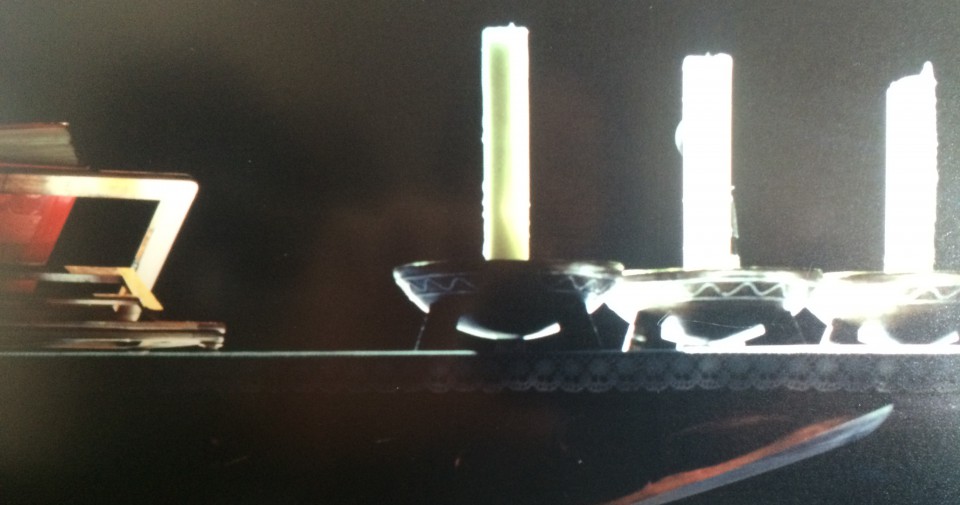
Light.  This Sunday, we light the first Advent candle and we will light the other candles over the next three weeks.  The light grows with each candle even as the days become shorter and the darkness of winter lengthens.  The light dispels the darkness and we await the coming of the light of the world and this light transforms our hearts even as we await it.  Dr. Martin Luther King Jr. reminded us that darkness cannot drive out darkness, only light can do that.  Hate cannot drive out hate, only love can do that.  We await the coming of the light and we let that light find a home in our hearts.

Home.  Hope.  Redemption.  Light. 

Come, Lord Jesus!     

Where are our hearts? Homily for 22nd Sunday of OT, Year B

31 Saturday Aug 2024

Posted by mcummins2172 in Uncategorized

≈ Leave a comment

Tags

22nd Sunday in Ordinary Time, Catholic Church, Christian life, discipleship, faith, Jesus

There is a story told in the Lakota tribe of the Man who Spoke Softly.  (Taken from The Lakota Way by Joseph M. Marshall III.) 

In a certain village there was a leader, a headman, who was respected for his quiet ways and good decisions.  He never sought to become a leader but as a young man he proved that he could think clearly and act calmly on the battlefield.  He was a good provider for his family and he took care of the helpless ones.  For these reasons the people asked him to be their leader and he reluctantly agreed.  As leader, he made good decisions and always spoke the truth in council meetings and under his leadership the village prospered and grew strong.

Two generations grew up under his leadership and the man was getting on in years.  There were a few young men in the village who yearned for a new leader.  They wanted someone with more daring and flair – more fitting to their prosperous village, they thought.  They had forgotten it was the headman’s leadership that grew their village. 

The young men formed a plan.  They would catch a small bird and one of them – in front of the whole village – would question the headman.  “Grandfather, I have a bird in my hand.  You are wise.  Is the bird dead or alive?”  If the headman answered “alive” then the young man would crush the bird and kill it before opening his hand.  If the headman said “dead” then the young man would open his hand and the bird would fly free.  Either way, they thought, the headman would be shown to be weak and uncertain. 

So, on the morning of an important tribal gathering when all the people were gathered, one of the young men called out in a loud voice to the headman. “Grandfather, I have an important question.  I have a bird in my hand.  Since you are wise, is the bird dead or alive?’

A hush fell over the people.  They knew that some of the young men were wanting new leadership and some wondered if the young men were right.  They waited for the headman’s answer. 

The old headman approached the young man with the question.  He stood quietly, seeming to study the ground as the people whispered.  Finally, the headman turned to the young man and smiled patiently and spoke firmly and gently as he always did when something important was to be said.

“Grandson,” he said, “the answer is in your hands.” 

The story invites us to look into what is in our hearts.  It is the same invitation that Jesus gives in today’s gospel; the invitation to move beyond the blind ritualism of the Pharisees that focused solely on external actions – This people honors me with their lips, but their hearts are far from me… – in order to see where ones heart is. 

Are our hearts in living relationship with God?  The answer is, and will always be, in our hands. 

St. James, in his letter, gives good advice on how to keep our hearts in living relationship with the Father. 

Humbly welcome the word that has been planted in you and is able to save your souls. 

Be doers of the word and not hearers only, deluding yourselves. 

Religion that is pure and undefiled before God and Father is this: to care for orphans and widows in their affliction and to keep oneself unstained by the world.  (James 1:17-18, 21b-22, 27)

Church, forget not your power! (Sixteenth Sunday of Ordinary Time – B)

21 Sunday Jul 2024

Posted by mcummins2172 in Uncategorized

≈ Leave a comment

Tags

Bible, Catholic Church, Christ, Christian life, Christianity, discipleship, Easter, faith, God, Jesus, Mk. 6:30-34

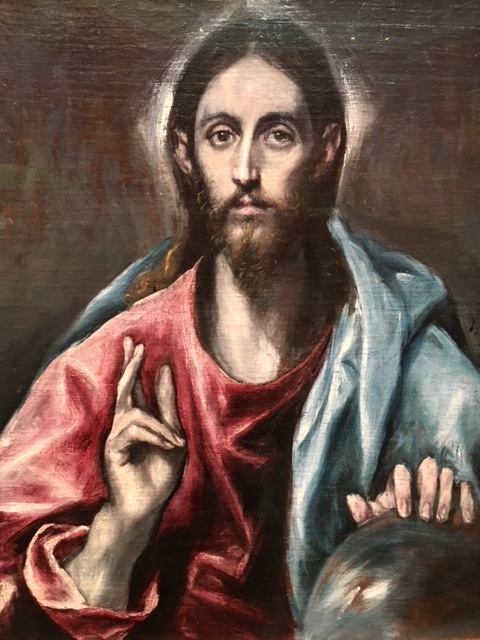
Christ the Saviour by El Greco. Image may be subject to copyright

The Gospel passage for this Sunday (Mk. 6:30-34) has the apostles returning to the Lord after having been sent out on mission to proclaim the coming of the Kingdom of God, to heal the sick and to aid the weak and the poor.  The evangelist makes note of a “power” being conferred on the apostles in order to accomplish these tasks.  The power mentioned here is not a worldly power because those first disciples had no such power.  They had neither wealth nor influence.  The “power” that the disciples went forth with were obedience to Jesus, the proclamation of his words and repeating the Lord’s gestures of mercy.  Through these simple powers great things happened and the apostles return full of excitement to share their experiences. 

In our Christian tradition there is a famous quote that states, “Christian, forget not your dignity!”  In relation to today’s Gospel, I think we can say, “Church, forget not your power!” 

The power of the Christian community is threefold: 1. obedience to Jesus, 2. the proclamation of his words, 3. repeating the Lord’s gestures of mercy.

Obedience to Jesus.  Jesus is Son of God, Son of Man and Lord of history.  Why do we keep searching for other lords and other messiahs?  Yet, we do.  There are great men and great women throughout history yet none of these people are Son of God and Son of Man.  The witness of the disciples is found both in what they said and in what they did.  They remained with the Lord.  They returned to him (as we see in today’s Gospel).  When they wandered and stumbled, they turned back.  Even when they scattered from the cross; they gathered together again in the locked room.  In times of triumph, times of struggles, and times of uncertainty the disciples remained with the Lord.  There is a power found in obedience to the Lord.

The proclamation of Christ’s words.  There are many great ideas, theories and achievement throughout human history and these amaze and astound us.  We celebrate what is good and true.  But even as the Church can and should learn from these achievements, we must remember that the words that we have to share are authentic, true and needed for every place and age.  They are words that truly bring life.  The words are not of our own making; rather they have been entrusted and given to us.  We are to speak Christ’s words to our world.  Elsewhere in the Gospel our Lord tells us that no one puts a light under a bushel basket yet how often are we tempted to give the Gospel second place in our lives to the latest theory, psychology, philosophy or social fad?  When we do so are we not, in essence, placing a basket over the light of the Gospel?  The words of Christ truly heal because Christ alone is the Lord of life.

The Lord’s gestures of mercy.  Jesus knew the power of gesture: he writes in the sand, he touches the leper, he sits down at the well with the Samaritan woman.  It is interesting to note how our Lord’s gestures were ever directed toward mercy.  The Church is at its best when it lives our Lord’s gestures of mercy – when the person seen as untouchable is touched, when the hungry are fed and when the sinner is forgiven.  These gestures will not make the evening news but they are true and they bring hope and healing to our world.

At the end of today’s gospel passage, we are told that when Jesus saw the crowd his heart was moved with pity.  The people were starving.  They were tired of that which failed to satisfy.  We, also, are tired of that which fails to satisfy.  Salvation does not come through the powers of our world.  Salvation comes through God’s mercy at work in our world, our hearts and our lives.

Christian, forget not your dignity!  Church, forget not your power!

The storm and Jesus’ dream (12th Sunday of Ordinary Time – B)

23 Sunday Jun 2024

Posted by mcummins2172 in Uncategorized

≈ Leave a comment

Tags

Bible, Christ asleep in boat, Christian life, Christianity, discipleship, faith, fear, God, Jesus, Mk: 4:35-41

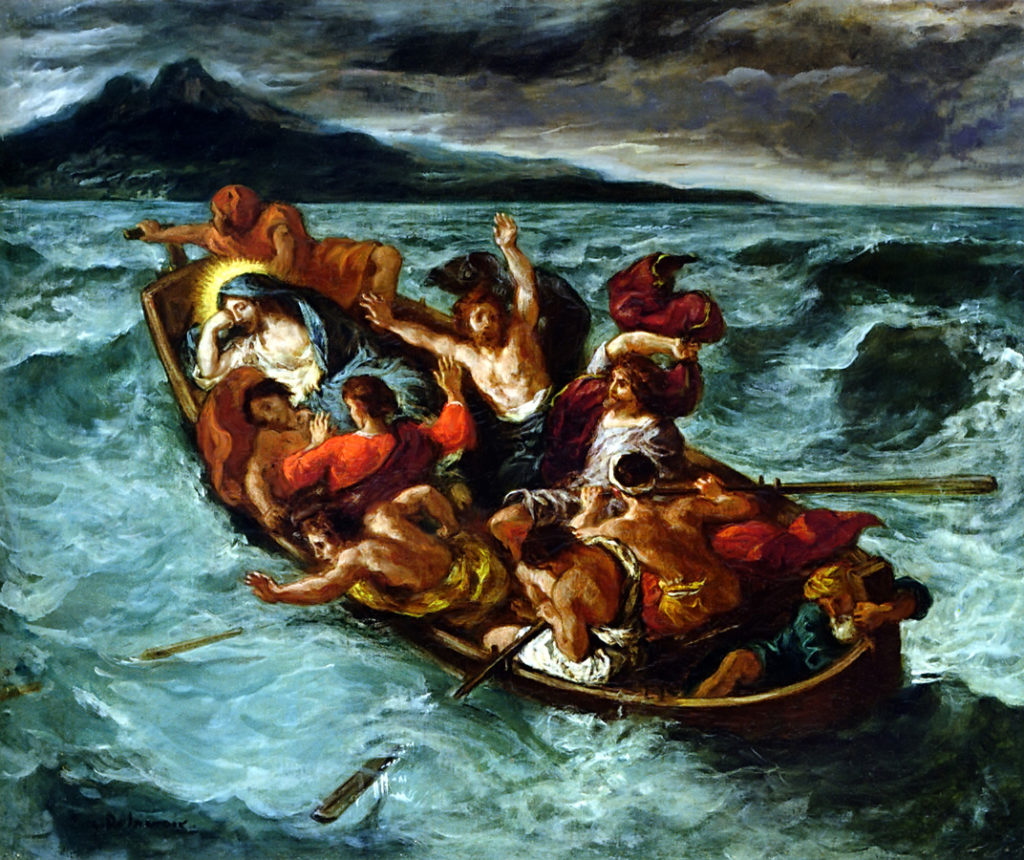
“Christ Asleep During Tempest” by Eugene Delacroix

In today’s gospel (Mk 4:35-41) we have the episode of the storm calmed by Jesus. The boat on which the disciples are crossing the lake is beaten by the wind and waves and they are afraid they will sink. Jesus is with them on the boat, yet he is in the stern asleep on the cushion. The disciples, filled with fear, cry out to him: “Teacher, do you not care if we perish?”

Often we too, beaten by the struggles of life have cried out to the Lord: “Why do you remain silent and do nothing for me?”. Especially when it seems we are sinking, because of the loss of love or the project in which we had laid great hopes disappears; or when we are at the mercy of the unrelenting waves of anxiety; or when we feel we are drowning in problems or lost in the middle of the sea of life, with no course and no harbor. Or even, in the moments in which the strength to go forward fails us, because we have no job, or an unexpected diagnosis makes us fear for our health or that of a loved one. There are many moments in which we feel we are in a storm; we feel we are almost done in.

In these situations, and in many others, we too feel suffocated by fear and, like the disciples, risk losing sight of the most important thing. On the boat, in fact, even if he is sleeping, Jesus is there, and he shares with us all that is happening. His slumber, on the one hand surprises us, yet on the other it puts us to the test. The Lord is there, present; indeed, he waits – so to speak – for us to engage him, to invoke him, to put him at the center of what we are experiencing. His sleep causes us to wake up! (From Angelus address given by Pope Francis on 6/20/21) 

Because to be disciples of Jesus it is not enough to believe that there is a God, that he exists, but that God is also here, with us in the boat, and that God cares and that he hears our cries and knows our needs.   

In praying over this gospel passage and the Holy Father’s words, a question came to me that I had never thought of before.  What would Jesus have dreamt when he slept?  Jesus is fully human.  Part of being human is needing sleep and in that sleep dreaming.  Rapid Eye Movement, the subconscious organizing the experiences of the day, all the things that go into the science of sleep, what would have been Jesus’ dreams?  I’m not talking about the strange dreams we get when we decide to have pepperoni pizza as a midnight snack but those deep dreams that remain with us. 

We cannot know but as dreams seem to be shaped by what is important to us and what we experience, I think it might be safe to say that his dreams would center on his relationship with the Father, his mission, his love for us and all those encounters and moments he had in his public ministry.  I think his dreams would have been rooted in the living mystery of the Kingdom of God which he proclaimed. 

A thought – when we feel we are drowning in life, when we feel lost and afraid remember not just that there is a God but that we have a God who is with us – even in our very boat.  Call upon him and maybe even ask him in friendship to share his dream with us – his dream of the Kingdom, a dream which can give hope and even calm the storms we encounter.        

“Soldiers for Christ” and the Standard of Christ

31 Friday May 2024

Posted by mcummins2172 in Uncategorized

≈ Leave a comment

Tags

Bible, Catholic Church, Christian life, Christianity, discipleship, faith, God, Jesus, Soldiers for Christ, Spiritual Exercises, St. Ignatius, Standard of Christ

“Soldiers for Christ” is a term used in our Christian life of faith but it is an ambiguous term in that it lends itself to different meanings for different people and it is an image that can be depicted and has been depicted in a variety of ways.  There are references to being “soldiers for Christ” (2 Tim 2:3) and putting on “the armor of God” (Eph. 6:11-17) in scripture and these passages highlight the resolve and determination that the life of faith demands.  Jesus never denounced military service; at one point he commends the faith of the Roman centurion (Mt. 8:5-13) and he made use of military images in his teaching (i.e. Mt. 14:31-33) but Jesus himself never used the term “soldier” in reference to his followers. 

My fallback for direction in the use of this term and its imagery is the “Standard of Christ” that St. Ignatius of Loyola speaks of in his spiritual exercises.  St. Ignatius came from a military background.  He knew the role that the lifted military standard or banner played in relaying orders and focusing the movement of soldiers across the chaos of a battlefield before there was any form of electronic communication.  Soldiers in St. Ignatius’ time knew to focus on their standard as the success of the battle and their very lives depended upon it. 

In the exercises, St. Ignatius encourages us to reflect on the two standards: the standard of Christ and the standard of Satan.  The standard of Satan is marked by riches, desire for vain honor and surging pride.  In contrast, the standard of Christ calls forth three steps: “the first, poverty in opposition to riches; the second, reproaches or contempt in opposition to honor from the world; and the third, humility in opposition to pride.” (SE 146) It is in these three steps that the good soldier rallies under the standard of Christ and knows success in the battle with the powers of the world.

“Poverty in opposition to riches.”  When the world says, “More is better.” the soldier under the standard of Christ learns that less is enough and that choosing the less leads to a joy that the world cannot offer.  Those who place themselves under the standard of Christ are called to learn and grow in appreciation of both the material and spiritual poverty that Jesus himself exemplified in order to learn reliance on God and to grow in relationship with God.  Why are you anxious about clothes?  Learn from the way the wild flowers grow.  They do not work or spin.  But I tell you that not even Solomon in all his splendor was clothed like one of them.  If God so clothes the grass of the field, which grows today and is thrown into the oven tomorrow, will he not provide for you, O you of little faith?  (Mt. 6:28-30)  A mark of the soldier of Christ is the ability and the desire to choose the less, just as Jesus did. 

“Reproaches or contempt in opposition to honor from the world.”  Just as Jesus himself was doubted, viewed with suspicion, misunderstood, the subject of slander, mockery and ridicule so will the soldier, who freely stands under the standard of Christ, be.  The disciple is not one who willingly seeks these things out nor revels in them (a badge of honor quickly leading into the sin of pride) but rather, learns that there are abundant graces received when one can walk through such moments as they come in faith and trust.  The disciple knows, that by so doing, he or she is walking where Jesus walked and that Jesus, himself, is present in companionship.  There is grace to be found when one is misunderstood, rejected and viewed in contempt for holding true to Jesus.  Whether or not it is recognized and valued by friend, stranger or neighbor, it is recognized and valued by Jesus and Jesus makes himself known to those who walk through reproaches and contempt for him.  The true soldier remains close to Jesus and patiently endures the storm if needed.    

“Humility in opposition to pride.”  The eternal Word let go of glory and humbly took the form of a slave being born of a virgin.  Jesus embraced humility throughout his life and ministry upon this earth.  Jesus washed the feet of his disciples and he humbly bore the weight of the cross.  In humble acceptance to the will of the Father, he even embraced death on the cross.  Humility is the road that Jesus himself walked and it is the disciple’s royal road of return to the Father.  It is within the humble heart alone that the Father, Son and Holy Spirit make their dwelling-place.  Whoever loves me will keep my word, and my Father will love him, and we will come to him and make our dwelling with him.  (Jn. 14:23)  Soldiers for Christ come to know humility both as a needed virtue and as a privileged place of encounter with the Triune God. 

What does it mean to be a soldier for Christ?  St. Ignatius, through his Spiritual Exercises, gives us a good understanding.  The soldier for Christ is the one who remains under the Standard of Christ.  The soldier for Christ is the one who learns the value of poverty, the value of reproaches and contempt and the value of humility. 

The Resurrection – Only God makes a beginning, only God creates an end.

13 Saturday Apr 2024

Posted by mcummins2172 in Uncategorized

≈ Leave a comment

Tags

Bible, Christian life, Christianity, discipleship, Easter, Easter homily, faith, homily, Jesus, resurrection, Third Sunday of Easter homily

I recently read an article where a woman by the name of Norann Voll reflects on the many lessons she learned from her father growing up on a farm during lambing season.  At one point the author wrote this,

When the miracle of (the twin lambs) lay there in the sawdust and the ewe licked them off, urging them to stand for their first meal, I looked at Dad.  His eyes shone as blue as chicory flowers and his face was wet with tears.  “No human can create a beginning, Nora,” he said, “and no human can create an end.  It’s all in God’s hands.”

Friends, this is a truth of faith and a lesson of Easter.  Only God creates a beginning and an end.  The first reading of the Easter Vigil Mass is the story of creation found in the Book of Genesis.  After that reading the Church prays these words,

Almighty and ever-living God, who are wonderful in the ordering of all your works, may those you have redeemed understand that there exists nothing more marvelous than the world’s creation in the beginning except that, at the end of the ages, Christ our Passover has been sacrificed. Who lives and reigns for ever and ever.   

… there exists nothing more marvelous than the world’s creation … except that, at the end of the ages, Christ our Passover has been sacrificed. 

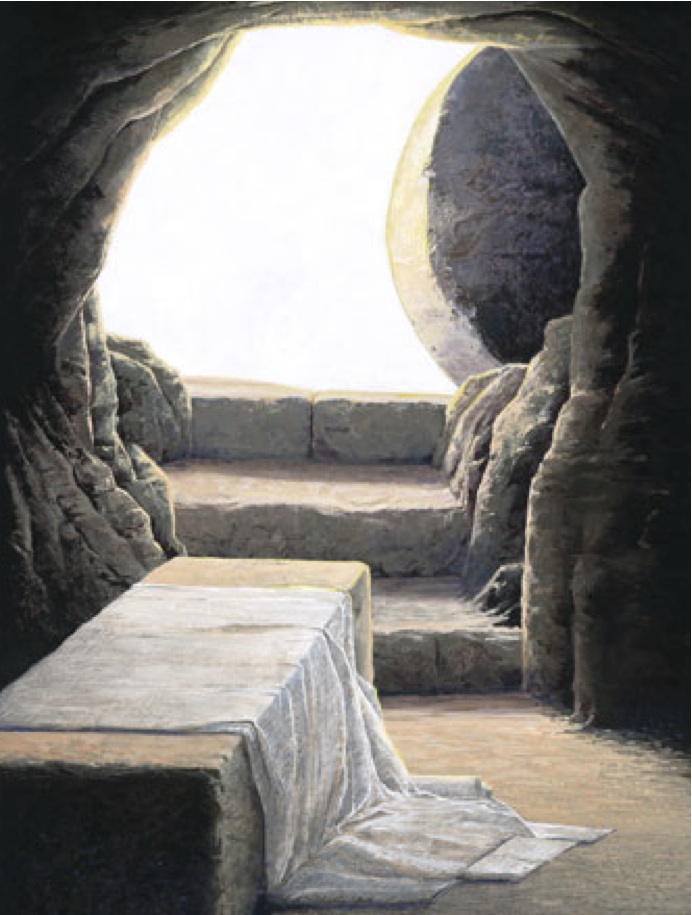
There is a tradition in our faith that Easter – the day of the resurrection of our Lord – should be considered the eighth day of creation.  Only God can create a beginning.  Only God is the author of life.  Only God could enter the false end that we made – the silence of the tomb – break it open and create a new beginning for us.  From the death of the tomb, Jesus rose! 

This is the wonder that the readings throughout this season of Easter proclaim and that the first disciples experienced!  In today’s gospel (Lk. 24:35-48), after the two disciples share how they encountered Jesus on the road to Emmaus, the risen Lord stands in the midst of his disciples, Peace be with you … Why are you troubled? … Look at my hands and my feet, that it is I myself.  Touch me and see …  Jesus showed them his hands and his feet, his wounds.   God wastes nothing and God redeems all.  Even the wounds of life are taken up into the new creation of the resurrection. 

Only God creates a beginning and an end.  There is nothing more wonderful than the world’s creation except, even more, the new creation brought about by the sacrifice and resurrection of Christ.  This is the truth we know and the hope we live by as Christians. 

If there are tombs in our lives – a besetting sin, an addiction, a wound inflicted or a pain endured – know that only God creates a beginning and only God creates an end.  The tomb has been broken in the resurrection.  Invite the risen Lord into that tomb.  Welcome Christ even into that!  Let his presence, his grace, his mercy pour forth and know that all tombs can be broken in Christ. 

“No human can create a beginning, Nora,” he said, “and no human can create an end.  It’s all in God’s hands.”

Easter as Homecoming and the joy of the Father

01 Monday Apr 2024

Posted by mcummins2172 in Uncategorized

≈ Leave a comment

Tags

Catholic Church, Christianity, Easter, Easter homily, faith, God, homily, Jesus, resurrection, resurrection of Christ

Icon of the Resurrection of Christ. Image may be subject to copyright

What images does homecoming call to mind?  A student coming home for the first time since leaving for studies.  A soldier coming home after a long and dangerous deployment.  A family, after a while apart, being able to come together for a holiday celebration.  Young parents bringing their newborn son to meet his grandparents for the first time.  Dear friends meeting up for some time together.  A child who had been lost in addiction but now sober being welcomed back home.  A tired spouse making it home after a long time away due to work. 

As we think of homecoming in all of its different forms there are some things that are consistent – there is joy, relief, welcome, laughter, peace, tears and embracing. 

In his resurrection and ascension, Jesus returns home to the Father.  What joy there must have been – what laughter, relief, love and embracing!  The risen Jesus returns having fulfilled his mission.  It is in the Letter to the Philippians that we find the hymn singing of this mission, the hymn that goes back to the first generation of disciples.  Jesus, who though in the form of God, did not regard equality with God something to be grasped but rather emptied himself and took the form of a slave.  Being born in our likeness, Jesus humbled himself and was obedient even to death on a cross. 

Jesus, the Son who emptied himself, stood in the place where we failed and he did not fail.  Where we failed through our pride in the Garden of Eden and chose to disobey, Jesus – in his humanity – obeyed.  Jesus did not rebel, he did not fall back.  Jesus obeyed the will of the Father.  Jesus stood in that place where we failed and he trusted in the love of the Father, even to death on the cross. 

What joy must have been in the risen Lord’s heart as he returned to the Father!  Coming home to Abba!  Through his obedience, Jesus healed what had been broken by our disobedience.  Jesus is the risen Good Shepherd, carrying back to the Father what had been lost.  The risen Lord carries us home to the Father!  The joy in our Lord’s heart is now also our joy!  We were lost and now we are found!  Now, we can return to the Father’s house!  Sin, death and the isolation of the tomb are not our destiny.  We are meant for life with the Father and, in his resurrection, Jesus goes to prepare a place for us!  This is our Easter joy!  Jesus’ joy is our joy – we can go home! 

And God the Father’s joy.  (We often don’t give enough thought to this.)  God the Father who cannot abide sin or death can now – in the return of the Son who conquered sin through his humanity – once again embrace us just as he embraces the Son.  This is the joy of the Father and this is the gift of the risen Son to the Father!  What pain there is in the heart of a parent when there exists a separation between parent and child.  What deep pain.  With the separation of sin overcome; the Father can once again embrace us.  The Father can once again welcome us home!  The heart of the Father rejoices in the return of his Son!   

Easter is homecoming!  The joy of the risen Son fulfilling his mission and returning to the embrace of the Father. Our joy in being brought home in the embrace of the risen Son with the Father.  The Father’s joy in embracing and welcoming us home! 

In my Father’s house there are many dwelling places … if I go and prepare a place for you, I will come back again and take you to myself, so that where I am you also may be. (Jn. 14: 2-3)


Good Friday – to stand where Jesus stood

29 Friday Mar 2024

Posted by mcummins2172 in Uncategorized

≈ Leave a comment

Tags

Bible, Christian life, Christianity, discipleship, Easter, faith, Good Friday, homily, Jesus

Image may be subject to copyright

Good Friday invites us to stand in that place where Jesus stood. 

In Isaiah 50:5-6 we hear of this place from the very mouth of the suffering servant.  And I have not rebelled, have not turned back.  I gave my back to those who beat me, my cheeks to those who plucked my beard; my face I did not shield from buffets and spitting.

In the Garden of Eden, through pride, we rebelled, and we turned back from God’s will for us, but Jesus does neither.  In his passion and in the fullness of his humanity, Jesus stands in that place where we failed.  Jesus obeys the will of the Father.  He neither rebels nor does he turn back. 

How do we respond to insult, mockery, abuse, disregard and violence?  Is not our first inclination to respond in kind?  If you insult me, then get ready for my insult back!  If you hurt me then I will hurt you even more!  We see this sad logic at play throughout human history and throughout our world today.  But Jesus does not buy into this sad logic.  Jesus does not rebel, he does not go against the will of the Father.  Jesus does not disobey God’s law; he does not respond to violence directed towards him in whatever form with violence in return. 

Nor does Jesus turn back.  Again, in the fullness of his humanity, he remains in the Father’s will even as he is betrayed, insulted, mocked, scourged, slandered, tossed between Pilate and Herod and disregarded by so many even as he hung on the cross for us.  Jesus remained, he took all the violence and spite that was thrown at him.  Could any of us have done this?  Would our inclination not have been to fall back, to get away from such pain? 

This is the place where Jesus stood, neither rebelling nor falling back.  Jesus stood fully in this place where we failed and he did what we could not.  Jesus obeyed, trusting in the love of the Father. 

Good Friday invites us to stand in this place where Jesus stood.  It is only in grace that we can do this but that grace has been given now in Christ.     

And a deeper truth, when (in grace) we are able to stand in that place where Jesus stood – neither rebelling nor falling back when violence is directed at us – we will find that Jesus stands there with us.  That very place becomes a place of encounter with our Lord where we know his companionship, his friendship and his love.  It becomes a place of blessing rather than a curse. 

Good Friday invites us to stand in that place where Jesus stood.   

← Older posts
Newer posts →
Follow The Alternate Path on WordPress.com

Enter your email address to follow this blog and receive notifications of new posts by email.

Previous Posts

  • December 2025
  • November 2025
  • August 2025
  • April 2025
  • February 2025
  • January 2025
  • December 2024
  • August 2024
  • July 2024
  • June 2024
  • May 2024
  • April 2024
  • March 2024
  • February 2024
  • January 2024
  • December 2023
  • November 2023
  • October 2023
  • August 2023
  • July 2023
  • May 2023
  • February 2023
  • January 2023
  • December 2022
  • August 2022
  • July 2022
  • April 2022
  • January 2022
  • December 2021
  • September 2021
  • August 2021
  • July 2021
  • May 2021
  • April 2021
  • January 2021
  • December 2020
  • November 2020
  • October 2020
  • August 2020
  • July 2020
  • May 2020
  • April 2020
  • March 2020
  • February 2020
  • December 2019
  • October 2019
  • September 2019
  • August 2019
  • July 2019
  • May 2019
  • April 2019
  • March 2019
  • February 2019
  • December 2018
  • November 2018
  • October 2018
  • August 2018
  • July 2018
  • June 2018
  • April 2018
  • March 2018
  • February 2018
  • January 2018
  • December 2017
  • November 2017
  • September 2017
  • August 2017
  • July 2017
  • June 2017
  • May 2017
  • April 2017
  • March 2017
  • February 2017
  • January 2017
  • December 2016
  • November 2016
  • October 2016
  • September 2016
  • August 2016
  • July 2016
  • June 2016
  • May 2016
  • April 2016
  • March 2016
  • February 2016
  • January 2016
  • December 2015
  • November 2015
  • October 2015
  • September 2015
  • August 2015
  • June 2015
  • May 2015
  • April 2015
  • March 2015
  • February 2015
  • January 2015
  • December 2014
  • November 2014
  • October 2014
  • September 2014
  • August 2014
  • July 2014
  • June 2014
  • May 2014
  • April 2014
  • March 2014
  • February 2014
  • January 2014
  • December 2013
  • November 2013
  • October 2013
  • September 2013
  • August 2013
  • July 2013
  • June 2013
  • May 2013
  • April 2013
  • March 2013
  • February 2013
  • January 2013
  • December 2012
  • November 2012
  • October 2012
  • September 2012
  • August 2012
  • July 2012
  • June 2012
  • May 2012
  • April 2012
  • March 2012
  • February 2012
  • January 2012
  • December 2011
  • November 2011
  • October 2011
  • September 2011
  • August 2011
  • July 2011
  • June 2011
  • May 2011
  • April 2011
  • March 2011
  • February 2011
  • January 2011
  • December 2010
  • November 2010
  • October 2010
  • September 2010
  • August 2010
  • July 2010
  • September 2008
  • August 2008
  • April 2008
  • March 2008
  • February 2008
  • January 2008
  • December 2007
  • November 2007
  • October 2007
  • September 2007

Popular Posts

  • thealternatepath.org/wp-c…
  • thealternatepath.org/wp-c…
  • thealternatepath.org/wp-c…

Blog at WordPress.com.

  • Subscribe Subscribed
    • The Alternate Path
    • Join 156 other subscribers
    • Already have a WordPress.com account? Log in now.
    • The Alternate Path
    • Subscribe Subscribed
    • Sign up
    • Log in
    • Report this content
    • View site in Reader
    • Manage subscriptions
    • Collapse this bar
 

Loading Comments...