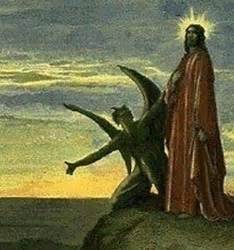
 Have you ever noticed that each of our Lord’s temptations in Luke’s Gospel is a temptation to something within the immediate and that our Lord responds to each temptation by his hope in the future? That Jesus responds by not getting stuck in the immediate but by looking beyond the immediate to the infinite?
The gospel tells us that our Lord, after fasting for forty days was hungry. That is an immediate need. We all know that when we are hungry it is hard to even think about anything else. The devil plays on this. “If you are the Son of God, command this stone to become bread.” Answer this immediate and pressing need! Satisfy your hunger! Our Lord responds, “… One does not live on bread alone.” Our Lord’s hope is not in a quick fix or easy answer right now but on that which is truly enduring and lasting – relationship with the Father.
The devil again tempts the Lord, “I shall give you all this power and glory … all this will be yours, if you worship me.” Okay, Jesus has come to be savior and king – the devil concedes this – but he need not go through the pain and struggle, suggests the Father of Lies. Jesus need not go to Jerusalem and walk the way of Calvary. He can be king now, immediately! Jesus can be king without the cross! Certainly tempting, but our Lord responds, “You shall worship the Lord, your God, and him alone shall you serve.” Jesus answers by showing where his hope lies – not in the devil and his power and neither in any power that the world affords in the here and now but in the Father and his will. Jesus hopes in the Father and the Father alone will Jesus serve.
If not through need nor through power will the Lord be tempted then through love will the devil try to tempt the Lord. Make the Father show his love here and now, force his hand! “If you are the Son of God, throw yourself down from here, for it is written: “He will command his angels concerning you, to guard you…” The Son will not force the Father to prove his love. His hope in the Father’s love does not need to be proven at any point, it endures even to the cross. “You shall not put the Lord, your God, to the test.”
Jesus overcomes these temptations in the immediate not through his own strength of will but through his hope in the Father. It is the Father who summons the Son into the future – into the desert, into ministry, to Jerusalem, through the cross to the resurrection and into the fullness of the Kingdom! God summoned Jesus and Jesus put his trust in the summons of the Father. And God summons us! God calls us forward into the future – not as we might have it or envision it – but into the fullness of His Kingdom! To be a Christian – to confess with our mouths that Jesus is Lord and to believe in our hearts that God raised Jesus from the dead – means to be a person never resigned to the immediate nor the status quo nor to the sad belief that it is solely up to our own effort. These are the illusions of the Father of lies. That things cannot change. That there is no hope. That we are abandoned.
Jesus is risen from the dead! Hope ever endures! The Father summons us into the Kingdom!
The hymn has it right. “My life flows on in endless song above earth’s lamentations! I hear the real, though far off hymn that hails a new creation! No storm can shake my inmost calm, while to that rock I’m clinging. Since love is Lord of heaven and earth, how can I keep from singing?”
We are members of the Body of Christ and Jesus’ hope is our hope! We turn our gaze to the Father…
 Nicodemus is an interesting figure in the gospel. He is a devout man and someone who is intrigued by Jesus. Nicodemus believes the Jesus is a teacher of God and that the signs which Jesus does prove that God is with him yet Nicodemus wants to fit Jesus into his own paradigm, into his own narrative about how God should act. Before the passage we just heard we are told that Nicodemus comes to Jesus, “by night”. Nicodemus is attracted to Jesus but he is still in the darkness of his own presumptions. How often we are like Nicodemus. How often we know people like Nicodemus.
 Jewish midrash is a way of interpreting Hebrew Scripture that seeks to fill in the gaps and therefore bring forth truths of faith. A midrash on the scene of God appearing to Moses in the burning bush that we heard in the first reading (Ex. 3:1-8a,13-15) holds that the bush had thorns. God witnessed the suffering of the Hebrew people in Egypt, their daily struggle and pain, and therefore God chose to reveal Himself to Moses in the midst of a thorn bush to show that He is a God who is present in the midst of the suffering of his people.
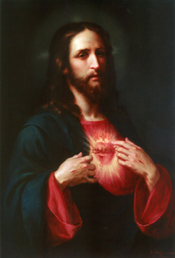 hrist comes to reveal the truth of who God is and to call us into relationship with Him because here and only here is where we will find true life. What choice will we make? We each have only so many days allotted us.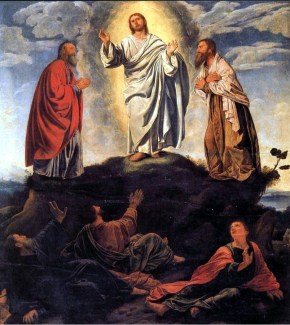
 The Alternate Path