 Scripture tells us that God’s ways are not our ways and neither is God’s freedom our freedom.
We look at the world and we see the injustice, the wrongs committed, human dignity is denied, nations threaten other nations, fear is pervasive and confusion seems to abound. We profess that God will certainly answer all of this but, so often, we then just assume that God will answer it as we would – through a show of power, force and dominance!
We are not alone in this, it has been the human fallback since the beginning – a sad result of our fall from the Garden of Eden. The people of Israel also held this. Their land was occupied by the world’s superpower, their kingdom was destroyed, their culture and religion was at odds with all of their neighbors yet, the idea of a messiah began to grow in the heart and hope of Israel, but they easily assumed that it would be a strongarm messiah who would vanquish the Romans, overcome all foes and restore Israel as the nation above all nations!
How little we understand the freedom of God.
God would send the messiah but simply and quietly – not leading an army but rather feeding the poor, healing the sick and preaching the Kingdom. The political oppression of Israel and the tumult among the nations was just the backdrop to the true story of God’s messiah and the oppression he came to confront and overcome – the oppression of sin and evil rooted deep in the human heart.
John the Baptist understood something of the freedom of God, so when he was questioned about his identity and the hope of the messiah, he was able to respond, “…there is one among you whom you do not recognize, the one who is coming after me, whose sandal strap I am not worthy to untie.” The messiah is not recognized because God’s freedom is not understood. God does not need the force of the world’s power nor is God bound by the terms of the world in accomplishing his will. God’s word is enough. God’s Spirit has been given.
The single most important event in human history (outside of creation itself) is accomplished by Jesus in his death and resurrection in a small part of a vast empire and the powers of the world barely noticed it. God’s freedom is shown in this! Now, in Christ – as adopted sons and daughters – we also have been given this freedom and this hope.
Here is a simple question to reflect upon that can lead us, I believe, into a little deeper awareness of the freedom of God and now our freedom as his children. The question often asked at this time of year is “How am I, how are we, going to celebrate Christmas?” But here is a different question, “How am I, how are we, going to give Christmas?” Christmas is the celebration of God’s light and God’s freedom breaking into our world! How can I give that light? How can I live that freedom? It is an appropriate question to reflect upon on this third Sunday of Advent when we rejoice in the coming of Christ! Christ came that we might have life and that we might live the life we receive for others! Christ invites us into the very freedom of God.
How am I, how are we, going to give Christmas and learn (in a deeper way) the freedom of God?
 A few weeks ago we had the reading of the parable of talents in Matthew’s gospel. Three servants are given different amounts of treasure to invest for their master while he is away – one is given five talents, the second is given two and the third is given one talent. On the master’s return we learn that the first two servants doubled what was entrusted to them (and were therefore rewarded generously by their master) while the third servant buried the talent in the earth that he had been given. He neither lost nor gained anything for the master and was therefore chastised for his laziness and was punished by being cast into “the darkness outside.”
 I am not much into church signs and I am glad that we do not have one here at St. Dominic’s because I am not witty enough to post a profound thought each week. I did see one church sign thought the other day that I did like though. It was, “Do not let self eclipse the Son.” Since we all survived the recent solar eclipse we can now breathe a sigh of relief! But the church sign thought is good and it connects well with the today’s gospel (Mt. 16:21-27).
 Reflecting on the reality of baptism, Diadochus – a theologian of the early church – writes, “Before a person comes to be baptized, grace is at work, from without, encouraging the soul toward the good, while Satan is at work, from within. After baptism, the contrary is the case. Grace works from within and the demons from without. These continue their work, and work even more evilly than before, but not as present together with grace. The only way they can work is through the promptings of the flesh.”
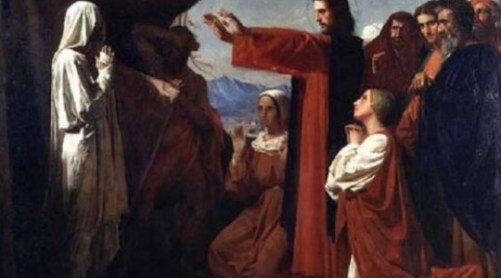 There is almost an ordinariness to the way our Lord goes about his mission of proclaiming and living God’s Kingdom.
 In the gospel (Mt. 17:1-9), our Lord takes Peter, James and John up on a high mountain and is transfigured before them. Our Lord’s face shone like the sun and his clothes became white as light. Moses and Elijah appear and converse with our Lord. Peter wants to build three tents on the spot but while he is speaking we are told that a bright cloud cast a shadow over them. This immediately gets our attention, something utterly unique is occurring. How can a cloud be “bright” and what does it mean that it casts a shadow over them?
 The “eye for an eye” teaching that our Lord refers to in today’s gospel (Mt. 5:38-48) was actually an attempt to restrict violence in a time when revenge was indiscriminate and excessive.
 The Alternate Path