
Tags
1 Kings 19:9a 11-13a, Bible, Christian life, Christianity, discipleship, faith, God, Jesus, Jesus walking on water, Mt. 14:22-33
I have two dogs – Lucy and Aggie. They are good dogs but it is sad to say that they suffer from the condition called, “selective hearing loss”. If we are out in a field and I let them off leash and they smell something of interest and I call them to come back, strangely they do not hear me. I can yell, shout, whistle, stomp my feet … nothing works. They are deaf. But if we are in my room in the evening and they are both napping and I whisper the words, “snack” or “treat”, they raise their heads and stare right at me! This selective hearing loss that they suffer from is quite strange.
There are two aspects to the first reading. The first aspect is how God chooses to reveal himself. God chooses the “tiny whispering sound”. God does not need the spectacular to reveal himself because God is not one being among other beings. God is being itself. God does not need to compete with anything else. God is. True power does not need the spectacular.
The second aspect is our receptivity. Elijah was receptive to God. He had a heart that was open. He lived in relationship with God and therefore he was able to discern that God was revealing himself in the tiny whispering sound.
St. Augustine offers a powerful image regarding being open to God. He writes, “Suppose God wanted to fill you with honey; if you are full of vinegar, where will you put the honey?”
Our being open to God, our living in right relationship so that we might learn to be discerning as Elijah was discerning is part of the equation. It is not that God is not present to us, rather it is that we do not hear because we are not open and we have filled our lives with other noises.
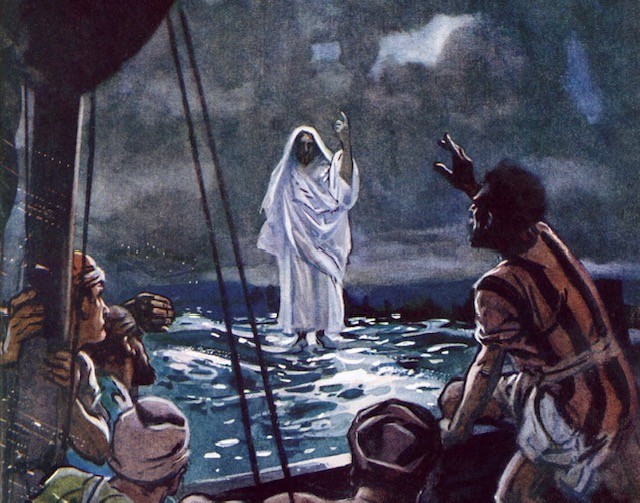
In the gospel we are told that Jesus went “up on the mountain by himself to pray.” Jesus lived in full relationship with the Father and in that simplicity, he walked on the water – not concerned about the waves.
Peter’s cry in the gospel is our cry, “Lord, if it is you, command me to come to you on the water.” It is an honest cry and an act of faith on Peter’s part. “Command me to come to you” is a cry for a lived relationship with the Lord in the awareness that only God can quiet the noise we fill our lives and hearts with.
Our being open to God. Our being receptive to him and his word is part of the equation. St. Augustine is right. “Suppose God wanted to fill you with honey; if you are full of vinegar, where will you put the honey?” How do we begin to get rid of the vinegar? How do we begin to listen and be open? We ask our Lord to command it and we have faith.