• About The Alternate Path

The Alternate Path

~ Thoughts on Walking the Path of Christian Discipleship

The Alternate Path

Tag Archives: Catholic Church

Growing in Faith

12 Sunday Aug 2018

Posted by mcummins2172 in homily, Uncategorized

≈ 1 Comment

Tags

Catholic Church, Christianity, discipleship, faith

safe_image(This homily is geared toward our parish “Growing in Faith Day”.  It focuses on the gifts of community, faith and the Eucharist.)
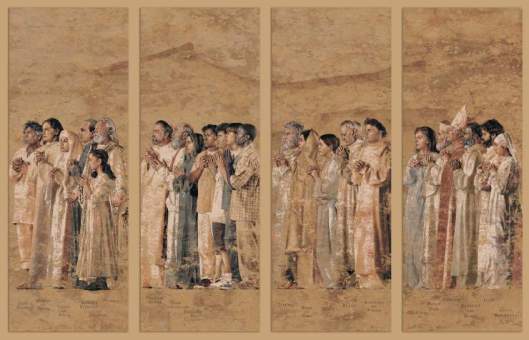
I have recently had two events occur that have allowed a reset in my life. The first was a gift I received for volunteering at Bays Mountain Park. It is a large insulated cup that allows me to now drink water throughout the day rather than automatically turning to soda. The second was a simple suggestion I received from my doctor to try to avoid “white” foods (i.e. potatoes, white bread, white rice, pasta).

These two things may not sound like much but I have been trying to live by them for a couple of weeks now and I can tell that they are having an effect. My energy level is more consistent throughout the day where it was not before, I’m sleeping better and I even think that some weight is starting to come off. I can now pull my belt in another notch!

Sometimes we need resets in life and they do not even have to be big in order to create lasting and beneficial effects and often even a mundane change can have spiritual impact. Now that I am sleeping better and have more consistent energy throughout the day, I am finding that I am actually attentive and praying during my morning holy hour rather than snoozing! This basic and often overlooked connection of the physical and spiritual it witnessed to in today’s first reading when the angel gives the very practical instruction to the prophet Elijah to “get up and eat” in order to have strength for the journey!

Resets are needed in the journey of life – individually and also in the life of community. Today is a bit of a reset for St. Dominic Church. It is not that the parish is not being community nor that faith and worship is lacking but (as with all things in life) we can get running and busy and without even thinking about it not realize that we are not really acting to full healthy capacity and are rather running on fumes. Here is another health tidbit – the second most traded commodity in our world today is coffee and therefore caffeine. What does that say about our world and our lives? Before my reset I was drinking caffeine pretty much all day long but caffeine is a diuretic – it allows a form of energy but it dehydrates at the same time. Sometimes our souls and our faith life can get dehydrated even as we honestly strive to live the life of faith.

Today, the Day of the Bible scheduled for November 3rd and 4th (Fr. James McIlhone will be with us and will talk about the parables in Luke’s gospel) and the other “Growing in Faith Days” we have set for spring are days for our parish as a whole to hear the instruction of the angel to get up, to eat, and to drink in order to be strengthened for the journey. Today we are being nourished in three ways and by three gifts.

Our society is biased toward the individual but here is a truth that we need to be reminded of – the individual needs community. We are nourished by community in a multitude of ways and on a multitude of levels – many of which we are not always even aware of. Yes, community takes work and it requires commitment but the community of faith which is the Church gives back more than it ever requires. It has been noted that Christianity cannot be a spectator sport but neither is it a solo act. We live the journey together. A person cannot be Christian without Church. As we come together today as community in Christ we are nourished.

There is no graduating from learning about and growing in our faith. There is always more to learn, to comprehend and to understand. No caring parent would want a child to stop learning with the conclusion of high school yet so often we are content to think that faith formation ends with the eighteenth birthday! Ridiculous! We are meant to be transformed, “from glory to glory”. Today is an invitation to take another step in understanding our faith and being further transformed in our relationship with Christ, our Lord and Savior. In this we are fed and our deep thirst is met.

“I am the bread of life,” says our Lord, “I am the living bread that came down from heaven; whoever eats this bread will live forever; and the bread that I will give is my flesh for the life of the world.” The Eucharist is the Body and Blood of Christ and as we receive the Body and Blood of Christ we, ourselves, are transformed! In the gospel we are told that the people “murmured” about Jesus among themselves. On our own we cannot get there. All we can do is murmur. We need Christ – his grace and his body and blood given in the Eucharist – to make the journey and to ourselves be transformed. Only in the gift of Christ can we move from murmuring into proclaiming by our words and our very lives the Kingdom of God! Every time we gather for Mass the only bread “that comes down from heaven” is offered. May we never fail to receive and be nourished.

May God bless our St. Dominic community and may we listen to the instruction offered by the angel to get up, to eat, to drink and to be once again nourished for the journey!

Christian Community and Charlottesville

19 Saturday Aug 2017

Posted by mcummins2172 in homily, Uncategorized

≈ 1 Comment

Tags

Catholic Church, Charlottesville, Christian community, Christianity, Church, racism, sad logic of sin and death

COMM-2

In light of the violent and tragic events that have occurred in Charlottesville, VA a dear friend asked me what can one person do “on a regular basis to fight racism and some of what’s going on in this country/world?” It is sad and frightening what is going on in our country and what we see happening in our world. We must reaffirm that there is no place for bigotry, prejudice and violence in our country, our world and in our hearts as Christians and, I think, we must do this as we also reaffirm and in many ways, rediscover, the value and unique power of Christian community.

In Matthew 18:15-20, we read that our Lord gives his disciples some instructions on the reality and role of Christian community. “If your brother sins against you,” our Lord says, then go and tell him the fault, if he fails to listen then take one or two others along with you and if he still refuses to listen then tell the Church and if he fails to listen even to the Church, “then treat him as you would a Gentile or tax collector.” It is worthy to note that Jesus often entered into relationship with the Gentile and tax collector throughout his ministry and that he sought their healing and salvation. Jesus then gives to the community the authority to bind and loose. “Amen, I say to you, whatever you bind on earth shall be bound in heaven, and whatever you loose on earth shall be loosed in heaven.” Our Lord then doubles down on the unique power and authority of the church community. “Again, amen, I say to you, if two of you agree on earth about anything for which they are to pray, it shall be granted to them by my heavenly Father. For where two or three are gathered in my name, there am I in the midst of them.”

The power of the Christian Church, the power of our Christian faith, is a weak power. We do not have the force of arms or military or police might, neither do we have economic or even (in our increasingly secular age) social might. What we do have is the presence of Christ in our midst and the gift of the Holy Spirit. This alone is that power that can bind and loose and that can open and call forth the grace of heaven through prayer.

Like many people, I have viewed the imaged coming out of Charlottesville including the video that recorded and interviewed a group of white supremacists during these sad and horrendous days. I was truly shocked by the vitriol, hatred and anger expressed by these people and I was also extremely saddened for them because I saw people locked in fear and hate. Theirs is a pseudo-community. Despite the bravado and the appeals to white unity there is no community there. They are people locked in a sad echo chamber stoked by the negative isolation of social media, resentment, fear and ignorance. They are imprisoned in their hate.

To this pseudo-community we are called to be community in Christ – the only community that can both bind and loose and here is found our unique and weak strength. Because Christ is with us and the Holy Spirit has been given us we can both bind and loose. Through the living of Christian community, we can work to truly bind those forces in society and in the human heart that seek to separate and isolate each one of us in resentment and fear. Through the living of Christian community, we can even help to loose those brothers and sisters who have become bound and imprisoned by resentment and fear. This has been my prayer and my hope since I have viewed those sad images coming out of Charlottesville. Pseudo-community only leads to a sad mockery and false caricature of true community as well as human dignity. All the pseudo-communities of our time must be met by the true community of the disciples gathered in prayer, truth and the mercy and the grace known in Christ.

In Christian community we are united by the presence of Christ and by the gift of the Holy Spirit. We are also united in the recognition that we are all sinners who stand in need of a savior. Scriptures tells us that “perfect love casts out all fear” (1 Jn. 4:18). This is the dynamic of true Christian community – not a community where everyone looks the same and thinks the same – but a community where we come to know the perfect love of Christ and where we are set free from those fears that bind us. Christian community is a community of sinners being set free by the perfect love of Christ!

There are many sad and broken things that lie at the root of the violence and hatred given expression in Charlottesville the past few days. One of these, I believe, is a crisis of true community in our society. People are isolated, people are lost, there is pain, uncertainty and fear and in such circumstances the false appeal of pseudo-community can be strong and alluring. This is all the more reason for us to strive in humility, love and grace to be Church – the community where Christ is present and where the Holy Spirit is given and the only true community that has the power to bind and to loose.

“Pastor”

22 Saturday Jul 2017

Posted by mcummins2172 in Catholic Church, Uncategorized

≈ Leave a comment

Tags

Catholic Church, Catholic faith, Catholic priesthood, Christianity, faith, Pastor, Roman Catholic


20228882_10154733343208483_529299139648763944_n

Artist Unknown.  Snapped a picture of this print when I was staying as a guest at St. William Catholic Church in Gardiner, Montana. 


Of all the titles that can be weighed upon a priest or bishop, I think “pastor” is the one closest to the heart of our Lord. And the one to which every priest and bishop must give the fullest account of when he stands before the Good Shepherd.

“Father, I thank you for hearing me.”

02 Sunday Apr 2017

Posted by mcummins2172 in homily, Uncategorized

≈ Leave a comment

Tags

Catholic Church, Catholic faith, Christianity, faith, God the Father, Jesus, raising of Lazarus

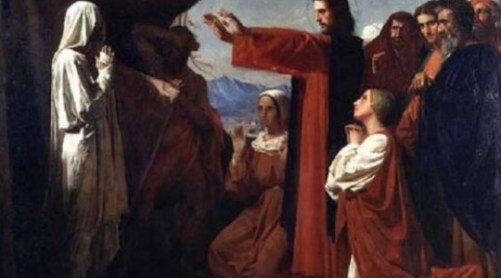
Jesus-Raises-Lazarus-from-the-Dead-540x300There is almost an ordinariness to the way our Lord goes about his mission of proclaiming and living God’s Kingdom.  Even his miracles and the raising of his friend Lazarus are not exceptions.  Our Lord takes his time in getting to the scene of Lazarus’ illness and death.  He takes time in speaking with both Martha and Mary.  Arriving at the tomb he asks that the stone be rolled back.  He addresses the Father and then, with a loud voice, cries, “Lazarus, come out!”  The once-dead man walks out. 

There are no flashes of light or rolling thunder.  Our Lord does not need to make strange incantations or weave any sort of spell.  He does not even seem to have to fast in preparation for such an extraordinary thing.  There is no burning of incense or sacrifices offered.  Jesus simply gives honor to the Father, calls Lazarus forth and his friend is restored to life.  

This is not a feat of our Lord’s own will at work.  Jesus is not a comic book superhero saving the world through his own strength and determination nor is he a wizard overcoming by his own intellect and perseverance (a.k.a., “will to power”).  Scripture tells us that Christ let go of his own glory and power and took on the form of a slave.  The salvation won through Christ is through the “letting-go” of the divinity which allows the humanity to live in full relationship of love and trust with the Father.  Jesus tells us that he can do nothing apart from the Father.  Jesus does not heal, or feed the multitude, or cast out demons or walk on water or raise the dead through his own, independent and isolated exercise of will but through his relationship with the Father.  Therefore he does not need the trappings of the superhero or of esoteric magic.  It is all through relationship and relationship is often one of the most ordinary of things. 

St. Paul in his letter to the Romans reminds us that we also have been invited into this relationship.  “But you are not in the flesh; on the contrary, you are in the spirit, if only the Spirit of God dwells in you.  Whoever does not have the Spirit of Christ does not belong to him.  But if Christ is in you, although the body is dead because of sin, the spirit is alive because of righteousness.  If the Spirit of the One who raised Jesus from the dead dwells in you, the One who raised Christ from the dead will give life to your mortal bodies also, through his Spirit dwelling in you.”  (Rom. 8:8-11) 

How often and how easily we overlook the grace we have been given, that is indeed active within us!  We easily we get lost in the noise and distractions of our world.  The Spirit of the One who raised Christ from the dead has been given us and dwells within us – giving life and transforming us.  God does not need the trappings of the extraordinary to accomplish his purpose.  The sacraments are a prime example of this.  Water, bread, wine, oil, the words of the priest, the love of a couple – yet underneath the ordinary divine grace, relationship and life is found and given.  

We should not disdain the ordinary and the grace and new life found there.  Just as Christ emptied himself of glory and held to his relationship with the Father so should we.  Life is not found in our control, our ego, our own little “wills to power”, living within our own little bubbles.  Life, salvation, healing, grace is found through relationship – recognizing God’s presence given and within and seeking to live always in the amazing ordinariness of that relationship. 

“Father, I thank you for hearing me.  I know that you always hear me; but because of the crowd here I have said this, that they may believe that you sent me.”


An invitation from Pope Francis: a Sunday given over entirely to the word of God

28 Wednesday Dec 2016

Posted by mcummins2172 in Pope Francis, Uncategorized

≈ Leave a comment

Tags

Bible, Catholic Church, Catholic faith, Christianity, Misericordia et Misera, Pope Francis, Sacred Scripture

Pope Francis raises Book of Gospels as he celebrates Easter Vigil in St. Peter's Basilica at VaticanBoth of my parents were converts.  My father grew up in the Presbyterian Church and my mother grew up as a Southern Baptist.  There is a story told in my family that once, not long after my father’s conversion, my two great aunts from Mississippi (both spinsters and staunch Presbyterians to boot) visited my grandfather.  Noticing some dust on the cover of the family bible, one great aunt is said to have remarked, “I guess if this Bible cover was not so dusty Jack would never have converted.”  I am not sure how my grandfather and grandmother replied although I would wager that a bit of a chill went through the room.

I, for one, am very grateful for my parents’ conversions and acknowledging that my views would differ from my great aunt’s in this regard (i.e. seeing my father’s conversion to Catholicism as a fulfilling of his faith journey and not a loss); I do believe her remark about the family Bible carries an intuition of truth.  There is a power and a grace to be found in Sacred Scripture.  The Bible is God’s holy word and within it we encounter our risen Lord.

In his Apostolic Letter, Misericordia et Misera given at the conclusion of the Jubilee Year of Mercy, Pope Francis brings to summation the Holy Year and puts forward his hope that the work of mercy will continue and be ever-strengthened in the Church.

(The Holy Year) must continue to be celebrated and lived out in our communities. Mercy cannot become a mere parenthesis in the life of the Church; it constitutes her very existence, through which the profound truths of the Gospel are made manifest and tangible. Everything is revealed in mercy; everything is resolved in the merciful love of the Father. (MM, 1)

The Holy Father reflects on how best to continue the work of mercy and he puts forward some specific thoughts for discernment by the Church – mercy should be celebrated and at the heart of every Eucharistic celebration and every homily, every encounter involving the sacrament of anointing should be guided by mercy and certainly mercy should be found in abundance within the sacrament of reconciliation.  Here the Holy Father grants the authority for every priest to forgive the sin of a procured abortion.  This permission given even gained the attention of the secular media for at least a day or two.

What did not garner as much attention though is an invitation that the Holy Father extended to the Church in his apostolic letter.  It is an invitation worthy of consideration and it is why I began this article by sharing the story of my two great aunts.  The Holy Father invites the Church to consider a Sunday, “given over entirely to the word of God”.

Why not just mandate such a thing?  Certainly the pope has the authority.  Here, I believe, Pope Francis is demonstrating a pastor’s wisdom.  Some things within the Church – especially those liturgical and devotional – are best established and encouraged from the foundation up rather than the top-down.  Pope Francis is inviting the Church into a dialogue regarding this possibility and he is giving his permission as the successor of Peter for this dialogue, this possibility, to occur and to even grow organically from within the life of the Church.  He is encouraging an idea to grow.

It is an idea already present within the full life of our faith and specifically rooted and expressed for our time in the document Dei Verbum of the Second Vatican Council.  Here are three quotes from the final chapter of that document which demonstrate this.  “It follows that all the preaching of the Church, as indeed the entire Christian religion, should be nourished and ruled by sacred Scripture.” (DV, 21)  “Access to sacred Scripture ought to be open wide to the Christian faithful.” (DV, 22)  “Just as from constant attendance at the Eucharistic mystery the life of the Church draws increase, so a new impulse of spiritual life may be expected from increased veneration of the Word of God, which ‘stands forever’.” (DV, 26)

Below are the two paragraphs of Misericordia et Misera specifically devoted to this invitation.  The first paragraph can be viewed as a summation of Vatican II’s Dei Verbum, the second is the invitation given by the Holy Father to the Church universal.

The Bible is the great story of the marvels of God’s mercy. Every one of its pages is steeped in the love of the Father who from the moment of creation wished to impress the signs of his love on the universe. Through the words of the prophets and the wisdom writings, the Holy Spirit shaped the history of Israel as a recognition of God’s tenderness and closeness, despite the people’s infidelity. Jesus’ life and preaching decisively marked the history of the Christian community, which has viewed its mission in terms of Christ’s command to be a permanent instrument of his mercy and forgiveness (cf. Jn 20:23). Through Sacred Scripture, kept alive by the faith of the Church, the Lord continues to speak to his Bride, showing her the path she must take to enable the Gospel of salvation to reach everyone. I greatly desire that God’s word be increasingly celebrated, known and disseminated, so that the mystery of love streaming from this font of mercy may be ever better understood. As the Apostle tells us clearly: “All Scripture is inspired by God and profitable for teaching, for reproof, for correction, and for training in righteousness” (2 Tim 3:16).

It would be beneficial if every Christian community, on one Sunday of the liturgical year, could renew its efforts to make the Sacred Scriptures better known and more widely diffused. It would be a Sunday given over entirely to the word of God, so as to appreciate the inexhaustible riches contained in that constant dialogue between the Lord and his people. Creative initiatives can help make this an opportunity for the faithful to become living vessels for the transmission of God’s word. Initiatives of this sort would certainly include the practice of lectio divina , so that the prayerful reading of the sacred text will help support and strengthen the spiritual life. Such a reading, centered on themes relating to mercy, will enable a personal experience of the great fruitfulness of the biblical text – read in the light of the Church’s spiritual tradition – and thus give rise to concrete gestures and works of charity.(MM, #7)

Could this be the beginnings of a liturgical feast for the Bible?  What would it look like?  I am not sure and I do not know if even the Holy Father knows but he is inviting the Church to the possibility and even encouraging a faith-filled creativity.  As both a Christian disciple and a pastor of a parish in the belt buckle of the Bible Belt – where there is such a strong emphasis on Scripture in the surrounding churches – I find this invitation of Pope Francis to creatively dream of such a day to be both exciting and necessary!  One of the great gifts of the Second Vatican Council was in reminding us that the Bible belongs to every member of the Church, that it should be picked up and read and that within Sacred Scripture we encounter Christ.  The Bible is much more than just proof texts for the sacraments and devotions.  A day given over entirely to the Bible would not lessen our sacramental identity as Catholics but would rather root our identity deeper in an awareness that we are a people of both Word and Sacrament!

A day devoted to the Bible would also be a strength and support for the ongoing work of mercy.  “I greatly desire that God’s word be increasingly celebrated, known and disseminated, so that the mystery of love streaming from this font of mercy may be ever better understood,” writes the Holy Father.  God’s word is a “font of mercy” which opens our minds in greater awareness, our imaginations in new possibilities and our hearts in greater charity.  Or, as expressed in Dei Verbum, “This nourishment (of Scripture) enlightens the mind, strengthens the will and fires the hearts of men with the love of God.” (DV, 23) 

Pope Francis, through his life as a Jesuit and priest is someone steeped in the Ignatian spiritual tradition of entering Scripture.  The Holy Father speaks from experience when he refers to Scripture as a “font of mercy” and he is here inviting the whole church to continually turn to this font.

It is a simple and beautiful invitation that the Holy Father puts forward in his letter – a day given over entirely to the Word of God – and within this invitation is found the possibility of innumerable graces and blessings.  I am praying how the parish I serve might answer this invitation of our Holy Father.  I would encourage all members of the Church to take to heart this simple and beautiful invitation of our Holy Father.

Christ the King and we, His people.

19 Saturday Nov 2016

Posted by mcummins2172 in homily, Uncategorized

≈ Leave a comment

Tags

Catholic Church, Christ the King, Christianity, faith, Feast of Christ the King, joy, Solemnity of Christ the King

christ-the-kingThis past week I was able to visit with a parishioner who, as a hobby, makes wine.  At one point during the visit he showed me the room with all his wine making equipment.  He took me to a table on which sat two large buckets.  He pulled off a cloth cover on each bucket and in one was a batch of blueberries fermenting and in the other were blackberries fermenting.  What I found interesting was that you could actually hear the fermenting process occurring as the juice was in the process of being changed into wine.  
In today’s second reading taken from St. Paul’s Letter to the Colossians (Col. 1:12-20) we find Paul writing that, “(God the Father) delivered us from the power of darkness and transferred us to the kingdom of his beloved Son, in whom we have redemption, the forgiveness of sins.”  Paul then goes on to share a beautiful hymn which states that Christ is the “firstborn of all creation” and that now all things are held together in him!  We are part of the body of Christ and we are citizens of the Kingdom of God where Christ is our King!  Just as we have been transferred into the kingdom of the beloved Son, so are we meant to help transform our world and the times in which we find ourselves.  

If there is a king then there must be a kingdom and there must be subjects loyal to the king and the kingdom.  

As disciples of Christ in the world we live by a different norm, a different understanding than that which is often proclaimed in the world.  After all, our king hung on the cross, mocked by everyone and viewed as a total failure.  But Christ was obedient not to the world and it’s message of seeking self and power but to the will of the Father who says life is found in letting go of self and seeking to serve.  By following our king we are meant to be a leaven that transforms the world just as we, ourselves, are transformed.

Like many people I believe, I also have been disheartened by this recent election cycle.  I do not want to get into the two candidates.  The election is over and that is done.  What has disheartened me most is the vitriol, the divisiveness, the half-truths and even lies paraded as fact (by all sides) displayed during this election cycle.  This election has demonstrated to the whole world the division within our society.  The division is there and it is deep. 

What do we do as Church?  We seek to be what we have always been called to be – citizens of the Kingdom of Christ and by so doing be a leaven of unity within a divided and fractured world.  This is in our DNA as Catholics.  “Catholic” means universal – a universal where both uniqueness and communion is upheld.  It is possible to be pro-life and pro-woman.  It is possible to uphold the dignity of immigrants and refugees while also seeking the security of a nation.  It is possible to uphold the dignity of the poor and all races and seek to be good stewards of the creation God has given us while not demonizing other people.  Is this easy?  No, but it is possible.  It is not possible if we parade lies and half-truths as truth.  It is possible if we follow Christ our king and live as members of his kingdom in our world.

To the Hispanic and all immigrant members of our church – a special word.  I understand that there is fear and worry.  I do not know exactly what will happen.  What I do know are a couple of things.  The Church upholds the dignity of all persons and will always do so.  Second, no matter who sits in the White House or who controls the levers of power in Washington, D.C.; Christ is King and to him, first and foremost, is our allegiance due and it is through him that all men and women are delivered from darkness.

St. Paul reminds us and it rings through the ages, “(God the Father) delivered us from the power of darkness and transferred us to the kingdom of his beloved Son, in whom we have redemption, the forgiveness of sins.”  

“The Kingdom of God is justice and peace and joy in the Holy Spirit.  Come, Lord, and open in us the gates of your kingdom!”  (Hymn from the Taize community)  Lord Jesus, you are our king!  May we be your loyal subjects and may we be a leaven of unity, justice, peace and joy in our world! 


That which endures

12 Saturday Nov 2016

Posted by mcummins2172 in homily, Uncategorized

≈ Leave a comment

Tags

Catholic Church, Christian life, Christianity, discipleship, faith, hope, Jesus

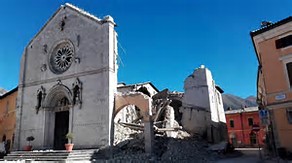
church-destroyed-by-earthquakeScholars suggest that by the time Luke composed his gospel the temple had already been destroyed.  This grand edifice, seemingly unmovable, adorned with costly stones that people were admiring in this passage was, by the time of Luke setting quill to parchment, just a heap of ruins.  It demonstrates how quickly things can change and also how little we really know about what will happen tomorrow.  We like to think we are in charge … but we are not.

Using the temple’s destruction and our Lord’s prophesying of that even as a springboard; today’s gospel (Lk. 21:5-19) invites us to go deep in the spiritual life.

There are levels to the spiritual life.  Saints and mystics throughout the Church’s history testify to this.  The first level and most basic is a level often caught up with outer things.  The grandeur of a temple, the use of precious stones, only a certain style of music or liturgy in worship, only this type of devotional practice or prayer.  Is there a value to the beauty of a church or worship or prayer?  Certainly, that is not being denied but all of these exist in order to usher one into an encounter with the Divine.  If they themselves become the focus then something is off-kilter.  As a friend of mine once said, there is always the temptation to major in the minors.

We have all heard of the recent earthquakes that have hit Italy.  In one of these earthquakes a beautiful church connected to St. Benedict completed collapsed.  A picture I saw just had the front façade standing with all else behind it flattened out.  Miraculously no person was killed when this happened.  What I found inspiring was that as soon as the monks and nuns of the community whose church has been destroyed determined that everyone in their community was accounted for they went out into the larger area and began to minister to others in need – helping physically to dig people out of the rubble and also bringing the sacraments to people.  They did this because they were rooted in something deeper than a building (an external).

The deeper reality our Lord is inviting each of us to in the journey of faith is relationship with him.  There will be false predictions that the end is upon us, nation will rise against nation, and there will be earthquakes, famines, plagues and signs in the sky.  These are all shifts in the greater turning of human history but there will also be personal shifts and turmoil.  People will be led before kings, governors and all the different powers of the world and our lives.  Families will be split and there will not be understanding.  Christians will be hated.  Yet in the midst of all this foretold turmoil of the history of our world and our own personal histories, our Lord – the one who foretold the destruction of the temple – says this, “Remember, you are not to prepare your defense beforehand, for I myself shall give you a wisdom in speaking that all your adversaries will be powerless to resist or refute.”  

“…for I myself shall give you a wisdom in speaking…”  The truth implied here in the midst of all the turmoils that this life brings is a living relationship with Christ.  Remaining on the level of the external spiritually – while not really knowing the Lord or allowing him to know us – will not cut it when life gets tumultuous.  In all seasons of life the Christian must root him or herself in relationship with Christ.  Only in this relationship can be found the wisdom and perseverance that we need in life.

Our Lord listened as people who had no idea of what tomorrow would bring spoke admiringly of the temple.  He asked them to move beyond the external to that which truly lasts.  He asks us to do the same – to trust in him and to find life.

Why Young Adults need the Catholic Church

30 Tuesday Aug 2016

Posted by mcummins2172 in Uncategorized, young people

≈ Leave a comment

Tags

Catholic Church, Catholic faith, Christian life, Christianity, discipleship, faith, Roman Catholic, Young Adult Ministry, younger generation and faith

young adult praying in churchWhy do some young adults wander away from the Church?  There are no easy answers to this.  At least, I have not found one in my own experience of ministry.  I have seen some young people fully immersed in the Church in high school and college who then just stop coming one day.  I have seen other young people who had wandered off come back with a great fervor almost bordering on zealotry.  A good number of young people I have known wander in and out with some choosing to stay loosely connected on the periphery of the Church.

Certainly each person’s journey of faith is unique.  There are movements in the heart that only God can see and everything occurs in God’s time.  We all know that there are scandals within the Church that wound hearts and discredit the gospel and the community.  There are voices against the Church and Christianity in our world and caricatures of religion too easily tossed about in society.  There is a diffused mistrust of all institutions.  There are also people not willing to change their view of the Church just as they, themselves, insist the Church must change (usually to their liking).  Finally, there are some people who are just lazy spiritually.

With all this in mind, I am firmly convinced that young adults need the Church.  No one may be able to adequately answer the big concerns noted above.  Still, I want to offer a few thoughts about why young adults need the Church.  Here are the thoughts in the form of a letter.

Dear young adults,

Do you know that you need more than just your peers?  I never really became a fan of the TV show “Friends”.  I do remember watching it and being entertained although I didn’t always agree with the moral choices portrayed in the show.  I remember that the whole universe portrayed in that show was that of a group of peers.  Every now and then a person from another generation (younger or older) would pop in and out of the show but they seemed to be just a distraction.  Everything centered on that particular group of peers and their enclosed world.  I have seen this same theme continue in newer generations of shows.  I am sorry, but that is not life.  Sadly, though, I think society and, surprisingly, the Church have followed suit.  There are retreat programs and youth ministry initiatives intentionally and exclusively structured around peer-given talks and peer-led discussions.  There are youth only liturgies.  I would wager that the same trend can be seen in education, athletics and all forms of engagement with our youth.  Is there a certain value and place for this?  Yes, but there are unintended consequences.  Dear young adults, I apologize.  You have been done a disservice.  Although no one intended it, you have been taught to only value peer input and peer relationship.  The voices of other generations – the insight, knowledge and wisdom of older generations that can help guide in life and help navigate its struggles as well as the hopes and dreams of younger generations – have been blocked from your awareness.  With this block there can also be a forgetfulness of how God has been faithful and active in all generations and how God continues to be faithful and active.

In my ministry with young adults I often felt frustrated by this block.  Over time, I learned to not get upset or frustrated by this.  They were just doing what they had been taught.  I was not a peer and therefore my voice and consideration would sometimes just bounce off their perspective somewhere into the ether.  But as I shared above, a world comprised only of peers with a particular generational perspective is not real life.  One of the things truly wonderful about Sunday worship is seeing generations coming together in Church – young and old and even in-between.  Young adults, I have to say that you are noticeably absent from these gatherings.   You are missing out.  You need more than your peers and the Christian community needs you.

Another thought for you.  You need a deeper narrative than just the secular one.  There are narratives that people set their lives by but not all narratives are equal nor are all equally true.  I learned an important lesson in my seminary training.  The gospel narrative is the rule by which all other narratives should be measured and judged.  Some might see this as Christian condescension, but I am not convinced that is true.  Think about it.  Catholicism has a proven track record.  Empires, movements, theories of thought have come and gone.  Christianity has remained and has grown consistently and organically even through persecution and even despite the sinful actions of some of its adherents.  Secularization, at its best, has real value.  It has fostered religious freedom, protection from oppression, and respect due the dignity of persons.  But the secular world has its own narrative with a down side.  A closed-end secularity pushes the sacred to the periphery.  And that truly diminishes life.  Here, I would caution that certain forms of “generic Christianity” will not suffice because they are neither able to see beyond nor challenge the limits of the secular narrative.  Certain popular forms of contemporary Christian expression found often in non-denominational, evangelical and mega-church communities are, in fact, closely linked to the secular narrative and a step away from the Christian sense of the sacred.  For example, I would point to the emphasis by some on material concern and comfort as found canonized by the gospel of prosperity preached in many places.

There is a deeper and fuller reality to life, existence and creation itself than just the measure of the secular.  There is a transcendent, spiritual and sacramental dimension to life.  We can embrace the benefits of secularity, while not letting ourselves be bound by the limits of its narrative.  The Catholic Church with its tradition, theology and worship provides for this broader perspective on reality.

Dear young adults, here’s something that you won’t hear about very often, if ever.  You need an awareness of redemptive suffering.  The Catholic Church is at home with the crucifix not because we believe that the resurrection should be downplayed and that Christ is still on the cross.  No, we are convinced that by his suffering on the cross our Lord has brought a redemptive dimension to all suffering.  He has brought life out of death.  On the cross and in the tomb, God entered into the furthest edges of human suffering and death.  The crucifix reminds us of the cost of salvation that has been won through the love and obedience of Christ.  This is a great mystery.  There is suffering in life and sooner or later for all of us.  We see suffering throughout our world.  The crucifix and its bold display of redemptive suffering protects us against the temptations of choosing to ignore suffering in our world, getting lost ourselves in the darkness of suffering and giving in to victimhood in the face of suffering.  Suffering, in Christ, can be redemptive.

Let me say a word about something that many people are skittish about – commitment.  You need commitment and not just new experiences.  When I was in campus and vocation ministry my schedule and responsibilities allowed and even required of me quite a bit of travel.  Now that I am in a parish my travelling has been greatly reduced due to the commitment of being a pastor.  This is not a bad thing.  There are seasons to life and there are seasons to ministry.  My faith life and my life in general is now being nourished more by the commitment of being a pastor than by a string of new experiences offered through travel and life situation.  Commitments in life offer nourishment too!  Our world does not emphasize this but it is true.  Young adults do not get lost in the siren call of chasing new experience after new experience through life!  Sooner or later, you will wear yourself out and, frankly, not have much depth.  Commitments in life are what lead to the depth of personhood, awareness and insight.  Do not be afraid to commit in faith and in love to Christ, his Church and another person if you are so called.  Be willing to go deep!

You also need a real community that will not fit neatly into your box, one that is not perfect, that disagrees and that argues.  I have known young people to leave the Church either because it is not “perfect” or because it does not fit into their own framework.  Frankly, I think that this is not a sign of good, adult judgment.  On college campuses, people are talking about “trigger notices” and “safe zones” around discussions that students might find threatening or challenging.  Social media and our current structure of news outlets may allow us to exist and interact in a universe occupied solely by like-minded people (this is one of the dangers of our contemporary information age) but the real world does not.  It is okay to argue and it is okay to debate and it is wonderful to be in a Church that has this and the Catholic Church has it in spades!  Many social commentators have noted that argument and disagreement are turn offs to young adults who like to avoid such things at all costs (again this is an unintended consequence of how the generation was raised) but life and insight is gained through respectful disagreement, discussion and debate.  We believe that the Holy Spirit leads the Church and this is testified especially through moments of disagreement, discussion, prayer and debate.

You need holiness that sanctifies.  One of my favorite professors in seminary likened the Catholic understanding of grace to a house that is being renovated from the inside out.  Grace, in our Catholic understanding, does not just cover over our sinfulness but rather goes to the heart of who we are in order to heal the wound of sin from within on out.  We are fully healed and fully restored through a lifetime of the working of grace and our cooperation with it.  The ones who witness this most fully are the saints.  Young adults, life can be different!  We can know a holiness that heals, restores and is authentic!  We are not meant to be defined by our sins, our stumblings and our weaknesses.  We are all called to be saints!  It is not just a nice thought but an eschatological truth.  We are called to sanctification through and through and we should not settle for anything less.

Hopefully, these thoughts will prove to be helpful.  Every generation has its blessings and every generation has its struggles.

Dear young adults, you need the Church … and the Church needs you.  From a priest who has truly been blessed by his interaction with so many young adults and who cares deeply about you, may God bless you and may God guide you.


Newer posts →
Follow The Alternate Path on WordPress.com

Enter your email address to follow this blog and receive notifications of new posts by email.

Previous Posts

  • May 2026
  • April 2026
  • March 2026
  • December 2025
  • November 2025
  • August 2025
  • April 2025
  • February 2025
  • January 2025
  • December 2024
  • August 2024
  • July 2024
  • June 2024
  • May 2024
  • April 2024
  • March 2024
  • February 2024
  • January 2024
  • December 2023
  • November 2023
  • October 2023
  • August 2023
  • July 2023
  • May 2023
  • February 2023
  • January 2023
  • December 2022
  • August 2022
  • July 2022
  • April 2022
  • January 2022
  • December 2021
  • September 2021
  • August 2021
  • July 2021
  • May 2021
  • April 2021
  • January 2021
  • December 2020
  • November 2020
  • October 2020
  • August 2020
  • July 2020
  • May 2020
  • April 2020
  • March 2020
  • February 2020
  • December 2019
  • October 2019
  • September 2019
  • August 2019
  • July 2019
  • May 2019
  • April 2019
  • March 2019
  • February 2019
  • December 2018
  • November 2018
  • October 2018
  • August 2018
  • July 2018
  • June 2018
  • April 2018
  • March 2018
  • February 2018
  • January 2018
  • December 2017
  • November 2017
  • September 2017
  • August 2017
  • July 2017
  • June 2017
  • May 2017
  • April 2017
  • March 2017
  • February 2017
  • January 2017
  • December 2016
  • November 2016
  • October 2016
  • September 2016
  • August 2016
  • July 2016
  • June 2016
  • May 2016
  • April 2016
  • March 2016
  • February 2016
  • January 2016
  • December 2015
  • November 2015
  • October 2015
  • September 2015
  • August 2015
  • June 2015
  • May 2015
  • April 2015
  • March 2015
  • February 2015
  • January 2015
  • December 2014
  • November 2014
  • October 2014
  • September 2014
  • August 2014
  • July 2014
  • June 2014
  • May 2014
  • April 2014
  • March 2014
  • February 2014
  • January 2014
  • December 2013
  • November 2013
  • October 2013
  • September 2013
  • August 2013
  • July 2013
  • June 2013
  • May 2013
  • April 2013
  • March 2013
  • February 2013
  • January 2013
  • December 2012
  • November 2012
  • October 2012
  • September 2012
  • August 2012
  • July 2012
  • June 2012
  • May 2012
  • April 2012
  • March 2012
  • February 2012
  • January 2012
  • December 2011
  • November 2011
  • October 2011
  • September 2011
  • August 2011
  • July 2011
  • June 2011
  • May 2011
  • April 2011
  • March 2011
  • February 2011
  • January 2011
  • December 2010
  • November 2010
  • October 2010
  • September 2010
  • August 2010
  • July 2010
  • September 2008
  • August 2008
  • April 2008
  • March 2008
  • February 2008
  • January 2008
  • December 2007
  • November 2007
  • October 2007
  • September 2007

Popular Posts

  • thealternatepath.org/wp-c…
  • lh3.googleusercontent.com…
  • thealternatepath.org/wp-c…
  • thealternatepath.org/wp-c…

Blog at WordPress.com.

  • Subscribe Subscribed
    • The Alternate Path
    • Join 157 other subscribers
    • Already have a WordPress.com account? Log in now.
    • The Alternate Path
    • Subscribe Subscribed
    • Sign up
    • Log in
    • Report this content
    • View site in Reader
    • Manage subscriptions
    • Collapse this bar

Loading Comments...