Tags
Christian community, Christianity, Church, faith, Feast of the Transfiguration, social isolation, social media
 In our social media driven world I sometimes find myself wondering “WWJP?” or “What would Jesus post?” I do believe that the positives of social media outweigh the negatives but there are negatives and these negatives do have effects. I recently heard a news story on how Facebook is having an impact on the number of people attending high school reunions – actually lessening the number. One reason that some people are giving is that they no longer feel the need for a reunion in order to catch up on things because they have already seen it all on Facebook! The more primary reason though (and this is more on the side of negative effects of social media, I think) is that via Facebook people have come to realize how much they actually disagree with old classmates on certain things and how they can’t seem to get beyond that.
Here is a danger of social media. Because I am looking at a screen while on social media and not actually sitting across a table from a live person having a discussion, I can – all the more easily – fall into the temptation of reducing a person made in God’s image to just one issue. Full relationship and interaction is lost in favor of a focus on whatever that one particular issue might be. Social media is a paradox – it connects yet it also separates and isolates. In the focus on that one issue presented on a flat, one-dimensional screen I forget the full humanity of the person on the other side – a human person who can never be reduced to a one dimensional, cut-out reality – a person who might be a parent or a spouse, someone who has had his or her own experiences in life, someone who might be selflessly serving his or her community in some particular way, maybe even a person who is just having a bad day. These are but a few examples. A human person can never be reduced to a one-dimensional reality yet this illusion can be given through social media.
The Transfiguration is neither flat nor one dimensional. Jesus invites Peter, James and John up the mountain and even within his encounter and relationship with the Father. Time itself seems to bend as Jesus is seen conversing with Moses and Elijah. Peter – as any of us would – wants so desperately to remain in this moment and space! Yes, because the glory of the Son is revealed and the voice of the Father is heard but also because the depth of true relationship is experienced in the Transfiguration! Jesus is fully human just as he is fully divine and now, through Christ, we are adopted sons and daughters of God. The relationship revealed in the moment of Transfiguration is also a relationship we are meant for in Christ. We are meant for full relationship with God and one another and are not meant to be reduced and constricted to a one dimensional reality.
In the vision of Daniel, the “one like a son of man” only receives dominion in and through his relationship with the “Ancient One” sitting on the throne. He also receives it within a gathering of “the court”, within a community. Peter, in his letter, remarks how “we” do not follow concocted myths because “we” have been eyewitnesses of the majesty of Christ and “we” possess the prophetic message that is true. None of this is one-dimensional. All of this is within true relationship and true community!
So much in our world wants us to separate, to isolate and to reduce one another to one dimensional realities. To this the voice of the Father says, “This is my beloved Son, with whom I am well pleased; listen to him.” Listen to the voice of Christ – a voice that always sought out, a voice that never reduced the other person. Peter, who entered that moment of Transfiguration, writes, “Moreover, we possess the prophetic message that is altogether reliable. You will do well to be attentive to it, as to a lamp shining in a dark place, until day dawns and the morning star rises in your hearts.” Even as we live in a world that reduces, we hold on in hope for that day when we live in full relationship with God and one another and we set our lives by that hope.

 It is interesting how some things stay with us and even become operating principles in our lives.
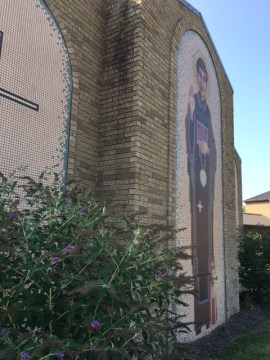 What is best for the environment? This is a question I find myself continually returning to after reading Pope Francis’ encyclical “Laudato Si” as well as my own growing interest in protecting and safe-guarding creation. Do the plants and shrubs we favor around churches help benefit the environment or do they just look nice from our human perspective? Can our parish grounds themselves become places that benefit and support creation? A couple of years ago now I planted two butterfly bushes in front of our Parish Life Center because they fit and enhance the space, they are low maintenance and hardy and, in regards to this question, they are a benefit to bees and butterflies. A simple choice in a planting can have ripples of effect.
 Wolves (for which I have always had an interest in since I was a child) were my main interest in visiting Yellowstone but during these days I was also thrilled to view numerous black bears (a few with cubs), bison, elk, mule deer, bighorn sheep, pronghorn, an osprey nest inhabited by mother, father and two chicks, foxes, coyotes, badgers, a bald eagle flying and numerous smaller animals and birds.
![IMG_5641[3392]](https://thealternatepath.org/wp-content/uploads/2017/07/img_56413392.jpg?w=290&h=193) For a week, I was “unplugged” – to some degree. Other than sharing some pictures on Facebook and Instagram and talking with the people I met or was around during the day I had no idea what was going on in the world. I would rise early to get into the park before the heat of the day became too oppressive, return to Gardner for lunch and a short siesta and then return into the park not to leave until late in the evening.
For a week, I was “unplugged” – to some degree. Other than sharing some pictures on Facebook and Instagram and talking with the people I met or was around during the day I had no idea what was going on in the world. I would rise early to get into the park before the heat of the day became too oppressive, return to Gardner for lunch and a short siesta and then return into the park not to leave until late in the evening. Although I have an interest in wolves and have now spotted three packs during my two visits to Yellowstone I do not think I have some “mystical” connection with them because the wolves are unconcerned about me and that is the way it should be. The wolves are just out there being wolves and if something were to happen and all of sudden humanity disappeared from the face of the earth the wolves, bears, bison, elk and all animals would just continue continuing on. But the wolves and other animals are of concern to me and that is what makes me human.
 Reflecting on the reality of baptism, Diadochus – a theologian of the early church – writes, “Before a person comes to be baptized, grace is at work, from without, encouraging the soul toward the good, while Satan is at work, from within. After baptism, the contrary is the case. Grace works from within and the demons from without. These continue their work, and work even more evilly than before, but not as present together with grace. The only way they can work is through the promptings of the flesh.”
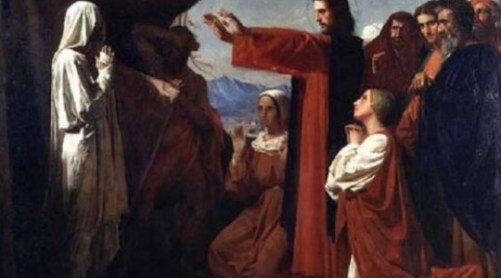 There is almost an ordinariness to the way our Lord goes about his mission of proclaiming and living God’s Kingdom.
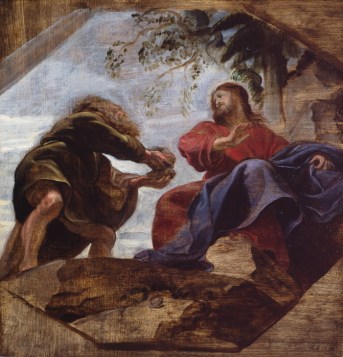 In Adam and Eve, the devil trips humanity up not just through the temptation to exalt ourselves by eating of the tree of the knowledge of good and evil (the sin of pride) but also through the temptation to reduce God to our limits. The serpent plants the seed for this second sin in his reply to Eve, You certainly will not die! No, God knows well that the moment you eat of it your eyes will be opened and you will be like gods who know what is good and what is evil.
 The “eye for an eye” teaching that our Lord refers to in today’s gospel (Mt. 5:38-48) was actually an attempt to restrict violence in a time when revenge was indiscriminate and excessive.
 In Matthew 5:13-16, our Lord gives us two very distinctive images of what it means to live the life of discipleship – salt and light.
