
• About The Alternate Path

The Alternate Path

~ Thoughts on Walking the Path of Christian Discipleship

The Alternate Path

Tag Archives: Christianity

A day without death: the movie “Risen” and our world’s violence

13 Monday Jun 2016

Posted by mcummins2172 in sad logic of violence, Uncategorized

≈ Leave a comment

Tags

"Risen", acts of violence, Christian life, Christianity, discipleship, hope, Orlando shooting, resurrection

risen1There are two scenes in the movie “Risen” that build upon one another. Both scenes involve the Roman tribune Clavius who has been assigned to investigate the empty tomb of Christ.

The first scene takes place right after the crucifixion at which Clavius was present. On the evening of that day, the tribune encounters Pontius Pilate in the baths.  Pilate, I believe, can be viewed as an embodiment of worldly and pragmatic cunning throughout this film.  After confirming that the Nazarene had been executed and buried, Pilate waxes, “One does what one must.”  “I don’t wish the mantle you wear,” responds Clavius.  “Spare me,” says Pilate, “it is your path too.  Your ambition is noticed.  Where do you hope it will lead?”  “Rome,” replies the tribune looking off into his own thoughts.  Pilate’s eyes arch, “And?”  “Position, power …” reflects Clavius.  Pilate presses, “Which brings?”  “…wealth, a good family, someday a place in the country.”  “What will you find?” asks Pilate.  “An end of travail … a day without death …  peace.” asserts the tribune.  “All that for peace,” muses Pilate, “Is there no other way?”

The second scene occurs at the Lake of Galilee. It is night.  The disciples are all asleep.  Clavius notices the risen Lord apart and watching the night sky.  Clavius approaches and sits down beside Jesus.  “I don’t even know what to ask,” he finally admits.  The Lord, now intent on his visitor, says, “Speak your heart.”  “How can I reconcile all this with the world I know?”  “With your own eyes you have seen,” responds the Lord, “yet still you doubt?  Imagine the doubt of those who have never seen.  That’s what they face.  What frightens you?”  “Being wrong,” answers Clavius, “wagering eternity.”  “Well then, know him,” invites the Lord.  Clavius is troubled and goes on to confess, “When you died.  I was present.  I helped.”  “I know,” forgives the Lord placing his hand on the tribune’s shoulder.  “What is it you seek Clavius?” inquires the risen Lord as he then goes on to say, “Certainty … peace … a day without death?”  Clavius gasps, his eyes widen and he is met by the full gaze of Christ and our Lord smiles. The tribune weeps; his heart and his pain have been recognized … and answered.

Clavius was a man fully versed in war and its politics. He was a man of action and hard fought experience.  Yet, he was war and violence weary and this becomes more and more apparent as the film progresses.  The question asked by Pilate, “All that for peace?  Is there no other way?” settles in the heart of the tribune just as the mystery about the Nazarene and his empty tomb begins to grow.  Clavius meets the risen Lord whom he, with his own eyes, had seen executed.  All is thrown upside down as Clavius is met head on with the answer to his question, “How can I reconcile all this with the world I know?”  He cannot.  The risen Lord is the truth and therefore the world as he had known it is not.  The resurrection of the Nazarene changes everything.

In Clavius, we see our world and our society. We are war and violence weary.  We yearn for a day without death.  How many more wars and battles?  How many more acts of random and senseless violence?  How much more political and social media posturing that goes nowhere and does nothing?  How much more division and an unwillingness to listen?  How much more fear?  How much more death?  I think it safe to say that along with the beleaguered tribune we also are done.  Enough!  We just want a day without death.

Our Lord is looking at us. He asks us the same question, “What is it you seek?”  We need to be honest.  It is the answer we have known all along.  The world as we know it, the world we have constructed, the world with its answers that we so often choose to go by even as Christians is not working.  The wars, violence and posturing – and even those given in rebuttal – are not leading to answers.  They are not leading to peace.

The risen Lord is looking at us. “What is it you seek?”  Lord, have mercy and forgive our unbelief!  Help us to be honest and help us to find and live the only true answer – which is you.  Give us the strength of conviction and courage to let go of all we think is true (the world as we know it) but, in fact, is not.  As Clavius followed the joy-filled disciples to Galilee, he stripped off his garments of the tribune.  He let go of that false identity.  Help us to also let go of those “truths as we know them” that are in fact not truth and that only deaden and divide.  You alone are truth; please clean us of all that is not true.

Our Lord is looking at us. We are so violence and war weary.

“What is it you seek?” We want a day without death.

God, grant us the courage to live the answer.

Of Gorillas, Wolves, Us and Creation

02 Thursday Jun 2016

Posted by mcummins2172 in creation, Uncategorized

≈ 1 Comment

Tags

Christian life, Christianity, creation, Gorilla shot at zoo in Cincinatti, Harambe

wolf2For close to a year now I have been volunteering at the wolf habitat in Bays Mountain Park in Kingsport, TN. The wolf habitat has been around for a few decades and currently is home to ten wolves.  When my schedule allows, I go to assist with the feeding of the wolves which occurs twice a week.  We do not go inside the enclosure but rather toss the food in.  It is only the naturalists who can go in with the wolves and even then only under the strictest guidelines.

Why do I do this? Partly, I think, because I have always been intrigued by wolves.  Wolves are fascinating animals and this awareness is only deepened the more one learns about them.  Their communal/pack instinct and identity is amazing and offers much for us to learn and even learn from.  Yet, wolves are often misunderstood and maligned throughout their history with the human race.  This needs to be corrected.  Also, helping out at the habitat is a small way to carry about the task of being a good steward of the creation that God has entrusted us with.  Our faith tradition tells us that we have been entrusted with the responsibility of stewardship to this planet and all of its inhabitants.  Each Christian should find some way in his or her life to live this responsibility.

The wolf enclosure is quite large and quite protected for safety – both for the animals and the human onlookers. There is a high fence with electric wiring top and bottom and even a larger timber frame meant to protect the fence from falling trees.  The regulating agency is always inspecting and there seems to be continual discussions about improving safety.

cincinnati-zoo2Like the whole nation I gasped when I saw the video of the little boy in the enclosure with the gorilla. Sadly, I have also watched as the ensuing social media debate has seemed to devolve to either “team human” or “team animal” as if those are the only two options and that they have to be opposing by nature. Can we just be okay with acknowledging the tragedy all around and leave it at that?  It is tragic that the child fell into the enclosure and could have been seriously harmed.  It is tragic that the zookeepers (the very people who knew, cared for and protected the gorilla) had to make a gut-wrenching and quick decision that I know I would not want to have to make.  It is tragic that the gorilla was shot and killed.  It is easy for everyone else not there – now after a continuous loop of the video has been played and scrutinized by the media for days – to be an arm-chair quarterback.  The reality of the situation was not easy; it was tragic.  Sadly, life is sometimes tragic.

Tragedy, for the Christian, has roots but it also points out hope. The story of our faith tells us that God created the universe, the world and all of its wonders and that God looked upon it all and said that it was good.  Our faith also tells us that in the beginning humanity walked in the garden of creation together with God and in harmony with all living creatures whom humanity even helped to name.  In pride, humanity sinned and our relationship with God and with all of creation was fractured and broken.  Yet, just as there is a part of us which yearns for restored relationship with God and knows that we are meant for that there is a part that knows we are meant for restored relationship with all of creation.  This is not the naïve, secular pantheism touted in movies but rather that which lies at the heart of the gasp of wonder we experience when we catch sight of a deer bounding through the forest or a whale breaching the surface of the water or a hawk cutting the air or the simple beauty of a butterfly or a bird.  We are connected yet, tragically, the connection breaks.  We go to animals whether in enclosures or out in the wild partly because we know in our hearts we are meant for that connection, that it was there once, even if it broken now.

But it will not be broken forever. This is the hope.  The twenty-first chapter of the Book of Revelation tells us that there will be a “new heaven and a new earth.”  The hope of the Christian is not in some spirit-only realm where the shackles of the body and creation are finally left behind – a thought akin more to some schools of Greek philosophical thought and Gnosticism than the Kingdom proclaimed by Christ.  Jesus Christ rose bodily!  The Virgin Mary was assumed bodily into heaven!  In the creed we profess our belief in a bodily resurrection!  God looked upon all that he made and said it was good.  God does not disdain his creation and for us to disdain creation means to disdain the Creator.  God is pure spirit but we are not.  To think we become pure spirit after death and in the resurrection would mean to question the wisdom of the Creator.  We will not become what we are not in the fullness of God’s Kingdom.  We will not become angels.  We will become as Christ and his mother (the first fruits of the future resurrection) risen in the glorified body.

I think that part of the “new heaven and new earth” foreseen in the Book of Revelation is our restored relationship both with the Creator and with all of his creation. What exactly this means and how it will look I do not know but I do believe that God is both creator and redeemer and that the two are not opposed.  The Creator does not disdain his creation.  This deep and abiding hope is within us and it pulls us forward.

I have been told that I have now been around enough that the wolves on Bays Mountain recognize me both visually and by my scent. A few times now my eyes have locked with a wolf’s eyes.  It is a neat moment.  There is wonder there and in that wonder is both a remembrance and a hope.  God’s Kingdom will be established, the tragedy of sin and suffering will be overcome and right relationship will be restored.

“Give them some food yourselves”: The Solemnity of the Most Holy Body and Blood of Christ

28 Saturday May 2016

Posted by mcummins2172 in homily, Uncategorized

≈ 1 Comment

Tags

Body and Blood of Christ, Christian life, Christianity, Corpus Christi, discipleship, Eucharist

feeding the multitudeAfter twenty-one years of priesthood, I had a stunning theological realization as I reflected on this Sunday’s gospel (Lk. 9:11b-17) of our Lord’s feeding of the multitude with some fish and some bread. This was the Church’s first potluck meal!  We bring a little bit of this, we bring a little bit of that and somehow we feed the multitude!  If a person wants a scriptural warrant for the potluck, here it is!

All that being said; the gospel given to us today does lead us into some profound truths about this solemnity of the most holy Body and Blood of Christ. The context of need and our Lord’s response sheds light on the living mystery of the Eucharist.  Immediately prior to this passage we are told that the crowds came to know where Jesus was and that he “… made them welcome …” (Lk. 11a).  Our Lord recognized the peoples’ desire for the Kingdom of God as well as their spiritual hunger and need.  His eyes and his heart were open in the broadness of welcome, care and love.  The disciples, well, not so much.  They want the Lord to dismiss the crowd.  On the surface it seems an appropriate and even caring response, “Lord, dismiss them so that they can find lodging and provisions.”  But surface concern can often mask over an underlying attitude of disregard.  “It’s not my problem.  They can fend for themselves.”  But Jesus’ response of “Give them some food yourselves,” challenges all such disregard.  Not only is the need and hunger of the crowd to be the disciple’s concern, the feeding and meeting of that need is to become the joy of the disciple.

I think we would be safe in saying that because Jesus is God incarnate, he could have fed the crowd on his own in some form or another but he does not do that, rather he specifically tells his disciples to give the people some food themselves! He chooses to involve them in both the situation and the solution.  Our Lord wants to open the hearts of his disciples to the very same broadness of welcome, care and love that he carries in his own heart.  So, in essence, he tells his disciples, “Look up.  Look away from yourselves.  See the crowd, see their hunger, see their need.  Now, give them some food yourselves.”

How does this relate to today’s solemnity? When we authentically receive the Body and Blood of Christ given as bread and wine then our very lives must, in essence, be transformed into bread given and wine poured out for other people! “Give them some food yourselves.”   This is the call of the Christian and it is critical for all ages.  The Eucharist opens our eyes and our hearts to the broadness of Christ’s own welcome, care and love.

For our times, as it was for all previous times, this is truly needed. In his most recent apostolic exhortation on love and the family, Pope Francis makes this observation, “The individualism so prevalent today can lead to creating small nests of security, where others are perceived as bothersome or a threat.  Such isolation, however, cannot offer greater peace or happiness; rather, it straitens the heart of a family and makes its life all the more narrow.”  (AL #187)

Christ does not want his disciples to have narrow lives and narrow hearts. He did not want it for his first disciples that day of the feeding of the multitude.  Even as the disciples, themselves, seemed very content to send away the crowds who were pressing in on their narrow reality.  He does not want it for his disciples today.  Christ does not want us to live in our own bubbles because he knows that true life and true joy is not found that way.  Our Lord wants nothing less than the abundance of joy for us and for every other person.  “Look up,” says our Lord, “give them some food yourselves, don’t fall into a narrow and sad life!”

The Eucharist is the very body and blood of our Lord and by its very nature and grace it transforms all who receive it authentically and honestly in faith, hope and love. “Give them some food yourselves,” says our Lord.  I feel truly sorry for those who turn away from the Eucharist as if it is mere superstition or just not that important.  By so doing, they are inviting a sad poverty into their lives.

The Eucharist is the very body and blood of our Lord given that we might have life and it transforms those who receive it. The Eucharist opens our own eyes and hearts to the very broadness of Christ’s own welcome, care and love.

Trinity Sunday: the way of love

21 Saturday May 2016

Posted by mcummins2172 in homily, Uncategorized

≈ Leave a comment

Tags

Christian life, Christianity, discipleship, faith, hope, Trinity, Trinity Sunday

Trinity-Rublev.jpg2Today we celebrate Trinity Sunday and as Church we reflect for a moment on the greatest of mysteries – God is a communion of persons – Father, Son and Holy Spirit. Here it is most helpful to remember the Christian understanding of mystery: mystery is not a puzzle to be figured out and then set aside but rather a reality to be lived and as we live the reality we, ourselves, are brought to deeper understanding.  On our own accord we cannot reason our way to the Trinity.  The Trinity is the ultimate truth both revealed and given and it is in living in this truth that we come to be grasped by it.  Our faith affirms that the best way to live within the truth of the Trinity (to be grasped and moved by the mystery) is the way of love.
In the first Letter of John we read that “God is love”. St. Augustine takes this biblical truth, enters within it and then concludes, “if God is love then God must be Trinity.”  The very dynamism and nature of love, he writes, “…presupposes one who loves, the one who is loved, and their love itself.”  Love links us into the reality of God and therefore the truest way to know God in the reality of Father, Son and Holy Spirit is to live authentic love.  As Christians it is not enough to just receive love and run the risk of getting trapped in a false sense of love which is only about self and ego, we must give love and give self if we are indeed to grow into the fullness of who we are meant to be and the fullness of understanding.

A lesson can be learned here from the two seas that are formed by the Jordan River; the Sea of Galilee and the Dead Sea. The Sea of Galilee receives the Jordan’s waters but then it lets it flow out again and the sea is full of life.  The Dead Sea receives the Jordan’s waters and keeps it, no streams flow out of it – it is in fact “dead” – no life in its waters or on its shores – a salty waste.  These two seas are a symbol to us.  Love has been given to us in our baptisms in the abundance of God’s generosity – God’s very triune life – but in order for it to fully bring life; this love must flow through us.  For Christians it is not enough to just receive love, we must give love.  It is in our triune DNA.  Further, this very giving of love is a pathway into knowledge of God.

God does the same for us. We ask God to give us a little love and God then asks us to first give Him and our neighbor all the little love we have.  Even if it just begins as the smallest of streams what little love we know must begin to flow out from us if our own hearts are to give life and know God.

The Christian knows, because of the Trinity, that true life and true joy is found not just in consuming and receiving but in the giving of self for other people. Authentic love that is freely given diminishes no one, rather it fulfills and brings life and understanding.  To give true love is a pathway into knowledge of God and the very mystery of the Trinity.

St. Augustine is correct. Because God is love it follows that God is Trinity.

Pentecost – we have a part to play

15 Sunday May 2016

Posted by mcummins2172 in homily, Uncategorized

≈ Leave a comment

Tags

Christian life, Christianity, discipleship, Holy Spirit, Jesus, Pentecost, Virgin Mary

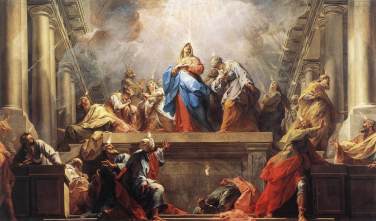
PentecostIn looking at my Facebook feed this weekend I have been reminded that we are in the midst of graduation season. Picture after picture of smiling graduates, at all levels, all across the country…  We certainly celebrate with graduates and congratulate them on what they have achieved.  But it is worthwhile to also note that behind every graduate stands dedicated teachers – men and women who often selflessly work for the good of their students.

I have recognized that one of the greatest gifts I have known in my life is that I have had exceptional teachers.  I have been blessed with men and women who have challenged and inspired me from elementary school all the way through my study of theology.  I owe to them so much – more than I can ever repay.  They guided my learning and also taught me how to keep learning.

But here is the catch – a teacher (even the very best teacher) can only instruct if the student is willing to listen. The student has a role to play.  The student must understand that he or she has a lack, that he or she does not have full knowledge, that he or she has something to learn and maybe even does not know what he or she does not know.  A student has to be open and willing to receive.  A student needs to be humble.

If today’s gospel (Jn. 14:15-16, 23b-25) sounds familiar it is because part of it was proclaimed last Sunday. Last Sunday I choose to focus on the Father and Son coming to dwell with the believer in friendship.  This Sunday, being Pentecost, it is appropriate I believe to focus on these words offered by our Lord, “I have told you this while I am with you. The Advocate, the Holy Spirit that the Father will send in my name, he will teach you everything and remind you of all that I told you.”  

One of the roles of the Holy Spirit is to teach but a teacher (even the very best) can only instruct if the student is willing to listen, if the student recognizes that he or she has a lack and if the student is humble and willing to receive. On Pentecost we proclaim and celebrate the coming of the Holy Spirit upon the disciples but the coming of the Spirit did not end there.  If this celebration is to be authentic then we, on our part, must be willing to ask the question, “Am I willing to listen and then receive the gift of the Spirit and the Spirit’s instruction for me?”  I have to be humble enough to acknowledge my need and my lack and then I have to be faith-filled enough to accept what the Holy Spirit has to give.

That day of Pentecost the gathering of disciples was so little, so small in such a big world. The Holy Spirit comes upon them like a strong driving wind and they begin to proclaim the good news!  Acts lists a multitude of nations and peoples present and then we are told that each nation and grouping heard the disciples proclaiming in their own tongue.  To this small, little gathering of disciples God gives nothing less than the whole world!  We have a part to play on Pentecost.  We have to be faith-filled enough to accept what the Holy Spirit has to give us!

Lord, may we not be so stingy and little of heart as to begrudge your call. Playing small is not part of Pentecost.  It is a false humility.

Pentecost is considered the birthday of the Church and on this birthday we find two things – the outpouring of the Holy Spirit and the small gathering of disciples in prayer, listening and fully aware of their need. How do we learn how to listen?  In any age the skill of listening is needed but I believe now, even more, this skill is needed in our lives and in our world.  How do we learn how to listen?

Here is one simple thought. Scripture testifies that there is only one person who was present at the birth of Christ, who was present at the crucifixion and who was present at Pentecost.  One person – Mary, the mother of our Lord.  To learn how to listen and then have the faith to say “yes” go to Mary.  Seek her out in Scripture, seek her out in prayer.  Ask her to pray for you and to pray with you.  She will teach if we are willing to listen.

A teacher can only instruct if the student is willing to listen. We have a part to play on Pentecost.  We need to listen and we need to have the faith to say “yes” to the Holy Spirit.

“We will come to him and make our dwelling with him…”

30 Saturday Apr 2016

Posted by mcummins2172 in homily, Uncategorized

≈ Leave a comment

Tags

Christian life, Christianity, discipleship, friendship with Christ, life in Christ, Sixth Sunday of Easter

Trinity_icon

A rendering of Rublev’s icon of the Trinity – a reflection on communion and friendship

When and where does friendship begin?  It is a question worthy of reflection.  When we look at the friendships within our lives, where and when did they start?  Did our friendships begin all at once in an instant or did they gradually develop and grow over time, even to the point where we might not exactly remember when a friendship began?  I think that the latter of these two is the more common nature of true friendship.  Friendship grows over time and it grows through daily means.

As Christians we believe in the friendship of God. This is an aspect of the uniqueness of Christianity.  But it is a friendship not because we have loved God first but because God has chosen to love us.  The readings for this sixth Sunday of Easter can be read in the terms of friendship (Acts 15:1-2, 22-29, Rev. 21:10-14, 22-23 and Jn. 14:23-29).

In today’s gospel we find our Lord saying, “Whoever loves me will keep my word, and my Father will love him, and we will come to him and make our dwelling with him…”  In his book, The Priority of Christ, Bishop Robert Barron takes some necessary time and effort to explore what the doctrine of Christ as fully human and fully God has to say about the very nature of God.  Bishop Barron begins by exploring the very common fallacy of viewing God as just the “biggest” of beings.  He points out that if this were the case then God would still just be a being among other beings (albeit the biggest) and therefore if God is just another being then God’s will necessarily inhibits and limits my will, my freedom and my very being.  Nothing is further from the truth and this is demonstrated in the reality of Christ being both fully God and fully human, because in Christ we find humanity fully realized and not inhibited in any way in the presence of full divinity.  God is not the biggest being among other beings who will necessarily limit my freedom by his presence; God is “otherly other” – to quote one early Church Father.  God operates in a way that we cannot fully grasp because we are limited beings.  God does not need to compete with us.

“Whoever loves me will keep my word, and my Father will love him, and we will come to him and make our dwelling with him…”  Christ is offering the terms of a friendship that is truly non-competitive in nature.  This is the amazing promise of Christ.  To the one who strives to keep the word of Christ; God will come and make his dwelling with him or her.  “Dwelling” is a neat word here.  It is not heavy.  It does not oppress.  It is a place of life and home.  The presence of God does not limit nor oppress because God is otherly other.  God can be fully present to us in our lives in a non-competitive manner and in a way that truly fulfills us.  Keeping God’s word leads to this true life.

Our Lord continues this invitation to a non-competitive friendship with the promise of the coming of the Holy Spirit.  “I have told you this while I am with you.  The Advocate, the Holy Spirit, whom the Father will send in my name, will teach you everything and remind you of all that I told you.  Peace I leave with you; my peace I give to you.”  Christ can promise and give a peace that moves beyond all the limits of this world precisely because Christ in the fullness of his divinity and humanity is otherly other.  Christ can enter into your life and my life in a way that brings fulfillment.  God as Father, Son and Holy Spirit does not come to limit life but to give the abundance of life and peace.

In today’s second reading from the Book of Revelation we are given the image of the new and heavenly Jerusalem.  It has been noted that in the development of Sacred Scripture there can be seen a progression in regards to the awareness of the presence of God.  First, God is present for his people in the meeting tent.  Second, God is present in the temple then God is present in Jerusalem.  In the New Testament, God is fully revealed within the person of Jesus who is both the new temple and the new covenant and Christ seeks to be welcomed within the human heart, “…and we will come to him and make our dwelling with him…”.

John writes of his vision, “I saw no temple in the city for its temple is the Lord God almighty and the Lamb.  The city had no need of sun or moon to shine on it, for the glory of God gave it light, and its lamp was the Lamb.”  There is no need of temple or church in the heavenly Jerusalem because the presence of God is fully realized and welcomed within each human heart.  This welcoming in friendship begins today and it is found in the daily invitation to encounter our Lord as he makes himself present to us.

In the first reading from Acts we find the early Church deliberating about its mission to the Gentiles – how this is to occur and even “if” it should occur.  This is no small thing.  In fact, it is at the heart of the mission of the Church and it, in many ways, is a question about friendship.  Can the friendship with God that we now know through Christ be extended and should it be extended to the whole world?  The Church, guided by the Spirit, comes to the decision that yes, friendship should be extended and friendship is always possible.  This mission continues today and it is primarily an invitation to friendship.  The love that we have heard and seen and touched is a love that, by its very nature, must be extended to others.  As Church, we proclaim that friendship is always possible and we make this proclamation despite the messages that seek to isolate and divide people from one another.

“Whoever loves me will keep my word, and my Father will love him, and we will come to him and make our dwelling with him…”

Little things matter: a thought on “Amoris Laetitia”

22 Friday Apr 2016

Posted by mcummins2172 in Amoris Laetitia, Uncategorized

≈ Leave a comment

Tags

Amoris Laetitia, Christian life, Christianity, discipleship, Pope Francis, Syrian refugees

big hand and little handOne take away that I have gained from Amoris Laetitia is to pay attention to the little things because they do matter.  Like many people, I am seeking to follow the Holy Father’s recommendation and read the exhortation a little at a time in order to reflect as I go.  I am doing my best to obey the pope in this regard and I have found that the document does lend itself to this style of reflective reading.

The exhortation is rich in scriptural and theological thought on love and marriage and there is much worthy of reflecting upon but one thing that I believe this pope is keenly aware of is that all that richness regarding love and marriage which our tradition affords has to be lived out in the daily and in the ordinary and that our daily choices do make a difference. Love and marriage do not exist locked away somewhere in a hermetically sealed vacuum but are made and grow (or sadly torn down) by the daily choices we make.  This is not to deny any of the teachings that the Church has but rather to both see and put them in context and to acknowledge that context does matter.

If God does not disdain the daily and ordinary (i.e. creation and the incarnation) then why should we? Pope Francis is aware of this and through his exhortation he is inviting the Church to this awareness.

One part of the exhortation that brings this awareness out for me can be found in chapters 127 and 128. It is shared below.  Notice how the Holy Father offers some astute theological and philosophical reasoning right alongside some very practical and daily observations and advice.  The two are not separate for Pope Francis.

…Loving another person involves the joy of contemplating and appreciating their innate beauty and sacredness, which is greater than my needs. This enables me to seek their good even when they cannot belong to me, or when they are no longer physically appealing but intrusive and annoying.  For “the love by which one person is pleasing to another depends on his or her giving something freely”.

The aesthetic experience of love is expressed in that “gaze” which contemplates other persons as ends in themselves, even if they are infirm, elderly or physically unattractive. A look of appreciation has enormous importance, and to begrudge it is usually hurtful.  How many things do spouses and children sometimes do in order to be noticed!  Much hurt and many problems result when we stop looking at one another.  This lies behind the complaints and grievances we often hear in families: “My husband does not look at me; he acts as if I were invisible”.  “Please look at me when I am talking to you!”  “My wife no longer looks at me, she only has eyes for our children.”  “In my own home nobody cares about me: they do not even see me; it is if I did not exist!”  Love opens our eyes and enables us to see, beyond all else, the great worth of a human being.  (AL, #127-128)

The innate dignity of the human person is affirmed along with the solid teaching that no human person should be treated as a means to an end. We can develop the ability to recognize this worth through the profound spiritual truth of making the free choice to love.  These are profound truths of our faith grounded both philosophically and theologically and the Holy Father immediately ties them in to our everyday lives when he then goes on to write: Much hurt and many problems result when we stop looking at one another. 

It is not enough to just contemplate the idea of love, we must be willing to live the choice to love and that choice is made in the very ordinary and daily context of our lives. In this regards it is the choice to simply gaze on the other person and simply make eye contact.  And it does make a difference.

Not that long ago I ran into a parishioner from a previous assignment and she shared with me that one of the things she appreciated about my ministry at her parish was that I actually made eye contact with her and other people when I distributed communion. This assignment was years ago and she still remembered the simple exchange of eye contact and not just hurriedly handing out the Eucharist as if in an assembly line!  The little things we do matter for people, more so than we may often realize.

Going further, I think that Pope Francis has recently given the whole world a lesson in this in his willingness to have the Vatican (assisted by the Community of Sant’Egidio) take in and provide shelter for twelve Syrian refugees. The Church and Popes have consistently taught both the dignity of the person and the dignity of refugees.  Pope Francis has continued this teaching and he has demonstrated his willingness to go beyond just a theoretical teaching and make the choice to love specifically in the context of our day by welcoming these refugees!  Before the whole world, the Pope is practicing what he is preaching.  By welcoming these refugees, the Holy Father is demonstrating that he has “made eye contact” as it were; he has gazed upon these men, women and children in their need and has recognized their innate dignity and worth and has made the choice to help them.

Choices made in the daily context of our situations do make a difference including the choice to gaze on the other person with love and respect.

In the gospel for this coming Sunday (Jn. 13:31-33a, 34-35) our Lord gives us the new commandment to love one another. It is important to note that this commandment is not given as a theoretical abstract but is given within a specific context: after our Lord humbles himself and washes the feet of his disciples at the Last Supper.  Throughout that sacred meal our Lord gazed upon his disciples with love (John tells us that he loved them to the end) and they humbly looked on as he (the teacher and master) washed their feet.  Love here is not an idea contemplated but a choice lived for the other.

Choices made in love do matter. They do make a difference.  Even the most daily and seemingly mundane of choices to love and show love matter and they connect us, as disciples, to our Lord himself.  Pope Francis knows this.  Hopefully we can learn from him.

Rejoice and Trust!

07 Thursday Apr 2016

Posted by mcummins2172 in joy, Uncategorized

≈ Leave a comment

Tags

Christianity, discipleship, joy, secularism, trust, U.S. culture

RESURRECTION PICTURE 2It is interesting to note what strikes us and what we notice when we journey yet again through a liturgical season through which we have already traversed each year of our lives. My experience has taught me that each year is different and that there are new challenges and new insights gained.  This liturgical season of Easter is no different.

Maybe it is because I just concluded a series on the Gospel of John in the parish which required me to delve deeper in my gospel study or because I recently saw the movie “Risen” which, at least for me, brought home the same point but this Easter season I have been reminded how the disciples still did not fully know where things were all going even after they encountered the risen Lord.

In their encounters with the risen Lord, as found in the gospels, we find within the reactions of the disciples an interesting mixture of incredible joy held along with fear and uncertainty. Christ is risen!  The master and teacher that the disciples loved and followed now lives again, the tomb is empty, but the disciples still gather behind locked doors.  Even as Christ defeats death, the powers of the world are searching out his followers to persecute and destroy them.  It began with that first small band of disciples and it continues to our day.

I believe that the scene which most struck me in the movie “Risen” was when the disciples were rushing to meet the risen Lord in Galilee as they were told to do. At one point the Roman tribune is running alongside Peter and they both stop to catch a breath.  I cannot remember the full and exact dialogue but the tribune basically asks Peter what he thinks they will find in Galilee, to which Peter replies, “I don’t know.”  The tribune then asks why Peter is going if he does not know what he will find.  “Because I trust,” replies Peter.

The book had not yet been written when the disciples encountered the risen Lord those first days after the resurrection. In one sense we have “the book”.  We know through Sacred Scripture and Church history what happens and how things begin to take shape.  We know what the apostles do afterwards and how they all go out in mission into the world.  We have the book.  They did not.  The pages were still being written.  All they had was their trust in the Lord and their amazement at his resurrection.  But that was enough.

The truth is that it is enough for us in our day also. This, I think, is a message we need to hear this Easter.  We live in interesting times to say the least.  In the U.S. it seems that Christianity no longer enjoys the dominant cultural status it had enjoyed and exercised (at least on the surface), our society is becoming more pluralistic and more secular.  Things once taken for granted can no longer be.

One reaction to this is to circle the wagons, say it is all done, the book is finished and the end times are upon us. Some people choose that route.  Another response is to do as the first disciples did: be amazed and overjoyed by the resurrection and trust!  I do not believe that the book of Christianity and the Church is done.  I think that the pages are still being written and that we are blessed to live in the times we find ourselves!

One of my favorite saints is St. Augustine. I love to read his writings, to try to follow and grasp his depth of thought and to catch his snarky comments.  For my Licentiate in Sacred Theology, I compared Augustine’s anthropology expressed in The Literal Meaning of Genesis with modern, secular anthropology.  The cliff notes version of my work is that Augustine’s anthropology is better.  There you have it.  During my study and since then, I have realized that part of the appeal of Augustine for me and other readers is connected to the context in which he lived and wrote.  He wrote in a time when Christianity was small and vulnerable and not the dominant social force but his writings still reveal the genius and beauty of our faith and thought.  There is something worthy of remembering and reflecting upon in this.

Is the United States becoming more secular and pluralistic? Seems so.  Will Christianity remain the dominant social power player it once was?  Maybe not.  Is Christ risen, is the tomb emptied?  Yes.  Then rejoice and trust!  The pages of Christianity and the Church are not finished being written!  Contexts may change but the gospel truth stays the same and continues on!

The very human temptation to remain behind the locked doors and believe that it is all coming to an end just because the context we find ourselves in is changing is constantly before us. But just because the context changes that does not mean that the end is near.  Frankly, history demonstrates that it is in times of change that the greatest growth occurs partly because we are brought back to what is essential which, in this case, means rejoicing in the risen Lord and trusting.  Our Lord’s call to go to Galilee is a continual call and corrective to his band of followers to move beyond the resignation of a “circle the wagons” mentality and to trust and go out into the times in which we find ourselves proclaiming the risen Christ as Lord!

As true for that first band of followers, so for us. Christ is risen!  The tomb is emptied.  Rejoice and trust!  The Lord goes ahead of us to Galilee!

The Priest as Friend

02 Saturday Apr 2016

Posted by mcummins2172 in priesthood, Uncategorized

≈ 2 Comments

Tags

Catholic priesthood, Christian faith, Christian life, Christianity, discipleship, Roman Catholic

friendship in christThere are many images of ordained priesthood that operate in our Church today – the priest as sacramental minister, the priest as co-worker with the bishop, the priest as pastor, the priest as leader of the worshipping community. These are some of the more “official” images of priesthood but there are others, I have come to realize, that can often operate in the hearts and minds of both priests and laity alike.  The priest as administrator and builder operating the parish with efficient ease!  The priest as superhero stomping out evil with his superpowers.  (I have seen many a vocation poster/image along this line and I have to admit I find it rather silly to say the least.)  The priest as shaman battling dark forces behind the scenes by the use of ancient languages and rituals.  The priest as philosopher or wisdom figure enlightening the masses with his erudite thought.  Are there times when a priest does have to head a building project and administrate a parish?  Yes, certainly.  There are also times when a priest has to wade through the darkness of sin and evil in life and I hope that at least every now and then the priest does offer something worthwhile for people to consider.  All this is to say that there are many images surrounding the priest – some official and some not-so-official yet held in different hearts.

One image that I would like to explore is priest as friend but a friendship that has a specific root and foundation which is from and in Christ. I do not presume that others cannot also share in this friendship, in fact I think it is a commonality among all disciples, but for my purposes here I want to relate this vocation of friendship specifically to the ordained priesthood.

In the fifteenth chapter of John we find our Lord uttering these rather amazing words, “This is my commandment: love one another, as I have loved you. No one has greater love than to lay down his life for his friends.  You are my friends, if you do what I command you.  I shall no longer call you servants, because a servant does not know the master’s business; I call you friends, because I have made known to you everything I have learnt from my Father.  You did not choose me, no, I chose you; and I commissioned you to go out and bear fruit, fruit that will last; so that the Father will give you anything you ask him in my name.  My command to you is to love one another.”  (Jn. 15:12-17)

I once read where a renowned theologian, much more knowledgeable than I, wrote that we need to, in essence, avoid the danger of presuming friendship with Christ. Friendship implies peer to peer and we must remember that Christ is “God made flesh” and we are creature.  I certainly agree with this and recognize the important point being made … but Jesus did say, “I call you friends…” I do not think this should be dismissed so readily.

It is a mercy to say the least that God, in Christ, now calls us friends but it is, in fact, a mercy given. You did not choose me, no, I chose you… It is interesting to note that it is within the gospel with the highest Christology that this assertion from our Lord is found.  It is a mystery of a friendship given that is truly intimate yet also does not deny the transcendence of our Lord.  It is also a unique mark of Christianity in relation to all other world religions that God so greatly desires to bestow upon his followers the grace of friendship.

Christ calls us friends because he has made known to us all that he has learned from the Father and that we are to do as he has commanded. We must put what we have learned into action to fully know and live this reality of friendship.  This comes after the washing of the feet where Christ teaches that we must do as he has done, which is to pour oneself out in love and service for others – especially the poor and forgotten.  This, I believe, is where the door to seeing priest as friend of Christ and friend of humanity has its foundation and root.

The priest is called to serve but to serve in a unique way. Many people, many good people who do not even have to have a faith, serve continuously throughout life.  Think of parents serving their children, police or EMTs serving the public, firefighters daily putting their lives at risk, people generously donating their time and effort for some cause.  These are all worthwhile forms of service which might or might not be attached to some form of belief but the priest serves explicitly for the Kingdom of God. I commissioned you to go out and bear fruit, fruit that will last… 

The service of the priest is connected to the Kingdom of God and therefore the friendship with Christ which the priest has been given is known and enlivened through this service to the Kingdom. I recently shared a confession with my parish.  My confession was that I do not always want to serve.  I do not always want to make the nursing home visit, I do not always want to sit in the confessional (especially on a beautiful spring day), I do not always want to make an administrative decision at yet another meeting, I do not always want to serve the poor but when I do, I meet Christ and his friendship enlivens and blesses me and my priesthood.

Yes, the priest can be seen through the lens of all the images shared at the beginning of this reflection but another worthwhile and truly important image is the priest as friend – friend of Christ and friend of humanity. I also believe that this image of priesthood truly explored and lived can also help provide a healing balm needed in our world today.  A balm that Christ can use to help heal the wound of isolation.

We find ourselves in a time where people are truly isolated one from another and this is causing intense pain, suffering and even death. The elderly are forgotten, the poor are ignored, the “other” is demonized and our hearts are continually being more and more hardened and turned inward.  We must not shrink before this gaping wound of our world’s isolation but rather hold even faster to the words our Lord speaks in John 15.  Christ calls us friends!  Christ calls us to love one another!  Christ calls us to bear fruit that will last!  In Christ, the priest must live friendship with all humanity and he does this precisely because Christ calls him friend.

Christ calls us friends! We need to believe this and truly let the awareness of this grace given sink into our lives and our hearts.  We have a friend in Jesus.  It is much more than just a cliché.  It is a reality and a mercy shared.

I call you friends… It is a mercy given from our Lord for all his disciples but also in this Jubilee Year of Mercy it a worthwhile grace for the priest to reflect upon and truly explore. The priest as friend.

The “Gathering In” of Holy Week

21 Monday Mar 2016

Posted by mcummins2172 in Holy Week, Uncategorized

≈ Leave a comment

Tags

Christ washing feet of disciples, Christian life, Christianity, faith, Holy Week, Love of Christ

Christ Washing Peter's Feet, Ford Madox BrownSo much of the Christian life seems to be about “going out”. We are called to go out to proclaim the good news.  We go out to share Christ’s love.  We go out to serve others.  This is good and authentic to our faith and it is the mandate that Christ has given us as Church to proclaim the good news to the ends of the earth.

That being said, it is interesting to note that Holy Week – the most sacred days of our year as Christians – is a time of “gathering in”. This is appropriate and right, I believe, because Jesus, himself, wants this time with his disciples.  More than just a remembering on our part; Jesus desires to spend these days with us.

In chapter thirteen of John’s Gospel we read the evangelist’s account of the Last Supper. John begins by setting the context as being the time of the celebration of Passover.  More so than the great Jewish feast; this is to be the time when our Lord will “pass over” death in order to return to the Father in triumph.  Certainly our Lord is preparing himself for the hour which has arrived but, important to note, he is also much concerned to prepare his disciples.  He knows that they will be tested over the next few days, he knows that one will betray him, that one will deny him and that they will flee and be afraid.  He also knows that eventually they will be sent out into the whole earth to proclaim the good news.  Jesus knows the weakness, limits and confusion of his disciples yet he loves them. Before the festival of the Passover, Jesus, knowing that his hour had come to pass from this world to the Father, having loved those who were his in the world, loved them to the end. (Jn. 13:1)

Scholars suggest that the Greek term “to the end” has two connotations. It can mean, “to the end of his life” and it can also mean, “to the very limit, the very maximum, of love”.  Christ loves his disciples, his “little ones” to the fullest extent and he greatly desires to spend this time with them.

There is a great tenderness of love that is being expressed in the account of the Last Supper. Jesus takes the role of the servant when he washes his disciples’ feet.  Peter knows that this is a fundamental break with the prevailing custom of the time.  It was the role of the servant, the slave to wash the feet of the guests not the role of the head of the household.  Yet, Jesus is the head of the household who is willing to serve and he tells his disciples that they must do the same.  They do not fully understand now but they will later.  More than just a nice symbol, token or remembrance, this call to serve and die to self is the royal road on which the disciple directly encounters our Lord.

I give you a new commandment: love one another; you must love one another just as I have loved you. It is by your love for one another, that everyone will recognize you as my disciples.  (Jn. 13:34-35) The love that we must have as Christians must be based in that very love that Christ has for us and it is in this love particularly that his little ones will be recognized as his disciples.

At this point Peter asks a question from which we all benefit; Simon Peter said, “Lord, where are your going?” Jesus replied, “Now you cannot follow me where I am going, but later you shall follow me.” Peter said to him, “Why can I not follow you now?  I will lay down my life for you.”  “Lay down your life for me?” answered Jesus.  “In all truth I tell you, before the cock crows you will have disowned me three times.” (Jn. 13:36-38)

“Now you cannot follow me where I am going, but later you shall follow me.” Yes, later Peter will follow our Lord to the sacrifice of his own life and beyond that to the glory of eternity with God but there is another, even more fundamental, following implied here. Peter must first learn the way of love that our Lord has initiated at the Last Supper.  Peter (the little one who balked at having his feet washed) is not yet ready to learn this true extent of love that the disciple of Christ is to be recognized by but he will be ready later.  And it is by the royal road of this love that Peter will later be able to then let go of his very self, even to the point of death.

We are all so much like Peter. We all think we have so much figured out yet, in truth, we all have so much to learn but Christ loves us to the end.

These days are more than just a remembrance. These days are more than something we do to acknowledge our faith.  Christ, our Lord, desires to spend these days with us.

Christ gathers us in and Christ loves us to the end.

← Older posts
Newer posts →
Follow The Alternate Path on WordPress.com

Enter your email address to follow this blog and receive notifications of new posts by email.

Previous Posts

  • December 2025
  • November 2025
  • August 2025
  • April 2025
  • February 2025
  • January 2025
  • December 2024
  • August 2024
  • July 2024
  • June 2024
  • May 2024
  • April 2024
  • March 2024
  • February 2024
  • January 2024
  • December 2023
  • November 2023
  • October 2023
  • August 2023
  • July 2023
  • May 2023
  • February 2023
  • January 2023
  • December 2022
  • August 2022
  • July 2022
  • April 2022
  • January 2022
  • December 2021
  • September 2021
  • August 2021
  • July 2021
  • May 2021
  • April 2021
  • January 2021
  • December 2020
  • November 2020
  • October 2020
  • August 2020
  • July 2020
  • May 2020
  • April 2020
  • March 2020
  • February 2020
  • December 2019
  • October 2019
  • September 2019
  • August 2019
  • July 2019
  • May 2019
  • April 2019
  • March 2019
  • February 2019
  • December 2018
  • November 2018
  • October 2018
  • August 2018
  • July 2018
  • June 2018
  • April 2018
  • March 2018
  • February 2018
  • January 2018
  • December 2017
  • November 2017
  • September 2017
  • August 2017
  • July 2017
  • June 2017
  • May 2017
  • April 2017
  • March 2017
  • February 2017
  • January 2017
  • December 2016
  • November 2016
  • October 2016
  • September 2016
  • August 2016
  • July 2016
  • June 2016
  • May 2016
  • April 2016
  • March 2016
  • February 2016
  • January 2016
  • December 2015
  • November 2015
  • October 2015
  • September 2015
  • August 2015
  • June 2015
  • May 2015
  • April 2015
  • March 2015
  • February 2015
  • January 2015
  • December 2014
  • November 2014
  • October 2014
  • September 2014
  • August 2014
  • July 2014
  • June 2014
  • May 2014
  • April 2014
  • March 2014
  • February 2014
  • January 2014
  • December 2013
  • November 2013
  • October 2013
  • September 2013
  • August 2013
  • July 2013
  • June 2013
  • May 2013
  • April 2013
  • March 2013
  • February 2013
  • January 2013
  • December 2012
  • November 2012
  • October 2012
  • September 2012
  • August 2012
  • July 2012
  • June 2012
  • May 2012
  • April 2012
  • March 2012
  • February 2012
  • January 2012
  • December 2011
  • November 2011
  • October 2011
  • September 2011
  • August 2011
  • July 2011
  • June 2011
  • May 2011
  • April 2011
  • March 2011
  • February 2011
  • January 2011
  • December 2010
  • November 2010
  • October 2010
  • September 2010
  • August 2010
  • July 2010
  • September 2008
  • August 2008
  • April 2008
  • March 2008
  • February 2008
  • January 2008
  • December 2007
  • November 2007
  • October 2007
  • September 2007

Popular Posts

  • thealternatepath.org/wp-c…
  • thealternatepath.org/wp-c…
  • lh3.googleusercontent.com…
  • thealternatepath.org/wp-c…
  • thealternatepath.org/wp-c…
  • thealternatepath.org/wp-c…
  • thealternatepath.org/wp-c…
  • thealternatepath.org/wp-c…

Blog at WordPress.com.

  • Subscribe Subscribed
    • The Alternate Path
    • Join 156 other subscribers
    • Already have a WordPress.com account? Log in now.
    • The Alternate Path
    • Subscribe Subscribed
    • Sign up
    • Log in
    • Report this content
    • View site in Reader
    • Manage subscriptions
    • Collapse this bar
 

Loading Comments...