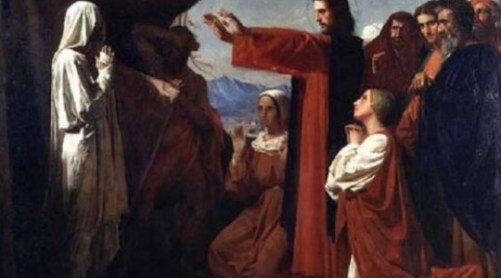
 There is almost an ordinariness to the way our Lord goes about his mission of proclaiming and living God’s Kingdom. Even his miracles and the raising of his friend Lazarus are not exceptions. Our Lord takes his time in getting to the scene of Lazarus’ illness and death. He takes time in speaking with both Martha and Mary. Arriving at the tomb he asks that the stone be rolled back. He addresses the Father and then, with a loud voice, cries, “Lazarus, come out!” The once-dead man walks out.
There are no flashes of light or rolling thunder. Our Lord does not need to make strange incantations or weave any sort of spell. He does not even seem to have to fast in preparation for such an extraordinary thing. There is no burning of incense or sacrifices offered. Jesus simply gives honor to the Father, calls Lazarus forth and his friend is restored to life.
This is not a feat of our Lord’s own will at work. Jesus is not a comic book superhero saving the world through his own strength and determination nor is he a wizard overcoming by his own intellect and perseverance (a.k.a., “will to power”). Scripture tells us that Christ let go of his own glory and power and took on the form of a slave. The salvation won through Christ is through the “letting-go” of the divinity which allows the humanity to live in full relationship of love and trust with the Father. Jesus tells us that he can do nothing apart from the Father. Jesus does not heal, or feed the multitude, or cast out demons or walk on water or raise the dead through his own, independent and isolated exercise of will but through his relationship with the Father. Therefore he does not need the trappings of the superhero or of esoteric magic. It is all through relationship and relationship is often one of the most ordinary of things.
St. Paul in his letter to the Romans reminds us that we also have been invited into this relationship. “But you are not in the flesh; on the contrary, you are in the spirit, if only the Spirit of God dwells in you. Whoever does not have the Spirit of Christ does not belong to him. But if Christ is in you, although the body is dead because of sin, the spirit is alive because of righteousness. If the Spirit of the One who raised Jesus from the dead dwells in you, the One who raised Christ from the dead will give life to your mortal bodies also, through his Spirit dwelling in you.” (Rom. 8:8-11)
How often and how easily we overlook the grace we have been given, that is indeed active within us! We easily we get lost in the noise and distractions of our world. The Spirit of the One who raised Christ from the dead has been given us and dwells within us – giving life and transforming us. God does not need the trappings of the extraordinary to accomplish his purpose. The sacraments are a prime example of this. Water, bread, wine, oil, the words of the priest, the love of a couple – yet underneath the ordinary divine grace, relationship and life is found and given.
We should not disdain the ordinary and the grace and new life found there. Just as Christ emptied himself of glory and held to his relationship with the Father so should we. Life is not found in our control, our ego, our own little “wills to power”, living within our own little bubbles. Life, salvation, healing, grace is found through relationship – recognizing God’s presence given and within and seeking to live always in the amazing ordinariness of that relationship.
“Father, I thank you for hearing me. I know that you always hear me; but because of the crowd here I have said this, that they may believe that you sent me.”
 The “eye for an eye” teaching that our Lord refers to in today’s gospel (Mt. 5:38-48) was actually an attempt to restrict violence in a time when revenge was indiscriminate and excessive.
 In Matthew 5:13-16, our Lord gives us two very distinctive images of what it means to live the life of discipleship – salt and light.
 During the weeks of Advent we hoped for and awaited the coming of the Messiah.
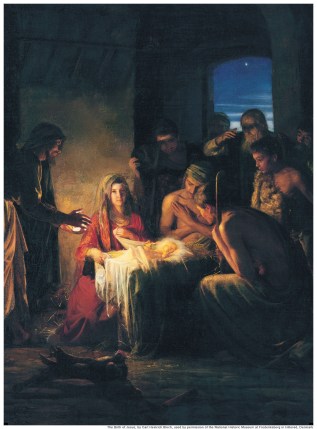 Caesar demanded a census and the whole world was in motion and turmoil.
 This last week I saw the movie “Arrival”.
 This past week I was able to visit with a parishioner who, as a hobby, makes wine.
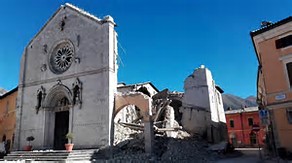 Scholars suggest that by the time Luke composed his gospel the temple had already been destroyed. This grand edifice, seemingly unmovable, adorned with costly stones that people were admiring in this passage was, by the time of Luke setting quill to parchment, just a heap of ruins. It demonstrates how quickly things can change and also how little we really know about what will happen tomorrow. We like to think we are in charge … but we are not.
 One of the truths revealed in today’s gospel (Lk. 15:1-10) is that our God is not a God content to let people remain anonymous. The shepherd goes out in search of the lost sheep because that one sheep truly matters to him. The woman turns the house over searching for the lost coin because that coin is of real concern to her. We are of concern to God. We are not alone in a vast universe governed by random chance. We do not have a God who does not care. God is willing to seek each one of us out, willing to even enter the darkness of sin and death, to find us and then rejoice in the finding!
 The Alternate Path